
Gigantamax Garbodor
Generation V · #10207 — Trash Heap Pokémon
Gigantamax Garbodor represents the colossal transformation of the Trash Heap Pokémon when empowered by Gigantamax energy, towering at an impressive 21.0 meters tall and weighing a staggering 1000.0 kilograms. Introduced as a Gigantamax-capable form in Pokémon Sword and Shield, this poison-type titan becomes a force to be reckoned with in competitive battles through access to its signature G-Max move, G-Max Malodor. Unlike traditional Mega Evolutions, Gigantamax is a temporary transformation that enhances Garbodor's already considerable physical presence while maintaining its core identity as a sentient pile of refuse weaponized for combat. The transformation showcases the raw potential of the Gigantamax mechanic to amplify even the most unconventional Pokémon into formidable battlefield threats, proving that even creatures born from human waste can achieve magnificent power.
Editor's Take
Gigantamax Garbodor's G-Max Malodor poisoning both opponents is genuinely good, and a Pokémon made of rubbish becoming competitively relevant is Gen 8's best joke.
Base Stats
Height
21.0m
Weight
1000.0kg
Category
Trash Heap Pokémon
Gender
Male 50% / Female 50%
Color
green
Shape
humanoid
Abilities
Has a 10% chance of making target Pokémon flinch with each hit.
Raises Speed and lowers Defense by one stage each upon being hit by a physical move.
Damages the attacker for 1/4 its max HP when knocked out by a contact move.

Gigantamax Garbodor Biology & Physical Characteristics
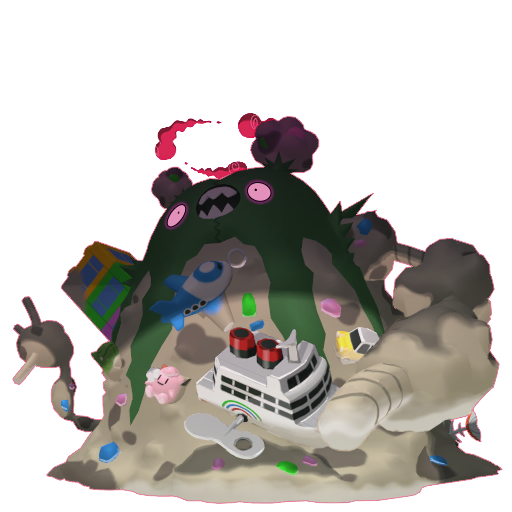
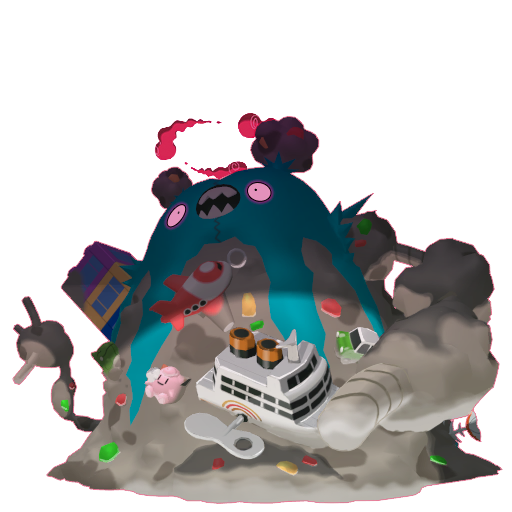
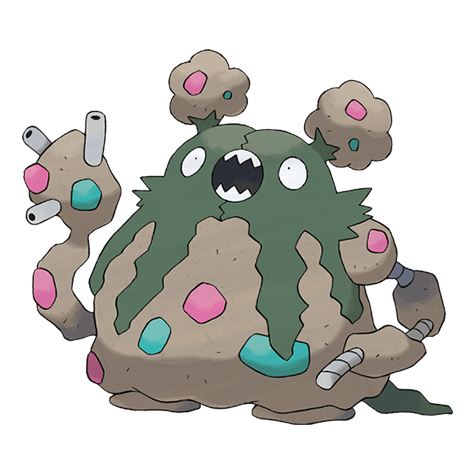
Gigantamax Garbodor magnifies the already unsettling appearance of its standard form to truly nightmarish proportions, becoming a mobile mountain of corrupted refuse approximately the size of a seven-story building. The transformation accentuates its lumpy tan body composed of refuse and garbage, with the blue and pink malformed masses becoming more pronounced and grotesque at this colossal scale. Its iconic ripped garbage bag head, which normally trails like a cape, extends further in this form, creating an almost cape-like appearance that billows menacingly around its enormous frame. The poisonous capabilities that define the species become exponentially more dangerous—its right arm, ordinarily capable of spraying virulent toxic liquid that can instantly kill weakened opponents, becomes a gargantuan bio-weapon capable of dispersing poison on a scale that affects entire battle arenas. The transformation does not alter Garbodor's fundamental physiology regarding its asymmetrical limbs: one arm held together with piping and featuring a single finger, the other reinforced with rebar and sporting three fingers, but magnifies these features to destructive proportions.
Pokedex Numbers
Training
Breeding
Gigantamax Garbodor Breeding, Gender Ratio & Egg Groups
Gigantamax Garbodor maintains the standard gender distribution of its species at exactly 50% male and 50% female, with no sex-exclusive characteristics affecting breeding capability or Gigantamax access. All Garbodor, regardless of gender, belong to the Mineral egg group, which represents an unusual breeding classification that reflects the creature's composed primarily of inorganic waste materials—this egg group compatibility allows for interesting breeding combinations with other mineral-classified Pokémon. The base friendship value for the species measures 70 in Generations V through VII, though this decreased to 50 in later generations, reflecting the Pokédex's darker portrayal of Garbodor in more recent entries. Since Gigantamax is not a permanent evolution but a battle transformation, gender and breeding mechanics remain entirely unchanged whether a Garbodor possesses the Gigantamax Factor or not; a female Garbodor with Gigantamax capability breeds identically to a female without it, producing Trubbish eggs rather than Garbodor or Gigantamax Garbodor eggs. The species follows a medium-fast growth rate, requiring 1,000,000 experience points to reach level 100, and its hatch counter of 20 cycles translates to approximately 4,884–5,140 steps before a Trubbish egg hatches.
Sprites


Gigantamax Garbodor's Evolution Chain


Gigantamax Garbodor Evolution, Mega Evolution & Special Forms
Gigantamax Garbodor is not a traditional evolution but rather a temporary transformation that Garbodor undergoes when exposed to Gigantamax energy, distinguishing it fundamentally from the permanent evolution that transforms Trubbish into standard Garbodor at level 36. To achieve this Gigantamax form, a Garbodor must possess the Gigantamax Factor, an innate genetic condition that allows it to harness Gigantamax energy—not all individuals of the species carry this factor, making Gigantamax-capable Garbodor relatively uncommon. The transformation itself is triggered during battle and persists for a limited number of turns, after which Garbodor reverts to its standard form, making it a strategic tool rather than a permanent state change. Mechanically, Gigantamax does not increase Garbodor's base stat total, which remains 474 with its characteristic distribution of 80 HP, 95 Attack, 82 Defense, 60 Special Attack, 82 Special Defense, and 75 Speed, but it grants access to the devastating G-Max Malodor move—a poison-type Gigantamax attack that can spread poisonous conditions across multiple opponents or provide other battle-altering effects depending on game mechanics and opponent conditions.
Where to Find
Location data not available for this Pokémon in the database.
Gigantamax Garbodor Behaviour and Natural Habitat
Gigantamax Garbodor maintains the dietary habits and ecological preferences of its base form but on a vastly expanded scale, requiring exponentially larger quantities of garbage to sustain its massive frame. The act of consuming refuse and transforming it into toxic compounds within its body becomes a defining metabolic feature—the species synthesizes new and potent poison gases and liquids from whatever waste it consumes, with the variety and virulence of its toxins directly reflecting the composition of its recent meals. Even in its gigantified state, it shows a strong preference for unsanitary environments such as garbage dumps and landfills, where it can gorge itself on copious amounts of refuse. The behavioral records from Alola are particularly telling: for a period, Garbodor populations there exploded dramatically as the region's waste disposal systems became overwhelmed, but their numbers subsequently crashed following the arrival of Grimer, suggesting complex predator-prey dynamics even among waste-consuming species. Its immobilization tactics, particularly the use of its left hand to drench opponents in poisonous liquid as documented in Ultra Sun Pokédex entries, become exponentially more effective when deployed at gigantic scale.
Pokedex Entries
It clenches opponents with its left arm and finishes them off with foul-smelling poison gas belched from its mouth.
Consuming garbage makes new kinds of poison gases and liquids inside their bodies.
They absorb garbage and make it part of their bodies. They shoot a poisonous liquid from their right-hand fingertips.
It clenches opponents with its left arm and finishes them off with foul-smelling poison gas belched from its mouth.
Consuming garbage makes new kinds of poison gases and liquids inside their bodies.
It clenches opponents with its left arm and finishes them off with foul-smelling poison gas belched from its mouth.
Consuming garbage makes new kinds of poison gases and liquids inside their bodies.
Beware the poisonous liquid it shoots from its right arm. If even a little of it gets on you, you’ll experience the effects of the unidentified toxin.
It locks opponents in place with its left hand, immobilizing them by entirely dousing their bodies with poisonous liquid.
For a time, their numbers increased explosively in Alola. Since the arrival of Grimer, their population has decreased dramatically.
Some say the reason Garbodor in Alola are a little stronger than their counterparts elsewhere is the presence of Muk, their natural enemy.
This Pokémon eats trash, which turns into poison inside its body. The main component of the poison depends on what sort of trash was eaten.
The toxic liquid it launches from its right arm is so virulent that it can kill a weakened creature instantly.
Gigantamax Garbodor Name Origin & Design Inspiration
The design philosophy of Gigantamax Garbodor directly extrapolates from its base form by amplifying its core concept: a sentient animated garbage heap has simply grown exponentially larger and more threatening. The name "Garbodor" itself derives from the fusion of "garbage" and "odor," with the Japanese name "Dustdas" combining "dust" and the sound of the syllables creating an onomatopoetic representation of trash. In its Gigantamax state, these etymological roots remain relevant but take on more sinister tones—the garbage it embodies becomes apocalyptic in scale, and the odor, while not directly perceptible to players, is heavily implied to be utterly overwhelming given the creature's massive size and toxic capabilities. The visual transformation emphasizes the grotesque over the cute, trading the somewhat endearing quality of a small trash creature for the genuinely disturbing sight of a multi-story-tall garbage monster that seems to defy biological classification. This design approach aligns with Gigantamax's broader aesthetic of transforming Pokémon into overwhelming, almost incomprehensible titans, and Garbodor's inherently unconventional appearance makes it a particularly striking candidate for such magnification.
Gigantamax Garbodor Competitive Battle Guide
Gigantamax Garbodor represents a niche but potentially viable competitive option in formats that permit Gigantamax, leveraging its 95 Attack stat and access to physical poison-type moves combined with the disruptive potential of G-Max Malodor. The Stench ability, which grants a 10% chance to make target Pokémon flinch with each hit, provides passive disruption that can accumulate over multiple turns, while Weak Armor offers a speed-boosting alternative at the cost of lower defense, making it useful in specific matchups where outspeeding threats matters. The Hidden Ability Aftermath punishes physical contact by damaging the attacker for 1/4 its maximum HP upon Garbodor's knockout, creating psychological pressure against physical sweepers and making it a dangerous sacrifice play in team structures. Upon Gigantaxing, Garbodor gains the power of G-Max Malodor, a signature move available only to Gigantax Garbodor that combines offensive pressure with strategic utility—the specific effects vary slightly across game generations, but the move typically guarantees poison conditions or provides beneficial stat alterations. However, its relatively low Special Attack of 60 and mediocre Speed of 75 limit its versatility, requiring careful team building and strategic prediction to maximize effectiveness; it thrives in bulky offense roles where its 82/82 Defense/Special Defense split allows it to survive and retaliate.
Commonly Asked Questions About Gigantamax Garbodor
What type is Gigantamax Garbodor?
Gigantamax Garbodor is a poison type Pokemon.
What does Gigantamax Garbodor evolve into?
Gigantamax Garbodor does not evolve into any other Pokemon. It is the final form in its evolution line.
What are Gigantamax Garbodor's weaknesses?
Gigantamax Garbodor is weak to ground and psychic type moves.
Gigantamax Garbodor Cultural Impact & Franchise History
Garbodor has occupied a peculiar niche in Pokémon culture as one of the most controversial generation five introductions due to its inherently unappetizing design concept—a conscious decision by developers to create a Pokémon based on literal garbage rather than drawing from animal biology. This boldness has earned it both devoted fans who appreciate its audacity and critics who question its aesthetic merit, making it one of the more polarizing species within the broader franchise. The Gigantamax form intensifies this division by magnifying the grotesque elements that already make standard Garbodor aesthetically challenging, transforming it from a minor visual inconvenience into a genuinely unsettling titan that dominates the visual frame. Despite its controversial status, Garbodor has achieved legitimate competitive recognition and gameplay relevance, particularly through its Gigantamax form in Sword and Shield competitive play, demonstrating that unconventional design does not preclude practical utility. Its presence in the games serves as a reminder that Pokémon design embraces the unusual and unexpected, subverting traditional cute or cool aesthetic expectations in favor of thematic coherence and gameplay balance.
Where to Find Gigantamax Garbodor in Every Pokémon Game
Gigantamax Garbodor is available exclusively in Pokémon Sword and Shield, where it can be encountered in the Wild Area under specific weather conditions or obtained through Raid Battles featuring Gigantamax-capable individuals. To obtain a Gigantamax-capable Garbodor for use in competitive formats, players must catch a standard Garbodor or Trubbish in Sword and Shield and ensure it possesses the Gigantamax Factor, which can be identified through the menu interface and is indicated by a special icon on the Pokémon's summary screen. The species itself can be found in various locations throughout the Galar region, with its capture rate of 60 making it moderately difficult but not impossible to catch with standard Poké Balls, particularly at full health. While Garbodor itself has appeared in subsequent games like Pokémon Legends: Arceus and the newest entries, the Gigantamax form specifically remains locked to Sword and Shield, making that generation essential for players seeking to use this particular transformation in their teams. Transfer capabilities through Pokémon Home allow Gigantamax-capable Garbodor to be moved into Sword and Shield from previous games where the species exists, though the Gigantamax transformation itself manifests only when battling in Sword and Shield or other Gigantamax-enabled formats.