Komala
Generation VII · #0775 — Drowsing Pokémon
As a Generation VII normal-type, Komala leans on comatose to cover what its raw numbers don't, particularly on the attack side. Despite this seemingly comatose existence, Komala possesses remarkable physical capabilities, boasting a notably high Attack stat of 115 that belies its sleepy nature. The Pokédex entries from multiple games consistently emphasize the extraordinary nature of this creature: it is born asleep, dies asleep, and all of its movements appear to be nothing more than the involuntary tossing and turning that occurs during dreams. This fundamental characteristic is reflected in its signature ability, Comatose, which causes Komala to always act as though it were asleep, providing unique competitive advantages and limitations that distinguish it from all other Pokémon species.
Editor's Take
Komala is permanently asleep, cannot be woken, and is therefore immune to all sleep-based strategies — the most elegant status immunity design in the series.
Base Stats
Height
0.4m
Weight
19.9kg
Category
Drowsing Pokémon
Gender
Male 50% / Female 50%
Color
blue
Shape
humanoid
Abilities
This Pokémon always acts as though it were Asleep.

Komala Biology & Physical Characteristics
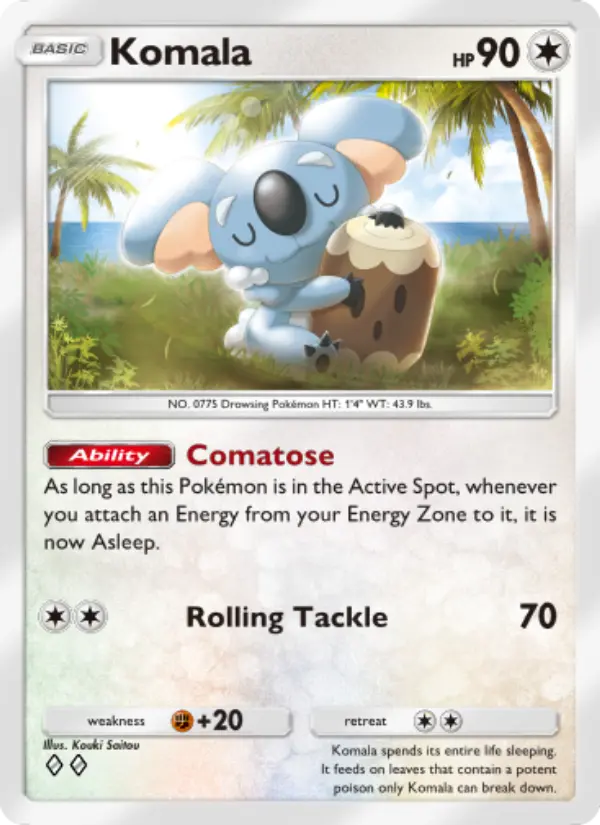
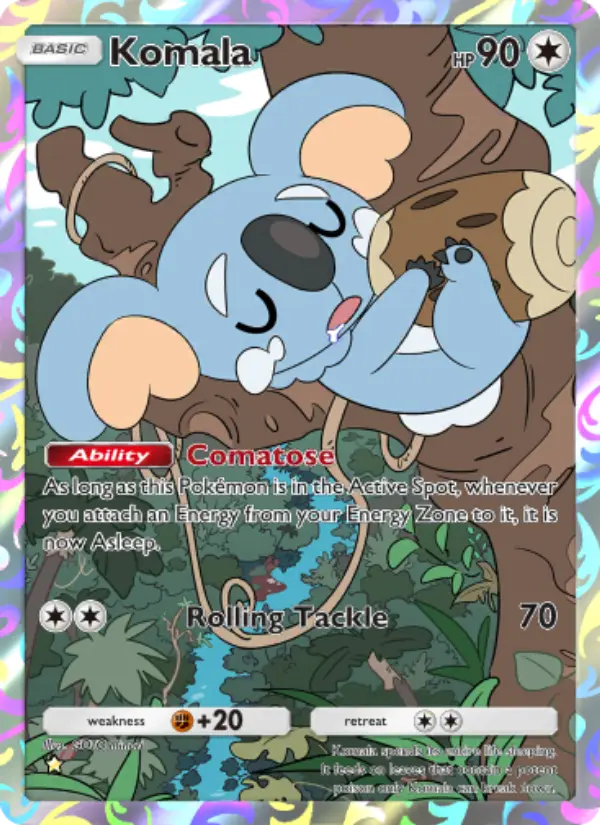
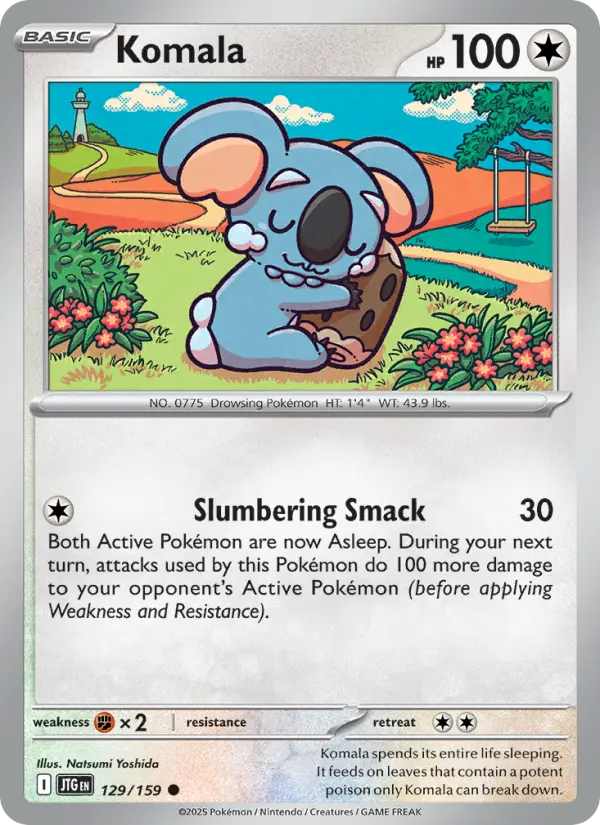
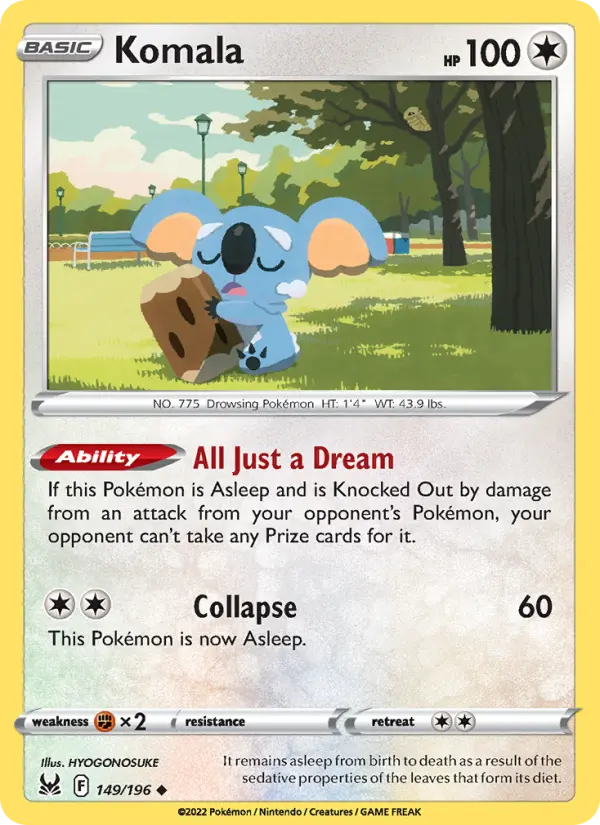
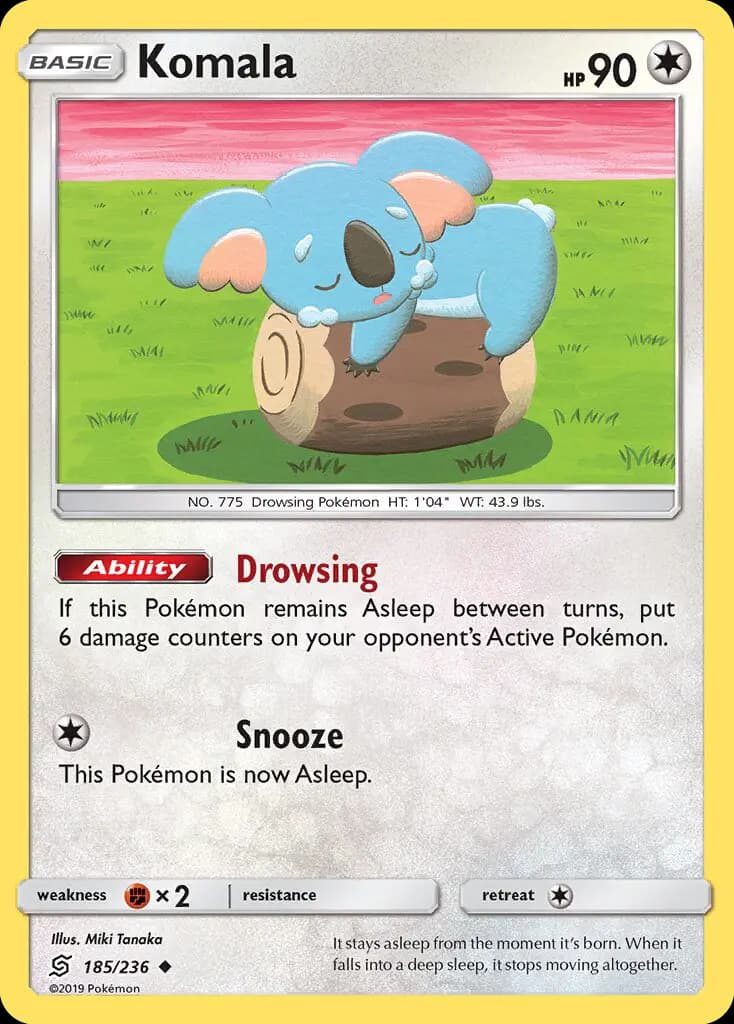
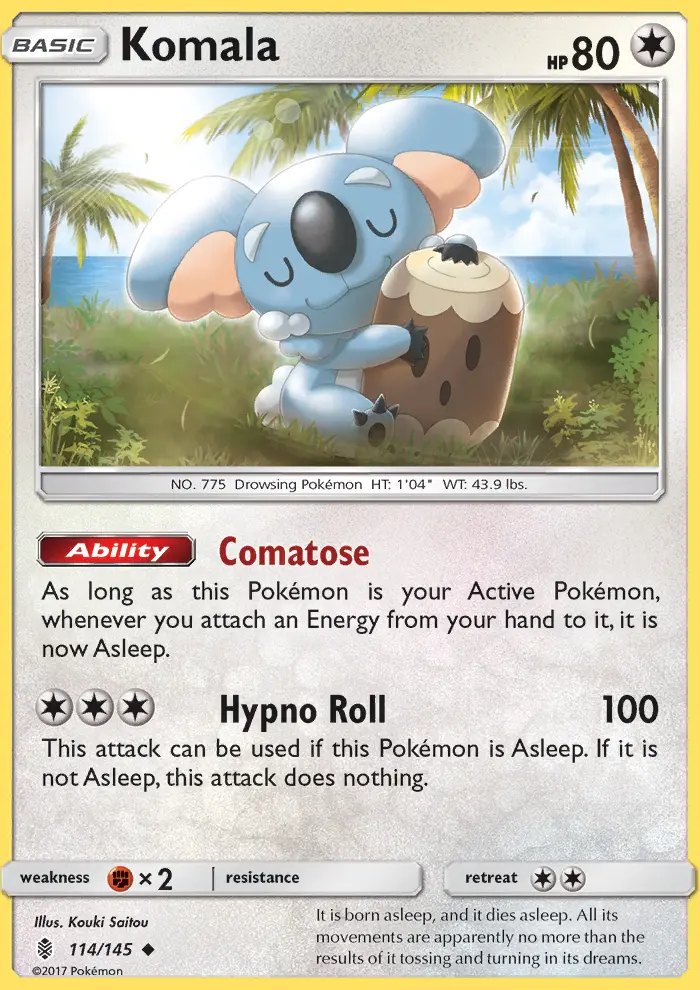
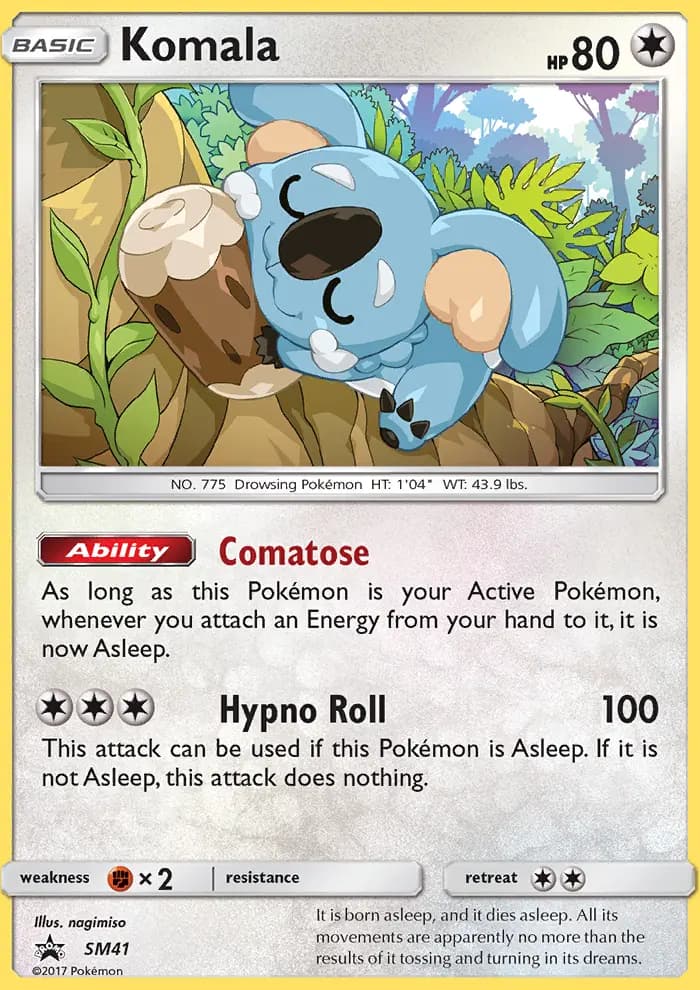
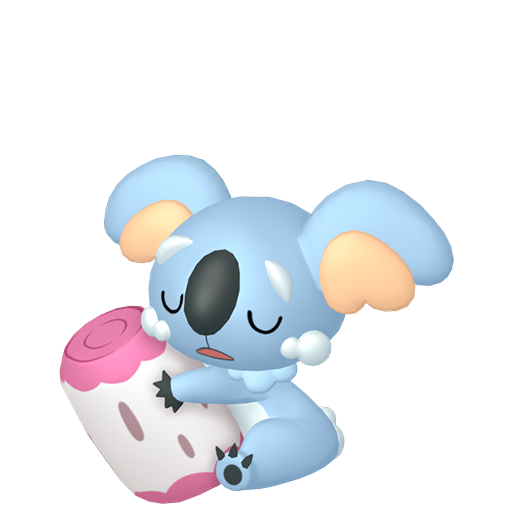
Komala's physical appearance draws inspiration from the koala, featuring a blue-gray body with distinctive large, rounded ears that possess light orange inner fur. Its face is marked by prominent white eyebrows and an oversized black nose that extends between them, flanked by white puffs of fur on its cheeks. A small ruff of longer gray fur encircles its neck, while its underbelly and short, fluffy tail are pure white. The creature's hands and feet are black with visible claws and paw pads, giving it a somewhat formidable appearance despite its peaceful, sleeping demeanor. Standing at just 0.4 meters tall and weighing 19.9 kilograms, Komala is a relatively small Pokémon that typically clutches a short wooden log, a gift from its parents at birth that serves as both comfort object and pillow. The biological mechanism behind Komala's eternal sleep is its unique diet of specially-formulated leaves that contain a potent poison capable of inducing powerful sedative properties—a poison that only Komala's specialized digestive system can safely process. This dietary adaptation represents an extraordinary evolutionary development, as the Pokémon's body has become dependent on these leaves to maintain its permanent sleep state.
Pokedex Numbers
Training
Breeding
Komala Breeding, Gender Ratio & Egg Groups
Gender-wise, Komala is an even 50/50 split between males and females, allowing for equal breeding opportunities regardless of which gender a trainer possesses. The species belongs to the Field egg group, which encompasses a diverse range of Pokémon with terrestrial associations. With a base friendship value of 70 (in Generation VII; this was later adjusted to 50 in subsequent generations), Komala begins its relationship with trainers with moderate affection, allowing opportunities for friendship-based bonding and evolution-like transformations in other Pokémon that require high friendship values. The relatively modest capture rate of 45 makes Komala moderately challenging to catch in the wild, requiring some effort and strategy beyond simply throwing a Poké Ball. Eggs containing Komala require 20 hatch cycles to develop, equivalent to approximately 4,884 to 5,140 steps, positioning it as a Pokémon with a moderate incubation period. The base experience yield of 168 provides steady growth progression, complementing the species' slow growth rate classification that means trainers must invest significant time to reach higher levels.
Sprites





TMs & HMs
tm01
ultra sun ultra moon
tm01
sun moon
tm03
yellow
tm03
crystal
tm03
gold silver
tm03
red blue
tm03
blue japan
tm04
gold silver
tm03
red green japan
tm04
emerald
tm04
firered leafgreen
tm04
ruby sapphire
tm04
diamond pearl
tm04
crystal
tm04
xd
tm04
heartgold soulsilver
tm04
black white
tm04
colosseum
tm04
platinum
tm04
sun moon
+562 more TMs/HMs
Komala Evolution, Mega Evolution & Special Forms
Komala sits alone on the evolutionary tree, with no pre-evolution or evolution, representing a complete evolutionary line unto itself. With a slow growth rate and no evolutionary branches or mega forms, Komala remains as it is throughout its entire life cycle. This lack of evolution is thematically fitting given the species' unique nature—a creature so fundamentally different from other Pokémon that standard evolutionary patterns do not apply. The absence of evolution chains does not diminish Komala's viability in gameplay or competitive settings, as its base stat total of 480 provides respectable coverage across various stats, with particular emphasis on its Attack stat of 115 and Special Defense stat of 95. Trainers seeking to use Komala in battle must work with the individual strengths of this static form, developing strategies that capitalize on its powerful physical attacks while accounting for the limitations imposed by its signature Comatose ability.
Where to Find
Alola Route 11
alola
+1 more
Komala Behaviour and Natural Habitat
Despite its constant slumber, Komala demonstrates an astonishing capacity to eat, travel, and even engage in Pokémon battles while remaining fully asleep. According to Pokédex entries, all of its movements appear to be the result of unconscious dream activity, yet these movements are purposeful and coordinated enough to function in combat situations. The log that Komala holds is not merely decorative; it serves as an essential comfort object, and should a Komala lose its grip on this log, it becomes unable to sleep well and will thrash about wildly in distress. However, Komala has demonstrated the capacity to form bonds of trust with human trainers, occasionally choosing to cling to a friendly trainer's arm instead of its wooden log—a behavior that suggests emotional intelligence and affection despite its dormant state. In its natural Alolan habitat, Komala faces predation from the psychic Pokémon Hypno, which appears to prefer hunting Komala over human prey. The species reaches a catatonic state during particularly deep sleep episodes when it ceases all movement entirely, remaining completely still until returning to its more active dream state.
Pokedex Entries
It is born asleep, and it dies asleep. All its movements are apparently no more than the results of it tossing and turning in its dreams.
It stays asleep from the moment it’s born. When it falls into a deep sleep, it stops moving altogether.
The log it holds was given to it by its parents at birth. It has also been known to cling to the arm of a friendly Trainer.
It remains asleep from birth to death as a result of the sedative properties of the leaves that form its diet.
Komala Name Origin & Design Inspiration
Komala's design and nomenclature derive from a blend of inspiration centered on sleep and koalas. The English name 'Komala' likely combines elements referencing coma and koala, perfectly encapsulating the species' core characteristics. The Japanese name 'Nekkoara' (ネッコアラ) similarly references both 'neko' (cat) and 'koala,' reflecting the designer's intention to create a feline-koala hybrid appearance. The creature's distinctive features—its rounded ears, fluffy fur, and cuddly proportions—clearly channel koala aesthetics, while its humanoid posture and black claws add a touch of uniqueness that prevents it from being a simple koala replica. The wooden log that Komala perpetually carries serves multiple design purposes: it provides a visual anchor that makes the Pokémon instantly recognizable, reinforces its sleeping theme by serving as a pillow, and creates an endearing image of a creature bonded to its comfort object. The color palette of blue-gray with white accents and black extremities gives Komala a soft, approachable appearance that contrasts with the potentially unsettling concept of a creature that never awakens.
Learnable Moves
Komala can learn 73 moves:
Move | Type | Cat. | Power | Acc. | PP |
|---|---|---|---|---|---|
| acrobatics | flying | Physical | 55 | 100 | 15 |
| attract | normal | Status | — | 100 | 15 |
| body slam | normal | Physical | 85 | 100 | 15 |
| brick break | fighting | Physical | 75 | 100 | 15 |
| bulk up | fighting | Status | — | — | 20 |
| bulldoze | ground | Physical | 60 | 100 | 20 |
| calm mind | psychic | Status | — | — | 20 |
| charm | fairy | Status | — | 100 | 20 |
| confide | normal | Status | — | — | 20 |
| curse | ghost | Status | — | — | 10 |
| defense curl | normal | Status | — | — | 40 |
| double team | normal | Status | — | — | 15 |
| double edge | normal | Physical | 120 | 100 | 15 |
| earthquake | ground | Physical | 100 | 100 | 10 |
| endeavor | normal | Physical | — | 100 | 5 |
| endure | normal | Status | — | — | 10 |
| facade | normal | Physical | 70 | 100 | 20 |
| flail | normal | Physical | — | 100 | 15 |
| fling | dark | Physical | — | 100 | 10 |
| frustration | normal | Physical | — | 100 | 20 |
| giga impact | normal | Physical | 150 | 90 | 5 |
| gunk shot | poison | Physical | 120 | 80 | 5 |
| hidden power | normal | Special | 60 | 100 | 15 |
| hyper beam | normal | Special | 150 | 90 | 5 |
| ice spinner | ice | Physical | 80 | 100 | 15 |
| iron head | steel | Physical | 80 | 100 | 15 |
| knock off | dark | Physical | 65 | 100 | 20 |
| last resort | normal | Physical | 140 | 100 | 5 |
| low kick | fighting | Physical | — | 100 | 20 |
| low sweep | fighting | Physical | 65 | 100 | 20 |
| metal claw | steel | Physical | 50 | 95 | 35 |
| payback | dark | Physical | 50 | 100 | 10 |
| play rough | fairy | Physical | 90 | 90 | 10 |
| protect | normal | Status | — | — | 10 |
| psych up | normal | Status | — | — | 10 |
| quash | dark | Status | — | 100 | 15 |
| rain dance | water | Status | — | — | 5 |
| rapid spin | normal | Physical | 50 | 100 | 40 |
| return | normal | Physical | — | 100 | 20 |
| reversal | fighting | Physical | — | 100 | 15 |
| rock slide | rock | Physical | 75 | 90 | 10 |
| rock tomb | rock | Physical | 60 | 95 | 15 |
| rollout | rock | Physical | 30 | 90 | 20 |
| round | normal | Special | 60 | 100 | 15 |
| seed bomb | grass | Physical | 80 | 100 | 15 |
| shadow claw | ghost | Physical | 70 | 100 | 15 |
| sing | normal | Status | — | 55 | 15 |
| slam | normal | Physical | 80 | 75 | 20 |
| sleep talk | normal | Status | — | — | 10 |
| snore | normal | Special | 50 | 100 | 15 |
| spit up | normal | Special | — | 100 | 10 |
| stockpile | normal | Status | — | — | 20 |
| stomping tantrum | ground | Physical | 75 | 100 | 10 |
| substitute | normal | Status | — | — | 10 |
| sucker punch | dark | Physical | 70 | 100 | 5 |
| sunny day | fire | Status | — | — | 5 |
| super fang | normal | Physical | — | 90 | 10 |
| superpower | fighting | Physical | 120 | 100 | 5 |
| swagger | normal | Status | — | 85 | 15 |
| swallow | normal | Status | — | — | 10 |
| swords dance | normal | Status | — | — | 20 |
| take down | normal | Physical | 90 | 85 | 20 |
| tera blast | normal | Special | 80 | 100 | 10 |
| thief | dark | Physical | 60 | 100 | 25 |
| thrash | normal | Physical | 120 | 100 | 10 |
| toxic | poison | Status | — | 90 | 10 |
| trailblaze | grass | Physical | 50 | 100 | 20 |
| u turn | bug | Physical | 70 | 100 | 20 |
| wish | normal | Status | — | — | 10 |
| wood hammer | grass | Physical | 120 | 100 | 15 |
| work up | normal | Status | — | — | 30 |
| yawn | normal | Status | — | — | 10 |
| zen headbutt | psychic | Physical | 80 | 90 | 15 |
Komala Competitive Battle Guide
Competitively, Komala occupies a unique niche defined entirely by its signature Comatose ability, which causes it to perpetually act as though it were asleep. This ability provides extraordinary defensive benefits: Komala cannot be put to sleep by opposing moves or abilities since it is already considered to be in that state, and it becomes immune to moves like Trick and Switcheroo that target held items, since Komala's log cannot be removed. However, the Comatose ability also imposes significant restrictions on Komala's offensive capabilities—it can only use physical moves with full accuracy and power, as sleep-related move penalties affect its psychological abilities. The species' stat distribution emphasizes Attack at 115, making physical movesets optimal, while its Special Defense of 95 and Defense of 65 suggest a preference for specially defensive training. With base Speed of only 65, Komala typically requires Speed-reducing natures or items to maximize its effectiveness in doubles formats where speed control is paramount. Its Normal-type classification provides weak offensive coverage, requiring careful movepool consideration and potential use of Hidden Power alternatives to address type matchups. Competitive players utilizing Komala must embrace its unusual mechanics and build teams that complement its unique defensive properties while compensating for its offensive limitations through coverage moves and strategic synergy with teammate Pokémon.
Commonly Asked Questions About Komala
What type is Komala?
Komala is a normal type Pokemon.
What does Komala evolve from?
Komala does not evolve.
What are Komala's weaknesses?
Komala is weak to fighting type moves.
Where can I find Komala?
Komala can be found in alola route 11 (alola).
Komala Cultural Impact & Franchise History
Komala has become a beloved icon within the Pokémon community for its genuinely bizarre and endearing premise—a creature that never wakes up yet somehow functions in the world. This concept has resonated with players, leading to widespread adoption of Komala in casual playthroughs and considerable fanart depicting the drowsy creature in various imaginative scenarios. The species has appeared in Pokémon animation, including the official anime series where its sleeping nature provides visual comedy and heartwarming moments as trainers interact with the perpetually dormant Pokémon. Beyond entertainment, Komala has entered cultural discourse regarding the fantasy of constant sleep and rest—in our high-stress modern world, the image of a creature that spends its entire existence in peaceful slumber has developed an almost aspirational quality for some players. The ancient peoples' use of Komala's diluted saliva as both a sleep aid and surgical anesthetic, as detailed in Pokédex entries, provides a touch of pseudo-scientific legitimacy to the creature's existence within the Pokémon world. This medicinal application connects Komala to human history and wellbeing, giving it cultural significance beyond its role as a battling creature, and has inspired creative works exploring the implications of a species whose biology offers genuine pharmaceutical benefits.
Where to Find Komala in Every Pokémon Game
Komala was introduced in Generation VII and made its first appearance in Pokémon Sun and Moon, where it could be encountered in specific locations within the Alola region. The species has maintained availability through subsequent generations, appearing in Pokémon Ultra Sun and Ultra Moon with adjusted Pokédex entries that further elaborate on its unique biology and sedative leaf diet. In the most recent games, Pokémon Scarlet and Violet, Komala continues to be available to trainers, allowing modern players to capture and train this unusual Pokémon. The creature's Alolan Pokédex numbers shifted between games—occupying slot 0222 in Sun and Moon and slot 0286 in Ultra Sun and Ultra Moon, before being assigned slot 0315 in the Paldean Pokédex. With a capture rate of 45, Komala presents a moderate challenge to capture, requiring standard Poké Balls or strategic use of status conditions and damage to improve catch rates, though trainers should be mindful that the species cannot be put to sleep as an aid in capture. Players seeking Komala should investigate specific location guides for their chosen game version, as spawn locations and availability conditions may vary between titles and may be influenced by time of day or weather conditions in certain entries.