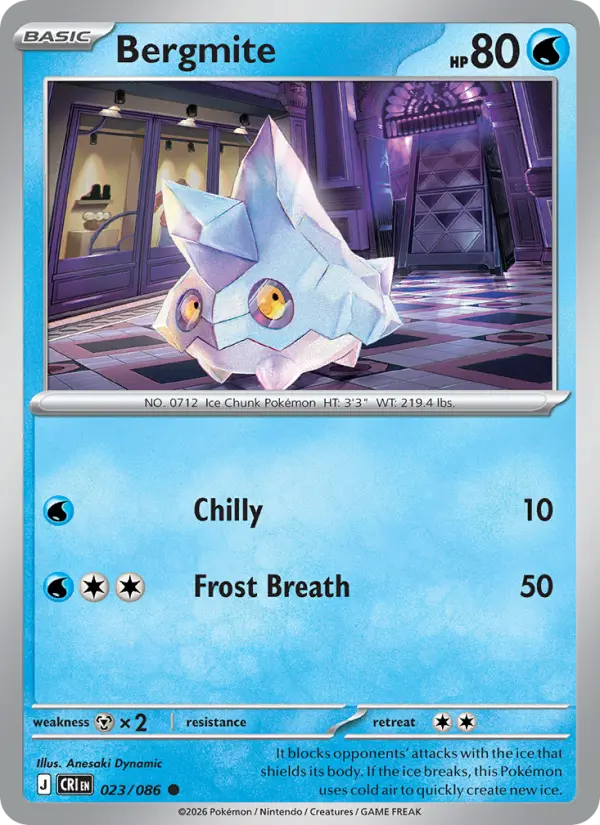
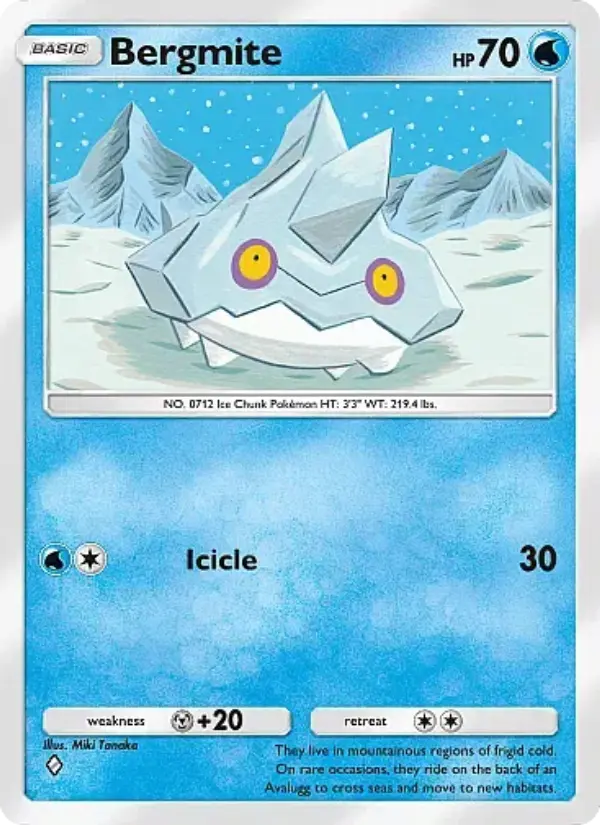
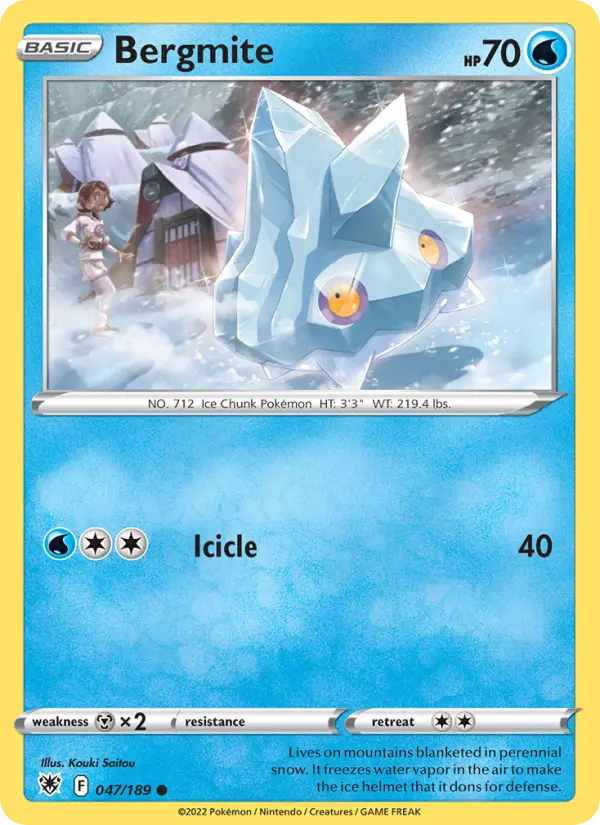
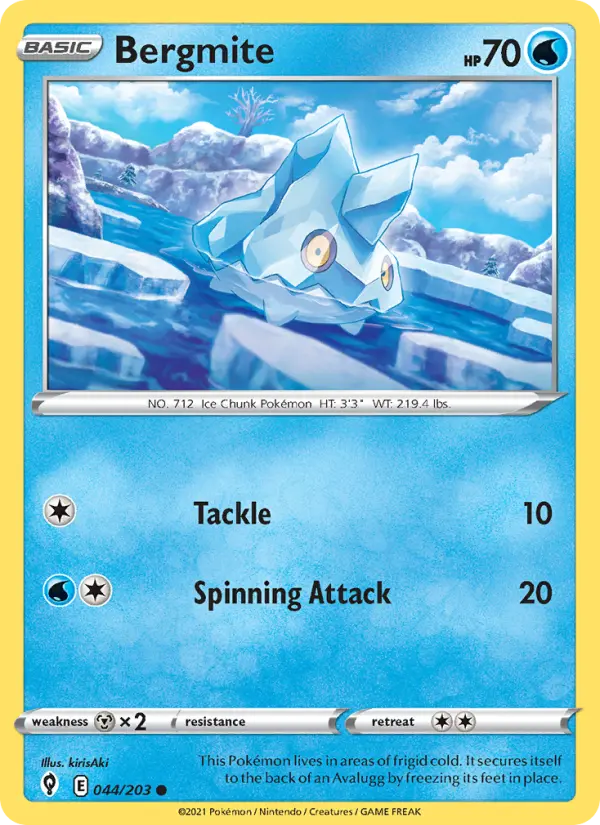
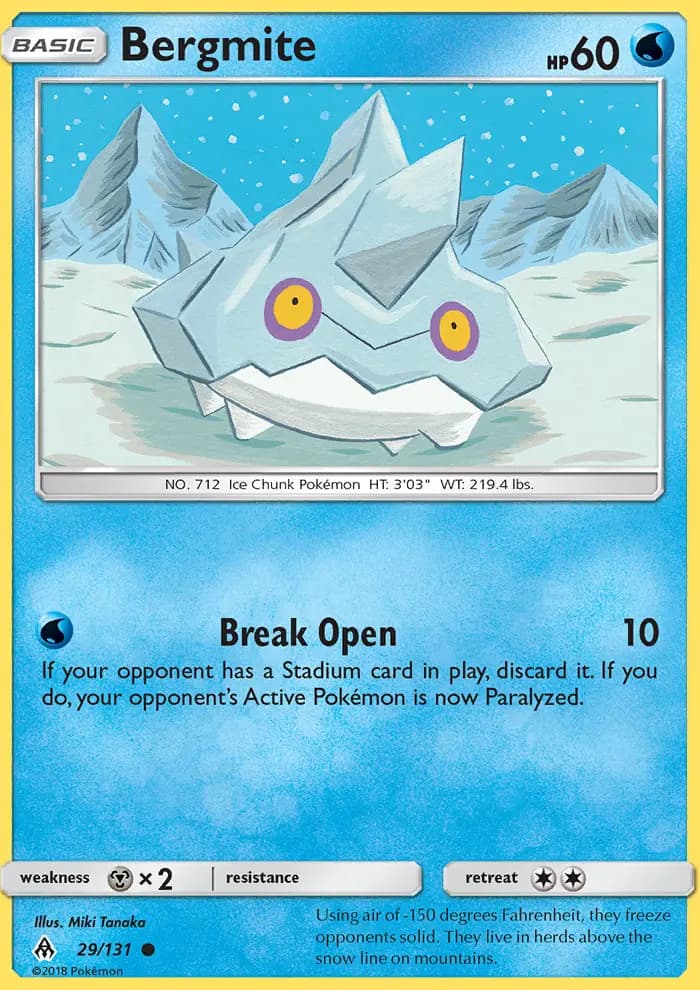
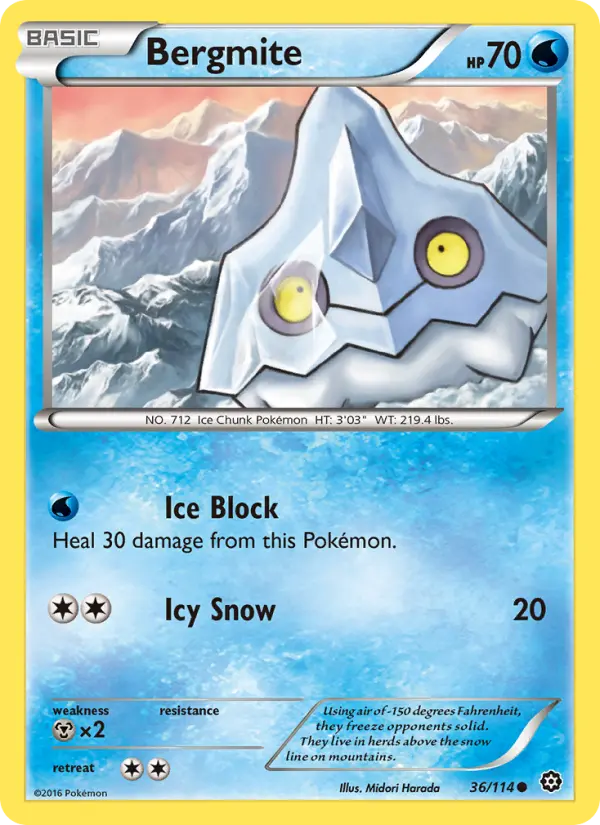
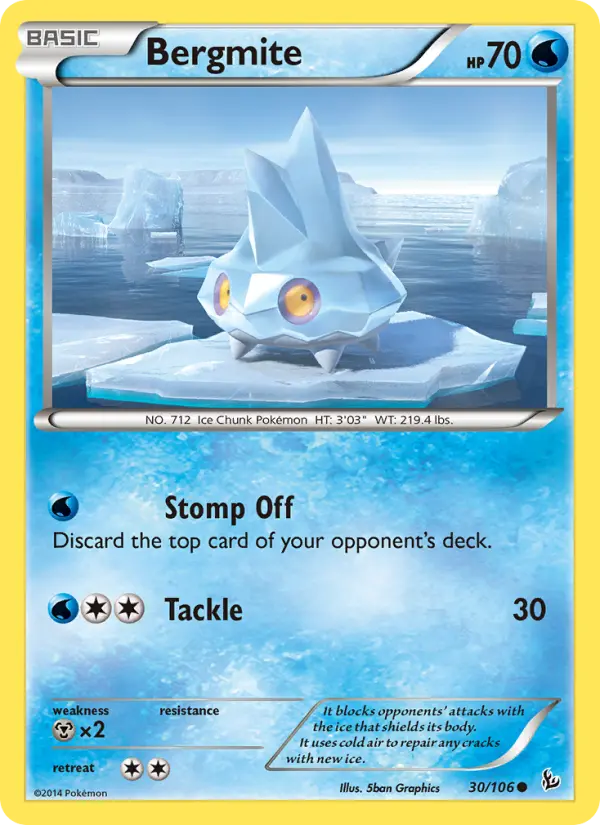
Bergmite
Generation VI · #0712 — Ice Chunk Pokémon
Weighing 99.5 kg and standing 1 m, Bergmite carries its ice typing into battle with a stat spread that leans hardest into Defense. Despite its modest appearance, Bergmite possesses a fascinating biology centered around its ability to generate and manipulate extreme cold, with documented air temperatures reaching −150 degrees Fahrenheit (−100 degrees Celsius). As the unevolved form in its evolutionary line, Bergmite serves as an excellent introduction to understanding how Ice-type Pokémon utilize environmental adaptation for survival in the harshest alpine regions of the Pokémon world.
Editor's Take
Bergmite's line ends in Avalugg, whose 184 base Defense makes it the single hardest Pokémon to break physically, and a pure Ice typing undoes most of that.
Base Stats
Height
1.0m
Weight
99.5kg
Category
Ice Chunk Pokémon
Gender
Male 50% / Female 50%
Color
blue
Shape
quadruped
Abilities
Prevents confusion.
Heals for 1/16 max HP after each turn during hail. Protects against hail damage.
Prevents being KOed from full HP, leaving 1 HP instead. Protects against the one-hit KO moves regardless of HP.

Bergmite Biology & Physical Characteristics
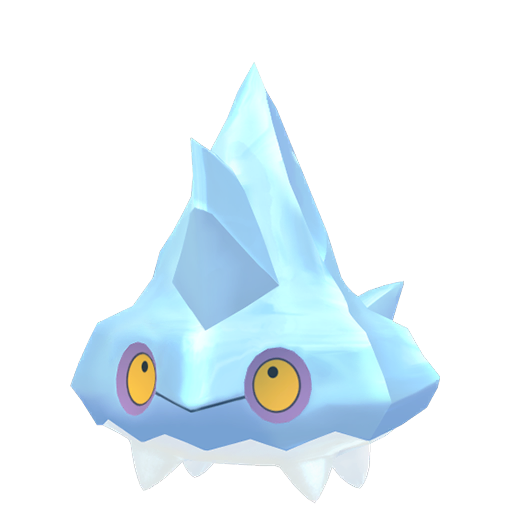
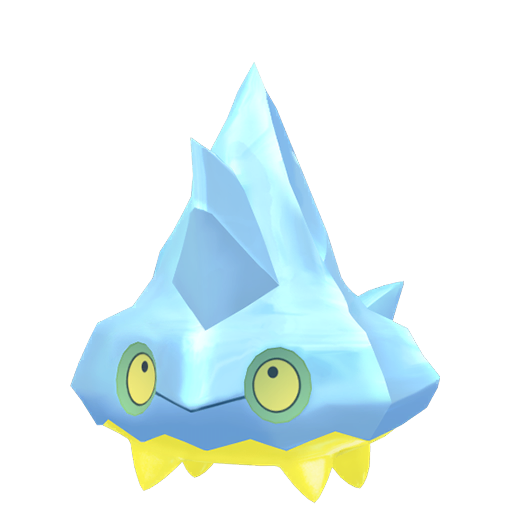
Bergmite is a compact quadrupedal Pokémon whose body structure represents a remarkable adaptation to extreme cold environments. Its physical form consists of a white, rounded body base covered entirely by a slightly translucent pale blue ice shell that forms a large triangular protrusion on its forehead with additional smaller spikes extending from its hind end. Through this transparent ice coating, its distinctive yellow eyes ringed with purple markings are clearly visible, serving as the only warm-colored features of this frigid creature. What makes Bergmite's biology particularly remarkable is its capacity for self-maintenance and repair; the Pokémon generates intensely cold air that freezes water vapor in the atmosphere, which it then uses to repair any cracks or damage to its protective ice armor. This biological process demonstrates an elegant symbiosis between the Pokémon's body temperature regulation and its environmental interaction. Despite its chunky, ice-encased appearance, Bergmite possesses sufficient muscular development beneath its frozen shell to achieve surprising mobility, including the ability to swim effectively through water and traverse steep mountainous terrain.
Pokedex Numbers
Training
Breeding
Bergmite Breeding, Gender Ratio & Egg Groups
Half of all Bergmite are male, half are female — no skew to plan around, allowing for reliable breeding outcomes when attempting to raise young specimens in captivity. The species belongs to the Monster and Mineral egg groups, a dual classification that reflects both its biological nature as a living creature and its mineral-like ice composition. This dual egg group classification provides breeders with relatively flexible options for cross-breeding with other Pokémon species that share either designation, enabling trainers to pass down specific moves or abilities through careful lineage planning. Bergmite eggs require 20 cycles to hatch, translating to approximately 4,884 to 5,140 steps of travel, making it a moderately fast-hatching species compared to legendaries and pseudo-legendaries. The species exhibits moderate base happiness of 70 in Generations VI and VII, increasing to the standard 50 in later generations, indicating a naturally friendly disposition toward trainers who treat their Bergmite with respect and care. Successful breeding of Bergmite typically produces offspring that inherit the parent's movepool and potential abilities, with the hidden ability Sturdy being passable through careful breeding when one parent possesses this rare trait.
Sprites




TMs & HMs
tm03
crystal
tm03
gold silver
tm03
ruby sapphire
tm03
platinum
tm03
firered leafgreen
tm03
heartgold soulsilver
tm03
diamond pearl
tm03
emerald
tm03
xd
tm03
colosseum
tm05
lets go pikachu lets go eevee
tm06
yellow
tm06
gold silver
tm06
red blue
tm06
crystal
tm06
emerald
tm06
firered leafgreen
tm06
diamond pearl
tm06
platinum
tm06
ruby sapphire
+543 more TMs/HMs


Bergmite Evolution, Mega Evolution & Special Forms
Bergmite undergoes a straightforward evolution into Avalugg upon reaching level 37, transforming from an individual ice chunk into a massive living glacier that can reach over 3.5 meters in length. This evolution represents a dramatic increase in physical mass and combat capability, with Avalugg gaining significantly in attack, special attack, and HP statistics while maintaining the pure Ice typing. In the Hisui region, an alternate evolutionary path exists where Bergmite evolves into Hisuian Avalugg, a variant that gains the Rock type alongside Ice, resulting in a dual-type Pokémon with enhanced special defense and entirely different strategic applications in battle. The evolution process itself is not documented with special conditions or held items; rather, it follows the simple level-based progression characteristic of early-stage Pokémon designed for accessibility to new trainers. The evolution from Bergmite to Avalugg symbolizes the transition from individual survival strategies to becoming part of larger, more formidable collective entities within mountain ecosystems.
Where to Find
Frost Cavern
kalos
+13 more
Bergmite Behaviour and Natural Habitat
Bergmite inhabits the most inhospitable mountain peaks and alpine regions where perpetual snow blankets the landscape year-round. These Ice Chunk Pokémon are highly social creatures that live in organized herds above the snow line, huddling together for warmth and mutual protection in their frozen habitats. In fascinating behavioral displays documented across multiple Pokédex entries, Bergmite frequently attaches itself to the backs of evolved Avalugg, freezing its feet directly to the larger Pokémon's body to secure transportation across snowy terrain and even across frozen seas to reach new habitats. This parasitic yet mutually beneficial relationship demonstrates a complex social hierarchy and cooperative behavior pattern unusual among Pokémon species. When encountering other Ice-type Pokémon like Frigibax, Bergmite exhibits competitive and quarrelsome behavior, engaging in territorial disputes over food resources and optimal shelter locations. The species' preference for frigid environments is absolute; they cannot survive in warmer climates and seek out areas of perpetual cold where their biological ice-generation abilities provide both defense and sustenance.
Pokedex Entries
It blocks opponents’ attacks with the ice that shields its body. It uses cold air to repair any cracks with new ice.
Using air of -150 degrees Fahrenheit, they freeze opponents solid. They live in herds above the snow line on mountains.
It blocks opponents’ attacks with the ice that shields its body. It uses cold air to repair any cracks with new ice.
Using air of -150 degrees Fahrenheit, they freeze opponents solid. They live in herds above the snow line on mountains.
They chill the air around them to −150 degrees Fahrenheit, freezing the water in the air into ice that they use as armor.
This Pokémon lives in areas of frigid cold. It secures itself to the back of an Avalugg by freezing its feet in place.
Lives on mountains blanketed in perennial snow. It freezes water vapor in the air to make the ice helmet that it dons for defense.
Bergmite Name Origin & Design Inspiration
Bergmite's name traces to the German word 'Berg,' meaning mountain, combined with 'mite,' suggesting both its small stature and its mineral composition as a chunk of ice. The Japanese name Kachikohru (カチコール) combines 'kachi' (カチ), imitating the hard, clicking sound of ice, with 'kohru' (コール), referencing 'cold,' creating an onomatopoetic name that evokes both the Pokémon's physical nature and its environmental association. Visually, Bergmite's design intentionally mimics a rounded boulder or chunk of ice that has been naturally weathered and shaped by alpine conditions, with the transparent ice shell allowing visibility of the living creature within—a clever design choice that communicates both its defensive capabilities and its organic nature despite its mineral appearance. The triangular ice protrusions on its head and rear serve as visual indicators of its ice-type classification while suggesting an aggressive posture despite the Pokémon's relatively docile nature. The design's color palette of pale blue and white establishes immediate environmental context, while the purple-ringed yellow eyes provide an unexpected touch of personality and warmth that contrasts beautifully with the cold aesthetic.
Learnable Moves
Bergmite can learn 63 moves:
Move | Type | Cat. | Power | Acc. | PP |
|---|---|---|---|---|---|
| after you | normal | Status | — | — | 15 |
| attract | normal | Status | — | 100 | 15 |
| aurora veil | ice | Status | — | — | 20 |
| avalanche | ice | Physical | 60 | 100 | 10 |
| barrier | psychic | Status | — | — | 20 |
| bite | dark | Physical | 60 | 100 | 25 |
| blizzard | ice | Special | 110 | 70 | 5 |
| body slam | normal | Physical | 85 | 100 | 15 |
| bulldoze | ground | Physical | 60 | 100 | 20 |
| chilling water | water | Special | 50 | 100 | 20 |
| confide | normal | Status | — | — | 20 |
| crunch | dark | Physical | 80 | 100 | 15 |
| curse | ghost | Status | — | — | 10 |
| double team | normal | Status | — | — | 15 |
| double edge | normal | Physical | 120 | 100 | 15 |
| endure | normal | Status | — | — | 10 |
| facade | normal | Physical | 70 | 100 | 20 |
| flash | normal | Status | — | 100 | 20 |
| flash cannon | steel | Special | 80 | 100 | 10 |
| frost breath | ice | Special | 60 | 90 | 10 |
| frustration | normal | Physical | — | 100 | 20 |
| gyro ball | steel | Physical | — | 100 | 5 |
| hail | ice | Status | — | — | 10 |
| harden | normal | Status | — | — | 30 |
| hidden power | normal | Special | 60 | 100 | 15 |
| ice ball | ice | Physical | 30 | 90 | 20 |
| ice beam | ice | Special | 90 | 100 | 10 |
| ice fang | ice | Physical | 65 | 95 | 15 |
| ice shard | ice | Physical | 40 | 100 | 30 |
| ice spinner | ice | Physical | 80 | 100 | 15 |
| icicle spear | ice | Physical | 25 | 100 | 30 |
| icy wind | ice | Special | 55 | 95 | 15 |
| iron defense | steel | Status | — | — | 15 |
| mirror coat | psychic | Special | — | 100 | 20 |
| mist | ice | Status | — | — | 30 |
| powder snow | ice | Special | 40 | 100 | 25 |
| protect | normal | Status | — | — | 10 |
| rain dance | water | Status | — | — | 5 |
| rapid spin | normal | Physical | 50 | 100 | 40 |
| recover | normal | Status | — | — | 5 |
| rest | psychic | Status | — | — | 5 |
| return | normal | Physical | — | 100 | 20 |
| rock polish | rock | Status | — | — | 20 |
| rock slide | rock | Physical | 75 | 90 | 10 |
| rock smash | fighting | Physical | 40 | 100 | 15 |
| rock tomb | rock | Physical | 60 | 95 | 15 |
| round | normal | Special | 60 | 100 | 15 |
| safeguard | normal | Status | — | — | 25 |
| secret power | normal | Physical | 70 | 100 | 20 |
| sharpen | normal | Status | — | — | 30 |
| sleep talk | normal | Status | — | — | 10 |
| snore | normal | Special | 50 | 100 | 15 |
| snowscape | ice | Status | 0 | — | 10 |
| stone edge | rock | Physical | 100 | 80 | 5 |
| strength | normal | Physical | 80 | 100 | 15 |
| substitute | normal | Status | — | — | 10 |
| surf | water | Special | 90 | 100 | 15 |
| swagger | normal | Status | — | 85 | 15 |
| tackle | normal | Physical | 40 | 100 | 35 |
| take down | normal | Physical | 90 | 85 | 20 |
| tera blast | normal | Special | 80 | 100 | 10 |
| toxic | poison | Status | — | 90 | 10 |
| water pulse | water | Special | 60 | 100 | 20 |
Bergmite Competitive Battle Guide
Looking at its competitive profile, Bergmite occupies a niche role as an unevolved Pokémon with modest but functional base statistics totaling 304. Its defensive profile is its strongest asset, with a base Defense stat of 85 that allows it to reliably wall physical attacks, while its HP of 55 and special defense of 35 create exploitable vulnerabilities to special attackers. The species' offensive capabilities are limited, with base Attack of 69 and Special Attack of merely 32, making Bergmite incapable of dealing significant damage output without considerable investment or coverage moves. Its Speed stat of 28 is among its primary weaknesses, leaving Bergmite consistently outsped by most competitive Pokémon. However, its three ability options provide strategic flexibility: Own Tempo prevents confusion from moves like Confuse Ray and Swagger, Ice Body provides passive recovery during hail weather while simultaneously protecting from hail damage, and the hidden ability Sturdy guarantees survival of full-HP attacks with 1 HP remaining while providing immunity to one-hit KO moves. Most competitive players utilize Bergmite exclusively in weather-heavy teams leveraging Ice Body for sustainable passive healing, or opt to immediately evolve it to Avalugg, which provides substantially superior stats and presence.
Commonly Asked Questions About Bergmite
What type is Bergmite?
Bergmite is a ice type Pokemon.
What does Bergmite evolve into?
Bergmite evolves into avalugg.
What are Bergmite's weaknesses?
Bergmite is weak to fighting, rock, steel and fire type moves.
Does Bergmite evolve by trading?
No — Bergmite evolves entirely through leveling up, with no trade required at any stage.
Where can I find Bergmite?
Bergmite can be found in frost cavern (kalos).
Bergmite Cultural Impact & Franchise History
Bergmite emerged in Generation VI as part of the Kalos region's diverse Pokédex expansion, contributing to a growing representation of Ice-type creatures with unique environmental niches and behavioral patterns. The species has appeared in Pokémon anime episodes and films, typically portrayed as part of mountain-dwelling communities that demonstrate complex social structures and cooperative survival strategies. Its design has resonated with players who appreciate Pokémon with clear environmental specialization and logical ecological placement, avoiding the generic 'cute ice creature' archetype by emphasizing its rocky, mineral-like qualities and actual bulk despite being an unevolved form. Bergmite has inspired fan art, creative fiction, and community discussions about Pokémon ecology and how different species adapt to extreme environments. The species has also contributed to competitive team-building discussions regarding weather-dependent strategies, with players experimenting with hail-based team compositions that leverage Ice Body's passive recovery. Its presence in multiple games and regions, including the historically significant Legends: Arceus, demonstrates continued developer support for the species despite its status as a relatively minor evolutionary line.
Where to Find Bergmite in Every Pokémon Game
Bergmite's regional availability has expanded significantly across multiple generations and games. In Pokémon X and Y, the species appears in Mountain Kalos as entry number 079 in the regional Pokédex, making it accessible relatively early in the player's journey through mountainous terrain. In Pokémon Sword and Shield, Bergmite appears as entry 358 in the regional Pokédex, available in ice-themed areas within the DLC regions, particularly the Crown Tundra. Pokémon Legends: Arceus features Bergmite as entry 215 in its regional Pokédex, emphasizing its historical presence in the ancient Hisui region where it evolves into the unique Hisuian Avalugg form. In Pokémon Scarlet and Violet, Bergmite is available as entry 363 in the regional Pokédex, found in appropriate mountainous and cold-weather areas of the Paldea region. The species maintains a relatively high catch rate of 190 out of 255, making it straightforward to capture in the wild without specialized ball types or weakening strategies. Bergmite can also be obtained through breeding Avalugg that possess the species in their egg move pool, providing an alternative acquisition method for trainers without access to wild encounters.