Bonnet Brute
Generation IX · #0986 — Paradox Pokémon
Trainers who write off Brute-Bonnet on looks alone are missing that its Attack of 127 is genuinely one of the higher marks among grass/dark-type Pokémon. Its signature ability, Protosynthesis, amplifies its already impressive stats by raising its highest stat during harsh sunlight or when holding Booster Energy, enabling strategic team compositions in competitive play. Standing at 1.2 meters tall and weighing 21.0 kilograms, this genderless Pokémon exhibits traits that defy conventional classification, blending the characteristics of both prehistoric creatures and modern mushroom Pokémon in a way that has intrigued researchers since its discovery in Paldea.
Editor's Take
Brute Bonnet is ancient Amoonguss with 127 base Attack, which inverts the original's entire defensive support identity into a physical attacker.
Base Stats
Height
1.2m
Weight
21.0kg
Category
Paradox Pokémon
Gender
Genderless
Color
gray
Shape
quadruped
Abilities
Raises highest stat in harsh sunlight, or if holding Booster Energy.

Bonnet Brute Biology & Physical Characteristics
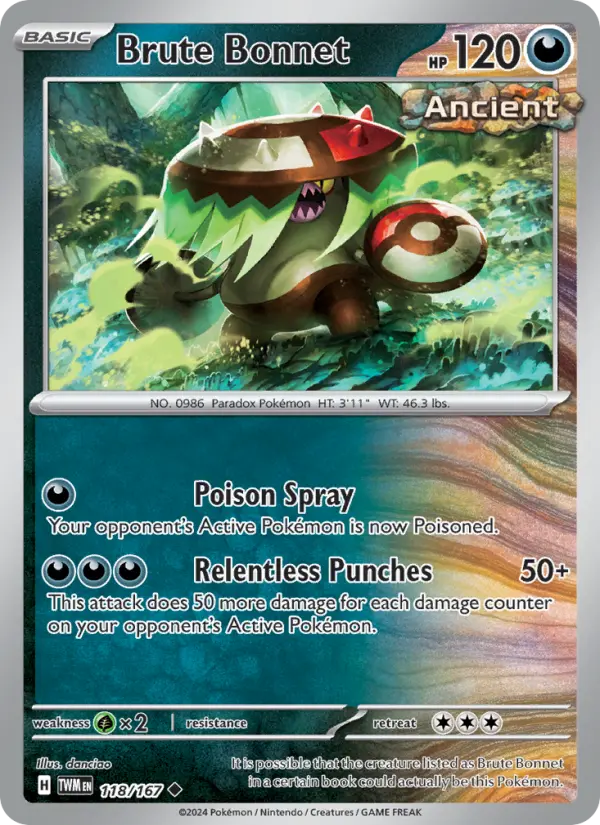
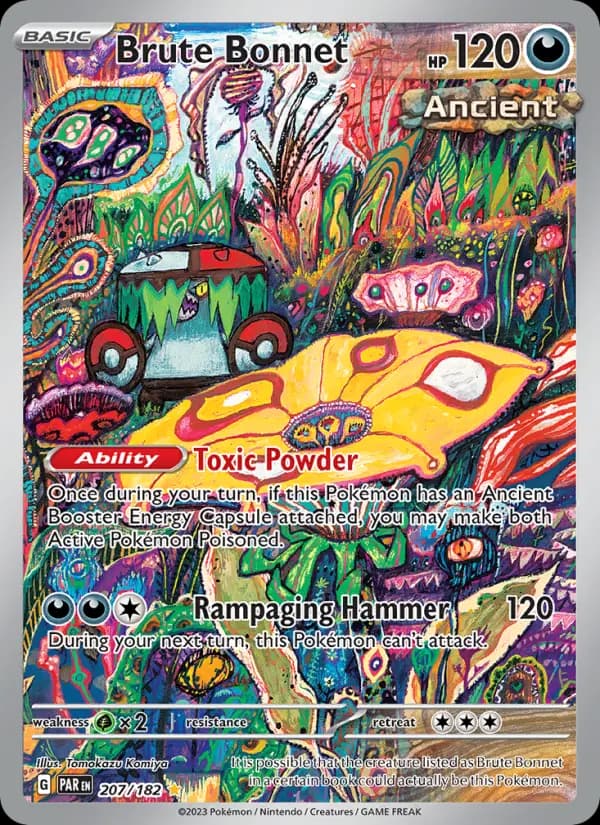
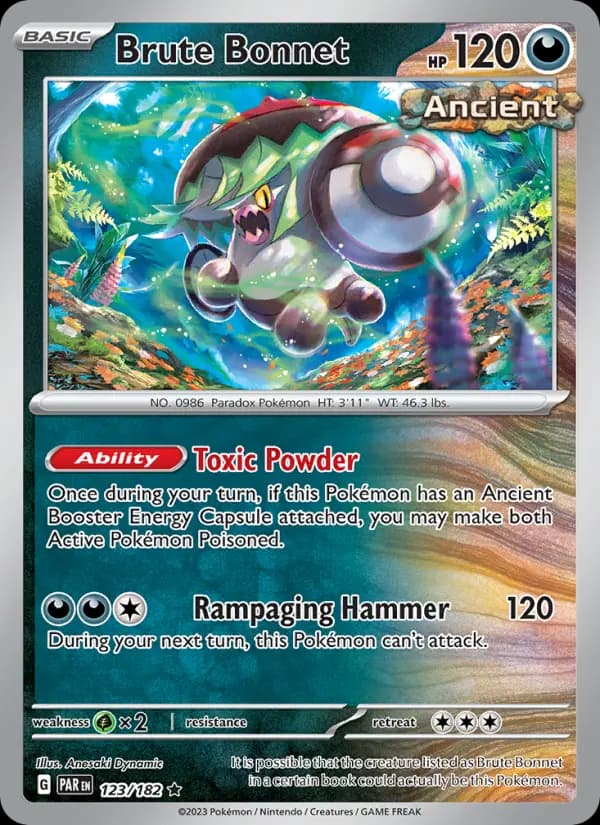
Brute Bonnet presents a remarkable physiological structure that combines fungal and reptilian characteristics in equal measure. Its most distinctive feature is the massive, spike-covered mushroom cap adorning its head, resembling a Poké Ball in appearance despite its purported ancient origins—a paradox that has fueled speculation among Pokémon scholars. Underneath this prominent cap lies what appears to be green moss, suggesting a symbiotic relationship with flora or a natural state of decomposition. The Pokémon possesses four stumpy brownish legs supporting its compact frame, along with a tail that extends from its posterior, and its most unsettling feature consists of prominent pink lips with a jagged, almost menacing appearance. Brute Bonnet's arms are similarly capped with mushroom-like protrusions that mirror the structure of its head, creating a symmetrical yet alien aesthetic. Its coloration—predominantly featuring white, brown, and green tones—reflects an organism that appears equally at home in ancient forests or subterranean environments, with the aforementioned Poké Ball-like markings on its caps suggesting either convergent design or something more inexplicable about the nature of these Paradox Pokémon.
Pokedex Numbers
Training
Breeding
Bonnet Brute Breeding, Gender Ratio & Egg Groups
Brute Bonnet exists as a genderless Pokémon, belonging to the 'Undiscovered' egg group and therefore incapable of breeding through conventional means. This biological impossibility presents one of the many mysteries surrounding its classification as a Paradox Pokémon, as it suggests reproduction mechanisms entirely foreign to standard Pokémon biology. The inability to produce eggs means that new specimens of Brute Bonnet cannot be obtained through breeding, restricting availability solely to direct encounters in the wild or through distribution events. The base happiness rating of 0, notably lower than standard Pokémon, compounds the impression of Brute Bonnet as something fundamentally alien to conventional Pokémon—it does not bond with trainers in the traditional sense, instead remaining indifferent or hostile regardless of treatment. This lack of emotional connection or trainability through affection underscores the creature's classification as a mysterious paradox rather than a regular Pokémon adapted to coexist with humans. The breeding impossibility also has significant implications for competitive play and collector value, as players cannot selectively breed for optimal natures and IVs as they would with conventional species, forcing players to either work with naturally-encountered specimens or rely on alternative training methods to optimize their Brute Bonnet's statistics.
Sprites






TMs & HMs
tm02
lets go pikachu lets go eevee
tm05
lets go pikachu lets go eevee
tm07
lets go pikachu lets go eevee
tm08
red blue
tm08
yellow
tm08
lets go pikachu lets go eevee
tm08
sword shield
tm08
red green japan
tm08
blue japan
tm09
ruby sapphire
tm09
firered leafgreen
tm09
emerald
tm09
diamond pearl
tm09
xd
tm09
black 2 white 2
tm09
sword shield
tm11
platinum
tm11
xd
tr65
sword shield
tm17
scarlet violet
+326 more TMs/HMs
Bonnet Brute Evolution, Mega Evolution & Special Forms
Brute Bonnet occupies a unique position in Pokémon taxonomy as it does not evolve into or from any other known species, remaining as a standalone evolutionary line. This characteristic aligns with its classification as a Paradox Pokémon, creatures whose origins and relationships to conventional Pokémon remain mysterious and scientifically contentious. The species exhibits no branching evolutionary paths, mega evolutions, or conditional transformations, presenting players with a complete and final form upon encounter. This stasis may reflect the ancient or alternate-timeline nature of Brute Bonnet itself—if it represents a prehistoric ancestor of Amoonguss rather than a direct descendant, then conventional evolution chains would be historically inapplicable. Some researchers, particularly those influenced by Professor Sada's research into temporal mechanics, have proposed that Brute Bonnet's inability to evolve might indicate that it has already reached its ultimate form, or that it evolved through mechanisms unknown to modern Pokémon science. The creature's genderless nature and inability to breed further supports the hypothesis that Brute Bonnet represents a biological anomaly whose reproduction, if any occurs at all, follows principles entirely distinct from those governing conventional Pokémon.
Where to Find
Location data not available for this Pokémon in the database.
Bonnet Brute Behaviour and Natural Habitat
Despite its relatively diminutive size compared to other physical powerhouses, Brute Bonnet demonstrates aggressive and savage combat behaviors that belie its appearance. The Pokédex notes that its gigantic stature—seemingly a misnomer given its modest height of 1.2 meters—combined with what researchers describe as low intelligence, create a powerful and instinctive fighter driven by primal impulses. Brute Bonnet thrives in dark, damp environments where its fungal biology allows it to flourish, preferring areas rich in organic matter and shadow where photosynthesis through conventional means becomes less critical. Within the depths of Area Zero, Brute Bonnet was discovered inhabiting the mysterious Crystal Pool region, where it exists alongside other Paradox Pokémon in an ecosystem that seems to transcend conventional biological understanding. Historical records from the Scarlet Book indicate that Brute Bonnet was encountered by individuals approximately 200 years ago, suggesting either extended longevity or multiple specimens existing across different time periods. The creature's presence in Area Zero appears connected to Professor Sada's time machine, which brought at least one specimen through the temporal distortion ten years prior to the events of Pokémon Scarlet and Violet.
Pokedex Entries
It is possible that the creature listed as Brute Bonnet in a certain book could actually be this Pokémon.
It bears a slight resemblance to a Pokémon described in a dubious magazine as a cross between a dinosaur and a mushroom.
Bonnet Brute Name Origin & Design Inspiration
The name 'Brute Bonnet' derives from the combination of 'brute,' emphasizing the creature's savage and primitive nature, with 'bonnet,' referring to its distinctive mushroom cap structure resembling a type of rounded hat. This naming convention mirrors the nomenclature established in historical texts, specifically the Scarlet Book, where a fierce mushroom creature bearing matching description receives the same designation. The Japanese name 'Araburutake' (アラブルタケ) combines elements suggesting both 'wild' and 'mushroom,' maintaining thematic consistency across linguistic boundaries. The design itself appears deliberately nostalgic and anachronistic, with its Poké Ball-like caps on both its head and arms creating a visual paradox—how could an ancient creature possess markings identical to a technology that would not be invented for millennia? This conceptual contradiction forms the crux of Brute Bonnet's identity as a Paradox Pokémon, challenging conventional understanding of Pokémon history and evolution. The spike-covered cap and jagged pink lips suggest aggression and danger, while the overall fungal morphology grounds the design in biological plausibility despite its impossible nature. Professor Sada's notes describe Brute Bonnet as a creature combining traits of dinosaurs with those of Amoonguss, and this fusion appears intentionally rendered in a way that feels alien rather than naturally harmonious, emphasizing that this is something science has yet to adequately explain.
Learnable Moves
Bonnet Brute can learn 51 moves:
Move | Type | Cat. | Power | Acc. | PP |
|---|---|---|---|---|---|
| absorb | grass | Special | 20 | 100 | 25 |
| astonish | ghost | Physical | 30 | 100 | 15 |
| body press | fighting | Physical | 80 | 100 | 10 |
| body slam | normal | Physical | 85 | 100 | 15 |
| bullet seed | grass | Physical | 25 | 100 | 30 |
| clear smog | poison | Special | 50 | — | 15 |
| close combat | fighting | Physical | 120 | 100 | 5 |
| confuse ray | ghost | Status | — | 100 | 10 |
| crunch | dark | Physical | 80 | 100 | 15 |
| dark pulse | dark | Special | 80 | 100 | 15 |
| double edge | normal | Physical | 120 | 100 | 15 |
| earth power | ground | Special | 90 | 100 | 10 |
| endure | normal | Status | — | — | 10 |
| energy ball | grass | Special | 90 | 100 | 10 |
| facade | normal | Physical | 70 | 100 | 20 |
| giga drain | grass | Special | 75 | 100 | 10 |
| giga impact | normal | Physical | 150 | 90 | 5 |
| grass knot | grass | Special | — | 100 | 20 |
| grassy terrain | grass | Status | — | — | 10 |
| growth | normal | Status | — | — | 20 |
| hex | ghost | Special | 65 | 100 | 10 |
| hyper beam | normal | Special | 150 | 90 | 5 |
| ingrain | grass | Status | — | — | 20 |
| lash out | dark | Physical | 75 | 100 | 5 |
| leaf storm | grass | Special | 130 | 90 | 5 |
| magical leaf | grass | Special | 60 | — | 20 |
| mega drain | grass | Special | 40 | 100 | 15 |
| outrage | dragon | Physical | 120 | 100 | 10 |
| payback | dark | Physical | 50 | 100 | 10 |
| pollen puff | bug | Special | 90 | 100 | 15 |
| protect | normal | Status | — | — | 10 |
| rage powder | bug | Status | — | — | 20 |
| rest | psychic | Status | — | — | 5 |
| scary face | normal | Status | — | 100 | 10 |
| seed bomb | grass | Physical | 80 | 100 | 15 |
| sleep talk | normal | Status | — | — | 10 |
| solar beam | grass | Special | 120 | 100 | 10 |
| spore | grass | Status | — | 100 | 15 |
| stomping tantrum | ground | Physical | 75 | 100 | 10 |
| stun spore | grass | Status | — | 75 | 30 |
| substitute | normal | Status | — | — | 10 |
| sucker punch | dark | Physical | 70 | 100 | 5 |
| sunny day | fire | Status | — | — | 5 |
| synthesis | grass | Status | — | — | 5 |
| taunt | dark | Status | — | 100 | 20 |
| tera blast | normal | Special | 80 | 100 | 10 |
| thief | dark | Physical | 60 | 100 | 25 |
| thrash | normal | Physical | 120 | 100 | 10 |
| trailblaze | grass | Physical | 50 | 100 | 20 |
| venoshock | poison | Special | 65 | 100 | 10 |
| zen headbutt | psychic | Physical | 80 | 90 | 15 |
Bonnet Brute Competitive Battle Guide
Judged by competitive standards, Brute Bonnet occupies a niche as a physical attacker with exceptional offensive power, leveraging its base Attack stat of 127 to deliver devastating hits. Its signature ability Protosynthesis provides remarkable versatility, automatically boosting its highest stat during harsh sunlight or when the holder carries Booster Energy, effectively amplifying its already considerable physical power or compensating for defensive vulnerabilities. With a movepool that includes both grass-type coverage moves like Solar Beam, Giga Drain, and Synthesis alongside dark-type offensive options such as Sucker Punch and Payback, Brute Bonnet can adapt to various offensive strategies and threat types. The inclusion of utility moves like Spore—a grass-type move with perfect accuracy that induces sleep—provides team support capabilities despite Brute Bonnet's primary role as a sweeper. Its defensive stats of 99 in both Defense and Special Defense offer moderate bulk, while its low Speed stat of 55 necessitates support from teammates or reliance on priority moves like Sucker Punch to outpace faster opponents. The grass/dark typing provides interesting defensive characteristics, including immunity to psychic-type moves, resistance to ghost and dark attacks, and solid offensive coverage against water, ground, and rock-type Pokémon. Team compositions featuring Brute Bonnet typically emphasize weather control to trigger Protosynthesis, pairing it with weather-setting Pokémon or focusing on strategies that leverage Booster Energy efficiently.
Commonly Asked Questions About Bonnet Brute
What type is Bonnet Brute?
Bonnet Brute is a grass and dark type Pokemon.
What does Bonnet Brute evolve from?
Bonnet Brute does not evolve.
What are Bonnet Brute's weaknesses?
Bonnet Brute is weak to fighting, flying, poison, bug, fire, ice and fairy type moves.
Bonnet Brute Cultural Impact & Franchise History
Brute Bonnet emerged as part of Generation IX's extensive roster of Paradox Pokémon introduced in Pokémon Scarlet and Violet, capturing player interest through its conceptually challenging nature and the narrative mysteries surrounding its origins. The creature's appearance in academic texts within the game's lore—specifically the Scarlet Book and Occulture magazine—provides an in-world context that blurs the boundary between legend and scientific fact, encouraging players to engage with the overarching mystery of Area Zero and temporal anomalies. Among competitive players and collectors, Brute Bonnet has established itself as a sought-after specimen due to its unique ability and distinctive typing combination, becoming a regular fixture in tournament teams and strategy discussions across online communities. Its role in the narrative surrounding Professor Sada's research and the revelation of time travel mechanics positions Brute Bonnet as more than merely another combat option—it becomes a physical embodiment of the game's central mysteries. The design's alien aesthetic, combining familiar mushroom Pokémon characteristics with prehistoric aggression, has resonated with players attracted to Paradox Pokémon as a thematic group that challenges conventional Pokémon logic. Fan discussions frequently contemplate Brute Bonnet's true nature, whether it represents an ancestor, parallel timeline variant, or entirely separate organism, keeping the creature at the forefront of speculation regarding the Pokémon franchise's broader lore and worldbuilding.
Where to Find Bonnet Brute in Every Pokémon Game
Brute Bonnet is exclusively available in Pokémon Scarlet and Violet within the Paldea region, where it inhabits the depths of Area Zero—the mysterious research facility at the game's center. Players encounter Brute Bonnet as part of the post-game exploration of Area Zero or through specific encounters tied to the narrative involving Professor Sada and the time machine mechanics. The species has not been made available in Pokémon Legends: Z-A, the next mainline generation title, nor has it appeared in other spin-off titles, limiting its availability primarily to the Generation IX games where it was introduced. The capture rate of 50, considered moderate, requires some effort to successfully obtain specimens, and the slow growth rate means that training caught individuals demands significant time investment. The base happiness of 0 presents a notable challenge for players attempting to utilize happiness-based mechanics or develop strong bonds with their Brute Bonnet, though this limitation reflects the creature's mysterious and alien nature. Distribution events have occasionally featured Brute Bonnet through the Poké Portal News system, providing alternative acquisition methods for players unable or unwilling to undertake Area Zero exploration. For collectors and competitive players, availability remains somewhat restricted compared to mainstream Pokémon, as breeding cannot generate new specimens, meaning each Brute Bonnet must be individually captured or event-distributed, maintaining scarcity relative to conventionally reproducible species.