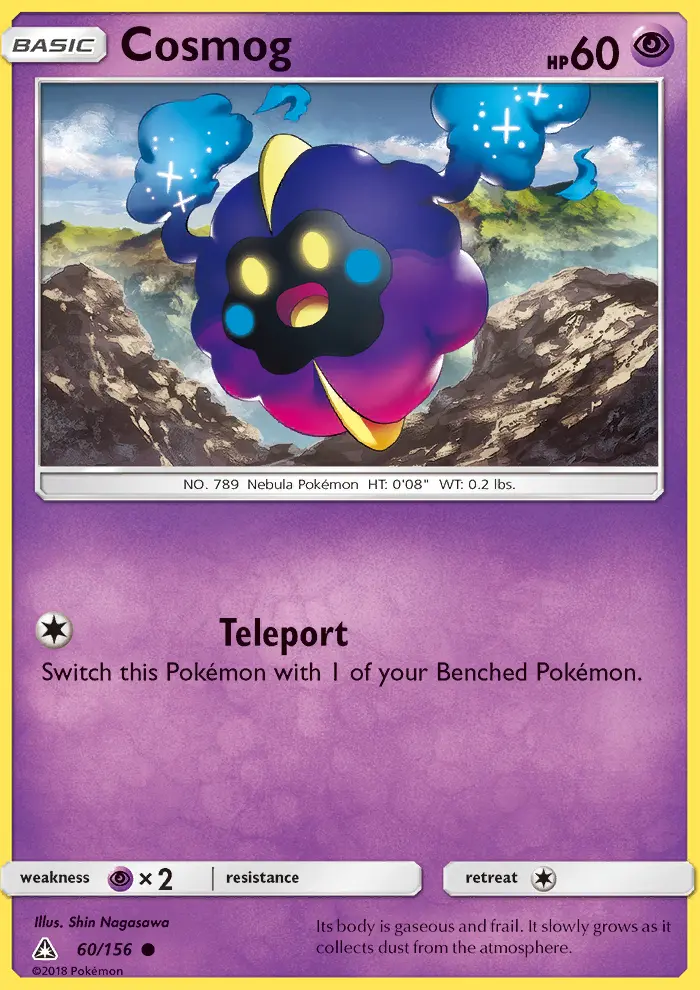
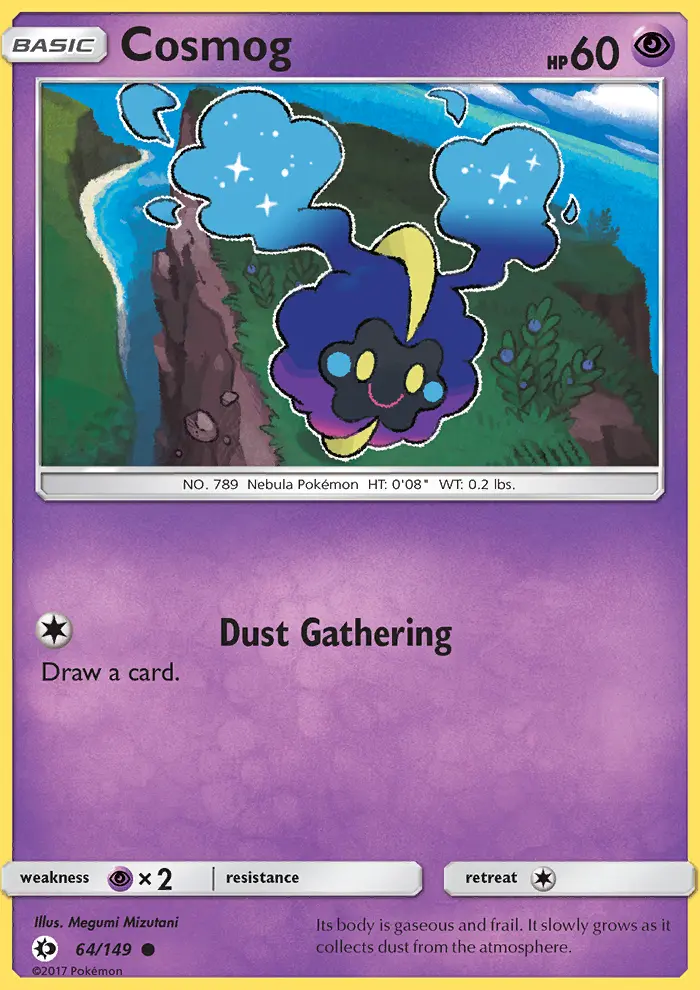
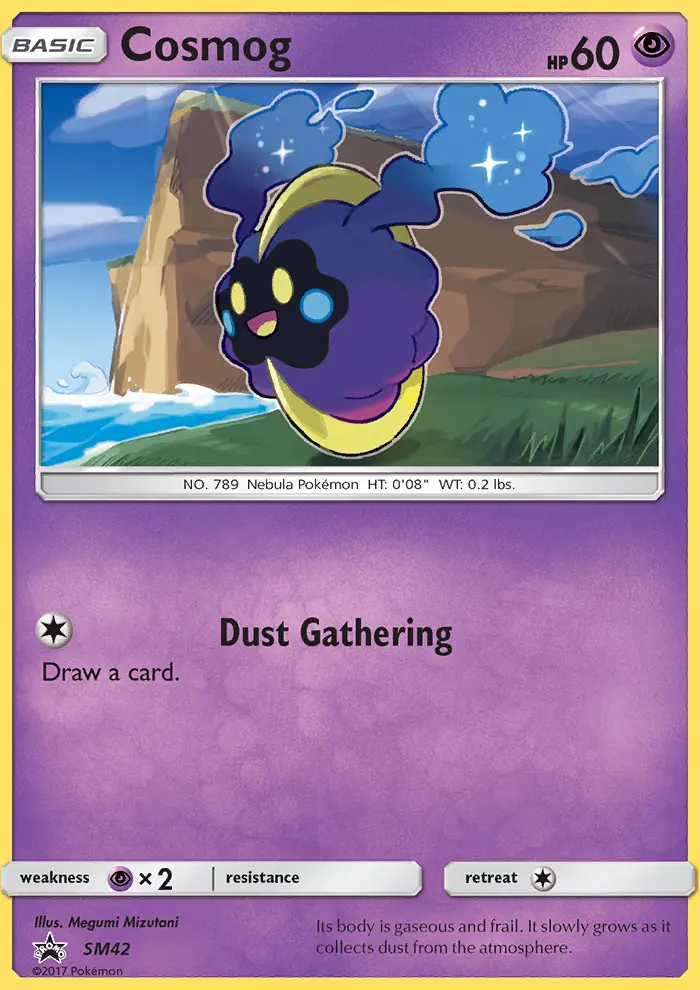
Cosmog
LegendaryGeneration VII · #0789 — Nebula Pokémon
Cosmog is built around HP first — 43 at base is the clearest signal of how it's meant to be used, more than its psychic typing alone would suggest. This tiny nebula-like creature serves as the foundational stage of one of Alola's most important legendary lineages, eventually evolving into either the powerful Solgaleo or Lunala depending on the game version. With a aggregate stat total of only 200, Cosmog represents one of the weakest legendary Pokémon in terms of raw stats, making it a fascinating study in how legendary status encompasses more than mere combat prowess. According to ancient Alolan tradition, Cosmog was known exclusively to the kings of Alola and their heirs, earning it the reverent title of "the child of the stars," though modern research continues to uncover mysteries about its true origins and nature.
Editor's Take
Cosmog has a base stat total of 200 and cannot attack meaningfully at all, which makes it the weakest legendary in the series by a considerable margin.
Base Stats
Height
0.2m
Weight
0.1kg
Category
Nebula Pokémon
Gender
Genderless
Color
blue
Shape
ball
Abilities
Ignores other Pokémon's stat modifiers for damage and accuracy calculation.

Cosmog Biology & Physical Characteristics
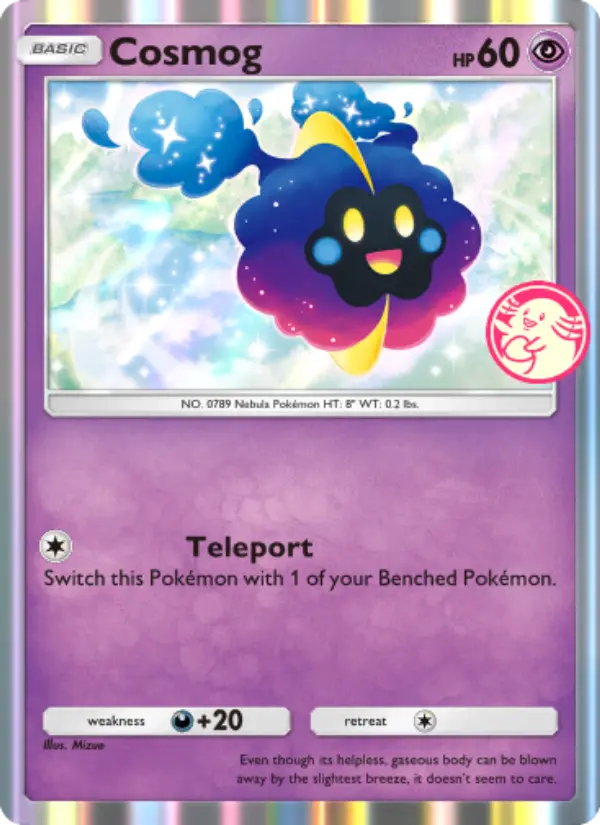
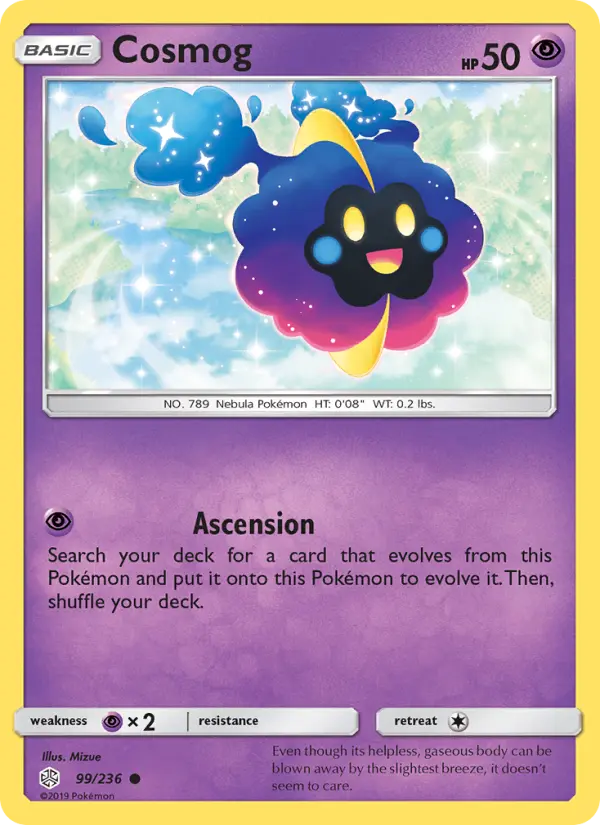
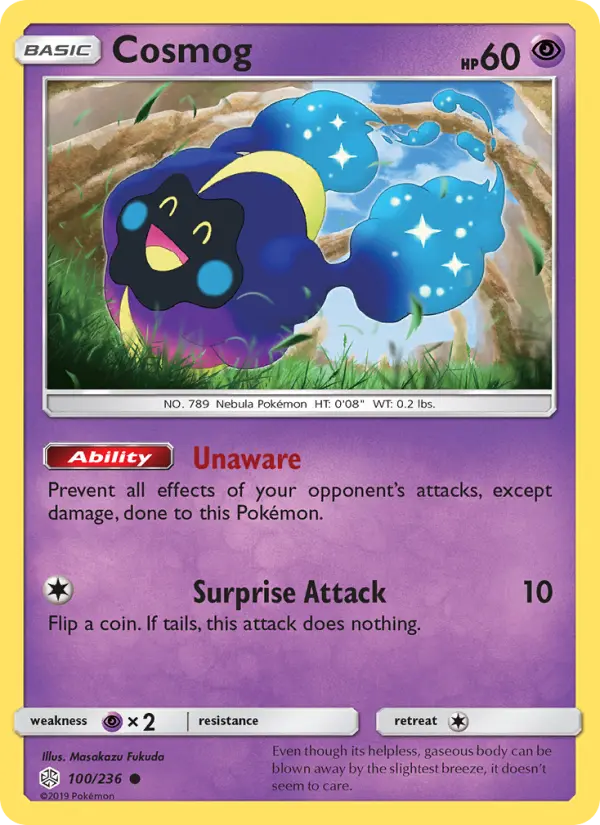
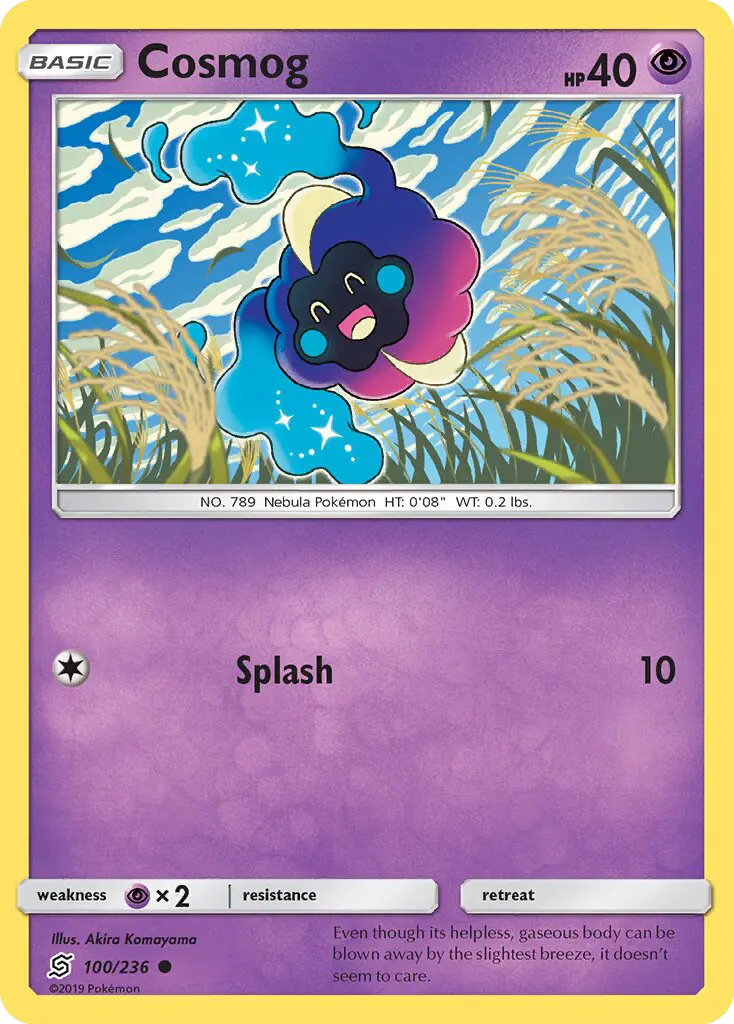
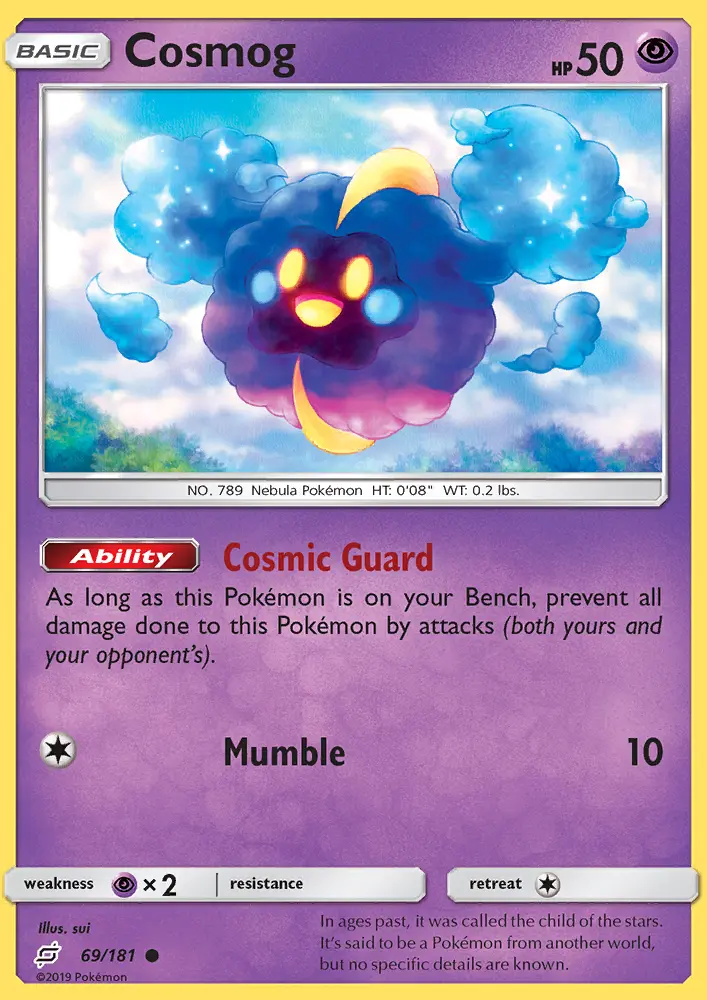
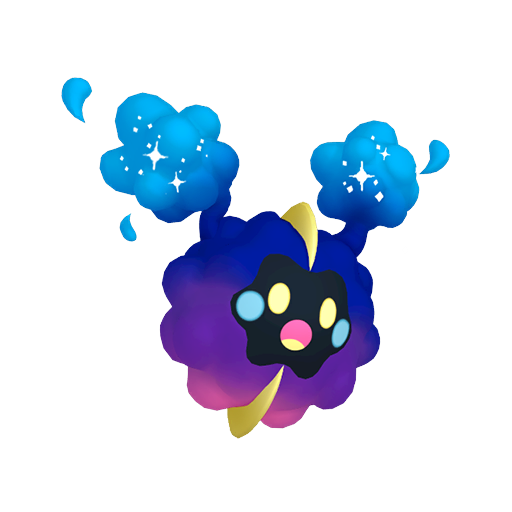
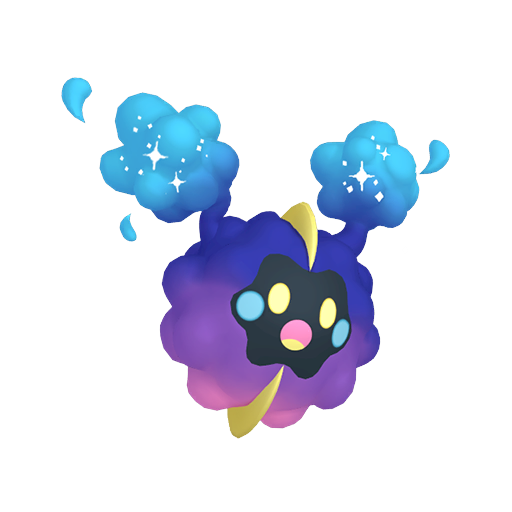
Cosmog's most distinctive biological feature is its gaseous, nebula-like body composed of ethereal gases that range in color from violet to light blue, creating an appearance reminiscent of a miniature cosmic cloud. At the center of its form lies a perfectly black void both on its front and back, with the front containing its adorable face featuring beady yellow eyes, circular blue cheeks, and a diminutive mouth, while the back displays only a single blue dot. Twin golden half-circlets divide its body horizontally, separating the upper and lower halves with precise symmetry, and two wispy, starry extensions serve as its arms, giving it an almost weightless appearance. The creature's extreme lightness—weighing only 0.1 kilograms and standing just 0.2 meters tall—makes it one of the lightest Pokémon in existence, with its frail gaseous composition so delicate that even a gentle breeze can scatter it. Despite this fragility, Cosmog possesses remarkable psychic abilities, including the capacity to teleport itself and nearby companions to safety, and under extreme stress, it can apparently open Ultra Wormholes, suggesting an interdimensional connection that researchers continue to investigate. Its growth process involves slowly accumulating atmospheric dust particles, a gradual accumulation that eventually provides the foundation for its eventual evolution into a more substantial form.
Pokedex Numbers
Training
Breeding
Cosmog Breeding, Gender Ratio & Egg Groups
Cosmog belongs to the Undiscovered egg group, classified as genderless with no capacity for conventional breeding through Pokémon Daycare centers. This reproductive restriction reflects its legendary and presumably unique nature within the Pokémon world, similar to other mythical and some legendary creatures that exist in limited quantities. The species possesses no gender ratio whatsoever, marked as entirely gender unknown across all official Pokédex databases and game data, emphasizing its non-biological or otherworldly origin. Rather than reproducing through standard breeding mechanisms, Cosmog perpetuates its lineage through the games' narrative structures, typically available as a unique encounter tied to the main storyline rather than through conventional breeding methods that players might employ with standard Pokémon species. This restriction does not prevent players from using Cosmog competitively or retaining it after completing the game, as it can be caught and trained like any other Pokémon despite its breeding limitations. The inability to breed Cosmog ensures that each individual encountered represents a singular, irreplaceable entity, heightening the sense of its legendary status and making each player's Cosmog a genuinely unique addition to their Pokédex rather than a mass-produced variant of a common species.
Sprites




TMs & HMs
tm04
lets go pikachu lets go eevee
tm30
yellow
tm30
red green japan
tm30
red blue
tm30
blue japan
Cosmog's Evolution Chain


Cosmog Evolution, Mega Evolution & Special Forms
Cosmog embarks on one of the most dramatic transformation sequences in Pokémon evolution, progressing through a three-stage evolution line that fundamentally reshapes its form and power. At level 43, Cosmog evolves into Cosmoem, a more solid yet still mysterious form that serves as a transitional state between the delicate nebula Pokémon and its final legendary form. The crucial final evolution occurs at level 53, where Cosmoem transforms into either Solgaleo or Lunala depending entirely on the game version in which the evolution takes place. In Pokémon Sun, Ultra Sun, Sword, and Scarlet, Cosmoem becomes Solgaleo, a Psychic and Steel-type legendary with a majestic lion-like appearance and significantly boosted offensive capabilities, while in Pokémon Moon, Ultra Moon, Shield, and Violet, it evolves into Lunala, a Psychic and Ghost-type with a ethereal bat-winged form emphasizing special attack and speed. This branching evolution reflects the dual nature of Alola's legendary guardians and demonstrates how Cosmog's role extends far beyond being a mere starter legendary, instead serving as a crucial narrative and mechanical element connecting the games' central legendary Pokémon. The evolution line features a remarkable stat growth trajectory, with Cosmog's humble base stat total of 200 expanding dramatically as it matures, allowing players to experience genuine progression from a vulnerable creature to a world-threatening force.
Where to Find
Lake of the Sunne
alola
Lake of the Moone
alola
Cosmog Behaviour and Natural Habitat
Cosmog exhibits a carefree and curious nature that stands in stark contrast to its physical vulnerability. According to Pokédex entries and field observations, it shows no inherent fear of people or Pokémon, readily forming bonds with those who show it kindness and consideration—a personality that often inadvertently places it in dangerous situations. The Pokédex notes that despite its helpless gaseous body being easily blown away by the slightest breeze, Cosmog doesn't seem to care, displaying a remarkable nonchalance about its precarious existence. When circumstances become genuinely threatening, however, Cosmog demonstrates acute self-preservation instincts, warping away to safe locations through its innate teleportation abilities. Its extreme rarity and historical isolation to Alola's royal families meant that general knowledge of Cosmog was extremely limited until recent decades, with most of the population unfamiliar with this legendary creature. The Pokédex suggests that Cosmog may originate from another world entirely, a hypothesis supported by its unusual physiology and the mysterious nature of its power to open interdimensional rifts, indicating it might belong to an entirely different universe or dimension than the one inhabited by most other Pokémon.
Pokedex Entries
Its body is gaseous and frail. It slowly grows as it collects dust from the atmosphere.
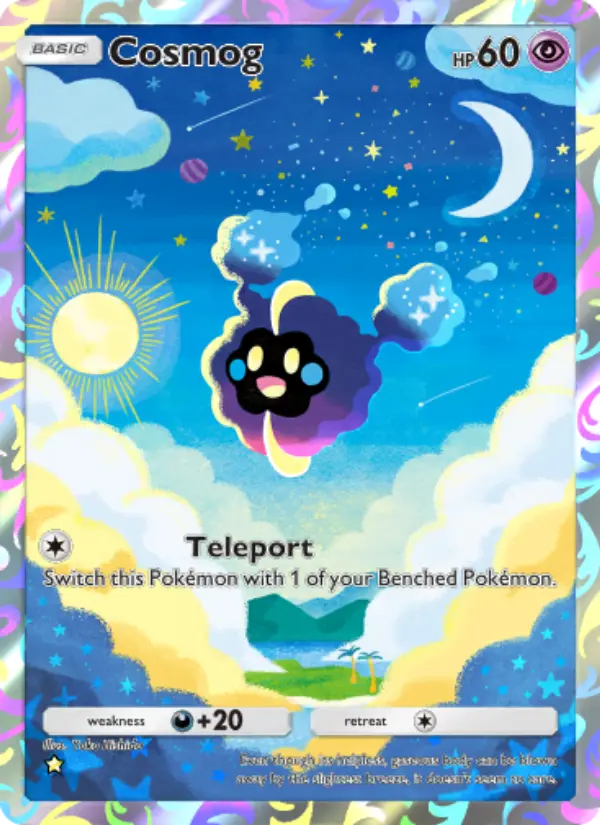
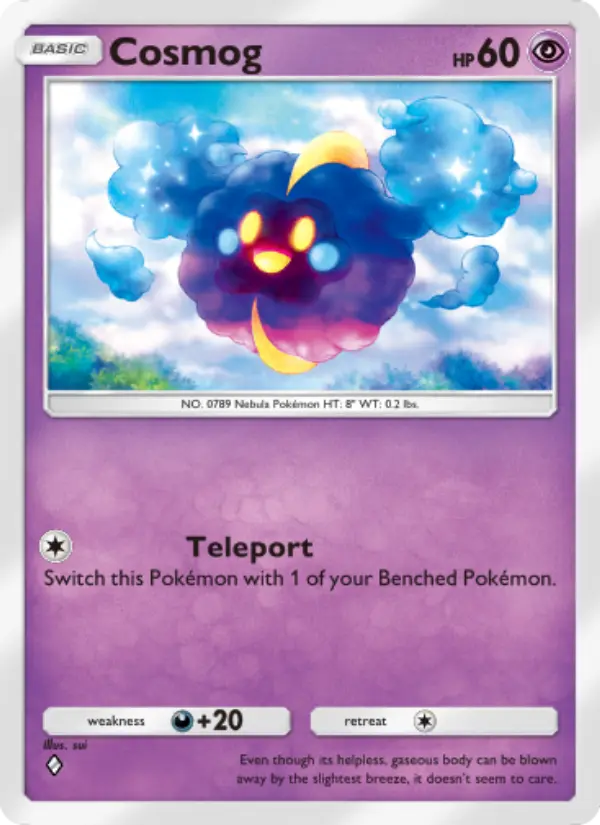
Even though its helpless, gaseous body can be blown away by the slightest breeze, it doesn’t seem to care.
In ages past, it was called the child of the stars. It’s said to be a Pokémon from another world, but no specific details are known.
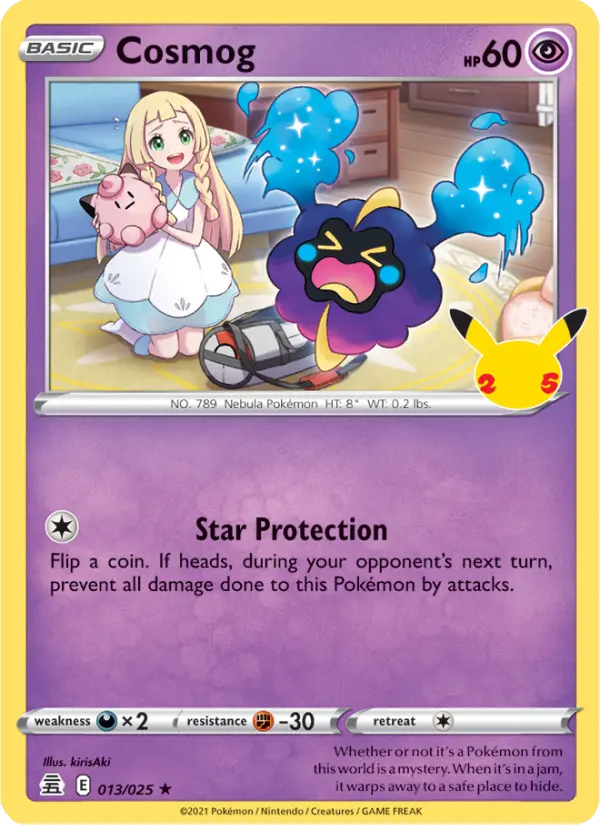
Whether or not it’s a Pokémon from this world is a mystery. When it’s in a jam, it warps away to a safe place to hide.
This Pokémon came from another universe. Its gaseous body is so light that even a gentle breeze can blow it away.
Cosmog is very curious but not very cautious, often placing itself in danger. If things start to look dicey, it teleports away.
Cosmog Name Origin & Design Inspiration
Cosmog's name can be traced to the Greek word "cosmos," meaning universe or order, combined with the suffix "-og" that evokes both the soft, cutesy sounds characteristic of baby Pokémon and an ethereal quality befitting its nebulous nature. Its Japanese name, コスモッグ (Kosmoggu), maintains this cosmic etymology while adapting it to Japanese phonetics, with the doubled consonant emphasizing its diminutive, adorable nature. The genus designation "Nebula Pokémon" perfectly encapsulates Cosmog's visual design, which unmistakably evokes a miniature nebula or cosmic dust cloud frozen in Pokémon form, complete with starry specks visible within its wispy appendages. The design philosophy behind Cosmog appears to draw inspiration from concepts of cosmic birth and creation, with its gaseous form suggesting primordial matter and its ability to manipulate space-time—manifested through teleportation and wormhole generation—hinting at powerful forces operating beyond conventional understanding. The golden half-circlets adorning its body may reference celestial mechanics and orbital structures, while its predominantly blue and violet coloration echoes astronomical imagery commonly associated with deep space and distant nebulae. The deliberate contrast between Cosmog's childlike appearance and helpless nature against its legendary and cosmic significance creates a thematic duality that permeates its entire design, suggesting that true power often manifests in unexpected and unassuming forms.
Learnable Moves
Cosmog Competitive Battle Guide
Cosmog's competitive viability is severely limited by its abysmal aggregate stat total of 200, with particularly dire offensive and defensive statistics that render it virtually useless in organized play. Its Attack and Special Attack both sit at a pitiful 29, while its Defense and Special Defense manage only 31 each, creating a creature that lacks both offensive punch and defensive resilience regardless of which attacking strategy an opponent employs. Even its Speed stat of 37 fails to provide the quick-strike advantage that might compensate for its offensive weakness, ensuring that Cosmog will consistently move after faster threats without sufficient offensive power to eliminate them. The species' saving grace lies in its ability Unaware, which ignores opposing Pokémon's stat modifiers when calculating damage and accuracy, potentially allowing it to wall setup sweepers that have accumulated stat boosts through various moves and abilities. However, even this defensive utility cannot overcome the reality that Cosmog must eventually evolve to become a remotely viable competitive choice, making it purely a stepping stone toward Cosmoem and ultimately Solgaleo or Lunala rather than a stand-alone threat. Competitive players universally proceed directly to Cosmog's evolved forms, where stat distributions become genuinely threatening and the creature can fulfill meaningful roles in team compositions.
Commonly Asked Questions About Cosmog
What type is Cosmog?
Cosmog is a psychic type Pokemon.
What does Cosmog evolve into?
Cosmog evolves into cosmoem, then into solgaleo, then into lunala.
What are Cosmog's weaknesses?
Cosmog is weak to bug, ghost and dark type moves.
Does Cosmog evolve by trading?
No — Cosmog evolves entirely through leveling up, with no trade required at any stage.
Where can I find Cosmog?
Cosmog can be found in lake of the sunne (alola) and lake of the moone (alola).
Cosmog Cultural Impact & Franchise History
Cosmog achieved significant cultural prominence through its central role in the Pokémon animated series, particularly within Pokémon the Series: Sun & Moon, where a specific Cosmog named Nebby became integral to the narrative arc and Ash's journey through Alola. This anime exposure introduced Cosmog to mainstream audiences and contributed substantially to its recognition among casual Pokémon fans who might not engage deeply with competitive play or extensive Pokédex research. The character Nebby and its relationship with various human characters demonstrated Cosmog's endearing personality traits, showing viewers how its curious and fearless nature could create compelling storytelling despite its limited combat abilities. The species' connection to Alola's legendary guardians and its mysterious extraplanar origins have spawned extensive fan theories and discussions within the Pokémon community, with dedicated fans attempting to decode the creatures' origins and ultimate significance within the broader Pokémon lore. Cosmog's design has inspired considerable fan art, merchandise, and creative content celebrating its ethereal, nebula-like aesthetic, with many fans expressing affection for the creature despite or perhaps because of its mechanical weakness in gameplay. The Pokémon's role as a foundational element in one of Generation VII's most significant legendary storylines has cemented its place in Pokémon history as a creature whose importance transcends its statistical limitations.
Where to Find Cosmog in Every Pokémon Game
Cosmog's availability varies significantly across different Pokémon game generations and versions, though it consistently remains a story-mandatory encounter rather than something found randomly in the wild. In Pokémon Sun and Moon, players receive a Cosmog as part of the main narrative progression, guaranteed to obtain one during their journey through Alola's islands, making it accessible to every player who completes the game. Similarly, in Pokémon Ultra Sun and Ultra Moon, Cosmog appears through story events, ensuring its availability to all trainers experiencing those versions' campaigns. In later generations like Pokémon Sword and Shield, Cosmog appears in the Crown Tundra DLC area, while in Pokémon Scarlet and Violet, it becomes available as a story-relevant encounter. The creature's genderless classification and Undiscovered egg group status prevent breeding, meaning players cannot multiply their Cosmog through conventional methods and must restart or trade for additional copies. Pokemon GO eventually introduced Cosmog into the mobile platform, allowing trainers to encounter and obtain this legendary creature through the augmented reality experience, democratizing access to a species previously exclusive to mainline console games. Despite its legendary status, Cosmog's guaranteed availability during story campaigns and eventual inclusion in most subsequent games demonstrates Game Freak's intention to provide players with consistent access to this foundational creature in the Solgaleo and Lunala evolution lines.