Dottler
Generation VIII · #0825 — Radome Pokémon
Dottler is a Bug/Psychic-type Pokémon introduced in Generation VIII, representing the intermediate stage of evolution between Blipbug and Orbeetle. As the Radome Pokémon, Dottler is designated as National Pokédex #825 and stands just 0.4 meters tall, weighing a modest 19.5 kilograms. Despite its diminutive size and seemingly inert nature, Dottler undergoes a profound transformation during its developmental stage, awakening latent psychic abilities that will define its final evolution. The Pokédex entries emphasize that this creature barely moves yet remains alive, having entered a cocoon-like state within its protective shell where it exists without sustenance, instead channeling that energy into developing its psychic powers. This transformation represents one of the most fascinating metamorphoses in the Galar region's ecosystem, as Dottler represents a bridge between the actively mobile Blipbug and the powerfully telepathic Orbeetle.
Editor's Take
Dottler is a cocoon stage with genuinely usable defensive stats, and Orbeetle's Gigantamax form later made the whole line unexpectedly relevant.
Base Stats
Height
0.4m
Weight
19.5kg
Category
Radome Pokémon
Gender
Male 50% / Female 50%
Color
yellow
Shape
armor
Abilities
Strengthens bug moves to inflict 1.5× damage at 1/3 max HP or less.
Increases moves' accuracy to 1.3×.
Protects against friendly Pokémon's damaging moves.
Dottler Biology & Physical Characteristics
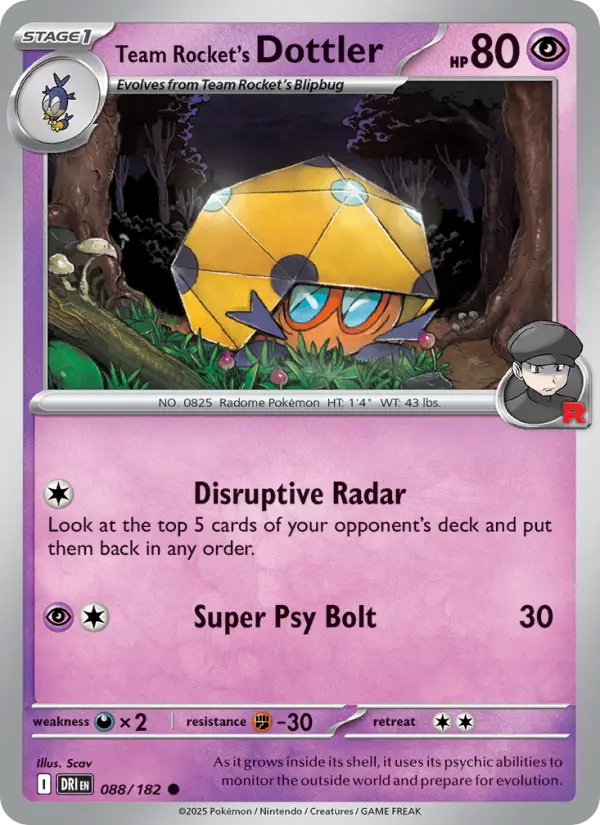
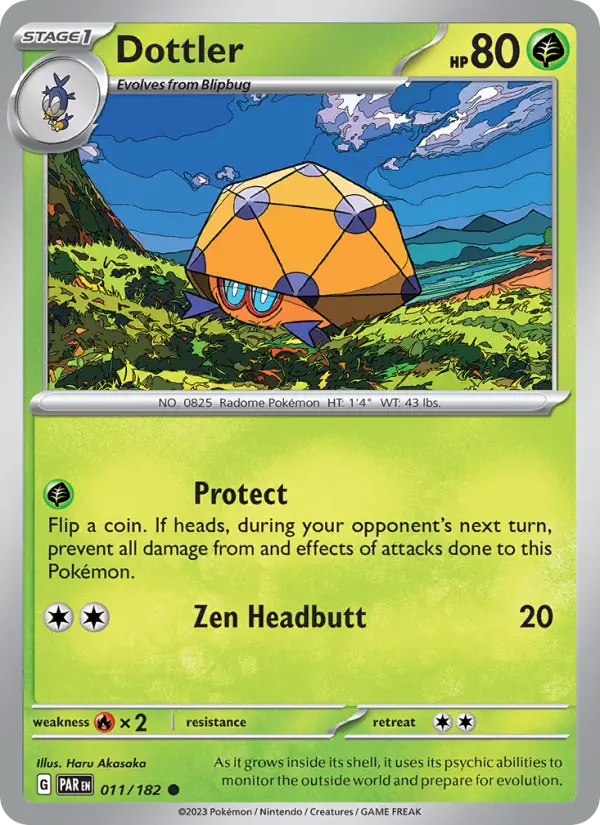
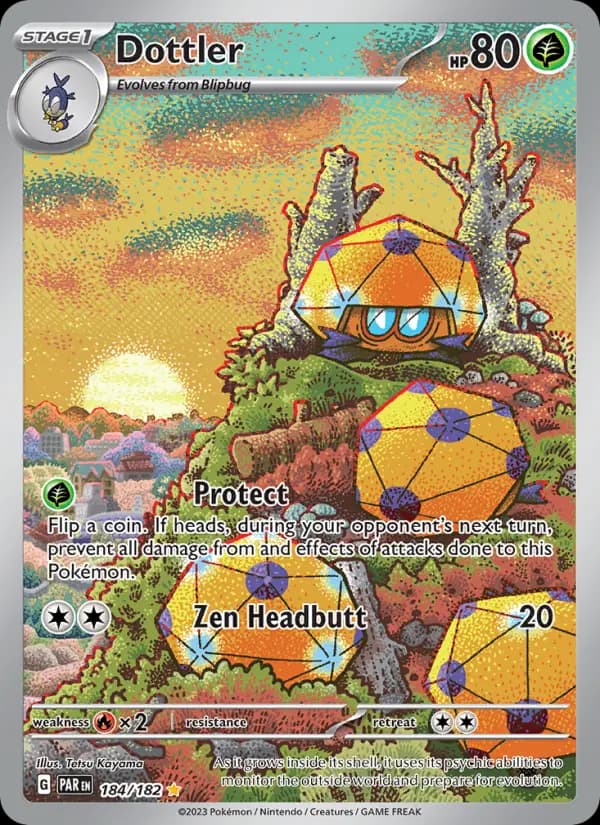
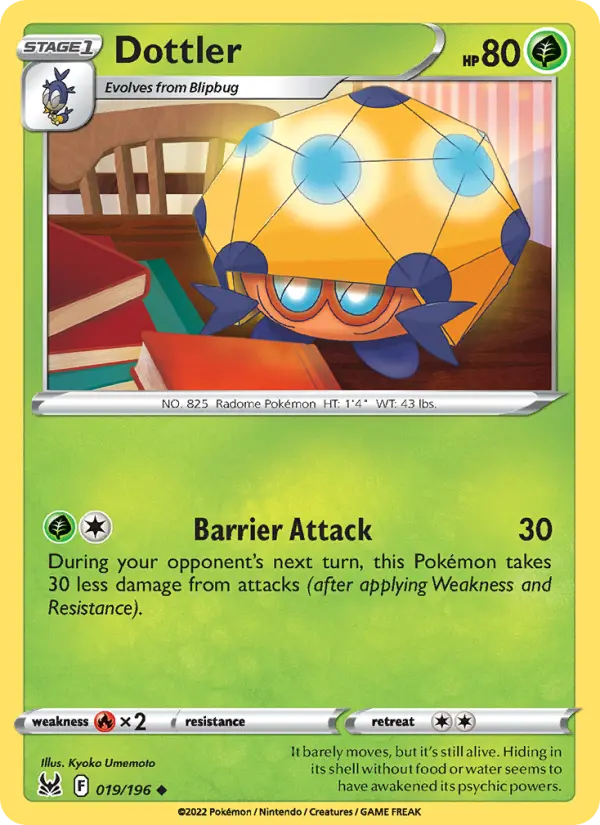
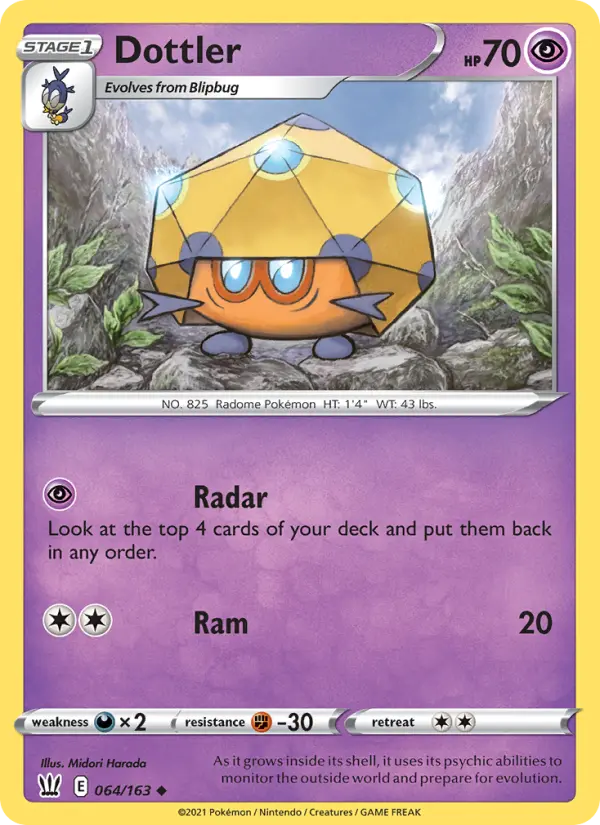
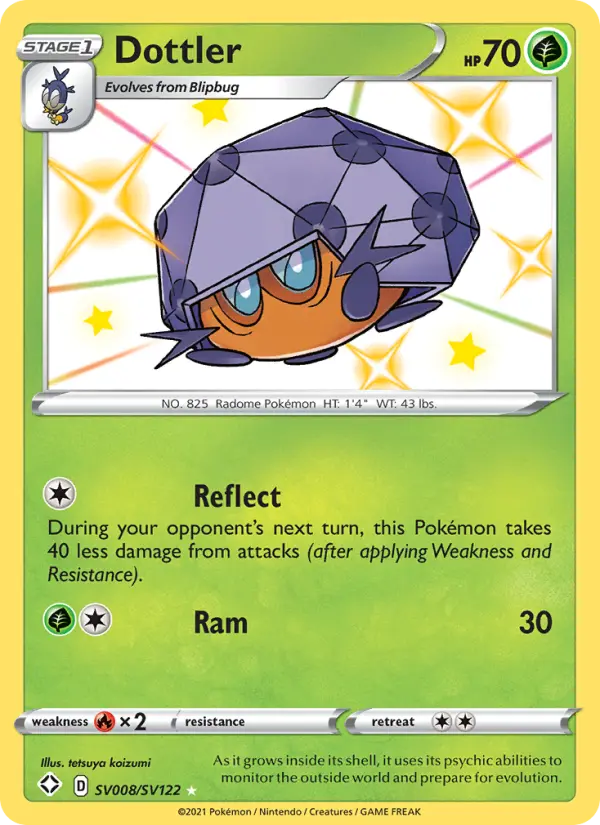
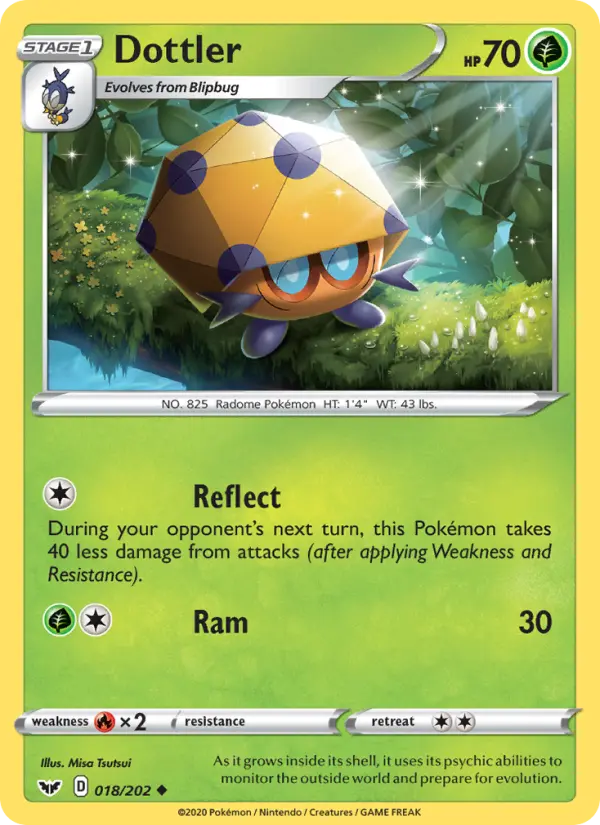
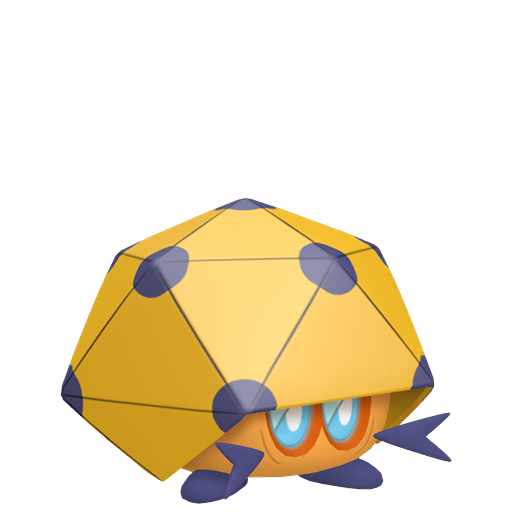
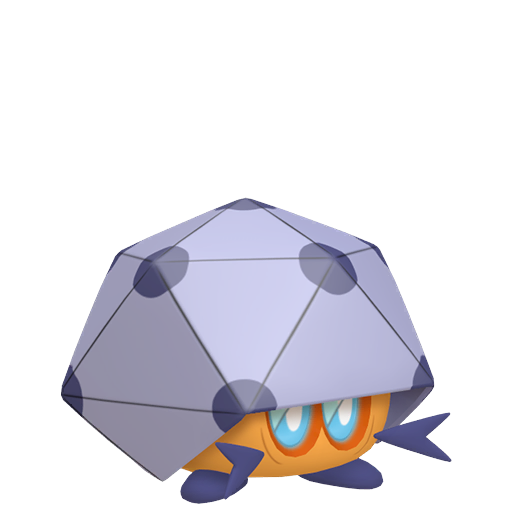
Dottler is an insectoid Pokémon with a distinctly geometric appearance that sets it apart from its pre-evolved form. Its body is largely orange and blob-like, but this organic form is almost entirely concealed beneath a striking geometric shell composed of yellow triangular faces arranged to resemble a gyroelongated pentagonal pyramid. The shell's vertices are marked with brilliant blue circles that constantly flash in sequence from top to bottom, creating a mesmerizing light display that may serve both communicative and sensory functions. Only Dottler's face and underside remain visible, revealing cyan, crystalline beady eyes similar to Blipbug's, a pair of distinctive blue feeler-like antennae arranged in a V-shape on each side of its face, and four stubby blue feet that barely support its weight. The shell itself is remarkably heavy and dense, effectively trapping Dottler within its confines. This isolation is extreme—the shell only permits tiny breathing holes and prevents Dottler from consuming any food or water, pushing the Pokémon into a state of dormancy reminiscent of insect pupation. Within this protective chamber, Dottler's body undergoes radical changes, preparing for its eventual emergence as Orbeetle.
Pokedex Numbers
Training
Breeding
Dottler Breeding, Gender Ratio & Egg Groups
Dottler has one of the simplest gender ratios in the game — a flat 50/50, presenting no genetic predisposition toward either sex and reflecting the species' reproductive equality. As a member of the Bug egg group, Dottler can breed with other Bug-type Pokémon and certain compatible species, potentially passing on its genetic material to produce Blipbug offspring that will themselves eventually develop into Dottler and Orbeetle. The breeding process for Dottler follows standard Pokémon reproduction mechanics, with eggs requiring 15 cycles to hatch, translating to approximately 3,599 to 3,855 steps of trainer travel before revealing a newborn Blipbug. The base happiness value of 50 indicates that Dottler has neutral starting affection toward newly obtained specimens, requiring effort and positive interaction to build stronger bonds with trainers. Egg moves available to Dottler through breeding include valuable techniques such as Infestation, Recover, Sticky Web, and Supersonic, allowing breeders to create Dottler with enhanced movepool options beyond what the species naturally learns through leveling. These bred moves can provide significant competitive advantages, particularly Sticky Web for speed control and Recover for sustained survivability, making breeding programs potentially worthwhile for competitive-minded trainers seeking optimized Dottler specimens.
Sprites




TMs & HMs
tm03
x y
tm03
black 2 white 2
tm03
black white
tm03
sun moon
tm03
lets go pikachu lets go eevee
tm03
ultra sun ultra moon
tm03
omega ruby alpha sapphire
tm04
emerald
tm04
firered leafgreen
tm04
ruby sapphire
tm04
diamond pearl
tm04
xd
tm04
heartgold soulsilver
tm04
black white
tm04
colosseum
tm04
platinum
tm04
sun moon
tm04
ultra sun ultra moon
tm04
x y
tm04
omega ruby alpha sapphire
+342 more TMs/HMs
Dottler's Evolution Chain


Dottler Evolution, Mega Evolution & Special Forms
Dottler occupies a critical position in the Blipbug evolutionary line, evolving from Blipbug at level 10 and subsequently evolving into Orbeetle at level 30. When Blipbug reaches level 10, it undergoes its first transformation, developing the characteristic geometric shell and gaining the Psychic-type alongside its original Bug-type, marking a significant shift in its elemental identity. This transition represents more than a simple growth phase; it reflects the Pokémon's entry into its chrysalis stage, where the active, mobile lifestyle of Blipbug gives way to the contemplative, psychically-attuned existence of Dottler. The evolution into Orbeetle at level 30 completes this metamorphosis, with Dottler's shell transforming into the hexagonal carapace of its final form while its psychic capabilities reach full maturation. The 20-level span between Dottler and Orbeetle allows trainers to experience the full scope of this Pokémon's developmental arc, witnessing the awakening of psychic power before its culmination in Orbeetle's heightened mental faculties. This evolution pattern mirrors real-world insect metamorphosis, providing a naturalistic framework for understanding the profound changes occurring within the Pokémon's biology.
Where to Find
Location data not available for this Pokémon in the database.
Dottler Behaviour and Natural Habitat
Dottler exhibits minimal behavioral activity due to its shell-bound existence, spending most of its time in a dormant state while undergoing internal transformation. The Pokédex reveals that despite barely moving, Dottler remains alive through some form of metabolic adaptation, having entered a hibernation-like phase where it requires neither food nor water. During this quiescent period, Dottler uses its developing psychic powers to monitor its external environment, effectively seeing without moving through telepathic perception and mental observation of the surrounding world. This ability to sense danger and environmental conditions while remaining safely ensconced within its shell represents a crucial survival mechanism, allowing Dottler to gather intelligence about potential threats and optimal evolution timing without exposing itself. Dottler typically inhabits locations where it can remain undisturbed during its transformative phase, often found in sheltered areas of the Galar region and on the Isle of Armor. These Pokémon may cluster in protected ecological niches where the environmental conditions remain stable enough for their extended metamorphosis. The transition period within the shell is essential for awakening and developing the psychic powers that will become central to Orbeetle's identity.
Pokedex Entries
It barely moves, but it’s still alive. Hiding in its shell without food or water seems to have awakened its psychic powers.
As it grows inside its shell, it uses its psychic abilities to monitor the outside world and prepare for evolution.
Dottler Name Origin & Design Inspiration
Dottler's name can be traced to 'dot,' referencing the distinctive blue circles adorning its shell's vertices, combined with a suffix suggesting its intermediate evolutionary status. The Japanese name 'Redomushi' combines 'redome' (radome), a radar dome structure used in meteorology and communications, with 'mushi' meaning insect. This terminology perfectly captures Dottler's nature as a living radome—a creature using its geometric shell as a sensory apparatus to detect and interpret information from its surroundings through psychic means rather than conventional radar. The design itself is heavily inspired by both crystalline geometry and the pupation stages of real insects, particularly the hard chrysalises formed by certain butterfly and moth species. The triangular faces covering Dottler's shell evoke both technological precision and natural mineral formations, suggesting that the shell itself may be composed of hardened biological material similar to chitin but refined into geometric perfection. The constant flashing blue circles create a visual metaphor for active data transmission and mental processing, emphasizing that despite physical immobility, Dottler's mind remains actively engaged in environmental scanning and psychic development. This design philosophy elegantly bridges the organic and technological, making Dottler instantly recognizable as a Pokémon caught between states of being.
Learnable Moves
Dottler can learn 40 moves:
Move | Type | Cat. | Power | Acc. | PP |
|---|---|---|---|---|---|
| ally switch | psychic | Status | — | — | 15 |
| attract | normal | Status | — | 100 | 15 |
| body press | fighting | Physical | 80 | 100 | 10 |
| bug buzz | bug | Special | 90 | 100 | 10 |
| calm mind | psychic | Status | — | — | 20 |
| confusion | psychic | Special | 50 | 100 | 25 |
| endure | normal | Status | — | — | 10 |
| energy ball | grass | Special | 90 | 100 | 10 |
| expanding force | psychic | Special | 80 | 100 | 10 |
| facade | normal | Physical | 70 | 100 | 20 |
| future sight | psychic | Special | 120 | 100 | 10 |
| guard swap | psychic | Status | — | — | 10 |
| helping hand | normal | Status | — | — | 20 |
| imprison | psychic | Status | — | — | 10 |
| iron defense | steel | Status | — | — | 15 |
| leech life | bug | Physical | 80 | 100 | 10 |
| light screen | psychic | Status | — | — | 30 |
| magic room | psychic | Status | — | — | 10 |
| payback | dark | Physical | 50 | 100 | 10 |
| power swap | psychic | Status | — | — | 10 |
| protect | normal | Status | — | — | 10 |
| psychic | psychic | Special | 90 | 100 | 10 |
| psychic terrain | psychic | Status | — | — | 10 |
| psyshock | psychic | Special | 80 | 100 | 10 |
| reflect | psychic | Status | — | — | 20 |
| rest | psychic | Status | — | — | 5 |
| round | normal | Special | 60 | 100 | 15 |
| safeguard | normal | Status | — | — | 25 |
| shadow ball | ghost | Special | 80 | 100 | 15 |
| skill swap | psychic | Status | — | — | 10 |
| sleep talk | normal | Status | — | — | 10 |
| snore | normal | Special | 50 | 100 | 15 |
| solar beam | grass | Special | 120 | 100 | 10 |
| stored power | psychic | Special | 20 | 100 | 10 |
| struggle bug | bug | Special | 50 | 100 | 20 |
| substitute | normal | Status | — | — | 10 |
| trick | psychic | Status | — | 100 | 10 |
| trick room | psychic | Status | — | — | 5 |
| wonder room | psychic | Status | — | — | 10 |
| zen headbutt | psychic | Physical | 80 | 90 | 15 |
Dottler Competitive Battle Guide
Dottler occupies a challenging position in competitive play due to its modest combined stat total of 335, distributed heavily toward defensive capabilities rather than offensive prowess. Its special defense stands at 90, defense at 80, and hit points at 50, creating a bulky yet fragile defensive profile that requires careful strategic implementation. The offensive statistics are notably limited, with special attack at 50 and attack at 35, making Dottler poorly suited for direct damage output despite its psychic typing. However, Dottler's ability to learn supportive moves such as Light Screen, Reflect, and Confusion upon evolution provides utility-focused options that can benefit team compositions. The special defense EV yield of 2 makes Dottler a useful EV training partner for Pokémon seeking special defense boosts, though this contributes little to its personal competitive viability. Dottler's abilities—Swarm, Compound Eyes, and the hidden ability Telepathy—offer different strategic angles. Swarm boosts bug-type moves to 1.5x damage when Dottler falls below one-third health, Compound Eyes increases accuracy to 1.3x, and Telepathy provides protection from friendly Pokémon's damaging moves in double battles. Generally, Dottler functions best as a transitional Pokémon within team building, with most competitive applications favoring its fully-evolved form Orbeetle for superior stats and coverage options. Nevertheless, dedicated trainers have found niche roles for Dottler in specialized formats and lower-tier competitive environments.
Commonly Asked Questions About Dottler
What type is Dottler?
Dottler is a bug and psychic type Pokemon.
What does Dottler evolve into?
Dottler evolves into orbeetle.
What are Dottler's weaknesses?
Dottler is weak to flying, rock, bug, ghost, fire and dark type moves.
Does Dottler evolve by trading?
No — Dottler evolves entirely through leveling up, with no trade required at any stage.
Dottler Cultural Impact & Franchise History
Dottler has established itself as a recognizable and beloved member of the Generation VIII Pokédex, particularly resonating with players who appreciate insectoid Pokémon and the metamorphic themes central to the bug type. The species appeared prominently in Pokémon Sword and Shield marketing materials as part of the Galar region's new additions, and its design has been featured in trading card game releases and various merchandise lines. The geometric shell design has inspired fan art communities, with artists particularly drawn to rendering the flashing blue circles and crystalline structure in various styles and interpretations. Dottler's narrative arc—dormancy leading to spiritual awakening—has spawned philosophical discussions within the Pokémon community about the nature of growth and transformation, with some players viewing Dottler as emblematic of introspective personal development. The species has appeared in Pokémon animation, including the main series and Pokémon: Twilight Wings, introducing Dottler to broader audiences and solidifying its place in the franchise's expanding media landscape. Educational value has also emerged from Dottler's design, as its appearance naturally leads to discussions about insect pupation, metamorphosis, and the biological processes underlying seemingly static life stages, making it pedagogically interesting for younger players learning about natural science concepts.
Where to Find Dottler in Every Pokémon Game
Dottler is available primarily through the Generation VIII games Pokémon Sword and Shield, where it appears as Regional Pokédex #011 in the base Galar region and #015 in the Isle of Armor DLC area, though it does not appear in the Crown Tundra DLC. The species was not available in earlier game generations, making Sword and Shield its sole original availability source. Trainers can encounter Dottler in the wild within specific Galar locations, though the easier and more reliable method for most players involves catching Blipbug and training it to level 10 to trigger the evolutionary transformation. As a fully evolved Pokémon with a captured capture rate of 120 (equivalent to 24.9% success with a standard Poké Ball at full health), Dottler can be caught directly if encountered, though patience and appropriate Poké Balls increase capture success rates. Notably, Dottler does not appear in Pokémon Brilliant Diamond, Shining Pearl, or Legends: Arceus, limiting its availability to Sword, Shield, and the Isle of Armor expansion. However, modern Pokémon home transfer systems and subsequent generation releases may enable Dottler availability in newer titles. The relative ease of obtaining Dottler through Blipbug evolution makes it an accessible option for players seeking a psychic-type team member during their Galar adventure, providing a natural progression through the insect-focused early-game options.