Glimmora
Generation IX · #0970 — Ore Pokémon
Weighing 45 kg and standing 1.5 m, Glimmora carries its rock/poison typing into battle with a stat spread that leans hardest into Special Attack. Its distinctive dual typing grants it interesting immunities and resistances, while its abilities—Toxic Debris and the hidden ability Corrosion—provide strategic depth in competitive play. The Pokédex reveals that Glimmora's petals are composed entirely of crystallized poison energy, and intriguingly, these structures bear a striking resemblance to Tera Jewels, hinting at a profound connection to the Terastal phenomenon that defines the Paldean region.
Editor's Take
Glimmora's Toxic Debris setting Toxic Spikes when hit physically is a defensive ability that punishes the opponent for doing the obvious thing, and it made Gen 9 lead slots genuinely difficult to plan.
Base Stats
Height
1.5m
Weight
45.0kg
Category
Ore Pokémon
Gender
Male 50% / Female 50%
Color
blue
Shape
ball
Abilities
Scatters poison spikes at the feet of the opposing team when the Pokémon takes damage from physical moves.
This Pokémon can inflict poison on Poison and Steel Pokémon.

Glimmora Biology & Physical Characteristics
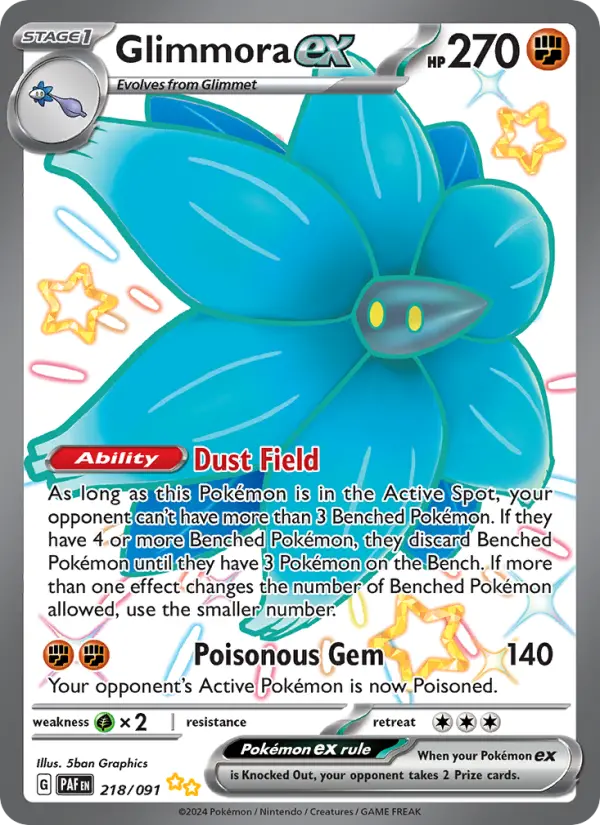
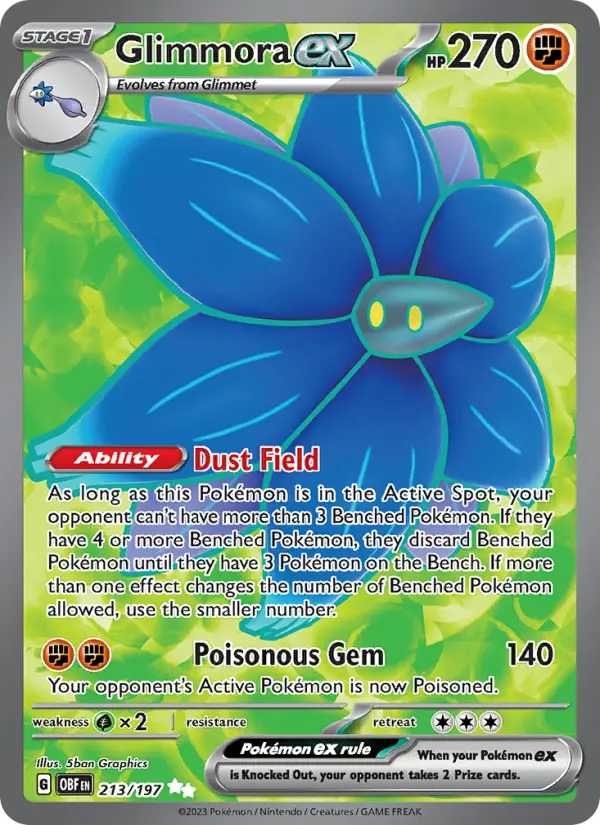
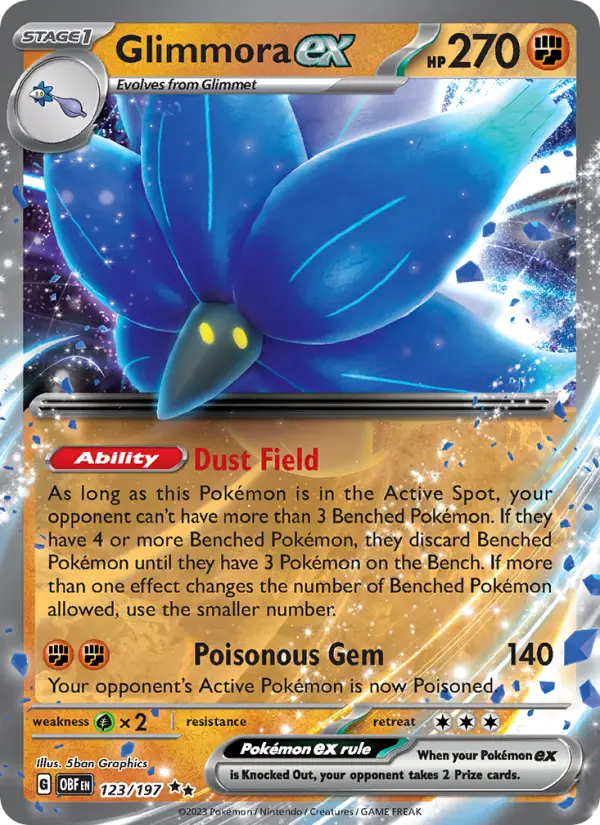
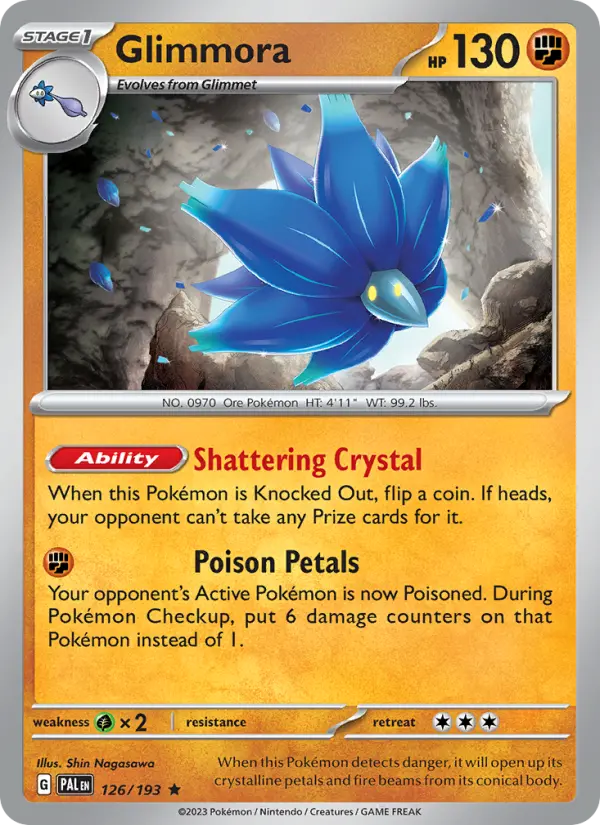
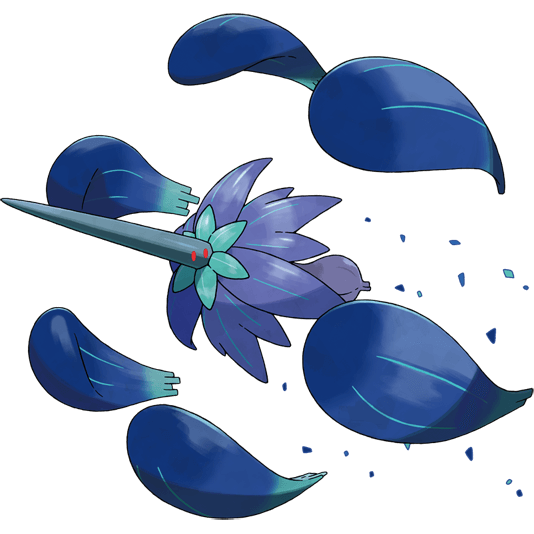
Glimmora presents a striking conical, flower-like morphology with a translucent black cone serving as its head, complete with yellow eyes that peer from within. Its body consists of meticulously layered petals constructed entirely from crystallized poison, arranged in three distinct corallas: the outermost corolla features six dark blue petals ending in light green rectangles, each traversed by two light green lines; beneath this sits four light purple petals, each marked with a single light green line; finally, the innermost corolla comprises three delicate light green petals. This extraordinary composition suggests that Glimmora's very structure is an amalgamation of poisonous crystalline formations, rendering it unique among rock-type Pokémon. The creature's ability to latch onto walls and disguise itself as a plant demonstrates its adaptive biology, allowing it to siphon energy and nutrients from its environment. When threatened, Glimmora exhibits remarkable defensive capabilities by opening its petals to expose the conical body within, from which it fires devastating beams as demonstrated in numerous Pokédex entries.
Pokedex Numbers
Training
Breeding
Glimmora Breeding, Gender Ratio & Egg Groups
Half of all Glimmora are male, half are female — no skew to plan around, allowing for equal breeding opportunities between individuals of either sex. As a member of the Mineral egg group, Glimmora breeds exclusively with other Pokémon sharing this egg classification, which includes various rock-type and steel-type species such as Magnemite, Geodude, and Carbink. The base happiness value of 50 indicates that newly caught or hatched Glimmora begin with neutral affection toward their trainers, requiring time and positive interactions to develop deeper bonds. Eggs produced from breeding Glimmora require 30 cycles to hatch, translating to approximately 7,454 to 7,710 steps in gameplay terms—a moderate incubation period reflecting the species' medium-slow growth rate. The balanced gender distribution and accessible breeding requirements make Glimmora a viable candidate for competitive breeding programs, though the species' relatively low catch rate of 25 means that obtaining initial specimens may require patience and persistence in the field.
Sprites





TMs & HMs
tm05
lets go pikachu lets go eevee
tm06
yellow
tm06
gold silver
tm06
red blue
tm06
crystal
tm06
emerald
tm06
firered leafgreen
tm06
diamond pearl
tm06
platinum
tm06
ruby sapphire
tm06
colosseum
tm06
black 2 white 2
tm06
xd
tm06
black white
tm06
heartgold soulsilver
tm06
omega ruby alpha sapphire
tm06
lets go pikachu lets go eevee
tm06
ultra sun ultra moon
tm06
sun moon
tm06
x y
+427 more TMs/HMs
Glimmora's Evolution Chain


Glimmora Evolution, Mega Evolution & Special Forms
Glimmora evolves from Glimmet at level 35, representing a significant developmental milestone in the species' life cycle. The evolution produces a notable increase in base stats across most categories, though the exact distribution maintains its special attacking specialty. Beyond standard evolution, Glimmora possesses the remarkable capability to Mega Evolve into Mega Glimmora using the Glimmoranite stone. This Mega Evolution, introduced in the Mega Dimension DLC for Pokémon Legends: Z-A, transforms Glimmora into a substantially larger form measuring 2.8 meters in height and weighing 77 kilograms. The Mega Evolution increases its base stat total to 625, with particularly noteworthy boosts to its Special Attack (reaching 150) and Speed (reaching 101), while also improving its defenses. The Mega Evolution also reshapes Glimmora's outermost petals, though the exact aesthetic changes remain partially documented in available sources. This transformation represents the pinnacle of Glimmora's combat potential, allowing it to function as a devastating special sweeper capable of overwhelming opponents with enhanced speed and special attacking power.
Where to Find
Location data not available for this Pokémon in the database.
Glimmora Behaviour and Natural Habitat
Glimmora demonstrates territorial and social behaviors, known to work cooperatively with groups of Glimmet to mount effective defense against threats. Its primary habitat encompasses Paldea's Area Zero and the mysterious Underdepths, regions rich in mineral deposits and exotic crystalline formations. The species has also been documented in Kitakami's Crystal Pool, further emphasizing its affinity for mineral-rich environments. When sensing danger, Glimmora employs an aggressive defensive strategy, opening its crystalline petals to unleash powerful beam attacks from its conical body. Its tendency to disguise itself among flora and mineral deposits suggests a degree of patience and predatory intelligence, waiting for optimal moments to strike or defend. The Pokédex entries suggest a creature deeply attuned to its surroundings, capable of detecting threats with sufficient sensitivity to warrant an immediate transformation into its offensive configuration.
Pokedex Entries
When this Pokémon detects danger, it will open up its crystalline petals and fire beams from its conical body.
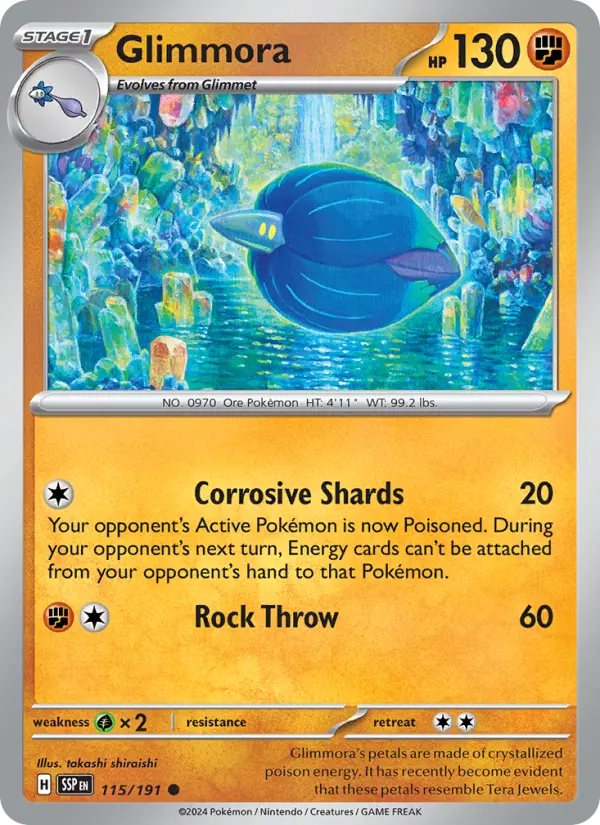
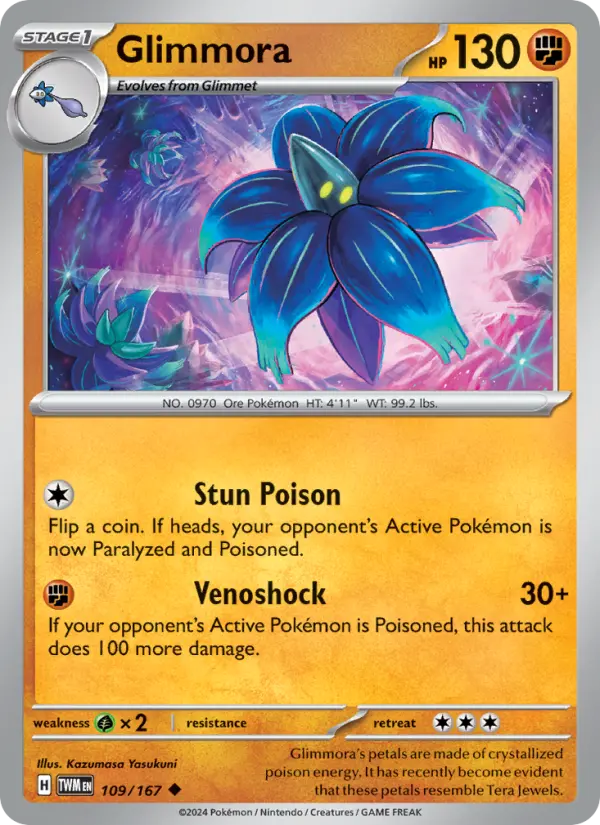
Glimmora’s petals are made of crystallized poison energy. It has recently become evident that these petals resemble Tera Jewels.
Glimmora Name Origin & Design Inspiration
Glimmora's name traces to the combination of 'glimmer,' referencing the crystalline sparkle of its petals, and 'flora,' reflecting its flower-like appearance. In Japanese, it is known as Kiraflor, combining 'kira' (meaning sparkle or glitter) with 'flora,' maintaining thematic consistency across languages. The creature's design deliberately evokes a blooming flower composed of gemstones, with the layered petals creating a naturalistic yet alien aesthetic that bridges botanical and mineralogical forms. The choice of crystallized poison energy as the material for its petals ingeniously combines the Rock and Poison typing into a singular visual narrative, with each petal color (dark blue outer petals, light purple middle petals, and light green inner petals) creating depth and visual complexity. The yellow eyes within the translucent black cone head establish a focal point that evokes both geological formations and organic life, deliberately ambiguous in a way that reflects Glimmora's own mysterious connection to the Terastal phenomenon. This design philosophy establishes Glimmora as one of Generation IX's most visually sophisticated new Pokémon.
Learnable Moves
Glimmora can learn 47 moves:
Move | Type | Cat. | Power | Acc. | PP |
|---|---|---|---|---|---|
| acid armor | poison | Status | — | — | 20 |
| acid spray | poison | Special | 40 | 100 | 20 |
| ancient power | rock | Special | 60 | 100 | 5 |
| confuse ray | ghost | Status | — | 100 | 10 |
| dazzling gleam | fairy | Special | 80 | 100 | 10 |
| earth power | ground | Special | 90 | 100 | 10 |
| endure | normal | Status | — | — | 10 |
| energy ball | grass | Special | 90 | 100 | 10 |
| facade | normal | Physical | 70 | 100 | 20 |
| flash cannon | steel | Special | 80 | 100 | 10 |
| giga impact | normal | Physical | 150 | 90 | 5 |
| gunk shot | poison | Physical | 120 | 80 | 5 |
| harden | normal | Status | — | — | 30 |
| hyper beam | normal | Special | 150 | 90 | 5 |
| iron defense | steel | Status | — | — | 15 |
| light screen | psychic | Status | — | — | 30 |
| meteor beam | rock | Special | 120 | 90 | 10 |
| mortal spin | poison | Physical | 30 | 100 | 15 |
| mud shot | ground | Special | 55 | 95 | 15 |
| power gem | rock | Special | 80 | 100 | 20 |
| protect | normal | Status | — | — | 10 |
| rain dance | water | Status | — | — | 5 |
| reflect | psychic | Status | — | — | 20 |
| rest | psychic | Status | — | — | 5 |
| rock blast | rock | Physical | 25 | 90 | 10 |
| rock polish | rock | Status | — | — | 20 |
| rock slide | rock | Physical | 75 | 90 | 10 |
| rock throw | rock | Physical | 50 | 90 | 15 |
| rock tomb | rock | Physical | 60 | 95 | 15 |
| sand tomb | ground | Physical | 35 | 85 | 15 |
| sandstorm | rock | Status | — | — | 10 |
| self destruct | normal | Physical | 200 | 100 | 5 |
| sleep talk | normal | Status | — | — | 10 |
| sludge bomb | poison | Special | 90 | 100 | 10 |
| sludge wave | poison | Special | 95 | 100 | 10 |
| smack down | rock | Physical | 50 | 100 | 15 |
| solar beam | grass | Special | 120 | 100 | 10 |
| spikes | ground | Status | — | — | 20 |
| spiky shield | grass | Status | — | — | 10 |
| stealth rock | rock | Status | — | — | 20 |
| stone edge | rock | Physical | 100 | 80 | 5 |
| substitute | normal | Status | — | — | 10 |
| sunny day | fire | Status | — | — | 5 |
| tera blast | normal | Special | 80 | 100 | 10 |
| toxic | poison | Status | — | 90 | 10 |
| toxic spikes | poison | Status | — | — | 20 |
| venoshock | poison | Special | 65 | 100 | 10 |
Glimmora Competitive Battle Guide
Glimmora's competitive viability centers primarily on its outstanding Special Attack base stat of 130, positioning it as a formidable special attacker in both casual and competitive formats. Its moderate Speed stat of 86 allows it to outpace many slower threats without requiring speed investment, though serious competitive applications may necessitate speed-boosting natures or items. The combination of defensive stats—90 Defense and 81 Special Defense—provides respectable bulk that allows Glimmora to survive priority moves and exploit its special attacking prowess. The Toxic Debris ability offers strategic value by scattering poison spikes when struck by physical moves, creating entry hazard synergy with other team members and punishing physical attackers. The hidden ability Corrosion provides an alternative strategic approach, allowing Glimmora to poison previously unpoisonable targets like Steel and Poison-type Pokémon, though this ability sees less practical application in most competitive scenarios. Glimmora's dual Rock/Poison typing grants important resistances to Flying, Grass, and Poison-type moves, while its weaknesses to Water, Ground, and Psychic-type attacks must be managed through careful team building and positioning. With access to diverse move pools and potential strategic applications through either ability, Glimmora represents a viable choice for trainers seeking specialized special attacking coverage with defensive utility.
Commonly Asked Questions About Glimmora
What type is Glimmora?
Glimmora is a rock and poison type Pokemon.
What does Glimmora evolve from?
Glimmora evolved from glimmet.
What are Glimmora's weaknesses?
Glimmora is weak to ground, steel, water and psychic type moves.
Glimmora Cultural Impact & Franchise History
As a Generation IX Pokémon introduced alongside the Scarlet and Violet games, Glimmora emerged during a period of significant franchise evolution and player engagement with the open-world Paldea region. The species gained particular cultural prominence due to its evident connection to the Terastal phenomenon, one of the generation's defining mechanics, and its presence in Area Zero—the game's central mystery location. The resemblance of Glimmora's crystalline petals to Tera Jewels sparked considerable fan discussion and theorycrafting regarding the nature of Terastallization and its origins within Paldean lore. Within the broader Pokémon community, Glimmora has established itself as a favorite among players who appreciate sophisticated design aesthetics that blend multiple visual themes—geological, botanical, and mystical—into a cohesive whole. Fan artists have been particularly drawn to Glimmora's crystalline composition and elaborate petal structure, producing numerous high-quality artworks exploring the Pokémon's visual appeal. Its role in competitive play, while not reaching the absolute highest tiers, has secured it a respectable position in the community's strategic discourse, with dedicated players discovering novel applications for its unique ability combinations.
Where to Find Glimmora in Every Pokémon Game
Glimmora can be encountered in the Paldea region across multiple locations within Pokémon Scarlet and Violet, with its distribution localized to areas containing mineral-rich environments and geological formations characteristic of Area Zero and the Underdepths. The species also appears in the Kitakami region as part of The Teal Mask DLC expansion, specifically in mineral-dense areas such as Crystal Pool. In Pokémon Legends: Z-A, Glimmora represents a native species with expanded availability across the game's reimagined Kalos region, where it receives its own Mega Evolution through the Mega Dimension mechanic. The capture rate of 25 indicates moderate difficulty in capturing wild Glimmora, suggesting that trainers should prepare appropriately with status-inducing moves and weakening strategies. Eggs containing Glimmora can be obtained through breeding with compatible Mineral group Pokémon, offering an alternative acquisition method for players seeking specific natures, abilities, or IVs for competitive purposes. The species' presence across multiple games and regions ensures that dedicated trainers can reliably obtain Glimmora specimens suited to their specific gameplay or competitive objectives, though the moderate catch rate and specialized habitat requirements mean that obtaining ideal specimens may require sustained effort and patience.