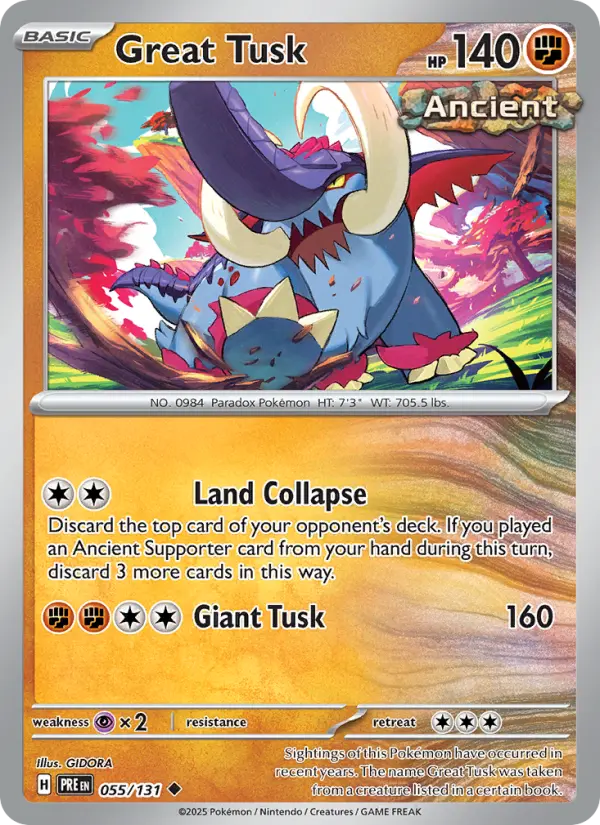
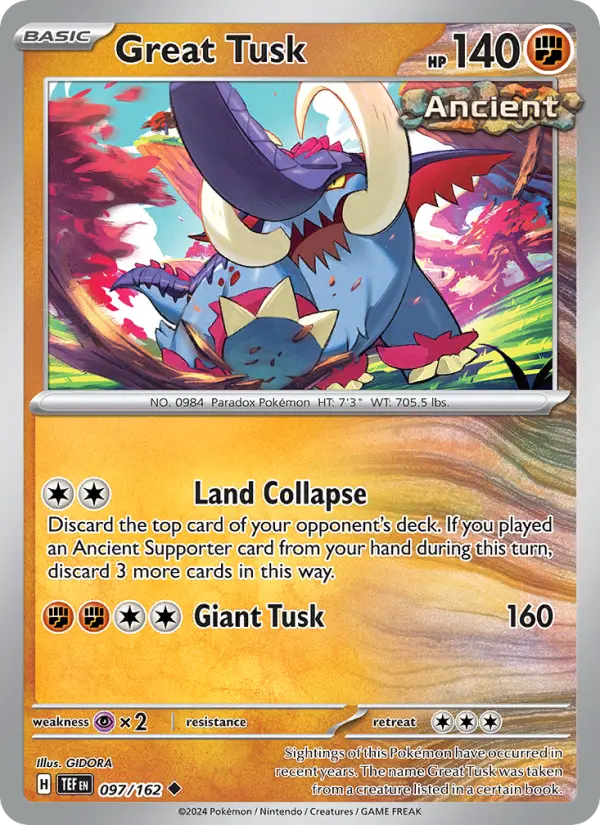
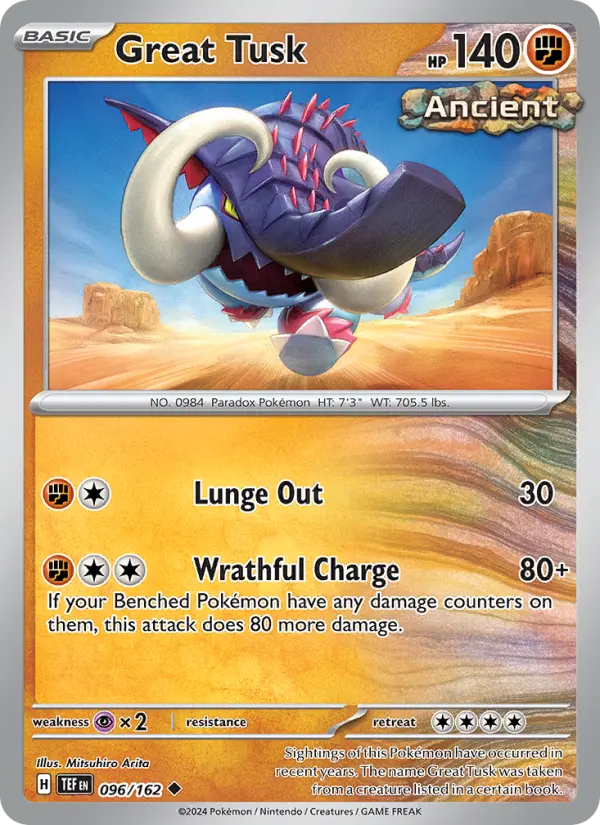
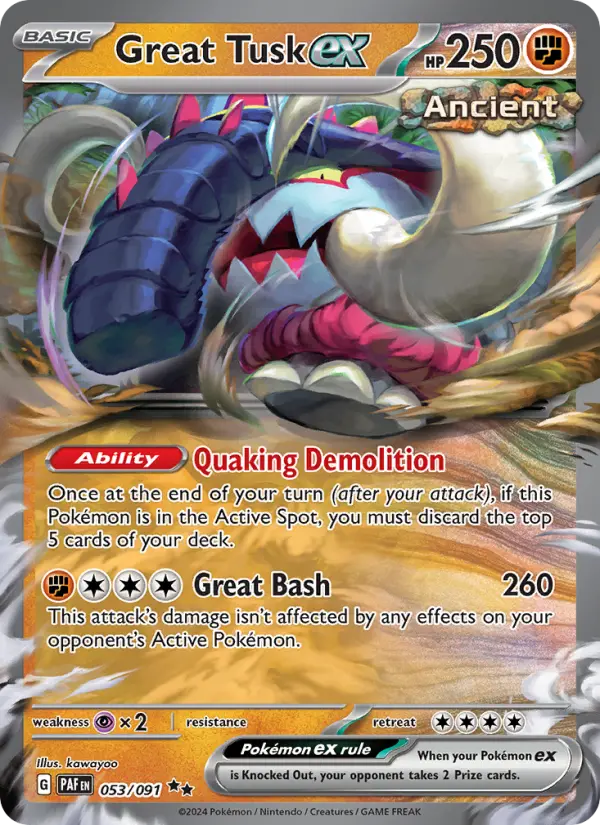
Tusk Great
Generation IX · #0984 — Paradox Pokémon
Great Tusk, known in Japanese as Idainakiba, is a Ground/Fighting-type Paradox Pokémon introduced in Generation IX that has captivated researchers and trainers alike with its mysterious origins and formidable presence. As the Paradox Pokémon counterpart to Donphan, Great Tusk represents a fascinating enigma in the Pokémon world—whether it is an ancient relative from a bygone era or a creature from an alternate timeline remains a subject of intense scholarly debate. This imposing creature stands at an impressive 2.2 meters tall and weighs 320 kilograms, making it a physically dominant force in any battle. The discovery of Great Tusk has revolutionized our understanding of Pokémon evolution and the possibility of parallel timelines within the Pokémon universe, particularly following the expeditions documented in the Scarlet Book and the paranormal investigations detailed in Occulture magazine.
Editor's Take
Great Tusk's Protosynthesis boosting its highest stat in sun, plus 131 base Attack and 131 base Defense, made it one of the most-used Pokémon in Gen 9 competitive play.
Base Stats
Height
2.2m
Weight
320.0kg
Category
Paradox Pokémon
Gender
Genderless
Color
purple
Shape
quadruped
Abilities
Raises highest stat in harsh sunlight, or if holding Booster Energy.

Tusk Great Biology & Physical Characteristics
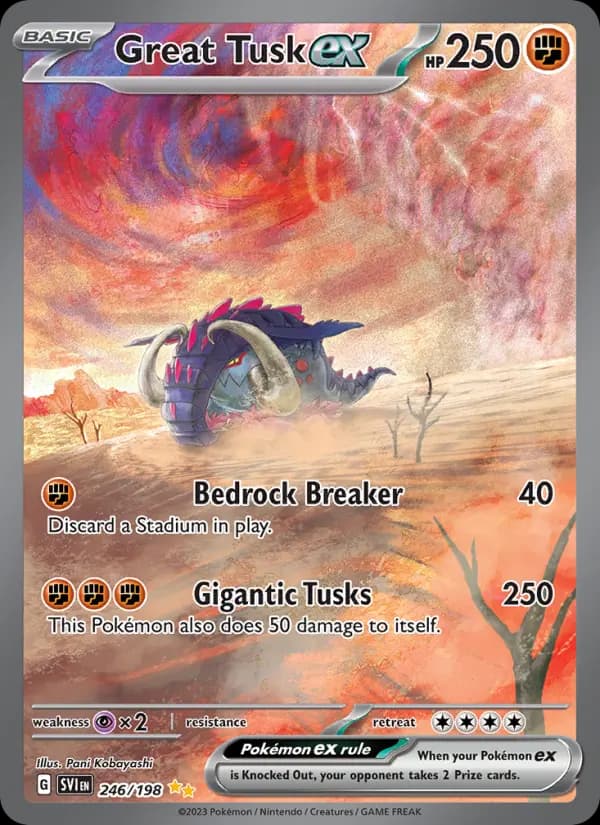
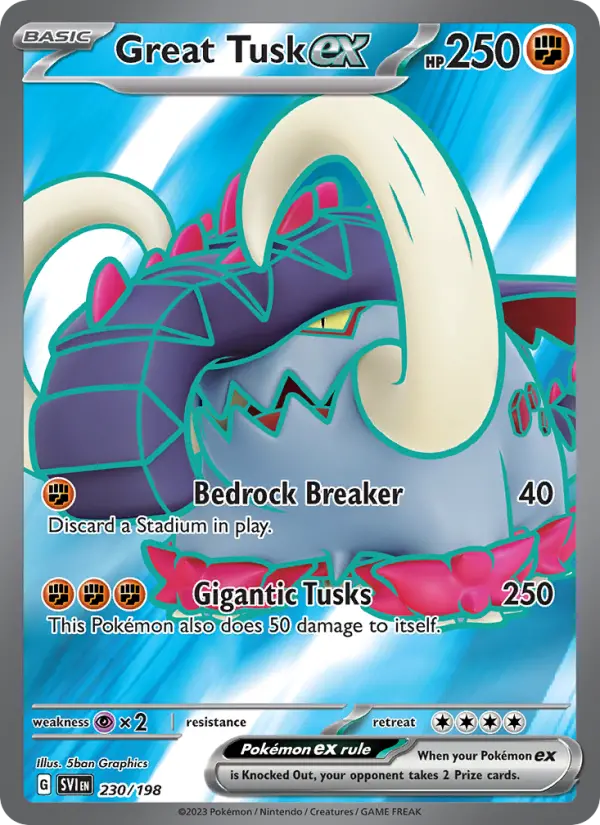
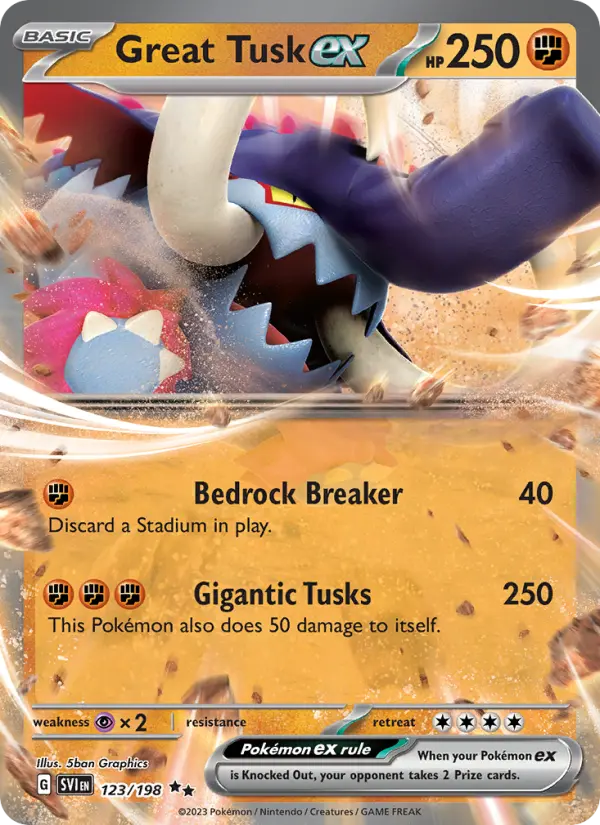
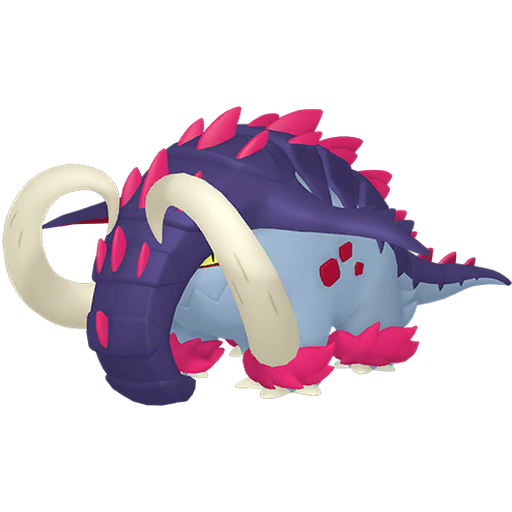
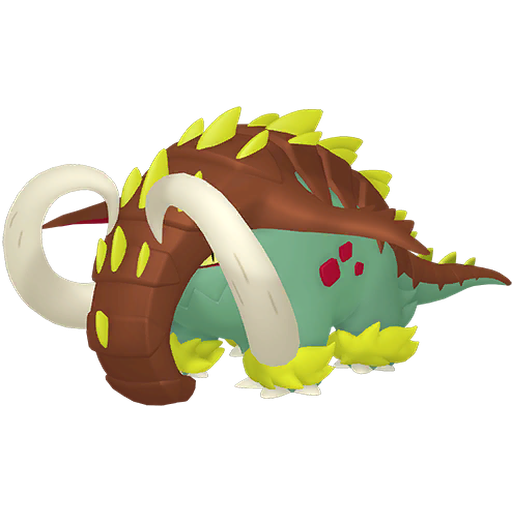
Great Tusk presents a striking appearance that blends prehistoric brutality with elegant anatomical design, featuring a large gray proboscidean body covered in distinctive markings and armor plating. Its most notable characteristics include two massive tusks that curve inward menacingly, a trunk topped with dark purple plates adorned with three rows of pinkish-red spikes, and an extensive array of similar crimson accents forming spots across its body and tufts of fur around its legs. The creature's head bears slanted yellow eyes rimmed with pinkish-red coloration, and its long, thin, serrated ears are lined with red on their inner surfaces, creating an overall appearance that suggests both ancient power and evolved sophistication. Unlike its contemporary relative Donphan, Great Tusk's physiology differs significantly—the proportions and placement of its tusks prevent it from typically curling into a ball for defense, though extraordinary circumstances have demonstrated it can execute rolling maneuvers despite this structural limitation. The creature's purple and red coloration scheme suggests an almost primordial design, distinguishing it visually from the smoother, more conventionally elephant-like appearance of modern Donphan specimens.
Pokedex Numbers
Training
Breeding
Tusk Great Breeding, Gender Ratio & Egg Groups
Great Tusk is a genderless Pokémon classified in the Undiscovered Egg Group, meaning it cannot breed with any other Pokémon species and cannot be obtained through egg breeding mechanisms. This genderless classification reinforces the Paradox Pokémon concept—these creatures exist outside the normal reproductive frameworks that govern typical Pokémon populations, suggesting they may have originated through means entirely divorced from conventional biological propagation. The lack of sexual dimorphism or reproductive capacity further emphasizes Great Tusk's alien or anachronistic nature, positioning it as fundamentally separate from the modern Pokémon ecosystem. While Great Tusk cannot produce offspring through traditional breeding, trainers who wish to add this species to their teams must encounter and capture wild specimens or receive them through special distributions and events. The creature's base happiness value of 0 reflects its savage, untamed nature, requiring significant effort and patience from trainers to develop bonds of trust and affection. Despite these barriers to acquisition, Great Tusk remains a highly sought specimen due to its remarkable combat statistics and the prestige associated with capturing one of these mysterious Paradox Pokémon.
Sprites




TMs & HMs
tm02
lets go pikachu lets go eevee
tm03
x y
tm03
black 2 white 2
tm03
black white
tm03
sun moon
tm03
ultra sun ultra moon
tm03
omega ruby alpha sapphire
tm04
gold silver
tm04
crystal
tm05
ruby sapphire
tm05
emerald
tm05
gold silver
tm05
crystal
tm05
diamond pearl
tm05
black white
tm05
platinum
tm05
heartgold soulsilver
tm05
firered leafgreen
tm05
black 2 white 2
tm05
omega ruby alpha sapphire
+439 more TMs/HMs
Tusk Great Evolution, Mega Evolution & Special Forms
Great Tusk does not evolve into any other known Pokémon form, nor does it represent an evolutionary stage for any other species. This stands as one of the defining characteristics of the Paradox Pokémon line—they exist as singular entities, apparently frozen in evolutionary time rather than serving as links in a broader evolutionary chain. The absence of evolutionary potential reflects the uncertain and potentially removed nature of Great Tusk's origin, whether it emerged from ancient times or an alternate dimension where the normal rules of Pokémon evolution may not apply. Similarly, Great Tusk cannot undergo Mega Evolution, Z-Move transformations, or other temporary power enhancements available to most modern Pokémon. However, Great Tusk possesses the signature Ability Protosynthesis, which fundamentally alters its power dynamics in specific environmental conditions. This Ability raises the Pokémon's highest stat during harsh sunlight or when holding a Booster Energy item, effectively allowing it to customize its combat effectiveness based on the strategic situation. The combination of static form stability and dynamic Ability-based power manipulation creates a unique strategic identity that distinguishes Great Tusk from traditionally evolving Pokémon lines.
Where to Find
Location data not available for this Pokémon in the database.
Tusk Great Behaviour and Natural Habitat
Great Tusk exhibits a notably savage and aggressive temperament that starkly contrasts with the generally more docile nature of modern Donphan, as documented in the Scarlet Book's account of the Area Zero Expedition. Historical records indicate that this Paradox Pokémon attacked the expedition team with tremendous ferocity, employing its massive body and tusks as devastating weapons and causing fatal injuries to at least one explorer, establishing it as a creature of considerable danger and unpredictability. Despite this aggressive disposition, Great Tusk appears to occupy ecological niches related to Area Zero and regions with specific environmental conditions, particularly those where harsh sunlight and extreme conditions prevail. The creature's presence seems tied to temporal or dimensional anomalies, appearing in recent years through means not fully understood by contemporary science. Researchers theorize that Great Tusk may have evolved different behavioral patterns than Donphan due to the environmental pressures and chronological context from which it originated, whether that context be ancient history or an alternative reality. The mysterious nature of Great Tusk's habitat and behavioral ecology continues to fascinate cryptozoologists and Pokémon researchers worldwide.
Pokedex Entries
Sightings of this Pokémon have occurred in recent years. The name Great Tusk was taken from a creature listed in a certain book.
This creature resembles a mysterious Pokémon that, according to a paranormal magazine, has lived since ancient times.
Tusk Great Name Origin & Design Inspiration
The name 'Great Tusk' directly references the creature's most prominent and intimidating physical features—its massive, inward-curving tusks that define both its appearance and its reputation for destructive capability. The Japanese designation 'Idainakiba' combines 'idai' (great/grand) with 'nakiba' (tusk), creating a parallel construction that emphasizes the same tusks as the dominant defining characteristic. The Pokémon's classification as a Paradox Pokémon itself reflects its design philosophy as a creature existing outside normal temporal or dimensional parameters, embodying an aesthetic that suggests ancient power with touches of otherworldly mystery. Great Tusk's visual design appears heavily inspired by prehistoric proboscideans and ancient elephants, particularly species with prominent tusks such as mastodons and mammoths, though exaggerated and stylized through the addition of the purple plating, crimson spikes, and an overall more predatory aspect. The stark color contrast between the gray body, dark purple armor, and vivid pinkish-red accents creates visual distinction that prevents confusion with Donphan while maintaining clear family resemblance, effectively communicating that these creatures share evolutionary ancestry across their respective timelines or eras. The design brilliantly captures the concept of something simultaneously ancient and alien, familiar yet profoundly foreign.
Learnable Moves
Tusk Great can learn 58 moves:
Move | Type | Cat. | Power | Acc. | PP |
|---|---|---|---|---|---|
| body press | fighting | Physical | 80 | 100 | 10 |
| body slam | normal | Physical | 85 | 100 | 15 |
| brick break | fighting | Physical | 75 | 100 | 15 |
| bulk up | fighting | Status | — | — | 20 |
| bulldoze | ground | Physical | 60 | 100 | 20 |
| close combat | fighting | Physical | 120 | 100 | 5 |
| defense curl | normal | Status | — | — | 40 |
| dig | ground | Physical | 80 | 100 | 10 |
| double edge | normal | Physical | 120 | 100 | 15 |
| earth power | ground | Special | 90 | 100 | 10 |
| earthquake | ground | Physical | 100 | 100 | 10 |
| endeavor | normal | Physical | — | 100 | 5 |
| endure | normal | Status | — | — | 10 |
| facade | normal | Physical | 70 | 100 | 20 |
| fire fang | fire | Physical | 65 | 95 | 15 |
| flash cannon | steel | Special | 80 | 100 | 10 |
| giga impact | normal | Physical | 150 | 90 | 5 |
| head smash | rock | Physical | 150 | 80 | 5 |
| headlong rush | ground | Physical | 120 | 100 | 5 |
| heavy slam | steel | Physical | — | 100 | 10 |
| high horsepower | ground | Physical | 95 | 95 | 10 |
| horn attack | normal | Physical | 65 | 100 | 25 |
| hyper beam | normal | Special | 150 | 90 | 5 |
| ice fang | ice | Physical | 65 | 95 | 15 |
| ice spinner | ice | Physical | 80 | 100 | 15 |
| iron head | steel | Physical | 80 | 100 | 15 |
| knock off | dark | Physical | 65 | 100 | 20 |
| megahorn | bug | Physical | 120 | 85 | 10 |
| mud shot | ground | Special | 55 | 95 | 15 |
| mud slap | ground | Special | 20 | 100 | 10 |
| play rough | fairy | Physical | 90 | 90 | 10 |
| protect | normal | Status | — | — | 10 |
| psyshock | psychic | Special | 80 | 100 | 10 |
| rapid spin | normal | Physical | 50 | 100 | 40 |
| rest | psychic | Status | — | — | 5 |
| reversal | fighting | Physical | — | 100 | 15 |
| roar | normal | Status | — | — | 20 |
| rock slide | rock | Physical | 75 | 90 | 10 |
| rock tomb | rock | Physical | 60 | 95 | 15 |
| rollout | rock | Physical | 30 | 90 | 20 |
| sandstorm | rock | Status | — | — | 10 |
| scary face | normal | Status | — | 100 | 10 |
| sleep talk | normal | Status | — | — | 10 |
| smack down | rock | Physical | 50 | 100 | 15 |
| smart strike | steel | Physical | 70 | — | 10 |
| stealth rock | rock | Status | — | — | 20 |
| stomping tantrum | ground | Physical | 75 | 100 | 10 |
| stone edge | rock | Physical | 100 | 80 | 5 |
| substitute | normal | Status | — | — | 10 |
| sunny day | fire | Status | — | — | 5 |
| supercell slam | electric | Physical | 100 | 95 | 15 |
| take down | normal | Physical | 90 | 85 | 20 |
| taunt | dark | Status | — | 100 | 20 |
| temper flare | fire | Physical | 75 | 100 | 10 |
| tera blast | normal | Special | 80 | 100 | 10 |
| throat chop | dark | Physical | 80 | 100 | 15 |
| thunder fang | electric | Physical | 65 | 95 | 15 |
| zen headbutt | psychic | Physical | 80 | 90 | 15 |
Tusk Great Competitive Battle Guide
Great Tusk stands as an exceptional competitive Pokémon, boasting impressive base stats totaling 570 points distributed across a powerful offensive and defensive framework perfectly suited to its Ground/Fighting typing. The creature's Attack stat of 131 and Defense stat of 131 create an ideal balance for physical attackers that can simultaneously weather incoming attacks, while its substantial HP of 115 provides a solid health pool enabling longer battle endurance. These offensive and defensive capabilities are complemented by a respectable Speed stat of 87, allowing Great Tusk to function effectively in many competitive tiers without requiring significant speed investment. The Protosynthesis Ability represents Great Tusk's most critical competitive asset, automatically raising its highest stat during harsh sunlight or when holding a Booster Energy item, enabling dynamic stat customization that adapts to battle conditions and team compositions. Great Tusk's movepool reflects its physical prowess, featuring devastating moves such as Close Combat (120 power, 100 accuracy), Earthquake (100 power, 100 accuracy), Headlong Rush (120 power, 100 accuracy), and Megahorn (120 power, 85 accuracy), all of which can be learned through level-up or Technical Machines. The combination of strong physical attacks, excellent defensive capabilities, and the adaptive Protosynthesis Ability positions Great Tusk as a formidable threat in Doubles formats particularly, where weather control and item management can be coordinated with teammates to maximize its potential. Its limited Special Attack and Special Defense stats of 53 each make it pure physical attacker rather than mixed or special-based combatant, requiring trainers to carefully construct teams that capitalize on this specialization.
Commonly Asked Questions About Tusk Great
What type is Tusk Great?
Tusk Great is a ground and fighting type Pokemon.
What does Tusk Great evolve from?
Tusk Great does not evolve.
What are Tusk Great's weaknesses?
Tusk Great is weak to flying, water, grass, psychic, ice and fairy type moves.
Tusk Great Cultural Impact & Franchise History
Great Tusk has generated significant fascination within the Pokémon community since its introduction in Generation IX, capturing the imagination of researchers, competitive players, and lore enthusiasts with its mysterious origins and implications for Pokémon science. The creature's connection to the Scarlet Book and the Area Zero incident has spawned extensive fan theories and academic discussions about the nature of parallel timelines, ancient Pokémon lineages, and the boundaries of evolutionary biology within the Pokémon universe. The dramatic account of Great Tusk's attack on the expedition team—fatally wounding an explorer—elevated it to near-legendary status in popular culture, positioning it as a genuinely dangerous wild creature rather than a simple encounter, an image reinforced by its low base happiness and aggressive behavioral descriptions. The design's prehistoric aesthetic has inspired countless artists, cosplayers, and creative professionals to incorporate Great Tusk imagery into their work, and the Paradox Pokémon concept as a whole has influenced how fans conceptualize Pokémon diversity and alternative evolutionary pathways. In competitive circles, Great Tusk's unique combination of mechanics, movepool, and stats has established it as a respected and feared team member, earning recognition through tournament victories and high-level play. The cultural phenomenon surrounding Great Tusk extends to merchandise, artwork, and fan communities dedicated to exploring the Paradox Pokémon line and their implications for the broader Pokémon narrative universe.
Where to Find Tusk Great in Every Pokémon Game
Great Tusk can be encountered and captured in Pokémon Scarlet and Pokémon Violet, where it appears as a wild Paradox Pokémon with a relatively modest catch rate of 30, making it challenging to capture even with optimal items and strategies. Within these games, Great Tusk is designated with a local Pokédex number of 0376 and maintains its National Pokédex identification as #0984, facilitating organization and cataloging across different regions and generations. The creature's appearance is documented in the Scarlet Book for Pokémon Scarlet and is referenced through paranormal magazine accounts in Pokémon Violet, with each version offering distinct narrative contexts for understanding this mysterious Pokémon's existence and origins. Trainers seeking to obtain Great Tusk must explore specific areas within the Paldea region associated with Area Zero and dimensional anomalies, where the Paradox Pokémon manifest under particular conditions. The creature cannot be obtained through breeding, Pokémon eggs, or standard evolutionary methods, restricting legitimate acquisition to wild encounters or special event distributions organized by the Pokémon Company and official retailers. Great Tusk's availability as a single-form, non-breeding Pokémon ensures that each captured specimen represents a unique prize, enhancing its value within competitive and casual communities. As Generation IX progresses and future games build upon the Paradox Pokémon concept, Great Tusk's availability may expand, though its current status as exclusive to Scarlet and Violet maintains its special significance within those titles.