
Gigantamax Lapras
Generation I · #10204 — Transport Pokémon
As a Generation I water/ice-type, Lapras-Gmax leans on water absorb to cover what its raw numbers don't, particularly on the hp side.
Editor's Take
Gigantamax Lapras's G-Max Resonance setting Aurora Veil without hail is a genuinely strong effect, and it's the clearest case of a G-Max form rescuing a Pokémon that had nothing else going for it.
Base Stats
Height
24.0m
Weight
1000.0kg
Category
Transport Pokémon
Gender
Male 50% / Female 50%
Color
blue
Shape
fish
Habitat
sea
Abilities
Absorbs water moves, healing for 1/4 max HP.
Protects against critical hits.
Cures any major status ailment after each turn during rain.

Gigantamax Lapras Biology & Physical Characteristics
Gigantamax Lapras maintains the fundamental plesiosaur-like physiology of its base form, featuring a distinctive blue hide with darker blue spots and a cream-colored underside that extends across its massive frame when enlarged. The Pokémon retains its characteristic long neck, four flippers with the foremost pair being noticeably larger than the hind pair, and its iconic gray shell covered in blunt knobs that runs along its back. When Gigantamaxing, these features are scaled up dramatically—the shell becomes a colossal carapace of imposing proportions, and the overall musculature and bone structure expand to support the 1,000-kilogram weight across its 24-meter length. The transformation process doesn't alter the core biological structure but rather amplifies it, allowing the Pokémon to harness significantly greater elemental power. The large brown eyes, short horn, and tightly curled ears that define Lapras's gentle demeanor persist even in this towering form, maintaining the species' distinctive facial features despite the radical size increase.
Pokedex Numbers
Training
Breeding
Gigantamax Lapras Breeding, Gender Ratio & Egg Groups
Lapras exhibits a perfectly balanced gender ratio of 50% male to 50% female, allowing equal breeding potential across the species regardless of which parent the trainer uses in breeding projects. The species belongs to both the Monster and Water 1 egg groups, making it compatible with a surprisingly diverse range of breeding partners and providing trainers with flexibility in creating offspring with varied movesets and abilities. Lapras has a base happiness value of 70, indicating a naturally friendly disposition toward trainers that translates to easier bonding and better performance in battle—an important consideration for competitive players seeking to maximize their team's effectiveness. The species has a slow growth rate, meaning that Lapras takes longer to reach higher levels compared to many other Pokémon, but this is offset by its impressive base stat total of 535 and the notable 130 base HP that gives it exceptional bulk. Eggs take 40 cycles to hatch, equivalent to approximately 10,024 to 10,280 steps, and the hatched Lapras will inherit the natures and abilities of its parents, making careful breeding practices worthwhile for competitive players aiming to create an optimally-statted Gigantamax form.
Sprites


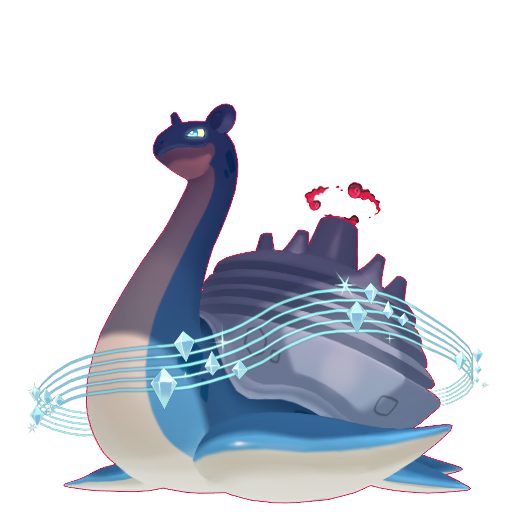
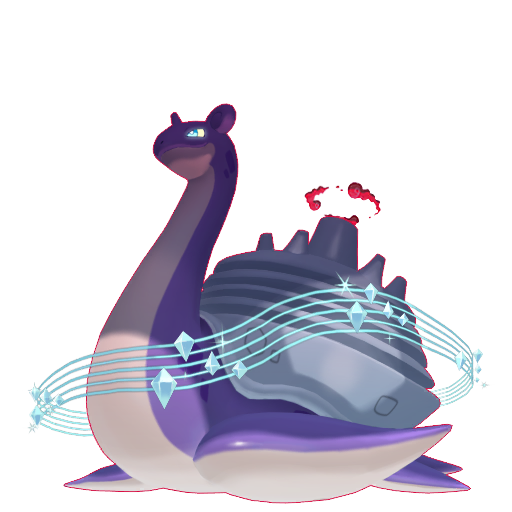



Gigantamax Lapras Evolution, Mega Evolution & Special Forms
Lapras does not evolve from any Pokémon nor does it evolve into any other species, making it a standalone evolutionary line since its introduction in Generation I. However, the introduction of Gigantamax mechanics in Pokémon Sword and Shield provided Lapras with a transformative capability that functionally elevates its competitive presence without constituting a traditional evolution. To access Gigantamax form, a Lapras must possess the Gigantamax Factor, a special genetic trait typically encountered in Pokémon discovered in specific game locations or through special events. Unlike Mega Evolution, which is permanent until battle's end and grants stat boosts, Gigantamax is a temporary transformation lasting only three turns during combat. The Gigantamax form grants access to G-Max Resonance, an exclusive move of colossal power that cannot be replicated by any other Pokémon, providing Lapras with unique strategic options unavailable to its base form. This mechanic allows trainers to dynamically shift their approach mid-battle, making Gigantamax Lapras a versatile choice that bridges the gap between its naturally high special defense stat of 95 and its need for immediate offensive pressure.
Where to Find
Location data not available for this Pokémon in the database.
Gigantamax Lapras Behaviour and Natural Habitat
Gigantamax Lapras exhibits the same gentle and intelligent temperament as its base form, retaining its renowned ability to comprehend human speech and ferry people across waterways—though on an almost incomprehensibly larger scale. According to Pokédex entries, this species possesses remarkable empathy and has been observed singing plaintively in the evenings as it seeks out remaining members of its dwindling population, a behavior that persists regardless of size. In its Gigantamax state, the Pokémon's intelligence becomes even more pronounced, as the sheer power at its disposal appears to amplify its already considerable cognitive abilities. Lapras inhabits coastal regions and open waters, preferring temperate ocean environments where it can use its flippers to propel itself gracefully through the sea. The Pokémon's habitat preference for milder waters contrasts sharply with its Ice-type capabilities, suggesting an adaptation to environments transitioning between warmer and colder aquatic zones. When Gigantamaxed, a Lapras commands its immediate aquatic environment with an almost primal authority, though it maintains the same peaceful disposition toward humans and compatible Pokémon that defines the species.
Pokedex Entries
A POKéMON that has been over hunted almost to extinction. It can ferry people across the water.
A gentle soul that can read the minds of people. It can ferry people across the sea on its back.
They have gentle hearts. Because they rarely fight, many have been caught. Their num ber has dwindled.
It ferries people across the sea on its back. It may sing an enchanting cry if it is in a good mood.
This gentle POKéMON loves to give people rides and provides a ve ry comfortable way to get around.
People have driven LAPRAS almost to the point of extinction. In the evenings, this POKéMON is said to sing plaintively as it seeks what few others of its kind still remain.
People have driven LAPRAS almost to the point of extinction. In the evenings, it is said to sing plaintively as it seeks what few others of its kind still remain.
Its high intelligence enables it to understand human speech. It likes to ferry people on its back.
A POKéMON that has been overhunted almost to extinction. It can ferry people on its back.
It loves crossing the sea with people and Pokémon on its back. It understands human speech.
They have gentle hearts. Because they rarely fight, many have been caught. Their number has dwindled.
It ferries people across the sea on its back. It may sing an enchanting cry if it is in a good mood.
It loves crossing the sea with people and Pokémon on its back. It understands human speech.
Able to understand human speech and very intelligent, it loves to swim in the sea with people on its back.
They have gentle hearts. Because they rarely fight, many have been caught. Their number has dwindled.
Its high intelligence enables it to understand human speech. It likes to ferry people on its back.
People have driven Lapras almost to the point of extinction. In the evenings, this Pokémon is said to sing plaintively as it seeks what few others of its kind still remain.
People have driven Lapras almost to the point of extinction. In the evenings, this Pokémon is said to sing plaintively as it seeks what few others of its kind still remain.
Its high intelligence enables it to comprehend human speech. When it’s in a good mood, it sings in its beautiful voice.
It likes swimming around with people on its back. In the Alola region, it’s an important means of transportation over water.
These Pokémon were once near extinction due to poaching. Following protective regulations, there is now an overabundance of them.
They’ve been so cherished that there’s now an overabundance. The fish Pokémon population has declined in waters with too many Lapras.
A gentle soul that can understand human speech. It can ferry people across the sea on its back.
A smart and kindhearted Pokémon, it glides across the surface of the sea while its beautiful song echoes around it.
Crossing icy seas is no issue for this cold-resistant Pokémon. Its smooth skin is a little cool to the touch.
Gigantamax Lapras Name Origin & Design Inspiration
The name 'Lapras' derives from 'Laplace,' likely referencing the French mathematician Pierre-Simon Laplace, reflecting the Pokémon's high intelligence and the scientific implications of its design. The species name also echoes 'lapse,' potentially alluding to the species' tragic history of near-extinction and the societal lapse in protecting them from overhunting. The design itself draws inspiration from the plesiosaur, an extinct marine reptile from the Mesozoic Era, with the Pokémon's long neck, four flippers, and shell-backed physiology directly mirroring paleontological reconstructions. The Gigantamax transformation amplifies these prehistoric aesthetics dramatically, making the already imposing Lapras appear almost like an ancient leviathan risen from the depths. The blue coloration with darker spots and cream underside evokes both modern marine life and idealized depictions of ancient sea creatures, creating a timeless design that has remained iconic across multiple generations. The horn on its forehead adds a subtle fantastical element that distinguishes it from realistic plesiosaur reconstructions, grounding the creature firmly in the fantastical world of Pokémon while maintaining biological plausibility.
Gigantamax Lapras Competitive Battle Guide
Gigantamax Lapras occupies a unique niche in competitive Pokémon battles, leveraging its high Special Defense stat of 95 to wall special attackers while its Access to G-Max Resonance provides a guaranteed way to set up terrain advantages on the field. The base Special Attack stat of 85, while moderate, becomes considerably more relevant when boosted by Gigantamaxing, and combined with a strong movepool featuring moves like Hydro Pump, Ice Beam, and Psychic, it can function as both a special wall and a solid special attacker depending on team construction. Water Absorb as an ability provides passive healing when struck by water-type moves, making Lapras exceptionally difficult to wear down in prolonged battles, while the hidden ability Hydration cures status ailments during rain, offering alternative utility builds for weather-based teams. Shell Armor, its other ability, prevents critical hits, providing additional longevity against unpredictable damage spikes. The modest Speed stat of 60 is Gigantamax Lapras's primary weakness, meaning it typically requires team support or careful switching to avoid being outsped by faster threats. Its comprehensive typing grants it four resistances and one immunity (to water moves with Water Absorb), making it surprisingly durable despite its relatively moderate defense stats, allowing it to function effectively as either a special tank or a mixed attacker depending on EV training and move selection.
Commonly Asked Questions About Gigantamax Lapras
What type is Gigantamax Lapras?
Gigantamax Lapras is a water and ice type Pokemon.
What does Gigantamax Lapras evolve into?
Gigantamax Lapras does not evolve.
What are Gigantamax Lapras's weaknesses?
Gigantamax Lapras is weak to fighting, rock, grass and electric type moves.
Gigantamax Lapras Cultural Impact & Franchise History
Lapras has maintained significant cultural presence throughout Pokémon history since its debut in Generation I, becoming one of the franchise's most iconic Water-type Pokémon and a beloved symbol of gentle intelligence and ecological awareness. The species' tragic backstory of near-extinction due to overhunting resonated deeply with players and has been referenced consistently across games, anime adaptations, and official media, making Lapras an ambassador for conservation themes within the Pokémon universe. In the anime series, Ash's Lapras became a fan-favorite companion, cementing the species' place in the cultural consciousness of the franchise, while numerous other significant Lapras characters have appeared throughout the animation and manga adaptations. The Gigantamax form elevated Lapras's relevance in modern competitive and casual play, introducing new players to the species while reinvigorating veteran trainer interest through the dramatic transformation and exclusive G-Max Resonance move. The design's elegant combination of ancient mystique and graceful serenity has made Lapras a favorite subject for fan art and creative interpretations, while its role as a transport Pokémon has inspired countless in-game narratives and trainer journeys. The species appears prominently in trading card games, merchandise, and competitive tournament formats, maintaining its status as a generation-defining Pokémon that transcends gaming to become a cultural touchstone for the franchise's broader appeal.
Where to Find Gigantamax Lapras in Every Pokémon Game
Gigantamax Lapras became available to players with the introduction of Pokémon Sword and Shield, where it could be obtained as a regular Lapras that possessed the Gigantamax Factor, enabling it to transform during battles. In these games, Lapras appears in various aquatic locations and can be found in the Wild Area and the DLC areas, with Pokédex number 361 in Galar and 190 in the Crown Tundra expansion. The Indigo Disk DLC further expanded availability with Pokédex number 145, allowing players in Pokémon Scarlet and Violet to obtain Gigantamax-capable Lapras through updated encounters. Prior to Gigantamax availability, Lapras could be obtained in virtually every Pokémon generation since its debut in Generation I, with consistent appearances in Red, Blue, Yellow versions and subsequent mainline titles. Wild encounters vary by generation and game version, though many games feature Lapras in late-game water routes or as a rare encounter, reflecting its special status within the Pokédex. The capture rate of 45 makes Lapras moderately difficult to catch in the wild, requiring standard Poké Balls or better equipment for reliable capture, though trainers also have the option of breeding or receiving Lapras through in-game trades or event distributions, particularly in recent generations where event Pokémon have become increasingly common.