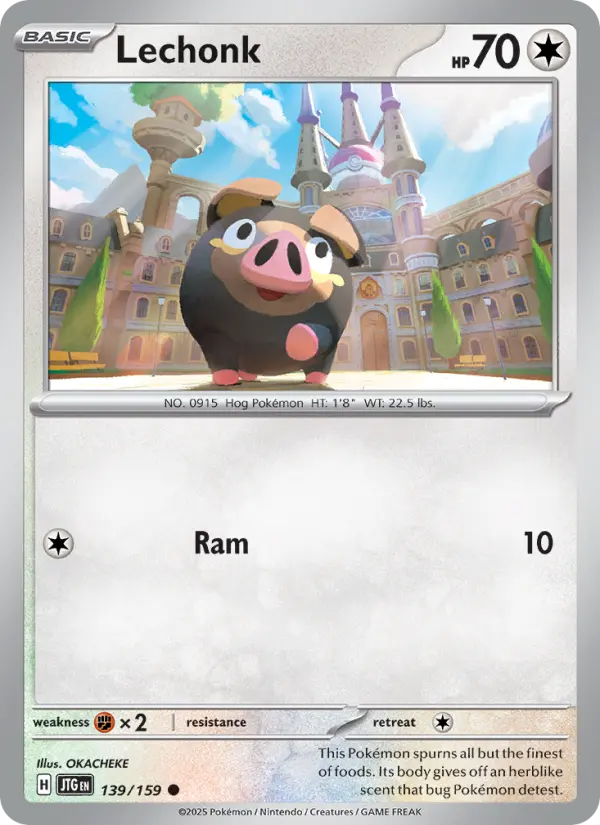
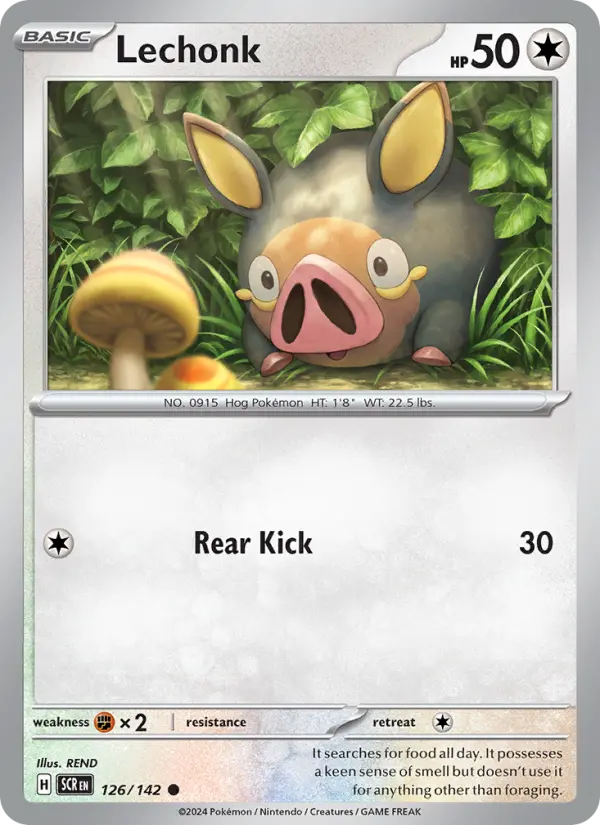
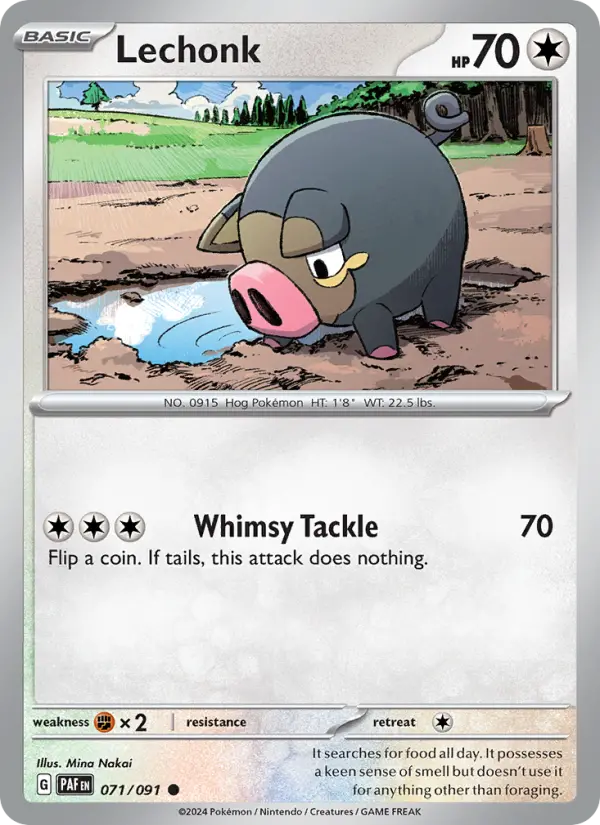
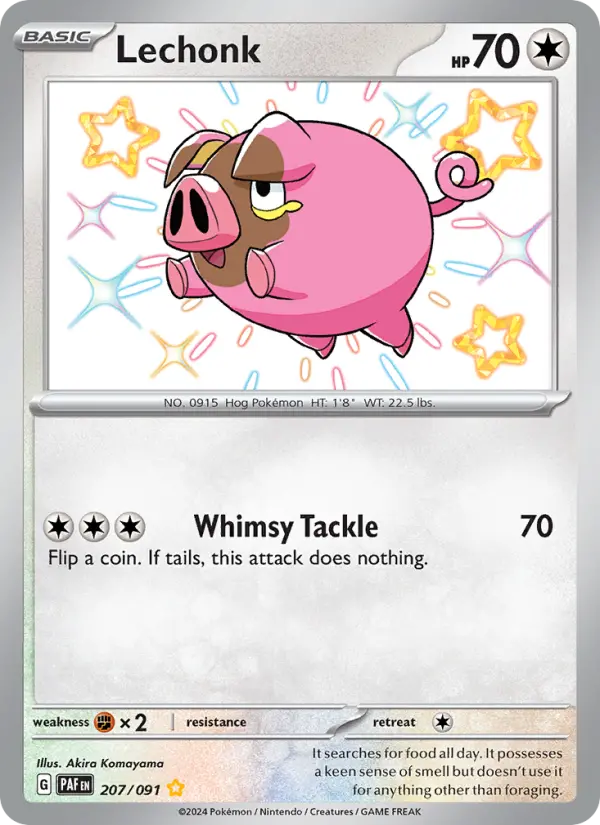
Lechonk
Generation IX · #0915 — Hog Pokémon
Lechonk's profile is easy to undersell: 0.5 m, 10.2 kg, and a normal typing that doesn't scream power — until you look at its HP of 54. The species embodies the charming aesthetic of Generation IX's Paldean designs, combining endearing features with practical in-game utility.
Editor's Take
Lechonk's line ends in Oinkologne, and the gender split producing two different ability sets and stat spreads is a genuinely unusual thing for a route Pokémon.
Base Stats
Height
0.5m
Weight
10.2kg
Category
Hog Pokémon
Gender
Male 50% / Female 50%
Color
gray
Shape
quadruped
Abilities
Protects allies against moves that affect their mental state.
Makes the Pokémon eat any held Berry triggered by low HP below 1/2 its max HP.
Halves damage from fire and ice moves.

Lechonk Biology & Physical Characteristics
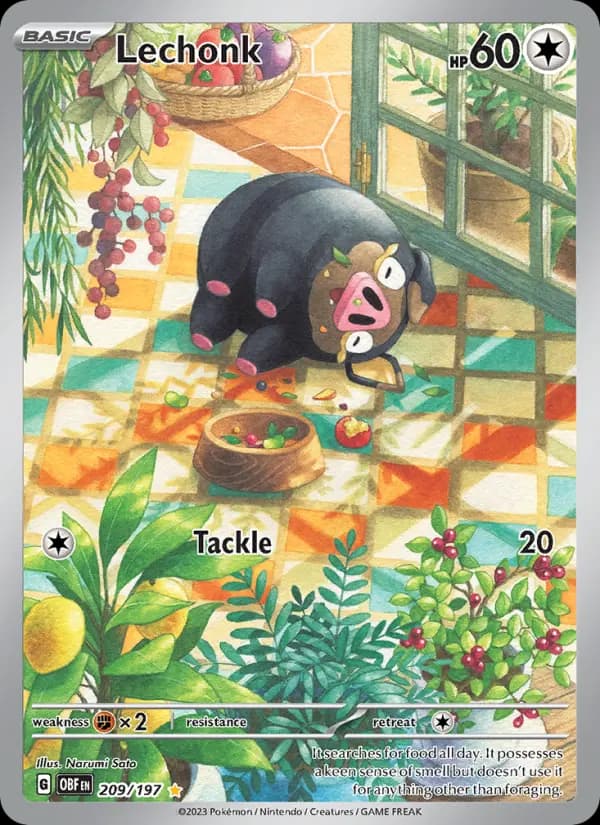
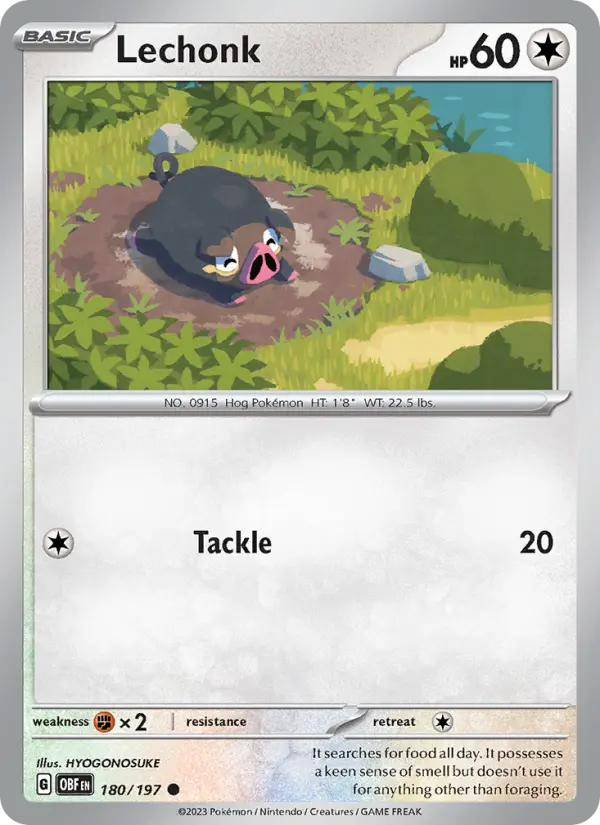
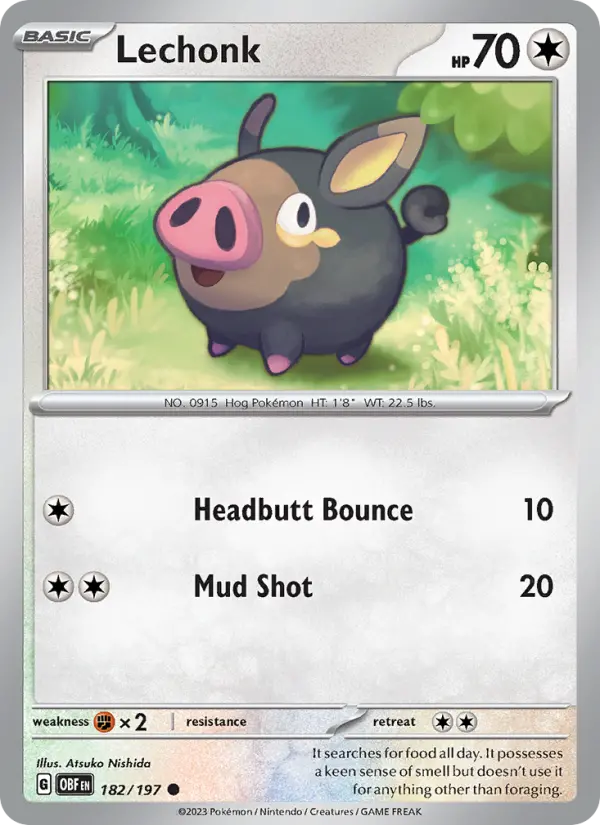
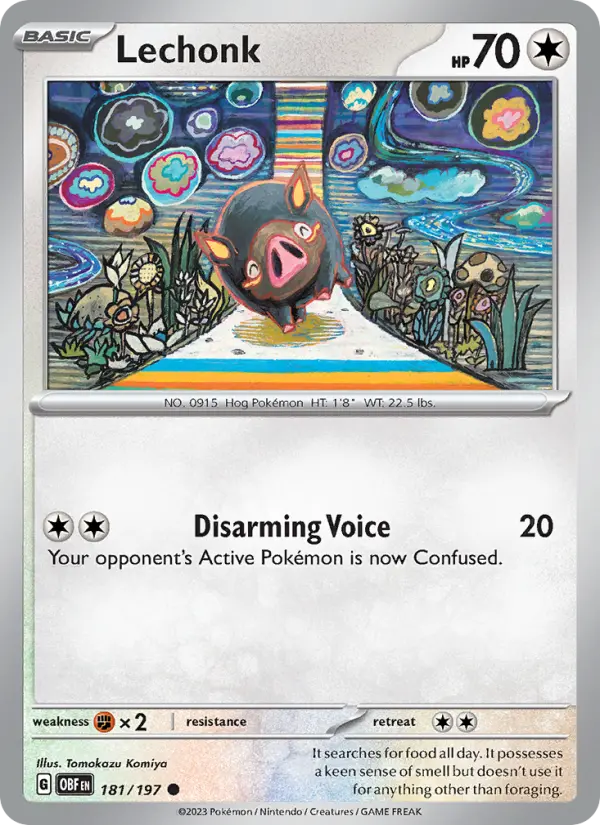
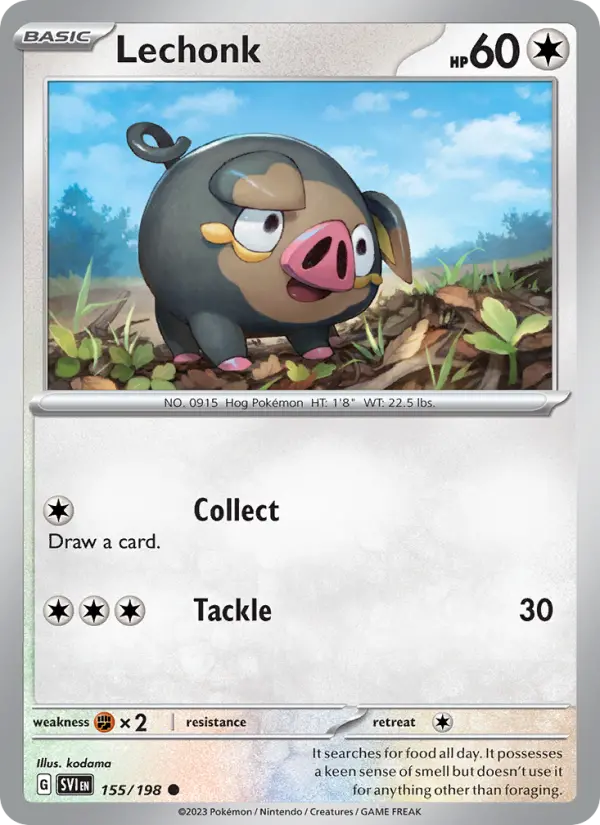
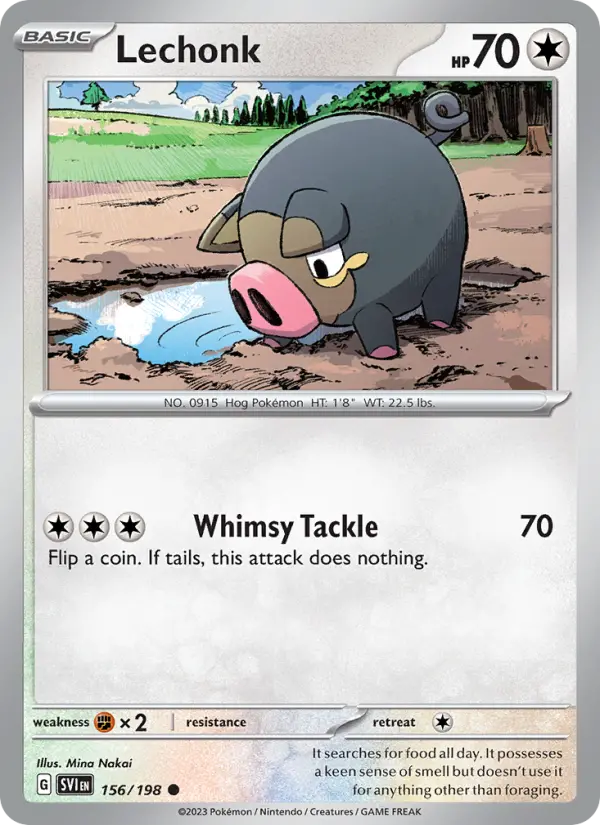
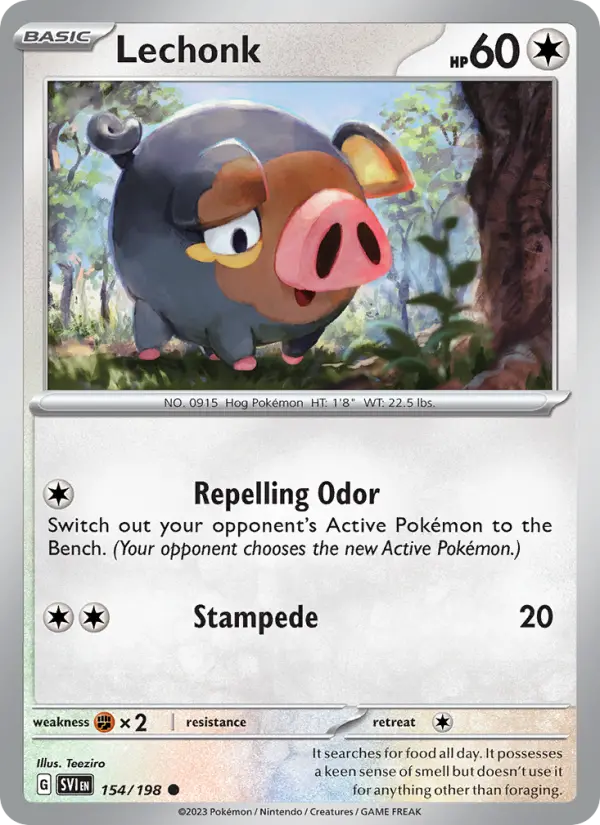
Lechonk is a stout, compact Pokémon that bears a striking resemblance to a domestic hog or pig. Its body is predominantly grayish-black in coloration, creating a sturdy silhouette that belies its actual composition—despite appearances suggesting otherwise, Lechonk's body is composed primarily of well-developed muscle rather than fat, built through its constant foraging activities. The Pokémon features distinctive brown colorations on its face and ears, paired with peculiar yellow growths beneath its eyes that resemble teardrops and give it an expressive, almost melancholic countenance. Its droopy ears have yellow insides and partially obscure its eyes, while a triangular pink snout dominates its face, complete with two enormous oval nostrils perfectly suited for its exceptional olfactory abilities. The species possesses stubby legs ending in pink hooves and sports a characteristically short, curled tail. Lechonk's most remarkable biological feature is its extraordinarily keen sense of smell, which it employs with singular focus on locating food sources. Its sophisticated olfactory system allows it to detect the most fragrant wild grasses and richest Berries from considerable distances, making it invaluable to trainers seeking culinary ingredients or natural food sources. This specialized diet of aromatic vegetation and sweet nectars—including the nectar found on Appletun's back—results in a fascinating adaptation: Lechonk's body gives off a distinctly herblike scent that repels bug-type Pokémon. This natural defense mechanism, while useful against insectoid predators, also serves as a reliable identifier of the species in the wild.
Pokedex Numbers
Training
Breeding
Lechonk Breeding, Gender Ratio & Egg Groups
Lechonk has one of the simplest gender ratios in the game — a flat 50/50, with no observable differences in appearance or base statistics between the genders in this evolutionary stage. The species belongs to the Field egg group, which encompasses numerous terrestrial and quadrupedal Pokémon, allowing it to breed with a wide variety of compatible species. With a hatch counter of 15 cycles, requiring approximately 3,599 to 3,855 steps to hatch, Lechonk eggs represent a moderate investment for breeders seeking to obtain the species or its evolutionary forms through artificial means. The base friendship value of 50 indicates that Lechonk begins with neutral affection toward its trainer, requiring time and positive interactions to develop strong bonds. Gender differences become more pronounced upon evolution into Oinkologne, where male and female forms diverge significantly in appearance, providing breeders with two distinctly different final products depending on their breeding targets. The species' reasonable hatch time and accessibility through the Field egg group make Lechonk a practical choice for both casual breeders and competitive players seeking to develop specific movesets through breeding techniques.
Sprites






TMs & HMs
tm01
lets go pikachu lets go eevee
tm01
ultra sun ultra moon
tm01
sun moon
tm02
crystal
tm02
gold silver
tm03
crystal
tm03
gold silver
tm03
lets go pikachu lets go eevee
tm05
lets go pikachu lets go eevee
tm07
lets go pikachu lets go eevee
tm08
red blue
tm08
yellow
tm08
lets go pikachu lets go eevee
tm09
yellow
tm08
red green japan
tm08
blue japan
tm09
red blue
tm09
ruby sapphire
tm09
firered leafgreen
tm09
emerald
+243 more TMs/HMs
Lechonk's Evolution Chain


Lechonk Evolution, Mega Evolution & Special Forms
Lechonk undergoes a standard single-stage evolution into Oinkologne when it reaches level 18, following the medium-fast growth rate shared by the entire evolutionary line. This evolution is notably one of the few Pokémon lines where the final form differs distinctly based on the Pokémon's gender, with male Lechonk evolving into male Oinkologne and female Lechonk evolving into female Oinkologne, each possessing unique appearances and characteristics. The evolution represents a substantial increase in base stats across most categories, particularly in Attack and Special Attack, transforming the modest Lechonk into a more formidable combatant. Oinkologne retains the Normal typing of its pre-evolution but gains access to significantly expanded movepool options and enhanced stat distributions that allow it to function effectively in mid-game encounters and beyond. The evolutionary transformation also refines Lechonk's somewhat awkward proportions into a more confident, imposing form, though the essential charm of the Hog Pokémon line remains intact throughout.
Where to Find
Location data not available for this Pokémon in the database.
Lechonk Behaviour and Natural Habitat
Lechonk is characterized by a surprisingly timid and faint-hearted temperament, despite its robust physical appearance. When startled or attacked, this normally docile Pokémon will panic and charge forward with unexpected aggression, demonstrating a fight-or-flight response that catches many unprepared trainers off guard. The species spends virtually its entire day engaged in purposeful foraging activities, wandering through various terrains in search of its next meal. Its dedication to finding food is so intense that it uses its remarkable sense of smell for virtually no other purpose—the Pokédex explicitly notes that while Lechonk possesses a keen nose, it applies this gift exclusively to locating food sources. Interestingly, Lechonk exhibits surprisingly selective dining habits, spurning mediocre fare in favor of only the finest foods available. This pickiness extends to its interaction with humans; as demonstrated in Pokémon Horizons: The Series, Lechonk will become actively hostile toward trainers carrying groceries or prepared meals, attacking them specifically to steal their food. This behavior reveals a personality far more complex than its docile demeanor suggests. Despite its bulk and stout frame, Lechonk is remarkably mobile and athletic, constantly roaming to find cooking ingredients—trainers have even enlisted Lechonk's services to locate specific items like detached Crabominable pincers scattered across mountain regions.
Pokedex Entries
It searches for food all day. It possesses a keen sense of smell but doesn’t use it for anything other than foraging.
This Pokémon spurns all but the finest of foods. Its body gives off an herblike scent that bug Pokémon detest.
Lechonk Name Origin & Design Inspiration
Lechonk's name originates from a fascinating linguistic blend designed to capture its essence as a food-focused Pokémon. The name combines "lechon," the Filipino word for roasted pig (a culinary dish of significant cultural importance), with "honk," evoking the characteristic snorting sounds associated with pigs and hogs. This etymology perfectly encapsulates both the species' appearance and its obsessive relationship with food and eating. The Japanese name "Gourton" derives from "gourmet" combined with "ton," the Japanese word for pig, reinforcing the international design theme of a discerning, food-obsessed swine. Visually, Lechonk draws heavily from real-world pig anatomy while maintaining the exaggerated features characteristic of Pokémon design philosophy. The yellow teardrop-shaped growths beneath its eyes serve as a distinctive identifying feature that adds personality and slight melancholy to an otherwise cheerful design. The brown ear and face coloration contrasts appealingly with the gray-black body, while the oversized nostrils immediately communicate the species' primary character trait—its reliance on smell. The stubby proportions and short, curled tail create an aesthetically pleasing silhouette that reads clearly at any distance, crucial for Pokémon design standards. Overall, Lechonk represents a masterclass in economical design, communicating multiple aspects of its nature and behavior through visual elements alone.
Learnable Moves
Lechonk can learn 42 moves:
Move | Type | Cat. | Power | Acc. | PP |
|---|---|---|---|---|---|
| body slam | normal | Physical | 85 | 100 | 15 |
| bulldoze | ground | Physical | 60 | 100 | 20 |
| bullet seed | grass | Physical | 25 | 100 | 30 |
| chilling water | water | Special | 50 | 100 | 20 |
| covet | normal | Physical | 60 | 100 | 25 |
| curse | ghost | Status | — | — | 10 |
| dig | ground | Physical | 80 | 100 | 10 |
| disarming voice | fairy | Special | 40 | — | 15 |
| double edge | normal | Physical | 120 | 100 | 15 |
| echoed voice | normal | Special | 40 | 100 | 15 |
| endeavor | normal | Physical | — | 100 | 5 |
| endure | normal | Status | — | — | 10 |
| facade | normal | Physical | 70 | 100 | 20 |
| headbutt | normal | Physical | 70 | 100 | 15 |
| helping hand | normal | Status | — | — | 20 |
| hyper voice | normal | Special | 90 | 100 | 10 |
| iron head | steel | Physical | 80 | 100 | 15 |
| mud shot | ground | Special | 55 | 95 | 15 |
| mud slap | ground | Special | 20 | 100 | 10 |
| play rough | fairy | Physical | 90 | 90 | 10 |
| protect | normal | Status | — | — | 10 |
| rain dance | water | Status | — | — | 5 |
| rest | psychic | Status | — | — | 5 |
| seed bomb | grass | Physical | 80 | 100 | 15 |
| sleep talk | normal | Status | — | — | 10 |
| spit up | normal | Special | — | 100 | 10 |
| stockpile | normal | Status | — | — | 20 |
| stuff cheeks | normal | Status | — | — | 10 |
| substitute | normal | Status | — | — | 10 |
| sunny day | fire | Status | — | — | 5 |
| super fang | normal | Physical | — | 90 | 10 |
| swallow | normal | Status | — | — | 10 |
| tackle | normal | Physical | 40 | 100 | 35 |
| tail whip | normal | Status | — | 100 | 30 |
| take down | normal | Physical | 90 | 85 | 20 |
| tera blast | normal | Special | 80 | 100 | 10 |
| thief | dark | Physical | 60 | 100 | 25 |
| trailblaze | grass | Physical | 50 | 100 | 20 |
| uproar | normal | Special | 90 | 100 | 10 |
| work up | normal | Status | — | — | 30 |
| yawn | normal | Status | — | — | 10 |
| zen headbutt | psychic | Physical | 80 | 90 | 15 |
Lechonk Competitive Battle Guide
In competitive Pokémon formats, Lechonk occupies an extremely limited role due to its significantly limited combined stat total of 254, distributed unfavorably across its six fundamental statistics. With its highest stat being HP at 54, followed by tied Attack and Special Defense at 45, Lechonk's offensive capabilities prove insufficient for meaningful offensive pressure. The offensive stats of 45 Attack and 35 Special Attack represent bottom-tier values that restrict Lechonk to a purely utility-based role, if any meaningful role exists at all. However, Lechonk's ability access provides some interesting strategic possibilities; Aroma Veil offers team support by protecting allies from mental state-altering moves like Taunt and Trick, while Gluttony enables creative held-item strategies involving berries. The hidden ability Thick Fat, reducing damage from Fire and Ice-type moves by 50%, provides valuable defensive utility in specific metagames where these types are prevalent. Lechonk's movepool includes respectable options like Dig, Headbutt, and Uproar, but its poor stats prevent these moves from achieving significant damage output. Most competitive players regard Lechonk as exclusively a beginning-game option, with evolution into Oinkologne representing the more viable competitive choice.
Commonly Asked Questions About Lechonk
What type is Lechonk?
Lechonk is a normal type Pokemon.
What does Lechonk evolve into?
Lechonk evolves into oinkologne-male.
What are Lechonk's weaknesses?
Lechonk is weak to fighting type moves.
Does Lechonk evolve by trading?
No — Lechonk evolves entirely through leveling up, with no trade required at any stage.
Lechonk Cultural Impact & Franchise History
Lechonk has emerged as one of Generation IX's most beloved Pokémon despite its limited competitive viability, achieving significant popularity among casual players and fans worldwide. The species' charming design and endearing personality have generated substantial fan engagement across social media platforms, with its distinctive appearance spawning countless fan artworks, memes, and merchandise designs. The Pokémon's obsession with food and selective dining habits resonate with audiences, creating relatable character dynamics that extend beyond typical Pokémon interactions. Its appearance in Pokémon Horizons: The Series introduced the species to anime audiences in memorable fashion, showcasing its aggressive food-stealing behavior and reinforcing its distinctive personality traits. The cultural significance of Lechonk extends to the broader Paldean region introduction, where it serves as an accessible first Pokémon encounter that many players remember fondly from their initial playthroughs. Additionally, the species' design draws meaningful connections to real-world culinary traditions, particularly Filipino culture through the "lechon" etymology, granting it cultural resonance beyond typical Pokémon representation. Lechonk has become emblematic of Generation IX's design philosophy, emphasizing charm and personality over raw statistical power.
Where to Find Lechonk in Every Pokémon Game
Lechonk is readily available in Pokémon Scarlet and Violet throughout the Paldea region, assigned the local Pokédex number #10 and appearing frequently in early-game areas. The species' phenomenal catch rate of 255—representing the maximum catch rate possible in Pokémon games—makes capturing Lechonk effortless regardless of health status or status conditions, requiring even basic Poké Balls to secure the species with near-guaranteed success. Players typically encounter Lechonk within the opening hours of their Paldean adventure, making it an accessible companion for trainers building their initial team. The species has not yet appeared in Pokémon Legends: Z-A, though it remains available across both versions of Pokémon Scarlet and Violet. Its exceptional availability and minimal resource requirements make Lechonk an ideal Pokémon for players seeking early-game assistance without resource expenditure. Additionally, the species' presence in multiple Pokédex entries and its consistent appearance in wild encounters throughout Paldea ensure that trainers seeking additional Lechonk specimens for breeding purposes, trading, or team building can locate them with minimal difficulty. The combination of high catch rates, frequent encounters, and widespread distribution makes Lechonk one of the most accessible Normal-type Pokémon available to modern players.