Maractus
Generation V · #0556 — Cactus Pokémon
Maractus is a grass-type Pokémon whose special attack — 106 at base — does more to define its role than its overall spread does. With a overall stat sum of 461, Maractus specializes in Special Attack with a respectable base of 106, though its defenses and Speed remain modest at 67 and 60 respectively. Unlike many Pokémon of its generation, Maractus does not evolve from or into any other species, standing alone as a complete evolutionary line. Its accessibility is reflected in its exceptionally high catch rate of 255, making it one of the easiest Pokémon to capture in the wild, and it maintains a base happiness of 70, suggesting a naturally friendly disposition toward trainers.
Editor's Take
Maractus has 106 base Special Attack, Chlorophyll and Water Absorb, which is a genuinely reasonable sun sweeper attached to 45 base Speed and no defensive stats.
Base Stats
Height
1.0m
Weight
28.0kg
Category
Cactus Pokémon
Gender
Male 50% / Female 50%
Color
green
Shape
blob
Abilities
Absorbs water moves, healing for 1/4 max HP.
Doubles Speed during strong sunlight.
Redirects single-target water moves to this Pokémon where possible. Absorbs Water moves, raising Special Attack one stage.

Maractus Biology & Physical Characteristics
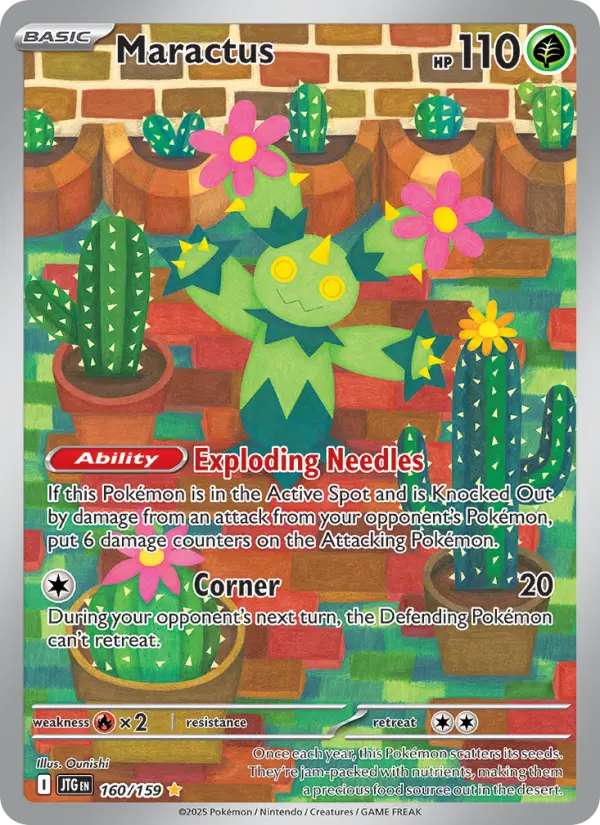
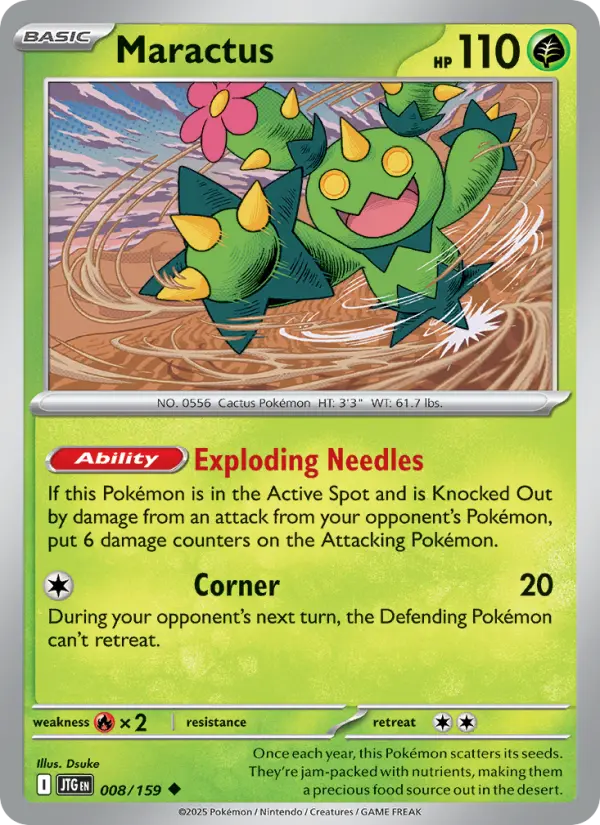
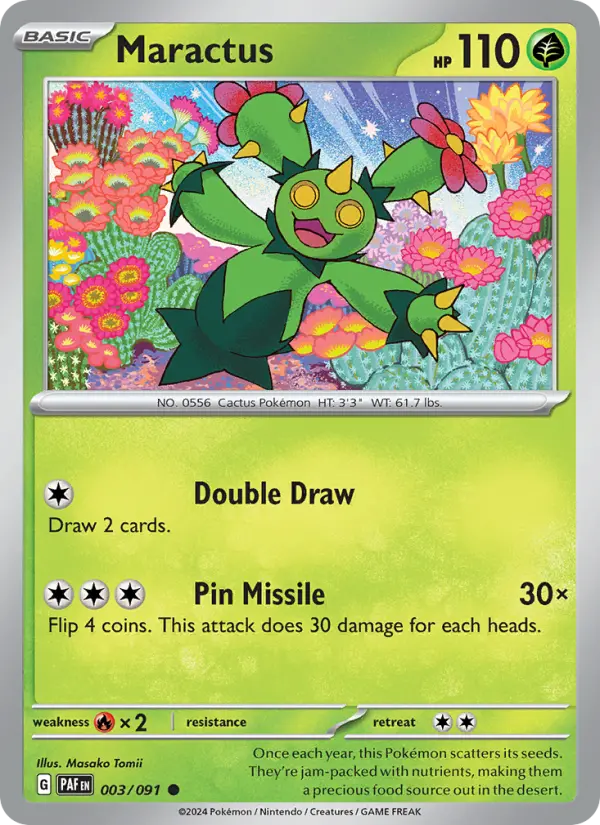
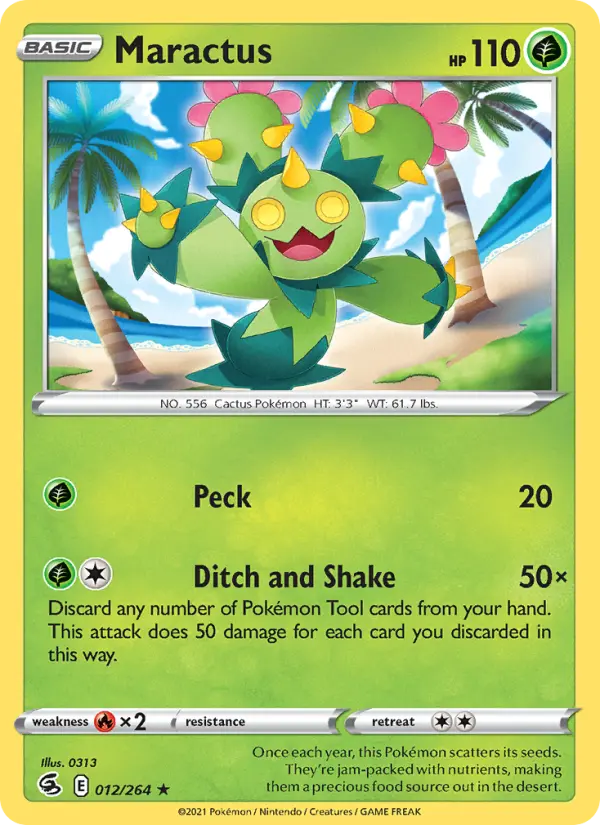
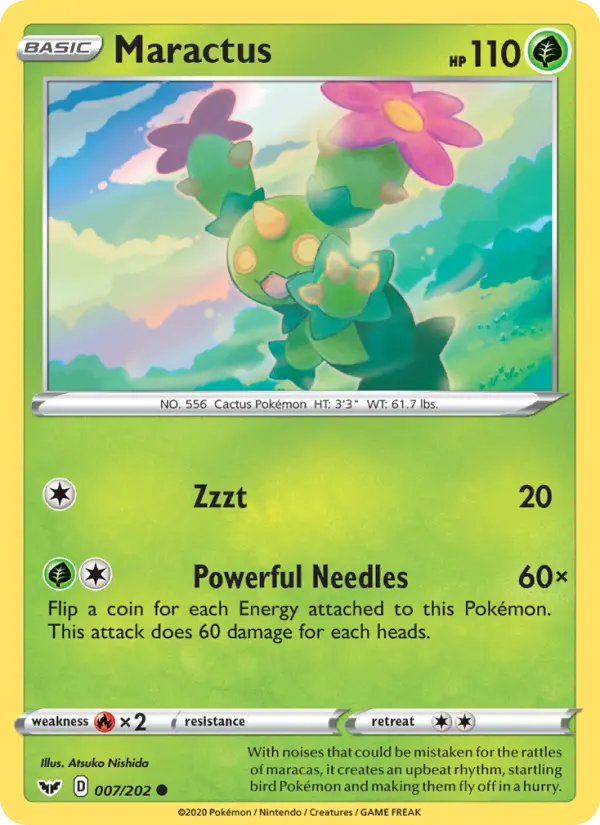
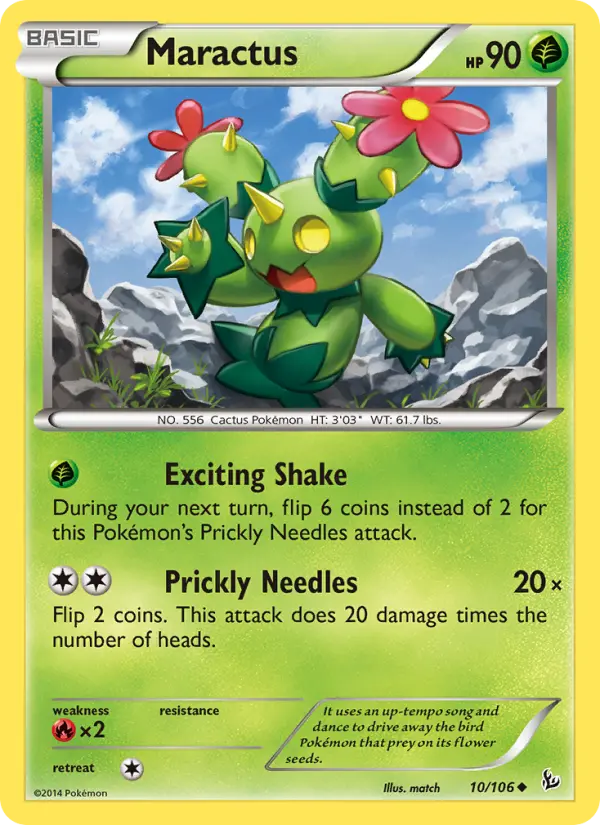
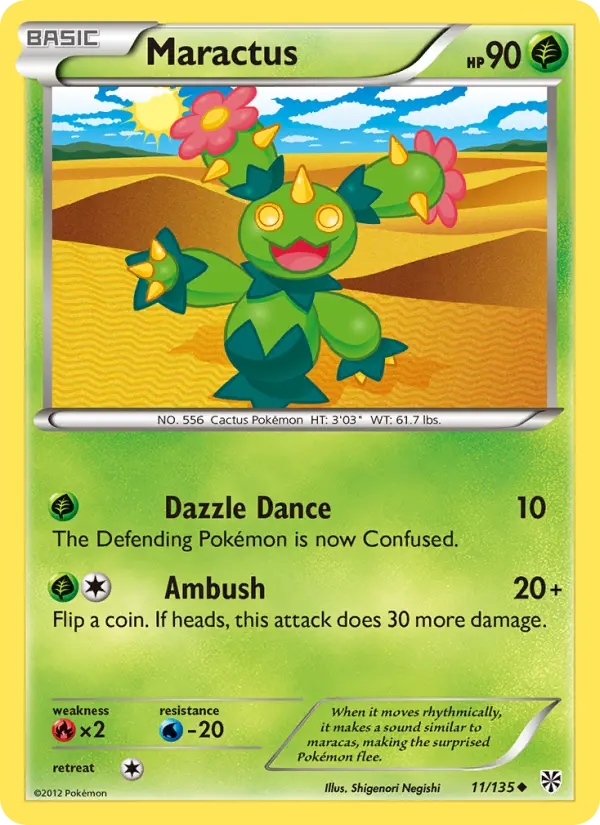
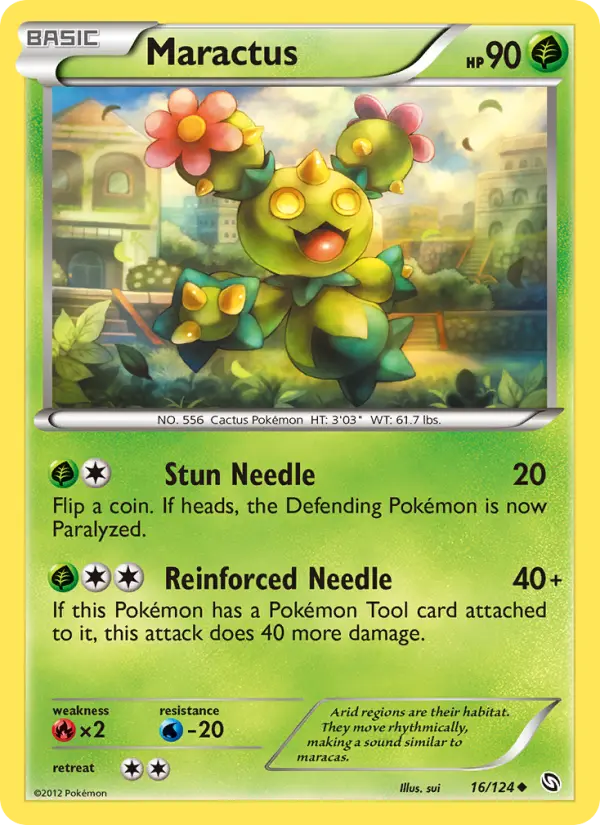
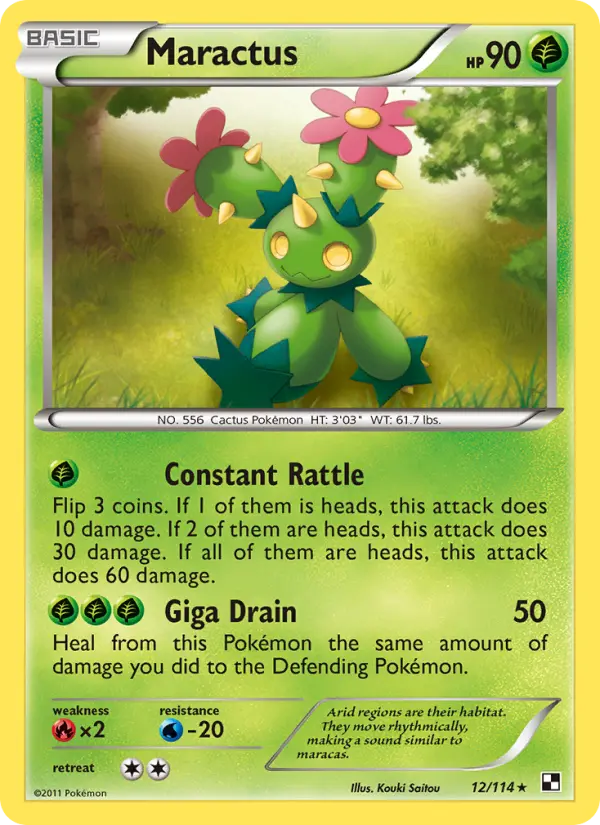
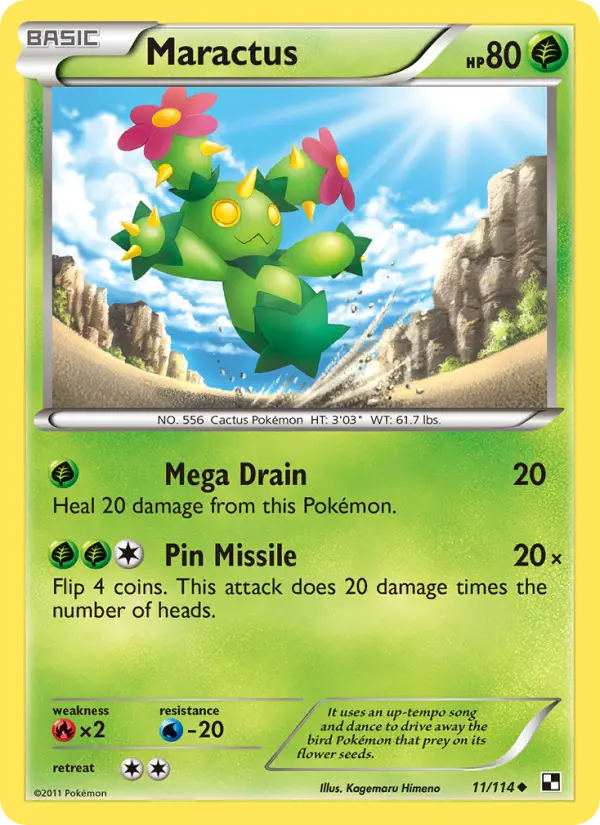
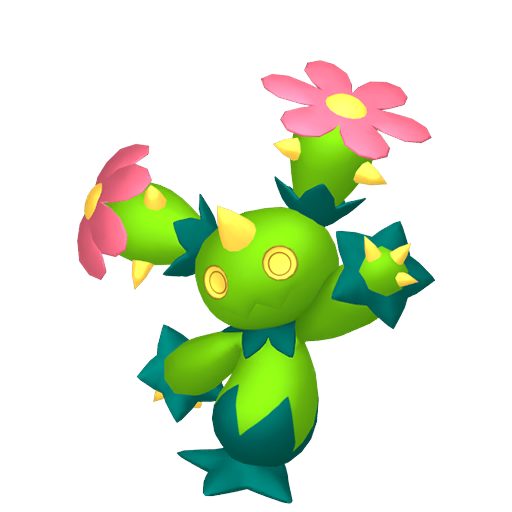
Maractus presents a striking cactus-inspired appearance that immediately evokes the desert landscapes it inhabits. Its body features a pair of prominent ear-like extensions protruding from its head, each resembling the arms of a barrel cactus, crowned with beautiful flowers composed of six pink petals surrounding a yellow center. These distinctive appendages are adorned with dark green spiky arrangements at their bases, transitioning to yellow spikes midway up their length. The Pokémon's facial features include a yellow spike prominently displayed on its forehead, bright yellow eyes, and a peculiar spiky-looking mouth that contributes to its expressive character. Its torso is equipped with two lobe-like arms similar to those of real cacti, with each hand featuring three yellow spines that serve as functional fingers. Additional dark green spiky protrusions circle its neck and wrists, while the base of its body displays spikes arranged in a distinctive five-pointed star pattern. This thorny exterior serves both aesthetic and defensive purposes, protecting the delicate flower and seeds that represent Maractus's most vulnerable—yet vital—components.
Pokedex Numbers
Training
Breeding
Maractus Breeding, Gender Ratio & Egg Groups
Half of all Maractus are male, half are female — no skew to plan around, ensuring equal representation of both sexes in wild populations and making gender-based breeding strategies equally viable regardless of player preference. This species belongs exclusively to the Grass Egg Group, restricting its breeding compatibility to other members of this ecological category—a classification that reflects Maractus's fundamental nature as a plant-based organism. The species demonstrates relatively quick breeding results compared to many Pokémon, requiring 20 egg cycles to hatch, which translates to approximately 4,884 to 5,140 steps with a standard incubation speed. Maractus offspring are known to be friendly and trainable, supported by its base happiness value of 70, a figure higher than many Pokémon and suggesting that Maractus eggs have been naturally selected by trainers for their cooperative temperament over generations. The ease with which Maractus breeds and the reliability of its offspring make it a popular choice for breeders seeking Grass-type Pokémon with good foundational natures and individual values.
Sprites




Held Items
Miracle Seed
type-enhancement
Held: Grass-Type moves from holder do 20% more damage.
Cost: 1000
Miracle Seed
type-enhancement
Held: Grass-Type moves from holder do 20% more damage.
Cost: 1000
Miracle Seed
type-enhancement
Held: Grass-Type moves from holder do 20% more damage.
Cost: 1000
Miracle Seed
type-enhancement
Held: Grass-Type moves from holder do 20% more damage.
Cost: 1000
Miracle Seed
type-enhancement
Held: Grass-Type moves from holder do 20% more damage.
Cost: 1000
Miracle Seed
type-enhancement
Held: Grass-Type moves from holder do 20% more damage.
Cost: 1000
Miracle Seed
type-enhancement
Held: Grass-Type moves from holder do 20% more damage.
Cost: 1000
Miracle Seed
type-enhancement
Held: Grass-Type moves from holder do 20% more damage.
Cost: 1000
Miracle Seed
type-enhancement
Held: Grass-Type moves from holder do 20% more damage.
Cost: 1000
Miracle Seed
type-enhancement
Held: Grass-Type moves from holder do 20% more damage.
Cost: 1000
Miracle Seed
type-enhancement
Held: Grass-Type moves from holder do 20% more damage.
Cost: 1000
Miracle Seed
type-enhancement
Held: Grass-Type moves from holder do 20% more damage.
Cost: 1000
TMs & HMs
tm03
lets go pikachu lets go eevee
tm05
lets go pikachu lets go eevee
tm06
yellow
tm06
gold silver
tm06
red blue
tm06
crystal
tm06
emerald
tm06
firered leafgreen
tm06
diamond pearl
tm06
platinum
tm06
ruby sapphire
tm06
colosseum
tm06
black 2 white 2
tm06
xd
tm06
black white
tm06
heartgold soulsilver
tm06
omega ruby alpha sapphire
tm06
ultra sun ultra moon
tm06
sun moon
tm06
x y
+426 more TMs/HMs
Maractus Evolution, Mega Evolution & Special Forms
Maractus remains a standalone Pokémon with no evolutionary relatives in any generation. Unlike the majority of Generation V Pokémon, which typically belong to multi-stage evolutionary chains, Maractus has never been known to evolve from a predecessor species nor has it received an evolutionary successor in any subsequent generation, including the introduction of Mega Evolution mechanics in Generation VI. This status as a complete, fully-formed Pokémon from the moment of encounter presents unique strategic considerations for trainers, as Maractus cannot improve through traditional evolution methods. However, this singular nature has allowed Game Freak to design Maractus as a fully optimized, independent entity, with its base stats distributed to maximize its distinctive strengths rather than serving as a transitional form. The absence of an evolutionary path makes Maractus stand out among Generation V Pokémon as a reminder that not all creatures require transformation to achieve their full potential.
Where to Find
Desert Resort
unova
+5 more
Maractus Behaviour and Natural Habitat
Maractus is intrinsically adapted to arid desert environments, where it thrives in conditions that would prove inhospitable to most other Pokémon. The species exhibits remarkable behavioral patterns centered around rhythmic movement and sound production; when Maractus moves its body in synchronized motions, it produces sounds strikingly similar to maracas being shaken, creating up-tempo melodies that serve multiple ecological purposes. These vocalizations function primarily as a defense mechanism against avian Pokémon that actively hunt Maractus's flower seeds, with the sudden noise and rhythmic display startling would-be predators into flight. According to Pokédex records, this annual seed dispersal is a critical event in the desert ecosystem, as Maractus scatters nutrient-rich seeds across vast arid regions, providing precious sustenance for countless other desert-dwelling Pokémon species. The species' behavioral adaptations demonstrate sophisticated survival strategies refined through evolution in harsh environmental conditions, where both predation pressure and resource scarcity demand constant vigilance and innovation.
Pokedex Entries
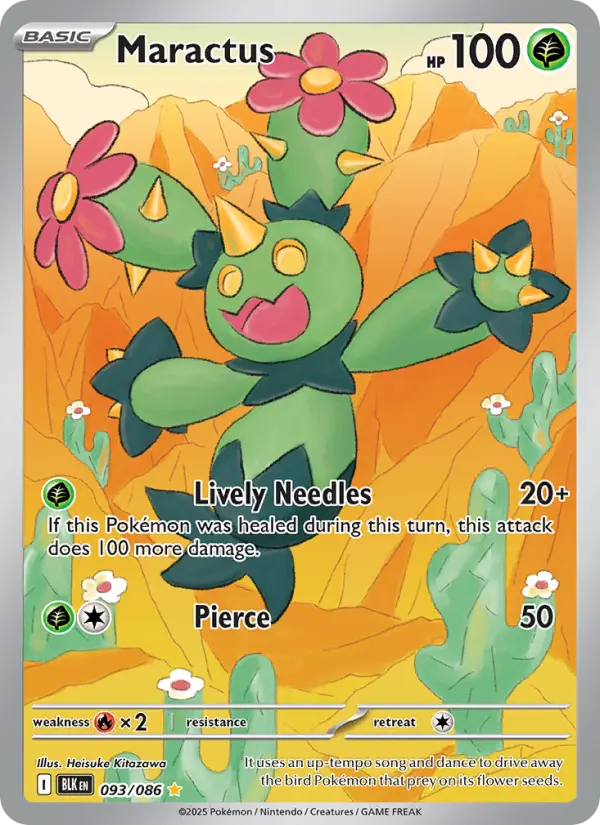
It uses an up-tempo song and dance to drive away the bird Pokémon that prey on its flower seeds.
When it moves rhythmically, it makes a sound similar to maracas, making the surprised Pokémon flee.
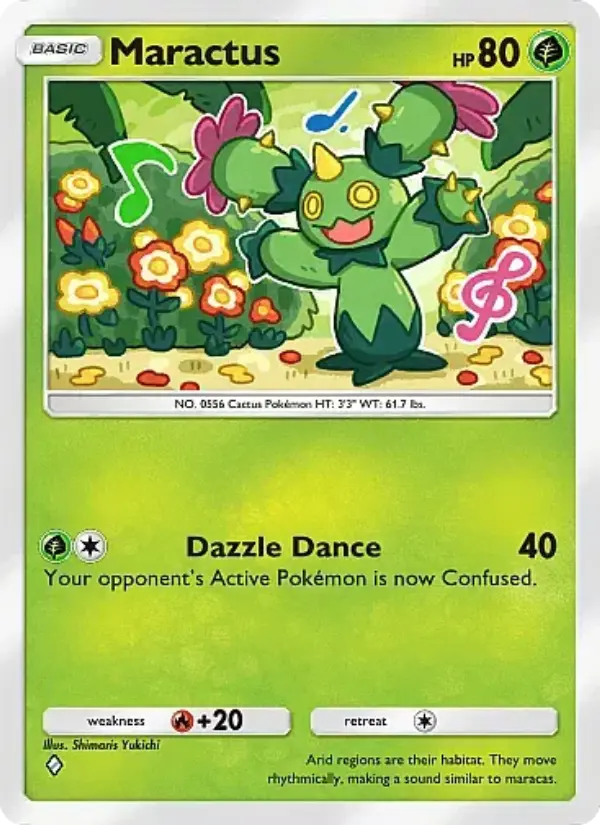
Arid regions are their habitat. They move rhythmically, making a sound similar to maracas.
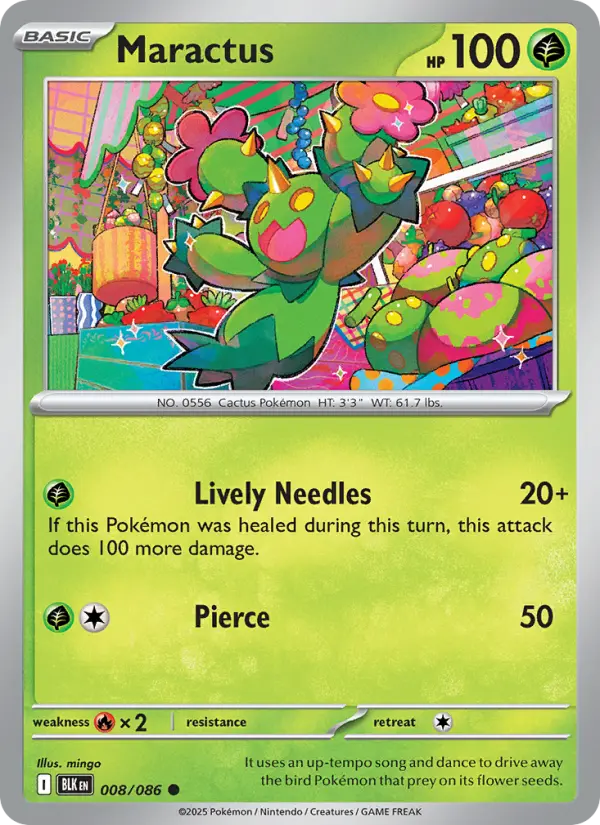
It uses an up-tempo song and dance to drive away the bird Pokémon that prey on its flower seeds.
Arid regions are their habitat. They move rhythmically, making a sound similar to maracas.
It uses an up-tempo song and dance to drive away the bird Pokémon that prey on its flower seeds.
Arid regions are their habitat. They move rhythmically, making a sound similar to maracas.
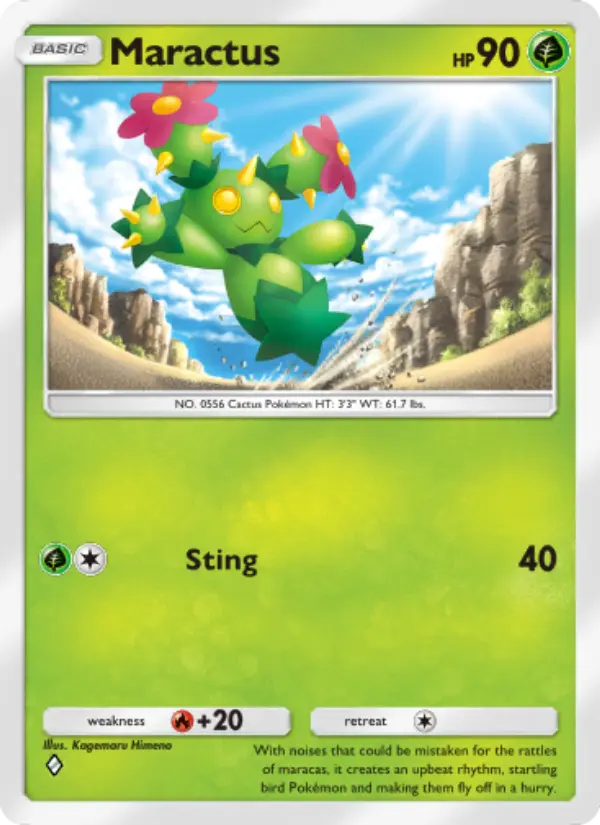
With noises that could be mistaken for the rattles of maracas, it creates an upbeat rhythm, startling bird Pokémon and making them fly off in a hurry.
Once each year, this Pokémon scatters its seeds. They’re jam-packed with nutrients, making them a precious food source out in the desert.
Maractus Name Origin & Design Inspiration
The name Maractus is a clever linguistic fusion of 'maraca' and 'cactus,' capturing the essence of this Pokémon's dual defining characteristics in a single, memorable designation. The Japanese name Maracacchi follows similar naming conventions, incorporating the onomatopoeia of maraca instruments into the cactus concept. This linguistic blend reflects the designer's intent to create a Pokémon that seamlessly merges musical instrumental references with botanical imagery, resulting in a creature that feels both whimsical and grounded in natural inspiration. The design itself borrows heavily from real-world cacti species, particularly the distinctive ear-like protrusions that evoke the appearance of a prickly pear or barrel cactus viewed from certain angles. The floral crown topping these appendages adds an unexpected elegance to what might otherwise be a purely defensive creature, suggesting beauty and vulnerability alongside ecological importance. The yellow coloration of spines and facial features provides visual contrast against the predominant green, creating a design that is immediately recognizable and visually striking despite the Pokémon's relatively modest stature.
Learnable Moves
Maractus can learn 65 moves:
Move | Type | Cat. | Power | Acc. | PP |
|---|---|---|---|---|---|
| absorb | grass | Special | 20 | 100 | 25 |
| acupressure | normal | Status | — | — | 30 |
| aerial ace | flying | Physical | 60 | — | 20 |
| after you | normal | Status | — | — | 15 |
| assurance | dark | Physical | 60 | 100 | 10 |
| attract | normal | Status | — | 100 | 15 |
| bounce | flying | Physical | 85 | 85 | 5 |
| bullet seed | grass | Physical | 25 | 100 | 30 |
| confide | normal | Status | — | — | 20 |
| cotton guard | grass | Status | — | — | 10 |
| cotton spore | grass | Status | — | 100 | 40 |
| double team | normal | Status | — | — | 15 |
| drain punch | fighting | Physical | 75 | 100 | 10 |
| endeavor | normal | Physical | — | 100 | 5 |
| endure | normal | Status | — | — | 10 |
| energy ball | grass | Special | 90 | 100 | 10 |
| facade | normal | Physical | 70 | 100 | 20 |
| frustration | normal | Physical | — | 100 | 20 |
| giga drain | grass | Special | 75 | 100 | 10 |
| grass knot | grass | Special | — | 100 | 20 |
| grass whistle | grass | Status | — | 55 | 15 |
| grassy glide | grass | Physical | 55 | 100 | 20 |
| grassy terrain | grass | Status | — | — | 10 |
| growth | normal | Status | — | — | 20 |
| helping hand | normal | Status | — | — | 20 |
| hidden power | normal | Special | 60 | 100 | 15 |
| hyper voice | normal | Special | 90 | 100 | 10 |
| ingrain | grass | Status | — | — | 20 |
| knock off | dark | Physical | 65 | 100 | 20 |
| leaf storm | grass | Special | 130 | 90 | 5 |
| leech seed | grass | Status | — | 90 | 10 |
| mega drain | grass | Special | 40 | 100 | 15 |
| nature power | normal | Status | — | — | 20 |
| needle arm | grass | Physical | 60 | 100 | 15 |
| peck | flying | Physical | 35 | 100 | 35 |
| petal blizzard | grass | Physical | 90 | 100 | 15 |
| petal dance | grass | Special | 120 | 100 | 10 |
| pin missile | bug | Physical | 25 | 95 | 20 |
| poison jab | poison | Physical | 80 | 100 | 20 |
| protect | normal | Status | — | — | 10 |
| rain dance | water | Status | — | — | 5 |
| rest | psychic | Status | — | — | 5 |
| return | normal | Physical | — | 100 | 20 |
| round | normal | Special | 60 | 100 | 15 |
| safeguard | normal | Status | — | — | 25 |
| screech | normal | Status | — | 85 | 40 |
| secret power | normal | Physical | 70 | 100 | 20 |
| seed bomb | grass | Physical | 80 | 100 | 15 |
| sleep talk | normal | Status | — | — | 10 |
| snore | normal | Special | 50 | 100 | 15 |
| solar beam | grass | Special | 120 | 100 | 10 |
| spikes | ground | Status | — | — | 20 |
| spiky shield | grass | Status | — | — | 10 |
| substitute | normal | Status | — | — | 10 |
| sucker punch | dark | Physical | 70 | 100 | 5 |
| sunny day | fire | Status | — | — | 5 |
| swagger | normal | Status | — | 85 | 15 |
| sweet scent | normal | Status | — | 100 | 20 |
| synthesis | grass | Status | — | — | 5 |
| throat chop | dark | Physical | 80 | 100 | 15 |
| toxic | poison | Status | — | 90 | 10 |
| uproar | normal | Special | 90 | 100 | 10 |
| weather ball | normal | Special | 50 | 100 | 10 |
| wood hammer | grass | Physical | 120 | 100 | 15 |
| worry seed | grass | Status | — | 100 | 10 |
Maractus Competitive Battle Guide
In competitive battling, Maractus occupies a niche role as a special attacker with interesting defensive utility options provided by its three distinct abilities. Its base Special Attack of 106 stands as its most formidable stat, providing genuine offensive pressure, while its base HP of 75 offers moderate bulk when paired with defensive training or appropriate movepool selection. The ability Water Absorb grants Maractus both defensive utility and offensive momentum by absorbing Water-type moves and healing for one-quarter of maximum HP, while also potentially allowing defensive pivoting into Water-type attacks. The Hidden Ability Storm Drain offers similar benefits with the added versatility of redirecting single-target Water moves toward Maractus while simultaneously boosting Special Attack—a rare combination that transforms would-be disadvantageous matchups into offensive opportunities. Chlorophyll, the species' regular Hidden Ability, doubles Speed during harsh sunlight, enabling sweeping strategies in sun-based team compositions. Maractus's modest base Speed of 60 and moderate defenses of 67 each limit its effectiveness in higher competitive tiers, relegating it primarily to casual play and lower-ranked competitive environments where its unique ability combinations and respectable Special Attack can secure victories through clever play rather than overwhelming stats.
Commonly Asked Questions About Maractus
What type is Maractus?
Maractus is a grass type Pokemon.
What does Maractus evolve from?
Maractus does not evolve.
What are Maractus's weaknesses?
Maractus is weak to flying, poison, bug, fire and ice type moves.
Where can I find Maractus?
Maractus can be found in desert resort (unova).
Maractus Cultural Impact & Franchise History
Maractus has earned recognition within the Pokémon community as a beloved representative of Generation V's commitment to creative design diversity, despite not achieving mainstream competitive prominence. The Pokémon's distinctive appearance and musical design philosophy have endeared it to casual players and collectors, particularly those drawn to plant-type Pokémon and desert-themed aesthetics. Its presence in the National Pokédex, combined with its high catchability and friendly demeanor, established Maractus as an accessible introduction to Grass-type Pokémon for players exploring Unova and subsequent generations. Fan communities have embraced Maractus's unique characteristics, often celebrating its maraca-based design in artwork, merchandise, and fan fiction that explore the rhythmic, musical aspects of its nature. The Pokémon's role in maintaining desert ecosystems through seed dispersal, as described in multiple Pokédex entries, has contributed to broader player appreciation for how individual Pokémon species contribute to their environments within the franchise's worldbuilding. While Maractus has not achieved iconic status equivalent to franchise legends, its steady presence across multiple game generations and media appearances has secured it a respectable place in the hearts of dedicated Pokémon enthusiasts.
Where to Find Maractus in Every Pokémon Game
Maractus was first introduced to the Pokémon franchise in Generation V, becoming available in Pokémon Black and White as Pokédex entry #062 in the regional Unova Dex, and was promoted to entry #119 in the subsequent Black 2 and White 2 entries. Its exceptionally high catch rate of 255 made it readily obtainable for trainers exploring desert environments in these games without requiring specialized capture techniques or extreme luck. The species has maintained consistent availability across subsequent generations, appearing in Generation VI's X and Y games, as well as the Alola region entries in Generation VII's Sun and Moon titles. Generation VIII's Sword and Shield saw Maractus return as a Pokédex entry #296 in the regional Galar Dex, confirming its status as a recurring staple of the franchise across multiple console generations and region variations. The Pokémon's reliable accessibility across different game versions and generational releases reflects its design as an introductory, approachable Grass-type option, ensuring that new players beginning their Pokémon journey have ready access to this distinctive desert companion regardless of which version or generation they choose to explore first.