Nymble
Generation IX · #0919 — Grasshopper Pokémon
Nymble's profile is easy to undersell: 0.2 m, 1 kg, and a bug typing that doesn't scream power — until you look at its Attack of 46.
Editor's Take
Nymble's line ends in Lokix, whose First Impression at 90 base power with priority on the first turn makes it one of the better revenge killers in Gen 9.
Base Stats
Height
0.2m
Weight
1.0kg
Category
Grasshopper Pokémon
Gender
Male 50% / Female 50%
Color
gray
Shape
armor
Abilities
Strengthens bug moves to inflict 1.5× damage at 1/3 max HP or less.
Doubles damage inflicted with not-very-effective moves.

Nymble Biology & Physical Characteristics
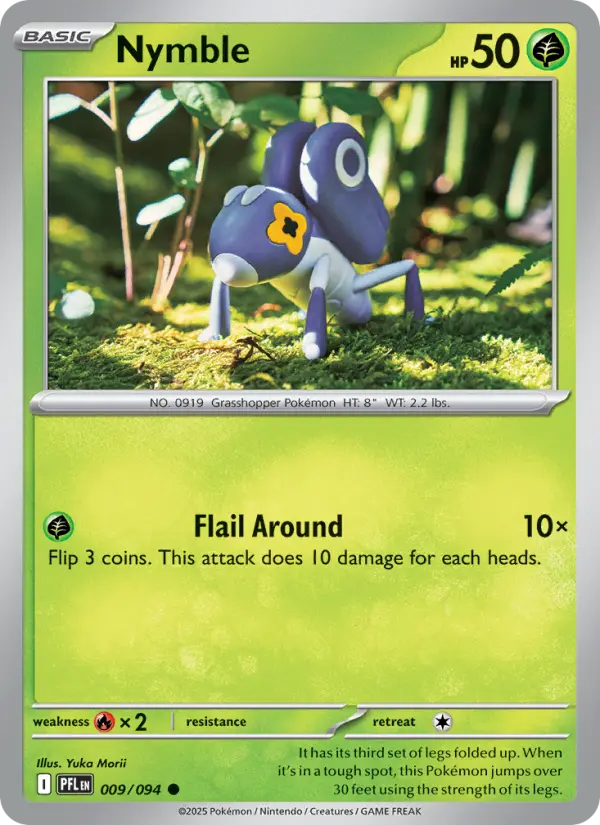
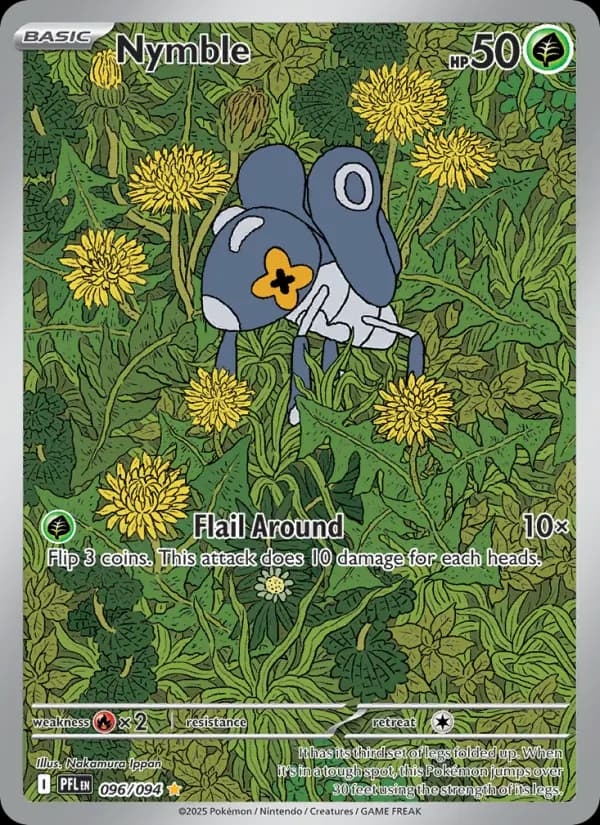
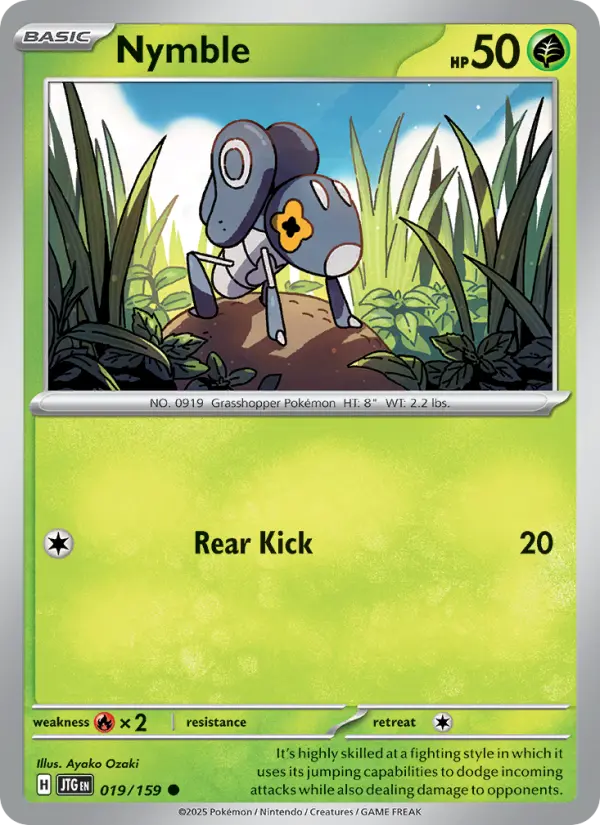
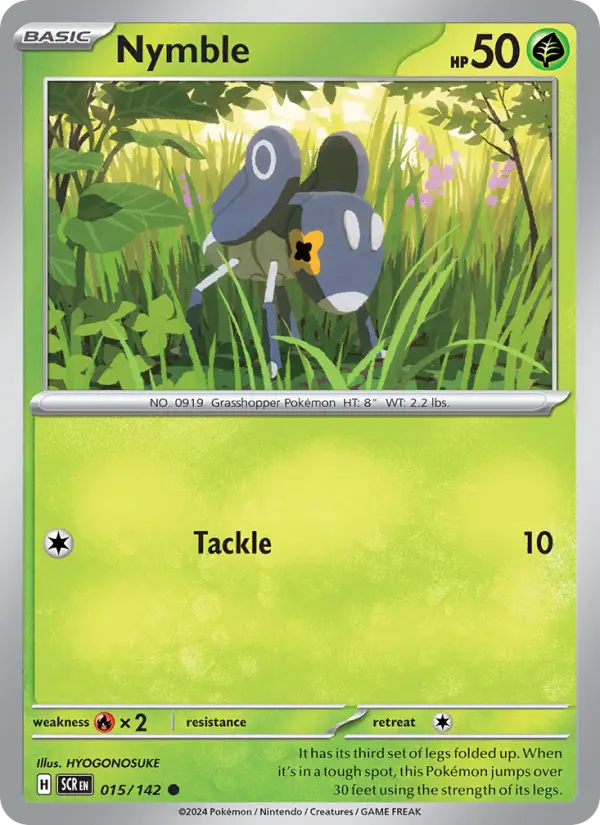
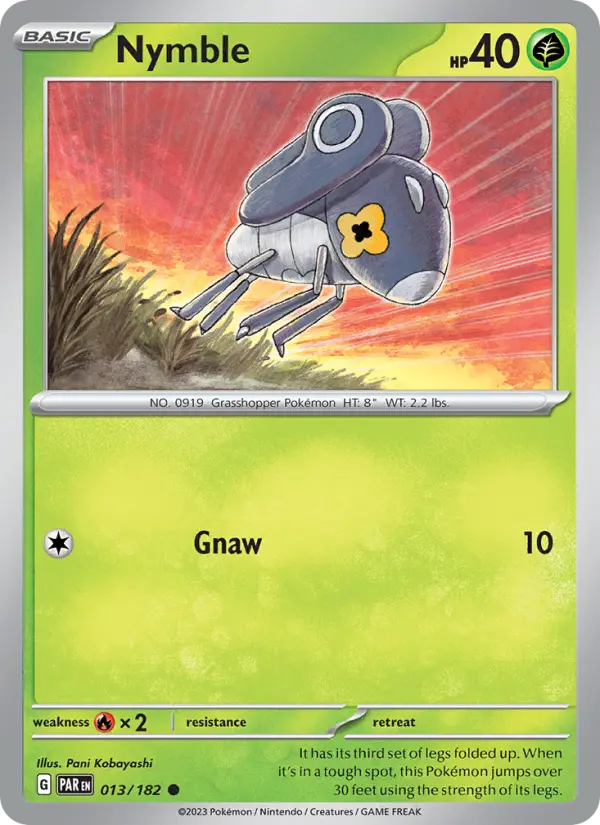
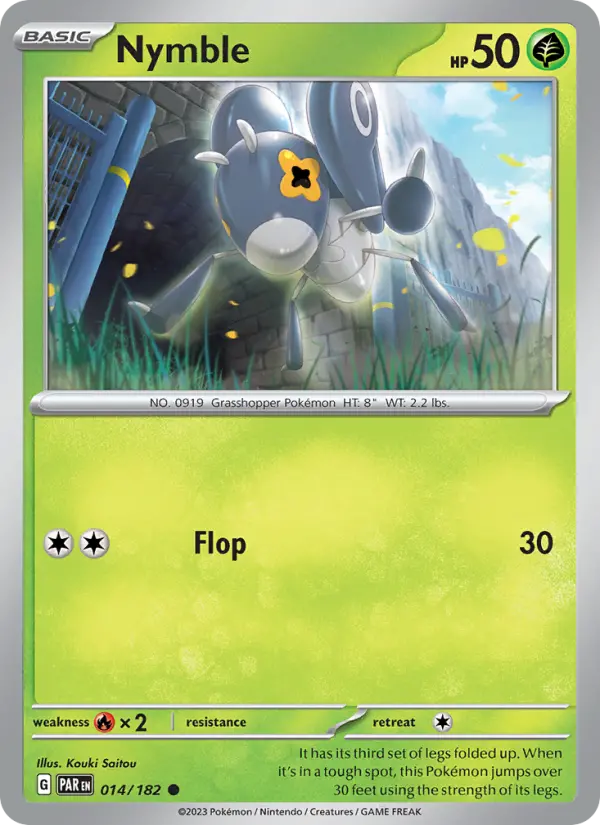
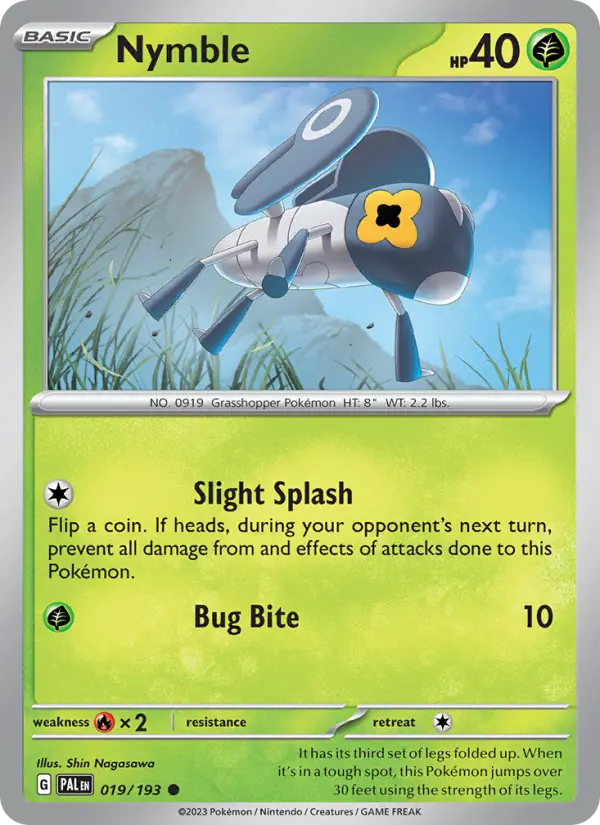
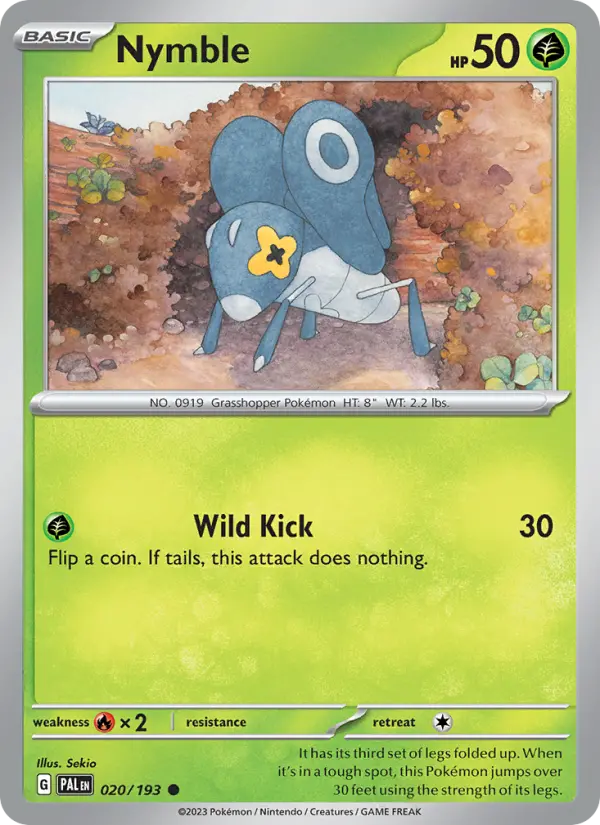
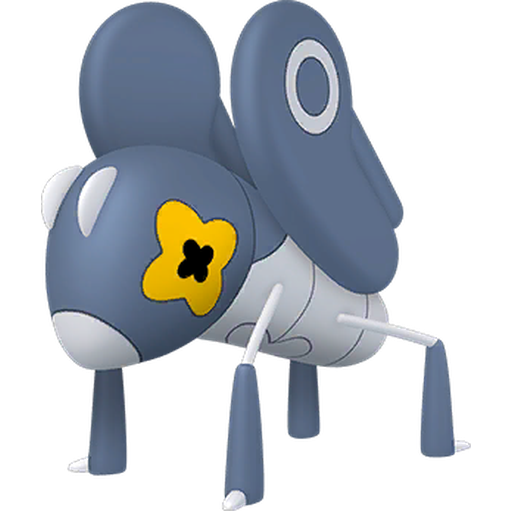
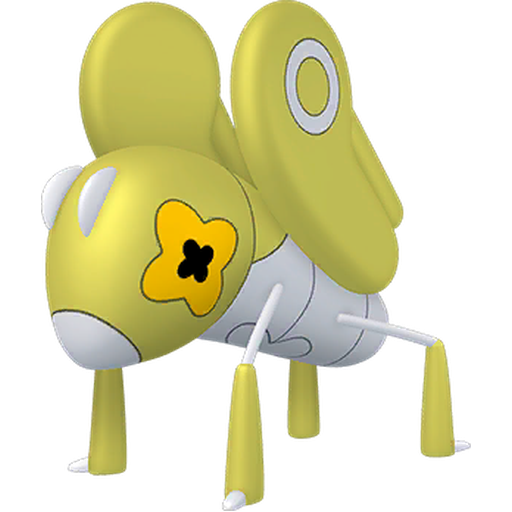
Nymble's physical structure is distinctly insectoid, featuring a gray, oblong body segmented by characteristic lines that reflect its grasshopper heritage. Its most striking features include a pair of stubby semicircular antennae atop its head, yellow compound eyes shaped like rounded crosses with cross-shaped pupils, and a circular marking on its snout that resembles either a mouth or nose. The Pokémon possesses six legs arranged in three pairs: the first two pairs are standard forelimbs located on the sides of its body, each tipped with a single dark gray claw, while the third pair—the most remarkable feature—consists of large, oblong dark gray legs positioned above its body with light gray ring patterns marking the joints. Nymble typically keeps this third set of legs folded compactly against its body, only extending them when jumping. The underside of its body displays an X-shaped pattern in lighter coloration, while its face and back feature darker gray markings that provide contrast to its predominantly gray appearance.
Pokedex Numbers
Training
Breeding
Nymble Breeding, Gender Ratio & Egg Groups
Gender-wise, Nymble is an even 50/50 split between males and females, allowing for flexible breeding combinations within the Bug egg group. With a relatively high catch rate of 190 and base happiness of only 20—notably lower than standard Pokémon—Nymble presents an interesting breeding subject for trainers seeking Bug-type Pokémon with specific movesets or natures. The species hatches from eggs in 20 cycles, equivalent to approximately 4,884 to 5,140 steps, making it a reasonably quick hatch compared to many other Pokémon. As a member of the Bug egg group, Nymble can breed with other Bug-type Pokémon and compatible partners to pass down egg moves such as Counter, Skitter Smack, and other specialized techniques not available through level-up or Technical Machine tutoring. The combination of its low base friendship stat and early-game availability makes Nymble an accessible option for breeders looking to establish breeding populations with favorable genetic traits or egg move combinations.
Sprites




TMs & HMs
tm05
lets go pikachu lets go eevee
tm07
lets go pikachu lets go eevee
tm08
lets go pikachu lets go eevee
tm09
yellow
tm09
red blue
tm11
platinum
tm11
xd
tm50
scarlet violet
tm11
diamond pearl
tm11
x y
tm11
crystal
tm11
emerald
tr60
sword shield
tm25
scarlet violet
tm49
scarlet violet
tm85
scarlet violet
tm09
blue japan
tm11
gold silver
tm11
colosseum
tm11
sun moon
+190 more TMs/HMs


Nymble Evolution, Mega Evolution & Special Forms
Nymble's evolutionary progression is straightforward but transformative. Upon reaching level 24, Nymble evolves into Lokix, a Bug/Dark-type Pokémon that represents a significant power spike in both stats and movepool capabilities. This evolution marks a shift from Nymble's pure Bug typing to a dual-type configuration, gaining Dark-type characteristics that expand its type coverage and strategic flexibility. The evolutionary process appears to mark a maturation in Nymble's development, with Lokix gaining considerably enhanced offensive stats and the ability to learn more powerful moves such as First Impression, which becomes available to Nymble at level 41 and continues into its evolved form. The transition from base form to Lokix represents not merely a statistical upgrade but a fundamental shift in battle strategy, with Lokix becoming capable of more aggressive and diversified approaches compared to Nymble's focus on speed and physical attacking prowess.
Where to Find
Location data not available for this Pokémon in the database.
Nymble Behaviour and Natural Habitat
According to Pokédex entries from both Scarlet and Violet versions, Nymble exhibits a remarkable fighting style centered entirely on its exceptional jumping capabilities. When faced with threats or opponents, this Pokémon can launch itself over 30 feet into the air using the explosive strength of its specialized leg muscles—a feat that demonstrates the raw power contained within its diminutive frame. The Violet Pokédex entry specifically notes that Nymble is highly skilled in a martial discipline that leverages these jumping abilities to both dodge incoming attacks and simultaneously deal damage to adversaries, suggesting a sophisticated understanding of evasive combat tactics despite its early evolutionary stage. This combination of mobility and offensive capability makes Nymble an effective early-game combatant, using its speed and athleticism to control battlefield positioning. In its natural habitat within the Paldea region, Nymble is found in various outdoor locations where its grasshopper-like nature would allow it to thrive among vegetation and open spaces.
Pokedex Entries
It has its third set of legs folded up. When it’s in a tough spot, this Pokémon jumps over 30 feet using the strength of its legs.
It’s highly skilled at a fighting style in which it uses its jumping capabilities to dodge incoming attacks while also dealing damage to opponents.
Nymble Name Origin & Design Inspiration
The Japanese name Mamebatta (マメバッタ) combines 'mame' (豆), meaning bean or small, with 'batta' (バッタ), the Japanese word for grasshopper—a fitting descriptor for this small insectoid Pokémon. The English designation of 'Nymble' appears to derive from 'nymph,' the term for the immature stage of grasshoppers and other insects that undergo incomplete metamorphosis, perfectly encapsulating its role as a pre-evolution form. This linguistic choice elegantly mirrors real-world entomology, where nymphs represent juvenile insects that gradually approach their final adult form through successive molts. The Grasshopper Pokémon classification further reinforces its biological inspiration and ecological niche. The design philosophy emphasizes a miniature, mobile creature with disproportionately powerful legs—a visual representation of how nature often concentrates specialized adaptations in unexpected places, much like real grasshoppers whose leg-to-body ratio allows for incredible jumping distances relative to their size.
Learnable Moves
Nymble can learn 31 moves:
Move | Type | Cat. | Power | Acc. | PP |
|---|---|---|---|---|---|
| agility | psychic | Status | — | — | 30 |
| assurance | dark | Physical | 60 | 100 | 10 |
| astonish | ghost | Physical | 30 | 100 | 15 |
| bug bite | bug | Physical | 60 | 100 | 20 |
| bug buzz | bug | Special | 90 | 100 | 10 |
| counter | fighting | Physical | — | 100 | 20 |
| double kick | fighting | Physical | 30 | 100 | 30 |
| endure | normal | Status | — | — | 10 |
| facade | normal | Physical | 70 | 100 | 20 |
| feint | normal | Physical | 30 | 100 | 10 |
| first impression | bug | Physical | 90 | 100 | 10 |
| leech life | bug | Physical | 80 | 100 | 10 |
| leer | normal | Status | — | 100 | 30 |
| pounce | bug | Physical | 50 | 100 | 20 |
| protect | normal | Status | — | — | 10 |
| rain dance | water | Status | — | — | 5 |
| rest | psychic | Status | — | — | 5 |
| screech | normal | Status | — | 85 | 40 |
| skitter smack | bug | Physical | 70 | 90 | 10 |
| sleep talk | normal | Status | — | — | 10 |
| struggle bug | bug | Special | 50 | 100 | 20 |
| substitute | normal | Status | — | — | 10 |
| sucker punch | dark | Physical | 70 | 100 | 5 |
| sunny day | fire | Status | — | — | 5 |
| tackle | normal | Physical | 40 | 100 | 35 |
| take down | normal | Physical | 90 | 85 | 20 |
| tera blast | normal | Special | 80 | 100 | 10 |
| thief | dark | Physical | 60 | 100 | 25 |
| trailblaze | grass | Physical | 50 | 100 | 20 |
| u turn | bug | Physical | 70 | 100 | 20 |
| x scissor | bug | Physical | 80 | 100 | 15 |
Nymble Competitive Battle Guide
In competitive environments, Nymble's viability is limited by its modest aggregate stat total of 210, with particular constraints on its Special Attack stat of only 21—making special moves largely impractical. However, its Attack stat of 46 and Speed stat of 45 establish it as a competent physical attacker within its tier, capable of dealing consistent damage through physical Bug-type moves like Bug Bite (60 power, 100 accuracy) and Struggle Bug (50 power, 100 accuracy). Nymble's movepool includes access to Dark-type coverage through moves like Assurance (60 power) and Sucker Punch (70 power, 100 accuracy), along with Fighting-type moves such as Double Kick (30 power each hit) and Counter, providing diverse damage options. Its two abilities offer contrasting strategic approaches: Swarm activates at low health thresholds to boost Bug-move damage to 1.5 times normal, creating a desperation tactic for late-game comebacks, while the hidden ability Tinted Lens doubles damage from not-very-effective moves, allowing Nymble to overcome the Bug-type's numerous weaknesses to Flying, Rock, and Fire-type attacks. In Little Cup formats where unevolved Pokémon compete, Nymble becomes a more relevant option, though most competitive players typically wait for its evolution into Lokix to access superior statistics and the Dark-type addition.
Commonly Asked Questions About Nymble
What type is Nymble?
Nymble is a bug type Pokemon.
What does Nymble evolve into?
Nymble evolves into lokix.
What are Nymble's weaknesses?
Nymble is weak to flying, rock and fire type moves.
Does Nymble evolve by trading?
No — Nymble evolves entirely through leveling up, with no trade required at any stage.
Nymble Cultural Impact & Franchise History
As a Generation IX introduction debuting in Pokémon Scarlet and Violet, Nymble emerged during a transformative period for the Pokémon franchise as players explored the open-world design of Paldea. The species has appeared in various anime adaptations and supplementary media, establishing its presence within Pokémon culture alongside its evolved form Lokix. The design's emphasis on athleticism and martial prowess through jumping mechanics has resonated with trainers seeking dynamic, movement-focused Pokémon that embody real-world insect capabilities. Nymble's relatively approachable early-game availability combined with its competitive evolution path has made it a popular choice among players building their first teams in Scarlet and Violet. The species represents the modern design philosophy of Generation IX, which emphasizes functional creature designs with clear ecological and behavioral foundations, avoiding purely fantastical abstractions in favor of naturalistic inspiration grounded in real animal behavior.
Where to Find Nymble in Every Pokémon Game
Nymble is exclusively available in Generation IX games, making its first appearance in Pokémon Scarlet and Violet where it appears in the Paldea Pokédex as entry #14. In these versions, Nymble can be encountered in various outdoor locations throughout the Paldea region, with specific spawn rates and habitat preferences that reflect its grasshopper nature. The species has not yet appeared in Pokémon Legends: Z-A, as evidenced by the absence of Pokédex entries or learnset data for that title. Players seeking to obtain Nymble in Generation IX can capture wild specimens, breed them from caught parents with compatible movesets, or trade with other players. The species' high catch rate of 190 makes it relatively accessible even when encountered at low health thresholds, facilitating easy capture for trainers building their teams. As a base-form Pokémon appearing relatively early in the Paldean experience, Nymble serves as an accessible Bug-type option for players prioritizing early-game team construction, with the evolutionary path to Lokix remaining available throughout the game for those who wish to develop their Nymble into a more powerful form.