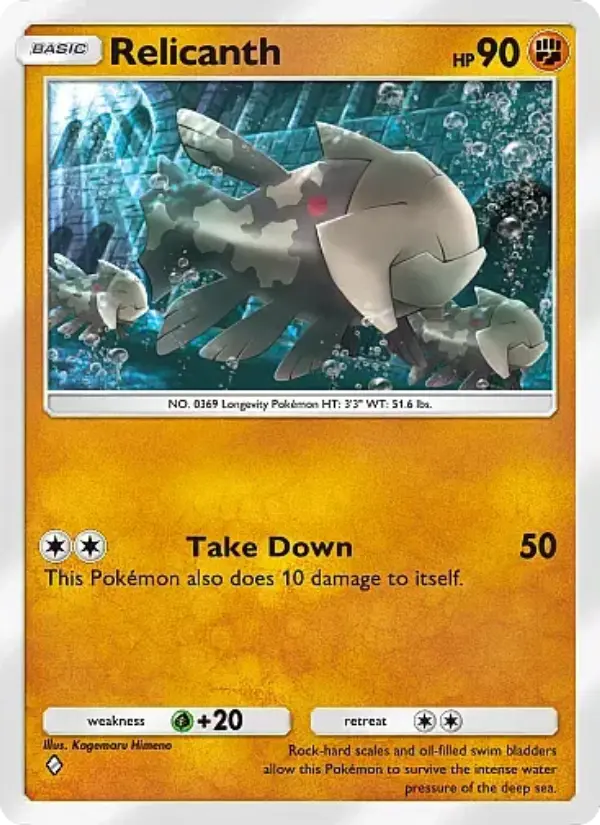
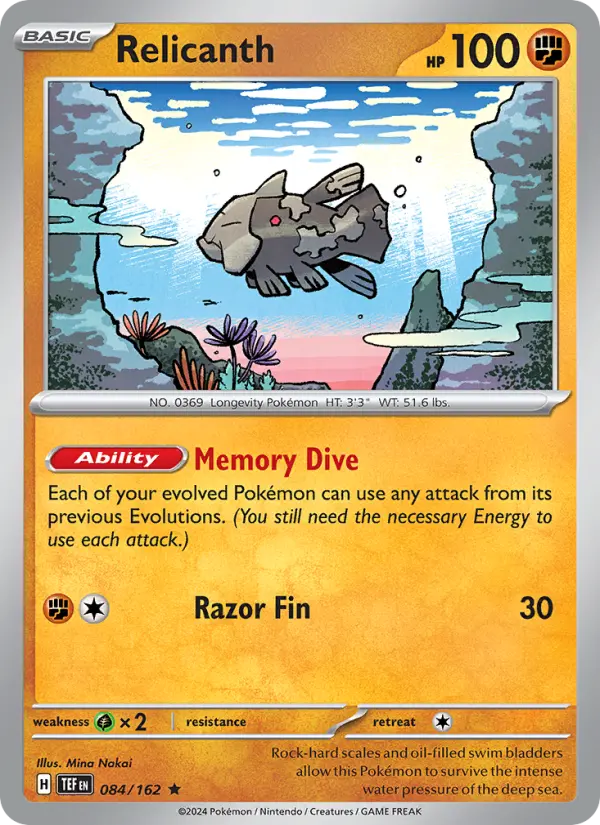
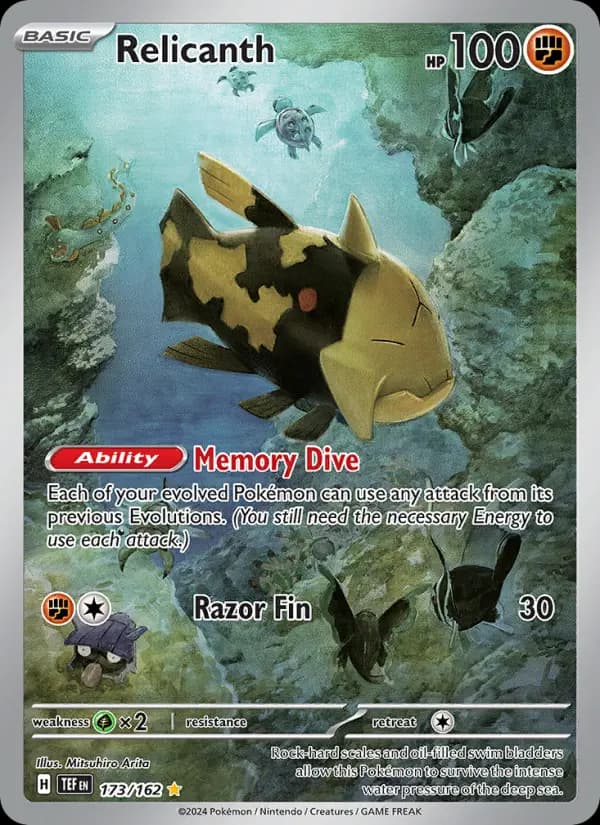
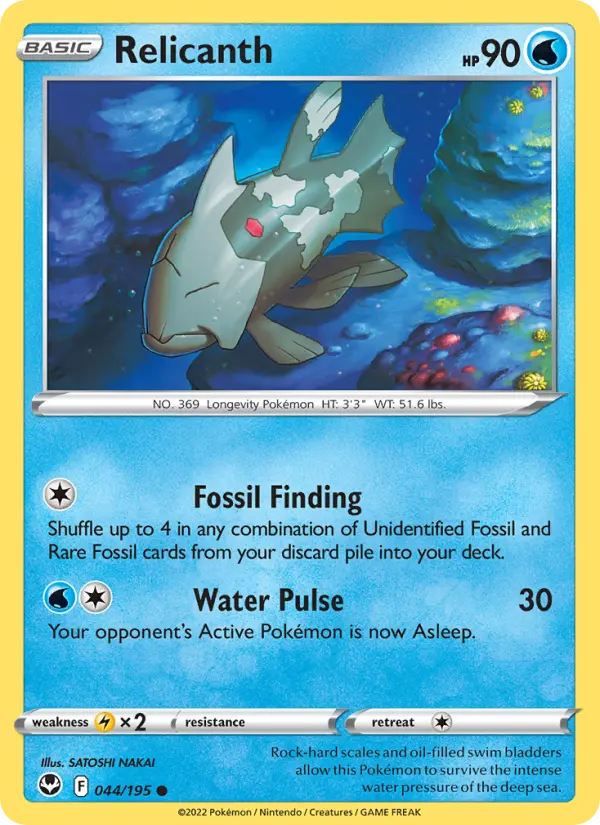
Relicanth
Generation III · #0369 — Longevity Pokémon
As a Generation III water/rock-type, Relicanth leans on swift swim to cover what its raw numbers don't, particularly on the defense side. Discovered during deep-sea explorations, Relicanth represents a window into prehistoric oceanic life, thriving in the extreme conditions of the ocean depths where few other creatures can survive. With a National Pokédex number of 369, Relicanth does not evolve from or into any other Pokémon, having achieved such evolutionary perfection that further adaptation became unnecessary. Its rarity and ancient lineage make it one of the most sought-after discoveries in marine Pokémon research, captivating trainers and scientists alike with its primordial heritage.
Editor's Take
Relicanth's Rock/Water typing gives it a quad Grass weakness and Head Smash gives it enormous recoil, and it is mostly remembered for its role in the Regi puzzle rather than any battle.
Base Stats
Height
1.0m
Weight
23.4kg
Category
Longevity Pokémon
Gender
Male 87.5% / Female 12.5%
Color
gray
Shape
fish
Habitat
sea
Abilities
Doubles Speed during rain.
Protects against recoil damage.
Prevents being KOed from full HP, leaving 1 HP instead. Protects against the one-hit KO moves regardless of HP.

Relicanth Biology & Physical Characteristics
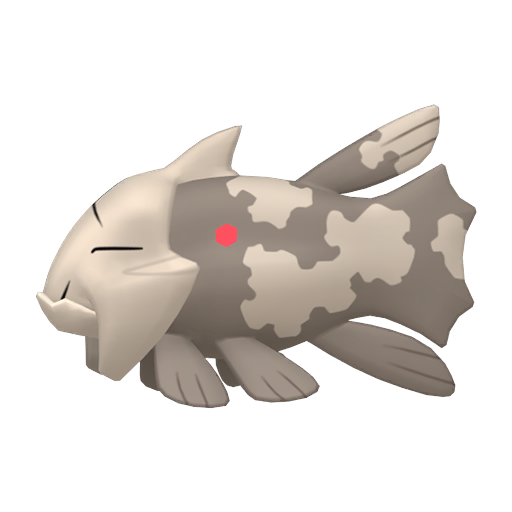
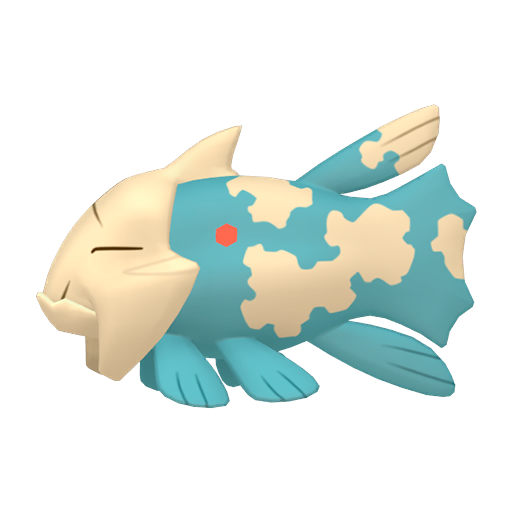
Relicanth's physiology is a masterpiece of deep-sea adaptation, featuring a robust body covered entirely in hard, brown scales that resemble craggy rocks—a protective adaptation that allows it to withstand the crushing water pressure of the abyssal depths. The Pokémon measures 1.0 meter in height and weighs 23.4 kilograms, with a tan-colored head characterized by protruding cheekbones that are notably smaller in female specimens. A distinctive triangular spike protrudes from the back of its head, while tan patches and characteristic red spots on either side of its body serve as identifying markers. What makes Relicanth truly extraordinary is its paired pectoral fins, which serve as limbs for locomotion across the seafloor, complemented by dorsal and pelvic fins near its wavy-outlined tail. The composition of its scales, combined with its fatty body and oil-filled swim bladders, creates an extraordinary pressure-resistant system that enables survival in environments that would crush most Pokémon instantly. Perhaps most fascinatingly, Relicanth has lost its teeth through millions of years of evolutionary refinement, becoming a specialized filter feeder that consumes microscopic organisms by sucking them into its toothless mouth—a testament to its dietary specialization in the deep ocean.
Pokedex Numbers
Training
Breeding
Relicanth Breeding, Gender Ratio & Egg Groups
Relicanth displays a pronounced sexual dimorphism in its physical characteristics, with females notably smaller and less prominent cheekbones compared to males, making the gender distinction visible at a glance. The species maintains a gender ratio of approximately 87.5% male to 12.5% female, a heavily skewed distribution that makes female Relicanth considerably rarer than their male counterparts and thus more desirable for collectors and breeders. This gender imbalance reflects the species' ancient nature and its biological design, though it also presents practical challenges for trainers seeking to breed Relicanth for competitive purposes. Relicanth belongs to the Water 1 and Water 2 egg groups, making it compatible with a diverse range of water-type and aquatic-themed Pokémon for breeding purposes. The species has a notably slow growth rate and a high hatch counter of 40 cycles, requiring 10,024 to 10,280 steps to hatch an egg—among the longest incubation periods in the Pokémon world. This extended breeding cycle reflects Relicanth's sluggish metabolism and ancient nature, requiring considerable time and effort for trainers hoping to produce offspring. The rarity of female specimens combined with the lengthy breeding process makes Relicanth offspring precious commodities in the trading community.
Sprites




Held Items
Green Shard
collectibles
No effect. Can be traded for items or moves.
Cost: 1000
Green Shard
collectibles
No effect. Can be traded for items or moves.
Cost: 1000
Green Shard
collectibles
No effect. Can be traded for items or moves.
Cost: 1000
Green Shard
collectibles
No effect. Can be traded for items or moves.
Cost: 1000
Green Shard
collectibles
No effect. Can be traded for items or moves.
Cost: 1000
Deep Sea Scale
species-specific
Doubles Clamperl’s Special Defense. Traded on a Clamperl: Holder evolves into Gorebyss.
Cost: 2000
Deep Sea Scale
species-specific
Doubles Clamperl’s Special Defense. Traded on a Clamperl: Holder evolves into Gorebyss.
Cost: 2000
Deep Sea Scale
species-specific
Doubles Clamperl’s Special Defense. Traded on a Clamperl: Holder evolves into Gorebyss.
Cost: 2000
Deep Sea Scale
species-specific
Doubles Clamperl’s Special Defense. Traded on a Clamperl: Holder evolves into Gorebyss.
Cost: 2000
Deep Sea Scale
species-specific
Doubles Clamperl’s Special Defense. Traded on a Clamperl: Holder evolves into Gorebyss.
Cost: 2000
Deep Sea Scale
species-specific
Doubles Clamperl’s Special Defense. Traded on a Clamperl: Holder evolves into Gorebyss.
Cost: 2000
Deep Sea Scale
species-specific
Doubles Clamperl’s Special Defense. Traded on a Clamperl: Holder evolves into Gorebyss.
Cost: 2000
Deep Sea Scale
species-specific
Doubles Clamperl’s Special Defense. Traded on a Clamperl: Holder evolves into Gorebyss.
Cost: 2000
Deep Sea Scale
species-specific
Doubles Clamperl’s Special Defense. Traded on a Clamperl: Holder evolves into Gorebyss.
Cost: 2000
Deep Sea Scale
species-specific
Doubles Clamperl’s Special Defense. Traded on a Clamperl: Holder evolves into Gorebyss.
Cost: 2000
Deep Sea Scale
species-specific
Doubles Clamperl’s Special Defense. Traded on a Clamperl: Holder evolves into Gorebyss.
Cost: 2000
Deep Sea Scale
species-specific
Doubles Clamperl’s Special Defense. Traded on a Clamperl: Holder evolves into Gorebyss.
Cost: 2000
Deep Sea Scale
species-specific
Doubles Clamperl’s Special Defense. Traded on a Clamperl: Holder evolves into Gorebyss.
Cost: 2000
Deep Sea Scale
species-specific
Doubles Clamperl’s Special Defense. Traded on a Clamperl: Holder evolves into Gorebyss.
Cost: 2000
Deep Sea Scale
species-specific
Doubles Clamperl’s Special Defense. Traded on a Clamperl: Holder evolves into Gorebyss.
Cost: 2000
Deep Sea Scale
species-specific
Doubles Clamperl’s Special Defense. Traded on a Clamperl: Holder evolves into Gorebyss.
Cost: 2000
Deep Sea Scale
species-specific
Doubles Clamperl’s Special Defense. Traded on a Clamperl: Holder evolves into Gorebyss.
Cost: 2000
TMs & HMs
tm01
lets go pikachu lets go eevee
tm02
crystal
tm02
gold silver
tm03
ruby sapphire
tm03
platinum
tm03
firered leafgreen
tm03
heartgold soulsilver
tm03
diamond pearl
tm03
emerald
tm03
xd
tm03
colosseum
tm04
emerald
tm04
firered leafgreen
tm04
ruby sapphire
tm04
diamond pearl
tm04
xd
tm04
heartgold soulsilver
tm04
black white
tm04
colosseum
tm04
platinum
+681 more TMs/HMs
Gender Differences
This Pokémon has visible differences between male and female forms.
Relicanth Evolution, Mega Evolution & Special Forms
Relicanth stands alone as a Pokémon that does not evolve, neither as a pre-evolution of another species nor into one. This lack of evolution is not a limitation but rather a reflection of its evolutionary perfection—having achieved such complete adaptation to its environment 100 million years ago that further change became unnecessary. The species' stasis is remarkable even within Pokémon biology, where evolutionary pressure typically drives constant change and adaptation. While many Pokémon from Generation III underwent Mega Evolution in later generations, Relicanth has never received such treatment, further cementing its status as a creature beyond the need for enhancement or transformation. This evolutionary permanence makes Relicanth unique among water types, serving as a biological paradox—a Pokémon from the distant past that remains present in the modern era without any alteration whatsoever. The absence of evolution reflects the game designers' intention to honor Relicanth's status as a living fossil, a creature so successful that improvement became impossible.
Where to Find
Hoenn Route 124
hoenn
+3 more
Hoenn Route 126
hoenn
+3 more
Sinnoh Sea Route 226
sinnoh
Kanto Route 12
kanto
+15 more
Unova Route 4
unova
+1 more
Ambrette Town
kalos
Cyllage City
kalos
Poni Wilds
alola
+1 more
Ancient Poni Path
alola
+1 more
Poni Breaker Coast
alola
+1 more
Relicanth Behaviour and Natural Habitat
Relicanth inhabits the deepest regions of the ocean, where darkness reigns and pressure reaches astronomical levels that would instantly destroy most life forms. This Pokémon walks along the seafloor using its pectoral fins with deliberate, methodical movements, systematically filtering microscopic organisms from the water column as it traverses the abyssal plains. Its behavior reflects a creature perfectly adapted to its environment—slow, deliberate, and utterly dependent on the stable conditions of the deep sea. Unlike many Pokémon that display dynamic or aggressive behaviors, Relicanth demonstrates the calm, patient demeanor befitting a creature that has existed unchanged for 100 million years. The species remains in the deepest oceanic trenches, rarely ascending to shallower waters, which explains its extreme rarity and the difficulty trainers face in encountering wild specimens. Despite being believed extinct at various points in scientific history, Relicanth has persisted in isolated deep-sea populations, continuing its ancient lifestyle uninterrupted by the evolutionary pressures that have transformed countless other species. Its sedentary nature and specialized feeding strategy suggest a Pokémon perfectly content in its ecological niche, requiring nothing more than the unchanging darkness and pressure of the deep.
Pokedex Entries
RELICANTH is a POKéMON species that existed for a hundred million years without ever changing its form. This ancient POKéMON feeds on microscopic organisms with its toothless mouth.
RELICANTH is a rare species that was discovered in deep-sea explorations. This POKéMON’s body withstands the enormous water pressure of the ocean depths. Its body is covered in tough scales that are like craggy rocks.
A POKéMON that was once believed to have been extinct. The species has not changed its form for 100 million years. It walks on the seafloor using its pectoral fins.
It has remained unchanged for 100 million years. It was discovered during a deep-sea exploration.
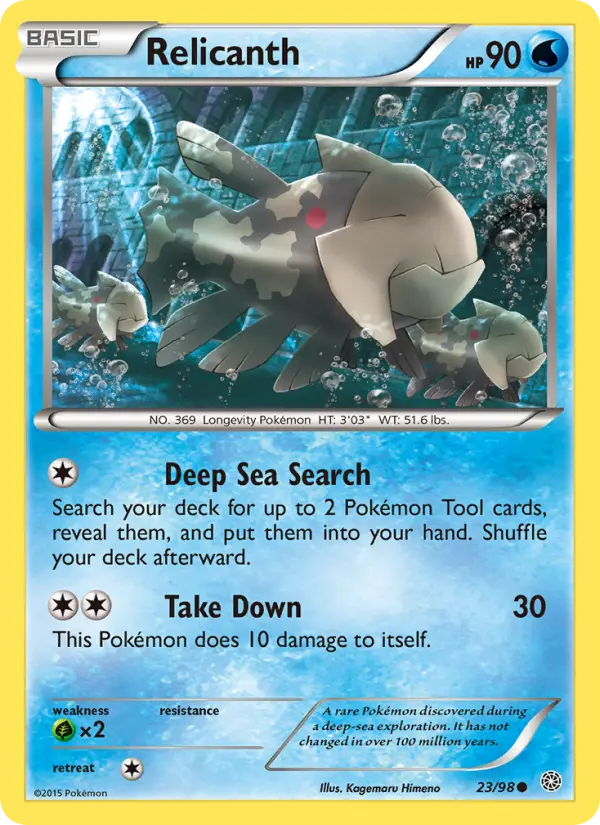
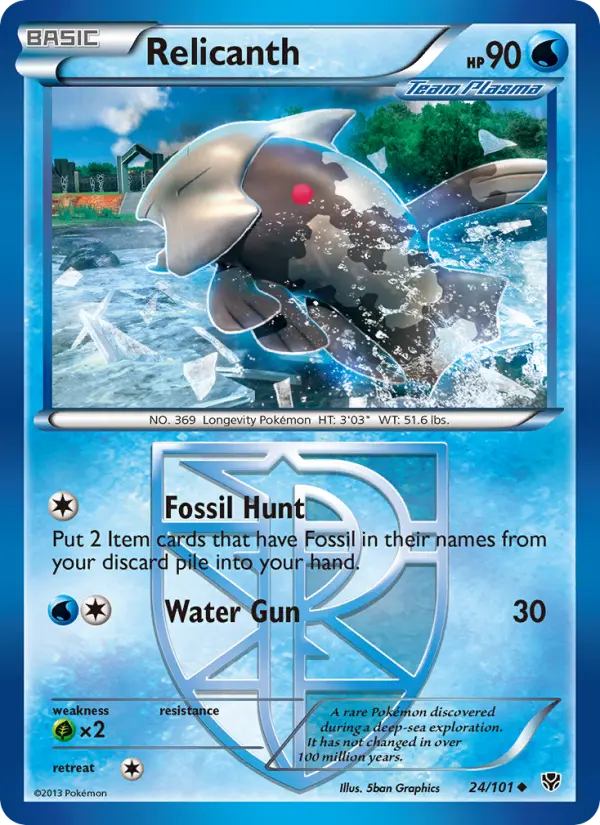
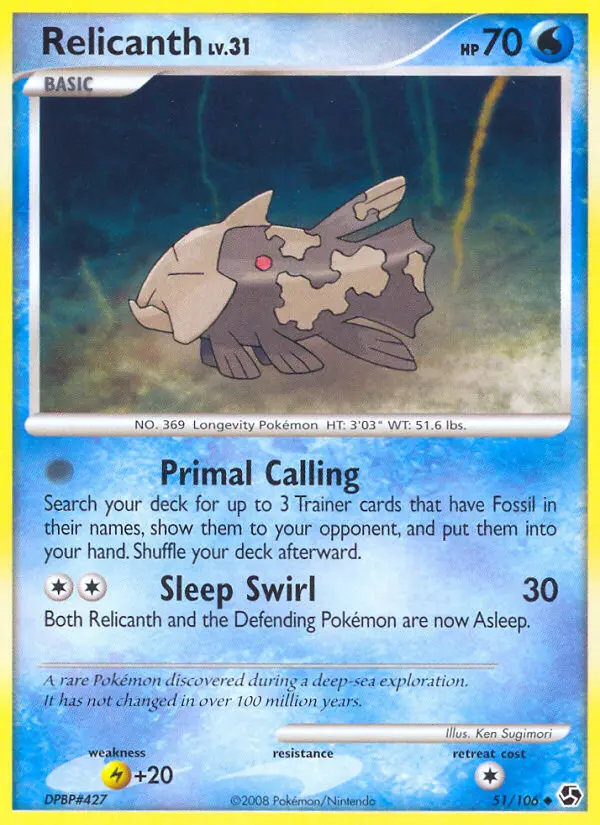
A rare Pokémon discovered during a deep-sea exploration. It has not changed in over 100 million years.
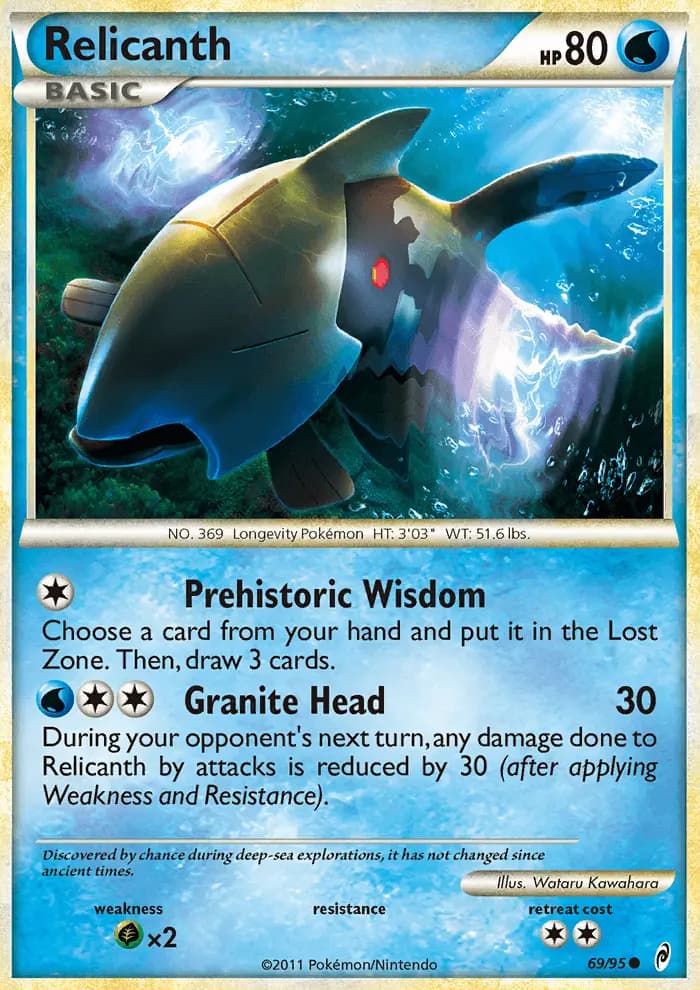
Discovered by chance during deep-sea explorations, it has not changed since ancient times.
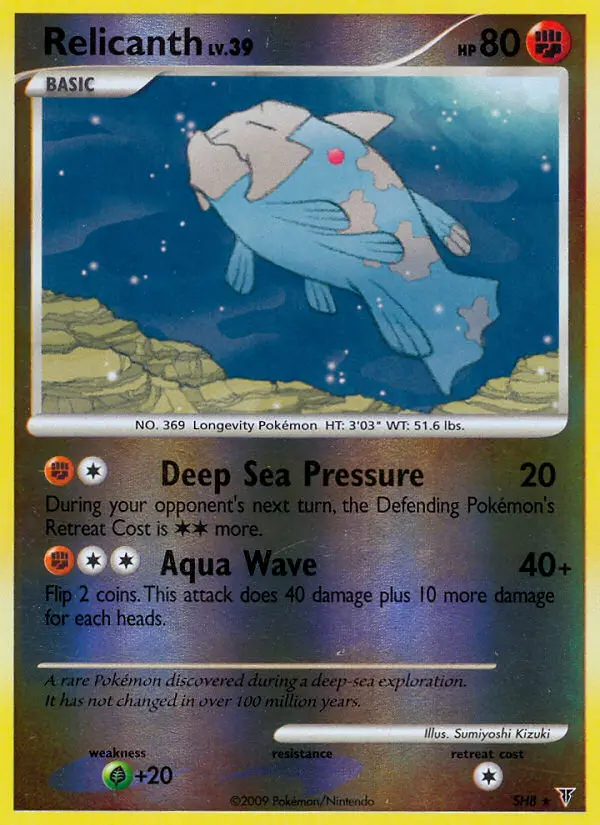
A rare Pokémon discovered during a deep-sea exploration. It has not changed in over 100 million years.
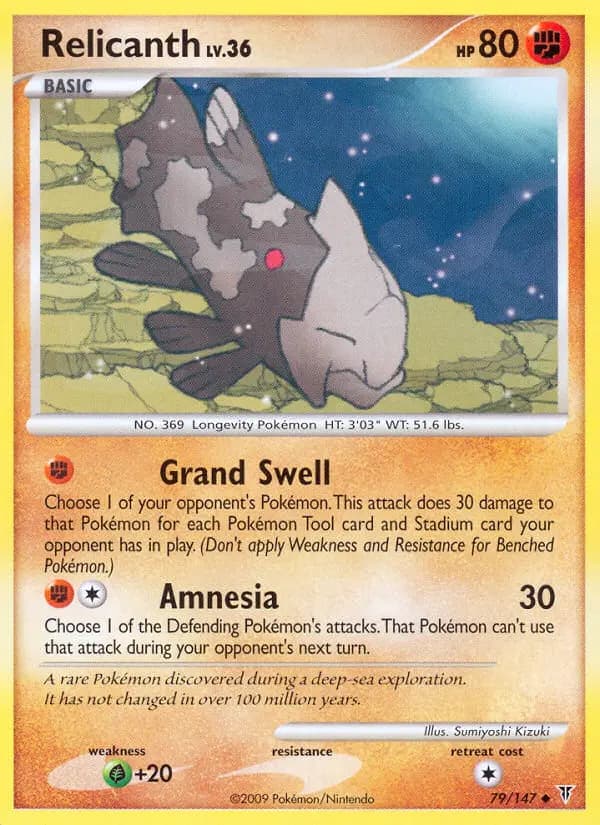
A rare Pokémon discovered during a deep-sea exploration. It has not changed in over 100 million years.
It has remained unchanged for 100 million years. It was discovered during a deep-sea exploration.
A rare Pokémon discovered during a deep-sea exploration. It has not changed in over 100 million years.
Relicanth is a Pokémon species that existed for a hundred million years without ever changing its form. This ancient Pokémon feeds on microscopic organisms with its toothless mouth.
Relicanth is a rare species that was discovered in deep-sea explorations. This Pokémon’s body withstands the enormous water pressure of the ocean depths. Its body is covered in tough scales that are like craggy rocks.
Its form has remained the same for one hundred million years. Its body is filled with fat, so it can withstand the water pressure of the deep sea.
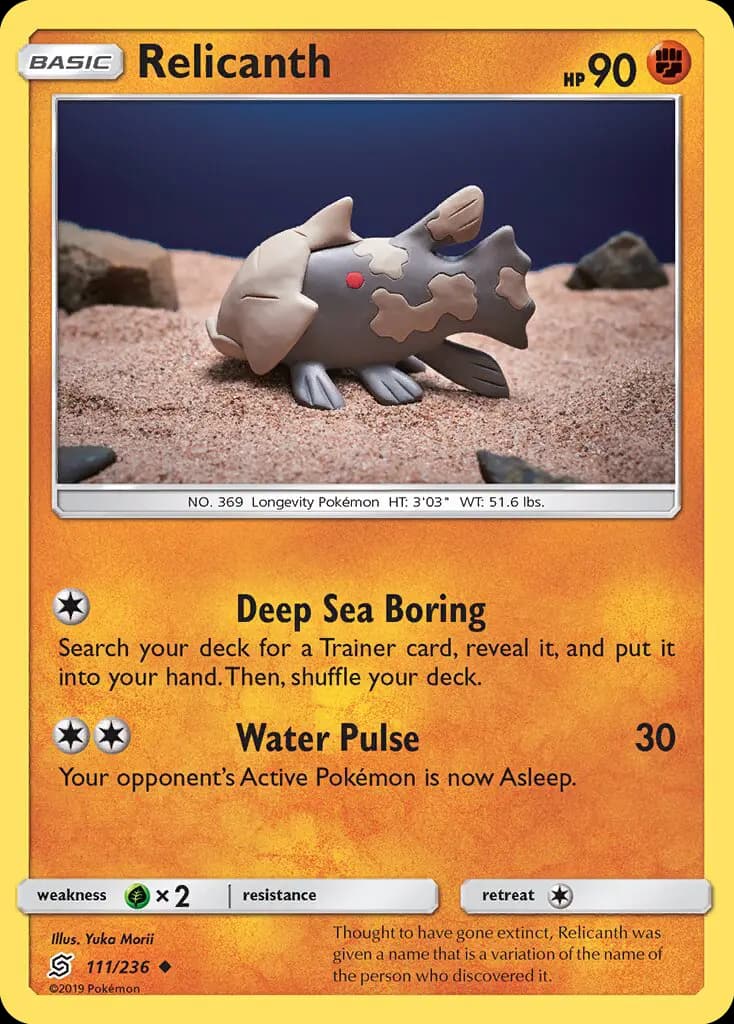
Thought to have gone extinct, Relicanth was given a name that is a variation of the name of the person who discovered it.
It was fortuitously discovered during a deep sea expedition. Its teeth have atrophied, so it now survives on microscopic organisms it sucks up.
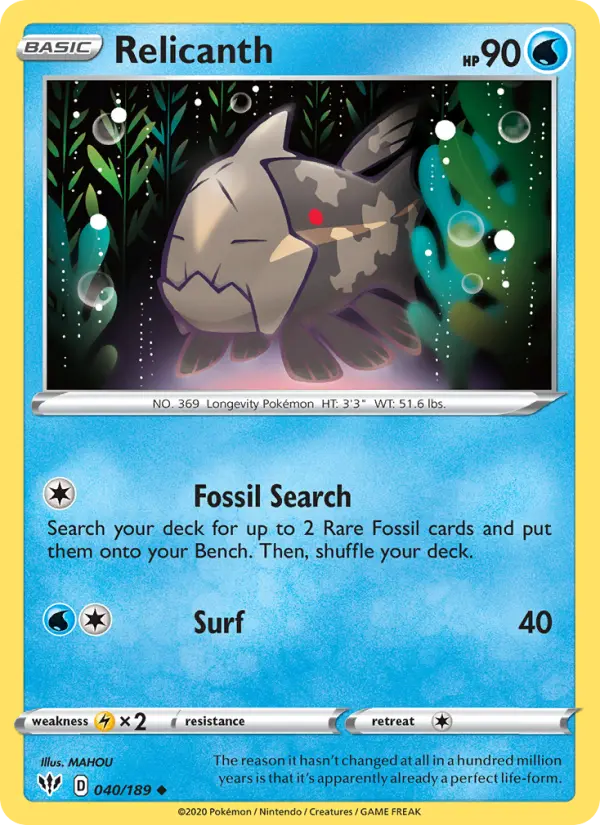
The reason it hasn’t changed at all in a hundred million years is that it’s apparently already a perfect life-form.
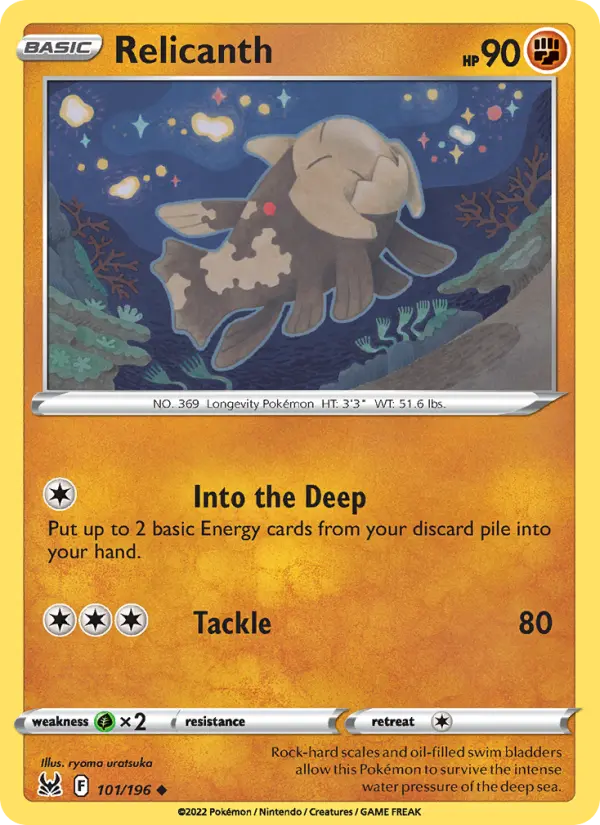
Rock-hard scales and oil-filled swim bladders allow this Pokémon to survive the intense water pressure of the deep sea.
This Pokémon was discovered during deep-sea exploration. Its appearance hasn’t changed in 100,000,000 years, so it’s called a living fossil.
Relicanth Name Origin & Design Inspiration
Relicanth's design draws heavy inspiration from the coelacanth, a real-world fish species that was believed to have gone extinct millions of years ago before being rediscovered in the 1930s, making it a symbol of evolutionary stasis and prehistoric survival. The Pokémon's physical characteristics—its scale composition, fin structure, body shape, and deep-sea coloration—all mirror those of the coelacanth, creating a faithful representation of this remarkable living fossil. Its name combines elements suggesting reliability and longevity with a reference to the coelacanth itself, though some sources suggest the name draws from an explorer figure, adding an element of discovery narrative to the Pokémon's identity. The deliberate visual design emphasizes Relicanth's primordial nature through muted brown and tan coloring, the stark simplicity of its features, and the primitive appearance of its scaled exterior. Every aspect of Relicanth's appearance—from its paired pectoral fins to its distinctive head spike to the wavy outline of its tail—serves to reinforce the impression of an ancient creature pulled directly from Earth's prehistoric oceans. The Japanese name, Glanth, similarly evokes the sense of an ancient, unchanging form, with a sound that feels both alien and primordial to modern ears.
Learnable Moves
Relicanth can learn 78 moves:
Move | Type | Cat. | Power | Acc. | PP |
|---|---|---|---|---|---|
| amnesia | psychic | Status | — | — | 20 |
| ancient power | rock | Special | 60 | 100 | 5 |
| aqua tail | water | Physical | 90 | 90 | 10 |
| attract | normal | Status | — | 100 | 15 |
| blizzard | ice | Special | 110 | 70 | 5 |
| body press | fighting | Physical | 80 | 100 | 10 |
| body slam | normal | Physical | 85 | 100 | 15 |
| bounce | flying | Physical | 85 | 85 | 5 |
| brine | water | Special | 65 | 100 | 10 |
| bulldoze | ground | Physical | 60 | 100 | 20 |
| calm mind | psychic | Status | — | — | 20 |
| captivate | normal | Status | — | 100 | 20 |
| confide | normal | Status | — | — | 20 |
| dive | water | Physical | 80 | 100 | 10 |
| double team | normal | Status | — | — | 15 |
| double edge | normal | Physical | 120 | 100 | 15 |
| earth power | ground | Special | 90 | 100 | 10 |
| earthquake | ground | Physical | 100 | 100 | 10 |
| endure | normal | Status | — | — | 10 |
| facade | normal | Physical | 70 | 100 | 20 |
| flail | normal | Physical | — | 100 | 15 |
| frustration | normal | Physical | — | 100 | 20 |
| giga impact | normal | Physical | 150 | 90 | 5 |
| hail | ice | Status | — | — | 10 |
| harden | normal | Status | — | — | 30 |
| head smash | rock | Physical | 150 | 80 | 5 |
| headbutt | normal | Physical | 70 | 100 | 15 |
| hidden power | normal | Special | 60 | 100 | 15 |
| hydro pump | water | Special | 110 | 80 | 5 |
| hyper beam | normal | Special | 150 | 90 | 5 |
| ice beam | ice | Special | 90 | 100 | 10 |
| icy wind | ice | Special | 55 | 95 | 15 |
| iron defense | steel | Status | — | — | 15 |
| liquidation | water | Physical | 85 | 100 | 10 |
| magnitude | ground | Physical | — | 100 | 30 |
| meteor beam | rock | Special | 120 | 90 | 10 |
| mimic | normal | Status | — | — | 10 |
| mud shot | ground | Special | 55 | 95 | 15 |
| mud sport | ground | Status | — | — | 15 |
| mud slap | ground | Special | 20 | 100 | 10 |
| muddy water | water | Special | 90 | 85 | 10 |
| natural gift | normal | Physical | — | 100 | 15 |
| protect | normal | Status | — | — | 10 |
| psych up | normal | Status | — | — | 10 |
| rain dance | water | Status | — | — | 5 |
| rest | psychic | Status | — | — | 5 |
| return | normal | Physical | — | 100 | 20 |
| rock blast | rock | Physical | 25 | 90 | 10 |
| rock polish | rock | Status | — | — | 20 |
| rock slide | rock | Physical | 75 | 90 | 10 |
| rock smash | fighting | Physical | 40 | 100 | 15 |
| rock tomb | rock | Physical | 60 | 95 | 15 |
| round | normal | Special | 60 | 100 | 15 |
| safeguard | normal | Status | — | — | 25 |
| sandstorm | rock | Status | — | — | 10 |
| scald | water | Special | 80 | 100 | 15 |
| scale shot | dragon | Physical | 25 | 90 | 20 |
| secret power | normal | Physical | 70 | 100 | 20 |
| skull bash | normal | Physical | 130 | 100 | 10 |
| sleep talk | normal | Status | — | — | 10 |
| smack down | rock | Physical | 50 | 100 | 15 |
| snore | normal | Special | 50 | 100 | 15 |
| stealth rock | rock | Status | — | — | 20 |
| stomping tantrum | ground | Physical | 75 | 100 | 10 |
| stone edge | rock | Physical | 100 | 80 | 5 |
| substitute | normal | Status | — | — | 10 |
| surf | water | Special | 90 | 100 | 15 |
| swagger | normal | Status | — | 85 | 15 |
| tackle | normal | Physical | 40 | 100 | 35 |
| take down | normal | Physical | 90 | 85 | 20 |
| toxic | poison | Status | — | 90 | 10 |
| water gun | water | Special | 40 | 100 | 25 |
| water pulse | water | Special | 60 | 100 | 20 |
| water sport | water | Status | — | — | 15 |
| waterfall | water | Physical | 80 | 100 | 15 |
| whirlpool | water | Special | 35 | 85 | 15 |
| yawn | normal | Status | — | — | 10 |
| zen headbutt | psychic | Physical | 80 | 90 | 15 |
Relicanth Competitive Battle Guide
Relicanth's competitive viability rests primarily upon its exceptional defensive capabilities, boasting a base Defense stat of 130 that ranks among the highest in the water-type category and grants it formidable physical bulk. With a base HP of 100 and Special Defense of 65, Relicanth achieves a respectable total base stat of 485, positioning itself as a defensive specialist rather than an offensive powerhouse—a role reinforced by its modest Attack of 90 and particularly weak Special Attack of 45. The Pokémon's ability choices significantly impact its competitive application: Swift Swim doubles its Speed during rain weather, transforming the otherwise glacial base Speed of 55 into a usable 110, while Rock Head eliminates recoil damage from moves like Double-Edge, and the hidden ability Sturdy prevents one-hit knockout moves and leaves the user with 1 HP if struck from full health. Competitively, Relicanth functions best as a defensive wall in weather-based teams, particularly those leveraging rain effects to maximize Swift Swim's potential. Its typing, while burdened with four weaknesses (Grass, Electric, Ground, and Fighting) and only three resistances (Normal, Flying, and Fire), grants STAB coverage across both Water and Rock moves, including powerful options like Waterfall, Stone Edge, and Ancient Power. Relicanth's slow speed and low special attack limit its offensive pressure, making it difficult for this Pokémon to contribute meaningfully in faster-paced competitive formats, though it retains niche viability in slower, defensive-oriented team structures.
Commonly Asked Questions About Relicanth
What type is Relicanth?
Relicanth is a water and rock type Pokemon.
What does Relicanth evolve from?
Relicanth does not evolve.
What are Relicanth's weaknesses?
Relicanth is weak to fighting, ground, grass and electric type moves.
Where can I find Relicanth?
Relicanth can be found in hoenn route 124 (hoenn), hoenn route 126 (hoenn) and sinnoh sea route 226 (sinnoh) and 7 other locations.
Relicanth Cultural Impact & Franchise History
Relicanth holds a special place in Pokémon lore as a symbol of evolutionary stasis and natural wonder, capturing players' imaginations through its role as a genuine living fossil within the game universe. The Pokémon appeared prominently in Generation III's Hoenn region and has maintained cultural significance through its unique story—that of a creature unchanged for 100 million years yet still alive and thriving in hidden ocean depths. Its discovery narrative resonates with real-world fascination with creatures like the coelacanth, lending Relicanth an air of scientific legitimacy and wonder that elevates it beyond typical Pokémon. The species features in various media appearances and has become a favorite among players interested in paleontology-themed Pokémon teams, often appearing alongside other prehistoric or fossil-inspired species. In competitive communities, Relicanth occasionally garners attention from dedicated enthusiasts seeking to build successful teams around unconventional Pokémon, though its limited offensive presence prevents it from achieving mainstream competitive prominence. The Pokémon's design and concept have inspired considerable fan interest in deep-sea ecology and marine biology, with many players appreciating the accurate representation of real-world adaptations to extreme environments. Relicanth's permanence in the Pokédex serves as a reminder that not all creatures must evolve to achieve success, challenging players' assumptions about progression and improvement while celebrating the beauty of evolutionary stasis.
Where to Find Relicanth in Every Pokémon Game
Relicanth's availability in Pokémon games reflects its rare, deep-sea nature, appearing primarily in underwater and oceanic locations across the various generations. In Generation III's Hoenn region, Relicanth can be found in deep ocean waters with Dive in specific locations, making its encounter rate low and requiring dedicated effort to capture. The species has maintained similar availability across subsequent generations, typically appearing in water-based routes or cave systems with strong connections to the ocean, such as those requiring Surf or Dive to access. In Generation V and beyond, Relicanth has appeared in various regional Pokédexes depending on the specific game, with locations varying from the Coastal Kalos region in X and Y to the Alola region in Sun and Moon. Pokémon Sword and Shield included Relicanth in the Crown Tundra DLC area, maintaining its association with cold, deep waters even in later generation games. The Pokémon's rarity—with a low catch rate of 25 and appearing only in specialized locations—ensures that obtaining Relicanth remains a genuine achievement requiring patience and exploration. For players seeking Relicanth outside of standard gameplay routes, the species has been available through various event distributions and special encounters across the main series games. In Pokémon GO, Relicanth became available through raids and special events, though its continued rarity ensures it remains a valuable and prized addition to any Pokédex, cementing its status as one of the more difficult water-type Pokémon to obtain across the entire franchise.