Shelmet
Generation V · #0616 — Snail Pokémon
Shelmet measures in at 0.4 m and 7.7 kg, a build that matches its hydration ability better than it matches raw offense or defense.
Editor's Take
Shelmet only evolves by being traded for a Karrablast, which means Accelgor is effectively unobtainable without another player — the same gate its partner faces.
Base Stats
Height
0.4m
Weight
7.7kg
Category
Snail Pokémon
Gender
Male 50% / Female 50%
Color
red
Shape
ball
Abilities
Cures any major status ailment after each turn during rain.
Protects against critical hits.
Protects against damage from weather.

Shelmet Biology & Physical Characteristics
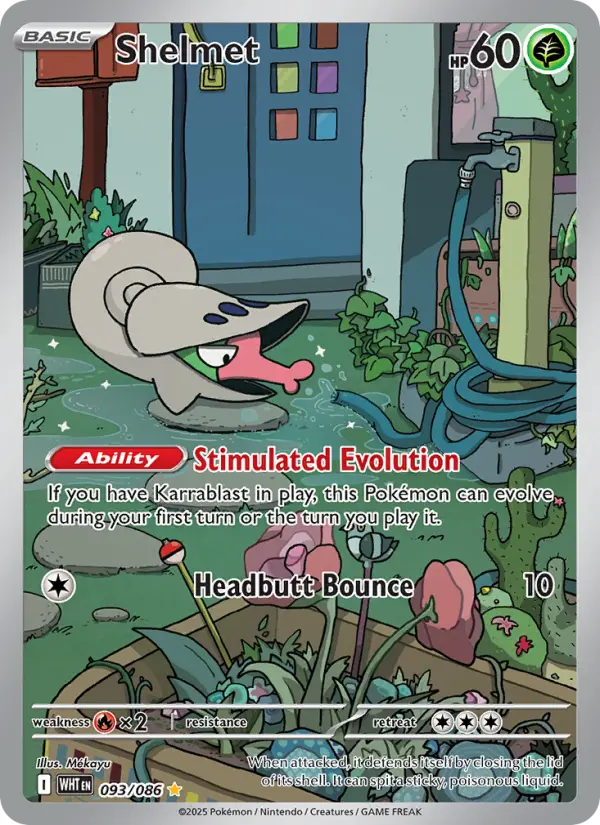
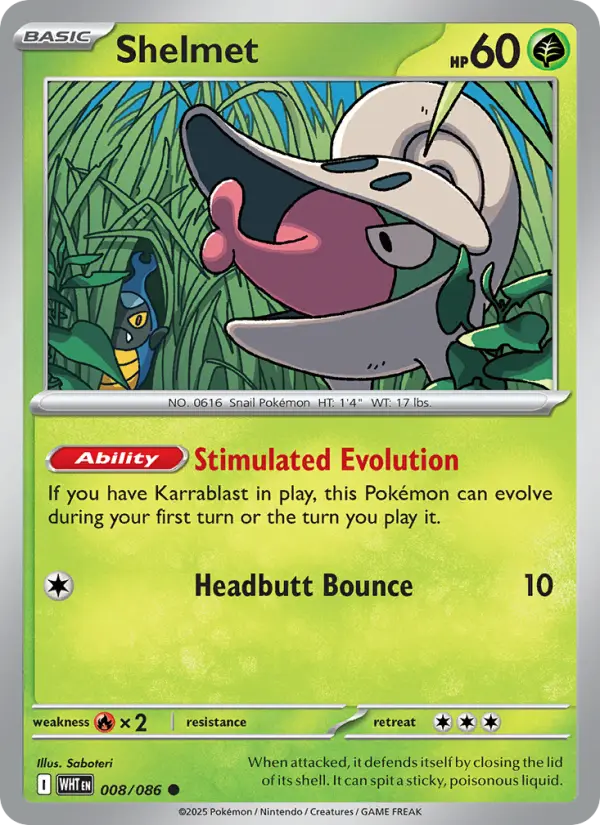
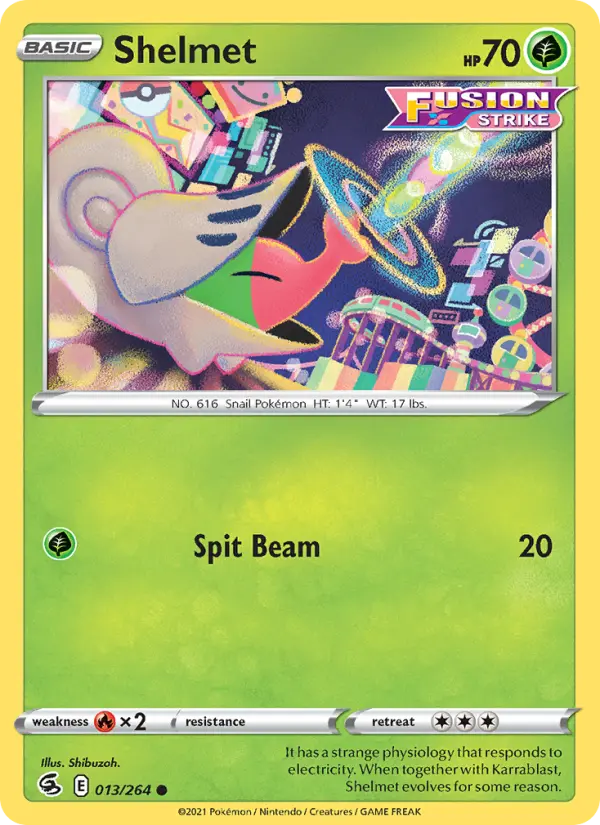
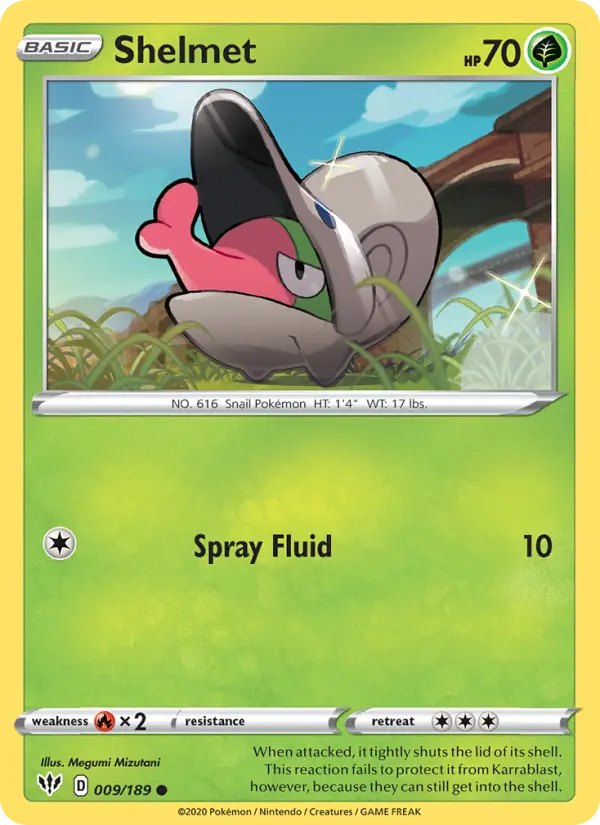
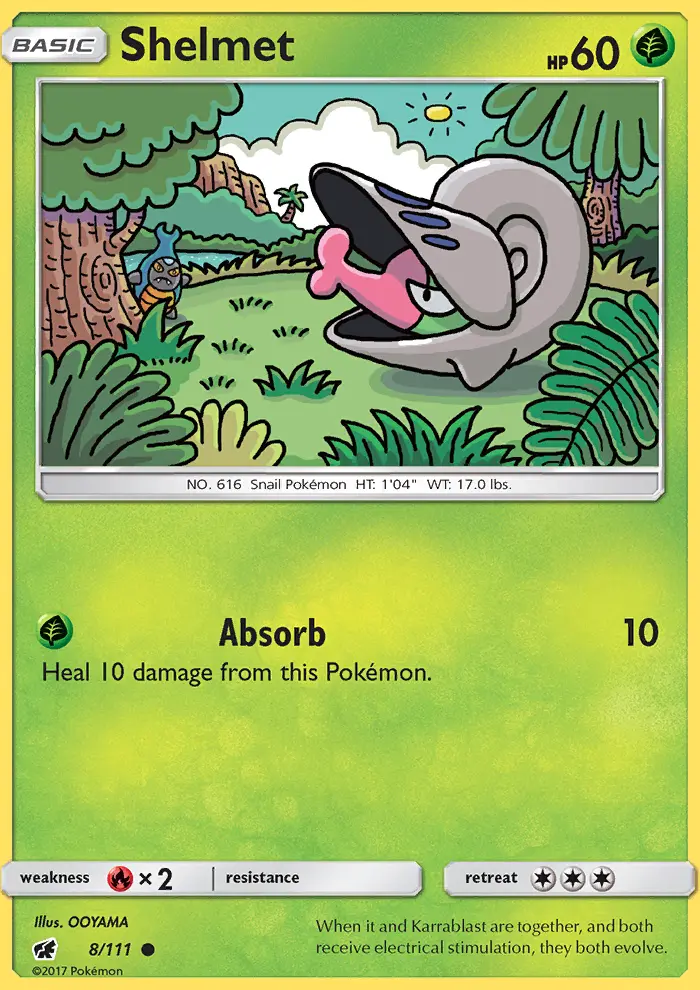
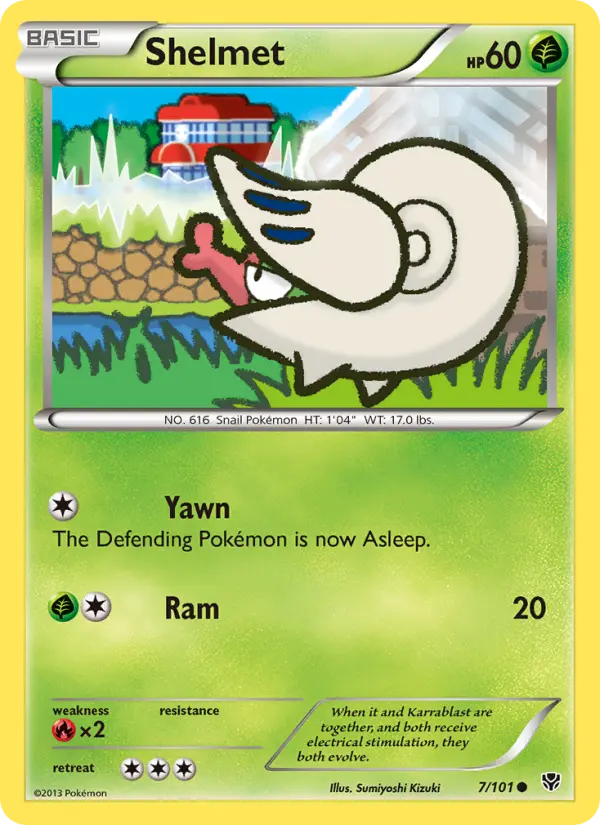
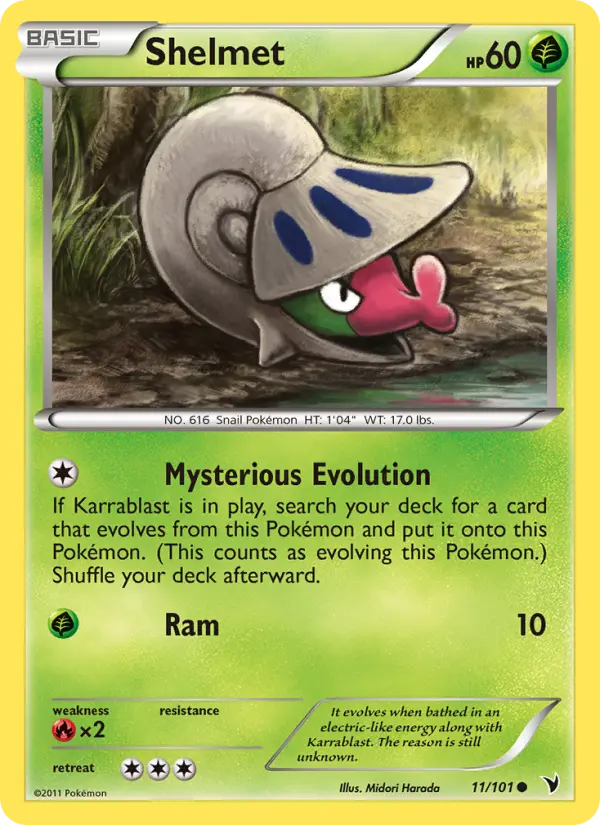
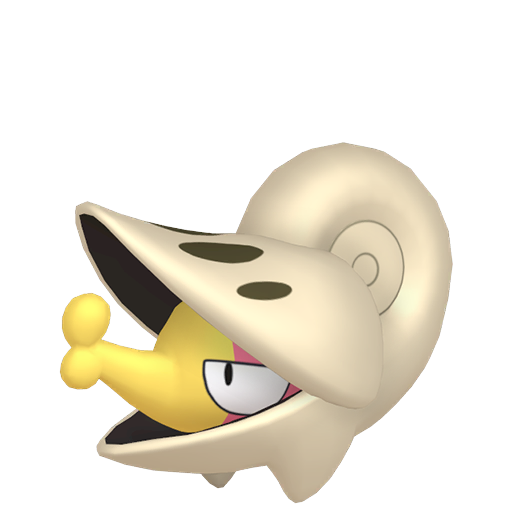
Shelmet exhibits a fascinating bivalve or snail-like anatomy that resembles an armored knight's visor more than a traditional snail. Its gray, helmet-shaped shell features a distinctive coiling spiral pattern along its back, with several protrusions underneath that serve as legs for locomotion. The interior of its body is predominantly pink, featuring a notably long, puckered mouth and characteristic green markings below its eyes. This unique physiology gives Shelmet an almost medieval aesthetic that sets it apart from other Bug-type Pokémon. The creature's most notable defensive adaptation is its ability to completely seal itself within its shell, though this strategy proves ineffective against its natural predator, Karrablast, which possesses the specialized ability to forcibly open Shelmet's protective casing. Additionally, Shelmet can secrete a sticky, poisonous liquid that it spits as a secondary defense mechanism when threatened.
Pokedex Numbers
Training
Breeding
Shelmet Breeding, Gender Ratio & Egg Groups
Shelmet exhibits a perfectly balanced gender ratio, with exactly 50 percent of the population being male and 50 percent female, allowing for straightforward breeding compatibility. The species belongs exclusively to the Bug egg group, meaning it can only breed with other Pokémon within the same egg classification. With a base friendship value of 70 across Generations V through VII (adjusted to 50 in later generations), Shelmet demonstrates moderate receptiveness to bonds with trainers, though it requires consistent positive interaction to develop stronger relationships. The species has a hatch counter of 15 cycles, translating to approximately 3,599 to 3,855 steps required before an egg produces a newly hatched Shelmet. This relatively moderate incubation period makes Shelmet reasonably accessible for breeders seeking to build up populations or obtain specimens with specific individual values and natures. The creature's growth rate is classified as medium, indicating it reaches its final evolution stage at a moderate pace compared to faster-evolving species like Magikarp but quicker than species with slow growth rates.
Sprites





TMs & HMs
tm03
crystal
tm03
gold silver
tm05
lets go pikachu lets go eevee
tm06
yellow
tm06
gold silver
tm06
red blue
tm06
crystal
tm06
emerald
tm06
firered leafgreen
tm06
diamond pearl
tm06
platinum
tm06
ruby sapphire
tm06
colosseum
tm06
black 2 white 2
tm06
xd
tm06
black white
tm06
heartgold soulsilver
tm06
omega ruby alpha sapphire
tm06
ultra sun ultra moon
tm06
sun moon
+350 more TMs/HMs


Shelmet Evolution, Mega Evolution & Special Forms
Shelmet's evolution represents one of the most enigmatic and mechanically unique transformations in Pokémon biology. The creature evolves into Accelgor, a sleeker and significantly faster Bug-type Pokémon, but this evolution requires very specific conditions that remain scientifically unexplained within the Pokémon universe. The evolution occurs exclusively when Shelmet is traded to another trainer while a Karrablast is simultaneously being traded in the opposite direction, and both Pokémon must receive electrical stimulation during this exchange. Multiple Pokédex entries describe this phenomenon as a mysterious process where both Shelmet and Karrablast are bathed in electric-like energy that triggers their simultaneous transformation into Accelgor and Escavalier respectively. The exact biological mechanism behind this coordinated evolution remains unknown, making it one of the series' most intriguing evolutionary mysteries. Importantly, neither Pokémon will evolve if either is holding an Everstone during the trade, indicating that the evolutionary change is not automatic but rather conditional upon specific circumstances. This rival-dependent evolution creates a fascinating parallel between Shelmet and Karrablast, suggesting a deeply intertwined evolutionary history between these two species.
Where to Find
Icirrus City
unova
+36 more
Moor of Icirrus
unova
+36 more
Unova Route 8
unova
+36 more
Unova Route 11
unova
+5 more
Unova Route 6
unova
+5 more
Kalos Route 19
kalos
+3 more
Kalos Route 14
kalos
+1 more
Shelmet Behaviour and Natural Habitat
Shelmet thrives in moist, humid environments such as bogs and swamps where moisture is abundant and vegetation is dense. The species displays a somewhat introverted temperament, preferring to remain sheltered within its protective shell when encountering danger or unfamiliar situations. When attacked, Shelmet's immediate response is to clamp shut the lid of its shell, creating a hermetically sealed defense that works against most predators. However, in the presence of Karrablast, this defensive behavior becomes obsolete, as Karrablast has evolved the specific capability to breach Shelmet's shell and access its vulnerable interior. Shelmet possesses a base friendship value of 70, indicating that despite its defensive nature, it forms meaningful bonds with trainers who treat it with care and respect. The species demonstrates a curious responsiveness to electrical stimuli, which plays a crucial role in triggering its transformation into Accelgor when exposed to electrical energy alongside a Karrablast.
Pokedex Entries
When attacked, it defends itself by closing the lid of its shell. It can spit a sticky, poisonous liquid.
When it and Karrablast are together, and both receive electrical stimulation, they both evolve.
It evolves when bathed in an electric-like energy along with Karrablast. The reason is still unknown.
When it and Karrablast are together, and both receive electrical stimulation, they both evolve.
It evolves when bathed in an electric-like energy along with Karrablast. The reason is still unknown.
When it and Karrablast are together, and both receive electrical stimulation, they both evolve.
It evolves when bathed in an electric-like energy along with Karrablast. The reason is still unknown.
When attacked, it tightly shuts the lid of its shell. This reaction fails to protect it from Karrablast, however, because they can still get into the shell.
It has a strange physiology that responds to electricity. When together with Karrablast, Shelmet evolves for some reason.
Shelmet Name Origin & Design Inspiration
The Japanese name Chobomaki is derived from the combination of "chobo" (referring to a comb shell or bivalve mollusc) and "maki" (referring to something rolled or spiral-shaped), which perfectly captures the creature's snail-like, spiraling shell morphology. The English name Shelmet combines "shell," referencing its prominent protective casing, with "helmet," emphasizing the distinctly armored, knightly appearance of its gray exterior. The design philosophy behind Shelmet heavily draws inspiration from medieval knights and their protective armor, evident in the helmet-visor appearance and the way it seals itself shut defensively. The creature's overall aesthetic represents a fusion of biological mollusc characteristics with humanoid armor design, creating a Pokémon that feels both natural and fantastical simultaneously. This blend of organic and metallic visual elements contributes to Shelmet's distinctive identity within the Bug-type category, differentiating it from other mollusc-inspired Pokémon like Shellder or Slowbro. The spiral pattern on its back references natural nautilus and snail shell geometry, grounding the fantastical design in biological reality.
Learnable Moves
Shelmet can learn 52 moves:
Move | Type | Cat. | Power | Acc. | PP |
|---|---|---|---|---|---|
| absorb | grass | Special | 20 | 100 | 25 |
| acid | poison | Special | 40 | 100 | 30 |
| acid armor | poison | Status | — | — | 20 |
| attract | normal | Status | — | 100 | 15 |
| baton pass | normal | Status | — | — | 40 |
| bide | normal | Physical | — | — | 10 |
| body slam | normal | Physical | 85 | 100 | 15 |
| bug bite | bug | Physical | 60 | 100 | 20 |
| bug buzz | bug | Special | 90 | 100 | 10 |
| confide | normal | Status | — | — | 20 |
| curse | ghost | Status | — | — | 10 |
| double team | normal | Status | — | — | 15 |
| double edge | normal | Physical | 120 | 100 | 15 |
| encore | normal | Status | — | 100 | 5 |
| endure | normal | Status | — | — | 10 |
| energy ball | grass | Special | 90 | 100 | 10 |
| facade | normal | Physical | 70 | 100 | 20 |
| feint | normal | Physical | 30 | 100 | 10 |
| final gambit | fighting | Special | — | 100 | 5 |
| frustration | normal | Physical | — | 100 | 20 |
| gastro acid | poison | Status | — | 100 | 10 |
| giga drain | grass | Special | 75 | 100 | 10 |
| guard split | psychic | Status | — | — | 10 |
| guard swap | psychic | Status | — | — | 10 |
| hidden power | normal | Special | 60 | 100 | 15 |
| infestation | bug | Special | 20 | 100 | 20 |
| leech life | bug | Physical | 80 | 100 | 10 |
| mega drain | grass | Special | 40 | 100 | 15 |
| mind reader | normal | Status | — | — | 5 |
| mud shot | ground | Special | 55 | 95 | 15 |
| mud slap | ground | Special | 20 | 100 | 10 |
| protect | normal | Status | — | — | 10 |
| pursuit | dark | Physical | 40 | 100 | 20 |
| rain dance | water | Status | — | — | 5 |
| recover | normal | Status | — | — | 5 |
| rest | psychic | Status | — | — | 5 |
| return | normal | Physical | — | 100 | 20 |
| round | normal | Special | 60 | 100 | 15 |
| secret power | normal | Physical | 70 | 100 | 20 |
| signal beam | bug | Special | 75 | 100 | 15 |
| skitter smack | bug | Physical | 70 | 90 | 10 |
| sleep talk | normal | Status | — | — | 10 |
| sludge bomb | poison | Special | 90 | 100 | 10 |
| snore | normal | Special | 50 | 100 | 15 |
| spikes | ground | Status | — | — | 20 |
| struggle bug | bug | Special | 50 | 100 | 20 |
| substitute | normal | Status | — | — | 10 |
| swagger | normal | Status | — | 85 | 15 |
| toxic | poison | Status | — | 90 | 10 |
| toxic spikes | poison | Status | — | — | 20 |
| venoshock | poison | Special | 65 | 100 | 10 |
| yawn | normal | Status | — | — | 10 |
Shelmet Competitive Battle Guide
Shelmet's competitive viability is significantly hampered by its abysmal Speed stat of just 25, which makes it one of the slowest Pokémon in the entire franchise and essentially renders it non-threatening in competitive battle scenarios. Its offensive stats are equally mediocre, with Attack and Special Attack both sitting at 40, leaving Shelmet unable to deal meaningful damage to opposing Pokémon. However, Shelmet compensates for these deficiencies with respectable defensive capabilities, boasting a Defense stat of 85 and a Special Defense of 65, allowing it to absorb hits more effectively than its Attack and Special Attack statistics might suggest. The species' ability Hydration proves remarkably useful in rain-based team compositions, automatically curing major status conditions like paralysis, burn, and poison at the end of each turn, making Shelmet a surprisingly viable support Pokémon in weather-reliant strategies. Its hidden ability Overcoat provides protection from weather-related damage, offering an alternative strategic approach that can preserve Shelmet's health in sandstorm or hail-heavy competitive environments. Competitively, Shelmet functions best as a defensive pivot and status absorber rather than a sweeper, with access to moves like Acid Armor providing additional bulk and Giga Drain offering modest recovery in tandem with its low attacking power.
Commonly Asked Questions About Shelmet
What type is Shelmet?
Shelmet is a bug type Pokemon.
What does Shelmet evolve into?
Shelmet evolves into accelgor.
What are Shelmet's weaknesses?
Shelmet is weak to flying, rock and fire type moves.
Does Shelmet evolve by trading?
No — Shelmet evolves entirely through leveling up, with no trade required at any stage.
Where can I find Shelmet?
Shelmet can be found in icirrus city (unova), moor of icirrus (unova) and unova route 8 (unova) and 4 other locations.
Shelmet Cultural Impact & Franchise History
Although Shelmet has not achieved the mainstream recognition of franchise icons like Pikachu or Charizard, it has developed a dedicated following among players who appreciate its unusual design and unique evolutionary mechanics. The species' partnership with Karrablast represents one of the most innovative evolutionary concepts introduced in Generation V, spawning considerable fan discussion and theoretical debate about the biological explanations for trade-based, simultaneous evolution. In the Pokémon Super Mystery Dungeon spinoff title, Shelmet appears as a school student and devoted follower of the bully Pancham, eventually befriending the protagonist and partner after being rescued from the Ancient Barrow, adding characterization and narrative depth to the species. The mysterious nature of Shelmet's evolution has made it a subject of fan theories and speculation forums, where players hypothesize about the electrical and biological mechanisms that trigger its transformation. Shelmet's presence in various Pokémon media adaptations has maintained its visibility within the franchise, though it typically appears in supporting roles rather than as a focal point for major storylines or character arcs.
Where to Find Shelmet in Every Pokémon Game
Shelmet's availability varies significantly depending on the generation and game title in question. In Generation V games Black and White, Shelmet can be found in the Unova region and is classified as Pokédex number 122, with availability increasing to number 157 in Black 2 and White 2. The species appears in Generation VI's X and Y versions as part of the Mountain Kalos regional Pokédex at number 24, and returns in subsequent generations including Sword and Shield, where it appears in the Isle of Armor DLC content. The creature's catch rate of 200 out of a maximum of 255 indicates it is relatively easy to capture when encountered in the wild, making it accessible to trainers of varying skill levels. Shelmet can hatch from Bug-type eggs with a hatch counter of 15 cycles, providing an alternative method of acquisition for players who prefer breeding strategies. The species' presence has been maintained across multiple generations, ensuring that dedicated collectors and players can obtain Shelmet through various Pokémon games, though its specific regional Pokédex numbers and availability locations depend on the particular title being played.