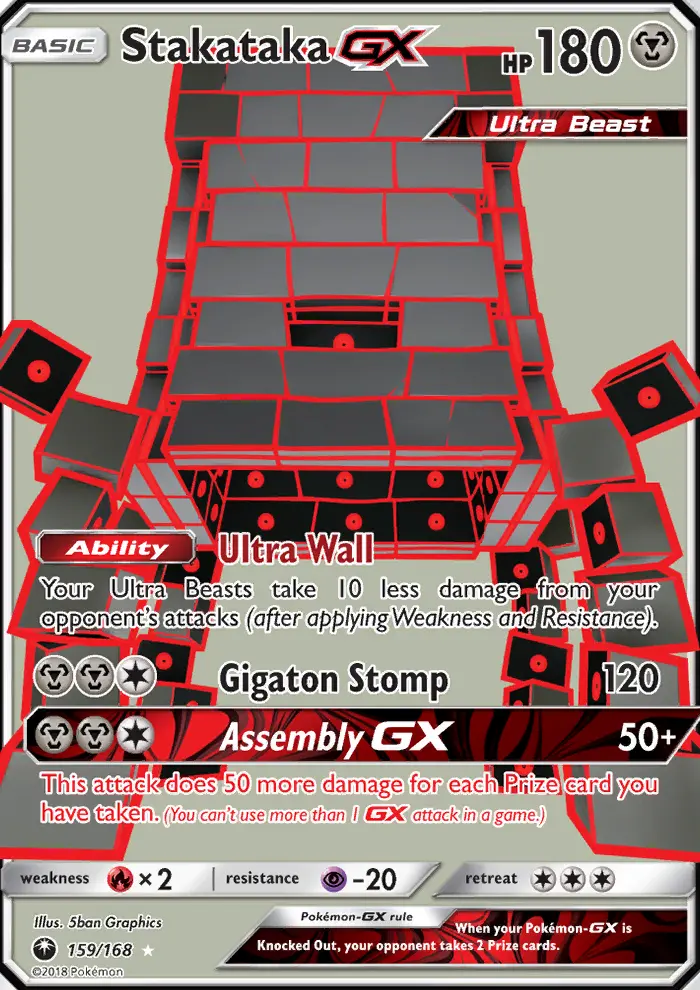
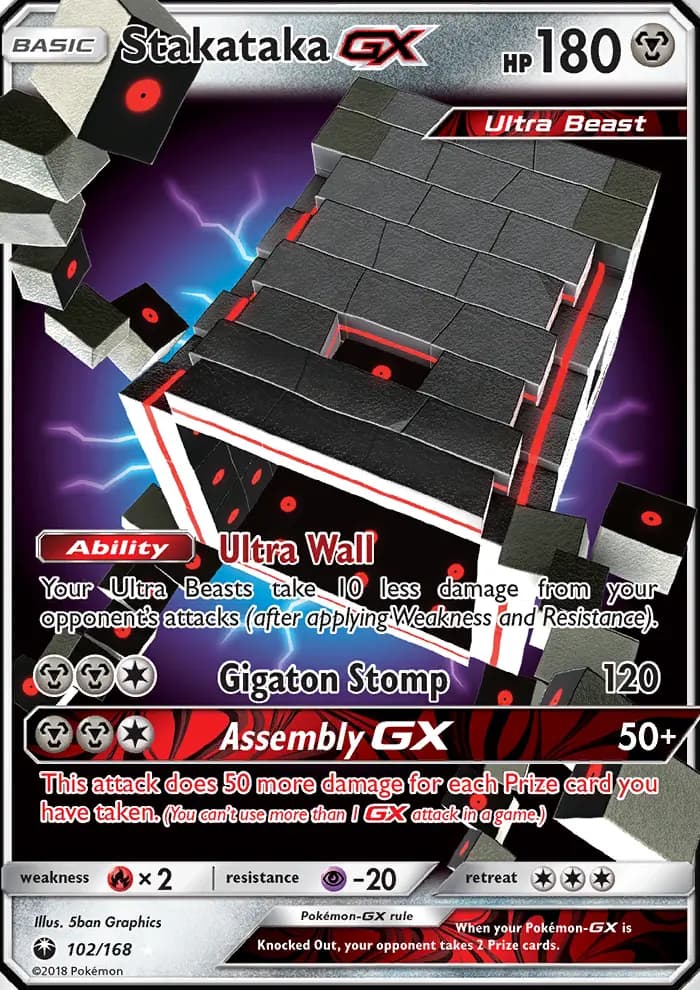
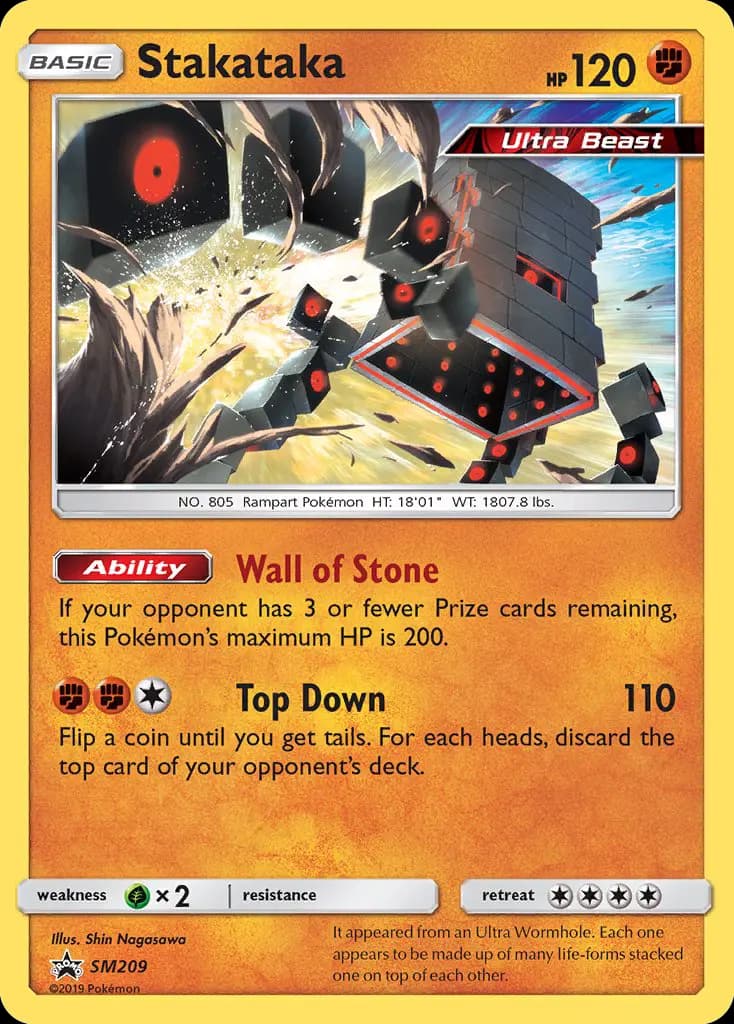
Stakataka
Generation VII · #0805 — Rampart Pokémon
Stakataka is a rock/steel-type Pokémon whose hp — 50 at base — does more to define its role than its overall spread does. Its signature ability, Beast Boost, empowers it to raise its highest stat by one stage whenever it defeats an opponent, creating opportunities for strategic stat manipulation during battles. Standing at an imposing 5.5 meters tall and weighing 820 kilograms, Stakataka is among the largest and heaviest Pokémon ever discovered, demanding respect wherever it appears.
Editor's Take
Stakataka has 211 base Defense and 13 base Speed, which makes it the slowest Pokémon in the series and a genuinely terrifying Trick Room attacker.
Base Stats
Height
5.5m
Weight
820.0kg
Category
Rampart Pokémon
Gender
Genderless
Color
gray
Shape
quadruped
Abilities
Raises this Pokémon's highest stat by one stage when it faints another Pokémon.

Stakataka Biology & Physical Characteristics
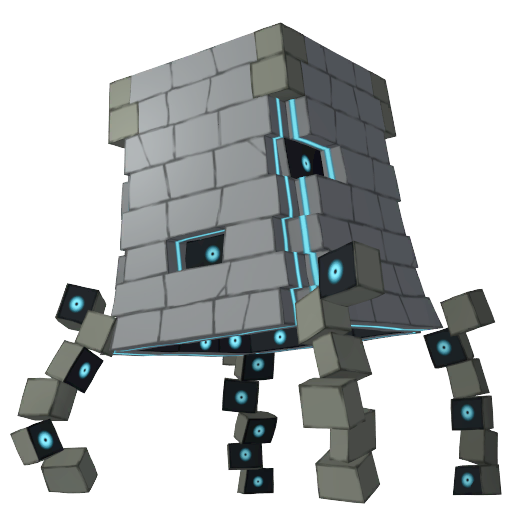
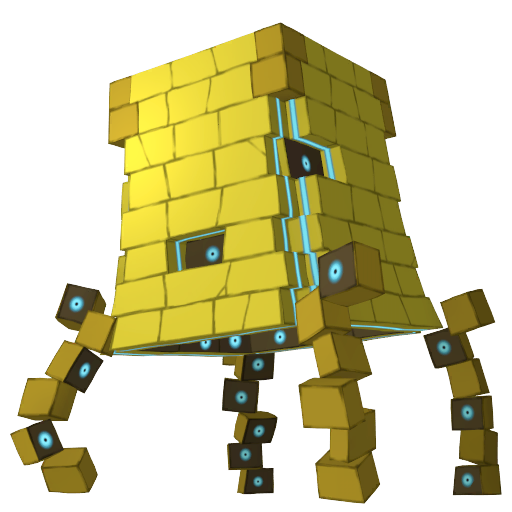
Stakataka presents one of the most extraordinary biological mysteries in Pokémon science, as it is not a singular organism but rather a colony of approximately 137 to 150 individual brick-like lifeforms perfectly stacked and organized into a unified structure. Each stone component functions as an independent entity, yet they coordinate seamlessly to create what appears to be a four-legged tower with glowing blue lines running along the edges of each rectangular block. The structure comprises 24 stones on each of its four sides, 8 darker corner stones, and 9 stones positioned atop the formation, totaling exactly 137 distinct lifeforms working in perfect synchronization. Each individual stone possesses a black underside with a circular, glowing blue eye that serves as a sensory organ, and remarkably, these eyes shift from blue to an angry red coloration whenever Stakataka enters combat or experiences heightened emotions. The spindly legs at each corner are composed of darker gray stone and can retract into the corners of the structure when at rest, allowing Stakataka to compress into a nearly perfect cube that resembles an ordinary stone building or wall. Like all Ultra Beasts, Stakataka channels Z-Power—the same mysterious energy found in Totem Pokémon—which manifests as a distinctive red, flaring aura surrounding its form. The individual stone components maintain remarkable structural integrity and can be manipulated freely, allowing Stakataka to open gaps within its body to permit attacks through or trap opponents inside its hollow interior.
Pokedex Numbers
Training
Breeding
Stakataka Breeding, Gender Ratio & Egg Groups
Stakataka is classified as a genderless Pokémon, reflecting its nature as a composite organism composed of individual stone lifeforms rather than a traditionally sexed biological entity. This genderless status places Stakataka in the Undiscovered egg group, making it completely unable to breed through conventional means with any other Pokémon species. The absence of gender characteristics aligns with Stakataka's status as an alien Ultra Beast, suggesting that reproduction in its native Ultra Space dimension may follow entirely different biological principles than those governing traditional Pokémon breeding. The lack of sexual dimorphism among Stakataka specimens supports the theory that all individuals represent colonies of identical stone lifeforms arranged in the same configuration, with each example being essentially interchangeable with others of its kind. This biological constraint ensures that trainers cannot obtain multiple Stakataka through breeding, making each captured specimen a unique and irreplaceable addition to a team. The genderless nature also raises fascinating questions about how Ultra Beasts propagate and multiply in their home dimension, suggesting reproduction methods potentially involving division, aggregation, or entirely novel mechanisms unknown to conventional Pokémon science.
Sprites


TMs & HMs
tm01
sword shield
tm05
red blue
tm05
yellow
tm05
red green japan
tm05
lets go pikachu lets go eevee
tm06
yellow
tm06
gold silver
tm06
red blue
tm06
crystal
tm05
blue japan
tm06
emerald
tm06
firered leafgreen
tm06
diamond pearl
tm06
platinum
tm06
ruby sapphire
tm06
colosseum
tm06
black 2 white 2
tm06
xd
tm06
black white
tm06
heartgold soulsilver
+467 more TMs/HMs
Stakataka Evolution, Mega Evolution & Special Forms
Stakataka does not evolve into any other Pokémon species, nor does it evolve from a pre-evolved form, representing a complete and final evolutionary stage in itself. The creature's status as an Ultra Beast places it outside conventional evolutionary frameworks that govern typical Pokémon development. Additionally, Stakataka does not possess a Mega Evolution form, distinguishing it from many other Generation VII Pokémon that gained access to Mega Evolution through the Mega Stone mechanic. This singular, non-evolving status underscores the fundamental alien nature of Stakataka's biology, suggesting that the individual stone lifeforms comprising its body have already reached their optimal configuration. The inability to evolve may also reflect the biological reality that Stakataka, being a composite organism of 137 independent lifeforms, exists in a state of perfect collective synergy that cannot be improved through traditional evolutionary processes. Players seeking to add Stakataka to their team must capture the Ultra Beast directly, as breeding is impossible due to its status in the Undiscovered egg group and genderless nature.
Where to Find
Poni Grove
alola
Stakataka Behaviour and Natural Habitat
Stakataka exhibits behavior patterns distinctly alien to most Pokémon species, reflecting its origin from another dimension entirely. The creature has demonstrated an unusual aversion to certain situations, particularly disliking being confined or having its stone components separated, as evidenced by observations from the International Police. When at rest and feeling non-confrontational, Stakataka employs a sophisticated camouflage strategy by planting itself firmly on the ground and disguising its entire body as an ordinary stone structure or wall, rendering it virtually indistinguishable from common architecture. This passive mimicry serves as both a defensive mechanism and an effective hunting strategy, allowing the Ultra Beast to ambush unsuspecting prey. However, when provoked or engaged in battle, Stakataka becomes an entirely different creature—its eyes illuminate a threatening crimson red across all 137 stone components, and it displays remarkable physical prowess despite its seemingly cumbersome construction. The creature's powerful legs possess enough destructive force to snap trees in half, making it a formidable physical threat in any environment. In its natural habitat within Ultra Space, Stakataka likely inhabited rocky, mountainous regions where its stone-like appearance would provide maximum camouflage. Since arrival in Alola, it has been observed primarily in rocky terrain and mountainous areas, though its preference for cooler, stone-rich environments suggests it may struggle in tropical or sandy biomes.
Pokedex Entries
It appeared from an Ultra Wormhole. Each one appears to be made up of many life-forms stacked one on top of each other.
When stone walls started moving and attacking, the brute’s true identity was this mysterious life-form, which brings to mind an Ultra Beast.
Stakataka Name Origin & Design Inspiration
Stakataka's name comes from the English word 'stack,' perfectly capturing the creature's most defining characteristic of stacked stone blocks arranged into a singular form. The Japanese name, Tundetunde (ツンデツンデ), echoes this concept while employing phonetic repetition common to Japanese creature nomenclature, suggesting the stacked, repetitive nature of its component stones. The design philosophy behind Stakataka represents a fascinating departure from traditional Pokémon aesthetics, drawing inspiration from castle walls, stone fortifications, and geological formations rather than biological organisms. Its Genus designation as the 'Rampart Pokémon' reinforces this architectural theme, evoking images of fortress walls and defensive ramparts built from stacked stone blocks. The gray coloration with darker corner stones mirrors real stone construction techniques, while the glowing blue lines suggest some form of energy conduit or connective tissue binding the individual lifeforms together. The design team's choice to implement independently visible eyes on each stone block was particularly inspired, creating a distinctly unsettling effect when these eyes glow red in anger. This composite design philosophy, showing intelligence in how 137 individual components work together, reflects the Ultra Beast concept of otherworldly creatures operating under biological principles entirely foreign to Alola's native Pokémon. The overall aesthetic resembles neither animal nor plant, but rather an architectural structure granted sentience and mobility, making Stakataka instantly recognizable among all Ultra Beasts.
Learnable Moves
Stakataka can learn 66 moves:
Move | Type | Cat. | Power | Acc. | PP |
|---|---|---|---|---|---|
| ally switch | psychic | Status | — | — | 15 |
| autotomize | steel | Status | — | — | 15 |
| bide | normal | Physical | — | — | 10 |
| bind | normal | Physical | 15 | 85 | 20 |
| block | normal | Status | — | — | 5 |
| body press | fighting | Physical | 80 | 100 | 10 |
| body slam | normal | Physical | 85 | 100 | 15 |
| brutal swing | dark | Physical | 60 | 100 | 20 |
| bulldoze | ground | Physical | 60 | 100 | 20 |
| double edge | normal | Physical | 120 | 100 | 15 |
| earthquake | ground | Physical | 100 | 100 | 10 |
| endure | normal | Status | — | — | 10 |
| facade | normal | Physical | 70 | 100 | 20 |
| flash cannon | steel | Special | 80 | 100 | 10 |
| frustration | normal | Physical | — | 100 | 20 |
| giga impact | normal | Physical | 150 | 90 | 5 |
| gravity | psychic | Status | — | — | 5 |
| gyro ball | steel | Physical | — | 100 | 5 |
| harden | normal | Status | — | — | 30 |
| heat crash | fire | Physical | — | 100 | 10 |
| heavy slam | steel | Physical | — | 100 | 10 |
| hidden power | normal | Special | 60 | 100 | 15 |
| high horsepower | ground | Physical | 95 | 95 | 10 |
| infestation | bug | Special | 20 | 100 | 20 |
| iron defense | steel | Status | — | — | 15 |
| iron head | steel | Physical | 80 | 100 | 15 |
| light screen | psychic | Status | — | — | 30 |
| magic coat | psychic | Status | — | — | 15 |
| magic room | psychic | Status | — | — | 10 |
| magnet rise | electric | Status | — | — | 10 |
| mega kick | normal | Physical | 120 | 75 | 5 |
| meteor beam | rock | Special | 120 | 90 | 10 |
| protect | normal | Status | — | — | 10 |
| recycle | normal | Status | — | — | 10 |
| reflect | psychic | Status | — | — | 20 |
| rest | psychic | Status | — | — | 5 |
| return | normal | Physical | — | 100 | 20 |
| rock blast | rock | Physical | 25 | 90 | 10 |
| rock polish | rock | Status | — | — | 20 |
| rock slide | rock | Physical | 75 | 90 | 10 |
| rock throw | rock | Physical | 50 | 90 | 15 |
| rock tomb | rock | Physical | 60 | 95 | 15 |
| role play | psychic | Status | — | — | 10 |
| round | normal | Special | 60 | 100 | 15 |
| safeguard | normal | Status | — | — | 25 |
| sandstorm | rock | Status | — | — | 10 |
| skill swap | psychic | Status | — | — | 10 |
| sleep talk | normal | Status | — | — | 10 |
| smack down | rock | Physical | 50 | 100 | 15 |
| snore | normal | Special | 50 | 100 | 15 |
| stealth rock | rock | Status | — | — | 20 |
| steel beam | steel | Special | 140 | 95 | 5 |
| steel roller | steel | Physical | 130 | 100 | 5 |
| stomp | normal | Physical | 65 | 100 | 20 |
| stomping tantrum | ground | Physical | 75 | 100 | 10 |
| stone edge | rock | Physical | 100 | 80 | 5 |
| substitute | normal | Status | — | — | 10 |
| superpower | fighting | Physical | 120 | 100 | 5 |
| tackle | normal | Physical | 40 | 100 | 35 |
| take down | normal | Physical | 90 | 85 | 20 |
| telekinesis | psychic | Status | — | — | 15 |
| toxic | poison | Status | — | 90 | 10 |
| trick room | psychic | Status | — | — | 5 |
| wide guard | rock | Status | — | — | 10 |
| wonder room | psychic | Status | — | — | 10 |
| zen headbutt | psychic | Physical | 80 | 90 | 15 |
Stakataka Competitive Battle Guide
Assessing its battle viability, Stakataka occupies a specialized defensive niche as one of the most physically bulky Pokémon available, with an exceptional Defense stat of 211 that enables it to absorb devastating physical attacks from nearly any opponent. Its Attack stat of 131 provides respectable offensive output, allowing it to function as a mixed defensive wall capable of threatening opponents while absorbing punishment. However, Stakataka's abysmal Speed stat of only 13 represents a critical vulnerability, ensuring it will almost always move last in battle regardless of opponent choice, a handicap that severely limits its competitive viability despite excellent bulk. The signature ability Beast Boost provides Stakataka with a unique strategic advantage, incrementally raising its highest stat by one stage whenever it defeats an opponent, potentially allowing it to accumulate stat boosts throughout a battle if played strategically. Its Steel/Rock typing grants exceptional defensive coverage with resistances to Normal, Flying, Rock, Bug, Grass, Psychic, and Fairy-type attacks, while dual resistances to many common competitive threats provide invaluable defensive utility. Key moves in Stakataka's competitive arsenal include Stealth Rock for entry hazard support, Iron Defense for self-boosting defensive strategies, Iron Head for reliable Steel-type coverage, and Rock Slide for offensive presence. The move Autotomize, which boosts Speed at the cost of weight reduction, sees limited use due to Stakataka's already-dismal velocity, though it can be marginally useful in specific bulky team compositions. Wide Guard provides team support in Double and Triple battles, protecting allies from spread moves while Stakataka stalls with its passive bulk. Competitive viability remains constrained primarily by its crippling Speed stat and lower Special Attack of 53, making Stakataka best deployed in specialized defensive teams built around weather, terrain, or entry hazards rather than offensive strategies.
Commonly Asked Questions About Stakataka
What type is Stakataka?
Stakataka is a rock and steel type Pokemon.
What does Stakataka evolve from?
Stakataka does not evolve.
What are Stakataka's weaknesses?
Stakataka is weak to fighting, ground and water type moves.
Where can I find Stakataka?
Stakataka can be found in poni grove (alola).
Stakataka Cultural Impact & Franchise History
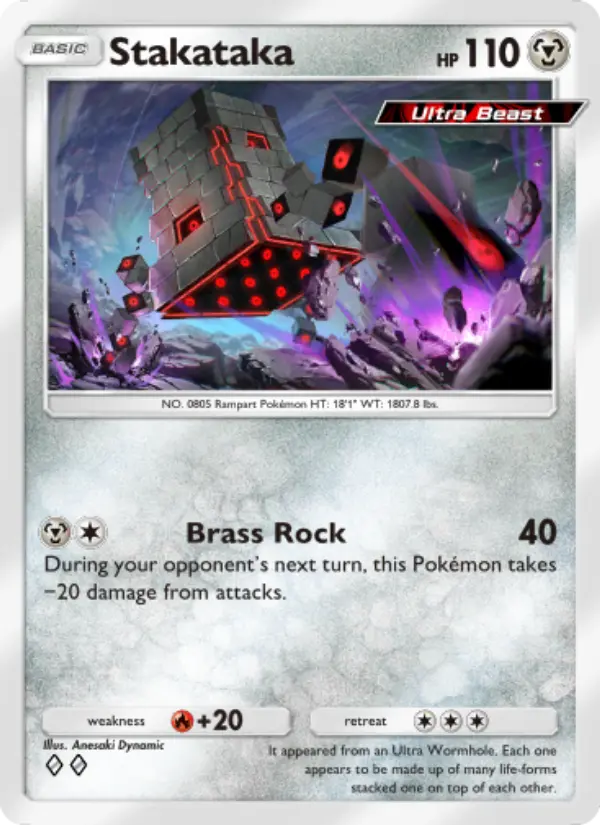
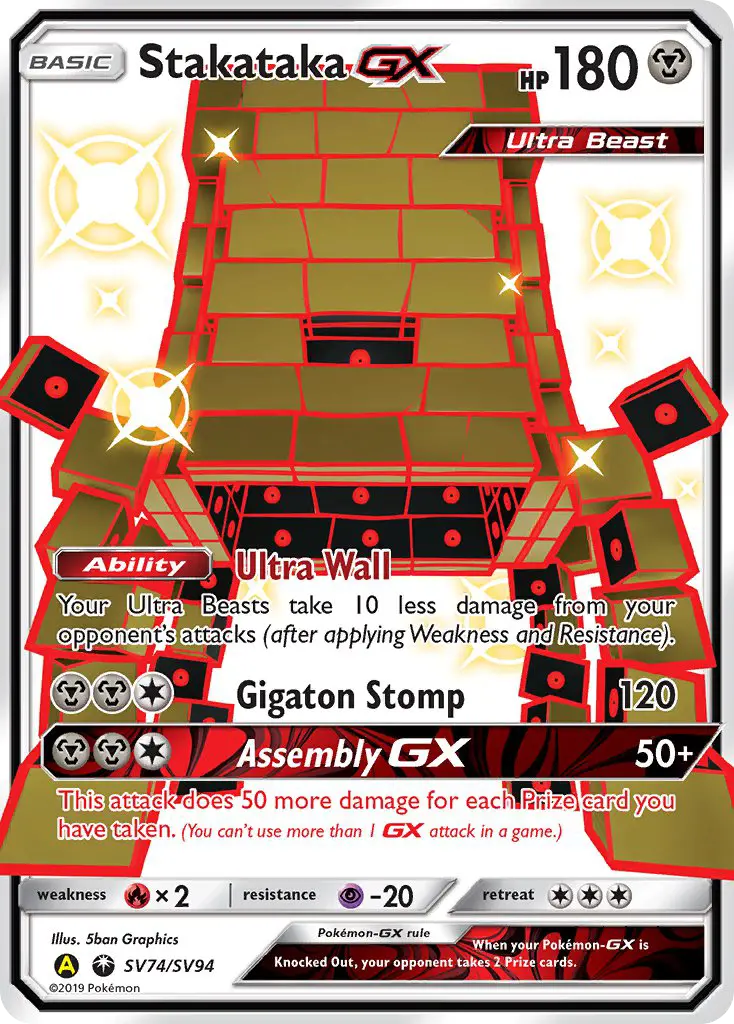
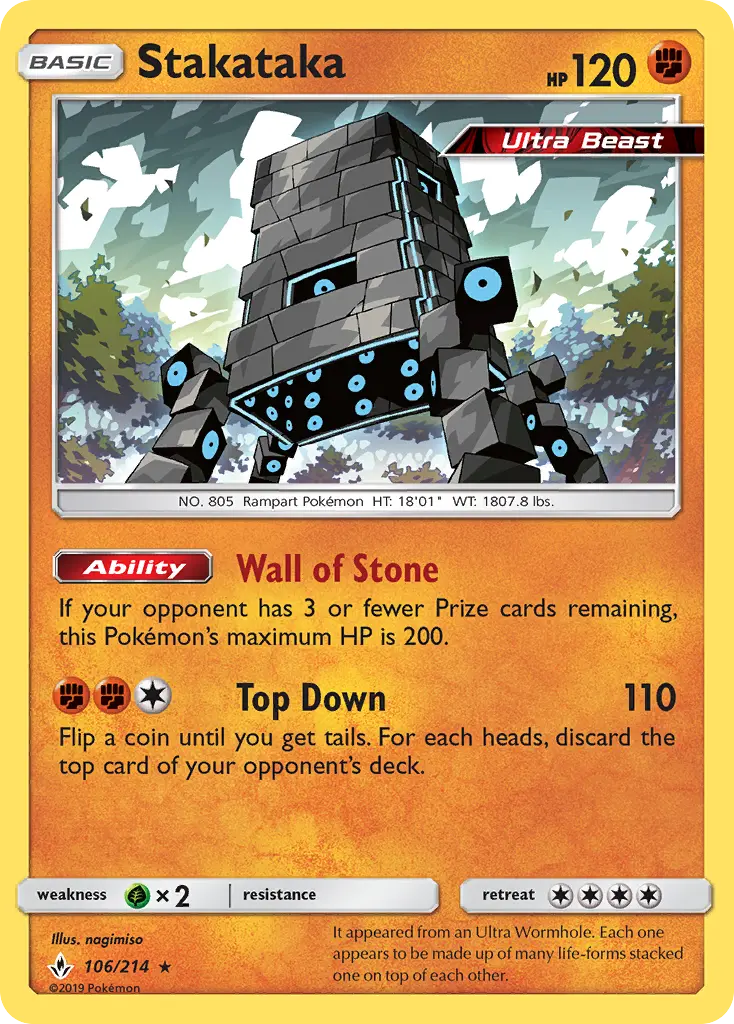
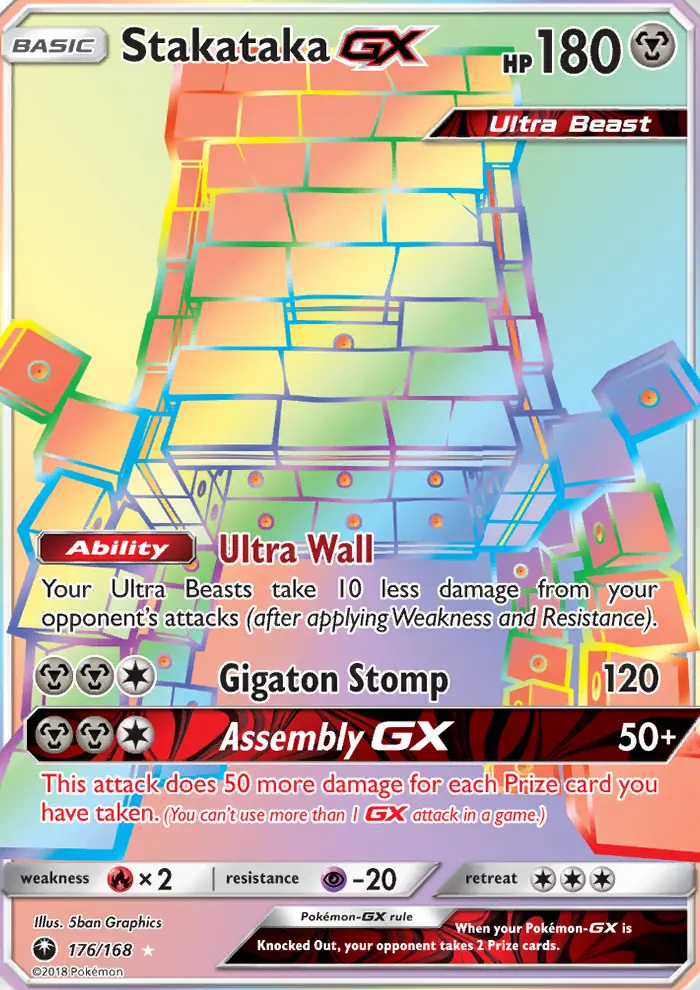
Stakataka captured international imagination as one of the most visually distinctive Ultra Beasts introduced in Generation VII, challenging conventional understandings of what constitutes a Pokémon through its composite, non-biological appearance. The creature's debut in Pokémon Ultra Sun and Ultra Moon marked a significant moment in franchise history, introducing players to genuinely alien lifeforms with fundamentally incomprehensible biology compared to traditional creatures. Fan communities became fascinated by the philosophical implications of Stakataka's existence as a colony organism—debates erupted across social media platforms questioning whether all 137 individual stones should be considered separate entities or a singular consciousness, generating unprecedented discussion about organism identity and collective consciousness within the Pokémon universe. The creature's striking design, combining fortress-like architecture with living biology, inspired numerous fan artworks, creative interpretations, and cosplay recreations, particularly among artists interested in non-traditional creature design. Competitive players embraced Stakataka as a novelty pick that challenged the metagame through sheer defensive wall capabilities, leading to viral battle videos showcasing its impressive bulk against optimized offensive teams. Stakataka's cultural presence extended into merchandise and collectibles, with action figures emphasizing its unique blocky construction and competitive TCG cards featuring its Beast Boost ability prominently in deck strategies. The Pokédex entries describing confusion between Stakataka and moving stone walls became iconic internet memes, particularly in gaming communities where the revelation of hidden identities proved endlessly entertaining. Educational content about Stakataka proliferated across fan wikis and community forums, with dedicated researchers attempting to catalogue all 137 individual stone components and speculate about their individual consciousness levels.
Where to Find Stakataka in Every Pokémon Game
Stakataka first became available to trainers exclusively in Pokémon Ultra Sun and Ultra Moon, where it appeared as an Ultra Beast encountered in the Alola region after the opening of Ultra Wormholes. In these Generation VII games, Stakataka could be caught in specific Ultra Space areas accessed through Ultra Wormhole encounters, with predetermined statistics and movesets reflecting its alien nature. The creature's relatively low catch rate of 30 (approximately 8.8 percent using a standard Poké Ball with full health) made capturing it considerably more challenging than standard Pokémon, reflecting its status as a rare and powerful Ultra Beast. Following its introduction, Stakataka maintained availability in subsequent generations through various methods including Pokémon Sword and Shield, where it appeared through Max Raid Battles in dynamaxed form, granting players an alternative method of obtaining specimens outside of the original Ultra Sun and Ultra Moon encounter. The creature's presence expanded further with each new generation, becoming available through transfer mechanics and various in-game encounters depending on the specific title. Stakataka's low base happiness of 0 upon capture creates an interesting gameplay mechanic, requiring players to invest significant effort into bonding with the creature through battles, item usage, and care to develop affection and maximize its potential. The slow growth rate classification extends the leveling process considerably compared to standard Pokémon, discouraging casual players but rewarding dedicated trainers who invest time in cultivating their Stakataka specimens. Its massive weight of 820 kilograms creates mechanical implications in some games where weight-based moves like Heavy Slam or Low Kick receive significant damage bonuses when used against or by Stakataka, making it an interesting consideration for team building across different titles.