
Totem Vikavolt
Generation VII · #10122 — Stag Beetle Pokémon
Vikavolt-Totem's profile is easy to undersell: 2.6 m, 147.5 kg, and a bug/electric typing that doesn't scream power — until you look at its HP of 50. Its Levitate ability grants it complete immunity to Ground-type moves, a crucial advantage that eliminates a significant weakness of most Electric-type Pokémon. The totem form designation signifies that this Vikavolt may appear with stat boosts or ally Pokémon during Alola's unique trial battles, making it a memorable encounter for players navigating the island's challenges.
Editor's Take
Totem Vikavolt is one of the more difficult Totem battles in Sun and Moon, largely because 145 base Special Attack with an aura boost hits extremely hard.
Base Stats
Height
2.6m
Weight
147.5kg
Category
Stag Beetle Pokémon
Gender
Male 50% / Female 50%
Color
blue
Shape
armor
Abilities
Evades ground moves.

Totem Vikavolt Biology & Physical Characteristics
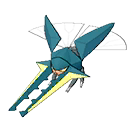
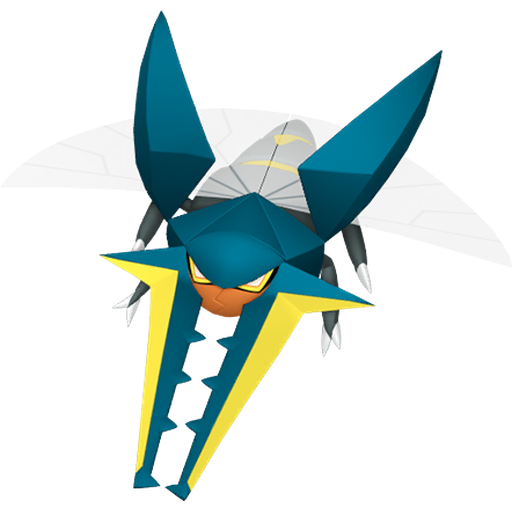
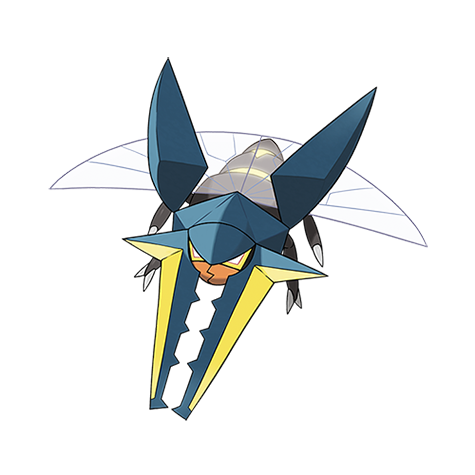
Vikavolt is a striking beetle-like Pokémon characterized by its large, imposing mandibles that extend prominently from its small blue helmet-shaped head. Its body features a segmented, black carapace divided into three distinct sections separated by yellow rings, with yellow spots adorning the last two segments. The creature's most distinctive feature consists of its transparent wings with blue elytra, allowing for surprising aerial agility despite its relatively large frame of 1.5 meters in height and 45 kilograms in weight. The totem form of Vikavolt maintains these physical characteristics but may display enhanced proportions or more vibrant coloration, reflecting its elevated status among its kind. Internally, Vikavolt possesses a specialized electrical organ located in its abdomen that generates the substantial electrical power it harnesses during combat. This organ's output is concentrated and controlled through the Pokémon's powerful jaws, which line their interiors with spikes and display blue inner surfaces contrasted with yellow outer edges. The mandibles themselves serve as both weapons and electrical conductors, allowing Vikavolt to produce precise, devastating electromagnetic beams with surgical accuracy.
Pokedex Numbers
Training
Breeding
Totem Vikavolt Breeding, Gender Ratio & Egg Groups
Vikavolt maintains a perfectly balanced gender ratio of 50% male to 50% female, allowing for consistent breeding opportunities regardless of which individual trainers catch. As a member of the Bug egg group, Vikavolt can breed with other Bug-type Pokémon and certain compatible species, producing Grubbin eggs that hatch after approximately 15 cycles of walking (equivalent to 3,599 to 3,855 steps depending on game mechanics). The base friendship value for Vikavolt in Generation VII was set at 70, indicating a reasonably friendly disposition that neither requires excessive effort nor develops immediately upon capture. The totem form designation does not affect breeding mechanics or gender distribution, as the totem form represents a battle state rather than a permanent genetic difference from standard Vikavolt. Trainers seeking to breed Vikavolt for competitive purposes should note that the species cannot pass down moves through egg inheritance alone, requiring specific move tutors or prior evolution stages to teach desired attacks. The Bug egg group classification limits Vikavolt's breeding options compared to more versatile Pokémon, but the species' strong Special Attack stat makes even standardly-trained offspring competitive threats.
Sprites
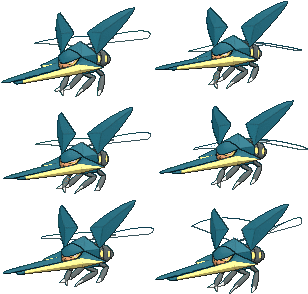
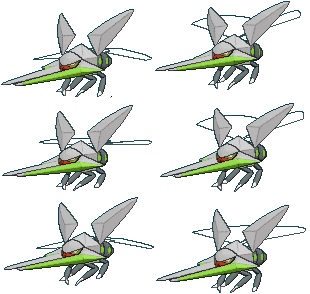
TMs & HMs
tm05
lets go pikachu lets go eevee
tm06
yellow
tm06
gold silver
tm06
red blue
tm06
crystal
tm06
emerald
tm06
firered leafgreen
tm06
diamond pearl
tm06
platinum
tm06
ruby sapphire
tm06
colosseum
tm06
black 2 white 2
tm06
xd
tm06
black white
tm06
heartgold soulsilver
tm06
omega ruby alpha sapphire
tm06
lets go pikachu lets go eevee
tm06
ultra sun ultra moon
tm06
sun moon
tm06
x y
+511 more TMs/HMs
Totem Vikavolt's Evolution Chain


Totem Vikavolt Evolution, Mega Evolution & Special Forms
Vikavolt evolves from Charjabug, the second stage of the Grubbin evolutionary line that begins at Generation VII. Unlike most Pokémon evolutions that occur through simple leveling, Charjabug evolves into Vikavolt under specific conditions that vary between game generations, reflecting the unique mechanics of the Alola region. In Generation VII games (Sun, Moon, Ultra Sun, and Ultra Moon), Charjabug evolves into Vikavolt when leveled up within special magnetic field areas scattered throughout Alola's landscape, creating an organic connection between the Pokémon and its environment. In subsequent generations beginning with Generation VIII (Sword and Shield), the evolution method was simplified, allowing Charjabug to evolve into Vikavolt when exposed to a Thunder Stone instead. The totem form of Vikavolt exists as an enhancement state rather than a separate evolution, representing a Vikavolt that has grown stronger through natural means or has been designated as a guardian of Alola's trials. As the apex form of the Grubbin line, Vikavolt represents a dramatic transformation from the small, grounded Grubbin into a powerful, flying electrical threat that demonstrates complete mastery over both its Bug-type heritage and Electric-type capabilities. This evolutionary journey symbolizes the progression from cautious insectile behavior to confident aerial predation.
Where to Find
Location data not available for this Pokémon in the database.
Totem Vikavolt Behaviour and Natural Habitat
Vikavolt exhibits remarkable aerial prowess and tactical intelligence in its combat approach, constantly circling opponents while searching for openings to strike with devastating electrical attacks. According to Pokédex entries, Vikavolt zips around with sharp vigilance, concentrating electrical energy within its massive jaws before unleashing powerful jolts at unsuspecting enemies. The species demonstrates particular effectiveness against bird Pokémon, overwhelming them with shocking beams of electrical energy fired from its electrical organ. In its natural habitat of Alola's forests, Vikavolt navigates the complicated tangles of branches at high speeds, performing acrobatic maneuvers including tailspins and sharp turns that would seem impossible for such a sturdy creature. The totem form exemplifies these behavioral traits to an elevated degree, fluttering opponents with more aggressive aerial maneuvers to create strategic openings for more powerful attacks. Notably, Vikavolt possesses the remarkable ability to carry a Charjabug while flying, utilizing its smaller pre-evolution as a spare battery to rapidly fire consecutive high-powered beams of electricity. During fierce aerial combat, Vikavolt will strategically release its Charjabug companion to reduce weight and maximize mobility, demonstrating tactical awareness and adaptability in battle.
Pokedex Entries
It zips around, on sharp lookout for an opening. It concentrates electrical energy within its large jaws and uses it to zap its enemies.
It has an organ that generates electricity in its abdomen. It concentrates energy in its strong jaws and fires off powerful jolts of electricity.
It produces electricity via an electrical organ in its abdomen. It overwhelms bird Pokémon with shocking beams of electrical energy.
Vikavolt flusters opponents with acrobatic flying maneuvers. This creates an opening for it to deliver an electric beam attack.
It builds up electricity in its abdomen, focuses it through its jaws, and then fires the electricity off in concentrated beams.
If it carries a Charjabug to use as a spare battery, a flying Vikavolt can rapidly fire high-powered beams of electricity.
Totem Vikavolt Name Origin & Design Inspiration
The name Vikavolt combines "Vikingsvalley" or references to "voltage" with a phonetic nod to stag beetles (known as kuwagata in Japanese), reflected in its Japanese name Kuwagannon. The design itself draws heavily from the iconic stag beetle, one of the most recognizable insects in Japanese culture, known for their impressive mandibles and armored bodies. The blue and yellow color scheme creates a striking visual appearance reminiscent of electricity and industrial machinery, emphasizing the electrical nature grafted onto this insectile form. The totem form likely receives enhanced visual styling—perhaps more vibrant coloration, stronger visual effects, or larger proportions—to distinguish it as a powerful individual worthy of guarding Alola's trials. Every aspect of Vikavolt's design reinforces its dual identity as both a fearsome beetle and a living conduit of electrical energy. The segmented body and yellow rings evoke the appearance of electrical coils or circuits, while the mandibles resemble both biological weapons and lightning rods. The transparent wings with blue elytra suggest advanced aerial technology merged with natural biology, creating a Pokémon that feels simultaneously like a force of nature and a technological marvel, perfectly encapsulating Generation VII's blend of natural Hawaiian inspiration with modern elements.
Learnable Moves
Totem Vikavolt can learn 52 moves:
Move | Type | Cat. | Power | Acc. | PP |
|---|---|---|---|---|---|
| acrobatics | flying | Physical | 55 | 100 | 15 |
| agility | psychic | Status | — | — | 30 |
| air slash | flying | Special | 75 | 95 | 15 |
| attract | normal | Status | — | 100 | 15 |
| bite | dark | Physical | 60 | 100 | 25 |
| bug bite | bug | Physical | 60 | 100 | 20 |
| bug buzz | bug | Special | 90 | 100 | 10 |
| charge | electric | Status | — | — | 20 |
| charge beam | electric | Special | 50 | 90 | 10 |
| confide | normal | Status | — | — | 20 |
| dig | ground | Physical | 80 | 100 | 10 |
| double team | normal | Status | — | — | 15 |
| electroweb | electric | Special | 55 | 95 | 15 |
| energy ball | grass | Special | 90 | 100 | 10 |
| facade | normal | Physical | 70 | 100 | 20 |
| flash cannon | steel | Special | 80 | 100 | 10 |
| frustration | normal | Physical | — | 100 | 20 |
| giga impact | normal | Physical | 150 | 90 | 5 |
| guillotine | normal | Physical | — | 30 | 5 |
| hidden power | normal | Special | 60 | 100 | 15 |
| hyper beam | normal | Special | 150 | 90 | 5 |
| iron defense | steel | Status | — | — | 15 |
| laser focus | normal | Status | — | — | 30 |
| light screen | psychic | Status | — | — | 30 |
| magnet rise | electric | Status | — | — | 10 |
| mud slap | ground | Special | 20 | 100 | 10 |
| poison jab | poison | Physical | 80 | 100 | 20 |
| protect | normal | Status | — | — | 10 |
| rain dance | water | Status | — | — | 5 |
| rest | psychic | Status | — | — | 5 |
| return | normal | Physical | — | 100 | 20 |
| roost | flying | Status | — | — | 5 |
| round | normal | Special | 60 | 100 | 15 |
| shock wave | electric | Special | 60 | — | 20 |
| signal beam | bug | Special | 75 | 100 | 15 |
| sky drop | flying | Physical | 60 | 100 | 10 |
| sleep talk | normal | Status | — | — | 10 |
| snore | normal | Special | 50 | 100 | 15 |
| solar beam | grass | Special | 120 | 100 | 10 |
| spark | electric | Physical | 65 | 100 | 20 |
| string shot | bug | Status | — | 95 | 40 |
| substitute | normal | Status | — | — | 10 |
| swagger | normal | Status | — | 85 | 15 |
| thunder | electric | Special | 110 | 70 | 10 |
| thunder wave | electric | Status | — | 90 | 20 |
| thunderbolt | electric | Special | 90 | 100 | 15 |
| toxic | poison | Status | — | 90 | 10 |
| vise grip | normal | Physical | 55 | 100 | 30 |
| volt switch | electric | Special | 70 | 100 | 20 |
| wild charge | electric | Physical | 90 | 100 | 15 |
| x scissor | bug | Physical | 80 | 100 | 15 |
| zap cannon | electric | Special | 120 | 50 | 5 |
Totem Vikavolt Competitive Battle Guide
Vikavolt occupies a specialized niche in competitive Pokémon battling, functioning as a powerful special attacker with respectable defensive bulk and game-changing ability. Its base Special Attack of 145 ranks among the highest of all Bug-type Pokémon, allowing it to deal significant damage with moves like Thunderbolt, Bug Buzz, and Power Gem. The Levitate ability provides invaluable utility by granting complete immunity to Ground-type moves, eliminating a major weakness that typically plagues Electric-type Pokémon and allowing Vikavolt to freely switch into anticipated Ground attacks. With a base Defense of 90 and base Special Defense of 75, Vikavolt achieves moderate bulk that allows it to survive neutral attacks while retaining offensive presence, particularly in tandem with defensive EVs or support moves. However, Vikavolt's base Speed of only 43 presents a significant vulnerability in faster-paced competitive formats, requiring either significant Speed investment through EVs or reliance on priority moves and choice items to maintain offensive momentum. The totem form of Vikavolt encountered in trials may benefit from stat boosts or ally support that amplifies these strengths further, potentially featuring boosted Special Attack or Speed to more effectively pressure opposing teams. Effective competitive sets typically employ a Choice Specs or Choice Scarf item to maximize special attack output or overcome Speed deficiencies, paired with moves like Volt Switch for intelligent pivoting and Bug Buzz for reliable STAB coverage.
Commonly Asked Questions About Totem Vikavolt
What type is Totem Vikavolt?
Totem Vikavolt is a bug and electric type Pokemon.
What does Totem Vikavolt evolve into?
Totem Vikavolt does not evolve into any other Pokemon. It is the final form in its evolution line.
What are Totem Vikavolt's weaknesses?
Totem Vikavolt is weak to rock and fire type moves.
Totem Vikavolt Cultural Impact & Franchise History
Vikavolt represents a significant addition to the Bug-type family within Generation VII's Alola region, offering players an unexpected fusion of biological and electrical aesthetics that captured fan imagination immediately upon the games' release. The species gained prominence through its association with Sophocles, a major character in the Pokémon Sun and Moon anime series, who utilizes Vikavolt as his ace Pokémon and primary competitive threat throughout his trials and gym battles. The design's obvious inspiration from stag beetles resonated particularly strongly with Japanese audiences, where these insects hold cultural significance as symbols of strength and nobility, extending Vikavolt's appeal beyond typical Pokémon enthusiasts. The totem form encounters in Alola's trial battles became memorable moments for players, representing peak difficulty spikes that required genuine strategic thinking and team preparation to overcome. Vikavolt's ability to carry Charjabug as a portable battery adds a whimsical, creative layer to its characterization that spawned countless fan discussions about symbiotic relationships and the mechanics of electricity production in fictional worlds. The Pokémon's striking visual design featuring prominent mandibles and electric-blue coloration made it instantly recognizable and popularized among online communities, merchandise collectors, and competitive battlers seeking distinctive team members that combined power with distinctive aesthetics.
Where to Find Totem Vikavolt in Every Pokémon Game
Vikavolt's availability varies significantly across different Pokémon game generations and regional entries, reflecting the Alola region's specific biodiversity and trial structure. In the original Generation VII games (Pokémon Sun and Moon), Vikavolt appears as Alola Pokédex number 0029, encountered primarily as a totem Pokémon during Sophocles' trial on Ula'ula Island, making wild encounters relatively uncommon outside of this specific context. In Pokémon Ultra Sun and Ultra Moon, Vikavolt's availability increased slightly with revised Pokédex numbering (0036 in the Alola dex), though it remains a species associated more with trainers' teams than wild encounters. In Generation VIII (Pokémon Sword and Shield), Vikavolt received a new Pokédex number (0018 in the Galar dex) and appeared in specific wild area locations and dynamax adventure encounters, becoming more accessible to players seeking to obtain one. The species reappeared in Generation IX's DLC (The Teal Mask), maintaining moderate availability through standard wild encounters and trainer battles within the expansion's environments. The catch rate of 45 indicates moderate difficulty when attempting to capture wild Vikavolt in regions where it appears as a wild Pokémon, requiring either status effect application or reduced HP to ensure reliable captures. Players seeking a Vikavolt for their team typically find it most readily available during story encounters as trainer-owned Pokémon or through breeding Charjabug caught at lower evolution stages.