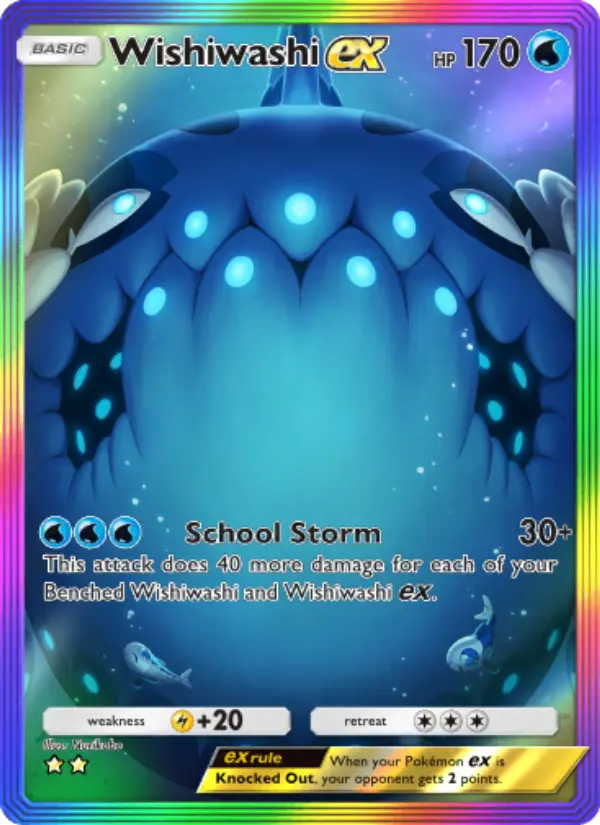
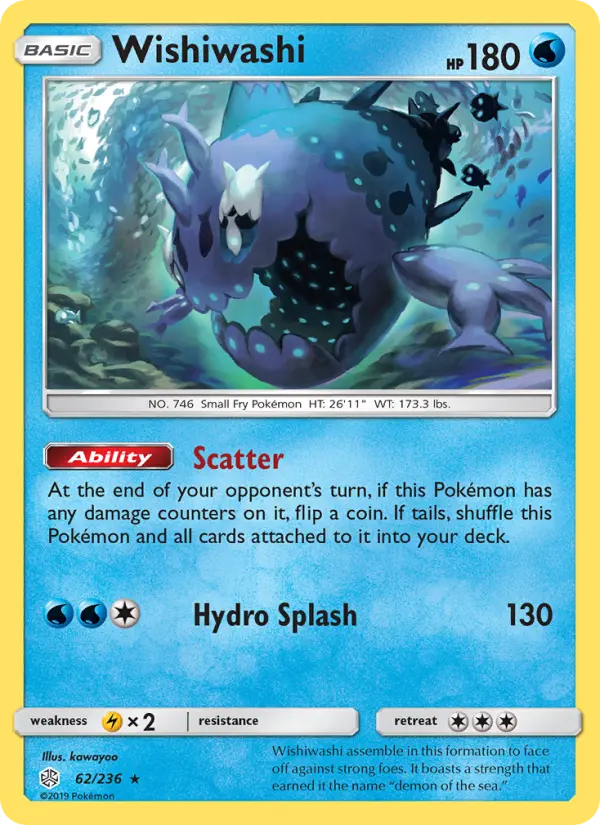
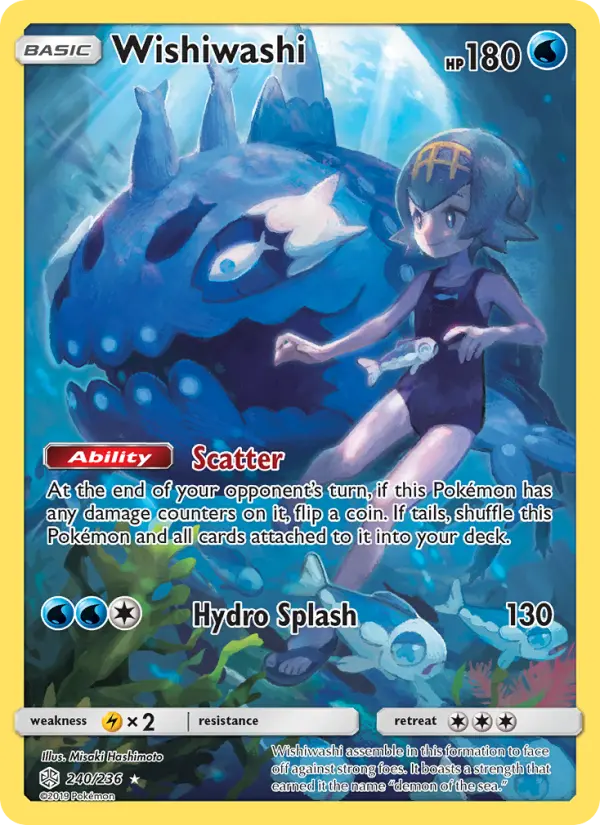
Solo Wishiwashi
Generation VII · #0746 — Small Fry Pokémon
Wishiwashi-Solo debuted in Generation VII, and its water typing has aged into one of its more defining traits, especially paired with schooling. At 0.2 m and 0.3 kg, its build reflects a specialist role rather than a generalist one. Despite its individually pathetic stats, Wishiwashi possesses a remarkable ability called Schooling that allows it to fundamentally transform when its health remains above 25%, swelling from a lone, defenseless fish into a powerful school formation. This unique mechanic makes Wishiwashi a fascinating study in survival strategy and represents a departure from traditional Pokémon evolution mechanics, as the transformation is conditional rather than permanent or level-based.
Editor's Take
Solo Wishiwashi has a base stat total of 175 and School Form has 620, which makes it the largest stat swing of any form change in the series by a wide margin.
Base Stats
Height
0.2m
Weight
0.3kg
Category
Small Fry Pokémon
Gender
Male 50% / Female 50%
Color
blue
Shape
fish
Abilities
Wishiwashi becomes Schooling Form when its HP is 25% or higher.

Solo Wishiwashi Biology & Physical Characteristics
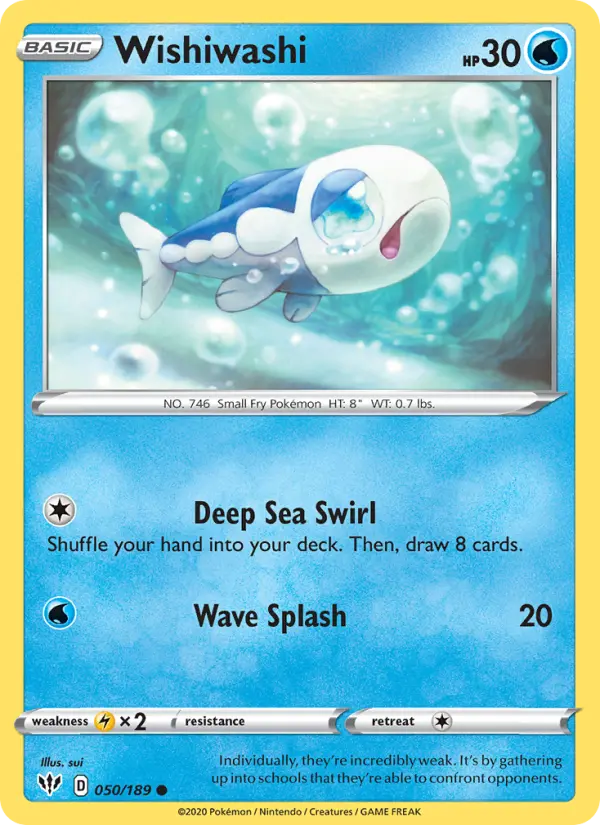
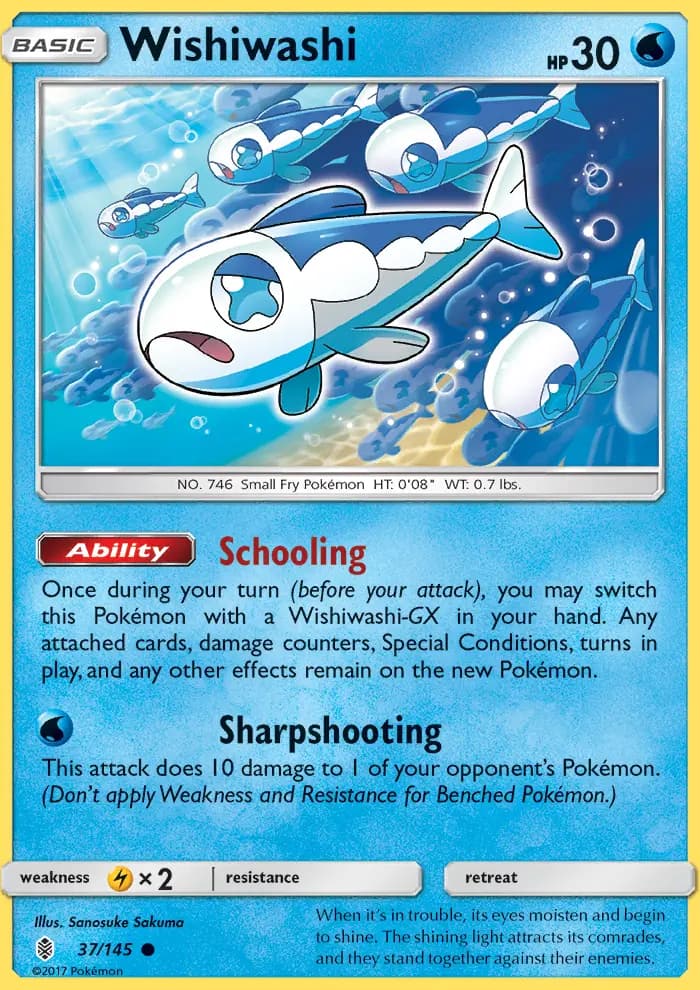
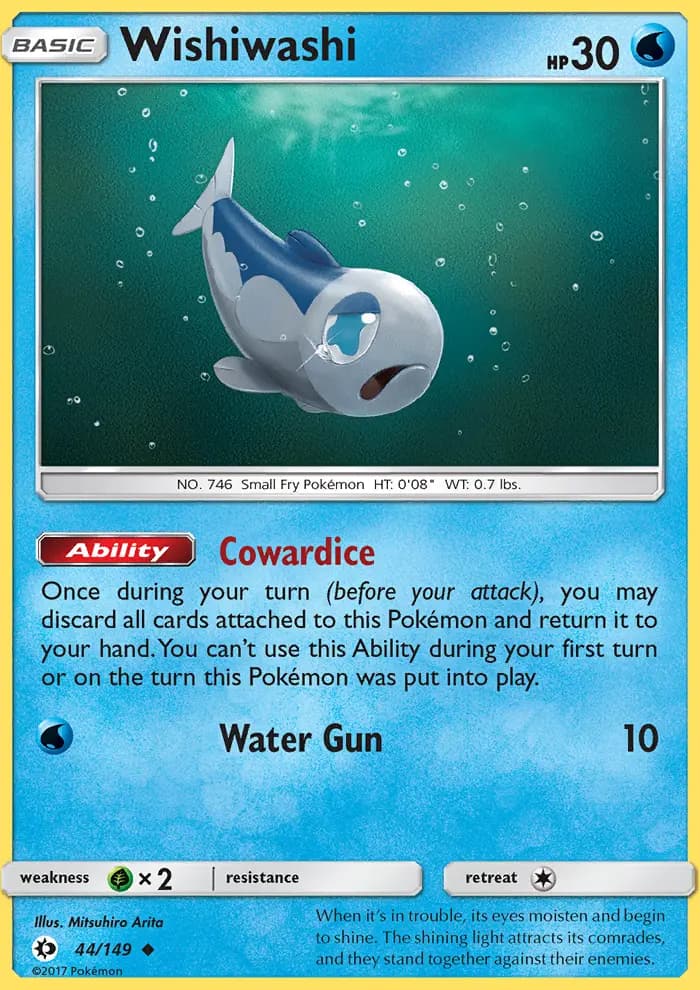
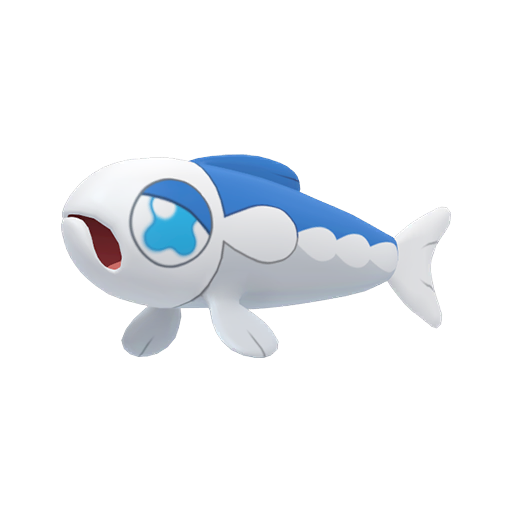
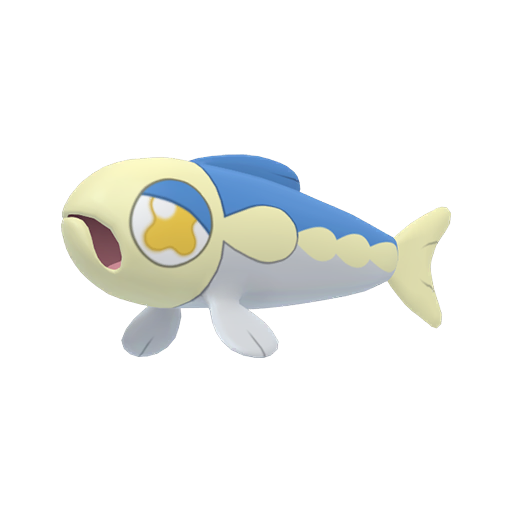
In its Solo Form, Wishiwashi is a small, fish-like Pokémon with a body composition that reflects its vulnerability in the wild. Its most striking features are its large, light blue eyes with pupil-like irises that resemble pools of water, framed by dark blue eyelids that give it an almost perpetually tearful expression. The creature's head and tail are pristine white, while white teardrop-shaped markings line each side of its body, with the marking nearest the head being noticeably larger than those toward the rear. The dorsal region of Wishiwashi's body is dark blue and features a short, rounded dorsal fin, while its ventral side is gray and equipped with two small pectoral fins for basic locomotion. The Solo Form's meager base stat total of 175 reflects its biological reality: with an Attack stat of merely 20, a Defense of 20, and Special Defense of 25, Wishiwashi is defenseless against most threats. Its slightly better Special Attack of 25 and Speed of 40 provide minimal compensation, though its HP base of 45 offers at least a small buffer against immediate knockout.
Pokedex Numbers
Training
Breeding
Solo Wishiwashi Breeding, Gender Ratio & Egg Groups
Wishiwashi exhibits a balanced gender ratio of exactly 50% male and 50% female, indicating no sexual dimorphism in appearance or breeding tendency. This even distribution suggests equal participation from both sexes in the species' schooling behavior and reproduction cycles. With a base happiness value of 70, Wishiwashi begins with moderate friendliness toward its trainer, slightly above the neutral baseline, which hints at its inherent social nature even in captivity. The species belongs to the Water 2 egg group, which includes diverse aquatic and semi-aquatic Pokémon, allowing for breeding compatibility with various water-dwelling creatures. Wishiwashi requires 15 egg cycles to hatch from an egg, translating to approximately 3,599 to 3,855 steps of travel, making it reasonably quick to produce in breeding programs. With a fast growth rate, Wishiwashi reaches its level cap relatively quickly, allowing trainers to access its Schooling Ability at level 20 in the early stages of team development.
Sprites




TMs & HMs
tm03
ruby sapphire
tm03
platinum
tm03
firered leafgreen
tm03
heartgold soulsilver
tm03
diamond pearl
tm03
emerald
tm03
xd
tm03
colosseum
tm03
lets go pikachu lets go eevee
tm05
lets go pikachu lets go eevee
tm06
yellow
tm06
gold silver
tm06
red blue
tm06
crystal
tm06
emerald
tm06
firered leafgreen
tm06
diamond pearl
tm06
platinum
tm06
ruby sapphire
tm06
colosseum
+449 more TMs/HMs
Regional & Special Forms
Solo Wishiwashi also has a related form: School Wishiwashi.
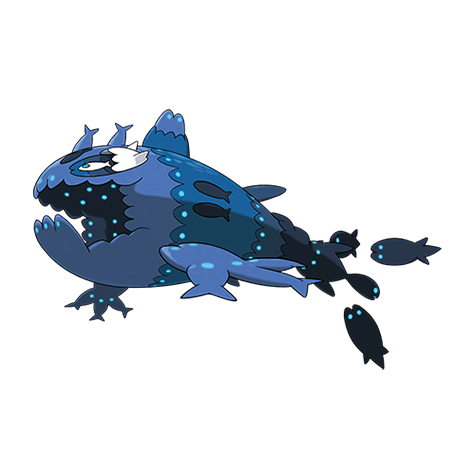
Solo Wishiwashi Evolution, Mega Evolution & Special Forms
Wishiwashi does not undergo traditional evolution in the manner of most Pokémon species. Rather than evolving into a different Pokémon through leveling or special items, Wishiwashi remains unchanged throughout its growth. However, its Schooling Ability provides a form transformation that functions similarly to evolution in practical terms. Upon reaching level 20, Wishiwashi gains access to its Schooling Ability, which causes it to change into School Form whenever its HP exceeds 25% during battle. This transformation is conditional and reversible, distinguishing it from true evolution; if Wishiwashi's health drops to 25% or below, it reverts immediately to its Solo Form. The transformation is automatic and occurs both upon entering battle and at the end of each turn, making it a dynamic mechanic that reflects the Pokémon's tactical response to danger. This design choice emphasizes that Wishiwashi's true power lies not in individual development but in collective action.
Where to Find
Melemele Sea
alola
+5 more
Brooklet Hill
alola
+5 more
Tapu Village
alola
+5 more
Kalae Bay
alola
+5 more
Alola Route 9
alola
+1 more
Alola Route 13
alola
+1 more
Alola Route 7
alola
+3 more
Secluded Shore
alola
Alola Route 14
alola
+5 more
Alola Route 8
alola
+5 more
Alola Route 15
alola
+5 more
Akala Outskirts
alola
+1 more
Hauoli City
alola
+1 more
Solo Wishiwashi Behaviour and Natural Habitat
Wishiwashi's behavior in the wild demonstrates sophisticated social organization despite its individual weakness. According to Pokédex entries, this species is known to move in schools, yet individuals are frequently encountered alone, apparently separated from their groups. When in danger, Wishiwashi's eyes begin to moisten and shine with a luminous glow—a phenomenon so distinctive that it serves as an SOS signal to attract other members of its species. The light produced is powerful enough to be visible from nearly 25 miles away, creating a beacon that draws allies to its aid. This desperate adaptation highlights why Wishiwashi is viewed as both pitiable and terrifying by the people of the Alola region; while individually it appears helpless and notably tasty to predators including Dewgong, Wailmer, Wailord, Wingull, and even Pelipper, any creature attempting to bully a lone Wishiwashi receives a painful lesson once the school arrives. This species inhabits shallow waters where schooling behavior provides the protection that individual strength cannot.
Pokedex Entries
When it’s in trouble, its eyes moisten and begin to shine. The shining light attracts its comrades, and they stand together against their enemies.
They’re weak, so they move in schools. However, they can also often be seen all alone, having strayed from the school.
It’s awfully weak and notably tasty, so everyone is always out to get it. As it happens, anyone trying to bully it receives a painful lesson.
When it’s in a jam, its shining eyes attract others of its kind. The light from its eyes is visible almost 25 miles away.
Individually, they’re incredibly weak. It’s by gathering up into schools that they’re able to confront opponents.
When it senses danger, its eyes tear up. The sparkle of its tears signals other Wishiwashi to gather.
Solo Wishiwashi Name Origin & Design Inspiration
The name Wishiwashi derives from the Japanese "yowashi," itself a combination of "yowai" (weak) and "sakana" (fish), directly referencing the Pokémon's defining characteristic of being individually feeble. The English name Wishiwashi appears to evoke "wishy-washy," a term describing something weak or indecisive, perfectly capturing both the creature's fragile nature and its hesitant, dependent personality. The design itself is deliberately simple and understated, resembling an ordinary small fish one might encounter in a stream or shallow water. This unremarkable appearance stands in stark contrast to its School Form, emphasizing the visual and conceptual transformation that occurs when individual Wishiwashi unite. The tearful eyes design is particularly clever, as tears traditionally symbolize vulnerability and distress, yet in Wishiwashi's case, these same tears become a signal of strength and unity—a visual metaphor for how weakness can be transformed through cooperation.
Learnable Moves
Solo Wishiwashi can learn 52 moves:
Move | Type | Cat. | Power | Acc. | PP |
|---|---|---|---|---|---|
| aqua ring | water | Status | — | — | 20 |
| aqua tail | water | Physical | 90 | 90 | 10 |
| attract | normal | Status | — | 100 | 15 |
| beat up | dark | Physical | — | 100 | 10 |
| brine | water | Special | 65 | 100 | 10 |
| bulldoze | ground | Physical | 60 | 100 | 20 |
| confide | normal | Status | — | — | 20 |
| covet | normal | Physical | 60 | 100 | 25 |
| dive | water | Physical | 80 | 100 | 10 |
| double team | normal | Status | — | — | 15 |
| double edge | normal | Physical | 120 | 100 | 15 |
| earthquake | ground | Physical | 100 | 100 | 10 |
| endeavor | normal | Physical | — | 100 | 5 |
| endure | normal | Status | — | — | 10 |
| facade | normal | Physical | 70 | 100 | 20 |
| feint attack | dark | Physical | 60 | — | 20 |
| flip turn | water | Physical | 60 | 100 | 20 |
| frustration | normal | Physical | — | 100 | 20 |
| growl | normal | Status | — | 100 | 40 |
| hail | ice | Status | — | — | 10 |
| helping hand | normal | Status | — | — | 20 |
| hidden power | normal | Special | 60 | 100 | 15 |
| hydro pump | water | Special | 110 | 80 | 5 |
| ice beam | ice | Special | 90 | 100 | 10 |
| iron tail | steel | Physical | 100 | 75 | 15 |
| liquidation | water | Physical | 85 | 100 | 10 |
| mist | ice | Status | — | — | 30 |
| mud shot | ground | Special | 55 | 95 | 15 |
| muddy water | water | Special | 90 | 85 | 10 |
| protect | normal | Status | — | — | 10 |
| rain dance | water | Status | — | — | 5 |
| rest | psychic | Status | — | — | 5 |
| return | normal | Physical | — | 100 | 20 |
| round | normal | Special | 60 | 100 | 15 |
| scald | water | Special | 80 | 100 | 15 |
| scale shot | dragon | Physical | 25 | 90 | 20 |
| sleep talk | normal | Status | — | — | 10 |
| snore | normal | Special | 50 | 100 | 15 |
| soak | water | Status | — | 100 | 20 |
| substitute | normal | Status | — | — | 10 |
| surf | water | Special | 90 | 100 | 15 |
| swagger | normal | Status | — | 85 | 15 |
| take down | normal | Physical | 90 | 85 | 20 |
| tearful look | normal | Status | — | — | 20 |
| toxic | poison | Status | — | 90 | 10 |
| u turn | bug | Physical | 70 | 100 | 20 |
| uproar | normal | Special | 90 | 100 | 10 |
| water gun | water | Special | 40 | 100 | 25 |
| water pulse | water | Special | 60 | 100 | 20 |
| water sport | water | Status | — | — | 15 |
| waterfall | water | Physical | 80 | 100 | 15 |
| whirlpool | water | Special | 35 | 85 | 15 |
Solo Wishiwashi Competitive Battle Guide
Judged by competitive standards, Wishiwashi's Solo Form is virtually unusable due to its abysmal individual statistics. With a total base stat of only 175—lower than even many baby Pokémon—Wishiwashi's offensive and defensive capabilities are laughable when fighting alone. Its Attack and Defense of 20 each are among the lowest in the entire Pokédex, while its Special Attack of 25 barely exceeds its physical counterpart. However, the Schooling Ability transforms this assessment entirely when the Pokémon reaches level 20 or higher. The School Form boasts a massive overall stat sum of 620, with Attack and Special Attack both jumping to 140, Defense to 130, and Special Defense to 135, making it a formidable Water-type offensive and defensive presence. Trainers using Wishiwashi must carefully manage its health, keeping it above the 25% threshold to maintain School Form throughout battles. Strategically, preserving Wishiwashi's HP becomes a critical element of team composition, requiring careful use of healing items, abilities that grant protection, or careful damage calculation to prevent accidental dips below the transformation threshold.
Commonly Asked Questions About Solo Wishiwashi
What type is Solo Wishiwashi?
Solo Wishiwashi is a water type Pokemon.
What does Solo Wishiwashi evolve from?
Solo Wishiwashi does not evolve.
What are Solo Wishiwashi's weaknesses?
Solo Wishiwashi is weak to grass and electric type moves.
Where can I find Solo Wishiwashi?
Solo Wishiwashi can be found in melemele sea (alola), brooklet hill (alola) and tapu village (alola) and 10 other locations.
Solo Wishiwashi Cultural Impact & Franchise History
Wishiwashi represents a unique design philosophy introduced in Generation VII that challenged conventional Pokémon game design by emphasizing unity and interdependence rather than individual strength and evolution. In the Alola region where Wishiwashi inhabits, local folklore has elevated this unlikely creature to legendary status—despite being mechanically one of the weakest Pokémon in existence, the people of Alola regard it with genuine fear and respect due to its collective power. This cultural inversion, where a pitiable creature becomes terrifying through numbers, has resonated with fans who appreciate the thematic depth and the subversion of typical power progression narratives. Wishiwashi's design also introduced the conditional form-change mechanic as a significant alternative to traditional evolution, influencing later Pokémon designs and broadening the mechanical possibilities for how species can transform and adapt. The Pokémon has become a symbol for communities, teamwork, and the idea that vulnerability need not define weakness when collective strength is available.
Where to Find Solo Wishiwashi in Every Pokémon Game
Wishiwashi was introduced in Generation VII and appears primarily in the Alola region of Pokémon Sun and Moon, where it is assigned the local Pokédex number #110. In the enhanced versions Pokémon Ultra Sun and Ultra Moon, Wishiwashi maintains its regional availability and climbs to number #133 in the Alola Pokédex. The species has subsequently appeared in later generations, including Pokémon Sword and Shield, where it receives the National Pokédex number #155 in the Galar region and number #110 in the Isle of Armor expansion. With a capture rate of 60, Wishiwashi is moderately easy to catch in the wild, making it accessible to most players early in their regional adventures. The species has a base experience yield of 61, which increases significantly to 217 when in School Form, incentivizing players to maintain the transformed state during grinding sessions. Its fast growth rate means Wishiwashi quickly reaches level 20 to unlock its Schooling Ability, allowing players to experience its transformation mechanics within the early-to-mid stages of gameplay.