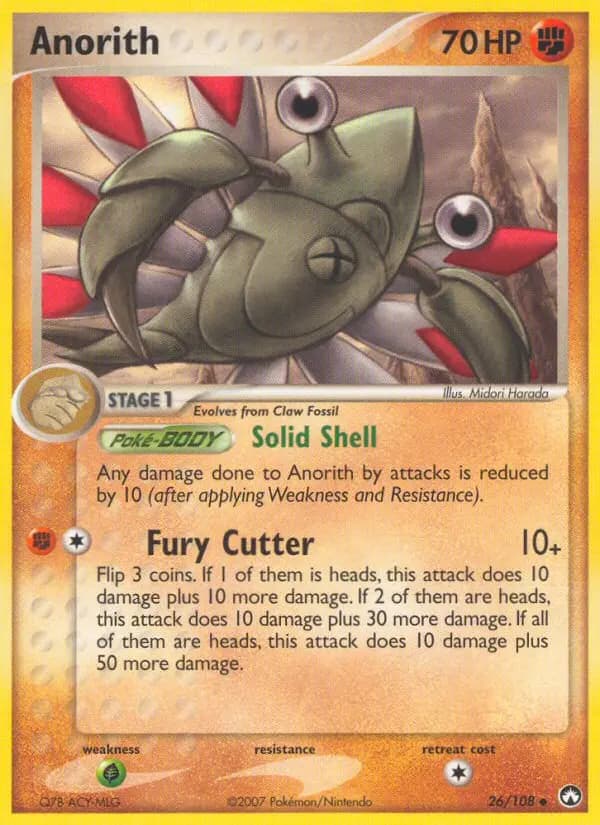
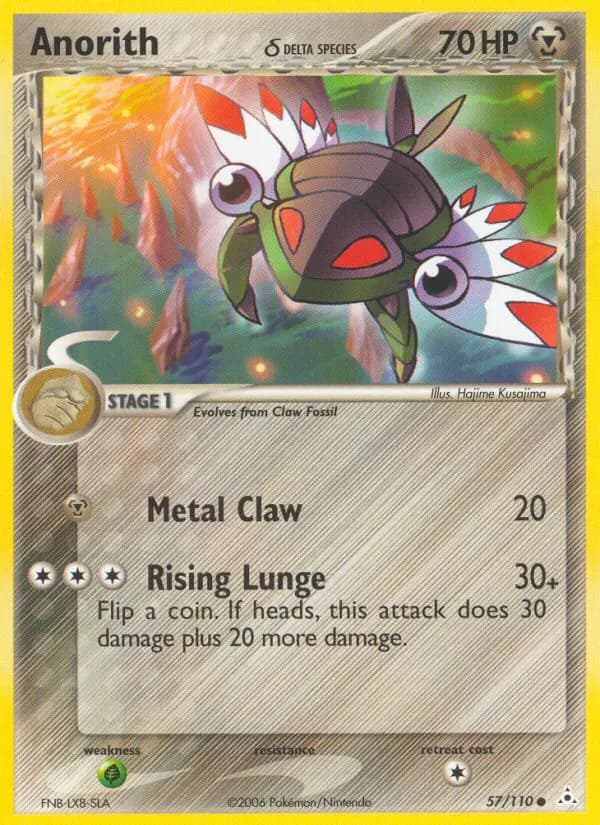
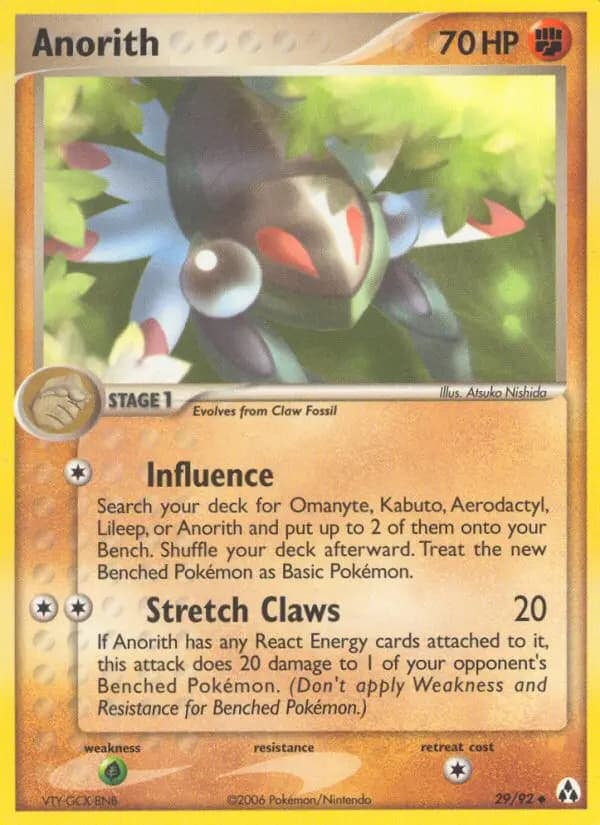
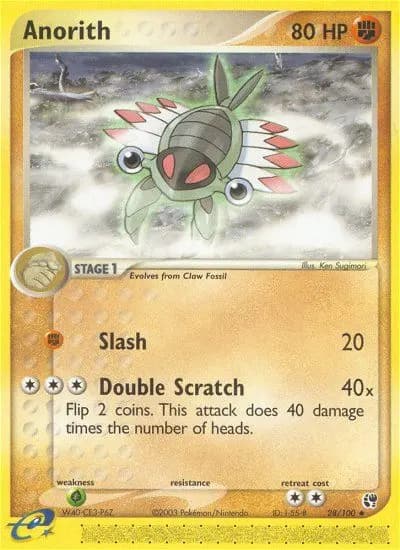
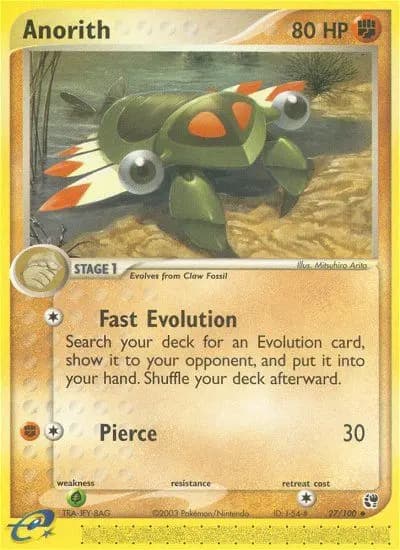
Anorith
Generation III · #0347 — Old Shrimp Pokémon
Anorith's profile is easy to undersell: 0.7 m, 12.5 kg, and a rock/bug typing that doesn't scream power — until you look at its Attack of 95. It measures 0.7 m and 12.5 kg, dimensions that pair with that stat lean in noticeable ways. With a National Pokédex number of 347, Anorith inhabits the evolutionary line that eventually leads to the powerful Armaldo at level 40. Despite being extinct in the wild for millions of years, trainers who have revived this prehistoric being from fossils can observe firsthand how Pokémon evolved in primordial seas roughly 100,000,000 years ago. Anorith is considered a progenitor species to modern Bug-type Pokémon, making it invaluable to those studying Pokémon evolution and paleontology.
Editor's Take
Anorith's line ends in Armaldo, and Bug/Rock giving it a quad Rock weakness of its own is the kind of typing decision that dooms a fossil Pokémon before it starts.
Base Stats
Height
0.7m
Weight
12.5kg
Category
Old Shrimp Pokémon
Gender
Male 87.5% / Female 12.5%
Color
gray
Shape
armor
Habitat
waters-edge
Abilities
Protects against critical hits.
Doubles Speed during rain.

Anorith Biology & Physical Characteristics
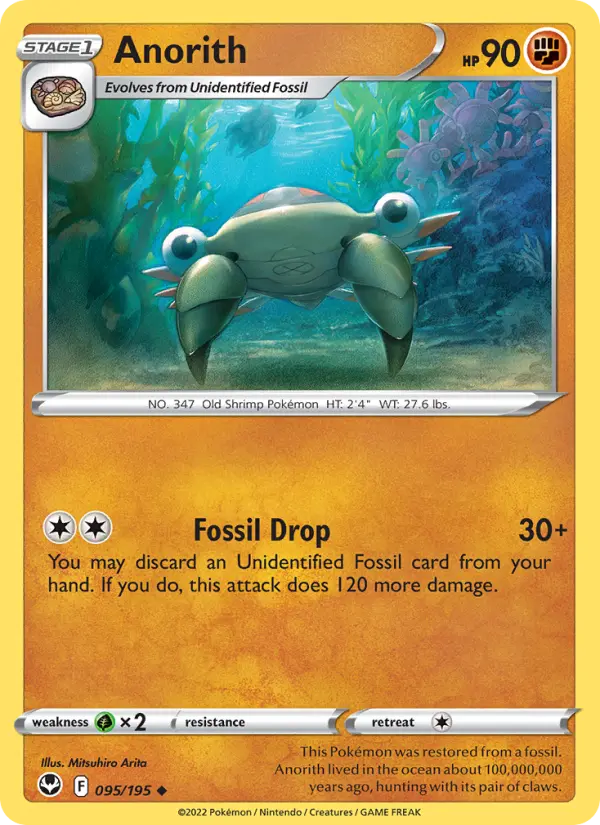
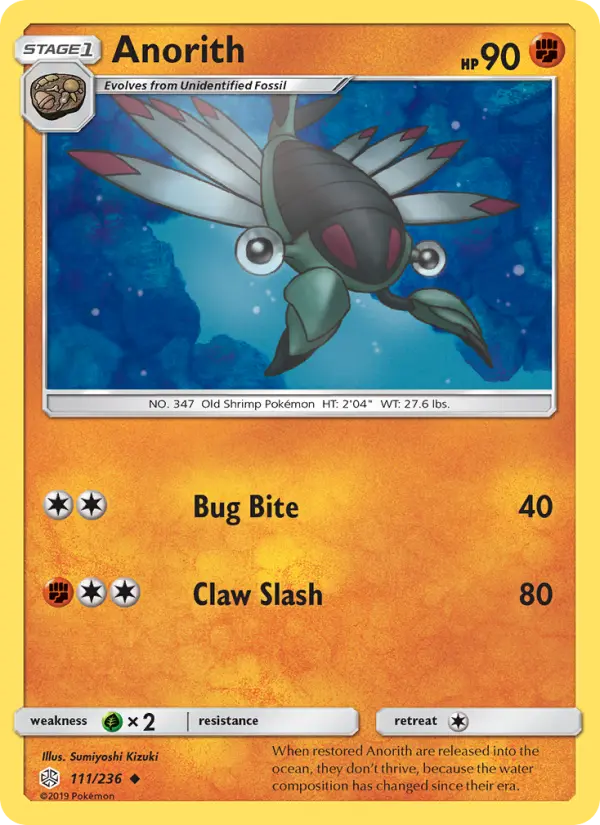
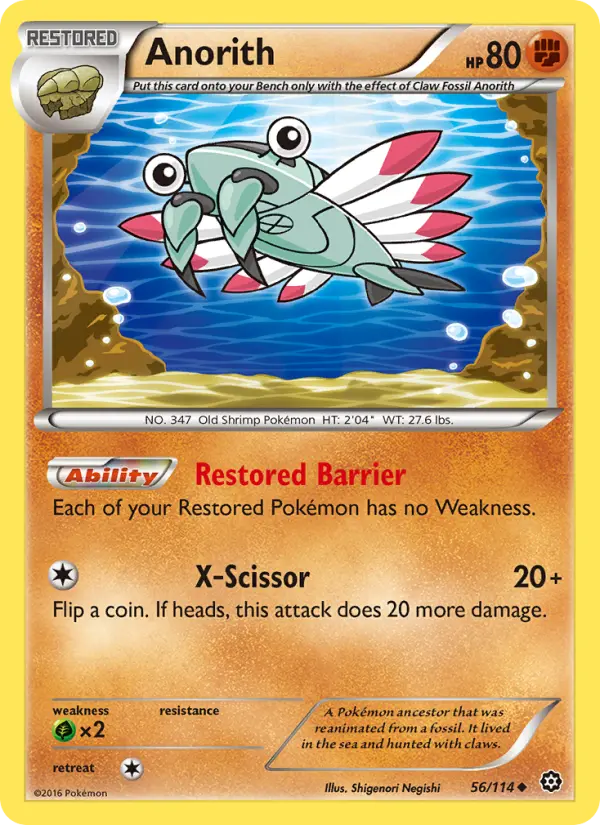
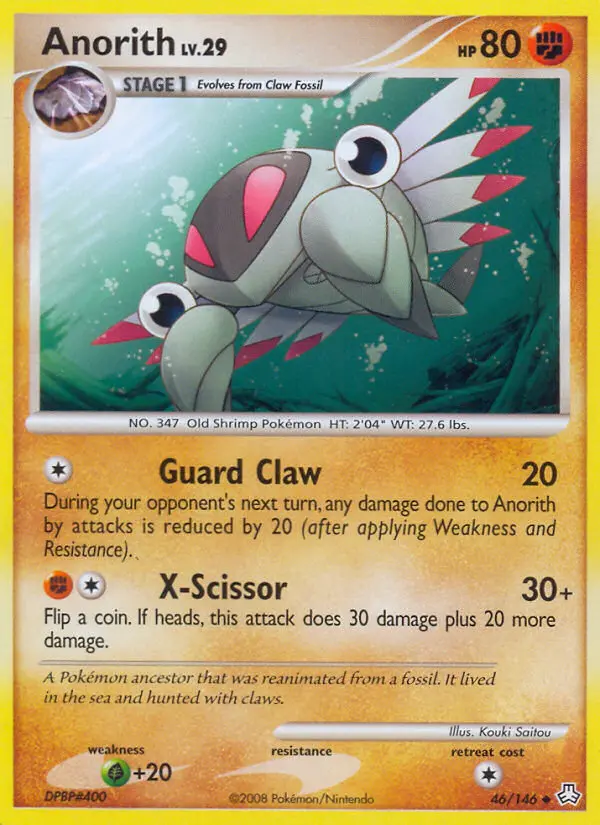
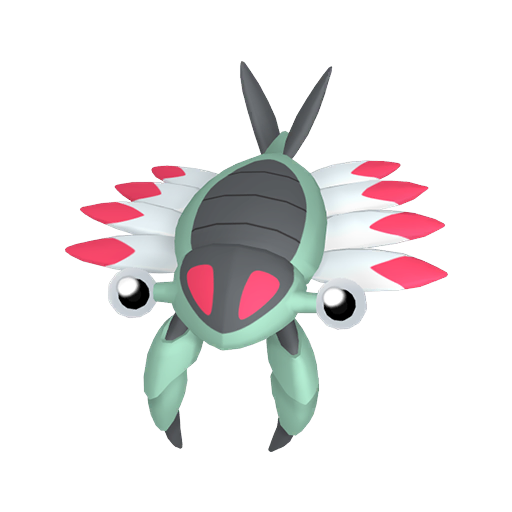
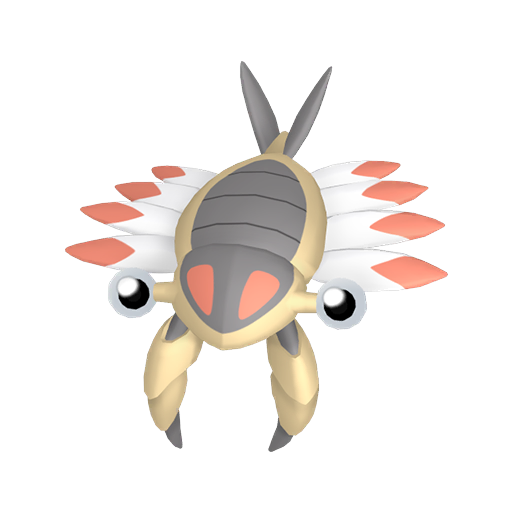
Anorith is a greenish-gray arthropod Pokémon that bears a striking resemblance to the prehistoric anomalocaris, a creature that dominated ancient oceans. Its distinctive anatomy features two eye stalks extending from either side of its head, each tipped with large spherical eyes that grant it exceptional visual perception in murky underwater environments. The creature's head displays a central black region marked with two red, teardrop-shaped patterns, while its most notable feature is an X-shaped mouth positioned on the underside of its torso, a unique adaptation for feeding on prey along the seafloor. Anorith possesses two large, segmented claws beneath its head that serve as formidable weapons for gripping and capturing prey hidden among rocks and crevices. Perhaps most remarkably, eight wing-like appendages line each side of its body—four on each flank—each tipped with red coloration, which were originally feet that adapted to aquatic propulsion over evolutionary time. These eight wings function as oars, allowing Anorith to undulate gracefully through water with surprising agility despite its modest size of 0.7 meters and weight of 12.5 kilograms.
Pokedex Numbers
Training
Breeding
Anorith Breeding, Gender Ratio & Egg Groups
Anorith exhibits a marked sexual dimorphism in terms of appearance frequency, with approximately 87.5% of wild specimens being male and only 12.5% being female, making female Anorith considerably rarer in the trainer community. This skewed gender ratio mirrors many aquatic arthropods in real life and adds to the mystique of obtaining female specimens. Anorith belongs to the Water 3 egg group, meaning it can only breed with other Pokémon in that same group, limiting breeding options for trainers seeking to produce Anorith offspring. The species has a hatch counter of 30, meaning eggs take approximately 7,454 to 7,710 steps to hatch, requiring moderate commitment from trainers engaging in breeding activities. The base happiness value of 70 indicates that Anorith responds reasonably well to affection and care from its trainer, though it doesn't reach the higher friendship thresholds of more domesticated species. Interestingly, breeding Anorith is a deliberate choice for trainers, as natural wild populations no longer exist—all instances must come either from fossil revival or from the offspring of previously revived specimens.
Sprites




TMs & HMs
tm01
black white
tm01
black 2 white 2
tm01
lets go pikachu lets go eevee
tm01
omega ruby alpha sapphire
tm01
x y
tm02
crystal
tm02
gold silver
tm03
yellow
tm03
crystal
tm03
gold silver
tm03
ruby sapphire
tm03
red blue
tm03
platinum
tm03
firered leafgreen
tm03
heartgold soulsilver
tm03
diamond pearl
tm03
emerald
tm03
xd
tm03
colosseum
tm03
blue japan
+518 more TMs/HMs
Anorith's Evolution Chain


Anorith Evolution, Mega Evolution & Special Forms
Anorith evolves into the formidable Armaldo when it reaches level 40, marking a dramatic transformation from a small aquatic predator into a larger, more versatile creature. This evolution represents the natural progression that Anorith would have undergone in prehistoric times, with the creature developing enhanced defensive capabilities and greater overall power. The evolution maintains Anorith's Rock/Bug typing while dramatically improving its stat distribution, particularly in areas like Attack, Defense, and HP, creating a more balanced and combat-capable Pokémon. Trainers seeking to evolve their Anorith need only provide steady experience through leveling, with the creature's Erratic growth rate meaning that progress accelerates significantly as it approaches the evolution threshold. The transformation from Anorith to Armaldo represents the bridge between a smaller ancient predator and the apex aquatic hunter it becomes, embodying millions of years of evolutionary adaptation compressed into a single level-up event.
Where to Find
Rustboro City
hoenn
Alola Route 8
alola
Anorith Behaviour and Natural Habitat
As an ancient predator of primordial seas, Anorith hunted in warm ocean waters using its powerful claws to extract prey from rocky seafloor hideaways. Its hunting strategy relied on stealth and precision, with the creature moving through water via undulating motions of its eight wing-like appendages. Modern Anorith, revived from fossils, retain these ancestral hunting instincts but face a significant challenge: they cannot thrive in contemporary oceans because the water composition has changed dramatically over the millions of years of their extinction. This limitation means that revived Anorith specimens exist only under the care of trainers, unable to establish wild populations. The Pokémon's aggressive nature is reflected in its high Attack stat of 95, complemented by a respectable Speed stat of 75, making it an active and mobile hunter that strikes with precision rather than brute force. Anorith's base happiness value of 70 suggests a creature of moderate temperament that can bond with dedicated trainers while retaining its predatory instincts.
Pokedex Entries
ANORITH was regenerated from a prehistoric fossil. This primitive POKéMON once lived in warm seas. It grips its prey firmly between its two large claws.
ANORITH is said to be a type of POKéMON predecessor, with eight wings at the sides of its body. This POKéMON swam in the primordial sea by undulating these eight wings.
It was resurrected from a fossil using the power of science. It swims by undulating the eight wings at its sides. They were feet that adapted to life in the sea.
It is a kind of POKéMON progenitor. It uses its extending claws to catch prey hiding among rocks on the seafloor.
A Pokémon ancestor that was reanimated from a fossil. It lived in the sea and hunted with claws.
An ancestral Pokémon that lived in the ocean. Over time, its eight feet transformed into wings.
A Pokémon ancestor that was reanimated from a fossil. It lived in the sea and hunted with claws.
A Pokémon ancestor that was reanimated from a fossil. It lived in the sea and hunted with claws.
It is a kind of Pokémon progenitor. It uses its extending claws to catch prey hiding among rocks on the seafloor.
A Pokémon ancestor that was reanimated from a fossil. It lived in the sea and hunted with claws.
Anorith was regenerated from a prehistoric fossil. This primitive Pokémon once lived in warm seas. It grips its prey firmly between its two large claws.
Anorith is said to be a type of Pokémon predecessor, with eight wings at the sides of its body. This Pokémon swam in the primordial sea by undulating these eight wings.
When restored Anorith are released into the ocean, they don’t thrive, because the water composition has changed since their era.
This is one kind of primeval bug Pokémon. With eight wings, it could apparently swim a lot faster than you’d expect.
This Pokémon was restored from a fossil. Anorith lived in the ocean about 100,000,000 years ago, hunting with its pair of claws.
Anorith can swim swiftly by pulling its eight wings through the water like oars on a boat. This Pokémon is an ancestor of modern bug Pokémon.
Anorith Name Origin & Design Inspiration
Anorith's name origin lies in 'anomalocaris,' the prehistoric marine arthropod that inspired its design, combined with morphological elements that suggest its Old Shrimp designation. The Japanese name アノプス (Anopth) similarly references the anomalocaris lineage while emphasizing its arthropod heritage. Visually, the Pokémon embodies characteristics of multiple ancient creatures: the segmented body structure and predatory claws echo crustaceans and early arthropods, while the eye stalks and overall morphology clearly reference anomalocaris, a creature that dominated early Cambrian oceans. The X-shaped mouth represents a unique evolutionary design feature, suggesting an alien feeding mechanism that would have been highly effective in capturing small prey. The transformation of primitive feet into wing-like appendages tells a story of evolutionary adaptation, with the Pokédex entries explicitly noting that these appendages were originally feet that transformed into wings—a poetic representation of how evolution shapes organisms to suit their environments. The red coloration on the wing tips and facial markings adds visual pop while suggesting vitality and dangerous predatory nature.
Learnable Moves
Anorith can learn 66 moves:
Move | Type | Cat. | Power | Acc. | PP |
|---|---|---|---|---|---|
| aerial ace | flying | Physical | 60 | — | 20 |
| ancient power | rock | Special | 60 | 100 | 5 |
| aqua jet | water | Physical | 40 | 100 | 20 |
| attract | normal | Status | — | 100 | 15 |
| body slam | normal | Physical | 85 | 100 | 15 |
| brick break | fighting | Physical | 75 | 100 | 15 |
| brine | water | Special | 65 | 100 | 10 |
| bug bite | bug | Physical | 60 | 100 | 20 |
| captivate | normal | Status | — | 100 | 20 |
| confide | normal | Status | — | — | 20 |
| cross poison | poison | Physical | 70 | 100 | 20 |
| crush claw | normal | Physical | 75 | 95 | 10 |
| curse | ghost | Status | — | — | 10 |
| cut | normal | Physical | 50 | 95 | 30 |
| dig | ground | Physical | 80 | 100 | 10 |
| double team | normal | Status | — | — | 15 |
| double edge | normal | Physical | 120 | 100 | 15 |
| earth power | ground | Special | 90 | 100 | 10 |
| endure | normal | Status | — | — | 10 |
| facade | normal | Physical | 70 | 100 | 20 |
| false swipe | normal | Physical | 40 | 100 | 40 |
| frustration | normal | Physical | — | 100 | 20 |
| fury cutter | bug | Physical | 40 | 95 | 20 |
| harden | normal | Status | — | — | 30 |
| headbutt | normal | Physical | 70 | 100 | 15 |
| hidden power | normal | Special | 60 | 100 | 15 |
| hone claws | dark | Status | — | — | 15 |
| iron defense | steel | Status | — | — | 15 |
| knock off | dark | Physical | 65 | 100 | 20 |
| metal claw | steel | Physical | 50 | 95 | 35 |
| meteor beam | rock | Special | 120 | 90 | 10 |
| mimic | normal | Status | — | — | 10 |
| mud shot | ground | Special | 55 | 95 | 15 |
| mud sport | ground | Status | — | — | 15 |
| mud slap | ground | Special | 20 | 100 | 10 |
| natural gift | normal | Physical | — | 100 | 15 |
| protect | normal | Status | — | — | 10 |
| rapid spin | normal | Physical | 50 | 100 | 40 |
| rest | psychic | Status | — | — | 5 |
| return | normal | Physical | — | 100 | 20 |
| rock blast | rock | Physical | 25 | 90 | 10 |
| rock polish | rock | Status | — | — | 20 |
| rock slide | rock | Physical | 75 | 90 | 10 |
| rock smash | fighting | Physical | 40 | 100 | 15 |
| rock tomb | rock | Physical | 60 | 95 | 15 |
| round | normal | Special | 60 | 100 | 15 |
| sand attack | ground | Status | — | 100 | 15 |
| sandstorm | rock | Status | — | — | 10 |
| scratch | normal | Physical | 40 | 100 | 35 |
| screech | normal | Status | — | 85 | 40 |
| secret power | normal | Physical | 70 | 100 | 20 |
| slash | normal | Physical | 70 | 100 | 20 |
| sleep talk | normal | Status | — | — | 10 |
| smack down | rock | Physical | 50 | 100 | 15 |
| snore | normal | Special | 50 | 100 | 15 |
| stealth rock | rock | Status | — | — | 20 |
| string shot | bug | Status | — | 95 | 40 |
| struggle bug | bug | Special | 50 | 100 | 20 |
| substitute | normal | Status | — | — | 10 |
| sunny day | fire | Status | — | — | 5 |
| swagger | normal | Status | — | 85 | 15 |
| swords dance | normal | Status | — | — | 20 |
| toxic | poison | Status | — | 90 | 10 |
| water gun | water | Special | 40 | 100 | 25 |
| water pulse | water | Special | 60 | 100 | 20 |
| x scissor | bug | Physical | 80 | 100 | 15 |
Anorith Competitive Battle Guide
Anorith possesses a total stat allocation of 355, making it a below-average fighter in its unevolved state, though its distribution reveals strategic potential. With an Attack stat of 95, Anorith significantly outpaces its other offensive capabilities, making physical moves its primary damage source, while its Special Attack of only 40 makes special coverage largely ineffective. Its Defense and Special Defense stats both sit at 50, indicating vulnerability to both physical and special attacks, while its Speed of 75 provides decent mobility to outrun many slower opponents but fails to establish speed control against faster threats. The Battle Armor ability prevents critical hits, reducing variance in damage taken and providing reliable survivability against high-crit-rate opponents. Its hidden ability, Swift Swim, doubles Speed during rain, potentially allowing Anorith to become a viable rain team sweeper if paired with appropriate weather-setting partners. Trainers typically use Anorith as a stepping stone toward the superior Armaldo rather than as an end-game competitive choice, though creative rain-team builders might find niche applications. Anorith learns moves like X-Scissor, Stone Edge, and Aqua Jet through level-up and TM tuition, providing access to moves that capitalize on its Attack stat across multiple types.
Commonly Asked Questions About Anorith
What type is Anorith?
Anorith is a rock and bug type Pokemon.
What does Anorith evolve into?
Anorith evolves into armaldo.
What are Anorith's weaknesses?
Anorith is weak to rock, steel and water type moves.
Does Anorith evolve by trading?
No — Anorith evolves entirely through leveling up, with no trade required at any stage.
Where can I find Anorith?
Anorith can be found in rustboro city (hoenn) and alola route 8 (alola).
Anorith Cultural Impact & Franchise History
Anorith represents a fascinating bridge between the worlds of paleontology and Pokémon training, embodying the scientific wonder of resurrecting extinct species. Its introduction in Generation III marked a significant expansion of the Pokédex's paleontological focus, with fossil Pokémon becoming a central mechanic that would continue throughout subsequent generations. The species has captured the imagination of players interested in prehistoric creatures and evolutionary biology, often appearing in Pokémon media featuring themes of ancient history and scientific discovery. Anorith's design has influenced how subsequent fossil Pokémon are conceived, establishing a template of unusual anatomy and aquatic or semi-aquatic habitats that defines the category. Within the competitive Pokémon community, while not a dominant force, Anorith maintains a devoted following among players who appreciate its unique type combination and ancient origins. The creature appears in various Pokémon spin-off games and media, though rarely as a featured protagonist, instead serving as a supporting character that enriches the world's evolutionary history. Educational content exploring Pokémon evolution frequently references Anorith as an example of how the franchise blends real paleontological concepts with fictional creatures.
Where to Find Anorith in Every Pokémon Game
Anorith is obtainable through fossil revival in most Pokémon games, specifically by reviving a Claw Fossil at the appropriate restoration facility in each region. In Pokémon Ruby, Sapphire, and Emerald, Anorith can be obtained from a Claw Fossil found in the Hoenn region, with a Pokédex number of 135 in the regional Hoenn Pokédex. Subsequent remakes and versions continue this tradition, allowing players to revive Anorith specimens across multiple generations. The species has appeared in games including FireRed, LeafGreen, Diamond, Pearl, Platinum, HeartGold, SoulSilver, Black 2, White 2, X, Y, Omega Ruby, Alpha Sapphire, Sun, Moon, Ultra Sun, Ultra Moon, and Sword/Shield (Crown Tundra DLC). A capture rate of 45 means that Anorith revived from fossils presents moderate difficulty in catching if trainers choose to engage in battle rather than simply receiving it post-revival. The species maintains availability in Pokémon Legends: Arceus and recent titles, ensuring that new generations of trainers can experience reviving this ancient ancestor. Breeding revived Anorith specimens allows dedicated players to produce multiple individuals without relying on fossil collection, though finding female specimens requires patience due to the 12.5% female ratio.