Armaldo
Generation III · #0348 — Plate Pokémon
Armaldo is a rock/bug-type Pokémon whose hp — 50 at base — does more to define its role than its overall spread does. Standing 1.5 m tall and weighing 68.2 kg, it's built around a distinct combination of rock traits that shapes how it performs both in the wild and in battle. This remarkable species was once thought to be entirely extinct, dwelling in prehistoric times millions of years ago, yet trainers can resurrect it from fossils discovered in archaeological sites. With a cumulative stat total of 495, Armaldo demonstrates exceptional physical prowess, boasting a commanding Attack stat of 125 that makes it a formidable physical attacker. Standing 1.5 meters tall and weighing 68.2 kilograms, Armaldo cuts an imposing figure covered in protective armor plating that has evolved to suit its amphibious lifestyle, making it equally capable whether navigating rocky terrain or diving through ocean depths.
Editor's Take
Armaldo has 125 base Attack and 45 base Speed, which is the Gen 3 stat spread problem in its purest form — enormous power with no way to deploy it.
Base Stats
Height
1.5m
Weight
68.2kg
Category
Plate Pokémon
Gender
Male 87.5% / Female 12.5%
Color
gray
Shape
upright
Habitat
waters-edge
Abilities
Protects against critical hits.
Doubles Speed during rain.

Armaldo Biology & Physical Characteristics
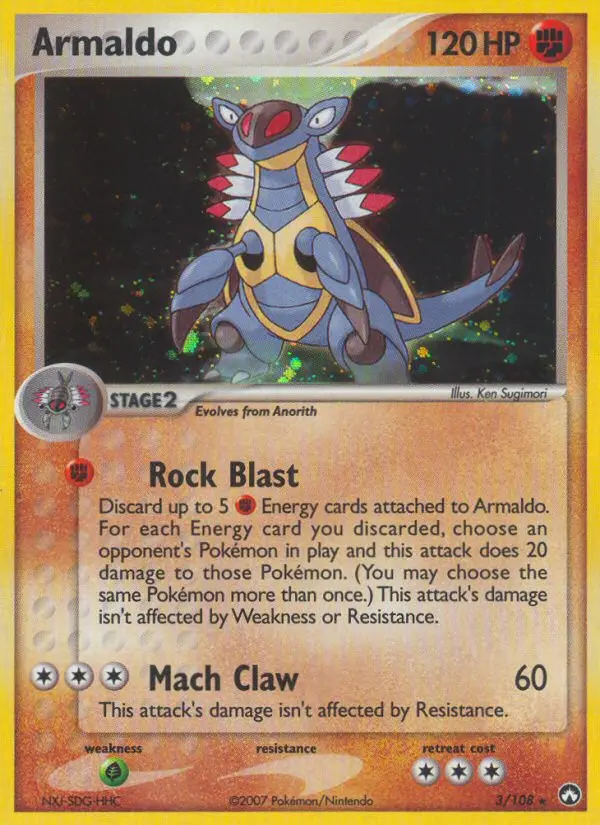
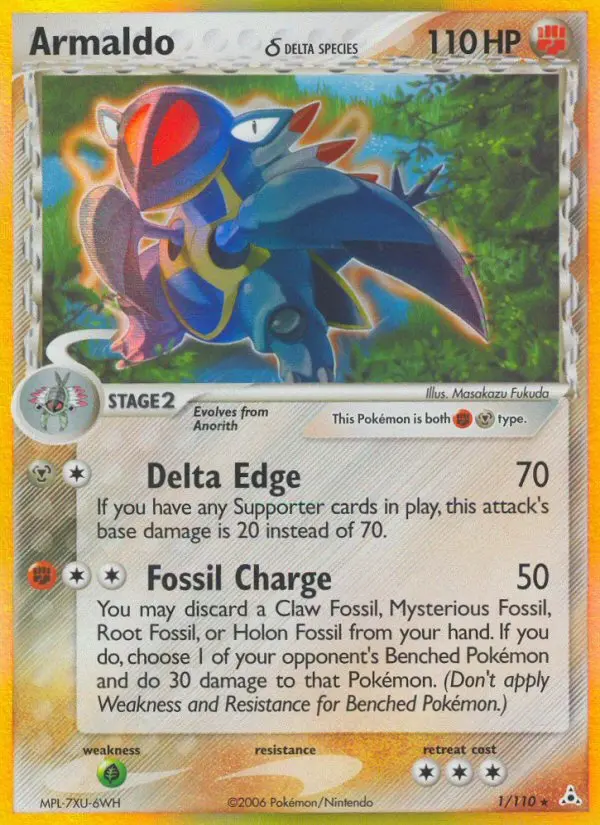
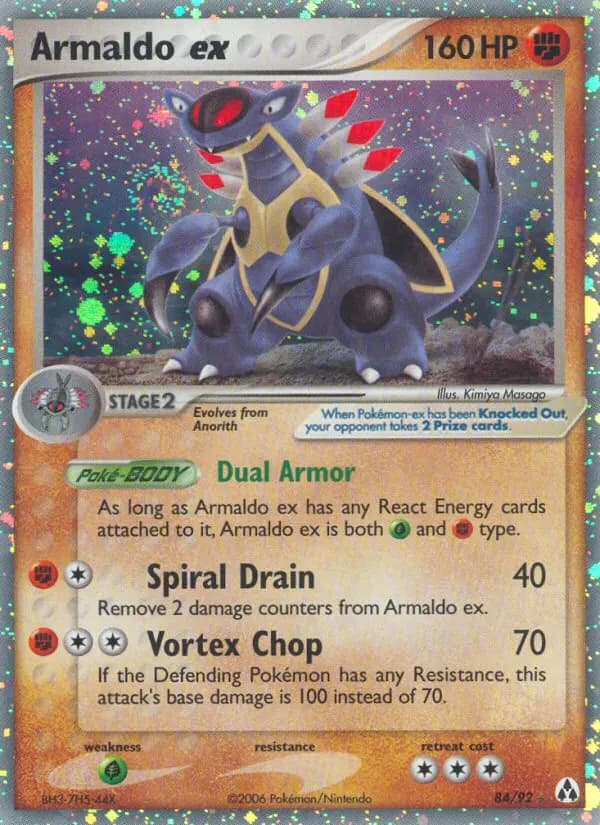
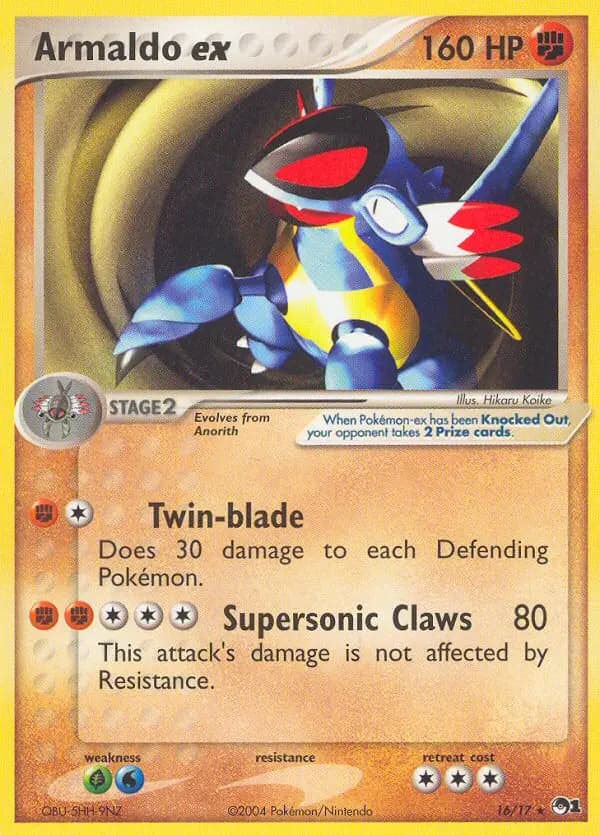
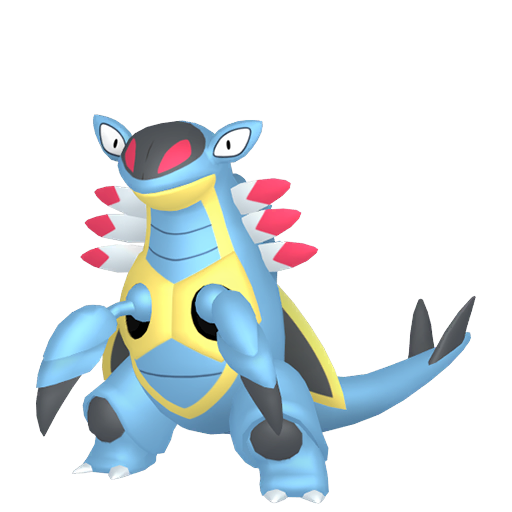
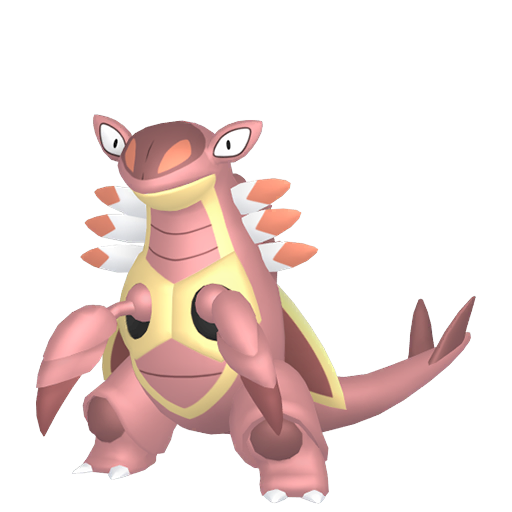
Armaldo is a bipedal, amphibious creature whose morphology bears striking resemblance to the mantis shrimp, one of nature's most fearsome aquatic predators. Its body is encased in thick, grayish-blue armor plates that serve as both protection and insulation, with distinctive yellow, black, white, and red accents distributed across its form. Two large, oblong eyes protrude from the sides of its head, giving Armaldo exceptional peripheral vision for detecting prey in murky waters. The most striking features are undoubtedly its massive retractable claws, each extending from specially designed armored plates on its chest, capable of punching through steel slabs with devastating force. Three pairs of wing-like appendages extend from its long, segmented neck, which serve primarily as swimming organs rather than aerial instruments, while a reinforced back plate sports four protective spikes and two triangular wings rimmed in yellow. Its long, muscular tail is tipped with black fins, and its segmented legs with black knee joints provide exceptional stability on land despite its aquatic origins.
Pokedex Numbers
Training
Breeding
Armaldo Breeding, Gender Ratio & Egg Groups
Armaldo exhibits a pronounced sexual dimorphism in gender distribution, with approximately 87.5% of wild encounters yielding male specimens compared to just 12.5% female individuals, reflecting either biological rarity of females in the species or ecological factors favoring male survival in ancient populations. This gender ratio is consistent across Pokémon databases and has remained unchanged across generations, suggesting deep evolutionary factors within Armaldo's prehistoric heritage. Despite the overwhelming male predominance, both genders share identical base stats, movepool, and abilities, with no visible physical distinctions between sexes affecting gameplay functionality. Armaldo belongs to the Water 3 egg group, a biological classification that somewhat mirrors its amphibious nature despite its current terrestrial preference, potentially reflecting its ancestral aquatic origins. The species has a base friendship value of 70, indicating moderate receptiveness to trainer bonding and positive disposition toward companionship. Its egg hatching counter of 30 cycles translates to approximately 7,454–7,710 steps required for eggs to hatch, representing a moderate incubation period consistent with its slow-then-very-fast growth rate classification that results in delayed early-game power progression before explosive late-game stat scaling.
Sprites




TMs & HMs
tm01
black white
tm01
black 2 white 2
tm01
lets go pikachu lets go eevee
tm01
omega ruby alpha sapphire
tm01
x y
tm02
crystal
tm02
gold silver
tm03
yellow
tm03
ruby sapphire
tm03
red blue
tm03
platinum
tm03
firered leafgreen
tm03
heartgold soulsilver
tm03
diamond pearl
tm03
emerald
tm03
xd
tm03
colosseum
tm03
blue japan
tm03
red green japan
tm05
lets go pikachu lets go eevee
+666 more TMs/HMs
Armaldo's Evolution Chain


Armaldo Evolution, Mega Evolution & Special Forms
Armaldo evolves from Anorith once the fossil Pokémon reaches level 40, marking a dramatic transformation in both appearance and capability. This evolution represents not merely a physical maturation but an ecological transition, with Armaldo's Pokédex entry from Sword version emphasizing that the Pokémon emerged onto land after evolution, its lower body becoming significantly stronger to support bipedal locomotion and deliver powerful tail attacks. The evolution from Anorith to Armaldo is reflected in base stat changes, particularly in the bolstering of Attack power and defensive capabilities through enhanced armor plating. This single-stage evolutionary line demonstrates the ancient lineage of Armaldo as a prehistoric survivor, with no Mega Evolution variant existing, suggesting the species represents an endpoint in its evolutionary journey rather than a springboard for further transformation. The level-based evolution mechanic emphasizes patience and training dedication, rewarding players who nurture their Anorith through extended battles and experiences until reaching the critical threshold where anatomical metamorphosis occurs.
Where to Find
Location data not available for this Pokémon in the database.
Armaldo Behaviour and Natural Habitat
In ancient times, Armaldo inhabited the boundary between land and sea, embodying an evolutionary transition that allowed it to thrive in both environments with remarkable versatility. According to Pokédex entries, Armaldo typically lives on land but ventures into the ocean when hunting prey, using its powerful claws and wing-like appendages to navigate underwater terrain with surprising grace. Its hunting strategy involves diving beneath waves to pursue aquatic prey, employing its razor-sharp claws to dispatch targets with surgical precision before returning to dry land. The species demonstrated exceptional adaptability, having evolved from its water-dwelling Anorith ancestors to become comfortable on solid ground, with particularly strengthened lower body musculature that generates devastating tail strikes. Pokédex data notes that Armaldo walked on its hind legs, an unusual bipedal stance that proved advantageous for terrestrial life and likely influenced the evolutionary path of modern Bug-type Pokémon. This amphibious existence required developing both robust armor plating for protection against terrestrial predators and hydrodynamic body modifications for efficient aquatic locomotion.
Pokedex Entries
ARMALDO’s tough armor makes all attacks bounce off. This POKéMON’s two enormous claws can be freely extended or contracted. They have the power to punch right through a steel slab.
ARMALDO is a POKéMON species that became extinct in prehistoric times. This POKéMON is said to have walked on its hind legs, which would have been more convenient for life on land.
ARMALDO usually lives on land. However, when it hunts for prey, it dives beneath the ocean. It swims around using its two large wings.
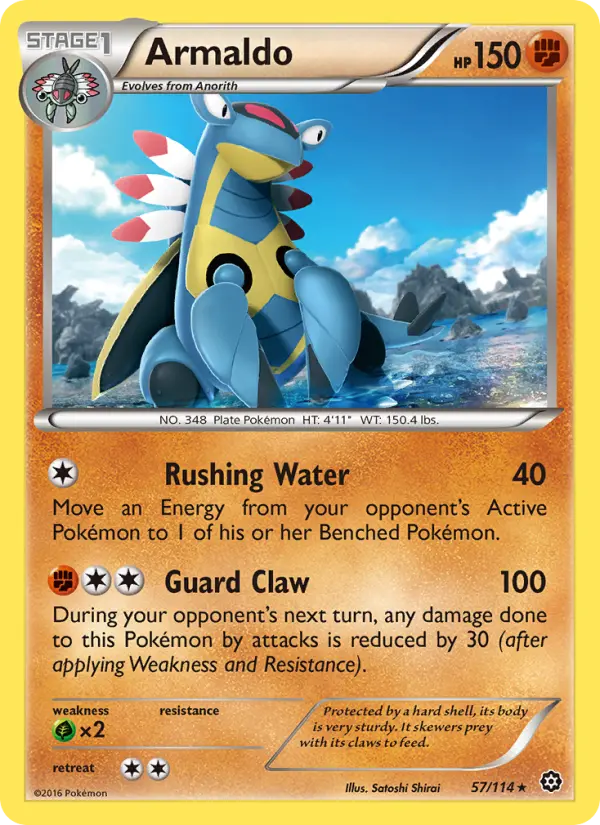
Protected by a hard shell, its body is very sturdy. It skewers prey with its claws to feed.
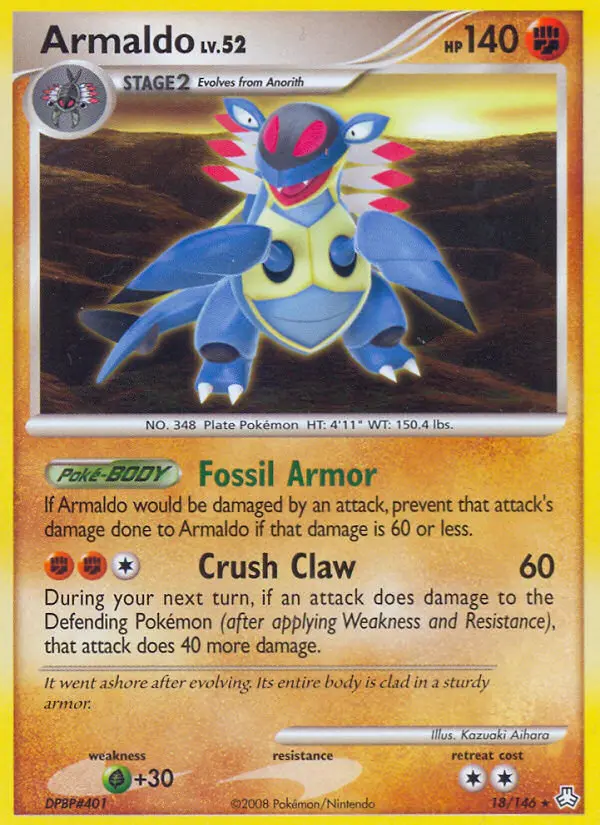
It went ashore after evolving. Its entire body is clad in a sturdy armor.
Its enormous, retractable claws can cut through most anything. Its entire body is clad in sturdy plates.
It went ashore after evolving. Its entire body is clad in a sturdy armor.
It went ashore after evolving. Its entire body is clad in a sturdy armor.
Its enormous, retractable claws can cut through most anything. Its entire body is clad in sturdy plates.
Protected by a hard shell, its body is very sturdy. It skewers prey with its claws to feed.
Armaldo’s tough armor makes all attacks bounce off. This Pokémon’s two enormous claws can be freely extended or contracted. They have the power to punch right through a steel slab.
Armaldo is a Pokémon species that became extinct in prehistoric times. This Pokémon is said to have walked on its hind legs, which would have been more convenient for life on land.
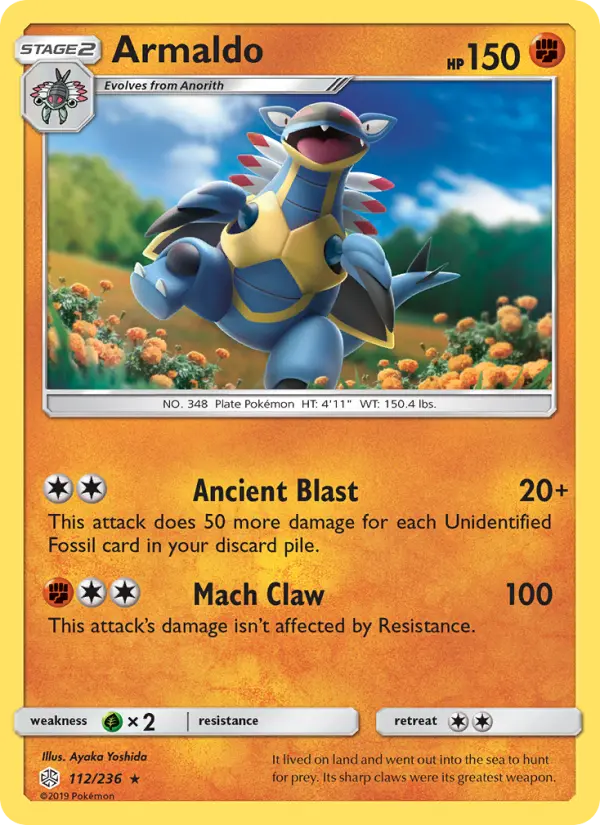
It lived on land and went out into the sea to hunt for prey. Its sharp claws were its greatest weapon.
Armaldo adapted from living in water to living on land. It has been determined that it is the ancestor of some bug Pokémon.
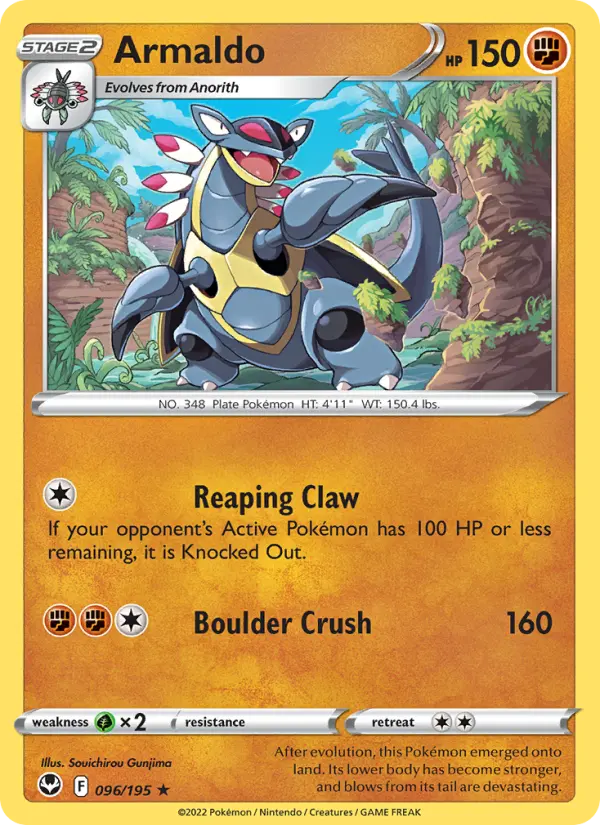
After evolution, this Pokémon emerged onto land. Its lower body has become stronger, and blows from its tail are devastating.
Though it lives on land, it’s also a good swimmer. It dives into the ocean in search of prey, using its sharp claws to take down its quarry.
Armaldo Name Origin & Design Inspiration
Armaldo's name derives from the Spanish word 'armado,' meaning 'armored' or 'armed,' a fitting designation for a Pokémon whose entire physiology centers on protective plating and offensive weaponry. The Japanese name アーマルド (Armaldo) maintains this martial connotation while evoking the creature's inspiration from the mantis shrimp, one of nature's most heavily armored and aggressive predators. The design philosophy reflects genuine paleontological influence, combining arthropod characteristics with elements of ancient arthropods like trilobites and anomalocarids that dominated prehistoric oceans. The visual emphasis on segmented armor, retractable claws, and wing-like swimming appendages creates a cohesive creature that feels authentically prehistoric while remaining distinctly Pokémon in aesthetic execution. The color scheme of grayish-blue with yellow and red accents provides visual distinctiveness while maintaining the stoic, ancient character appropriate for a fossil-revived species. Every design element—from the protrusion eyes suggesting excellent vision in murky waters to the reinforced back plate and tail fins—serves both biological function within the creature's lore and gameplay purpose.
Learnable Moves
Armaldo can learn 79 moves:
Move | Type | Cat. | Power | Acc. | PP |
|---|---|---|---|---|---|
| aerial ace | flying | Physical | 60 | — | 20 |
| ancient power | rock | Special | 60 | 100 | 5 |
| aqua tail | water | Physical | 90 | 90 | 10 |
| attract | normal | Status | — | 100 | 15 |
| block | normal | Status | — | — | 5 |
| body slam | normal | Physical | 85 | 100 | 15 |
| brick break | fighting | Physical | 75 | 100 | 15 |
| brine | water | Special | 65 | 100 | 10 |
| brutal swing | dark | Physical | 60 | 100 | 20 |
| bug bite | bug | Physical | 60 | 100 | 20 |
| bulldoze | ground | Physical | 60 | 100 | 20 |
| captivate | normal | Status | — | 100 | 20 |
| confide | normal | Status | — | — | 20 |
| cross poison | poison | Physical | 70 | 100 | 20 |
| crush claw | normal | Physical | 75 | 95 | 10 |
| cut | normal | Physical | 50 | 95 | 30 |
| dig | ground | Physical | 80 | 100 | 10 |
| double team | normal | Status | — | — | 15 |
| double edge | normal | Physical | 120 | 100 | 15 |
| earth power | ground | Special | 90 | 100 | 10 |
| earthquake | ground | Physical | 100 | 100 | 10 |
| endure | normal | Status | — | — | 10 |
| facade | normal | Physical | 70 | 100 | 20 |
| false swipe | normal | Physical | 40 | 100 | 40 |
| flash cannon | steel | Special | 80 | 100 | 10 |
| frustration | normal | Physical | — | 100 | 20 |
| fury cutter | bug | Physical | 40 | 95 | 20 |
| giga impact | normal | Physical | 150 | 90 | 5 |
| harden | normal | Status | — | — | 30 |
| headbutt | normal | Physical | 70 | 100 | 15 |
| hidden power | normal | Special | 60 | 100 | 15 |
| hone claws | dark | Status | — | — | 15 |
| hyper beam | normal | Special | 150 | 90 | 5 |
| iron defense | steel | Status | — | — | 15 |
| iron tail | steel | Physical | 100 | 75 | 15 |
| knock off | dark | Physical | 65 | 100 | 20 |
| liquidation | water | Physical | 85 | 100 | 10 |
| low kick | fighting | Physical | — | 100 | 20 |
| metal claw | steel | Physical | 50 | 95 | 35 |
| meteor beam | rock | Special | 120 | 90 | 10 |
| mimic | normal | Status | — | — | 10 |
| mud shot | ground | Special | 55 | 95 | 15 |
| mud sport | ground | Status | — | — | 15 |
| mud slap | ground | Special | 20 | 100 | 10 |
| natural gift | normal | Physical | — | 100 | 15 |
| protect | normal | Status | — | — | 10 |
| rest | psychic | Status | — | — | 5 |
| return | normal | Physical | — | 100 | 20 |
| rock blast | rock | Physical | 25 | 90 | 10 |
| rock polish | rock | Status | — | — | 20 |
| rock slide | rock | Physical | 75 | 90 | 10 |
| rock smash | fighting | Physical | 40 | 100 | 15 |
| rock tomb | rock | Physical | 60 | 95 | 15 |
| round | normal | Special | 60 | 100 | 15 |
| sandstorm | rock | Status | — | — | 10 |
| scratch | normal | Physical | 40 | 100 | 35 |
| screech | normal | Status | — | 85 | 40 |
| secret power | normal | Physical | 70 | 100 | 20 |
| seismic toss | fighting | Physical | — | 100 | 20 |
| shadow claw | ghost | Physical | 70 | 100 | 15 |
| slash | normal | Physical | 70 | 100 | 20 |
| sleep talk | normal | Status | — | — | 10 |
| smack down | rock | Physical | 50 | 100 | 15 |
| snore | normal | Special | 50 | 100 | 15 |
| stealth rock | rock | Status | — | — | 20 |
| stomping tantrum | ground | Physical | 75 | 100 | 10 |
| stone edge | rock | Physical | 100 | 80 | 5 |
| strength | normal | Physical | 80 | 100 | 15 |
| string shot | bug | Status | — | 95 | 40 |
| struggle bug | bug | Special | 50 | 100 | 20 |
| substitute | normal | Status | — | — | 10 |
| sunny day | fire | Status | — | — | 5 |
| superpower | fighting | Physical | 120 | 100 | 5 |
| swagger | normal | Status | — | 85 | 15 |
| swords dance | normal | Status | — | — | 20 |
| toxic | poison | Status | — | 90 | 10 |
| water gun | water | Special | 40 | 100 | 25 |
| water pulse | water | Special | 60 | 100 | 20 |
| x scissor | bug | Physical | 80 | 100 | 15 |
Armaldo Competitive Battle Guide
Armaldo's competitive viability centers on its exceptional Attack stat of 125, making it a premiere physical attacker despite possessing middling offensive typing in Rock/Bug combinations. Its solid Defense stat of 100 and respectable HP of 75 provide adequate bulk for setting up and executing physical attacks, though its critically low Speed stat of 45 necessitates either priority move reliance or team support through Trick Room mechanics. Battle Armor as its standard ability proves invaluable in competitive formats, completely negating opponent critical hits that might otherwise circumvent its defensive capabilities, providing consistent protection against variance-dependent burst damage. The hidden ability Swift Swim offers situational speed control in rain-based strategies, doubling Armaldo's ordinarily glacial Speed stat to achieve competitive velocities during weather-dependent competitive matchups. Armaldo's movepool includes powerful physical STAB options like Stone Edge and X-Scissor alongside priority moves such as Aqua Jet, allowing flexible offensive coverage that punishes the Pokémon's lack of inherent speed through supplementary mechanics. Its Access to Swords Dance enables rapid Attack amplification for sweeping potential, though Armaldo typically functions as a bulky physical attacker or revenge killer rather than traditional sweeper, relying on methodical damage accumulation rather than explosive offense.
Commonly Asked Questions About Armaldo
What type is Armaldo?
Armaldo is a rock and bug type Pokemon.
What does Armaldo evolve from?
Armaldo evolved from anorith.
What are Armaldo's weaknesses?
Armaldo is weak to rock, steel and water type moves.
Armaldo Cultural Impact & Franchise History
Armaldo represents a unique intersection between paleontological fascination and Bug-type Pokémon lore, offering players an ancient creature simultaneously connected to modern evolutionary lines. The species has maintained consistent presence across Pokémon titles since Generation III introduction in Ruby and Sapphire, though never achieving the cultural prominence of more iconic fossil Pokémon like Dragonite or Charizard. In competitive communities, Armaldo enjoys modest tier placement as a viable physical attacker with niche advantages in specific metagames, particularly appreciating team synergies with Speed-control mechanisms. The creature's design philosophy influenced subsequent fossil Pokémon, establishing templates for depicting prehistoric creatures with authentic biological inspiration coupled with fantastical Pokémon aesthetics. Among lore enthusiasts and fossil Pokémon collectors, Armaldo maintains devoted fan appreciation for its unique position as ancestor to modern Bug-types, elevating it beyond mere battling utility into cultural significance within broader Pokémon evolutionary mythology. The species occasionally appears in animated media and manga adaptations, typically portrayed as formidable opponent deserving respect for its ancient origins and devastating combat capability.
Where to Find Armaldo in Every Pokémon Game
Armaldo's availability varies significantly across Pokémon generations and games, primarily acquired through fossil revival rather than wild encounters in most titles. In Pokémon Ruby, Sapphire, and Emerald, players obtain Anorith fossils and resurrect them at Rustboro City, with Armaldo subsequently available post-evolution at level 40. Subsequent generations including FireRed, LeafGreen, Diamond, Pearl, Platinum, HeartGold, SoulSilver, Black, White, Black 2, and White 2 all feature fossil resurrection mechanics allowing Armaldo acquisition, though specific fossil locations vary. Pokémon X and Y, Omega Ruby and Alpha Sapphire, Sword and Shield, and Brilliant Diamond and Shining Pearl continue offering fossil-based Armaldo availability through modified resurrection mechanics appropriate to each generation's technological framework. Ultra Sun and Ultra Moon feature Armaldo in the Alola regional Pokédex (#234), with fossil revival occurring at the Fossil Restoration Center. Pokémon Crown Tundra expansion includes Armaldo availability through fossil acquisition and restoration. While Armaldo never appears as wild encounters in standard gameplay, recent games including Pokémon Legends: Arceus and Pokémon Scarlet and Violet may feature alternative availability methods. Armaldo's base capture rate of 45 translates to approximately 11.9% success with standard Poké Balls at full health, requiring sustained effort for fossil-revived specimens.