Applin
Generation VIII · #0840 — Apple Core Pokémon
Applin's grass/dragon typing gets most of the attention, but ripen is doing just as much work in how it holds up in practice.
Editor's Take
Applin evolving into Flapple or Appletun depending on which apple you use is a genuinely charming branching evolution, and both endpoints found real uses.
Base Stats
Height
0.2m
Weight
0.5kg
Category
Apple Core Pokémon
Gender
Male 50% / Female 50%
Color
green
Shape
squiggle
Abilities
Doubles the effect of berries.
Makes the Pokémon eat any held Berry triggered by low HP below 1/2 its max HP.
Protects against bullet, ball, and bomb-based moves.
Applin Biology & Physical Characteristics
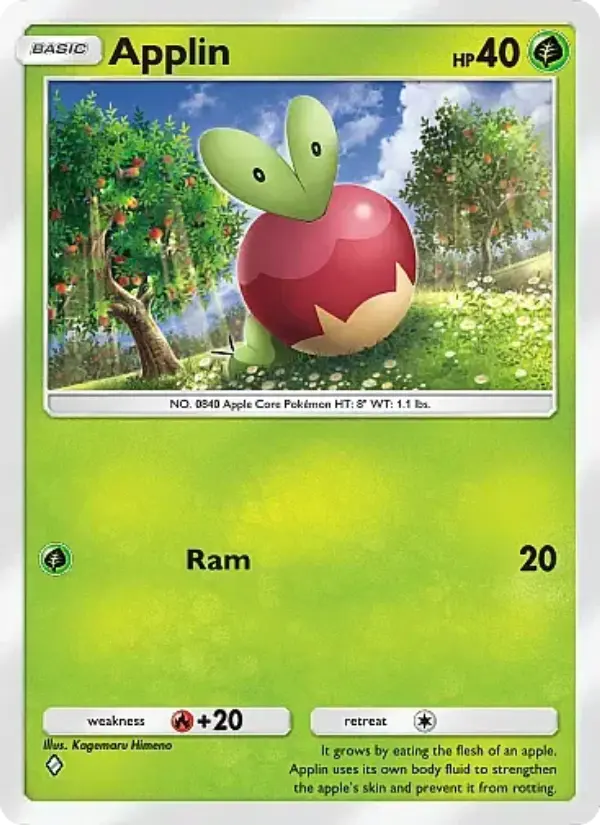
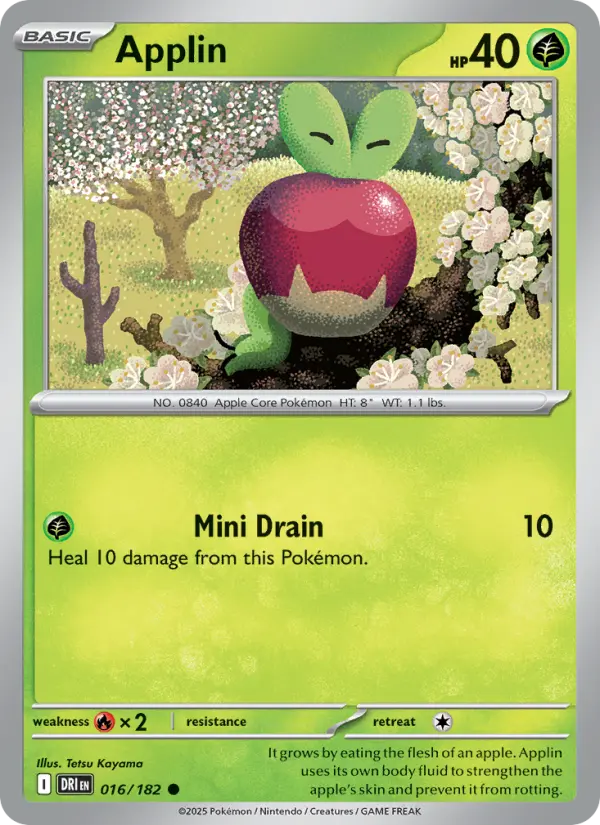
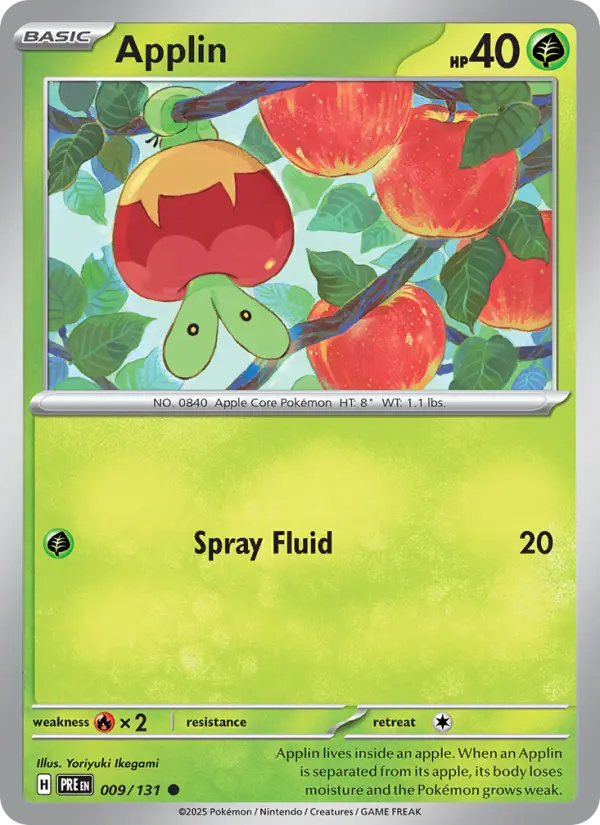
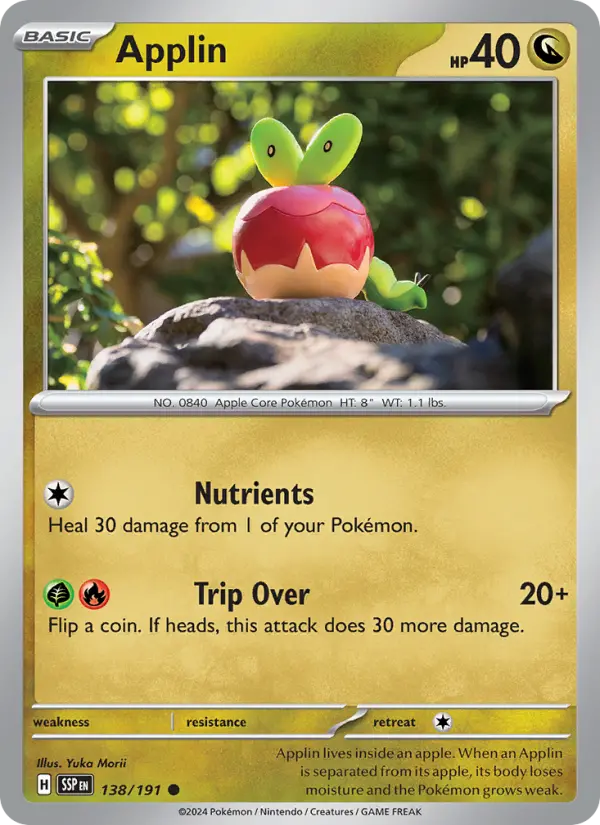
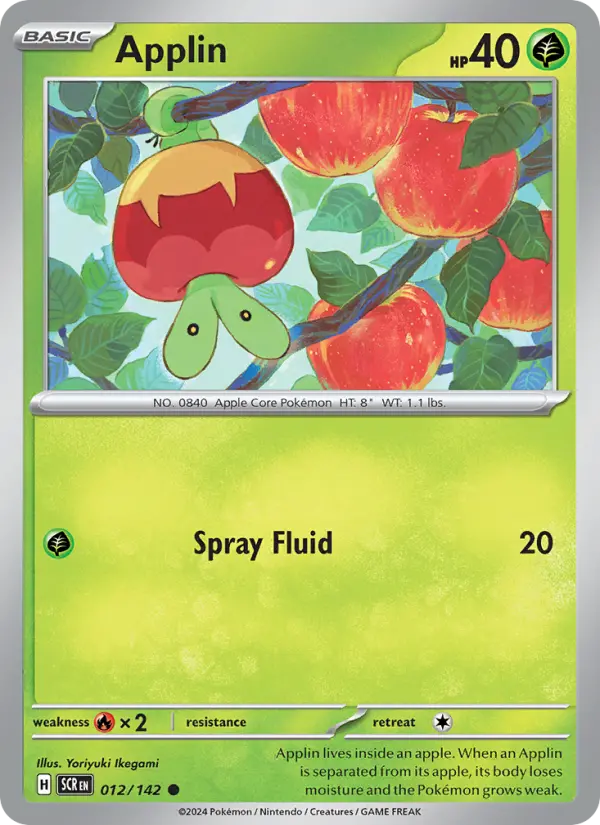
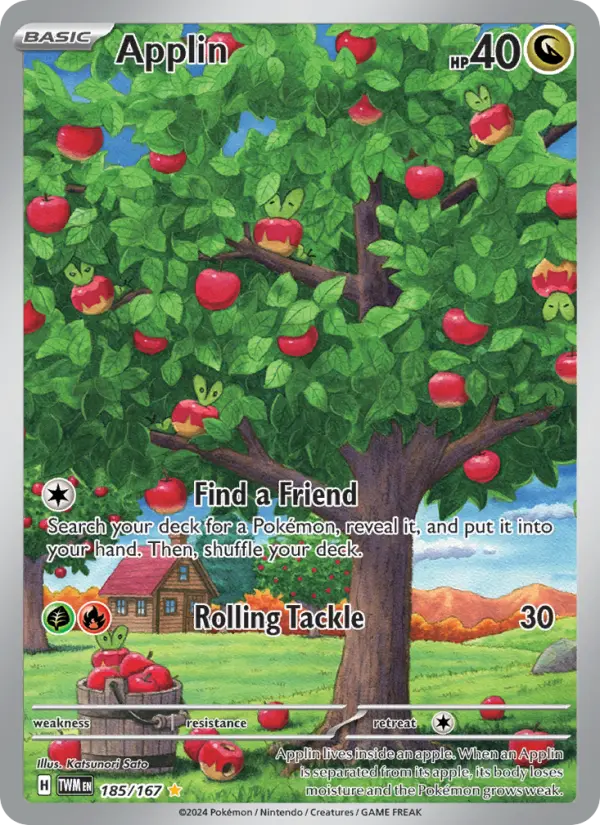
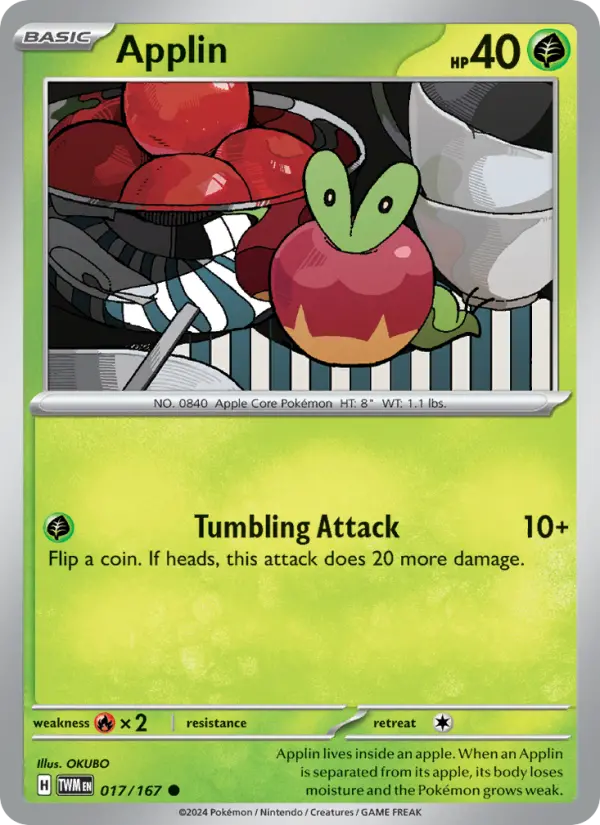
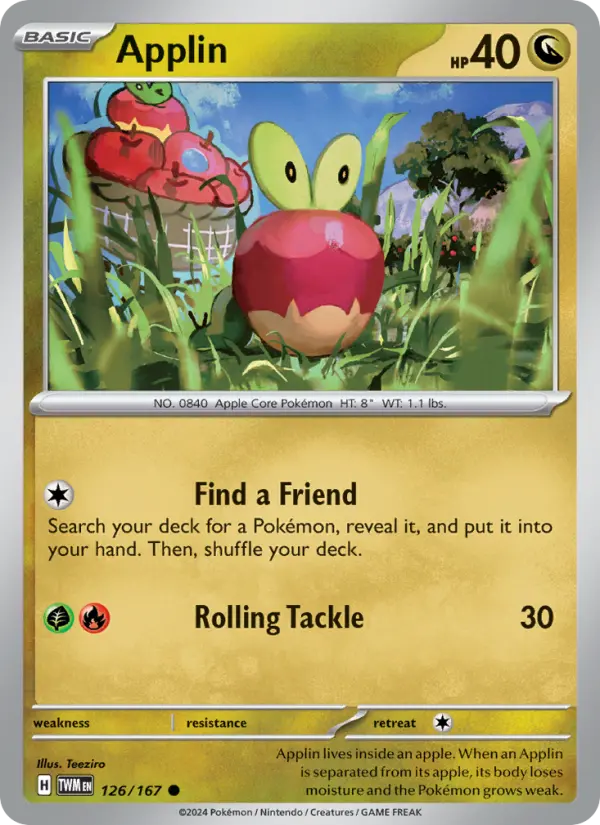
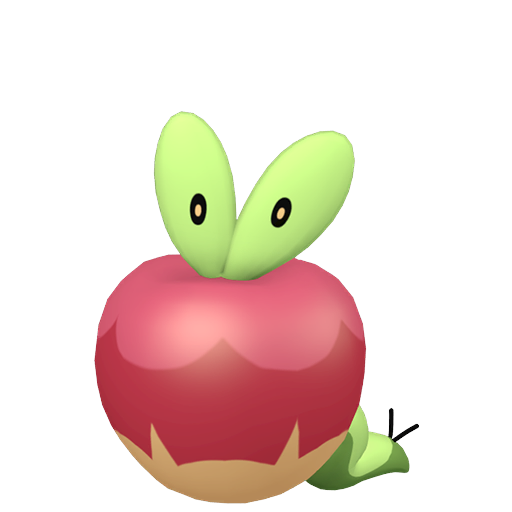
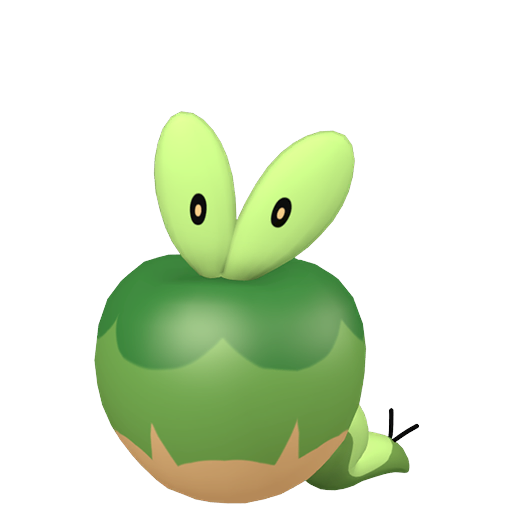
Applin is a small, worm-like Pokémon characterized by a light green body with a darker green underside, featuring a round head adorned with two prominent pink nostrils. Its most distinctive anatomical features are the two large leaf-like eyestalks that rise above its head, each housing a small black eye—these structures create the illusion of an apple stem and leaves when Applin retreats into its fruit home. The creature also possesses two thin hairs at the tip of its tail and two stubby forelimbs that typically remain hidden within its apple shelter. Immediately upon birth, Applin instinctively burrows into an apple resembling a Leppa Berry, which becomes its permanent residence, sustenance, and primary defense mechanism against predatory bird Pokémon. The relationship between Applin and its apple is profoundly symbiotic: Applin's specialized body fluids prevent the fruit from rotting while simultaneously strengthening its rind, creating a mutually beneficial arrangement that can last the creature's entire lifespan. Should Applin become separated from its apple or exhaust its food supply, its body rapidly loses moisture, leading to severe dehydration and physical weakness.
Pokedex Numbers
Training
Breeding
Applin Breeding, Gender Ratio & Egg Groups
Applin splits evenly down the middle — 50% male, 50% female, allowing for straightforward breeding practices without gender-based complications. The species belongs to both the Plant and Dragon egg groups, a dual categorization that reflects its unique biological nature and enables it to breed with a diverse range of compatible Pokémon partners. With a base friendship value of 50, Applin starts with neutral affinity toward its trainer, requiring effort and positive interactions to develop deeper bonds and improve its in-battle performance and evolution compatibility. The species has a notably slow egg-hatching time, requiring 20 cycles (approximately 4,884 to 5,140 steps) to hatch from its egg, reflecting the slower developmental pace that characterizes its growth rate classification. When breeding, Applin can pass down various egg moves to its offspring, including Defense Curl, Recycle, Rollout, and Sucker Punch, providing competitive advantages to bred individuals. The extended hatching period and breeding compatibility with multiple egg groups make Applin an interesting prospect for dedicated breeders seeking to create optimized competitive specimens or explore genetic combinations with other Dragon and Plant-type Pokémon.
Sprites




TMs & HMs
tm04
gold silver
tm04
crystal
tm21
scarlet violet
tm169
scarlet violet
tm171
scarlet violet
tm194
scarlet violet
tm171
the indigo disk
tm31
sword shield
tm194
the indigo disk
tm40
crystal
tm45
ruby sapphire
tm45
colosseum
tm45
gold silver
tm45
omega ruby alpha sapphire
tm45
ultra sun ultra moon
tm194
the teal mask
tm40
gold silver
tm45
black white
tm45
black 2 white 2
tm45
firered leafgreen
+11 more TMs/HMs
Applin's Evolution Chain


Applin Evolution, Mega Evolution & Special Forms
Applin's evolutionary line is uniquely determined by environmental factors rather than traditional leveling mechanics, creating one of the most distinctive progression pathways in modern Pokémon games. When exposed to a Tart Apple, Applin evolves into Flapple, a sleeker, more aggressive form that develops wings and enhanced offensive capabilities suited for aerial combat. Alternatively, exposure to a Sweet Apple triggers evolution into Appletun, a sturdier form with increased bulk and special defense, representing a more defensive evolutionary direction. In more recent games, a Syrupy Apple causes Applin to evolve into Dipplin, a multi-headed form that maintains the Grass/Dragon typing while gaining additional heads and complexity. The final evolution in this chain, Hydrapple, is reached when Dipplin levels up while knowing the move Dragon Cheer, representing a culmination of growth and mastery that transforms Applin into a formidable multi-dragon form. This multi-branching evolutionary system reflects the developmental importance of environmental conditions and dietary influences in determining a Pokémon's ultimate form and capabilities, making Applin's evolution process a microcosm of ecological adaptation and specialization.
Where to Find
Location data not available for this Pokémon in the database.
Applin Behaviour and Natural Habitat
Applin exhibits remarkable behavioral adaptations centered entirely around its apple home, spending its entire existence concealed within the fruit as both camouflage and sanctuary. The Pokémon's primary survival strategy involves remaining perfectly still and maintaining its disguise as an ordinary apple, effectively deceiving visual predators—particularly hungry Noibat, which occasionally mistake Applin-inhabited apples for food items. This sedentary lifestyle is reflected in Applin's extremely low base Speed stat of just 20, making it one of the slowest Pokémon in existence, though this disadvantage is offset by its defensive capabilities and symbiotic relationship with its fruit. In the wild regions of Galar and beyond, Applin can be found in areas abundant with apple-bearing trees, where it carefully selects a suitable fruit that matches its dietary and developmental needs. The flavor profile of the chosen apple plays a crucial role in determining which of Applin's evolutionary forms it will eventually become—tart apples lead to Flapple, sweet apples to Appletun, and syrupy apples to Dipplin. Despite its apparent helplessness outside of an apple, Applin possesses natural abilities like Ripen and Gluttony that allow it to manipulate berry effects, suggesting a deeper ecological role beyond simple camouflage.
Pokedex Entries
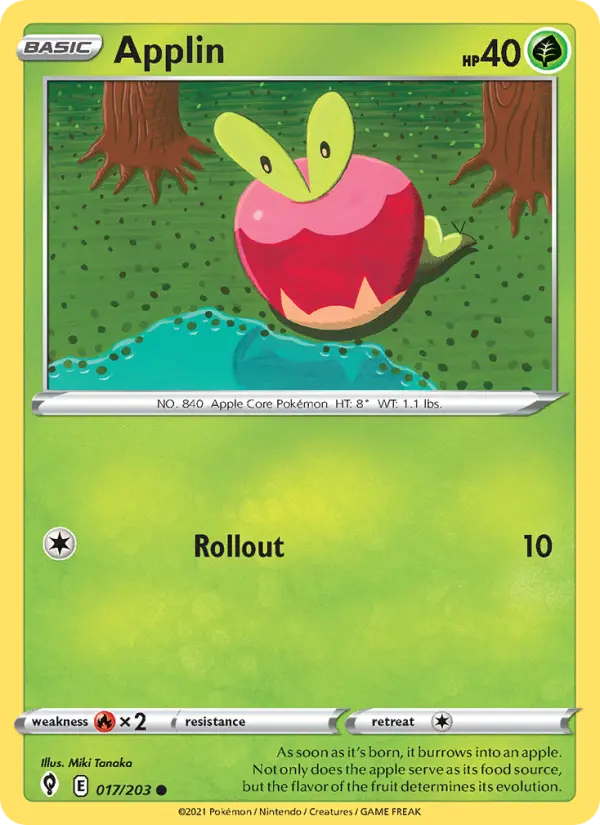
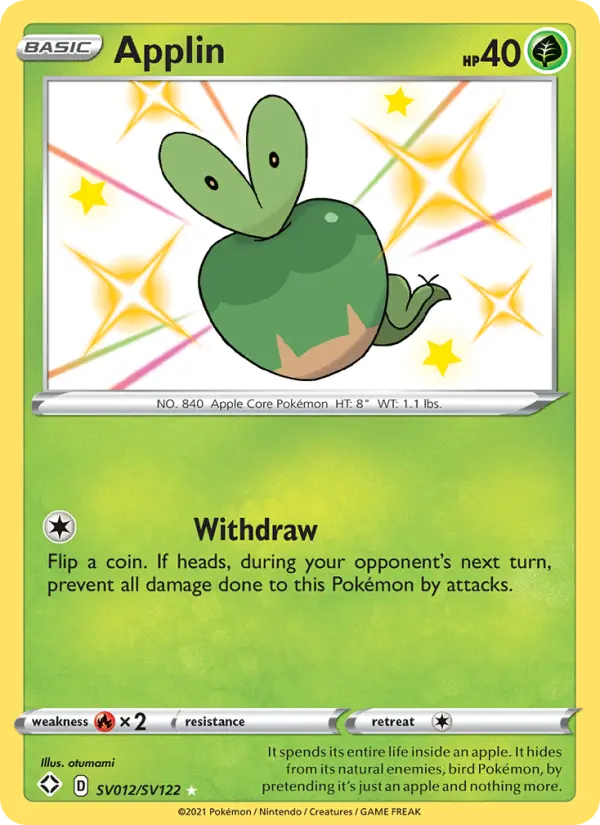
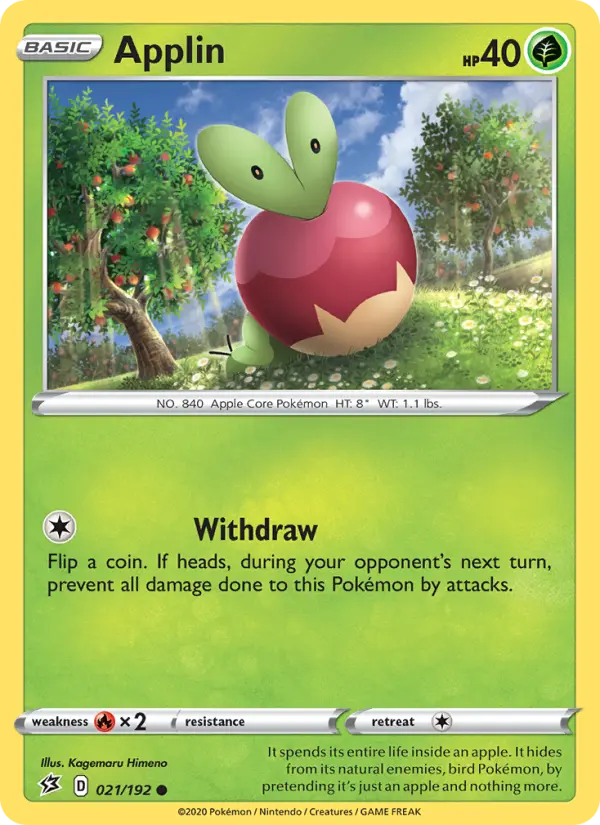
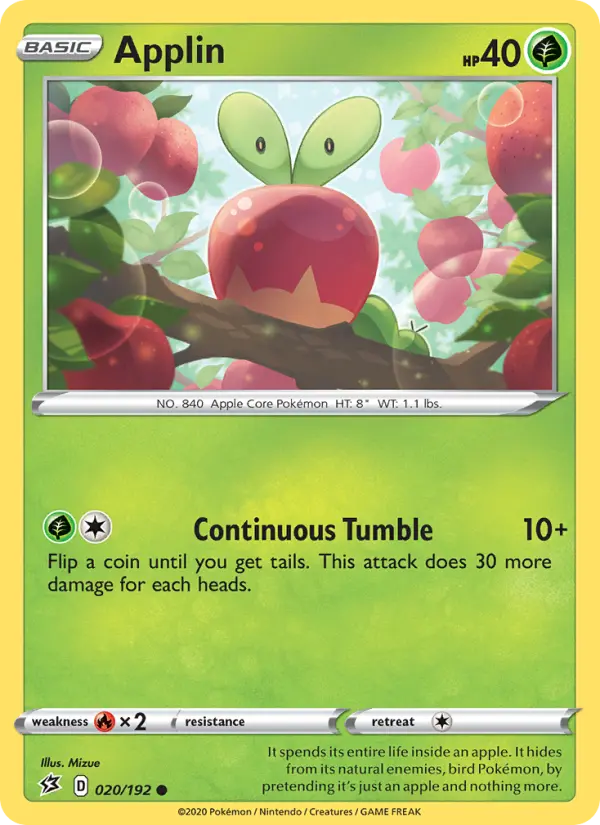
It spends its entire life inside an apple. It hides from its natural enemies, bird Pokémon, by pretending it’s just an apple and nothing more.
As soon as it’s born, it burrows into an apple. Not only does the apple serve as its food source, but the flavor of the fruit determines its evolution.
Applin Name Origin & Design Inspiration
Applin's name derives from the combination of 'apple' and 'caterpillar' or 'grub,' accurately describing the creature's worm-like appearance and apple-dwelling lifestyle. The Japanese name Kajicchu (カジッチュ) similarly combines 'kajiru' (かじる), meaning 'to gnaw or nibble,' with 'chou' (チュ), an onomatopoeia for small creature sounds, perfectly capturing the essence of a tiny fruit-eating worm. Applin's design philosophy centers on creating a Pokémon that appears, at first glance, indistinguishable from an ordinary apple, with only its eyestalks (disguised as a stem and leaves) visible when it retreats into its fruit. The leaf-like eyestalks serve the dual purpose of housing the creature's visual organs while maintaining the deception of being merely botanical material, demonstrating elegant design efficiency. By utilizing natural camouflage and mimicry as its primary defensive strategy, Applin embodies biological adaptation principles found in real-world organisms that have evolved to blend seamlessly with their environments. The creature's classification as the Apple Core Pokémon emphasizes both its location within the apple and its potential to serve as the 'core' or foundation of more complex evolutionary forms, creating a thematic consistency throughout the entire Applin line.
Learnable Moves
Applin can learn 11 moves:
Move | Type | Cat. | Power | Acc. | PP |
|---|---|---|---|---|---|
| astonish | ghost | Physical | 30 | 100 | 15 |
| attract | normal | Status | — | 100 | 15 |
| defense curl | normal | Status | — | — | 40 |
| draco meteor | dragon | Special | 130 | 90 | 5 |
| grassy glide | grass | Physical | 55 | 100 | 20 |
| pounce | bug | Physical | 50 | 100 | 20 |
| recycle | normal | Status | — | — | 10 |
| rollout | rock | Physical | 30 | 90 | 20 |
| sucker punch | dark | Physical | 70 | 100 | 5 |
| tera blast | normal | Special | 80 | 100 | 10 |
| withdraw | water | Status | — | — | 40 |
Applin Competitive Battle Guide
In competitive battling, Applin faces significant challenges due to its abysmal base Speed of 20 and modest combined stat total of 260, making it one of the least offensively threatening Pokémon available. However, its typing of Grass/Dragon grants it useful resistances to Water, Electric, and Grass moves while maintaining immunity to key threatening types, providing defensive utility despite its low special defense stat of 40. Applin's movepool is extremely limited, beginning with only Astonish and Withdraw upon hatching, though breeding allows access to moves like Sucker Punch and Rollout that can add some offensive dimension. Its abilities present the most competitive merit: Ripen doubles the effects of held berries, potentially enabling creative strategies involving items like Sitrus Berries or offensive stat-boosting berries, while the hidden ability Bulletproof provides protection against ball and bomb-based moves like Pollen Powder and Bullet Seed. Most competitive players view Applin as a pre-evolution requiring immediate evolution into one of its superior forms rather than as a standalone threat, as the base form lacks the offensive stats and move coverage necessary to compete effectively at any tier. For casual play or lower-tier competitions, Applin's defensive typing and ability to manipulate berry effects through Ripen can provide unexpected strategic value, but serious competitive battlers will almost certainly evolve it into Flapple, Appletun, or Dipplin to access superior statistics and expanded movesets.
Commonly Asked Questions About Applin
What type is Applin?
Applin is a grass and dragon type Pokemon.
What does Applin evolve into?
Applin evolves into flapple, then into appletun, then into dipplin, then into hydrapple.
What are Applin's weaknesses?
Applin is weak to flying, poison, bug, ice, dragon and fairy type moves.
Does Applin evolve by trading?
No — Applin evolves entirely through leveling up, with no trade required at any stage.
Applin Cultural Impact & Franchise History
Within the Galar region, Applin has achieved remarkable cultural significance as a symbol of romance and affection, with the tradition of gifting Applin to romantic interests establishing it as the Pokémon equivalent of flowers in human culture. This custom reflects the creature's delicate nature, small size, and the care required to maintain its apple home, making it a thoughtful and meaningful present that demonstrates commitment and nurturing capability. The Pokémon's popularity has extended beyond Galar into broader Pokémon media, appearing prominently in the Pokémon Sword and Shield games as a foundational species available early in the adventure, allowing players to develop attachments as they progress through the region. Applin's unique evolutionary mechanics, determined by apple flavor rather than traditional leveling or stone-based evolution, have resonated with players who appreciate environmental storytelling and the biological realism of dietary influences on development. The creature has also captured the imagination of competitive players and creative trainers who appreciate its distinctive typing and symbiotic relationship with its fruit home, inspiring fan art, fiction, and breeding projects exploring the boundaries of Applin's potential. In the anime and various Pokémon media, Applin has been featured as both a charming comic character and a subject of deeper ecological exploration, cementing its place as one of Generation VIII's most memorable introductions despite its initial weakness as a base-form Pokémon.
Where to Find Applin in Every Pokémon Game
Applin was first introduced in Pokémon Sword and Shield, where it can be encountered relatively early in the player's journey through the Galar region, making it accessible to trainers of all progression levels. The species carries a maximum catch rate of 255, meaning it can be captured with nearly any Poké Ball even at full health, facilitating easy acquisition for players interested in training this species. In the Pokémon Sword and Shield Expansion Pass, Applin appears in the Isle of Armor content with local Pokédex number 0019, providing additional encounters and breeding opportunities for players who wish to obtain multiple specimens. Within Pokémon Scarlet and Violet, Applin has been relocated to the Paldea region with local Pokédex number 0108, though it can also be found in the Kitakami area of the Teal Mask DLC where it appears with local number 0019. The creature's high catch rate and early-game availability across multiple game generations ensure that trainers seeking to build an Applin team or simply experience its evolutionary forms can do so without excessive grinding or late-game grinding requirements. Notably, Applin's easy availability through breeding in the Pokémon Sword and Shield games, combined with its diverse evolutionary options and cultural significance in Galar lore, has made it one of the most commonly distributed starter-adjacent creatures in modern Pokémon gaming, ensuring its continued presence in competitive and casual play across multiple regions.