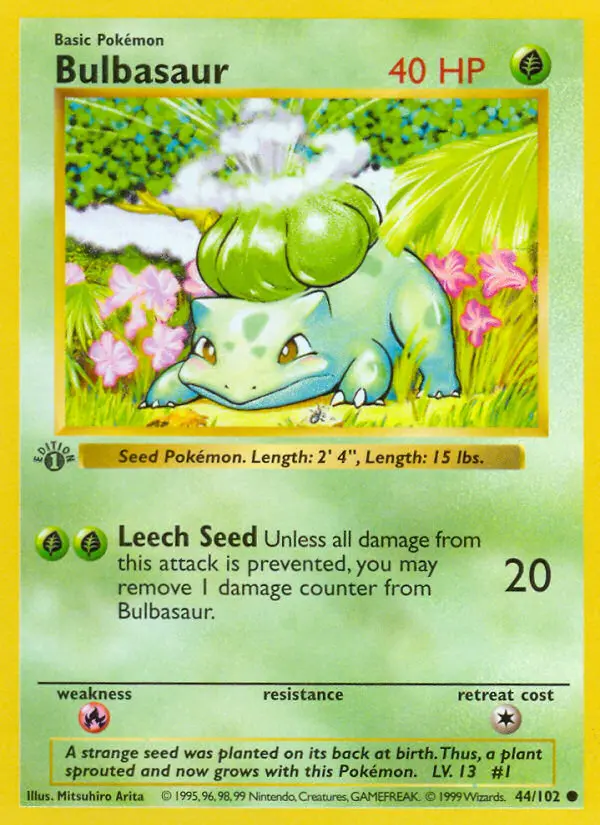
Bulbasaur
Generation I · #0001 — Seed Pokémon
Bulbasaur holds the distinguished honor of being Pokédex entry #0001, marking it as the very first Pokémon ever catalogued in the National Pokédex. This dual-type Grass/Poison Pokémon was introduced in Generation I and stands as one of the three iconic starter Pokémon available to trainers beginning their journey in the Kanto region, alongside Charmander and Squirtle. Its classification as the Seed Pokémon perfectly encapsulates its defining characteristic: a mysterious plant bulb embedded in its back from birth. Bulbasaur's combination of gentle nature and reliable movepool has made it a timeless choice for trainers of all skill levels, from complete beginners to seasoned veterans seeking nostalgia. With a base friendship value of 70, Bulbasaur demonstrates a naturally affectionate temperament toward its trainer, fostering strong bonds relatively quickly compared to many other Pokémon.
Editor's Take
Bulbasaur's Chlorophyll line never gets picked in a vacuum, but pair a Venusaur with literally any sun-setter on the team and it goes from the slowest starter in Kanto to outrunning most of the format — that's the kind of stat-line transformation you don't see coming from the base numbers alone.
Base Stats
Height
0.7m
Weight
6.9kg
Category
Seed Pokémon
Gender
Male 87.5% / Female 12.5%
Color
green
Shape
quadruped
Habitat
grassland
Abilities
Strengthens grass moves to inflict 1.5× damage at 1/3 max HP or less.
Doubles Speed during strong sunlight.

Bulbasaur Biology & Physical Characteristics
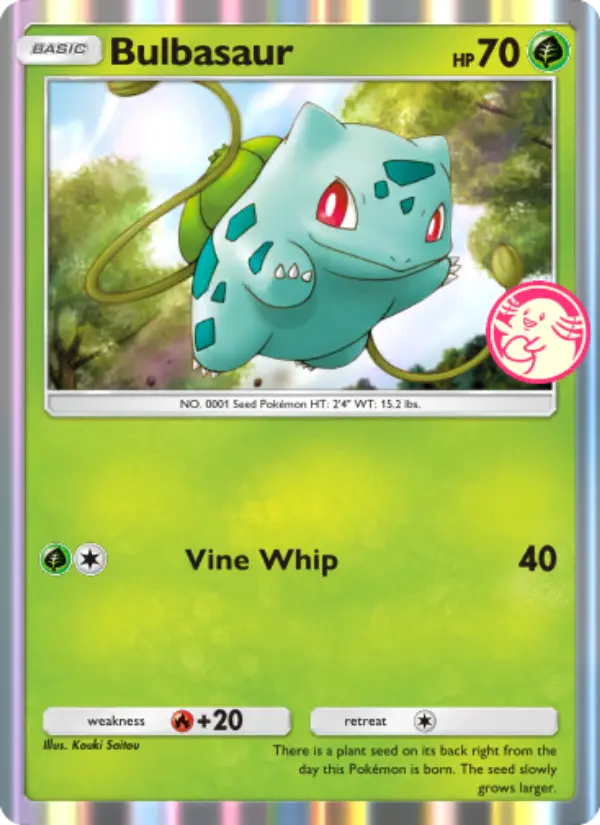
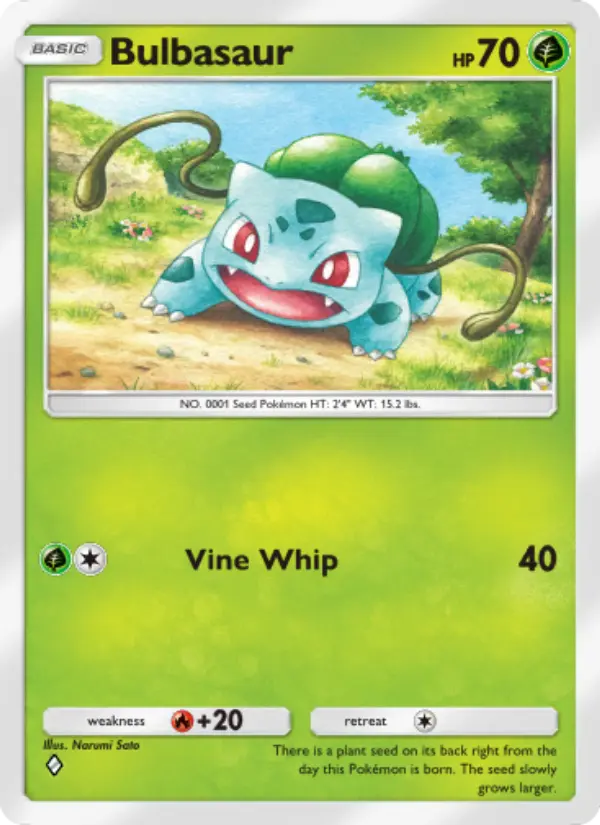
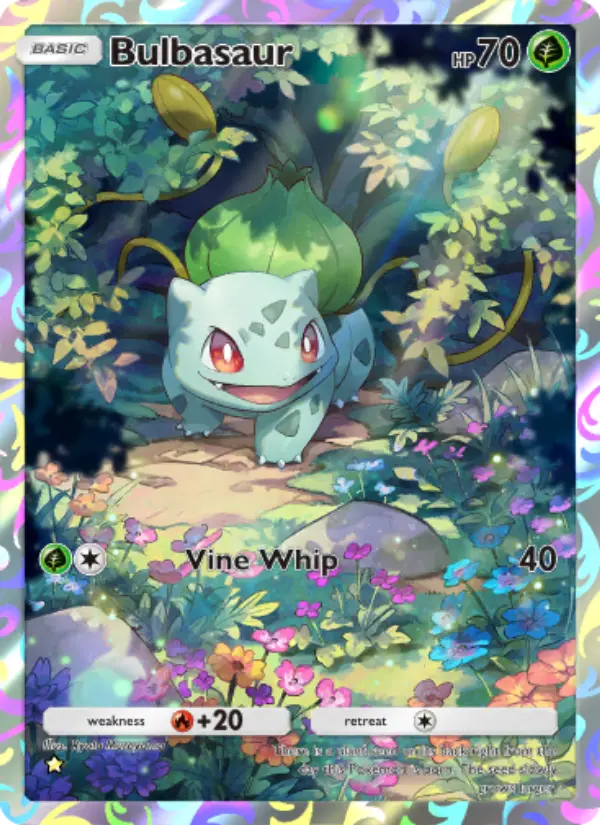
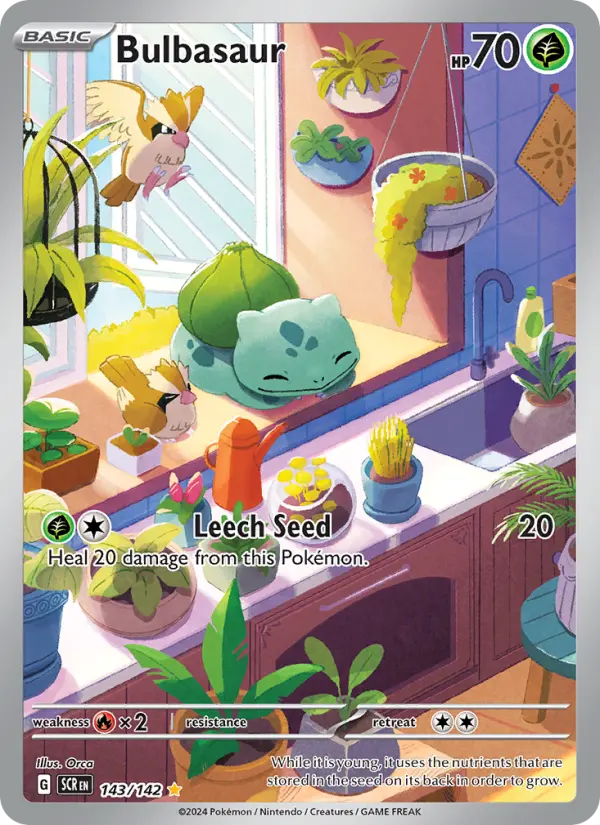
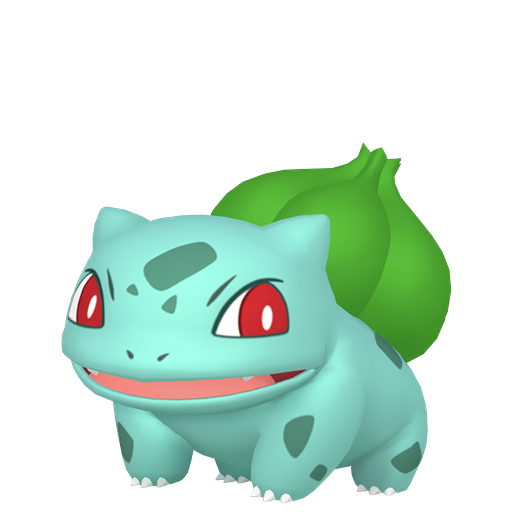
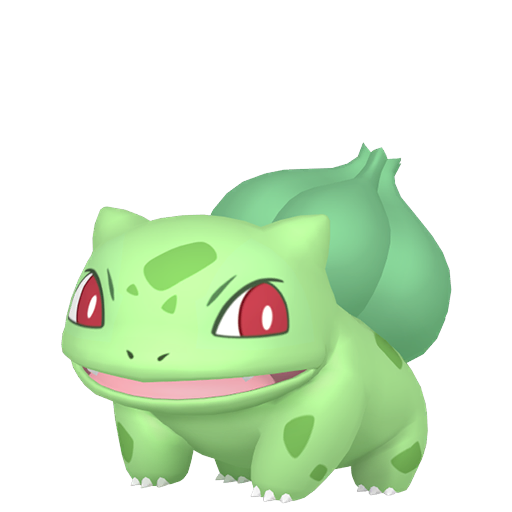
Bulbasaur is a small, quadrupedal amphibian Pokémon with predominantly turquoise or blue-green skin adorned with darker patches across its body. Standing at a modest 0.7 meters tall and weighing only 6.9 kilograms, it remains one of the smallest starter Pokémon, making it easily manageable for novice trainers. Its distinctive features include large red eyes with white pupils, pointed ear-like structures protruding from its head, and a short, blunt snout with a wide mouth containing small, visible teeth in the upper jaw. The most striking aspect of Bulbasaur's physiology is the verdant bulb mounted on its back, which serves as both a botanical and biological marvel. Each of its sturdy, thick legs terminates in three sharp claws suited for climbing and traversing varied terrain. The bulb itself is filled with nutrient reserves that sustain the Pokémon during its developmental stages, explaining its ability to forgo food for extended periods by drawing sustenance directly from this living storehouse.
Pokedex Numbers
Training
Breeding
Bulbasaur Breeding, Gender Ratio & Egg Groups
Gender-wise, Bulbasaur leans hard toward male (87.5%), with females making up just 12.5%. This significant disparity makes female Bulbasaur considerably rarer in the wild, a characteristic shared across multiple Pokémon species. When breeding, Bulbasaur falls into the Monster and Grass egg groups, allowing for diverse breeding combinations with compatible Pokémon species. The gestation period for Bulbasaur eggs spans 20 cycles, equivalent to approximately 4,884 to 5,140 steps for the trainer, making it a moderately quick hatcher compared to some other Pokémon. Newly hatched Bulbasaur begin their lives at a base friendship level that varies slightly depending on the generation; historically set at 70 in Generations II through VII, this value reflects their naturally amicable disposition. The gender imbalance, while scientifically unexplained within the Pokémon universe's lore, has become an established characteristic of the species. Female Bulbasaur are particularly sought after by competitive breeders and collectors due to their rarity, though males are equally effective for gameplay purposes and team composition.
Sprites




TMs & HMs
tm01
lets go pikachu lets go eevee
tm02
yellow
tm02
red blue
tm02
crystal
tm02
gold silver
tm02
blue japan
tm02
red green japan
tm03
yellow
tm03
crystal
tm03
gold silver
tm03
red blue
tm03
blue japan
tm03
red green japan
tm05
lets go pikachu lets go eevee
tm06
yellow
tm06
gold silver
tm06
red blue
tm06
crystal
tm06
emerald
tm06
firered leafgreen
+368 more TMs/HMs
Bulbasaur's Evolution Chain


Bulbasaur Evolution, Mega Evolution & Special Forms
Bulbasaur's evolution line follows a straightforward progression that reflects its botanical maturation. At level 16, Bulbasaur evolves into Ivysaur, during which the bulb on its back opens and a pink flower bud begins to emerge, signifying the transition from the seed stage to the budding phase. This evolution is accompanied by modest increases in all base stats, bringing its overall base stat total to 348, with particular improvements to its HP and Special Attack. The final evolution occurs at level 32 when Ivysaur transforms into Venusaur, a fully-formed grass/poison-type Pokémon with a blooming flower completely replacing the budding bulb. Venusaur represents the zenith of botanical evolution, with the bulb having matured into a magnificent pink and green flower crown, and its base stats reaching a total of 525. Additionally, Venusaur possesses the capability to Mega Evolve into Mega Venusaur, a form exclusive to certain games that grants it the Thick Fat ability, reducing damage from Fire and Ice-type moves, and dramatically enhancing its defensive capabilities while maintaining its offensive prowess.
Where to Find
Pallet Town
kanto
+5 more
Cerulean City
kanto
Lumiose City
kalos
Alola Route 2
alola
Viridian Forest
kanto
Bulbasaur Behaviour and Natural Habitat
Bulbasaur is characteristically docile and herbivorous, spending much of its time basking in bright sunlight to promote the growth of the seed on its back. According to multiple Pokédex entries, it can frequently be observed napping in sunny locations, passively absorbing solar radiation to energize both itself and its developing bulb. This sun-seeking behavior is intrinsically linked to its growth cycle, as the seed grows progressively larger with consistent exposure to the sun's rays. The species demonstrates remarkable self-sufficiency, capable of sustaining itself for days without consuming a single morsel of food thanks to the energy reserves stored within its bulb. In its natural habitat, Bulbasaur is known to inhabit grassy, temperate regions where sunlight is abundant and vegetation is plentiful. The Pokémon exhibits gentle, curious behavior toward humans and other Pokémon, rarely showing aggression unless directly threatened or provoked. Its climbing ability, aided by those three sharp claws on each foot, allows it to scale trees and rocky outcroppings with ease, making it an adaptable creature in diverse environments ranging from grasslands to light forests.
Pokedex Entries
A strange seed was planted on its back at birth. The plant sprouts and grows with this POKéMON.
It can go for days without eating a single morsel. In the bulb on its back, it stores energy.
The seed on its back is filled with nutrients. The seed grows steadily larger as its body grows.
It carries a seed on its back right from birth. As it grows older, the seed also grows larger.
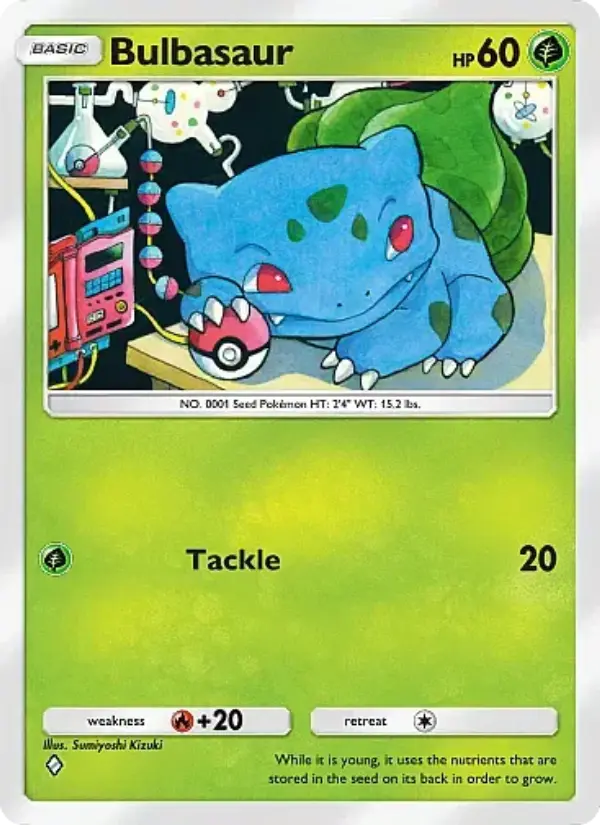
While it is young, it uses the nutrients that are stored in the seeds on its back in order to grow.
BULBASAUR can be seen napping in bright sunlight. There is a seed on its back. By soaking up the sun’s rays, the seed grows progressively larger.
BULBASAUR can be seen napping in bright sunlight. There is a seed on its back. By soaking up the sun’s rays, the seed grows progressively larger.
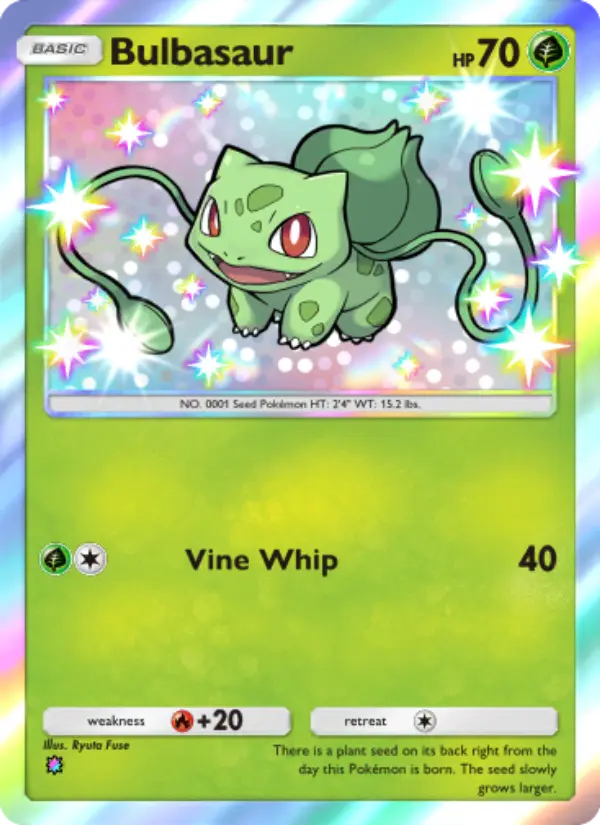
There is a plant seed on its back right from the day this POKéMON is born. The seed slowly grows larger.
A strange seed was planted on its back at birth. The plant sprouts and grows with this POKéMON.
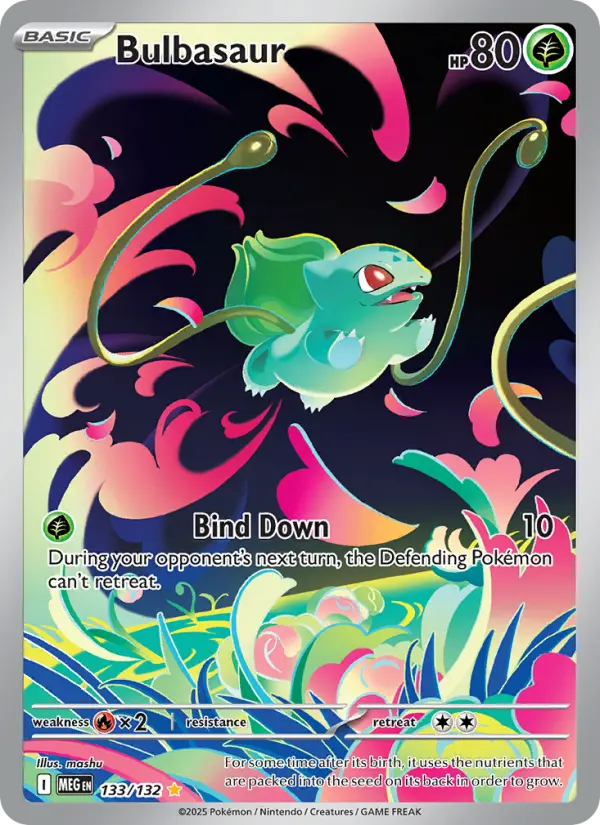
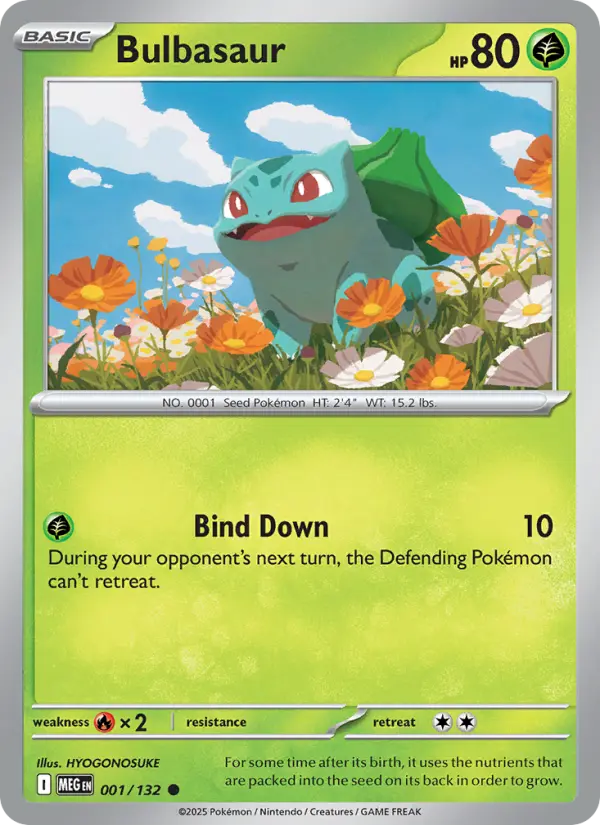
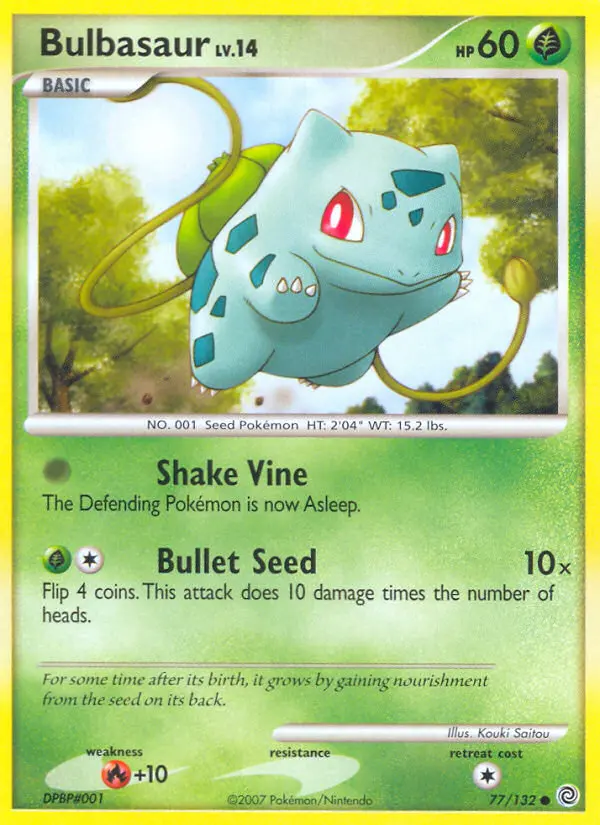
For some time after its birth, it grows by gaining nourishment from the seed on its back.
The seed on its back is filled with nutrients. The seed grows steadily larger as its body grows.
It carries a seed on its back right from birth. As it grows older, the seed also grows larger.
For some time after its birth, it grows by gaining nourishment from the seed on its back.
For some time after its birth, it grows by gaining nourishment from the seed on its back.
A strange seed was planted on its back at birth. The plant sprouts and grows with this Pokémon.
For some time after its birth, it grows by gaining nourishment from the seed on its back.
Bulbasaur can be seen napping in bright sunlight. There is a seed on its back. By soaking up the sun’s rays, the seed grows progressively larger.
It can go for days without eating a single morsel. In the bulb on its back, it stores energy.
There is a plant seed on its back right from the day this Pokémon is born. The seed slowly grows larger.
While it is young, it uses the nutrients that are stored in the seed on its back in order to grow.
Bulbasaur Name Origin & Design Inspiration
The name Bulbasaur represents a clever portmanteau of 'bulb' and 'dinosaur,' capturing both the prominent plant bulb on its back and the quadrupedal, reptilian appearance that evokes prehistoric creatures. Its Japanese name, Fushigidane, derives from 'fushigi' meaning 'strange' or 'mysterious,' and 'dane' referring to a seed or bulb, perfectly encapsulating the enigmatic origins of the seed implanted at its birth. The design philosophy behind Bulbasaur reflects a blend of amphibian and botanical characteristics, creating a creature that embodies the fusion of animal and plant life. The turquoise coloration and overall aesthetic draw inspiration from the axolotl and other aquatic salamanders, reinforcing its amphibian classification while the verdant bulb grounds it firmly in the plant kingdom. This thoughtful design juxtaposition was intentional, as the original Pokémon creators sought to develop starter Pokémon that represented different elemental and biological categories. Bulbasaur's relatively simple but instantly recognizable silhouette has proven timeless, remaining practically unchanged across all generations while still feeling fresh and appealing to both nostalgic veterans and new audiences encountering the species for the first time.
Learnable Moves
Bulbasaur can learn 46 moves:
Move | Type | Cat. | Power | Acc. | PP |
|---|---|---|---|---|---|
| amnesia | psychic | Status | — | — | 20 |
| attract | normal | Status | — | 100 | 15 |
| bide | normal | Physical | — | — | 10 |
| bind | normal | Physical | 15 | 85 | 20 |
| body slam | normal | Physical | 85 | 100 | 15 |
| curse | ghost | Status | — | — | 10 |
| cut | normal | Physical | 50 | 95 | 30 |
| defense curl | normal | Status | — | — | 40 |
| double team | normal | Status | — | — | 15 |
| double edge | normal | Physical | 120 | 100 | 15 |
| flash | normal | Status | — | 100 | 20 |
| frustration | normal | Physical | — | 100 | 20 |
| growl | normal | Status | — | 100 | 40 |
| growth | normal | Status | — | — | 20 |
| headbutt | normal | Physical | 70 | 100 | 15 |
| hidden power | normal | Special | 60 | 100 | 15 |
| leech seed | grass | Status | — | 90 | 10 |
| light screen | psychic | Status | — | — | 30 |
| mega drain | grass | Special | 40 | 100 | 15 |
| mimic | normal | Status | — | — | 10 |
| petal dance | grass | Special | 120 | 100 | 10 |
| poison powder | poison | Status | — | 75 | 35 |
| rage | normal | Physical | 20 | 100 | 20 |
| razor leaf | grass | Physical | 55 | 95 | 25 |
| razor wind | normal | Special | 80 | 100 | 10 |
| reflect | psychic | Status | — | — | 20 |
| rest | psychic | Status | — | — | 5 |
| return | normal | Physical | — | 100 | 20 |
| safeguard | normal | Status | — | — | 25 |
| skull bash | normal | Physical | 130 | 100 | 10 |
| sleep powder | grass | Status | — | 75 | 15 |
| sleep talk | normal | Status | — | — | 10 |
| sludge | poison | Special | 65 | 100 | 20 |
| snore | normal | Special | 50 | 100 | 15 |
| solar beam | grass | Special | 120 | 100 | 10 |
| strength | normal | Physical | 80 | 100 | 15 |
| string shot | bug | Status | — | 95 | 40 |
| substitute | normal | Status | — | — | 10 |
| sunny day | fire | Status | — | — | 5 |
| sweet scent | normal | Status | — | 100 | 20 |
| swords dance | normal | Status | — | — | 20 |
| synthesis | grass | Status | — | — | 5 |
| tackle | normal | Physical | 40 | 100 | 35 |
| take down | normal | Physical | 90 | 85 | 20 |
| toxic | poison | Status | — | 90 | 10 |
| vine whip | grass | Physical | 45 | 100 | 25 |
Bulbasaur Competitive Battle Guide
Bulbasaur's competitive viability is considerably limited at its base form due to its modest overall stat sum of 318, distributed across relatively weak offensive and defensive parameters. With a base Special Attack of 65 and base Speed of 45, Bulbasaur lacks the raw power and velocity necessary to threaten opponents in competitive singles formats, making it primarily a choice for casual play or novelty teams. Its movepool, while serviceable for a starter, includes useful moves such as Synthesis for recovery, Sludge Bomb for STAB coverage, and Leech Seed for sustained damage, yet these tools struggle to compensate for its statistical shortcomings. However, its hidden ability Chlorophyll transforms Bulbasaur into a weather-dependent speed sweeper during sunny conditions, doubling its Speed stat to 90 when sunlight is active, potentially enabling more competitive viability in sun-based team constructs. The real competitive potential lies in Bulbasaur's evolved forms, particularly Venusaur, which gains significantly superior stats and access to powerful moves like Solar Beam and Synthesis. In formats like Little Cup, where only unevolved Pokémon are permitted, Bulbasaur can serve as a solid defensive pivot or special attacker, leveraging its respectable Special Attack and defenses relative to other Little Cup-legal starter Pokémon to occupy specific team roles effectively.
Commonly Asked Questions About Bulbasaur
What type is Bulbasaur?
Bulbasaur is a grass and poison type Pokemon.
What does Bulbasaur evolve into?
Bulbasaur evolves into ivysaur, then into venusaur.
What are Bulbasaur's weaknesses?
Bulbasaur is weak to flying, fire, psychic and ice type moves.
Does Bulbasaur evolve by trading?
No — Bulbasaur evolves entirely through leveling up, with no trade required at any stage.
Where can I find Bulbasaur?
Bulbasaur can be found in pallet town (kanto), cerulean city (kanto) and lumiose city (kalos) and 2 other locations.
Bulbasaur Cultural Impact & Franchise History
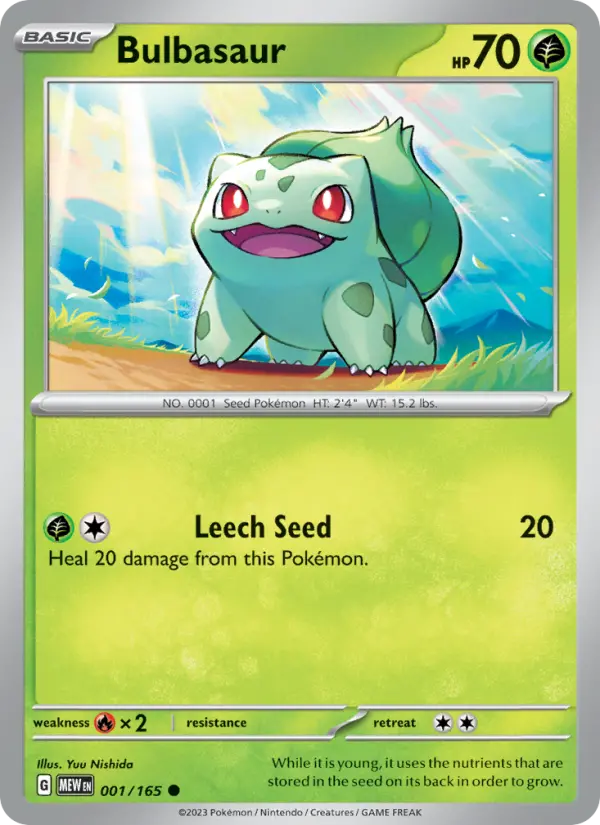
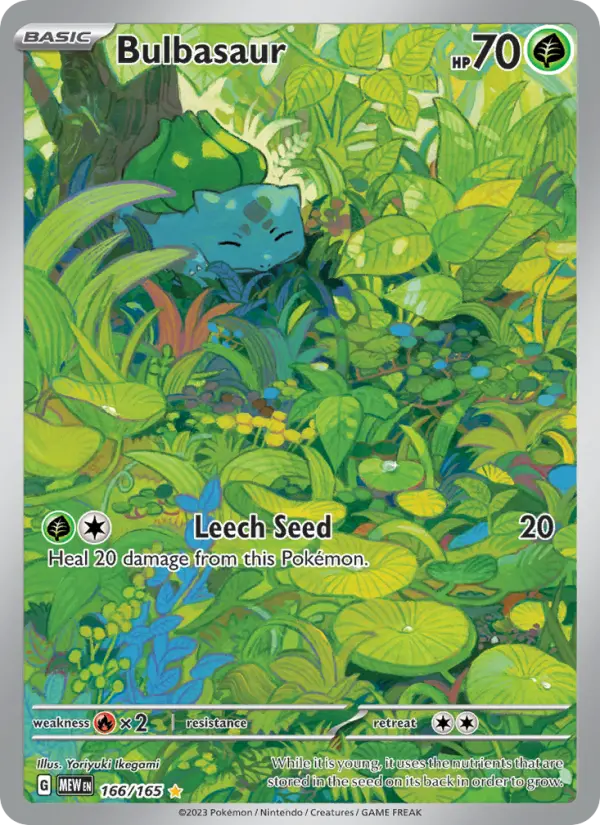
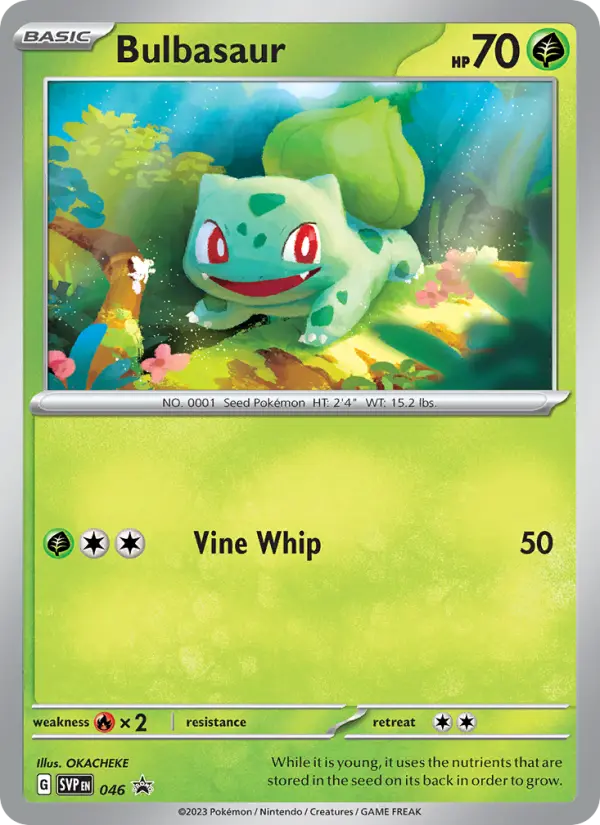
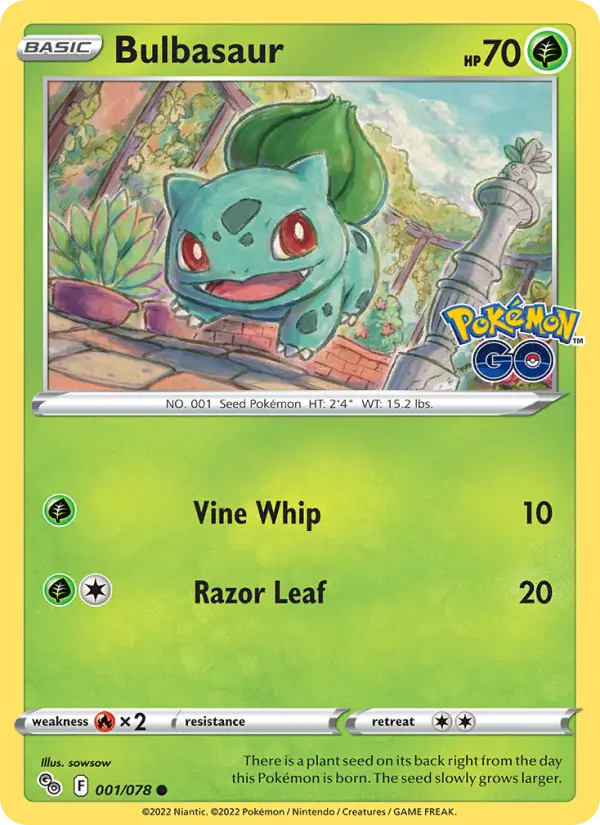
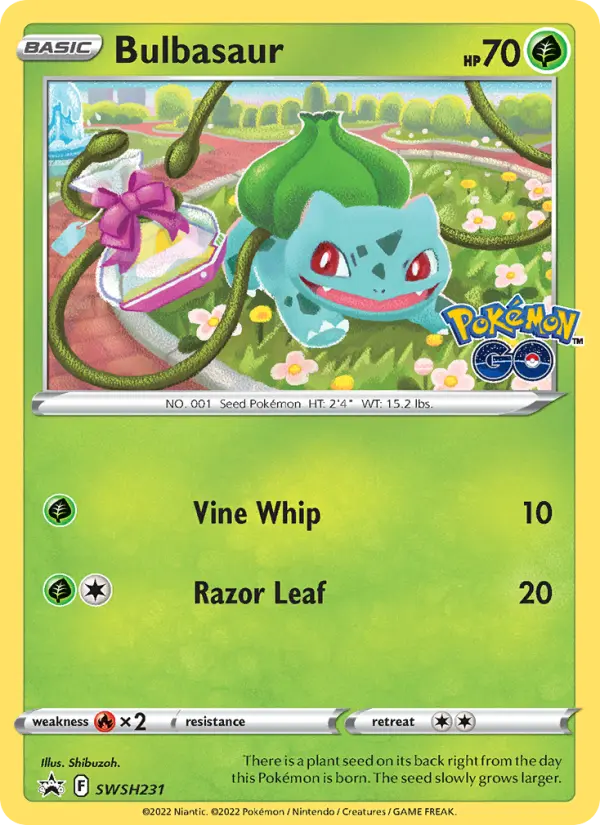
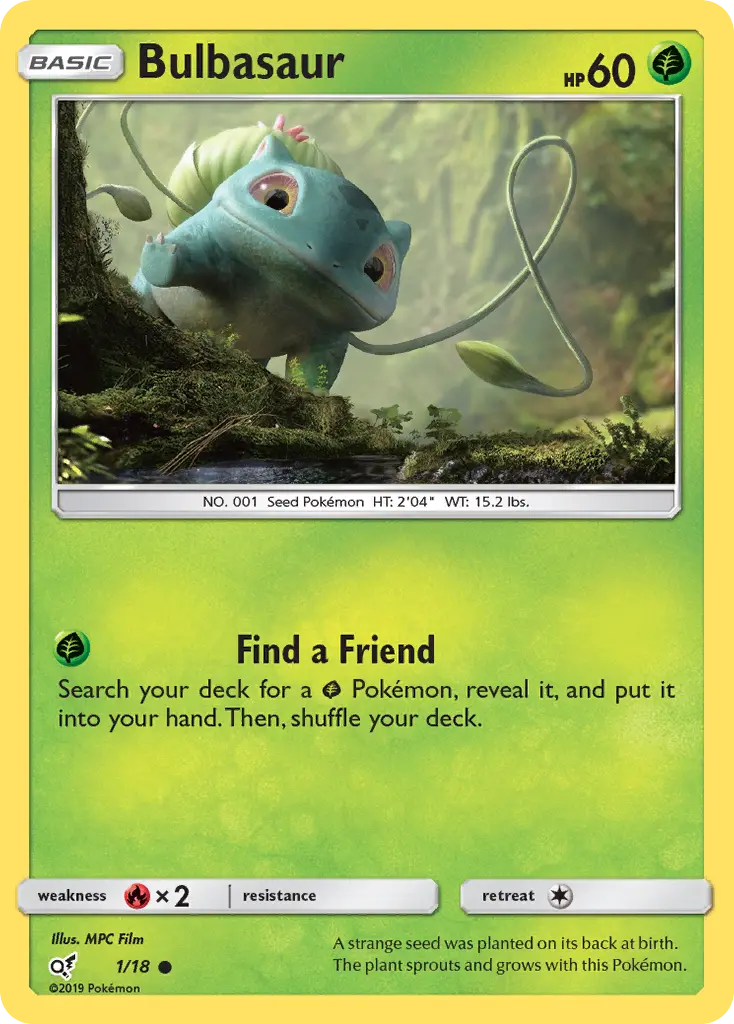
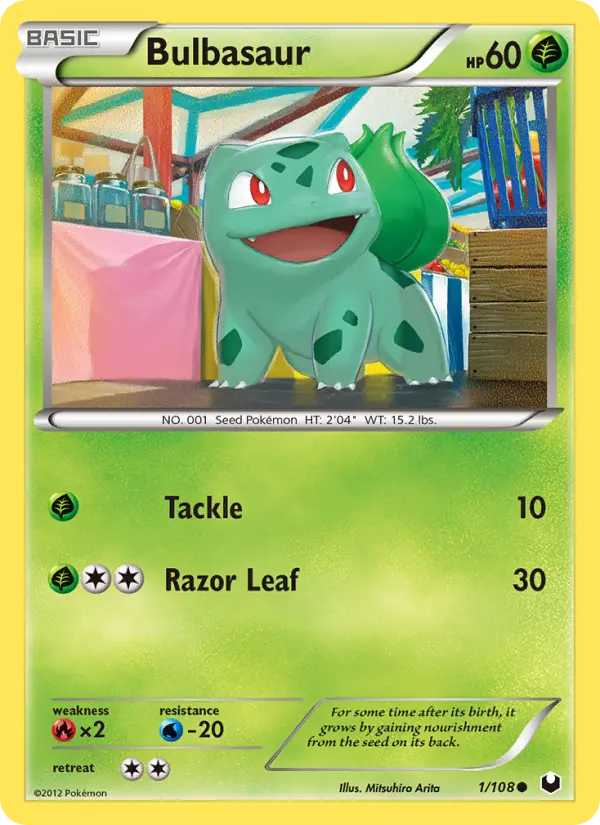
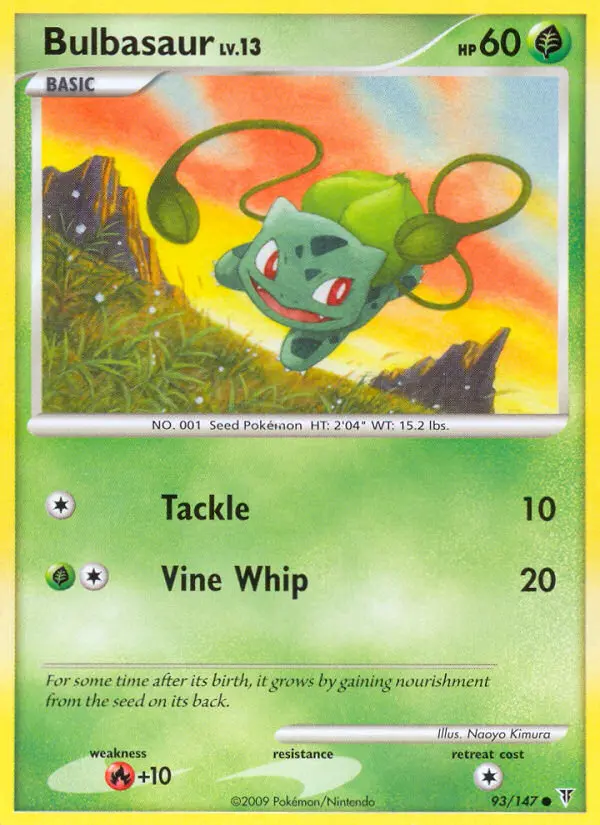
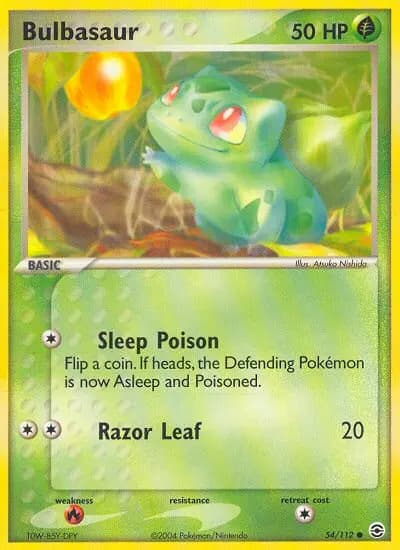
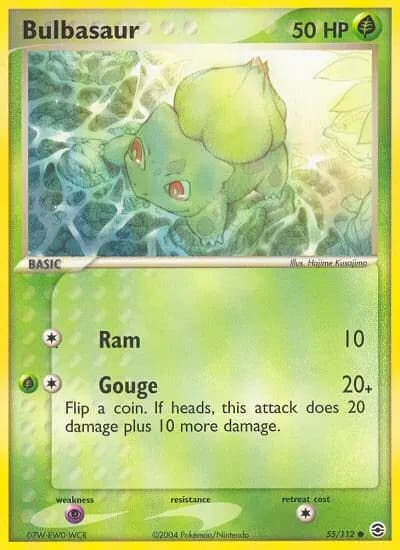
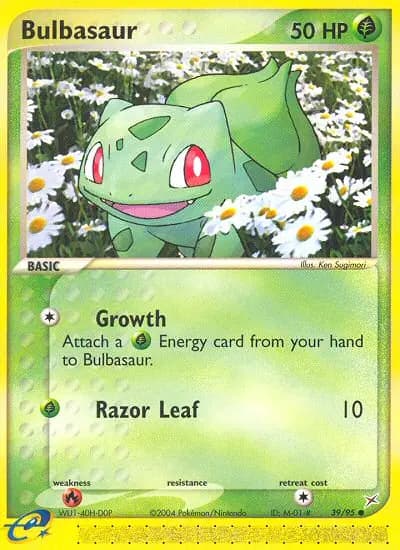
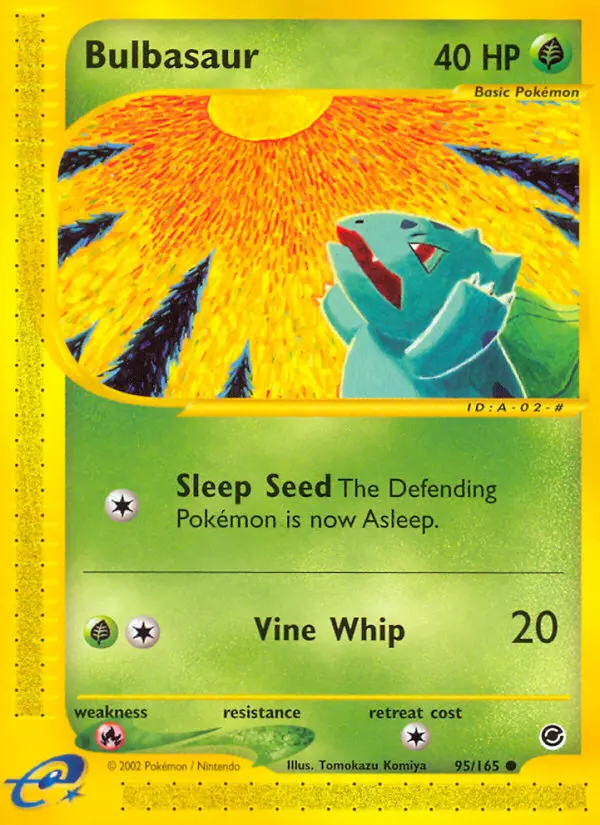
Bulbasaur's status as Pokédex #0001 has cemented its position as an iconic figurehead of the entire franchise, achieving a cultural prominence that extends far beyond gaming communities. It was prominently featured in Pokémon Red and Blue's marketing campaigns in the 1990s, becoming instantly recognizable to millions of players worldwide and serving as a gateway to the phenomenon that would define an entire generation's childhood. In the anime series, Ash's Bulbasaur became a fan-favorite companion, earning multiple evolutionary milestones that showcased its growth and loyalty throughout the Kanto saga. The character's gentle yet determined personality resonated with audiences, making it one of the most beloved Pokémon in the animated canon. Bulbasaur has appeared extensively in trading card games, merchandise, and promotional materials, often selected as the representative Grass-type starter for multi-generation celebrations and retrospectives. Its presence in Super Smash Bros. games and numerous spin-off titles has maintained its cultural relevance across multiple gaming platforms and demographics. The species has inspired countless fan communities, artwork collections, and discussion forums, with many trainers citing Bulbasaur as their first or favorite Pokémon due to its foundational role in franchise history.
Where to Find Bulbasaur in Every Pokémon Game
Bulbasaur's availability varies significantly across different Pokémon games and generations, though it consistently remains obtainable to dedicated trainers. In the original Generation I titles—Pokémon Red, Blue, and Yellow—Bulbasaur is available as one of the three starter Pokémon selections in Kanto, making it accessible to any player choosing it at the game's beginning. In Generation II games (Gold, Silver, Crystal), Bulbasaur can be obtained as one of the starter Pokémon after defeating Professor Elm, providing a second opportunity for trainers who didn't select it in previous games. The remakes FireRed and LeafGreen faithfully reproduce this availability, allowing players to start with Bulbasaur in a modernized Kanto experience. In Generation VI (X and Y), Bulbasaur becomes available in the Central Kalos Pokédex as a starter selection, and it appears at a relatively low encounter rate in specific locations. Later generations have included Bulbasaur in various ways: Sword and Shield feature it in The Isle of Armor DLC, Legends: Arceus allows limited encounters, and Let's Go Pikachu/Eevee provides it as a gift Pokémon after completing specific story objectives. Additionally, Bulbasaur regularly appears in various events, special distributions, and Pokémon GO with seasonal availability, ensuring that newer players and collectors have regular opportunities to obtain this foundational Pokémon species.