Carnivine
Generation IV · #0455 — Bug Catcher Pokémon
Since its Generation IV debut, Carnivine has carried a stat spread built around hp — 50 at base, its clearest strength. The Pokémon's signature ability, Levitate, grants it immunity to Ground-type moves, a useful defensive trait that sets it apart from many other Grass-type competitors. As a standalone Pokémon with no evolutionary relatives, Carnivine represents a complete evolutionary line unto itself, having existed since its introduction in the Sinnoh region.
Editor's Take
Carnivine has Levitate on a pure Grass type, which is a fine ability on a Pokémon with a base stat total of 454 and no evolutionary relatives to justify its existence.
Base Stats
Height
1.4m
Weight
27.0kg
Category
Bug Catcher Pokémon
Gender
Male 50% / Female 50%
Color
green
Shape
tentacles
Abilities
Evades ground moves.

Carnivine Biology & Physical Characteristics
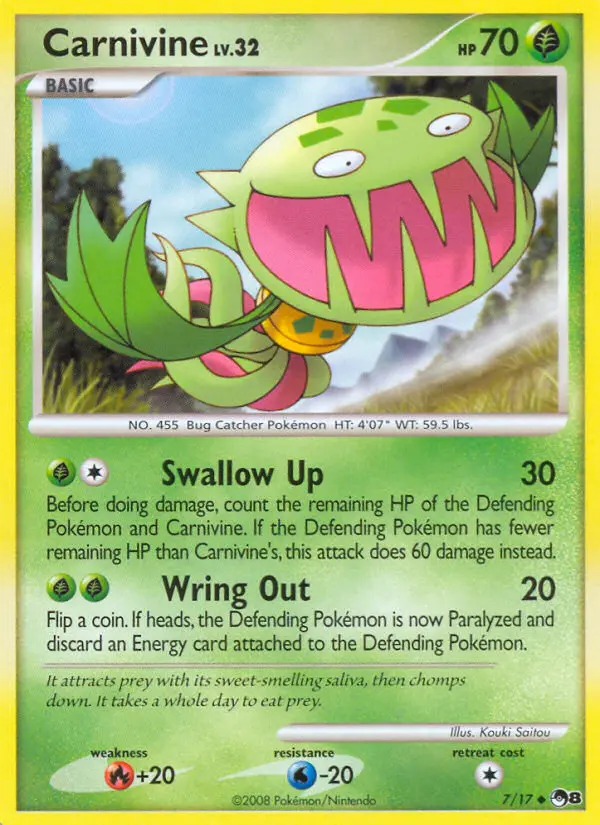
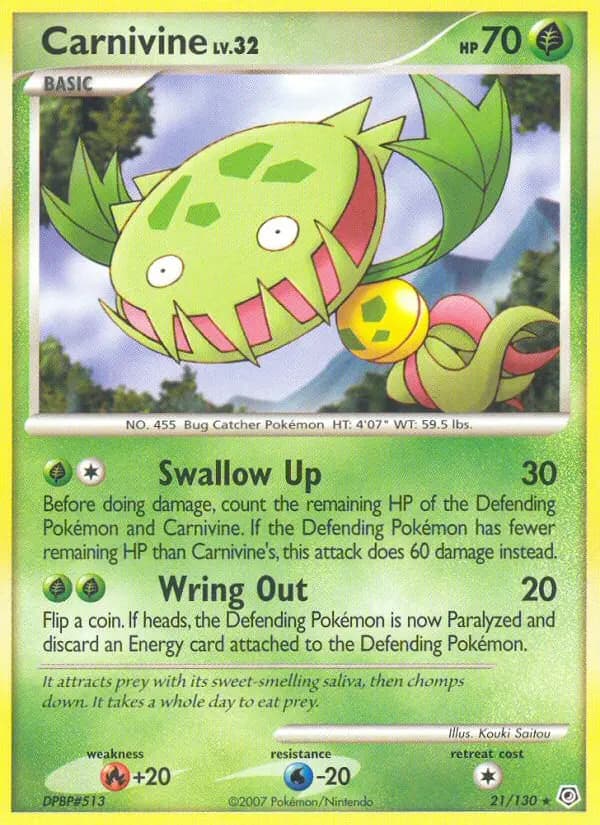
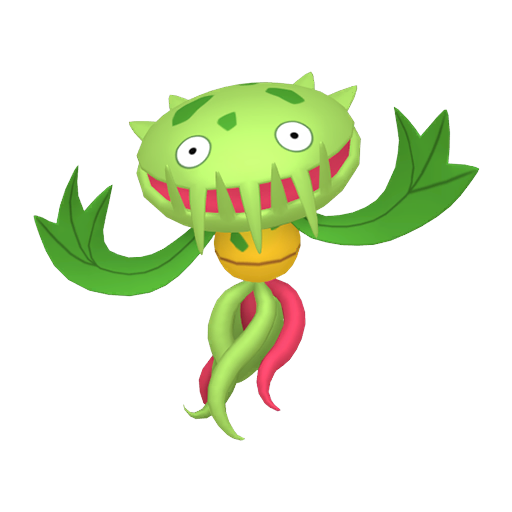
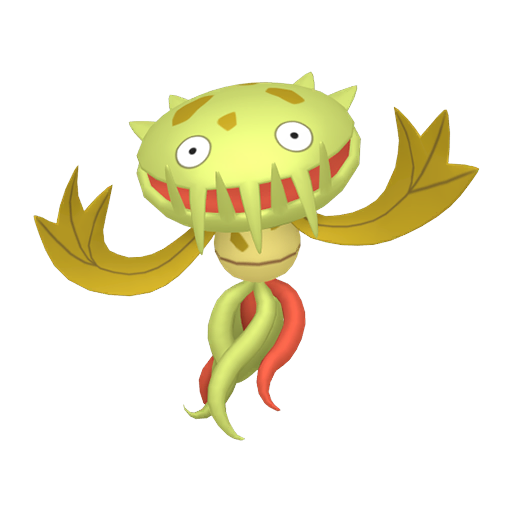
Carnivine is a green, plant-like Pokémon that bears a striking resemblance to the Venus flytrap, complete with a large circular mouth capable of opening to approximately 180 degrees wide. Its body features a yellow stem with green spots as the main trunk, from which extend red and green vine-like tentacles that give it a deceptively plant-like appearance when stationary. The creature possesses two arm-like appendages resembling leaves, each terminating in three leafy 'fingers' that aid in manipulation and climbing. Its face is characterized by circular eyes with small pupils and a prominent set of spiky teeth lining its cavernous maw. The anatomical design of Carnivine cleverly mimics genuine plant life, allowing it to disguise itself among marsh vegetation and wait unsuspecting for prey to approach. Its structure is equally suited to both predatory hunting and arboreal locomotion, with the tentacles serving as powerful gripping appendages for suspending itself from tree branches.
Pokedex Numbers
Training
Breeding
Carnivine Breeding, Gender Ratio & Egg Groups
Carnivine's population splits evenly by gender, 50% each way, making it equally viable for breeding purposes regardless of the sex of the individual specimen a trainer encounters. The species belongs to the Grass egg group, which it shares with numerous other plant-based and some unusual Pokémon, enabling cross-breeding compatibility with other members of that egg group. With a base happiness value of 70 in Generations IV through VII, Carnivine possesses moderate friendship potential, meaning it responds reasonably well to trainer affection and care but is not as naturally bonded as some other species that begin with higher base happiness. The egg cycle counter of 25 indicates a moderate hatching time of between 6,169 and 6,425 steps, placing Carnivine in the middle range for breeding convenience. The slow growth rate that Carnivine exhibits means that raising one from a newly hatched egg to full experience development requires considerable time investment compared to Pokémon with faster growth curves. Despite these considerations, Carnivine remains a viable breeding choice for players interested in building custom teams or establishing breeding lines with desirable individual values and move sets.
Sprites


TMs & HMs
tm03
yellow
tm03
red blue
tm03
blue japan
tm03
red green japan
tm05
lets go pikachu lets go eevee
tm06
yellow
tm06
gold silver
tm06
red blue
tm06
crystal
tm06
emerald
tm06
firered leafgreen
tm06
diamond pearl
tm06
platinum
tm06
ruby sapphire
tm06
colosseum
tm06
black 2 white 2
tm06
xd
tm06
black white
tm06
heartgold soulsilver
tm06
omega ruby alpha sapphire
+496 more TMs/HMs
Carnivine Evolution, Mega Evolution & Special Forms
Carnivine does not evolve from any Pokémon, nor does it evolve into any other species, making it a complete evolutionary line on its own. This distinction places Carnivine among other Generation IV Pokémon that exist as standalone entities within the franchise's complex evolutionary web. Unlike many Pokémon that undergo dramatic transformations to reach their final form, Carnivine remains unchanged throughout a trainer's entire journey with the species, suggesting that it has already reached its ultimate biological potential in its encountered state. The absence of evolutionary pressure or progression does not diminish Carnivine's combat viability or appeal, as its base stats are sufficiently balanced across most categories to enable competitive gameplay. Additionally, Carnivine does not receive a Mega Evolution form, aligning with its status as a non-evolving species that stands complete and independent from the broader evolutionary framework that defines most Pokémon lines.
Where to Find
Viridian Forest
kanto
+1 more
Ilex Forest
johto
+1 more
Unova Route 18
unova
+1 more
Kalos Route 19
kalos
+9 more
Kalos Route 14
kalos
+7 more
Carnivine Behaviour and Natural Habitat
Carnivine inhabits forests and marshes, where it demonstrates a sophisticated ambush hunting strategy described across multiple Pokédex entries. The creature binds itself to trees using its prehensile tentacles, hanging motionless to disguise itself as ordinary plant growth while awaiting the arrival of unsuspecting prey. Once a potential meal approaches, Carnivine employs a deceptive tactic by secreting sweet-smelling saliva that lures insects and small bugs close enough to attack. Once prey enters its mouth, Carnivine clamps down with tremendous force, and the digestion process is remarkably slow—a single meal can take an entire day to consume completely. The Pokémon is described as very gluttonous and temperamentally unruly, displaying aggressive feeding behaviors that seem disproportionate to its gentle plant-like camouflage. During non-hunting periods, Carnivine actively walks around on its tentacles in search of suitable tree branches from which to dangle, perpetually scouting for new hunting grounds and optimal ambush locations.
Pokedex Entries
It attracts prey with its sweet- smelling saliva, then chomps down. It takes a whole day to eat prey.
Hanging from branches using its tentacles, it looks like a plant. It awaits prey, mouth wide open.
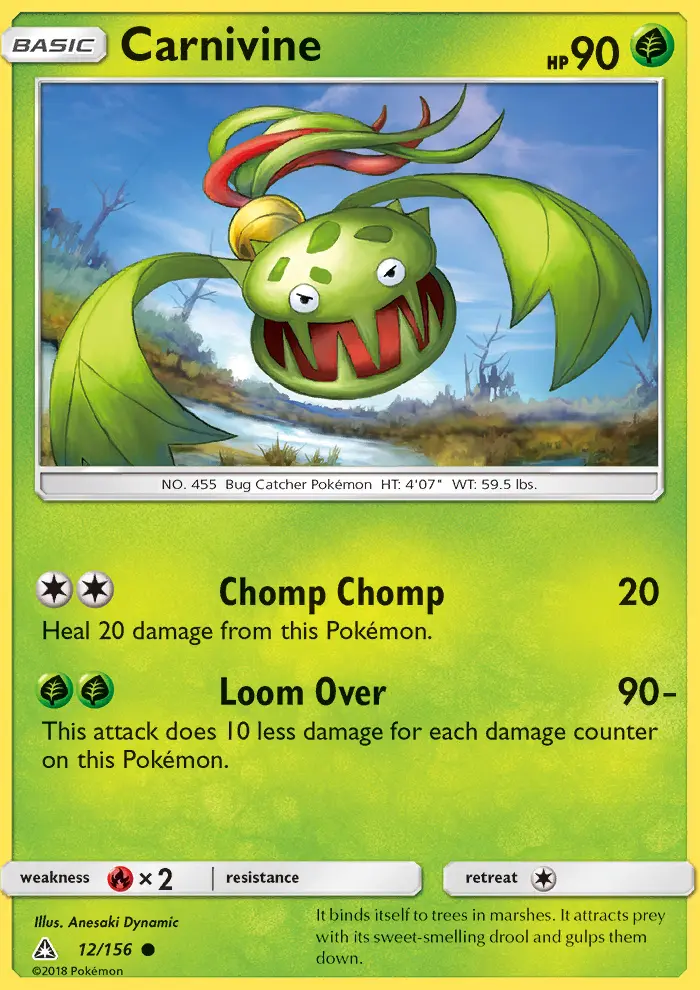
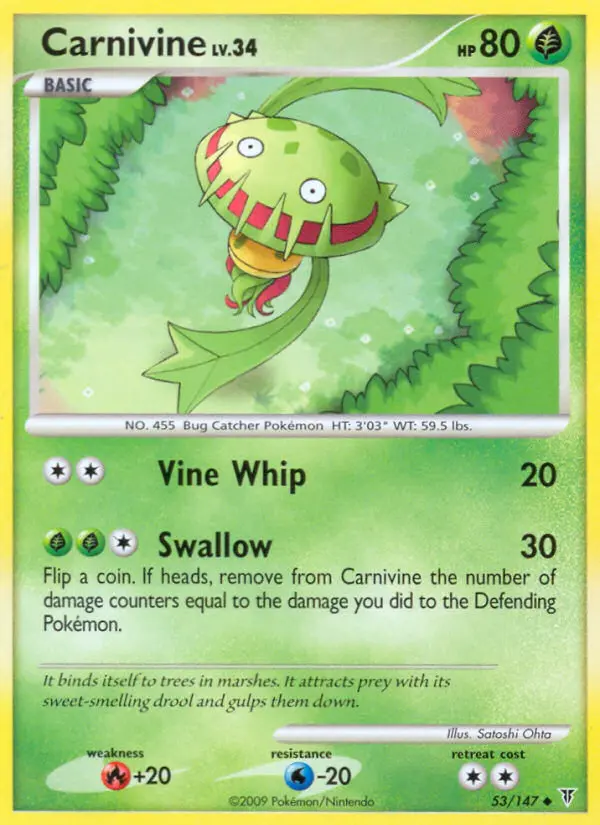
It binds itself to trees in marshes. It attracts prey with its sweet- smelling drool and gulps them down.
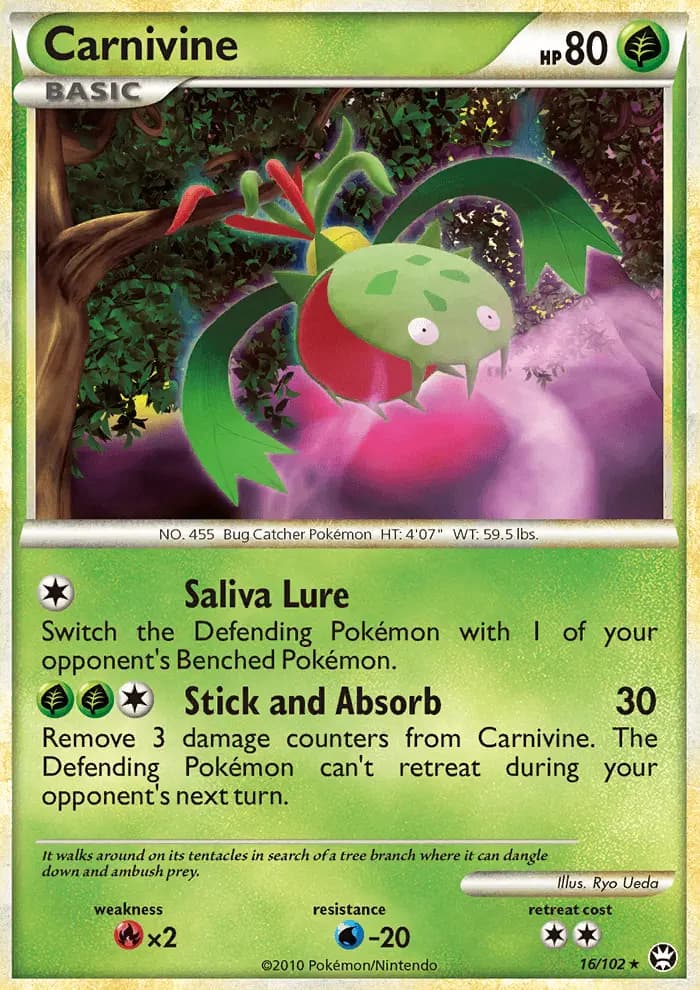
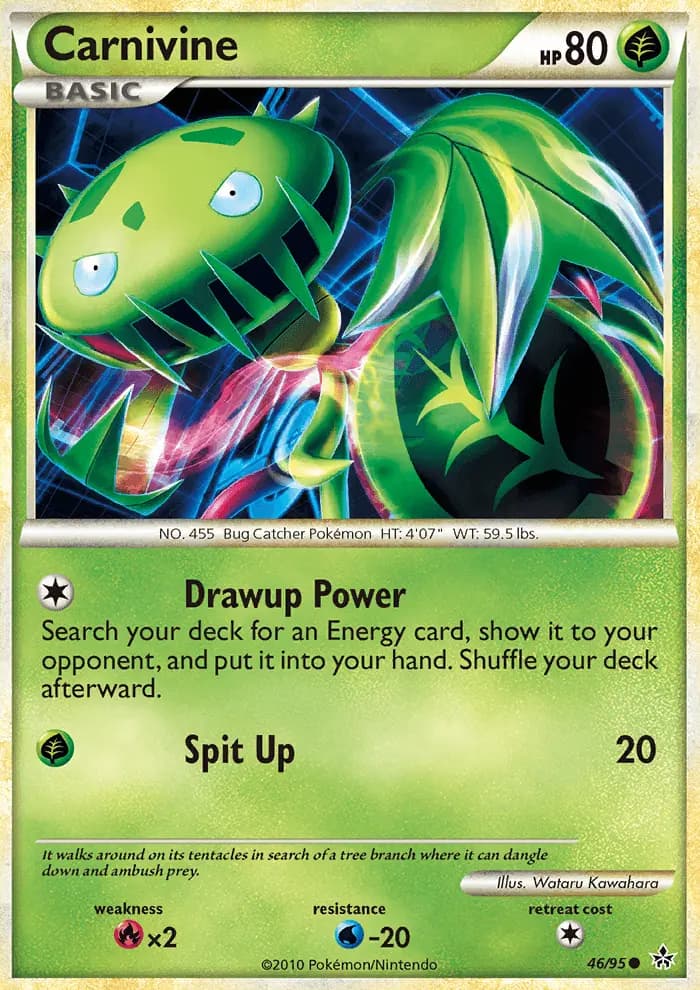
It walks around on its tentacles in search of a tree branch where it can dangle down and ambush prey.
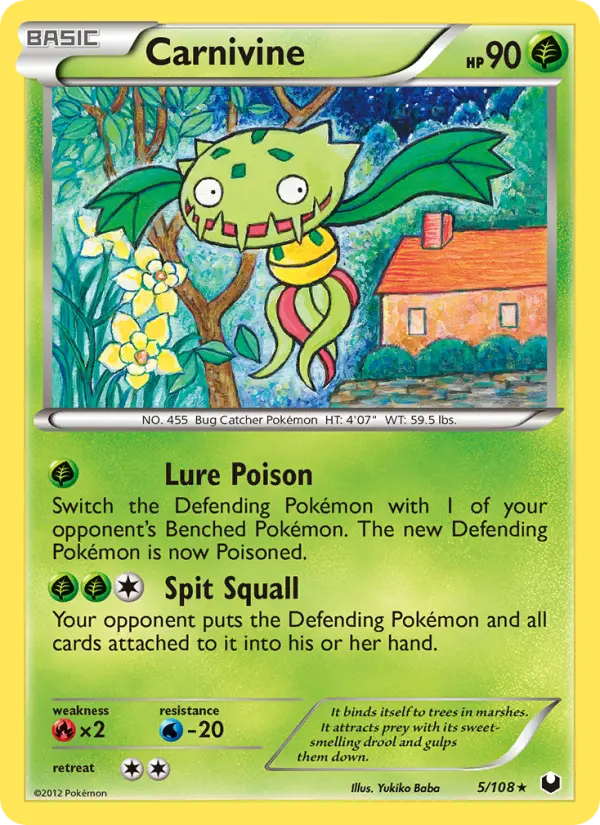
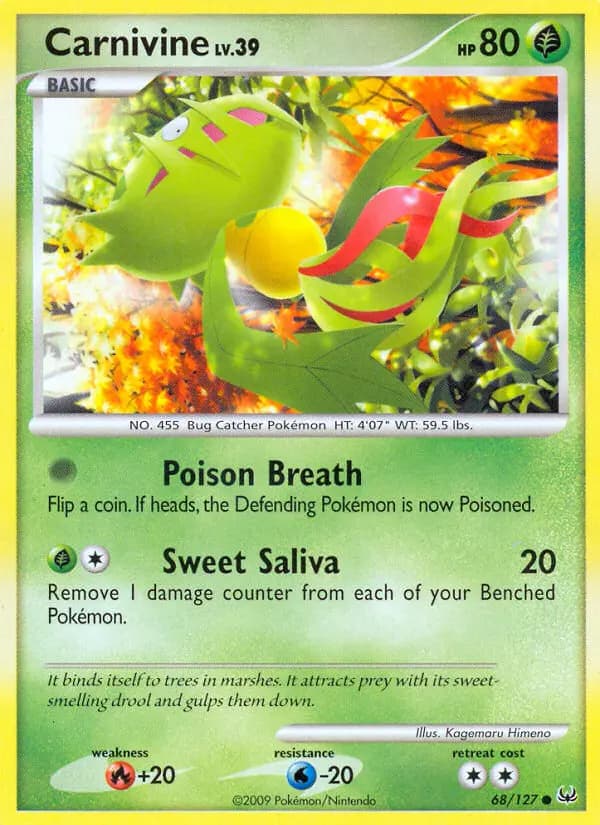
It binds itself to trees in marshes. It attracts prey with its sweet- smelling drool and gulps them down.
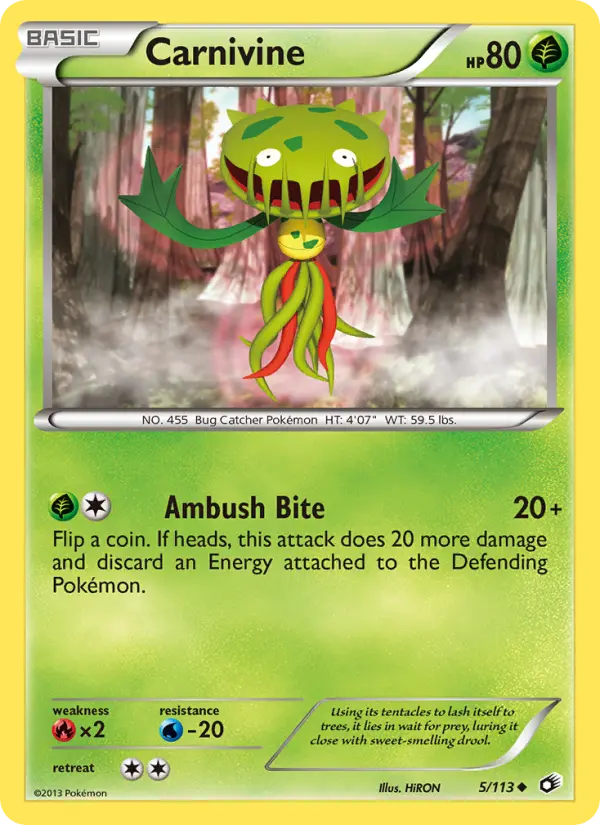
Using its tentacles to lash itself to trees, it lies in wait for prey, luring it close with sweet-smelling drool.
It attracts prey with its sweet-smelling saliva, then chomps down. It takes a whole day to eat prey.
It binds itself to trees in marshes. It attracts prey with its sweet-smelling drool and gulps them down.
It attracts prey with its sweet-smelling saliva, then chomps down. It takes a whole day to eat prey.
It binds itself to trees in marshes. It attracts prey with its sweet-smelling drool and gulps them down.
Though this is a plant Pokémon, it has a gluttonous and unruly temperament. Carnivine attacks its prey with its cavernous maw wide open.
Carnivine Name Origin & Design Inspiration
The name Carnivine is a portmanteau of 'carnivorous' and 'vine,' directly referencing the Pokémon's predatory nature and plant-based biology. The Japanese name, Muskippa, derives from 'mushi' (insect) and 'kippa,' relating to its status as an insect-consuming creature. The design is primarily inspired by the Venus flytrap (Dionaea muscipula), one of nature's most famous carnivorous plants, which inspired the wide-opening mouth mechanism and the overall appearance of a botanical predator. The color palette of greens, reds, and yellows mirrors the vibrant coloration of real carnivorous plants, particularly tropical species designed to attract insects through visual appeal. Carnivine's tentacles evoke the sensory appendages of actual flowering plants while simultaneously giving the creature a more mobile, animal-like quality that bridges the gap between flora and fauna. The circular, pupiled eyes and spiky teeth anthropomorphize the design sufficiently to make Carnivine feel like a living creature rather than merely a plant, creating a thematically cohesive design that embodies the predatory essence of its carnivorous inspiration.
Learnable Moves
Carnivine can learn 70 moves:
Move | Type | Cat. | Power | Acc. | PP |
|---|---|---|---|---|---|
| absorb | grass | Special | 20 | 100 | 25 |
| acid spray | poison | Special | 40 | 100 | 20 |
| attract | normal | Status | — | 100 | 15 |
| bind | normal | Physical | 15 | 85 | 20 |
| bite | dark | Physical | 60 | 100 | 25 |
| bug bite | bug | Physical | 60 | 100 | 20 |
| bullet seed | grass | Physical | 25 | 100 | 30 |
| captivate | normal | Status | — | 100 | 20 |
| confide | normal | Status | — | — | 20 |
| crunch | dark | Physical | 80 | 100 | 15 |
| cut | normal | Physical | 50 | 95 | 30 |
| defog | flying | Status | — | — | 15 |
| double team | normal | Status | — | — | 15 |
| endure | normal | Status | — | — | 10 |
| energy ball | grass | Special | 90 | 100 | 10 |
| facade | normal | Physical | 70 | 100 | 20 |
| feint attack | dark | Physical | 60 | — | 20 |
| flash | normal | Status | — | 100 | 20 |
| fling | dark | Physical | — | 100 | 10 |
| frustration | normal | Physical | — | 100 | 20 |
| fury cutter | bug | Physical | 40 | 95 | 20 |
| gastro acid | poison | Status | — | 100 | 10 |
| giga drain | grass | Special | 75 | 100 | 10 |
| giga impact | normal | Physical | 150 | 90 | 5 |
| grass knot | grass | Special | — | 100 | 20 |
| grass whistle | grass | Status | — | 55 | 15 |
| growth | normal | Status | — | — | 20 |
| hidden power | normal | Special | 60 | 100 | 15 |
| hyper beam | normal | Special | 150 | 90 | 5 |
| infestation | bug | Special | 20 | 100 | 20 |
| ingrain | grass | Status | — | — | 20 |
| knock off | dark | Physical | 65 | 100 | 20 |
| leaf tornado | grass | Special | 65 | 90 | 10 |
| leech seed | grass | Status | — | 90 | 10 |
| magical leaf | grass | Special | 60 | — | 20 |
| mud slap | ground | Special | 20 | 100 | 10 |
| natural gift | normal | Physical | — | 100 | 15 |
| nature power | normal | Status | — | — | 20 |
| payback | dark | Physical | 50 | 100 | 10 |
| power whip | grass | Physical | 120 | 85 | 10 |
| protect | normal | Status | — | — | 10 |
| rage powder | bug | Status | — | — | 20 |
| razor leaf | grass | Physical | 55 | 95 | 25 |
| rest | psychic | Status | — | — | 5 |
| return | normal | Physical | — | 100 | 20 |
| round | normal | Special | 60 | 100 | 15 |
| secret power | normal | Physical | 70 | 100 | 20 |
| seed bomb | grass | Physical | 80 | 100 | 15 |
| slam | normal | Physical | 80 | 75 | 20 |
| sleep powder | grass | Status | — | 75 | 15 |
| sleep talk | normal | Status | — | — | 10 |
| sludge bomb | poison | Special | 90 | 100 | 10 |
| snore | normal | Special | 50 | 100 | 15 |
| solar beam | grass | Special | 120 | 100 | 10 |
| spit up | normal | Special | — | 100 | 10 |
| stockpile | normal | Status | — | — | 20 |
| stun spore | grass | Status | — | 75 | 30 |
| substitute | normal | Status | — | — | 10 |
| sunny day | fire | Status | — | — | 5 |
| swagger | normal | Status | — | 85 | 15 |
| swallow | normal | Status | — | — | 10 |
| sweet scent | normal | Status | — | 100 | 20 |
| swords dance | normal | Status | — | — | 20 |
| synthesis | grass | Status | — | — | 5 |
| thief | dark | Physical | 60 | 100 | 25 |
| throat chop | dark | Physical | 80 | 100 | 15 |
| toxic | poison | Status | — | 90 | 10 |
| vine whip | grass | Physical | 45 | 100 | 25 |
| worry seed | grass | Status | — | 100 | 10 |
| wring out | normal | Special | — | 100 | 5 |
Carnivine Competitive Battle Guide
Carnivine occupies a niche position in competitive Pokémon battling, primarily leveraging its exceptional Attack stat of 100 to deliver physical damage while benefiting from its solid Special Attack of 90 for mixed offense strategies. The Levitate ability provides valuable immunity to Ground-type moves, a significant defensive advantage that allows Carnivine to avoid moves like Earthquake and Toxic Spikes entirely, granting it strategic flexibility in team compositions. However, Carnivine's significantly low Speed stat of 46 severely limits its competitive viability, forcing it to rely on slower, methodical strategies or the use of priority moves to overcome faster opponents. Its defenses are modest, with Defense and Special Defense both sitting at 72, making it vulnerable to powerful special attacks that can exploit its reliance on bulky defensive coverage. Carnivine learns a diverse movepool including Grass-type STAB options like Leaf Storm and Power Whip, physical Dark-type moves such as Crunch and Sucker Punch, and utility coverage moves like Sludge Bomb and Earthquake through technical machines. While Carnivine sees occasional use in casual and lower-tier competitive formats, its combination of slow Speed, modest defenses, and the existence of more efficient physical attackers in higher competitive tiers limit its presence in official tournaments and ranked online battles.
Commonly Asked Questions About Carnivine
What type is Carnivine?
Carnivine is a grass type Pokemon.
What does Carnivine evolve from?
Carnivine does not evolve.
What are Carnivine's weaknesses?
Carnivine is weak to flying, poison, bug, fire and ice type moves.
Where can I find Carnivine?
Carnivine can be found in viridian forest (kanto), ilex forest (johto) and unova route 18 (unova) and 2 other locations.
Carnivine Cultural Impact & Franchise History
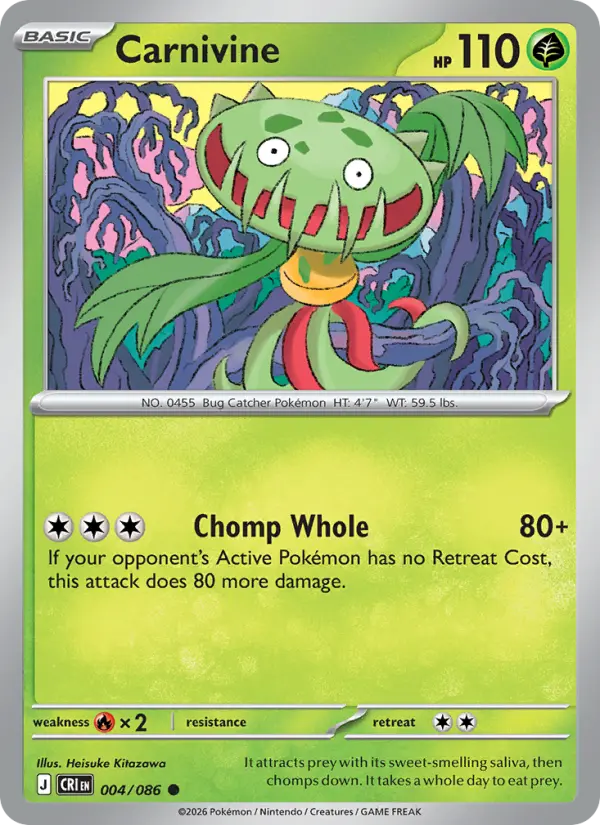
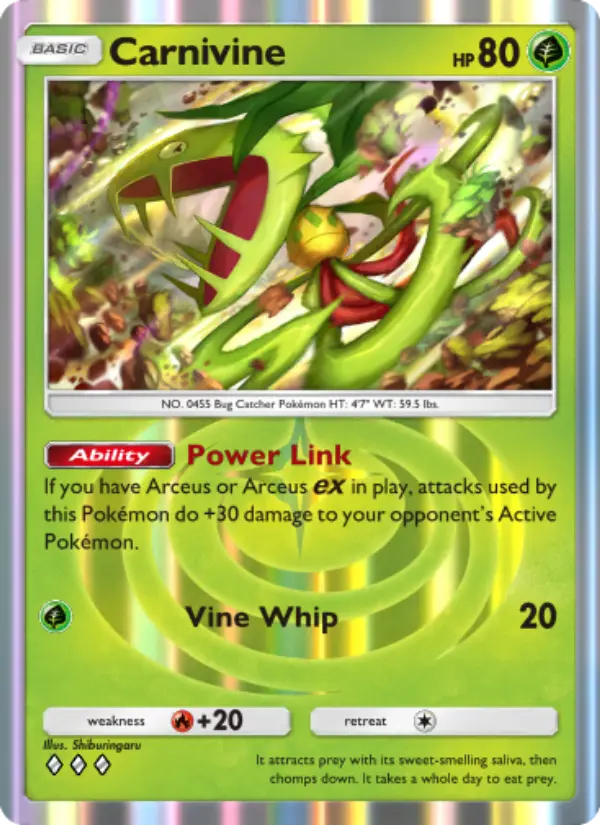
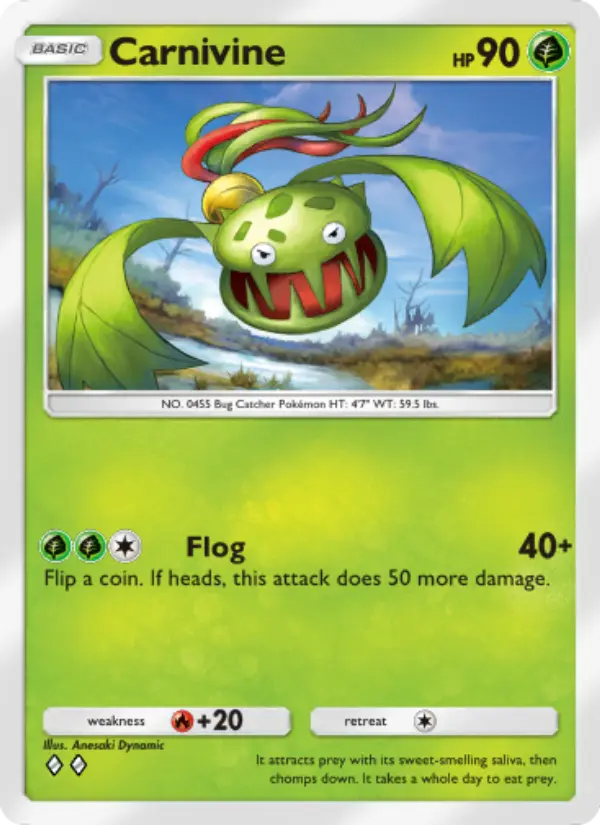
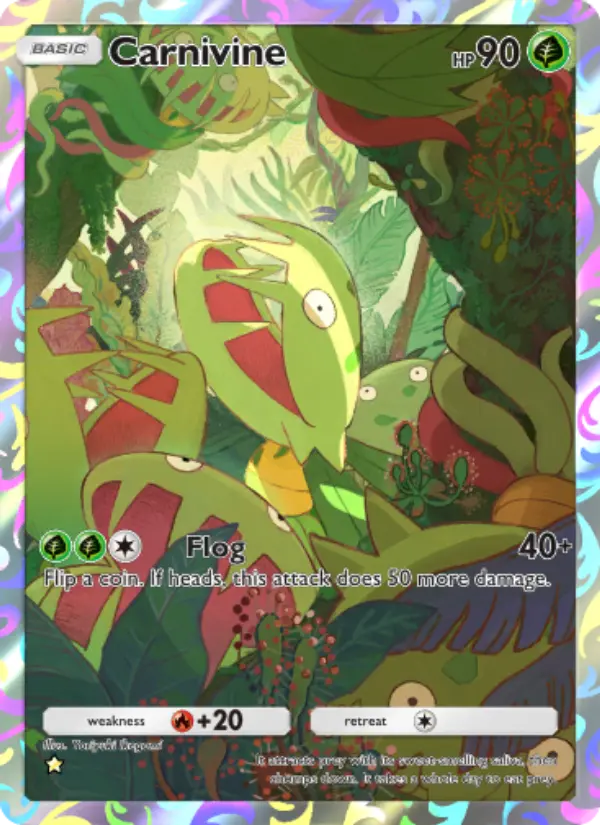
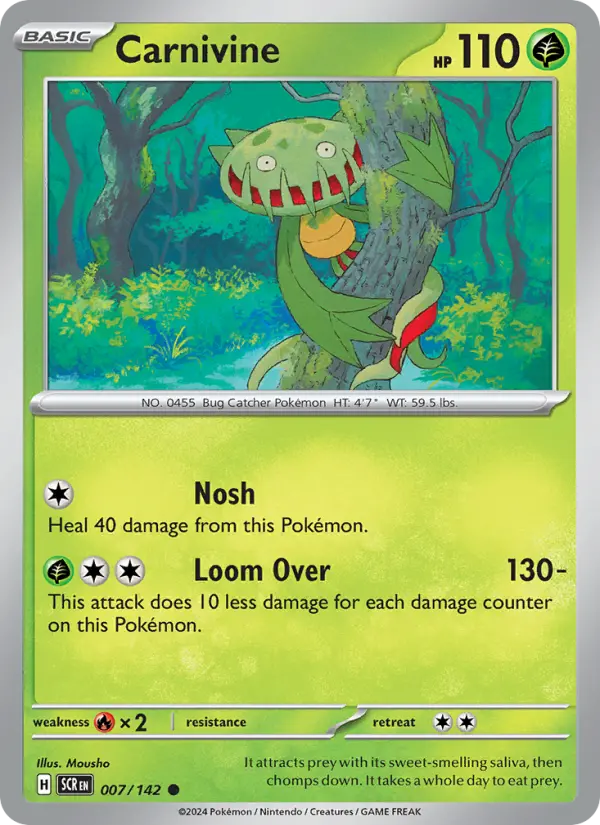
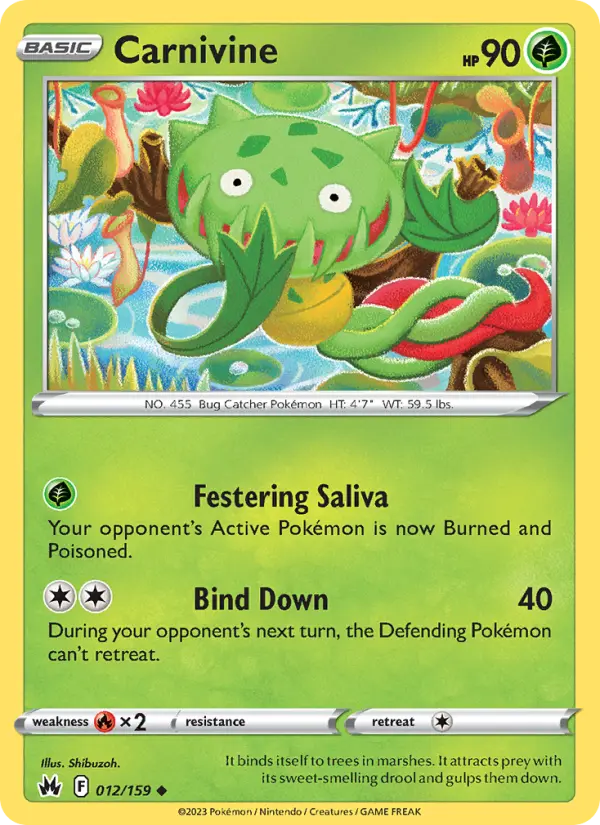
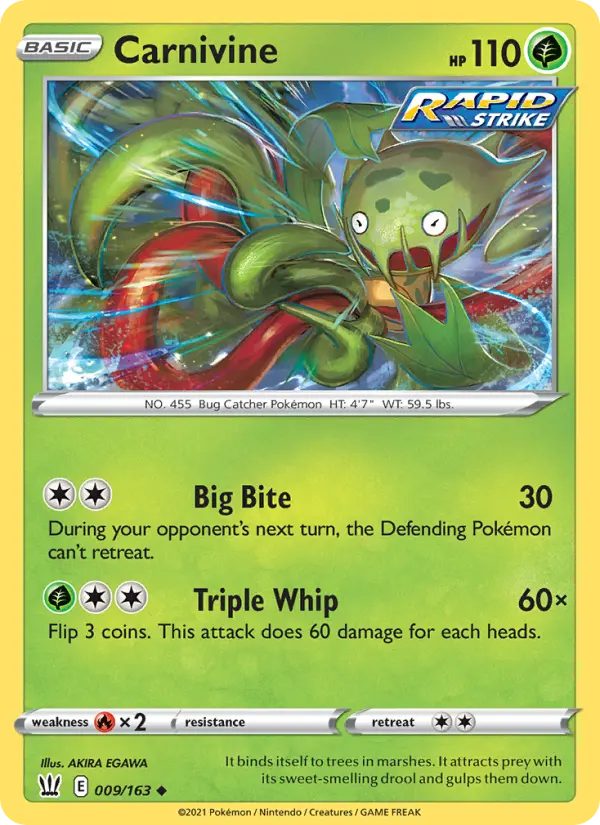
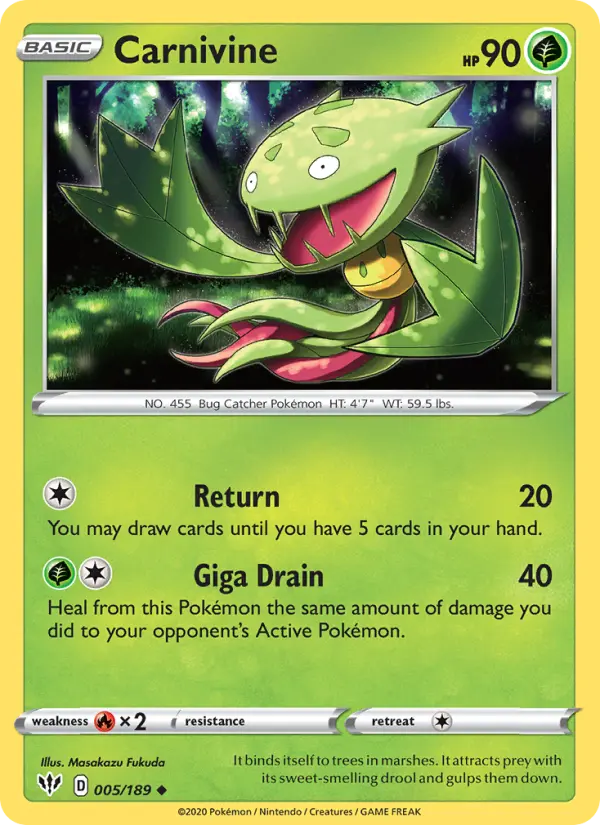
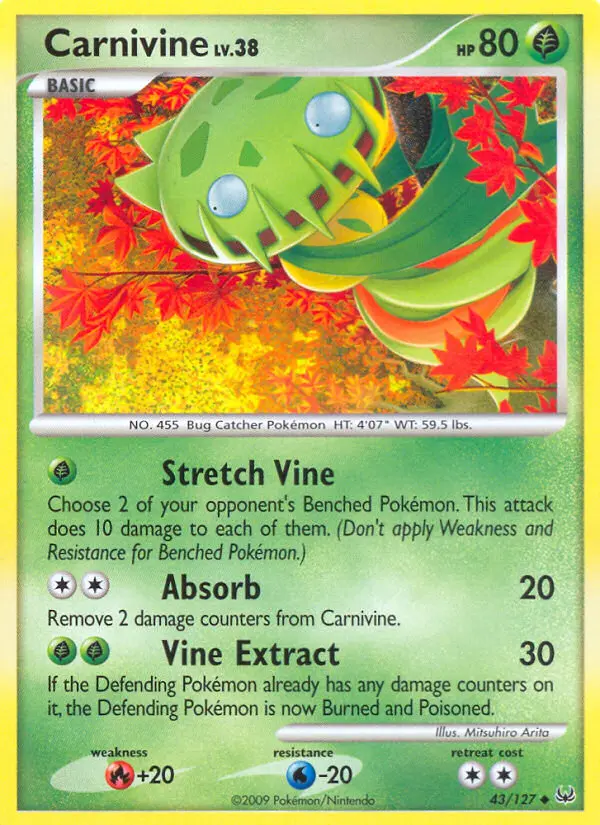
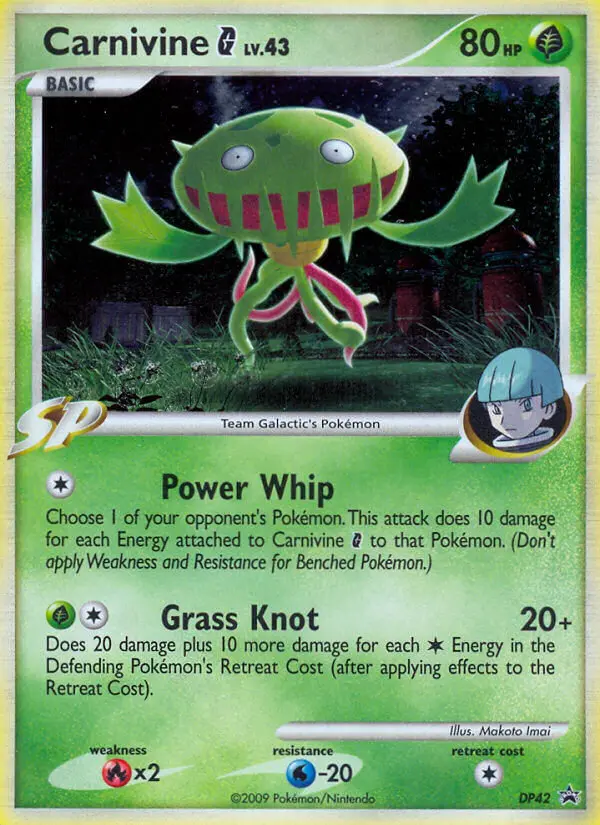
Carnivine achieved notable cultural significance within the Pokémon animated series through its major appearance as the signature Pokémon of James of Team Rocket, where it demonstrated both the comedic and endearing qualities that made it memorable to viewers. James's Carnivine was particularly known for its affectionate but chaotic behavior, often attacking James himself with overwhelming enthusiasm despite his status as its trainer—a dynamic that provided consistent comic relief throughout its appearances. The character development of James's Carnivine helped establish the species as more than merely a predatory plant monster, instead portraying it as a creature capable of forming genuine bonds with its trainers despite its inherently aggressive nature. Beyond anime appearances, Carnivine has maintained a steady presence in Pokémon trading card games and manga adaptations, appearing in multiple series including Pokémon Adventures and Pokémon Diamond and Pearl Adventure. The species represents an important design philosophy within Pokémon's broader worldbuilding—the concept of predatory creatures that operate within specific ecological niches while remaining capable of domestication and companionship with human trainers. Carnivine's unique niche as a carnivorous plant that stands alone without evolutionary relatives has made it a fan-favorite among players who appreciate unconventional Pokémon designs and appreciate its role as a complete, independent species.
Where to Find Carnivine in Every Pokémon Game
Carnivine was first made available to players in Generation IV, appearing in Pokémon Diamond, Pearl, and Platinum as a native species found in the Sinnoh region's marshes and wetlands, where it fit naturally into the regional ecosystem. In subsequent generations, availability expanded considerably, with Carnivine appearing in Pokémon HeartGold and SoulSilver before becoming accessible in Black 2 and White 2 within Unova. The species received widespread regional availability in Generation VI through Pokémon X and Y in the Mountain Kalos region, making it accessible to a broader audience of trainers. Pokémon Brilliant Diamond and Shining Pearl, the Generation IV remakes for Nintendo Switch, restored Carnivine to its original Sinnoh habitat while maintaining its traditional availability patterns. More recently, Carnivine appeared in Pokémon Legends: Arceus as a Sinnoh region Pokédex entry, continuing its presence in newer game releases. The Pokémon's capture rate of 200 makes it relatively easy to catch in the wild compared to many rarer species, though obtaining one requires navigating to appropriate marsh or forest habitats within games where it naturally spawns. For modern players seeking Carnivine, trading and breeding remain viable options, as the species's presence in multiple game generations and its representation in Pokémon Home ensures that acquiring one is achievable through various contemporary methods.