Carvanha
Generation III · #0318 — Savage Pokémon
Carvanha is a water/dark-type Pokémon whose hp — 50 at base — does more to define its role than its overall spread does. Standing 0.8 m tall and weighing 20.8 kg, it's built around a distinct combination of water traits that shapes how it performs both in the wild and in battle. With a National Pokédex number of #318, Carvanha sits between Swalot and Sharpedo in the evolutionary line, serving as the unevolved form that eventually matures into the formidable Sharpedo at level 30. Its cumulative stat total of 305 reflects its role as an early-game predator, with a particularly notable Attack stat of 90 paired with modest Speed and special stats that hint at its physical prowess in the water.
Editor's Take
Carvanha's Speed Boost is the reason Sharpedo works at all, and having 20 base Defense on both stages makes this the most committed glass cannon line in Gen 3.
Base Stats
Height
0.8m
Weight
20.8kg
Category
Savage Pokémon
Gender
Male 50% / Female 50%
Color
red
Shape
fish
Habitat
sea
Abilities
Damages attacking Pokémon for 1/8 their max HP on contact.
Raises Speed one stage after each turn.

Carvanha Biology & Physical Characteristics
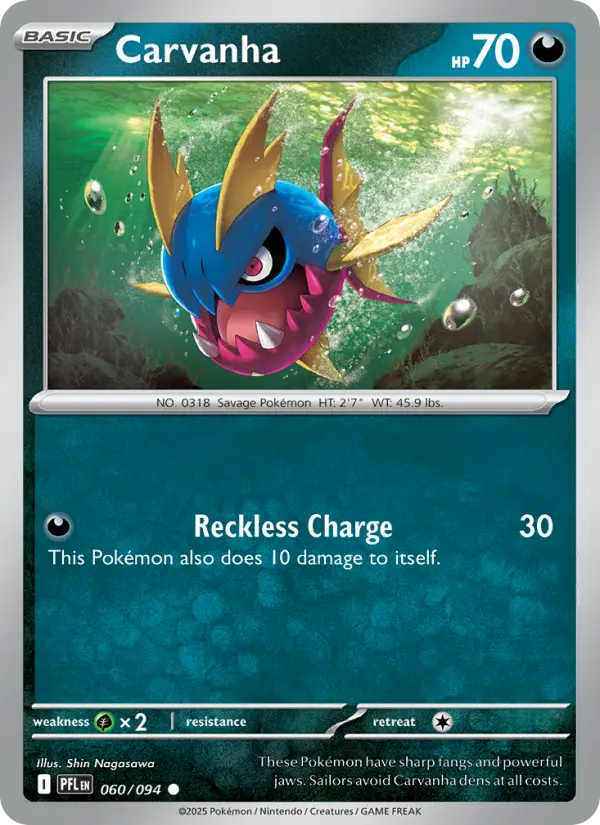
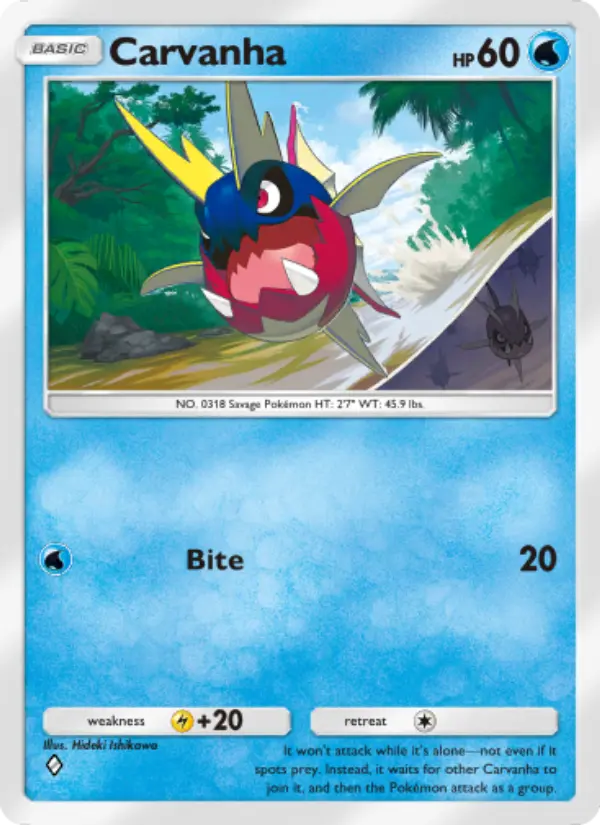
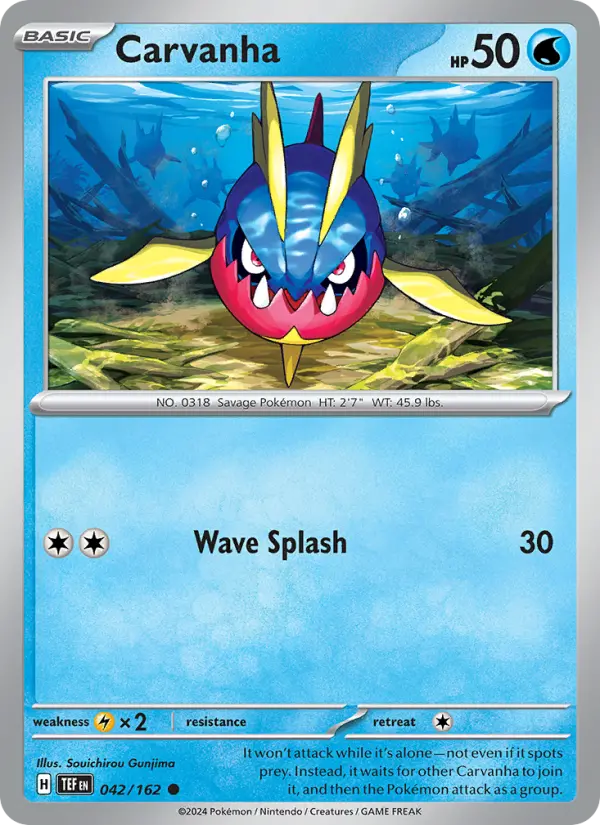
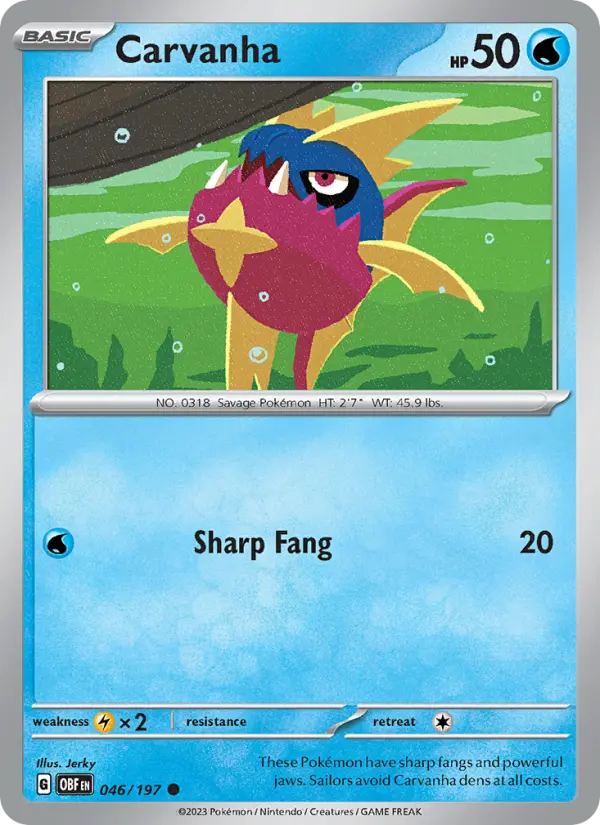
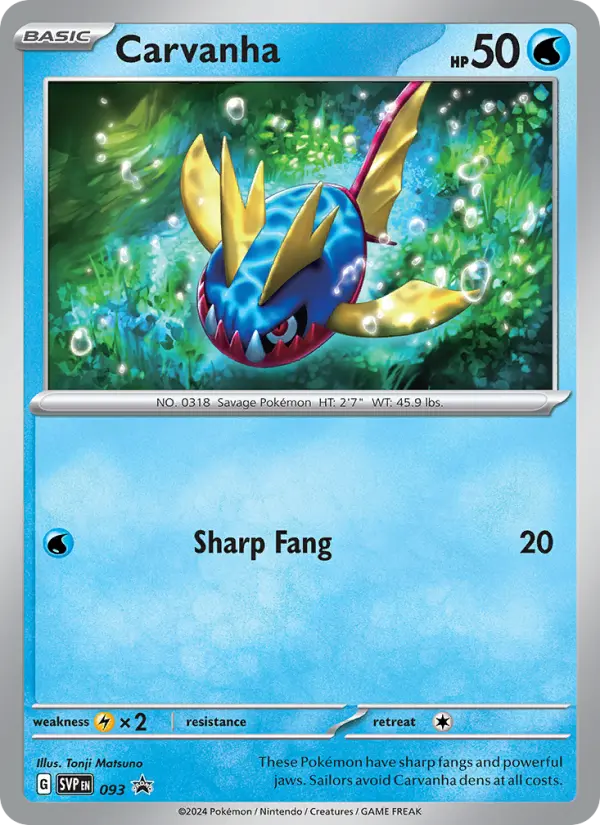
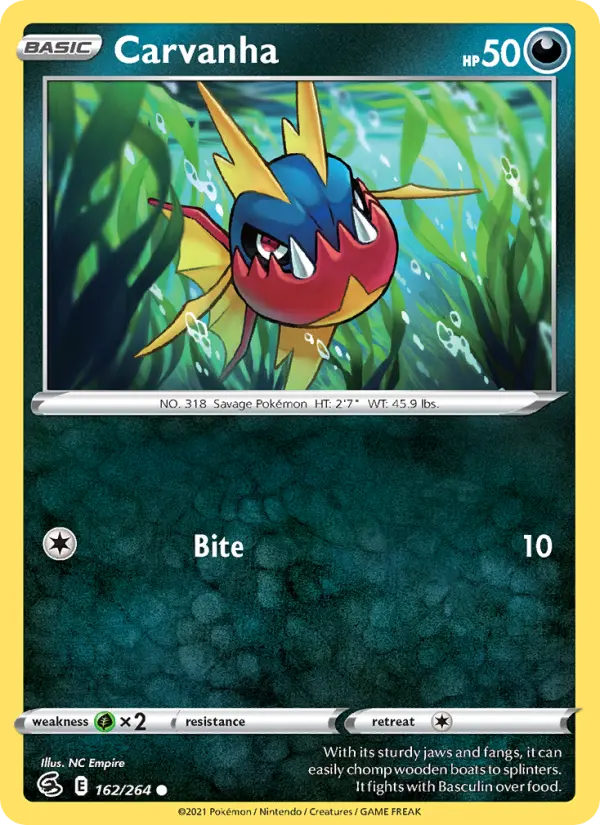
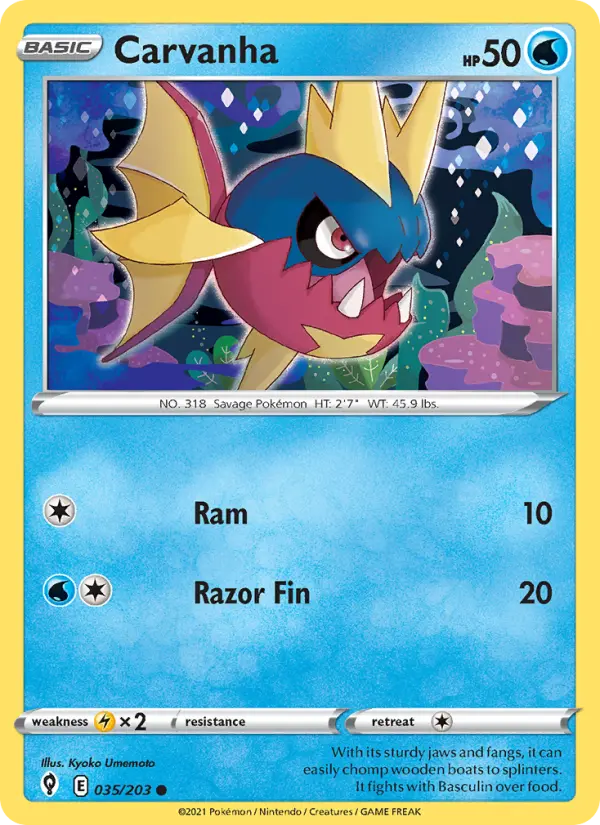
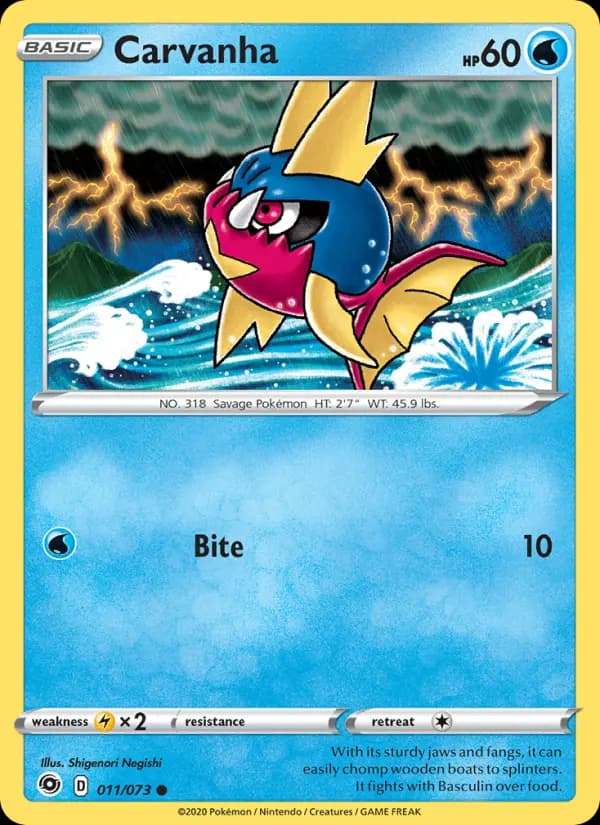
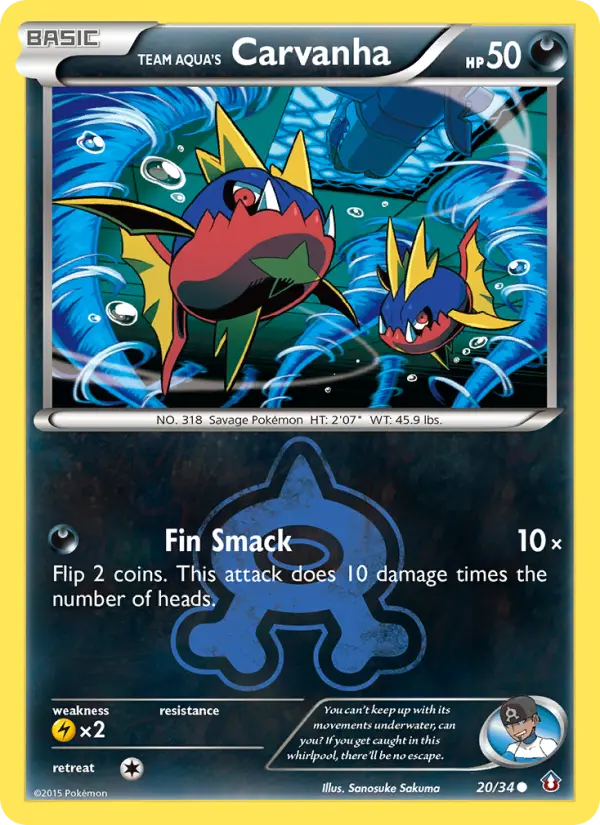
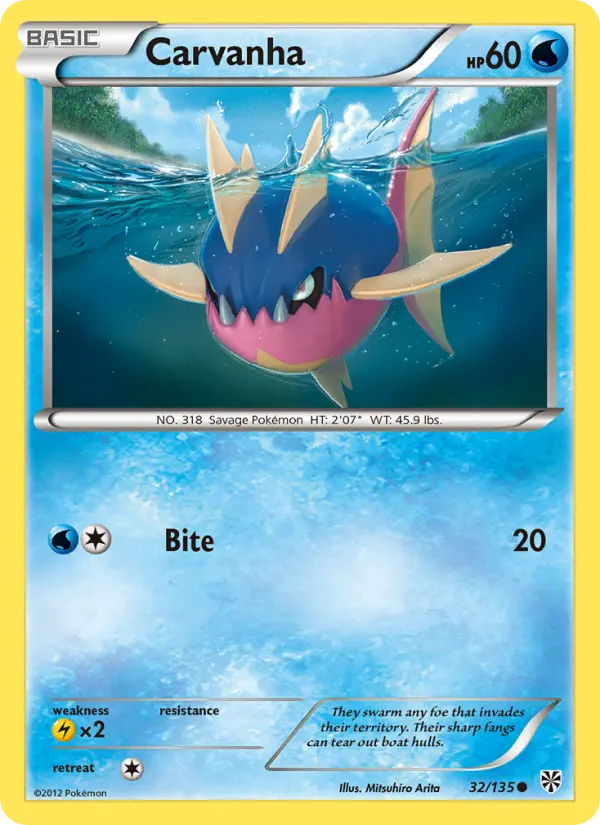
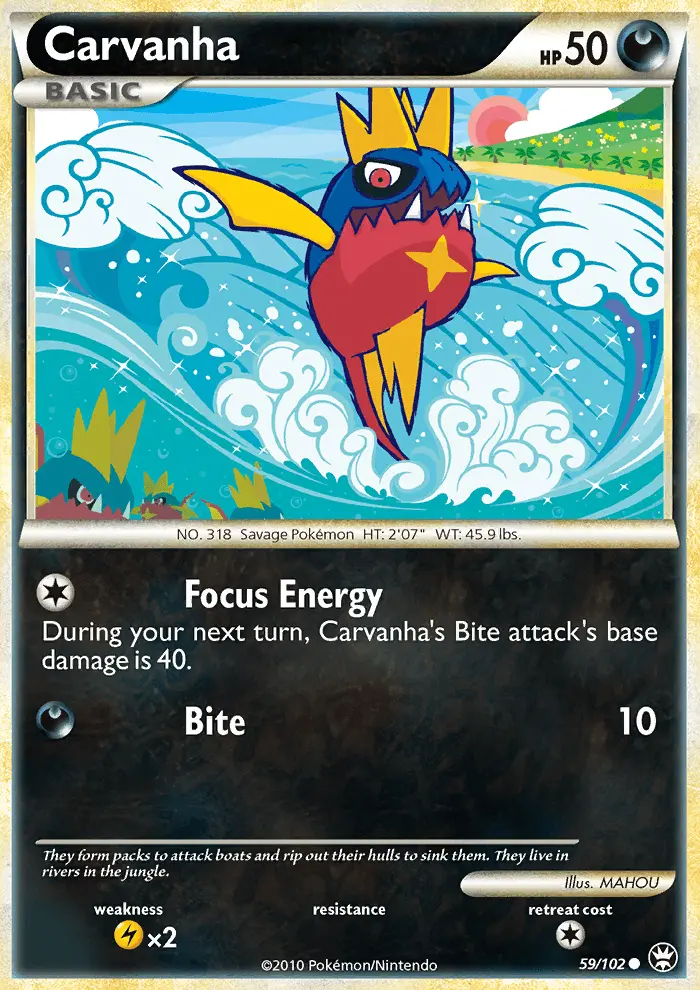
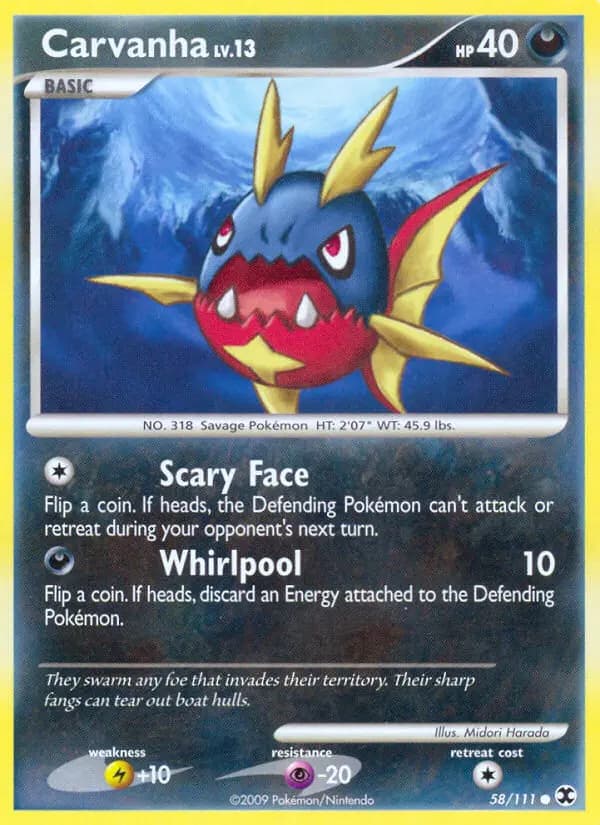
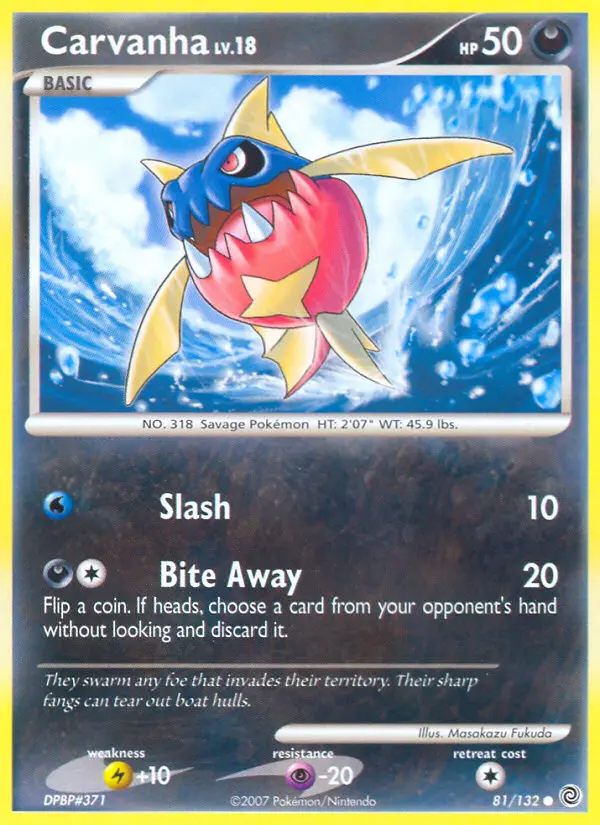
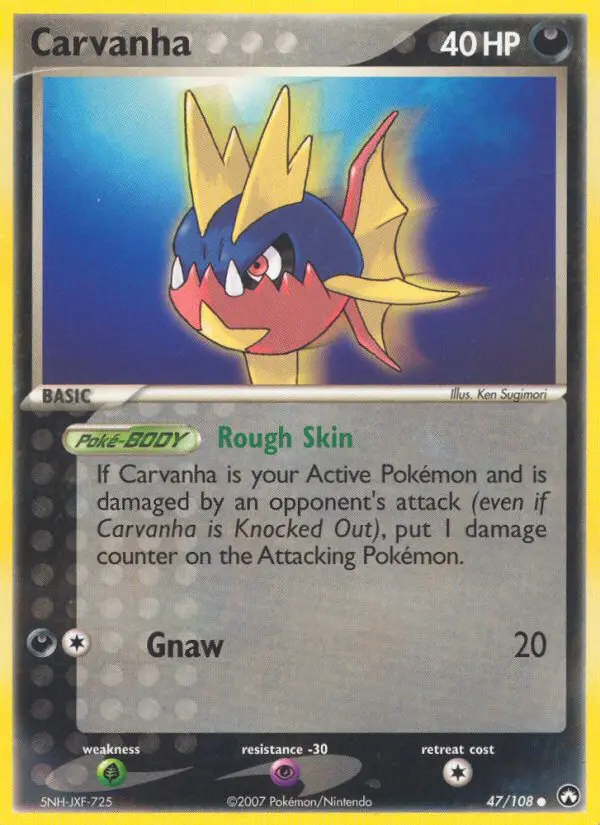
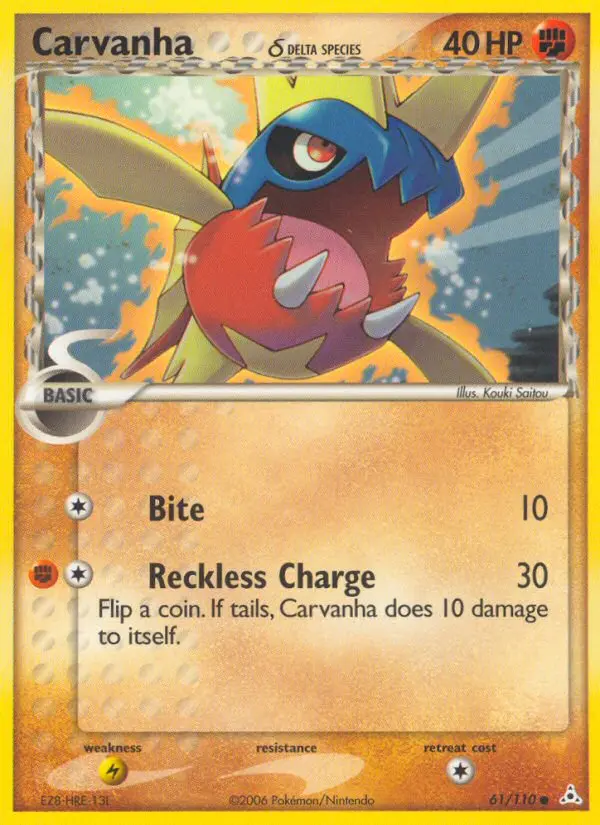
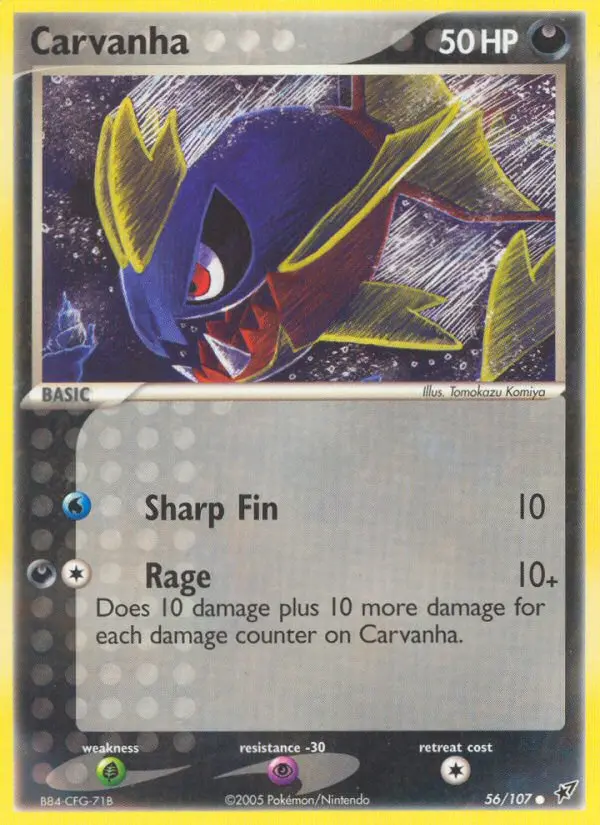
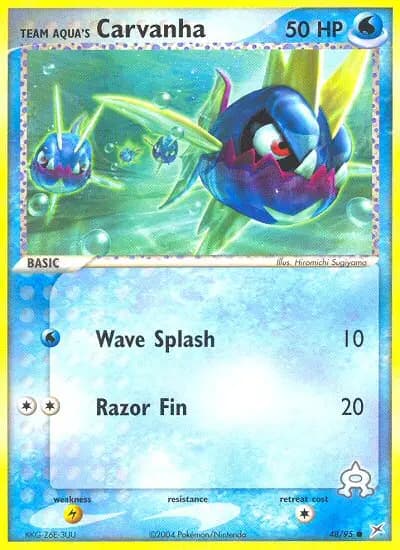
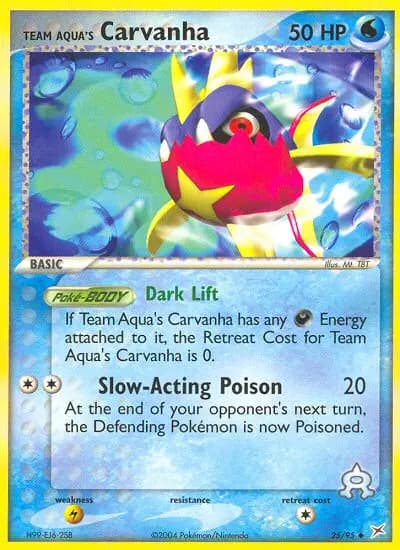
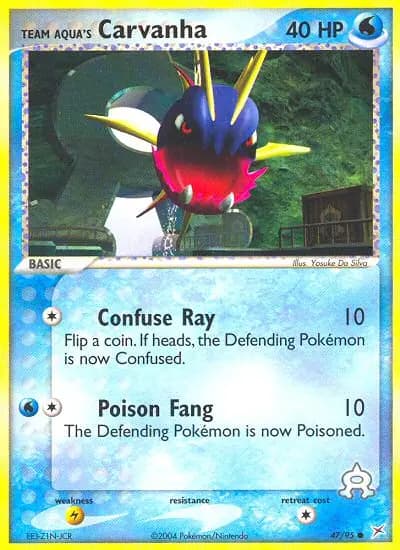
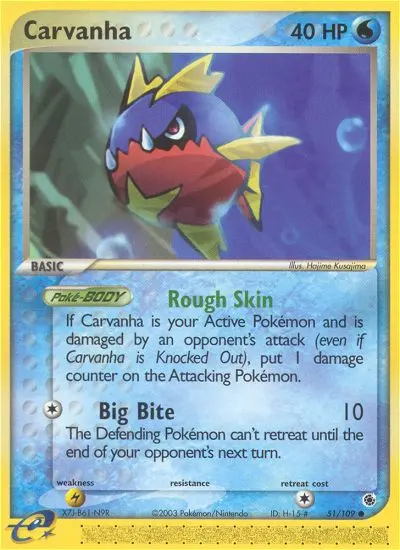
Carvanha is a fish Pokémon with a distinctly spherical body covered in microscopic, razor-sharp denticles that provide hydrodynamic advantages in aquatic environments. Its coloration is striking and purposeful: the upper hemisphere displays a vibrant blue coloration, while the lower half transitions to red, with a distinctive yellow four-pointed star marking positioned below its mouth. Its most intimidating features are undoubtedly its powerful jaws and exceptionally sharp fangs, which are capable of shearing through solid steel and ripping wooden boat hulls to splinters—a capability that has made Carvanha notorious among maritime communities. The Pokémon possesses two yellow dorsal fins positioned above its eyes that resemble shark fins, matching yellow pelvic fins on its belly, and yellow pectoral fins, while its caudal fin consists of two red spines connected by a thin yellow membrane. These anatomical features collectively demonstrate adaptation toward predatory hunting, with its biological design optimized for delivering devastating bite attacks.
Pokedex Numbers
Training
Breeding
Carvanha Breeding, Gender Ratio & Egg Groups
Carvanha splits evenly down the middle — 50% male, 50% female. The species belongs to the Water 2 egg group, classifying it within a breeding category primarily composed of aquatic and water-dwelling Pokémon. With a relatively slow growth rate, Carvanha develops gradually through experience and leveling, requiring consistent training and engagement to reach its evolutionary threshold. The species has a notably low base friendship value of 35, which is considerably below normal and reflects its naturally antisocial and timid disposition when alone. Carvanha has an egg hatch counter of 20 cycles, translating to approximately 4,884 to 5,140 steps required for an egg to hatch into a Carvanha. This moderate hatch time, combined with its presence in the Water 2 egg group, makes Carvanha reasonably accessible to breeders seeking to develop competitive specimens or maintain breeding populations for specific movesets and abilities.
Sprites


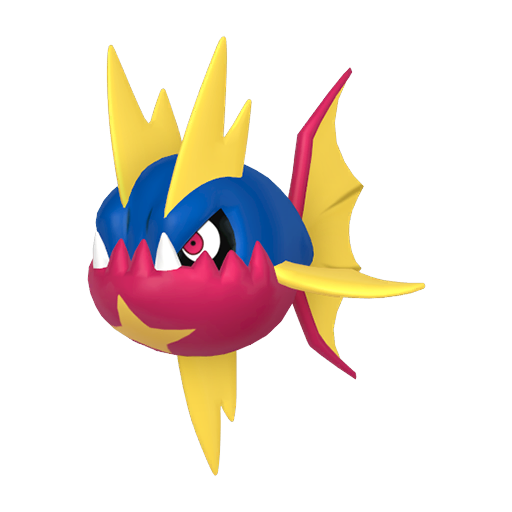
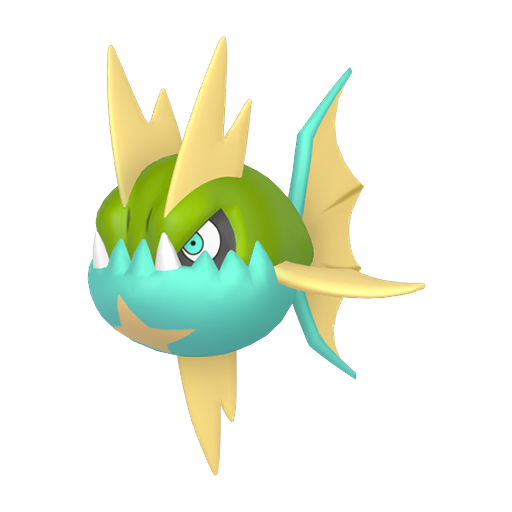


Held Items
Deep Sea Tooth
species-specific
Doubles Clamperl’s Special Attack. Traded on a Clamperl: Holder evolves into Huntail.
Cost: 2000
Deep Sea Tooth
species-specific
Doubles Clamperl’s Special Attack. Traded on a Clamperl: Holder evolves into Huntail.
Cost: 2000
Deep Sea Tooth
species-specific
Doubles Clamperl’s Special Attack. Traded on a Clamperl: Holder evolves into Huntail.
Cost: 2000
Deep Sea Tooth
species-specific
Doubles Clamperl’s Special Attack. Traded on a Clamperl: Holder evolves into Huntail.
Cost: 2000
Deep Sea Tooth
species-specific
Doubles Clamperl’s Special Attack. Traded on a Clamperl: Holder evolves into Huntail.
Cost: 2000
Deep Sea Tooth
species-specific
Doubles Clamperl’s Special Attack. Traded on a Clamperl: Holder evolves into Huntail.
Cost: 2000
Deep Sea Tooth
species-specific
Doubles Clamperl’s Special Attack. Traded on a Clamperl: Holder evolves into Huntail.
Cost: 2000
Deep Sea Tooth
species-specific
Doubles Clamperl’s Special Attack. Traded on a Clamperl: Holder evolves into Huntail.
Cost: 2000
Deep Sea Tooth
species-specific
Doubles Clamperl’s Special Attack. Traded on a Clamperl: Holder evolves into Huntail.
Cost: 2000
Deep Sea Tooth
species-specific
Doubles Clamperl’s Special Attack. Traded on a Clamperl: Holder evolves into Huntail.
Cost: 2000
Deep Sea Tooth
species-specific
Doubles Clamperl’s Special Attack. Traded on a Clamperl: Holder evolves into Huntail.
Cost: 2000
Deep Sea Tooth
species-specific
Doubles Clamperl’s Special Attack. Traded on a Clamperl: Holder evolves into Huntail.
Cost: 2000
Deep Sea Tooth
species-specific
Doubles Clamperl’s Special Attack. Traded on a Clamperl: Holder evolves into Huntail.
Cost: 2000
Deep Sea Tooth
species-specific
Doubles Clamperl’s Special Attack. Traded on a Clamperl: Holder evolves into Huntail.
Cost: 2000
Deep Sea Tooth
species-specific
Doubles Clamperl’s Special Attack. Traded on a Clamperl: Holder evolves into Huntail.
Cost: 2000
Deep Sea Tooth
species-specific
Doubles Clamperl’s Special Attack. Traded on a Clamperl: Holder evolves into Huntail.
Cost: 2000
Deep Sea Tooth
species-specific
Doubles Clamperl’s Special Attack. Traded on a Clamperl: Holder evolves into Huntail.
Cost: 2000
TMs & HMs
tm02
lets go pikachu lets go eevee
tm03
ruby sapphire
tm03
platinum
tm03
firered leafgreen
tm03
heartgold soulsilver
tm03
diamond pearl
tm03
emerald
tm03
xd
tm03
colosseum
tm05
lets go pikachu lets go eevee
tm06
yellow
tm06
gold silver
tm06
red blue
tm06
crystal
tm06
emerald
tm06
firered leafgreen
tm06
diamond pearl
tm06
platinum
tm06
ruby sapphire
tm06
colosseum
+549 more TMs/HMs
Carvanha's Evolution Chain


Carvanha Evolution, Mega Evolution & Special Forms
Carvanha evolves into Sharpedo upon reaching level 30, a transformation that marks a significant increase in power and refinement of its predatory abilities. The evolution represents not merely a growth in physical size but a fundamental shift in behavioral capability, as Sharpedo becomes a genuinely threatening apex predator rather than a cowardly schooling fish. While Carvanha retains its dual Water/Dark typing through evolution, Sharpedo gains substantially improved stats across the board, with particular enhancements to its Attack and Speed, transforming it into a genuine threat in competitive play. The evolutionary process also refines Carvanha's design into the sleeker, more aggressive form of Sharpedo, maintaining the color scheme while emphasizing predatory features. Unlike many Pokémon lines, neither Carvanha nor Sharpedo possess Mega Evolution capabilities, meaning Carvanha's evolution line represents a straightforward two-stage progression without branching forms or alternative developments.
Where to Find
Hoenn Route 118
hoenn
+12 more
Hoenn Route 119
hoenn
+15 more
Great Marsh
sinnoh
+45 more
Village Bridge
unova
+17 more
Kalos Route 22
kalos
Ancient Poni Path
alola
+1 more
Poni Breaker Coast
alola
+1 more
Carvanha Behaviour and Natural Habitat
Carvanha exhibits one of the most paradoxical behavioral patterns in the Pokémon world, as documented across numerous Pokédex entries. While individual Carvanha are notably timid and cowardly when solitary, they undergo a dramatic personality transformation when gathered in schools of five or more, becoming instantly ferocious and merciless hunters. This transformation is so pronounced that solitary Carvanha will flee from confrontation despite their fearsome reputation when in groups. They are strongly drawn to the scent of blood, which triggers aggressive swarming behavior and coordinated attacks against intruders or prey that venture into their territory. Each Carvanha school maintains its own distinct territory within massive jungle rivers and temperate aquatic regions, fiercely defending these areas against rivals. The species competes directly with Basculin for food resources, and their pack hunting strategy has made them infamous for attacking ships in coordinated swarms, ripping out hulls and causing vessels to sink—a threat serious enough that many sailors actively avoid areas populated by these Pokémon.
Pokedex Entries
CARVANHA’s strongly developed jaws and its sharply pointed fangs pack the destructive power to rip out boat hulls. Many boats have been attacked and sunk by this POKéMON.
If anything invades CARVANHA’s territory, it will swarm and tear at the intruder with its pointed fangs. On its own, however, this POKéMON turns suddenly timid.
CARVANHA attack ships in swarms, making them sink. Although it is said to be a very vicious POKéMON, it timidly flees as soon as it finds itself alone.
It lives in massive rivers that course through jungles. It swarms prey that enter its territory.
They swarm any foe that invades their territory. Their sharp fangs can tear out boat hulls.
They form packs to attack boats and rip out their hulls to sink them. They live in rivers in the jungle.
They swarm any foe that invades their territory. Their sharp fangs can tear out boat hulls.
They swarm any foe that invades their territory. Their sharp fangs can tear out boat hulls.
They form packs to attack boats and rip out their hulls to sink them. They live in rivers in the jungle.
It lives in massive rivers that course through jungles. It swarms prey that enter its territory.
Carvanha’s strongly developed jaws and its sharply pointed fangs pack the destructive power to rip out boat hulls. Many boats have been attacked and sunk by this Pokémon.
If anything invades Carvanha’s territory, it will swarm and tear at the intruder with its pointed fangs. On its own, however, this Pokémon turns suddenly timid.
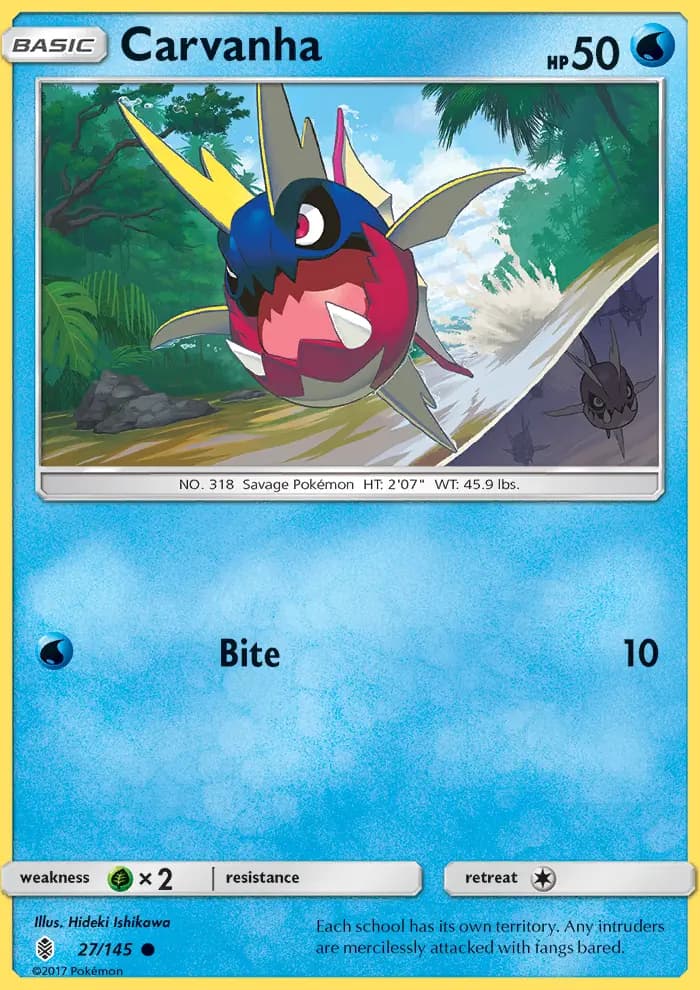
Each school has its own territory. Any intruders are mercilessly attacked with fangs bared.
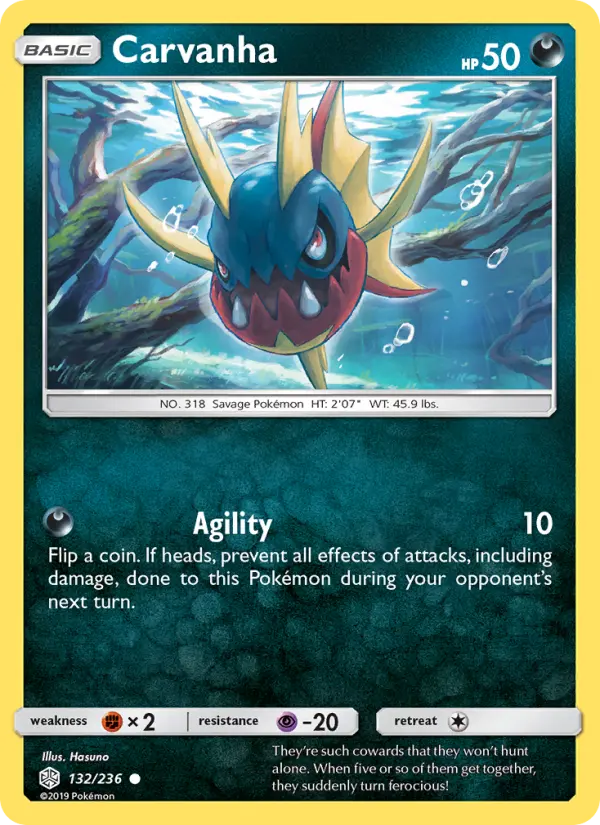
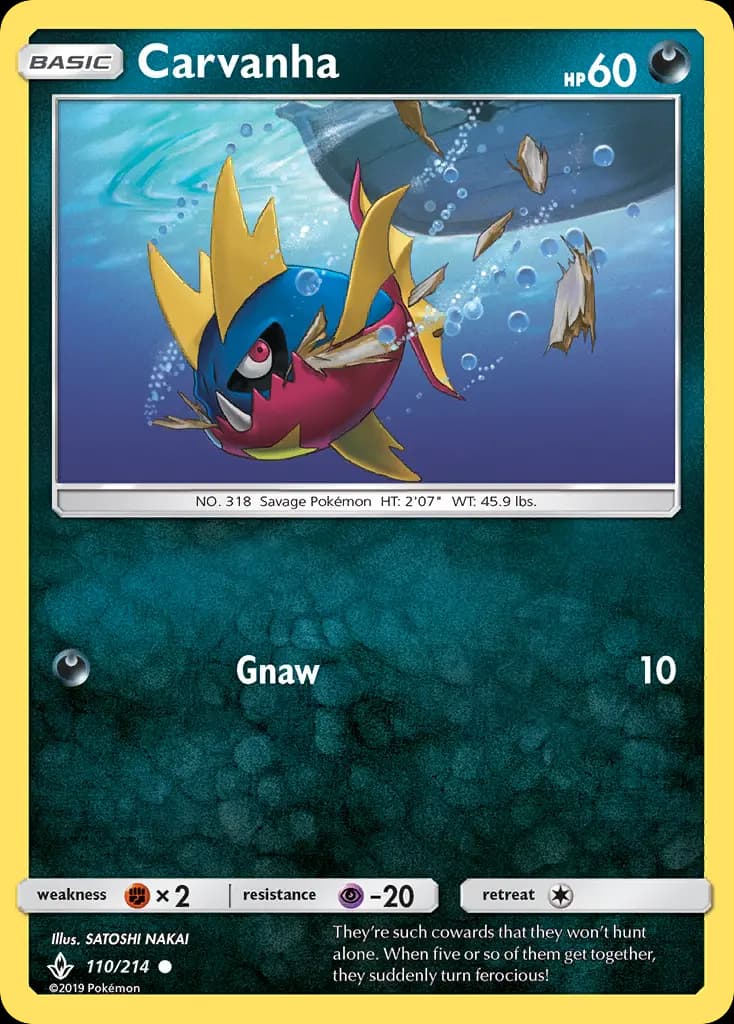
They’re such cowards that they won’t hunt alone. When five or so of them get together, they suddenly turn ferocious!
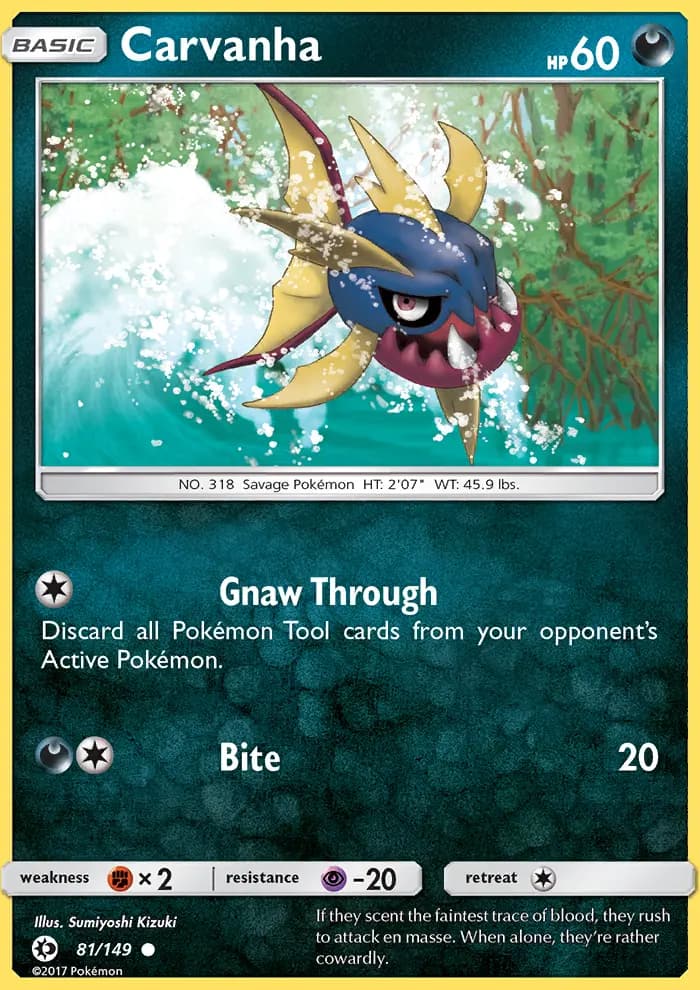
If they scent the faintest trace of blood, they rush to attack en masse. When alone, they’re rather cowardly.
With its sturdy jaws and fangs, it can easily chomp wooden boats to splinters. It fights with Basculin over food.
It won’t attack while it’s alone—not even if it spots prey. Instead, it waits for other Carvanha to join it, and then the Pokémon attack as a group.
These Pokémon have sharp fangs and powerful jaws. Sailors avoid Carvanha dens at all costs.
Carvanha Name Origin & Design Inspiration
The name Carvanha appears to derive from a combination of 'carve' and 'piranha,' directly referencing its destructive bite and pack hunting behavior reminiscent of real-world piranha fish. The Japanese name Kibania (キバニア) combines 'kiba' meaning 'fang' with 'ania,' creating a designation that emphasizes the Pokémon's most distinctive feature—its formidable dentition. The design itself draws heavy inspiration from piranhas and sharks, blending the aggressive schooling behavior of piranhas with the dorsal fin structure and predatory anatomy of sharks. The red and blue coloration may reference real piranha species while simultaneously evoking aquatic danger and predatory intent. The yellow markings, particularly the four-pointed star beneath its mouth, serve as distinctive visual markers that aid in species recognition while the spherical body shape differentiates it from typical fish Pokémon designs, giving it a more compact and aggressive silhouette that reinforces its role as a dangerous threat despite its modest size of 0.8 meters and weight of 20.8 kilograms.
Learnable Moves
Carvanha can learn 69 moves:
Move | Type | Cat. | Power | Acc. | PP |
|---|---|---|---|---|---|
| agility | psychic | Status | — | — | 30 |
| ancient power | rock | Special | 60 | 100 | 5 |
| aqua jet | water | Physical | 40 | 100 | 20 |
| assurance | dark | Physical | 60 | 100 | 10 |
| attract | normal | Status | — | 100 | 15 |
| bite | dark | Physical | 60 | 100 | 25 |
| blizzard | ice | Special | 110 | 70 | 5 |
| bounce | flying | Physical | 85 | 85 | 5 |
| brine | water | Special | 65 | 100 | 10 |
| captivate | normal | Status | — | 100 | 20 |
| confide | normal | Status | — | — | 20 |
| crunch | dark | Physical | 80 | 100 | 15 |
| dark pulse | dark | Special | 80 | 100 | 15 |
| destiny bond | ghost | Status | — | — | 5 |
| dive | water | Physical | 80 | 100 | 10 |
| double team | normal | Status | — | — | 15 |
| double edge | normal | Physical | 120 | 100 | 15 |
| endure | normal | Status | — | — | 10 |
| facade | normal | Physical | 70 | 100 | 20 |
| flip turn | water | Physical | 60 | 100 | 20 |
| focus energy | normal | Status | — | — | 30 |
| frustration | normal | Physical | — | 100 | 20 |
| fury cutter | bug | Physical | 40 | 95 | 20 |
| hail | ice | Status | — | — | 10 |
| hidden power | normal | Special | 60 | 100 | 15 |
| hydro pump | water | Special | 110 | 80 | 5 |
| ice beam | ice | Special | 90 | 100 | 10 |
| ice fang | ice | Physical | 65 | 95 | 15 |
| icy wind | ice | Special | 55 | 95 | 15 |
| leer | normal | Status | — | 100 | 30 |
| liquidation | water | Physical | 85 | 100 | 10 |
| mimic | normal | Status | — | — | 10 |
| mud slap | ground | Special | 20 | 100 | 10 |
| natural gift | normal | Physical | — | 100 | 15 |
| payback | dark | Physical | 50 | 100 | 10 |
| poison fang | poison | Physical | 50 | 100 | 15 |
| protect | normal | Status | — | — | 10 |
| psychic fangs | psychic | Physical | 85 | 100 | 10 |
| rage | normal | Physical | 20 | 100 | 20 |
| rain dance | water | Status | — | — | 5 |
| rest | psychic | Status | — | — | 5 |
| retaliate | normal | Physical | 70 | 100 | 5 |
| return | normal | Physical | — | 100 | 20 |
| round | normal | Special | 60 | 100 | 15 |
| scald | water | Special | 80 | 100 | 15 |
| scale shot | dragon | Physical | 25 | 90 | 20 |
| scary face | normal | Status | — | 100 | 10 |
| screech | normal | Status | — | 85 | 40 |
| secret power | normal | Physical | 70 | 100 | 20 |
| sleep talk | normal | Status | — | — | 10 |
| snarl | dark | Special | 55 | 95 | 15 |
| snore | normal | Special | 50 | 100 | 15 |
| spite | ghost | Status | — | 100 | 10 |
| substitute | normal | Status | — | — | 10 |
| super fang | normal | Physical | — | 90 | 10 |
| surf | water | Special | 90 | 100 | 15 |
| swagger | normal | Status | — | 85 | 15 |
| swift | normal | Special | 60 | — | 20 |
| take down | normal | Physical | 90 | 85 | 20 |
| taunt | dark | Status | — | 100 | 20 |
| thief | dark | Physical | 60 | 100 | 25 |
| thrash | normal | Physical | 120 | 100 | 10 |
| torment | dark | Status | — | 100 | 15 |
| toxic | poison | Status | — | 90 | 10 |
| uproar | normal | Special | 90 | 100 | 10 |
| water pulse | water | Special | 60 | 100 | 20 |
| waterfall | water | Physical | 80 | 100 | 15 |
| whirlpool | water | Special | 35 | 85 | 15 |
| zen headbutt | psychic | Physical | 80 | 90 | 15 |
Carvanha Competitive Battle Guide
Carvanha's competitive viability is severely limited by its modest cumulative stat total of 305, which places it firmly in the early-game category despite its respectable Attack stat of 90. Its defensive statistics are particularly problematic, with Defense and Special Defense both sitting at a pitiful 20, making Carvanha extremely fragile and incapable of withstanding sustained offensive pressure from nearly any opponent. However, Carvanha's two available abilities offer distinct strategic pathways: Rough Skin functions as a hazard-like ability that damages attacking opponents for one-eighth of their maximum HP upon contact, potentially discouraging physical attackers and providing passive damage output. Its hidden ability, Speed Boost, grants Carvanha a Speed increase of one stage after each turn in battle, potentially allowing it to outpace opponents that would normally outspeed it if given sufficient turns. The Speed Boost combination with Carvanha's Speed stat of 65 could theoretically enable prolonged battles where Carvanha gains increasing speed advantage, though the fragility issue remains insurmountable in competitive formats. Most competitive players transitioning from Carvanha opt immediately for Sharpedo upon reaching level 30, as Sharpedo's dramatically improved stats and abilities make it substantially more threatening.
Commonly Asked Questions About Carvanha
What type is Carvanha?
Carvanha is a water and dark type Pokemon.
What does Carvanha evolve into?
Carvanha evolves into sharpedo.
What are Carvanha's weaknesses?
Carvanha is weak to fighting, bug, grass, electric and fairy type moves.
Does Carvanha evolve by trading?
No — Carvanha evolves entirely through leveling up, with no trade required at any stage.
Where can I find Carvanha?
Carvanha can be found in hoenn route 118 (hoenn), hoenn route 119 (hoenn) and great marsh (sinnoh) and 4 other locations.
Carvanha Cultural Impact & Franchise History
Carvanha has maintained a consistent presence throughout the Pokémon franchise since its introduction in Generation III, appearing in numerous main series anime episodes and serving as a notable encounter for players exploring aquatic routes. The Pokémon's paradoxical nature—fearsome in groups yet cowardly individually—has made it a memorable representative of Water/Dark types and contributed to the broader mythology surrounding predatory Pokémon species. Its design as a fish-eating threat to maritime commerce resonates with human cultural fears surrounding dangerous aquatic predators, making Carvanha an effective symbol of nature's unpredictability and the dangers lurking beneath water surfaces. The species has appeared across multiple regional Pokédexes including Hoenn, Kalos, Alola, and others, demonstrating its relevance across different generations of games. Carvanha's evolution into the more formidable Sharpedo further establishes it as a foundational example of growth and transformation within the Pokémon universe, where initial weakness transforms into genuine power through development and maturation.
Where to Find Carvanha in Every Pokémon Game
Carvanha's availability varies significantly across different Pokémon games and regions, reflecting its classification as a water-dwelling species tied to specific aquatic environments. In the original Ruby and Sapphire versions, Carvanha appears as a common encounter in various water routes throughout the Hoenn region, bearing local Pokédex number #0097. The species reappears in later generations with different availability patterns: in X and Y it receives Kalos Pokédex number #0055 (Central Kalos), in Omega Ruby and Alpha Sapphire it holds number #0102, and in Sun and Moon it receives Alola Pokédex number #0264, with Ultra Sun and Ultra Moon positioning it at #0345. More recent games including Legends: Arceus and The Isle of Armor DLC continue to feature Carvanha availability, maintaining its presence across multiple gaming platforms. The species' capture rate of 225 makes it considerably easier to catch than many Pokémon, reducing the likelihood of escape during capture attempts. Its relatively generous base experience yield of 61 (in Generation V onwards) and presence in the Water 2 egg group make Carvanha accessible for players seeking to breed competitive specimens or maintain diverse water-type teams throughout their journey.