Cherubi
Generation IV · #0420 — Cherry Pokémon
Cherubi measures in at 0.4 m and 3.3 kg, a build that matches its chlorophyll ability better than it matches raw offense or defense. Standing 0.4 m tall and weighing 3.3 kg, it's built around a distinct combination of grass traits that shapes how it performs both in the wild and in battle. With a combined stat total of only 275 and modest individual stats distributed across its attributes, Cherubi exemplifies the characteristics of an early-game Pokémon designed for accessibility rather than immediate competitive viability. However, its potential evolution into the far more capable Cherrim at level 25 makes it a valuable stepping stone for trainers building their teams. The species' signature trait lies in its distinctive dual-body structure: a main cherry-like body paired with a nutrient-rich secondary sphere that plays a crucial role in its lifecycle and eventual transformation.
Editor's Take
Cherubi's line ends in Cherrim, whose Flower Gift boosts the whole team's Attack in sun — a doubles ability printed in a generation that barely played doubles.
Base Stats
Height
0.4m
Weight
3.3kg
Category
Cherry Pokémon
Gender
Male 50% / Female 50%
Color
pink
Shape
heads
Abilities
Doubles Speed during strong sunlight.
Cherubi Biology & Physical Characteristics
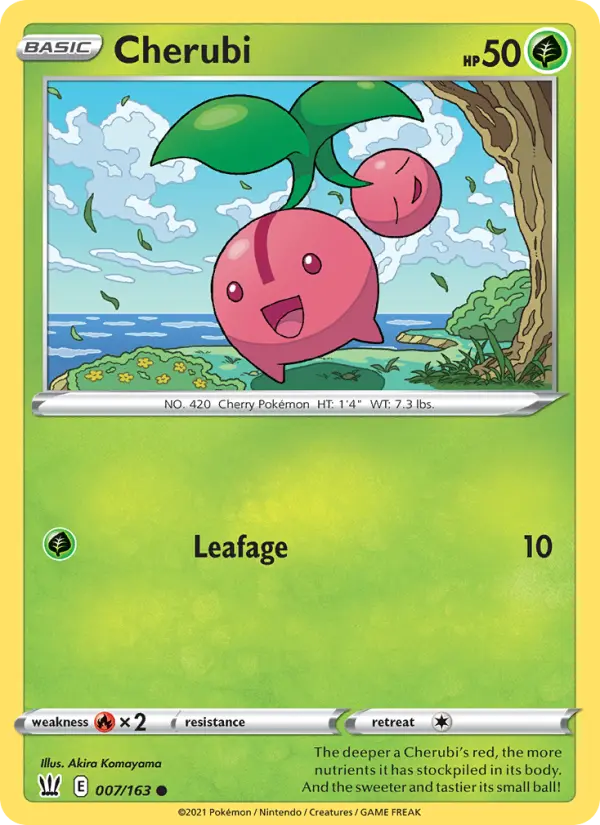
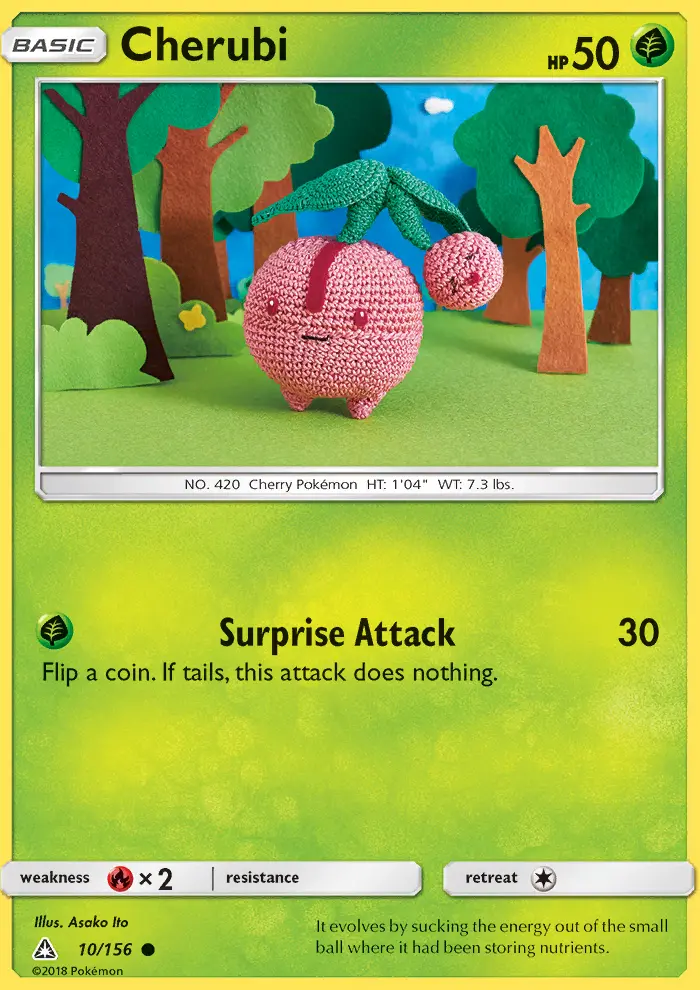
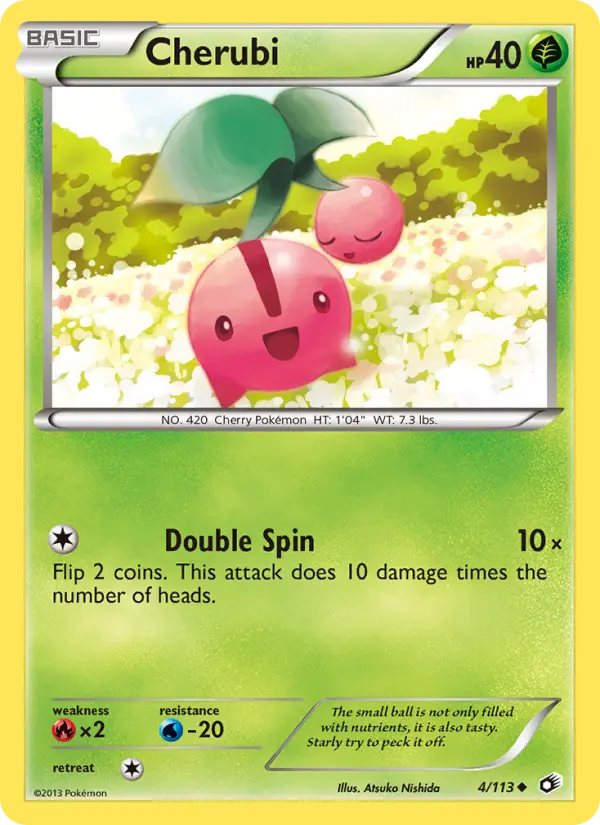
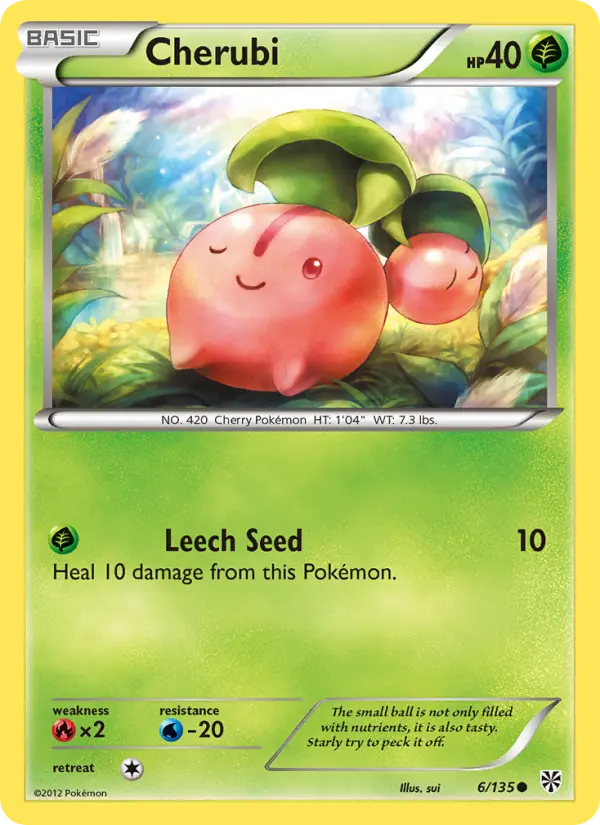
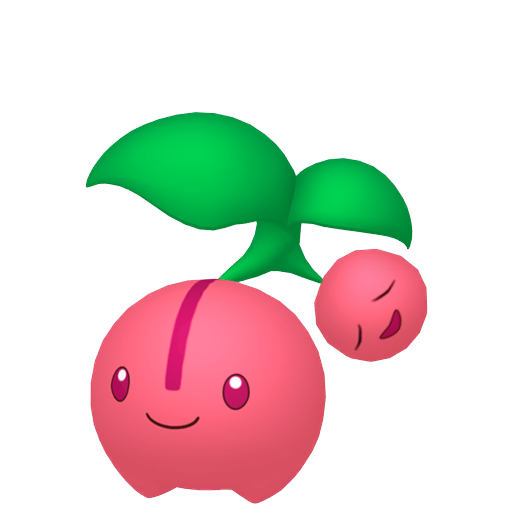
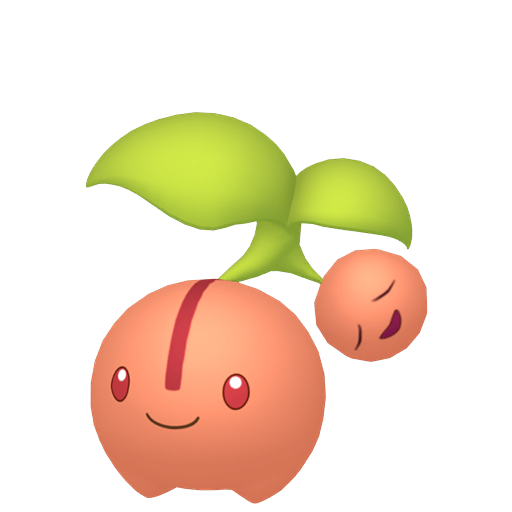
Cherubi presents a distinctive morphology centered around its iconic dual-body design. The primary body consists of a small, round, deep-pink form supported by two stubby feet, with beady eyes and a characteristic purple-red stripe running across its face. Protruding from the main body is a short, green stem bearing two prominent leaves, from which extends a second, much smaller spherical head that serves as both a vestigial structure and a vital nutrient reservoir. This secondary orb, despite being functionally vestigial, contains the essential nutrients required for Cherubi's growth and evolution, functioning as its initial food source. The Pokédex reveals that sunlight plays a critical role in Cherubi's physiology: exposure to strong sunlight causes the body to deepen in red coloration, visibly indicating the accumulation of stored nutrients and energy. As Cherubi approaches evolution, the secondary nutrient ball begins to wilt and shrivel, signaling the onset of transformation into Cherrim. The nutrient-rich secondary head proves so appetizing that various Pokémon, particularly Starly, actively seek to pluck it from Cherubi's body, making the preservation of this crucial structure a matter of survival for the species.
Pokedex Numbers
Training
Breeding
Cherubi Breeding, Gender Ratio & Egg Groups
Cherubi exhibits a balanced gender ratio of 50% male and 50% female, making it equally accessible to trainers regardless of their breeding objectives or team composition preferences. The species belongs to both the Fairy and Grass egg groups, a dual classification that grants considerable flexibility in breeding combinations and allows Cherubi to participate in a diverse range of cross-generational breeding chains. This dual egg group membership means that Cherubi can breed with Pokémon from either group, significantly expanding the potential movepool and genetic traits available to offspring through strategic breeding selection. With a base friendship value of 70 and a medium growth rate, Cherubi represents a moderately approachable Pokémon for trainers interested in breeding projects, offering neither exceptional ease nor extreme difficulty in cultivation. The species' relatively rapid hatching cycle of 20 egg cycles (approximately 4,884 to 5,140 steps) ensures that breeding Cherubi is not an excessively time-consuming endeavor, making it accessible to casual breeders. The generous gender distribution and dual egg group classification have made Cherubi a valuable breeding resource throughout the generations, particularly for trainers seeking to establish efficient breeding chains or introduce specific movesets to their Pokémon collections through egg moves derived from compatible breeding partners.
Sprites




Held Items
Miracle Seed
type-enhancement
Held: Grass-Type moves from holder do 20% more damage.
Cost: 1000
Miracle Seed
type-enhancement
Held: Grass-Type moves from holder do 20% more damage.
Cost: 1000
Miracle Seed
type-enhancement
Held: Grass-Type moves from holder do 20% more damage.
Cost: 1000
Miracle Seed
type-enhancement
Held: Grass-Type moves from holder do 20% more damage.
Cost: 1000
Miracle Seed
type-enhancement
Held: Grass-Type moves from holder do 20% more damage.
Cost: 1000
Miracle Seed
type-enhancement
Held: Grass-Type moves from holder do 20% more damage.
Cost: 1000
Miracle Seed
type-enhancement
Held: Grass-Type moves from holder do 20% more damage.
Cost: 1000
Miracle Seed
type-enhancement
Held: Grass-Type moves from holder do 20% more damage.
Cost: 1000
Miracle Seed
type-enhancement
Held: Grass-Type moves from holder do 20% more damage.
Cost: 1000
Miracle Seed
type-enhancement
Held: Grass-Type moves from holder do 20% more damage.
Cost: 1000
Miracle Seed
type-enhancement
Held: Grass-Type moves from holder do 20% more damage.
Cost: 1000
Miracle Seed
type-enhancement
Held: Grass-Type moves from holder do 20% more damage.
Cost: 1000
Miracle Seed
type-enhancement
Held: Grass-Type moves from holder do 20% more damage.
Cost: 1000
Miracle Seed
type-enhancement
Held: Grass-Type moves from holder do 20% more damage.
Cost: 1000
Miracle Seed
type-enhancement
Held: Grass-Type moves from holder do 20% more damage.
Cost: 1000
Miracle Seed
type-enhancement
Held: Grass-Type moves from holder do 20% more damage.
Cost: 1000
Miracle Seed
type-enhancement
Held: Grass-Type moves from holder do 20% more damage.
Cost: 1000
TMs & HMs
tm03
yellow
tm03
red blue
tm03
lets go pikachu lets go eevee
tm03
blue japan
tm04
gold silver
tm03
red green japan
tm04
crystal
tm05
lets go pikachu lets go eevee
tm06
yellow
tm06
gold silver
tm06
red blue
tm06
crystal
tm06
emerald
tm06
firered leafgreen
tm06
diamond pearl
tm06
platinum
tm06
ruby sapphire
tm06
colosseum
tm06
black 2 white 2
tm06
xd
+416 more TMs/HMs


Cherubi Evolution, Mega Evolution & Special Forms
Cherubi undergoes a straightforward evolution into Cherrim upon reaching level 25, a relatively early threshold that allows trainers to obtain its final form with minimal grinding. This evolution represents a dramatic transformation in both appearance and capability, as Cherrim develops into a more robust, flower-like Pokémon with significantly enhanced base stats. The evolution process itself is intrinsically tied to Cherubi's biology: as the secondary nutrient sphere becomes fully depleted and shrivels during the transformation, Cherubi absorbs all remaining energy from this structure to fuel its evolution. Once the transformation is complete, the detached nutrient ball becomes sustenance for other creatures in the ecosystem, completing a natural cycle of energy redistribution. This evolutionary progression does not represent a mere cosmetic change but rather a fundamental shift in the Pokémon's ecological role, as it transitions from a vulnerable prey species with limited combat capabilities to a more independent organism with enhanced special attack prowess, increasing from a base of 62 to Cherrim's superior stats. The level-based evolution mechanism makes Cherubi accessible to players at virtually any stage of their journey through Sinnoh, ensuring its relevance as a team member throughout the early and mid-game portions of their adventure.
Where to Find
Location data not available for this Pokémon in the database.
Cherubi Behaviour and Natural Habitat
Cherubi exhibits behavior patterns closely tied to its reliance on sunlight and its need to protect its vulnerable nutrient storage system. The species is notably attracted to honey, suggesting a foraging behavior that complements its plant-based nature. Due to the high desirability of its nutrient-rich secondary ball, Cherubi has evolved defensive behaviors to avoid predation, nimbly dashing about to evade bird Pokémon such as Starly that would eagerly consume this sweetly-flavored appendage. The species thrives in environments with abundant sunlight, as this directly correlates with nutrient accumulation and the deepening of its coloration. In terms of habitat preferences, Cherubi gravitates toward areas conducive to plant growth, fitting naturally into the grass-type Pokémon ecosystem. The depth of a Cherubi's red coloration serves as a visual indicator of its health and nutritional status, with particularly vibrant red specimens possessing both sweeter secondary balls and more abundant nutrient reserves. During the approach to evolution, Cherubi's behavior likely becomes more cautious and withdrawn, as the withering of its nutrient sphere signals both vulnerability and impending transformation.
Pokedex Entries
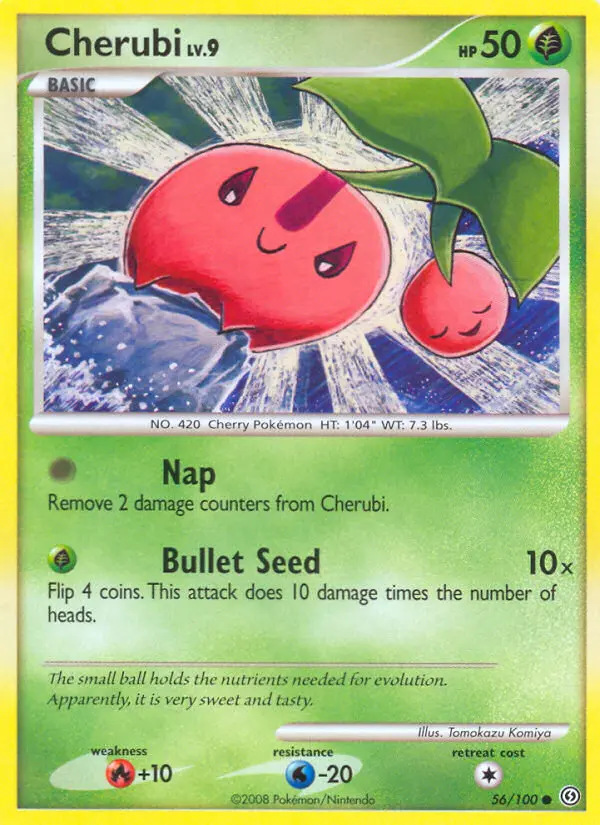
The small ball holds the nutrients needed for evolution. Apparently, it is very sweet and tasty.
Sunlight colors it red. When the small ball is drained of nutrients, it shrivels to herald evolution.
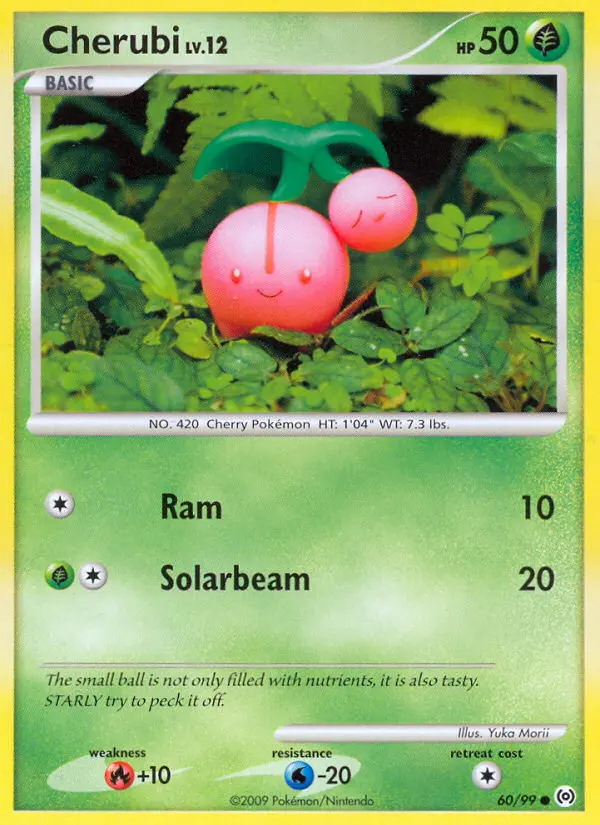
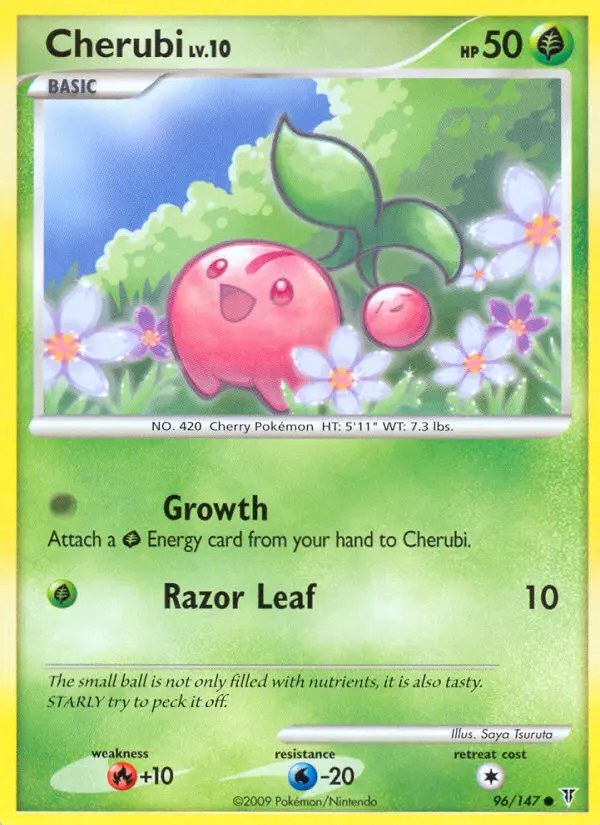
The small ball is not only filled with nutrients, it is also tasty. STARLY try to peck it off.
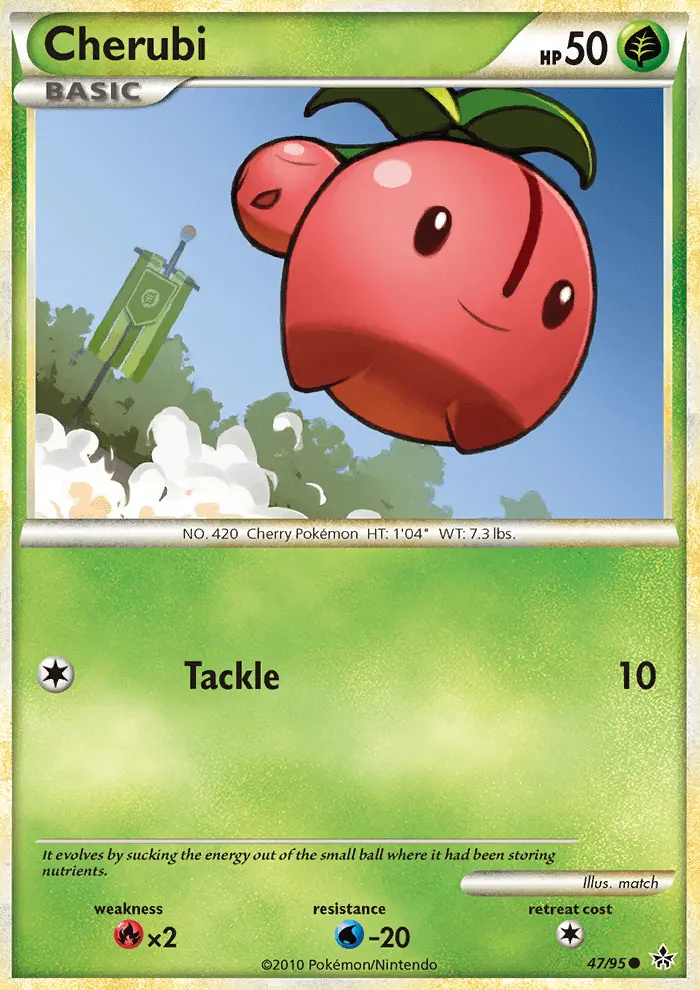
It evolves by sucking the energy out of the small ball where it had been storing nutrients.
The small ball is not only filled with nutrients, it is also tasty. Starly try to peck it off.
The small ball is not only filled with nutrients, it is also tasty. Starly try to peck it off.
Sunlight colors it red. When the small ball is drained of nutrients, it shrivels to herald evolution.
It evolves by sucking the energy out of the small ball where it had been storing nutrients.
Sunlight colors it red. When the small ball is drained of nutrients, it shrivels to herald evolution.
It evolves by sucking the energy out of the small ball where it had been storing nutrients.
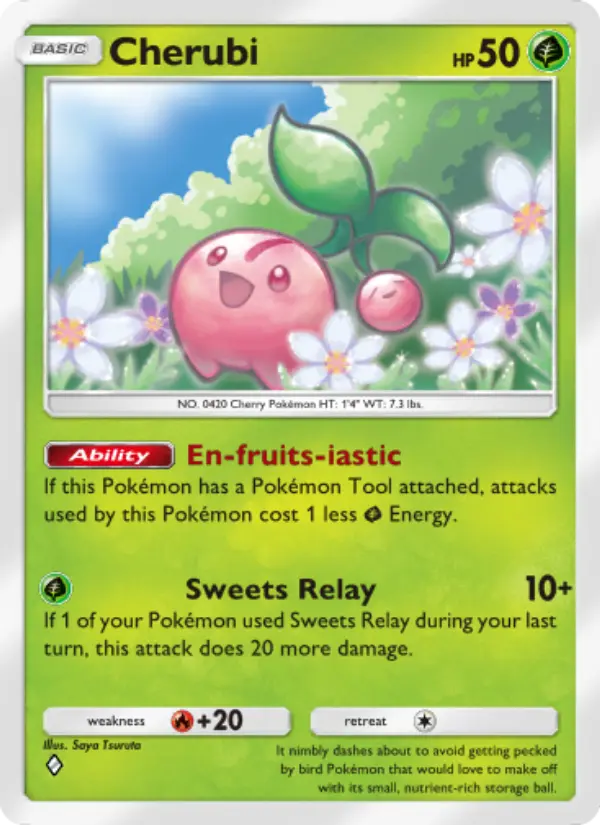
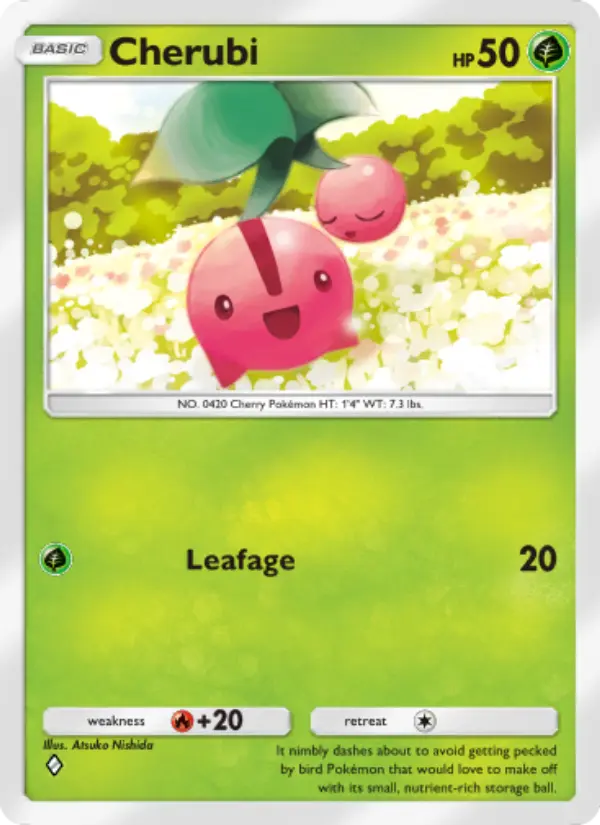
It nimbly dashes about to avoid getting pecked by bird Pokémon that would love to make off with its small, nutrient-rich storage ball.
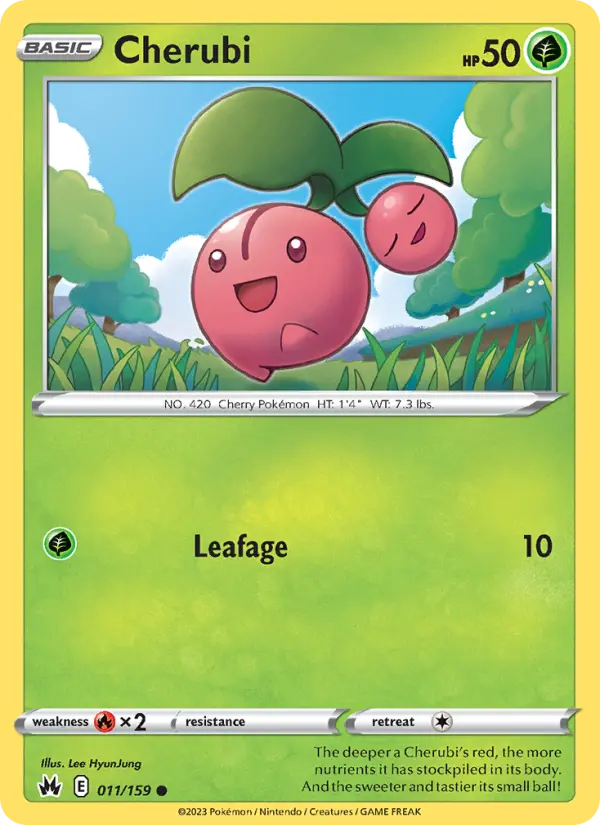
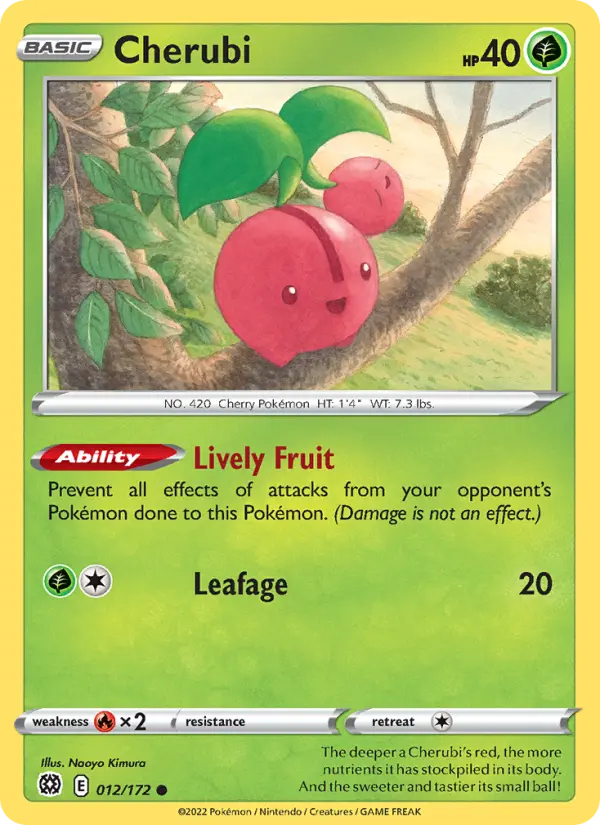
The deeper a Cherubi’s red, the more nutrients it has stockpiled in its body. And the sweeter and tastier its small ball!
Once the fruit growing alongside the main body is large and plump, Cherubi will use the nutrients within to evolve. The fruit then detaches, becoming nourishment for other creatures.
Cherubi Name Origin & Design Inspiration
The name Cherubi derives directly from the combination of 'cherry' and what appears to be a diminutive suffix, reflecting the Pokémon's small, cherry-like primary body and its designation as the Cherry Pokémon. The Japanese name, Cherinbo (チェリンボ), similarly combines 'cherry' (cherry) with phonetic elements that suggest youth and cuteness, emphasizing its role as an unevolved, juvenile Pokémon. The visual design brilliantly encapsulates the botanical concept of fruit production and nutrient storage, with the dual-body structure mirroring real-world fruits that develop with accessory structures. The deep pink coloration evokes cherry fruit, while the secondary nutrient sphere represents an exaggerated, stylized version of the seed or pit within a cherry, recontextualized as an external, edible appendage rather than an internal structure. The inclusion of the green stem and leaves creates a complete plant aesthetic, emphasizing Cherubi's pure botanical nature and distinguishing it from other fruit-themed Pokémon through its integrated, visible plant components. The purple-red facial stripe adds character and personality to what might otherwise be a simplistic design, while the stubby feet ground the floating orb appearance with physical substance and stability. This thoughtful design synthesis ensures that Cherubi remains immediately recognizable while communicating its fundamental role in the evolutionary line and ecosystem.
Learnable Moves
Cherubi can learn 63 moves:
Move | Type | Cat. | Power | Acc. | PP |
|---|---|---|---|---|---|
| absorb | grass | Special | 20 | 100 | 25 |
| aromatherapy | grass | Status | — | — | 5 |
| attract | normal | Status | — | 100 | 15 |
| bullet seed | grass | Physical | 25 | 100 | 30 |
| captivate | normal | Status | — | 100 | 20 |
| confide | normal | Status | — | — | 20 |
| dazzling gleam | fairy | Special | 80 | 100 | 10 |
| defense curl | normal | Status | — | — | 40 |
| double team | normal | Status | — | — | 15 |
| double edge | normal | Physical | 120 | 100 | 15 |
| draining kiss | fairy | Special | 50 | 100 | 10 |
| endure | normal | Status | — | — | 10 |
| energy ball | grass | Special | 90 | 100 | 10 |
| facade | normal | Physical | 70 | 100 | 20 |
| flash | normal | Status | — | 100 | 20 |
| flower shield | fairy | Status | — | — | 10 |
| frustration | normal | Physical | — | 100 | 20 |
| giga drain | grass | Special | 75 | 100 | 10 |
| grass knot | grass | Special | — | 100 | 20 |
| grass whistle | grass | Status | — | 55 | 15 |
| grassy glide | grass | Physical | 55 | 100 | 20 |
| grassy terrain | grass | Status | — | — | 10 |
| growth | normal | Status | — | — | 20 |
| heal pulse | psychic | Status | — | — | 10 |
| healing wish | psychic | Status | — | — | 10 |
| helping hand | normal | Status | — | — | 20 |
| hidden power | normal | Special | 60 | 100 | 15 |
| leafage | grass | Physical | 40 | 100 | 40 |
| leech seed | grass | Status | — | 90 | 10 |
| lucky chant | normal | Status | — | — | 30 |
| magical leaf | grass | Special | 60 | — | 20 |
| morning sun | normal | Status | — | — | 5 |
| natural gift | normal | Physical | — | 100 | 15 |
| nature power | normal | Status | — | — | 20 |
| petal blizzard | grass | Physical | 90 | 100 | 15 |
| petal dance | grass | Special | 120 | 100 | 10 |
| pollen puff | bug | Special | 90 | 100 | 15 |
| protect | normal | Status | — | — | 10 |
| razor leaf | grass | Physical | 55 | 95 | 25 |
| rest | psychic | Status | — | — | 5 |
| return | normal | Physical | — | 100 | 20 |
| rollout | rock | Physical | 30 | 90 | 20 |
| round | normal | Special | 60 | 100 | 15 |
| safeguard | normal | Status | — | — | 25 |
| secret power | normal | Physical | 70 | 100 | 20 |
| seed bomb | grass | Physical | 80 | 100 | 15 |
| sleep powder | grass | Status | — | 75 | 15 |
| sleep talk | normal | Status | — | — | 10 |
| snore | normal | Special | 50 | 100 | 15 |
| solar beam | grass | Special | 120 | 100 | 10 |
| stun spore | grass | Status | — | 75 | 30 |
| substitute | normal | Status | — | — | 10 |
| sunny day | fire | Status | — | — | 5 |
| swagger | normal | Status | — | 85 | 15 |
| sweet scent | normal | Status | — | 100 | 20 |
| swords dance | normal | Status | — | — | 20 |
| synthesis | grass | Status | — | — | 5 |
| tackle | normal | Physical | 40 | 100 | 35 |
| take down | normal | Physical | 90 | 85 | 20 |
| tickle | normal | Status | — | 100 | 20 |
| toxic | poison | Status | — | 90 | 10 |
| weather ball | normal | Special | 50 | 100 | 10 |
| worry seed | grass | Status | — | 100 | 10 |
Cherubi Competitive Battle Guide
Cherubi's competitive viability is severely limited by its modest combined stat total of 275, with particularly weak offensive and speed statistics that render it impractical for serious competitive play even in formats designated for lower-tier Pokémon. Its attack and speed both stand at only 35, making physical offense and outspeed potential virtually nonexistent, while its highest stat is special attack at 62, which remains insufficient for meaningful special attacking pressure. The Chlorophyll ability, which doubles speed during harsh sunlight, provides a theoretical avenue for speed enhancement, but the base 35 speed stat merely becomes a mediocre 70 with this boost, still falling short of competitively relevant thresholds. In competitive contexts, trainers would universally favor the evolved Cherrim, which provides substantially superior stats and greater strategic flexibility, making Cherubi's inclusion in competitive teams an intentional handicap rather than a deliberate strategic choice. The species' primary role within competitive frameworks exists solely as a stage on the path to Cherrim evolution, useful only for players engaging in intentional self-imposed challenge formats or novelty team compositions. Outside of these niche contexts, Cherubi's limited movepool, weak stats, and overall combat potential ensure it remains relegated to early-game and casual play, where its charming design and modest power requirements align appropriately with low-level encounter expectations.
Commonly Asked Questions About Cherubi
What type is Cherubi?
Cherubi is a grass type Pokemon.
What does Cherubi evolve into?
Cherubi evolves into cherrim.
What are Cherubi's weaknesses?
Cherubi is weak to flying, poison, bug, fire and ice type moves.
Does Cherubi evolve by trading?
No — Cherubi evolves entirely through leveling up, with no trade required at any stage.
Cherubi Cultural Impact & Franchise History
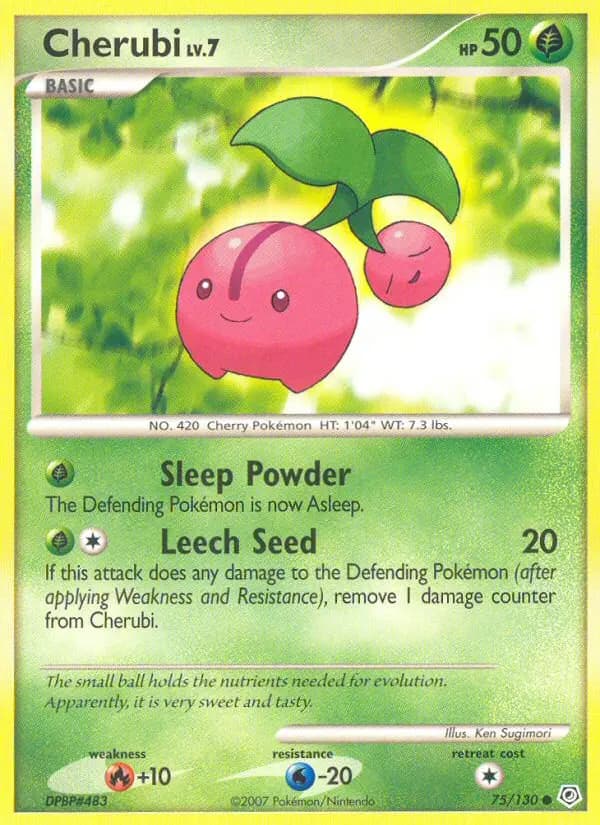
Cherubi has established itself as an iconic early-generation Pokémon within the Sinnoh region's cultural consciousness, appearing prominently in the Diamond and Pearl animated series as memorable encounters for the protagonist Ash Ketchum and his traveling companions. The species' distinctive dual-body design and nutrient-sphere appendage have made it instantly recognizable across Pokémon media, contributing to its role as a symbol of the Generation IV's introduction of new, botanically-inspired creatures to the franchise. In the anime, Cherubi encounters often emphasize the vulnerability of its nutrient storage system and the predatory interest other Pokémon display toward this sweet appendage, creating narrative tension that highlights the species' precarious ecological position. The Pokémon Trading Card Game has featured Cherubi in numerous sets, cementing its place in the collectible community and ensuring its accessibility to players building casual and thematic decks centered on Grass-type strategies. The species' appearance in Pokémon Ranger: The Comic – Shadows of Almia and Pokémon Adventures manga adaptations has further expanded its cultural footprint, introducing the species to audiences across multiple media platforms. Its status as a regional Pokédex entry in multiple Sinnoh remakes (Brilliant Diamond and Shining Pearl) ensures continued prominence for players experiencing the region in contemporary formats, maintaining Cherubi's relevance to both nostalgic and new audiences.
Where to Find Cherubi in Every Pokémon Game
Cherubi was introduced in Generation IV and has maintained consistent availability across virtually all mainline Pokémon games released since its debut, making it one of the more accessible Grass-type Pokémon in the franchise. Within the Sinnoh region specifically, Cherubi appears as Pokédex entry #058 in Diamond, Pearl, and Platinum versions, with encounters available in grassy areas throughout the region's early stages, facilitating its acquisition for new teams. The species retains its Sinnoh availability in the remakes Brilliant Diamond and Shining Pearl, maintaining its position as an early-game Pokémon accessible through standard wild encounters and trainer battles. In subsequent generations, Cherubi has appeared sporadically but consistently across the National Pokédex entries in later titles, with locations varying depending on the specific game and regional Pokédex implementation. The species boasts a respectable capture rate of 190, making it substantially easier to catch than many Grass-type Pokémon and enabling trainers to obtain Cherubi with standard Poké Balls even in early encounters. Outside of mainline games, Cherubi has appeared in Pokémon GO and various spin-off titles, ensuring its accessibility to players across multiple gaming platforms and formats. The availability of Cherubi through breeding and egg distribution means that trainers can consistently obtain the species across generations, making it one of the most reliably accessible Grass-type options for team building and competitive preparation.