Corsola
Generation II · #0222 — Coral Pokémon
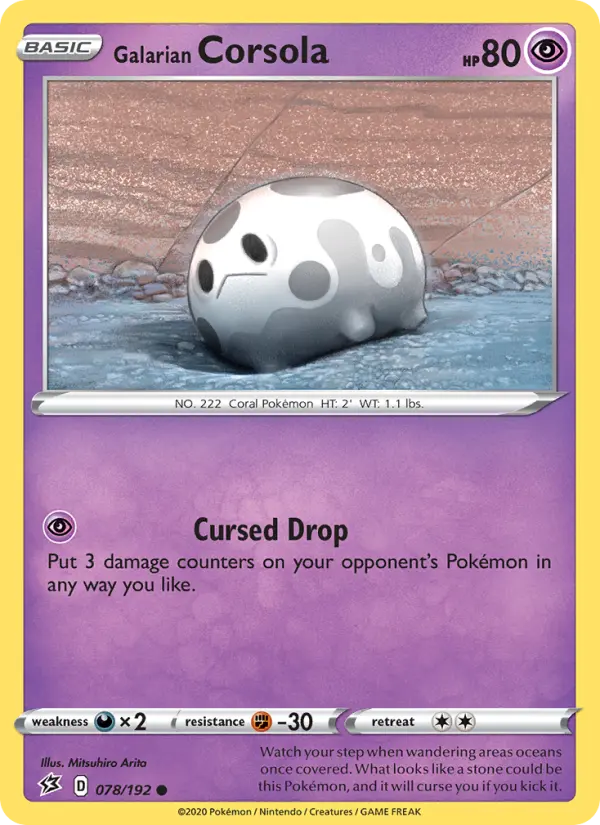
As a Generation II water/rock-type, Corsola leans on hustle to cover what its raw numbers don't, particularly on the defense side. Standing 0.6 m tall and weighing 5.0 kg, it's built around a distinct combination of water traits that shapes how it performs both in the wild and in battle. Its relatively low catch rate of 60 and fast growth rate make it an accessible yet meaningful addition to many trainers' teams. The species gained additional prominence with the introduction of its Galarian form in Pokémon Sword and Shield, which takes on a Ghost-type classification and tells a haunting tale of ecological collapse. Corsola's design philosophy emphasizes natural beauty and environmental awareness, making it more than just a battling companion—it serves as a gentle reminder of the fragility of our planet's coral ecosystems.
Editor's Take
Corsola was a fragile Water/Rock curiosity for seven generations, and Galarian Corsola evolving into Cursola with Perish Body is one of the darkest and best regional variant ideas.
Base Stats
Height
0.6m
Weight
5.0kg
Category
Coral Pokémon
Gender
Male 25% / Female 75%
Color
pink
Shape
armor
Habitat
sea
Abilities
Strengthens physical moves to inflict 1.5× damage, but decreases their accuracy to 0.8×.
Cures any major status ailment upon switching out.
Heals for 1/3 max HP upon switching out.
Corsola Biology & Physical Characteristics
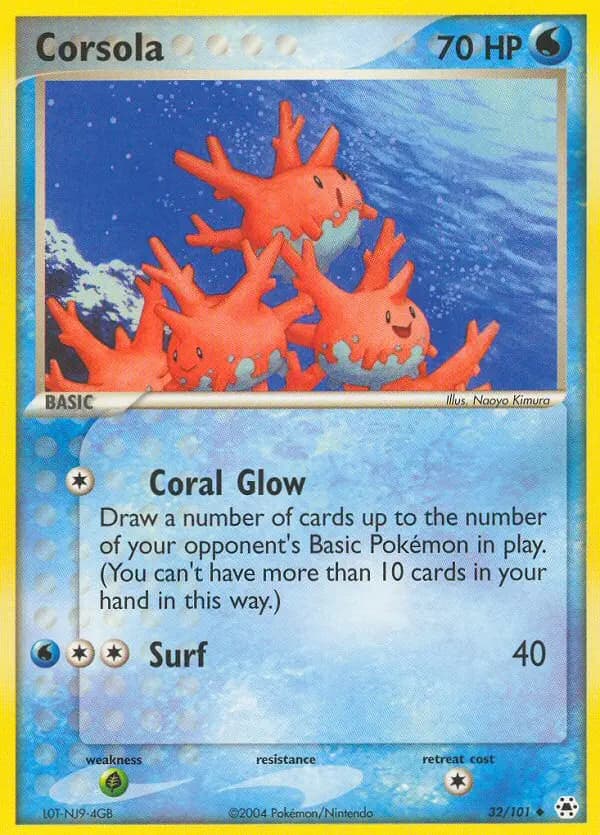
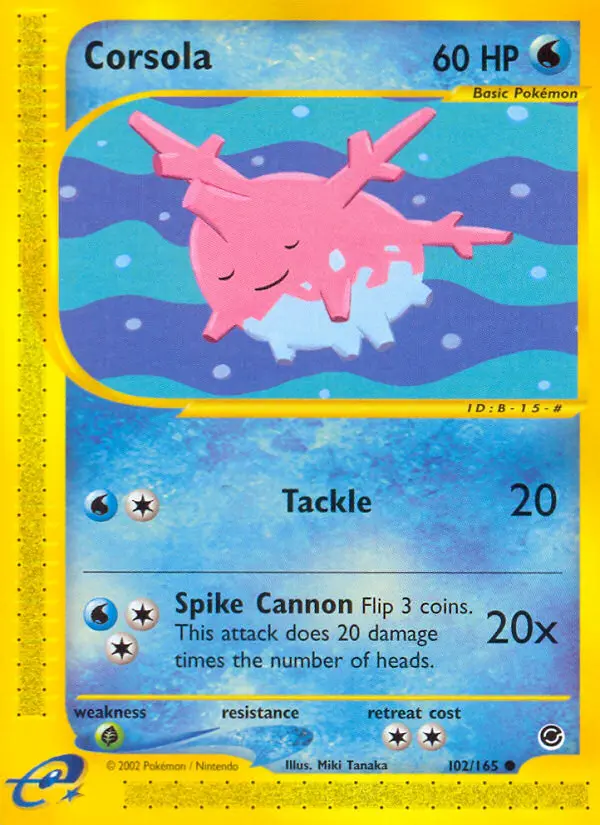
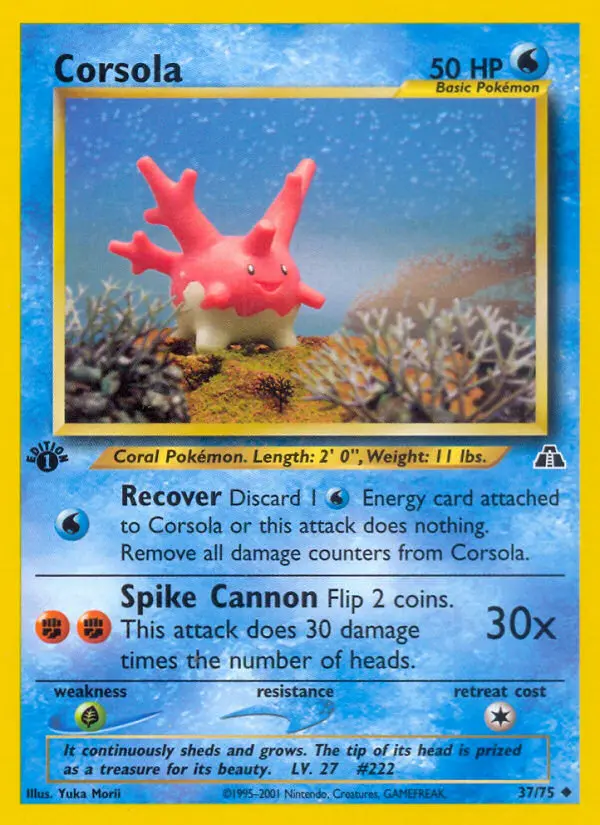
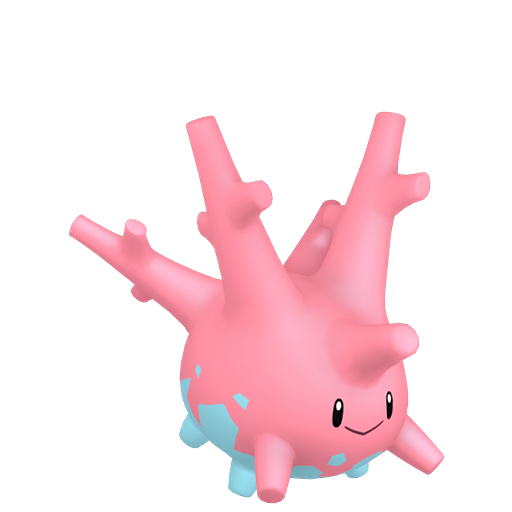
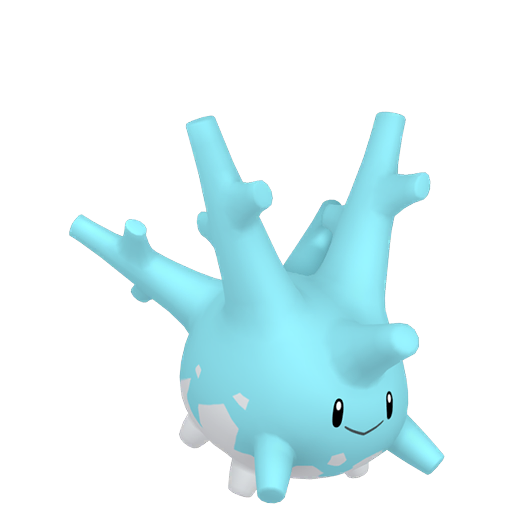
Corsola is a small, rounded Pokémon standing just 0.6 meters tall and weighing a mere 5.0 kilograms, making it one of the more diminutive creatures in the Pokédex. Its body is predominantly pink with a lighter blue underside that speckles toward its sides, giving it an organic, naturally colored appearance. The most distinctive feature of Corsola is the series of branching coral-like growths protruding from its back, which shimmer in seven different colors when caught in sunlight according to Pokédex entries from Ruby and Sapphire. These branches are not merely decorative—they function as nutrient absorption organs that draw sustenance from clean water, making Corsola's health directly dependent on environmental purity. Corsola possesses a blunt horn on its forehead, oval-shaped black eyes, and a characteristic smiling mouth that conveys a benign, friendly demeanor. The species demonstrates remarkable regenerative capabilities, continuously shedding and regrowing its external structures; broken branches are fully restored in a single night, showcasing nature's incredible adaptive resilience.
Pokedex Numbers
Training
Breeding
Corsola Breeding, Gender Ratio & Egg Groups
Corsola exhibits a pronounced gender ratio strongly skewed toward female individuals, with females comprising 75% of the population while males account for only 25%, making it one of the most female-dominant Pokémon species. This unusual distribution reflects the real-world biological complexity of coral reproduction, many species of which employ strategies where certain individuals dominate population growth. Both genders belong to the Water 1 and Water 3 egg groups, allowing Corsola to breed with compatible partners from these groups, producing eggs that hatch in 20 cycles—approximately 4,884 to 5,140 steps depending on various in-game factors. The species has a base friendship value of 70, indicating a naturally docile and friendly temperament that makes it relatively easy to bond with through training and companionship. Corsola's fast growth rate means that individuals level up quickly, making them efficient team members for trainers seeking rapid progression through early and mid-game content. The heavy female bias in the species' gender ratio creates interesting breeding dynamics, as trainers seeking male specimens for specific breeding projects may find them comparatively rare and valuable, adding a subtle layer of collection strategy to the game mechanics.
Sprites




Held Items
Red Shard
collectibles
No effect. Can be traded for items or moves.
Cost: 1000
Red Shard
collectibles
No effect. Can be traded for items or moves.
Cost: 1000
Red Shard
collectibles
No effect. Can be traded for items or moves.
Cost: 1000
Red Shard
collectibles
No effect. Can be traded for items or moves.
Cost: 1000
Red Shard
collectibles
No effect. Can be traded for items or moves.
Cost: 1000
Hard Stone
type-enhancement
Held: Rock-Type moves from holder do 20% more damage.
Cost: 1000
Hard Stone
type-enhancement
Held: Rock-Type moves from holder do 20% more damage.
Cost: 1000
Hard Stone
type-enhancement
Held: Rock-Type moves from holder do 20% more damage.
Cost: 1000
Hard Stone
type-enhancement
Held: Rock-Type moves from holder do 20% more damage.
Cost: 1000
Hard Stone
type-enhancement
Held: Rock-Type moves from holder do 20% more damage.
Cost: 1000
Hard Stone
type-enhancement
Held: Rock-Type moves from holder do 20% more damage.
Cost: 1000
Hard Stone
type-enhancement
Held: Rock-Type moves from holder do 20% more damage.
Cost: 1000
Hard Stone
type-enhancement
Held: Rock-Type moves from holder do 20% more damage.
Cost: 1000
Hard Stone
type-enhancement
Held: Rock-Type moves from holder do 20% more damage.
Cost: 1000
Hard Stone
type-enhancement
Held: Rock-Type moves from holder do 20% more damage.
Cost: 1000
Hard Stone
type-enhancement
Held: Rock-Type moves from holder do 20% more damage.
Cost: 1000
Luminous Moss
held-items
Held: If the holder is hit by a damaging Water move, raises its Special Defense by one stage.
Cost: 4000
Luminous Moss
held-items
Held: If the holder is hit by a damaging Water move, raises its Special Defense by one stage.
Cost: 4000
Luminous Moss
held-items
Held: If the holder is hit by a damaging Water move, raises its Special Defense by one stage.
Cost: 4000
Luminous Moss
held-items
Held: If the holder is hit by a damaging Water move, raises its Special Defense by one stage.
Cost: 4000
Luminous Moss
held-items
Held: If the holder is hit by a damaging Water move, raises its Special Defense by one stage.
Cost: 4000
Luminous Moss
held-items
Held: If the holder is hit by a damaging Water move, raises its Special Defense by one stage.
Cost: 4000
TMs & HMs
tm01
lets go pikachu lets go eevee
tm02
crystal
tm02
gold silver
tm03
crystal
tm03
gold silver
tm03
ruby sapphire
tm03
platinum
tm03
firered leafgreen
tm03
heartgold soulsilver
tm03
diamond pearl
tm03
emerald
tm03
xd
tm03
colosseum
tm04
gold silver
tm04
emerald
tm04
firered leafgreen
tm04
ruby sapphire
tm04
diamond pearl
tm04
crystal
tm04
xd
+719 more TMs/HMs
Corsola's Evolution Chain


Corsola Evolution, Mega Evolution & Special Forms
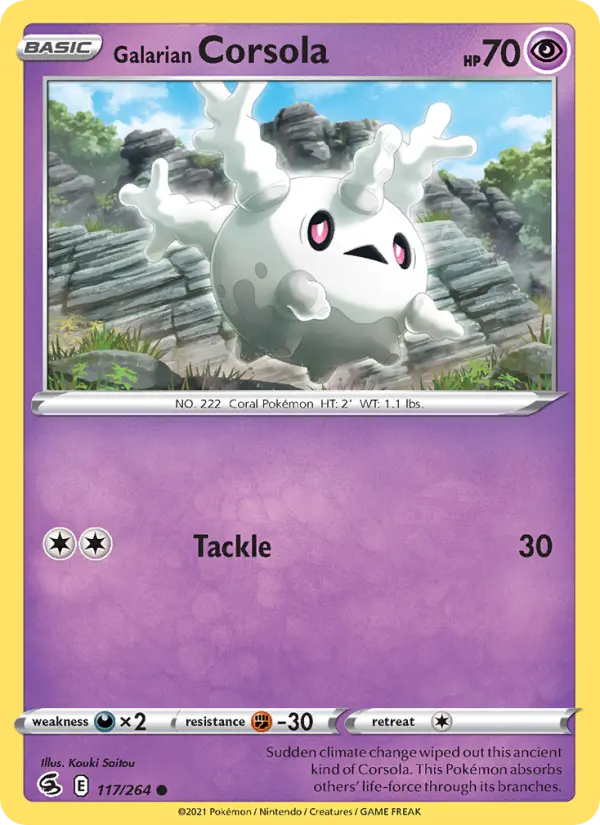
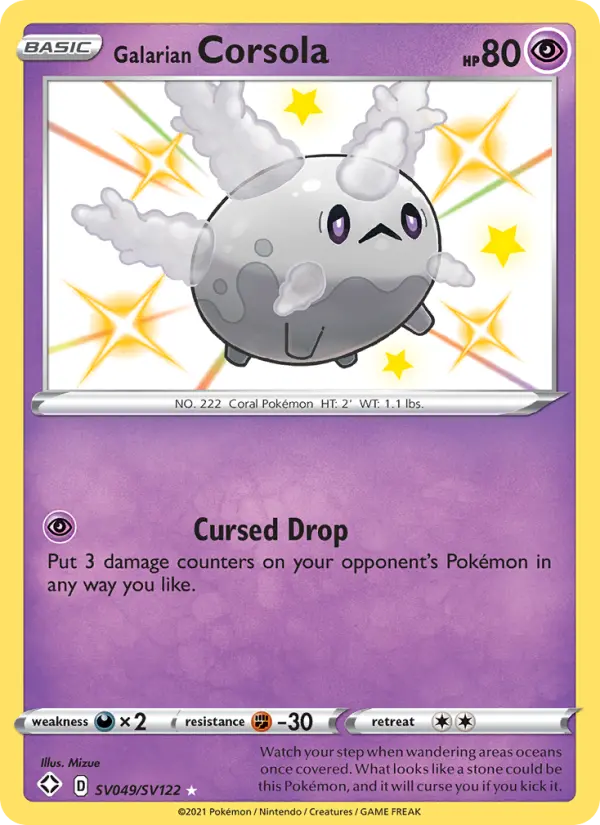
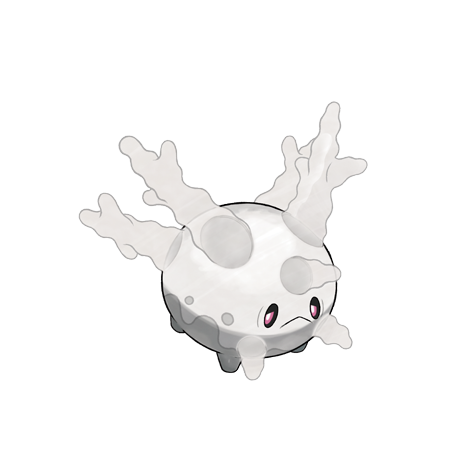
Corsola does not evolve in its traditional Johtonian form, remaining a standalone Water/Rock-type throughout its lifetime in most games and regions. However, Corsola received an evolutionary line through its Galarian regional variant, introduced in Pokémon Sword and Shield. The Galarian form, transformed into a Ghost-type as a result of ancient catastrophe, evolves into Cursola starting at level 38, representing a dramatic metamorphosis driven by ecological tragedy. According to Pokédex lore, Galarian Corsola originated from populations that lived in the sea surrounding the Galar region during ancient times and perished due to a meteorite impact, their spirits lingering as Ghost-type variants of their former living selves. This evolutionary line shift from Water/Rock to pure Ghost-type reflects a thematic transformation from vibrant life to spectral remnants, with Cursola maintaining the coral-like appearance while adopting a pale, ethereal coloration that contrasts sharply with its ancestor's pink vitality. The introduction of Galarian Corsola and its evolution provides narrative depth to Generation VIII, serving as a poignant commentary on extinction and environmental disaster while mechanically offering trainers new strategic options in competitive play.
Where to Find
Union Cave
johto
+17 more
Cherrygrove City
johto
+17 more
Olivine City
johto
+17 more
Cianwood City
johto
+17 more
Johto Route 34
johto
+17 more
Kanto Sea Route 19
kanto
+17 more
Johto Sea Route 40
johto
+17 more
Hoenn Route 128
hoenn
Ever Grande City
hoenn
Sinnoh Sea Route 230
sinnoh
+3 more
Unova Route 13
unova
Undella Town
unova
Unova Route 18
unova
+1 more
Humilau City
unova
Kalos Route 12
kalos
Melemele Sea
alola
+7 more
Alola Route 9
alola
+1 more
Poke Pelago
alola
+3 more
Hauoli City
alola
+1 more
Corsola Behaviour and Natural Habitat
Corsola congregates in warm southern seas and tropical regions, forming clusters that serve as vital hiding places for smaller Pokémon species seeking refuge and protection from larger predators. These communities are so integral to local ecosystems that in certain south sea nations, human populations have established entire settlements built directly upon groups of these Pokémon, creating a unique symbiosis between human civilization and the natural world. The species is highly sensitive to water quality and pollution; when seas become contaminated, Corsola's beautiful coral stalks lose their vibrant coloration and begin to crumble away in tatters, making the Pokémon an effective biological indicator of environmental health. During colder seasons, Corsola exhibits migratory behavior, traveling to warmer southern waters to survive temperature fluctuations that would otherwise compromise its survival. The species' preference for clean, nutrient-rich waters and its inability to thrive in polluted environments reflects the real-world vulnerability of actual coral species, adding educational depth to the Pokémon's conceptual design and ecological significance.
Pokedex Entries
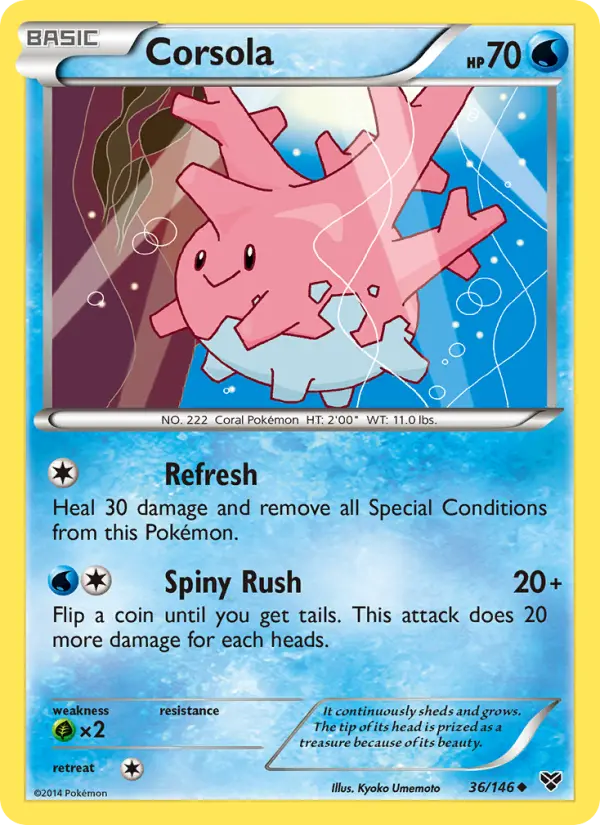
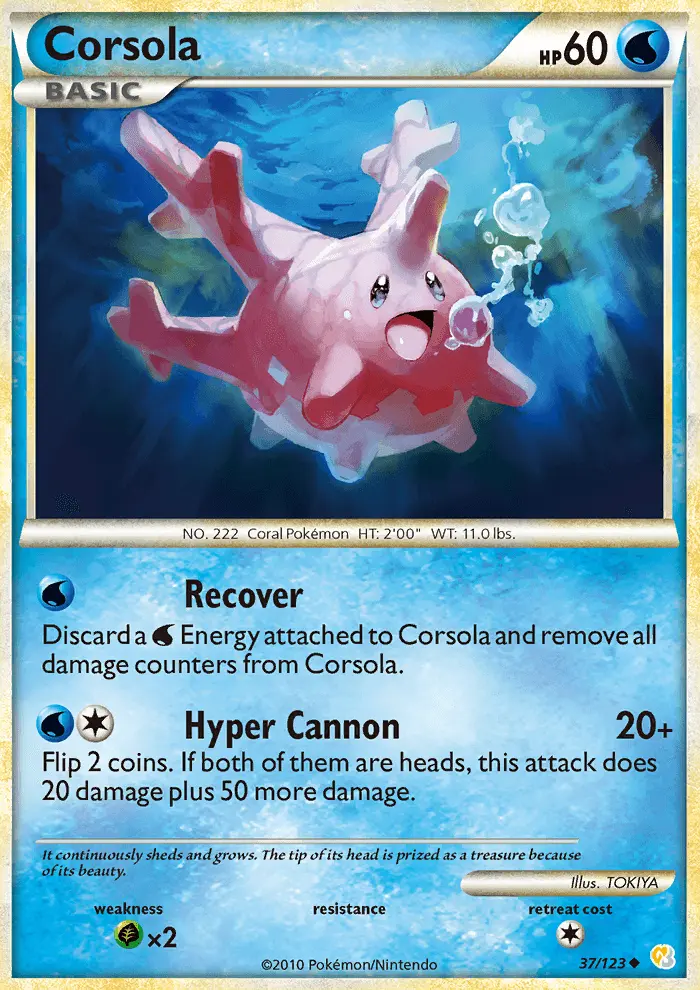
It continuously sheds and grows. The tip of its head is prized as a treasure for its beauty.
In a south sea nation, the people live in communi ties that are built on groups of these POKéMON.
The points on its head absorb nutrients from clean water. They cannot survive in polluted water.
CORSOLA’s branches glitter very beautifully in seven colors when they catch sunlight. If any branch breaks off, this POKéMON grows it back in just one night.
Clusters of CORSOLA congregate in warm seas where they serve as ideal hiding places for smaller POKéMON. When the water temperature falls, this POKéMON migrates to the southern seas.
CORSOLA live in warm southern seas. If the sea becomes polluted, the beautiful coral stalks become discolored and crumble away in tatters.
In a south sea nation, the people live in communities that are built on groups of these POKéMON.
It continuously sheds and grows. The tip of its head is prized as a treasure for its beauty.
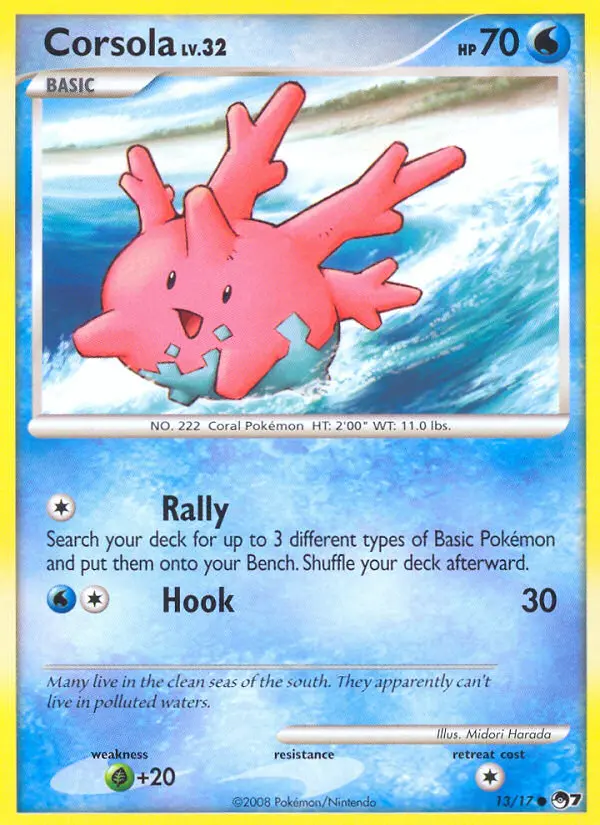
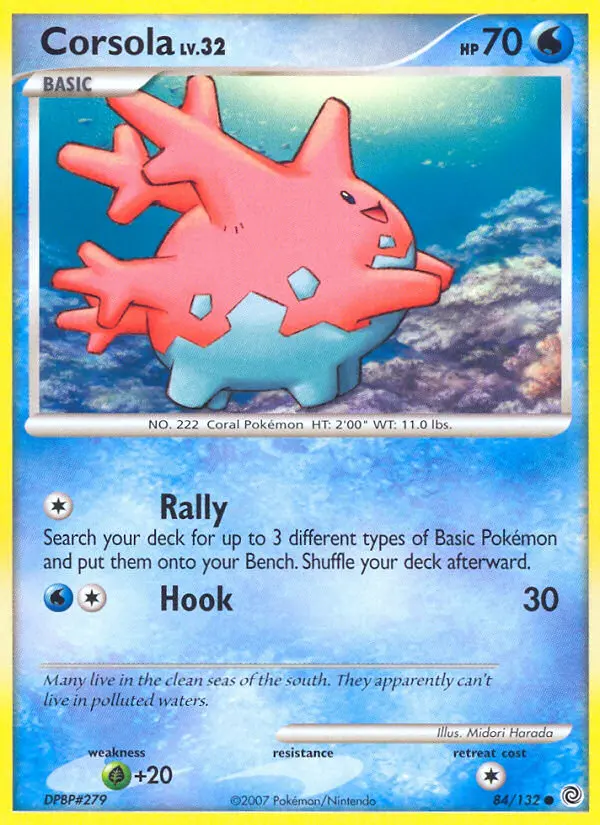
Many live in the clean seas of the south. They apparently can’t live in polluted waters.
It continuously sheds and grows. The tip of its head is prized as a treasure because of its beauty.
In a south-sea nation, the people live in communities that are built on groups of these Pokémon.
Many live in the clean seas of the south. They apparently can’t live in polluted waters.
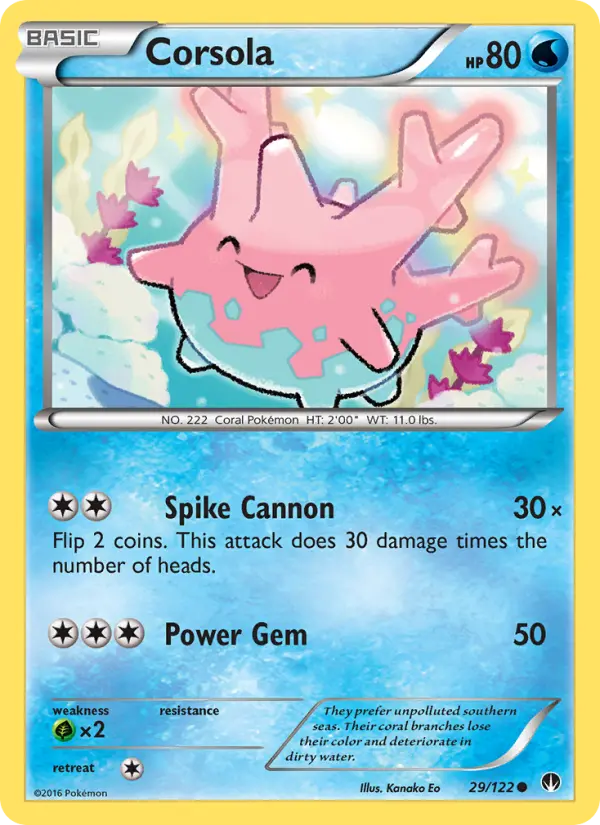
They prefer unpolluted southern seas. Their coral branches lose their color and deteriorate in dirty water.
It continuously sheds and grows. The tip of its head is prized as a treasure because of its beauty.
They prefer unpolluted southern seas. Their coral branches lose their color and deteriorate in dirty water.
Corsola’s branches glitter very beautifully in seven colors when they catch sunlight. If any branch breaks off, this Pokémon grows it back in just one night.
Clusters of Corsola congregate in warm seas where they serve as ideal hiding places for smaller Pokémon. When the water temperature falls, this Pokémon migrates to the southern seas.
Coral branches grow from its head. They break off quite easily, but they grow back in about three days.
The pink of Corsola that live in Alola is deep and vibrant, thanks to seas filled with nutrition.
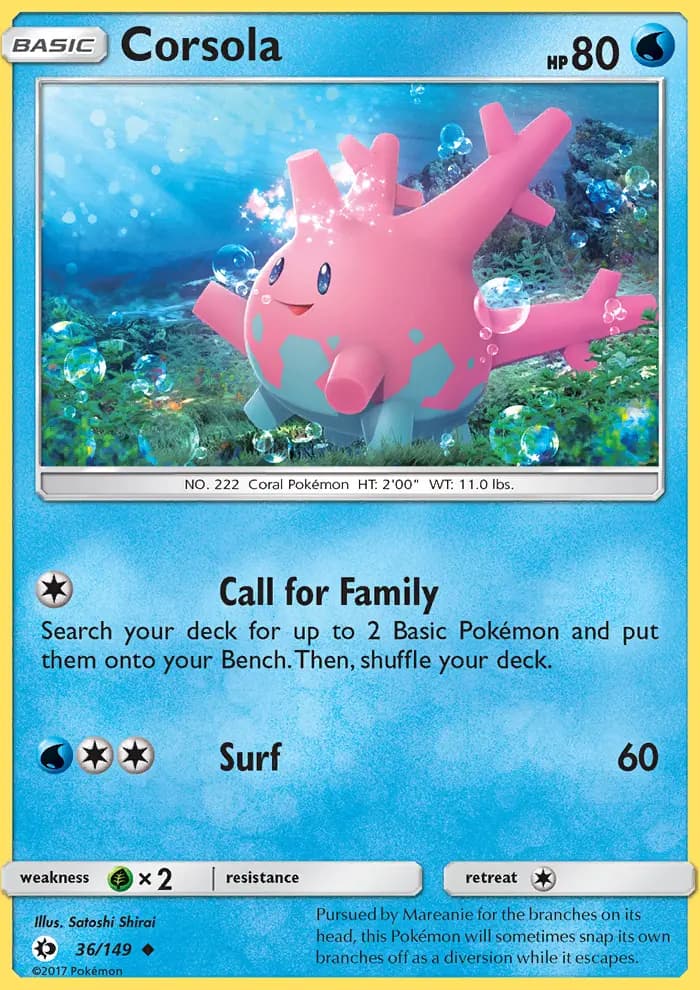
Pursued by Mareanie for the branches on its head, this Pokémon will sometimes snap its own branches off as a diversion while it escapes.
In Alola, where their natural enemies Mareanie are plentiful, many Corsola have stubby branches on their heads.
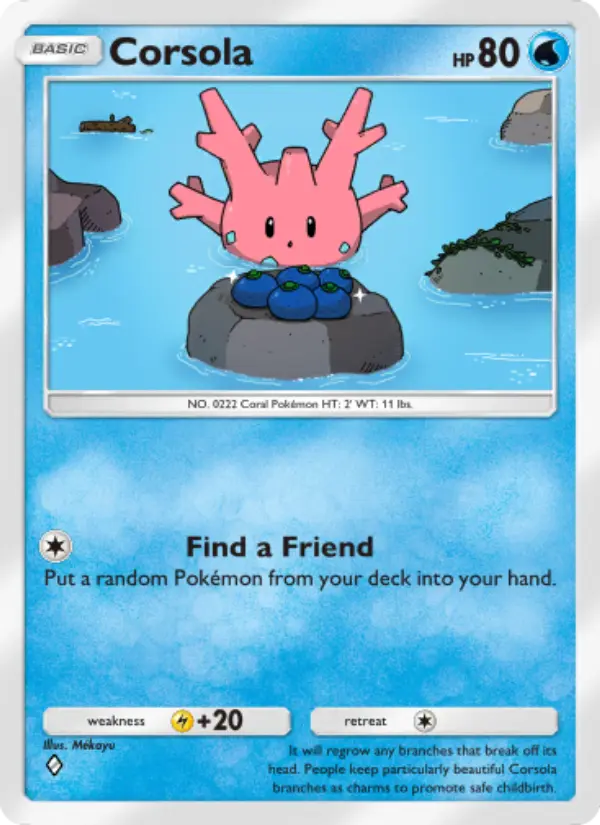
It will regrow any branches that break off its head. People keep particularly beautiful Corsola branches as charms to promote safe childbirth.
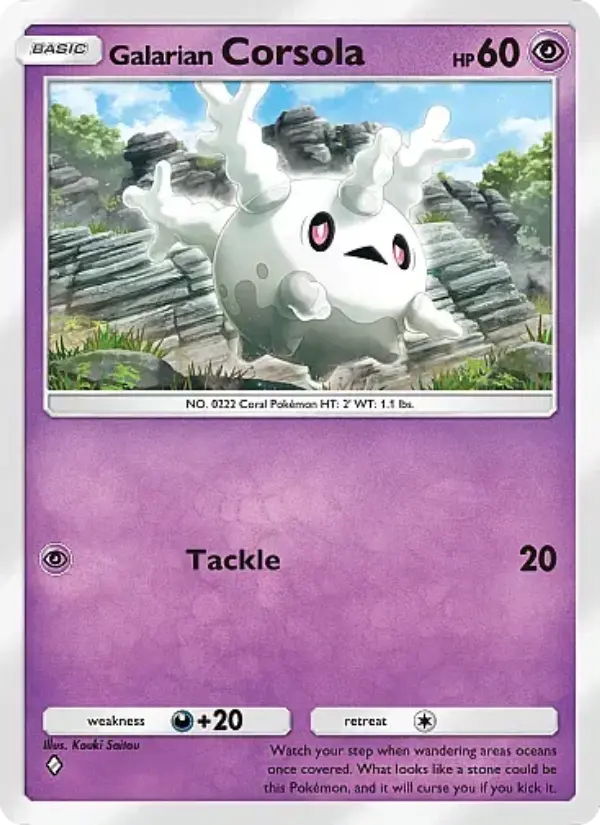
These Pokémon live in warm seas. In prehistoric times, many lived in the oceans around the Galar region as well.
Corsola Name Origin & Design Inspiration
Corsola's name derives from 'coral,' the biological organism that inspired its entire design philosophy, combined with an ending reminiscent of scientific nomenclature. In Japanese, it is known as Sunnygo (サニーゴ), where 'sunny' references both the tropical sunlight reflecting off its colorful branches and its cheerful demeanor, while 'go' mirrors the English 'coral.' The design itself represents a romanticized yet scientifically grounded interpretation of coral reef ecosystems—the branching structures directly mimic real coral morphology, while the color palette of pink and blue reflects actual coral coloration found in nature. The simplistic, rounded body shape contrasts deliberately with the complex, organic branching growths, creating visual balance between cute accessibility and ecological authenticity. Corsola's seven-colored gleam references the incredible biodiversity of coral reefs, often called the 'rainforests of the sea,' emphasizing their status as some of Earth's most vibrant and complex ecosystems. The species' depiction as predominantly female (75% female to 25% male ratio) may subtly reinforce its role as a generative, life-supporting force within its marine environment, further strengthening the parallel to real coral species' reproductive significance in maintaining reef health.
Learnable Moves
Corsola can learn 80 moves:
Move | Type | Cat. | Power | Acc. | PP |
|---|---|---|---|---|---|
| amnesia | psychic | Status | — | — | 20 |
| ancient power | rock | Special | 60 | 100 | 5 |
| attract | normal | Status | — | 100 | 15 |
| barrier | psychic | Status | — | — | 20 |
| bide | normal | Physical | — | — | 10 |
| blizzard | ice | Special | 110 | 70 | 5 |
| body slam | normal | Physical | 85 | 100 | 15 |
| brine | water | Special | 65 | 100 | 10 |
| bubble | water | Special | 40 | 100 | 30 |
| bubble beam | water | Special | 65 | 100 | 20 |
| calm mind | psychic | Status | — | — | 20 |
| camouflage | normal | Status | — | — | 20 |
| captivate | normal | Status | — | 100 | 20 |
| confuse ray | ghost | Status | — | 100 | 10 |
| curse | ghost | Status | — | — | 10 |
| defense curl | normal | Status | — | — | 40 |
| dig | ground | Physical | 80 | 100 | 10 |
| double team | normal | Status | — | — | 15 |
| double edge | normal | Physical | 120 | 100 | 15 |
| earth power | ground | Special | 90 | 100 | 10 |
| earthquake | ground | Physical | 100 | 100 | 10 |
| endeavor | normal | Physical | — | 100 | 5 |
| endure | normal | Status | — | — | 10 |
| explosion | normal | Physical | 250 | 100 | 5 |
| facade | normal | Physical | 70 | 100 | 20 |
| flail | normal | Physical | — | 100 | 15 |
| frustration | normal | Physical | — | 100 | 20 |
| hail | ice | Status | — | — | 10 |
| harden | normal | Status | — | — | 30 |
| headbutt | normal | Physical | 70 | 100 | 15 |
| hidden power | normal | Special | 60 | 100 | 15 |
| hydro pump | water | Special | 110 | 80 | 5 |
| ice beam | ice | Special | 90 | 100 | 10 |
| icicle spear | ice | Physical | 25 | 100 | 30 |
| icy wind | ice | Special | 55 | 95 | 15 |
| ingrain | grass | Status | — | — | 20 |
| iron defense | steel | Status | — | — | 15 |
| light screen | psychic | Status | — | — | 30 |
| magic coat | psychic | Status | — | — | 15 |
| mimic | normal | Status | — | — | 10 |
| mirror coat | psychic | Special | — | 100 | 20 |
| mist | ice | Status | — | — | 30 |
| mud slap | ground | Special | 20 | 100 | 10 |
| nature power | normal | Status | — | — | 20 |
| power gem | rock | Special | 80 | 100 | 20 |
| protect | normal | Status | — | — | 10 |
| psychic | psychic | Special | 90 | 100 | 10 |
| rain dance | water | Status | — | — | 5 |
| recover | normal | Status | — | — | 5 |
| reflect | psychic | Status | — | — | 20 |
| refresh | normal | Status | — | — | 20 |
| rest | psychic | Status | — | — | 5 |
| return | normal | Physical | — | 100 | 20 |
| rock blast | rock | Physical | 25 | 90 | 10 |
| rock polish | rock | Status | — | — | 20 |
| rock slide | rock | Physical | 75 | 90 | 10 |
| rock smash | fighting | Physical | 40 | 100 | 15 |
| rock tomb | rock | Physical | 60 | 95 | 15 |
| rollout | rock | Physical | 30 | 90 | 20 |
| safeguard | normal | Status | — | — | 25 |
| sandstorm | rock | Status | — | — | 10 |
| screech | normal | Status | — | 85 | 40 |
| secret power | normal | Physical | 70 | 100 | 20 |
| self destruct | normal | Physical | 200 | 100 | 5 |
| shadow ball | ghost | Special | 80 | 100 | 15 |
| sleep talk | normal | Status | — | — | 10 |
| snore | normal | Special | 50 | 100 | 15 |
| spike cannon | normal | Physical | 20 | 100 | 15 |
| stealth rock | rock | Status | — | — | 20 |
| stone edge | rock | Physical | 100 | 80 | 5 |
| strength | normal | Physical | 80 | 100 | 15 |
| substitute | normal | Status | — | — | 10 |
| sunny day | fire | Status | — | — | 5 |
| surf | water | Special | 90 | 100 | 15 |
| swagger | normal | Status | — | 85 | 15 |
| tackle | normal | Physical | 40 | 100 | 35 |
| toxic | poison | Status | — | 90 | 10 |
| water gun | water | Special | 40 | 100 | 25 |
| water pulse | water | Special | 60 | 100 | 20 |
| whirlpool | water | Special | 35 | 85 | 15 |
Corsola Competitive Battle Guide
In tournament-level play, Corsola occupies a unique defensive niche thanks to its impressive defensive statistics, boasting a base Defense of 95 and Special Defense of 95—among the highest stats in its total pool of 410. These dual defenses make Corsola surprisingly durable despite its modest HP of 65, allowing it to function as a defensive wall against many physical and special threats, particularly in lower-tier competitive formats. Its three ability options each provide distinct strategic value: Hustle boosts physical moves to 1.5x damage at the cost of 0.8x accuracy, Natural Cure provides immunity to status conditions upon switching out, and the hidden ability Regenerator heals 1/3 of maximum HP upon switching out—the latter proving exceptionally valuable in team structures emphasizing pivoting and sustained advantage. Corsola's offensive capabilities remain modest, with Attack and Special Attack both sitting at 55, necessitating careful move selection to maximize damage output. Its abysmal Speed stat of 35 typically relegates Corsola to a support or defensive role rather than an offensive sweeper, making it ideal for strategies emphasizing trick room setups or priority move chaining. The species' Water/Rock typing grants it reasonable defensive coverage, resisting Normal, Flying, Poison, and Fire-type moves while only taking super-effective damage from Grass, Electric, Ground, and Fighting moves, making it a flexible defensive option in team building despite its overall lack of offensive pressure.
Commonly Asked Questions About Corsola
What type is Corsola?
Corsola is a water and rock type Pokemon.
What does Corsola evolve into?
Corsola evolves into cursola.
What are Corsola's weaknesses?
Corsola is weak to fighting, ground, grass and electric type moves.
Does Corsola evolve by trading?
No — Corsola evolves entirely through leveling up, with no trade required at any stage.
Where can I find Corsola?
Corsola can be found in union cave (johto), cherrygrove city (johto) and olivine city (johto) and 16 other locations.
Corsola Cultural Impact & Franchise History
Corsola has achieved notable cultural significance beyond gaming through its role as an environmental ambassador within the Pokémon franchise, representing real-world conservation concerns about coral bleaching and ocean acidification. The species appeared prominently in the Pokémon animated series, most notably through Misty's Corsola, which became an iconic part of her character development and emotional journey throughout the show's progression. This memorable pairing introduced millions of viewers to the species and, by extension, to the ecological importance of coral reefs in global biodiversity. The introduction of Galarian Corsola in Pokémon Sword and Shield sparked considerable discussion within the fan community about the game's environmental themes, with many players recognizing the Ghost-type form as a commentary on extinction and climate change-related ecological collapse. Corsola merchandise, artwork, and fan creations have flourished on social media platforms, with its distinctive pink coloration and charming design making it a popular subject for Pokémon fan communities. The species has inspired real-world conservation awareness campaigns, with environmental organizations occasionally citing Pokémon like Corsola to engage younger audiences in discussions about ocean health and reef preservation. Its prominent placement in various Pokédex entries emphasizing water purity and environmental sensitivity has made Corsola a symbol of ecological awareness within gaming culture, transcending its role as mere entertainment to become a meaningful cultural touchstone for environmental advocacy.
Where to Find Corsola in Every Pokémon Game
Corsola's availability varies significantly across different game generations and regions, reflecting its design as a water-dwelling Pokémon tied to warm tropical seas. In its native Generation II games—Gold, Silver, and Crystal—Corsola appears in the Johto region with local Pokédex number #171, typically encountered in specific water routes characteristic of southern or island communities. The species maintains accessibility across subsequent generations, appearing in Ruby and Sapphire with local number #180, in HeartGold and SoulSilver as #173, and continuing through later generations with varying regional Pokédex positions. In Pokémon X and Y, Corsola is classified as #146 in the Coastal Kalos Pokédex, emphasizing its association with coastal environments. The introduction of Pokémon Sword and Shield brought both traditional Corsola and its Galarian variant as #236 and #171 in the Galar Pokédex respectively, with the Galarian form being region-exclusive to Galar. Corsola maintains a respectable capture rate of 60, making it moderately difficult to catch but not excessively rare, encouraging players to employ standard capture strategies rather than requiring specialized techniques. The species' regular availability across multiple generations and consistent presence in water-type encounters throughout various regions makes Corsola accessible to trainers at multiple points in their Pokémon journey, though dedicated players seeking specific Corsola with optimal natures or abilities may need to engage in breeding or soft-resetting mechanics.