Cramorant
Generation VIII · #0845 — Gulp Pokémon
Cramorant is a dual-type Flying/Water Pokémon introduced in Generation VIII, classified as the Gulp Pokémon and assigned National Pokédex number #845. This remarkable avian creature stands at 0.8 meters tall and weighs 18.0 kilograms, making it a relatively small but surprisingly formidable combatant. Cramorant does not evolve into or from any other Pokémon species, existing as a standalone entry in the evolutionary chain. However, it possesses a unique characteristic through its signature Ability, Gulp Missile, which allows it to change forms dynamically during battle, transforming into either its Gulping Form or Gorging Form depending on its current health status and whether it uses the moves Surf or Dive. This mechanic makes Cramorant one of the most mechanically interesting Pokémon of its generation, combining unpredictable form-shifting with solid offensive and defensive capabilities.
Editor's Take
Cramorant's Gulp Missile spitting a fish at whoever hits it after using Surf or Dive is the single funniest ability in the game and genuinely useful.
Base Stats
Height
0.8m
Weight
18.0kg
Category
Gulp Pokémon
Gender
Male 50% / Female 50%
Color
blue
Shape
wings
Abilities
If a Cramorant with Gulp Missile uses Surf or Dive, it catches prey and changes its form depending on its remaining HP.

Cramorant Biology & Physical Characteristics
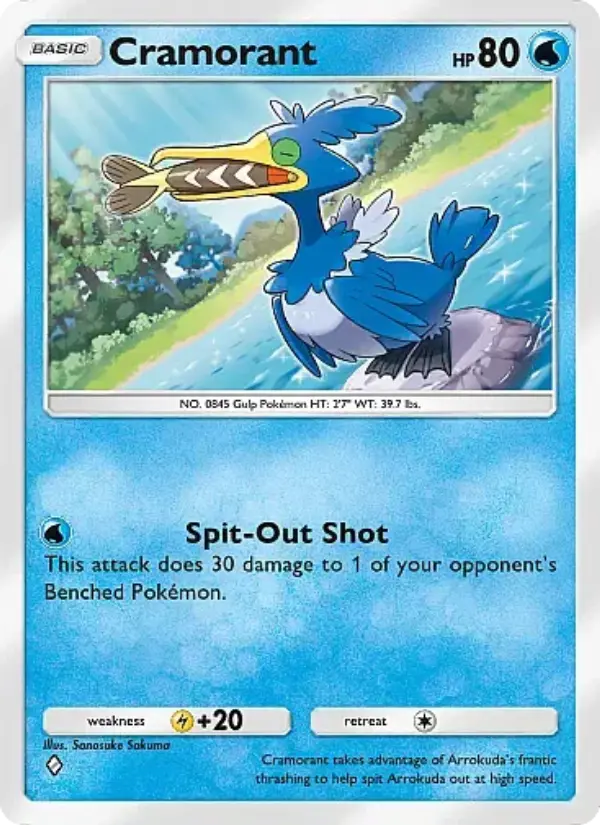
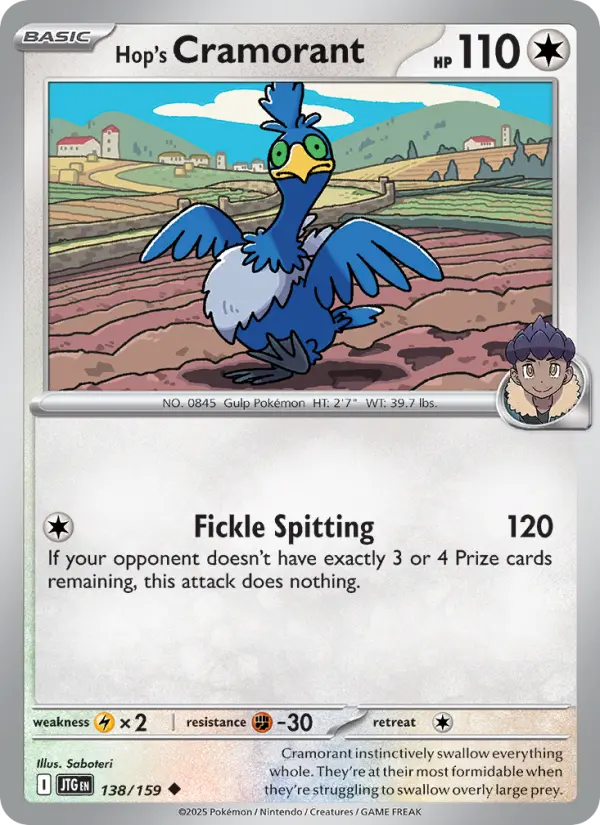
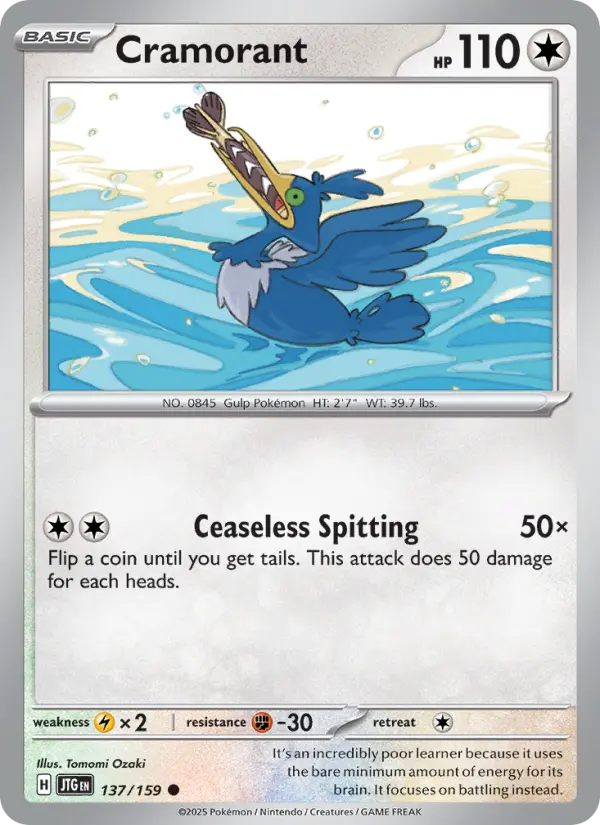
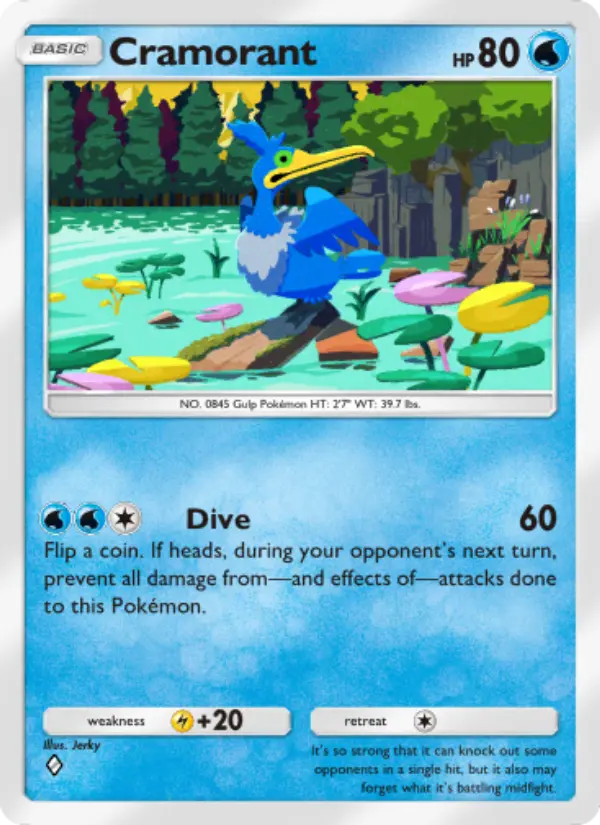
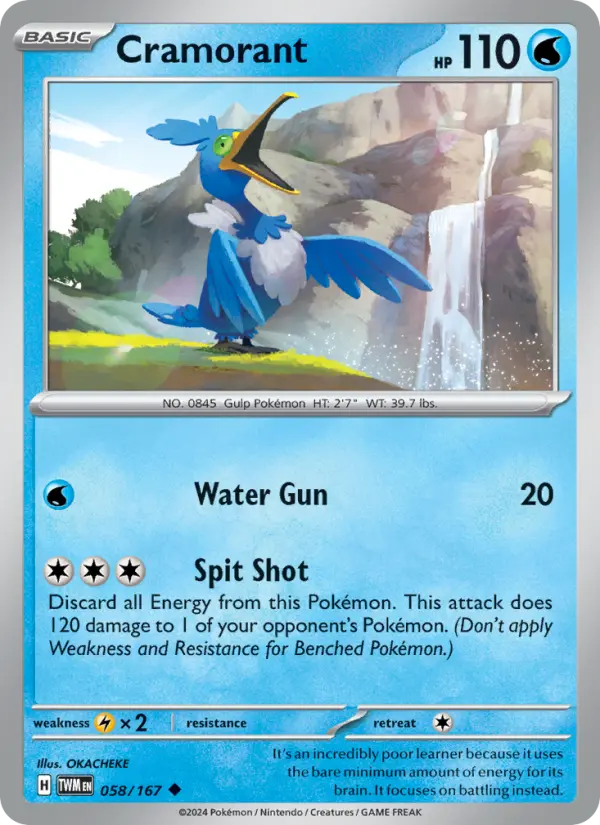
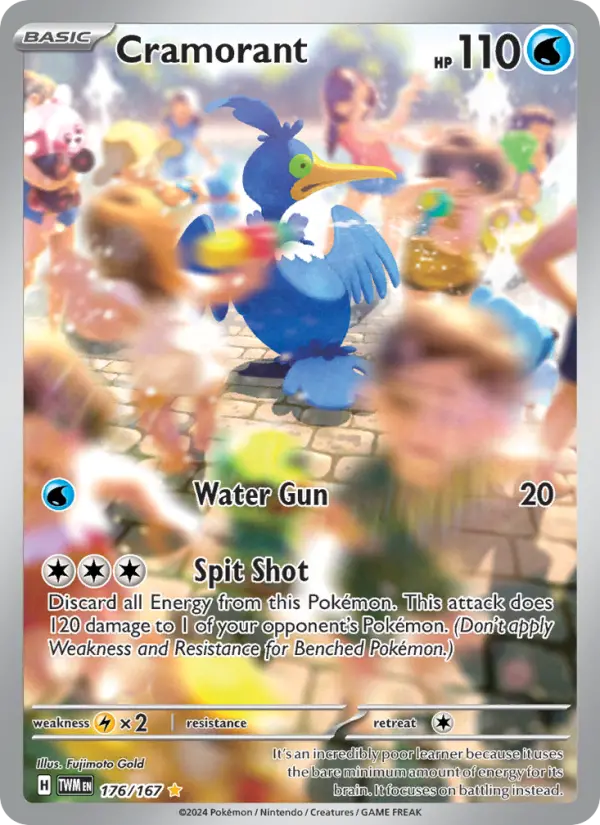
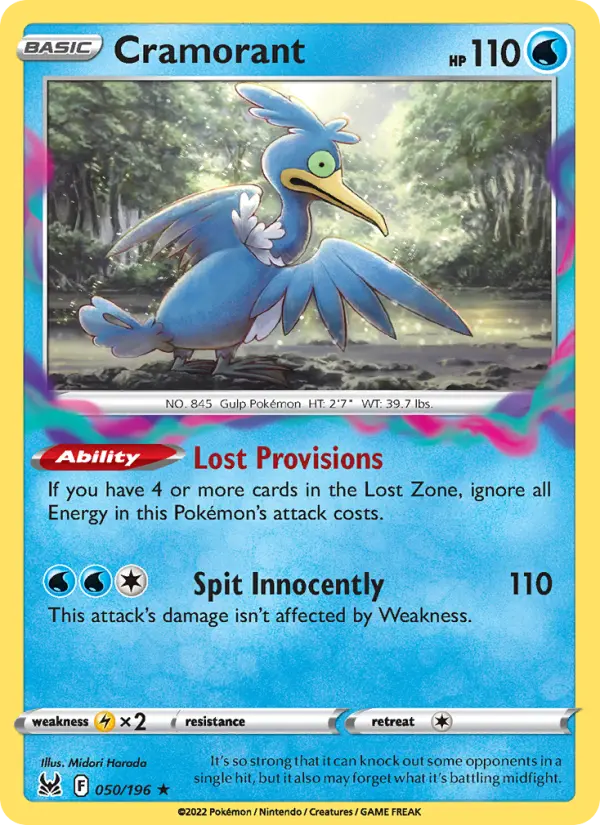
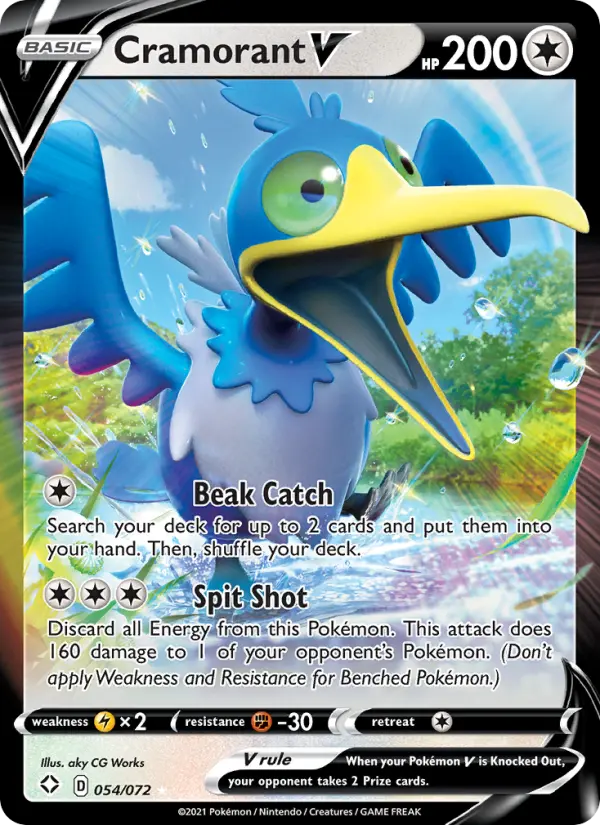
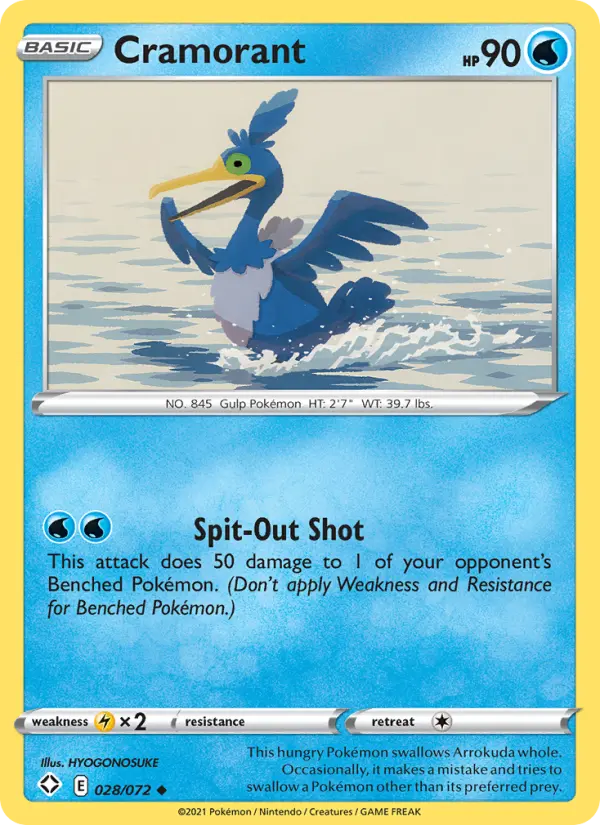
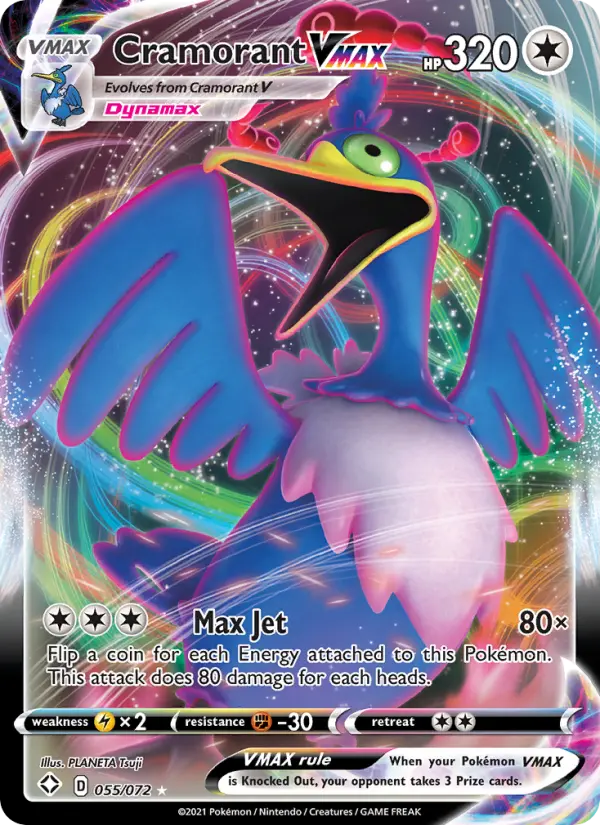
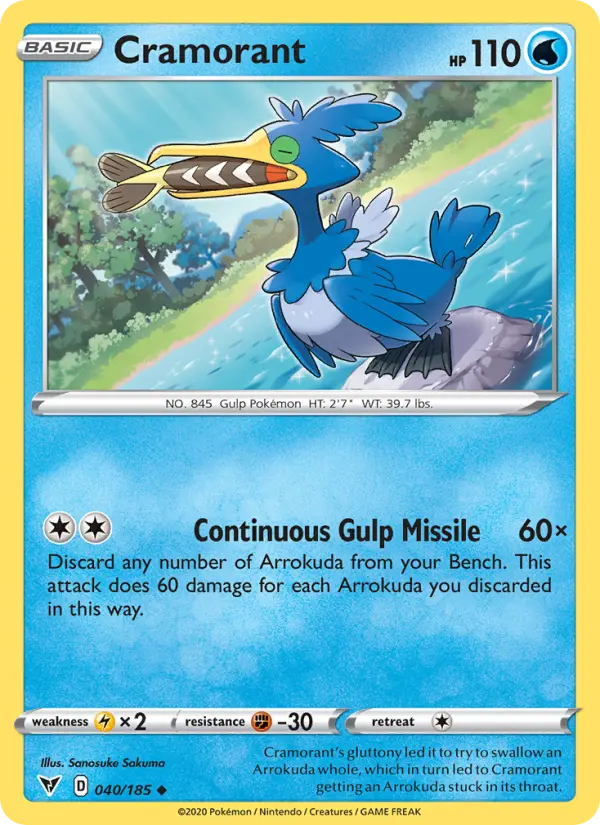
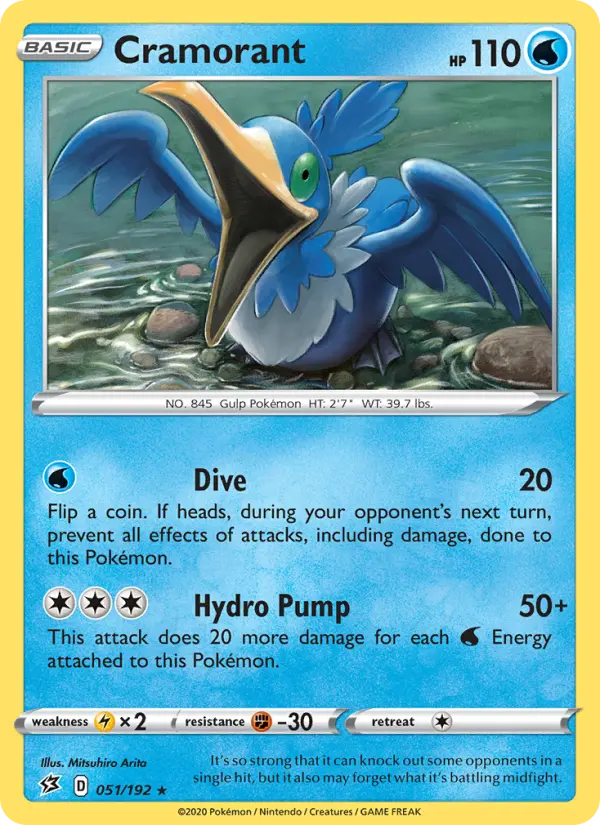
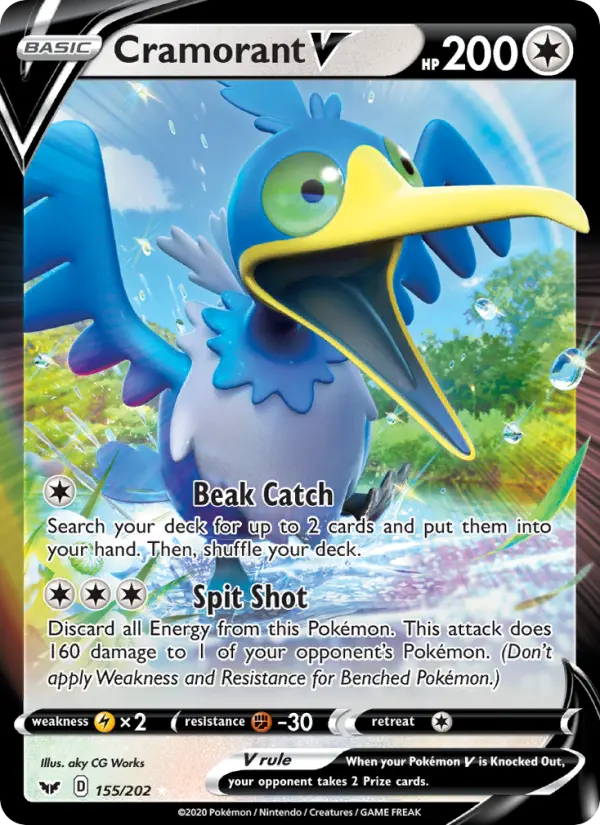
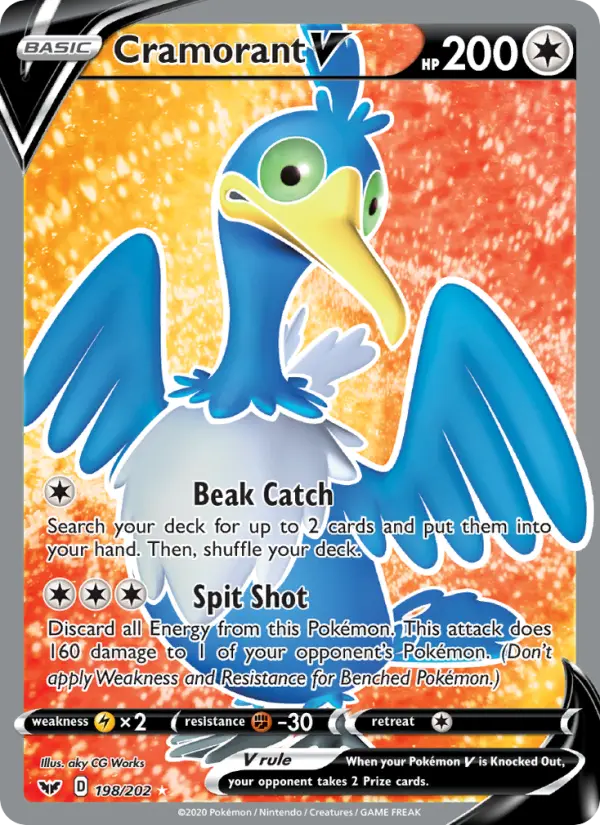
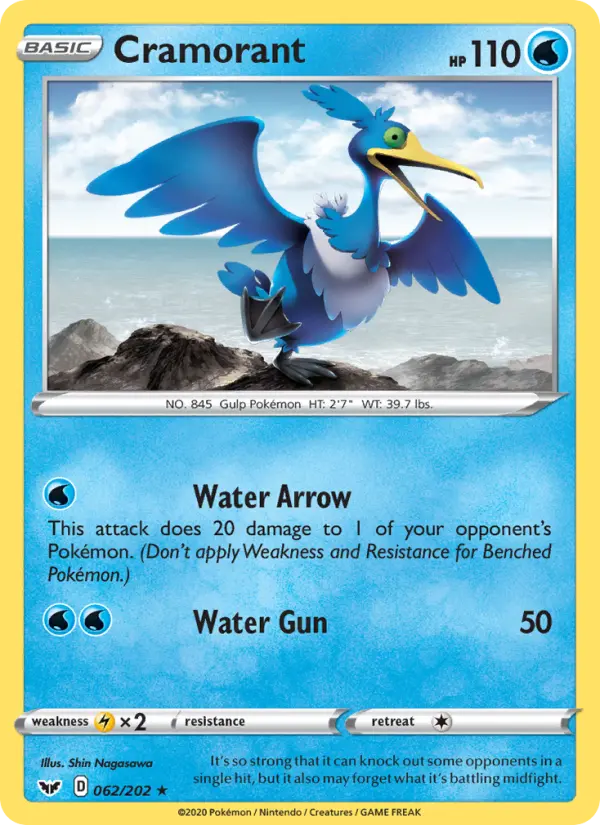
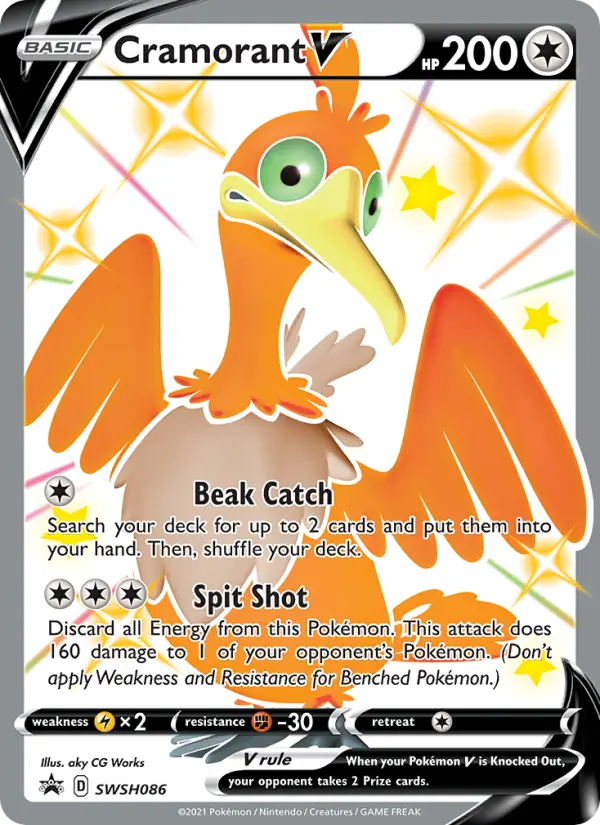
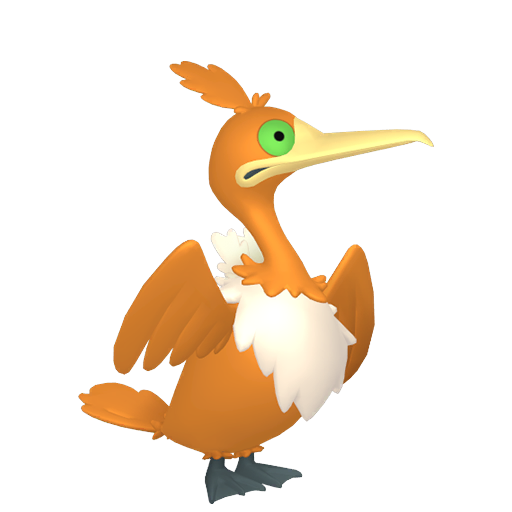
Cramorant is a blue avian Pokémon bearing a striking resemblance to a cormorant, a real-world diving seabird known for its fishing prowess. The species features a distinctively large, thin yellow beak and bright green circular eyes with small black pupils that convey an almost comical intensity. Its head is crowned with a distinctive ruff of feathers pointing backward, surrounded by smaller singular feathers that give it a somewhat unkempt appearance. A light gray feathered ruff encircles its torso like a bib, contrasting with its predominantly blue plumage, while its wings remain perpetually spread outward at its sides. Its feet are black, webbed, and possess three toes adapted for aquatic movement, while its asymmetrical tail feathers feature a curious slit between them. The most remarkable aspect of Cramorant's physiology is its enormous gullet capable of swallowing other Pokémon whole, which becomes visually apparent in its alternate forms when prey becomes lodged within its throat, creating the distinctive bulging appearance of its Gulping and Gorging Forms.
Pokedex Numbers
Training
Breeding
Cramorant Breeding, Gender Ratio & Egg Groups
Cramorant maintains an equal gender distribution with 50% male and 50% female individuals occurring naturally in the wild, allowing both sexes to participate equally in breeding activities. The species belongs to both the Water 1 and Flying egg groups, making it compatible with a diverse range of Pokémon for breeding purposes. With a base friendship value of 50, Cramorant exhibits neutral temperament toward trainers, neither particularly affectionate nor hostile, though consistent positive interactions can increase its affection and loyalty over time. The species has a hatch counter of 20 cycles, translating to approximately 4,884 to 5,140 steps required for an egg to hatch into a Cramorant, placing it in the moderate hatching timeframe. The capture rate of 45 indicates moderate difficulty in capturing wild Cramorant, requiring somewhat more effort than common Pokémon but substantially less than legendaries or notably elusive species. When bred, Cramorant offspring will hatch with base stats distributed across HP, Attack, Special Attack, Special Defense, and Speed as their primary strengths, with Defense representing their relative weakness.
Sprites





TMs & HMs
tm03
ruby sapphire
tm03
platinum
tm03
firered leafgreen
tm03
heartgold soulsilver
tm03
diamond pearl
tm03
emerald
tm03
xd
tm03
colosseum
tm05
lets go pikachu lets go eevee
tm06
sword shield
tm07
lets go pikachu lets go eevee
tm08
lets go pikachu lets go eevee
tm08
sword shield
tm09
yellow
tm09
red blue
tm09
sword shield
tm95
sword shield
hm02
crystal
hm02
diamond pearl
hm02
heartgold soulsilver
+420 more TMs/HMs
Regional & Special Forms
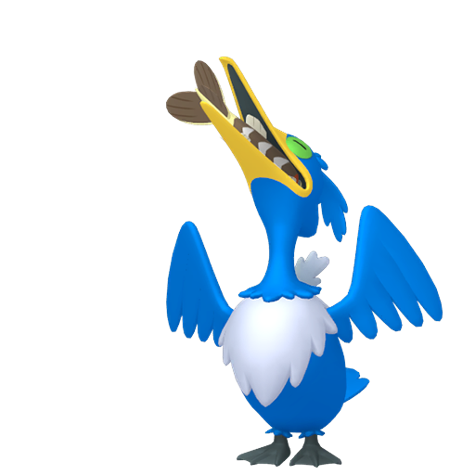
Cramorant also has 2 related forms: Gulping Cramorant and Gorging Cramorant.

Cramorant Evolution, Mega Evolution & Special Forms
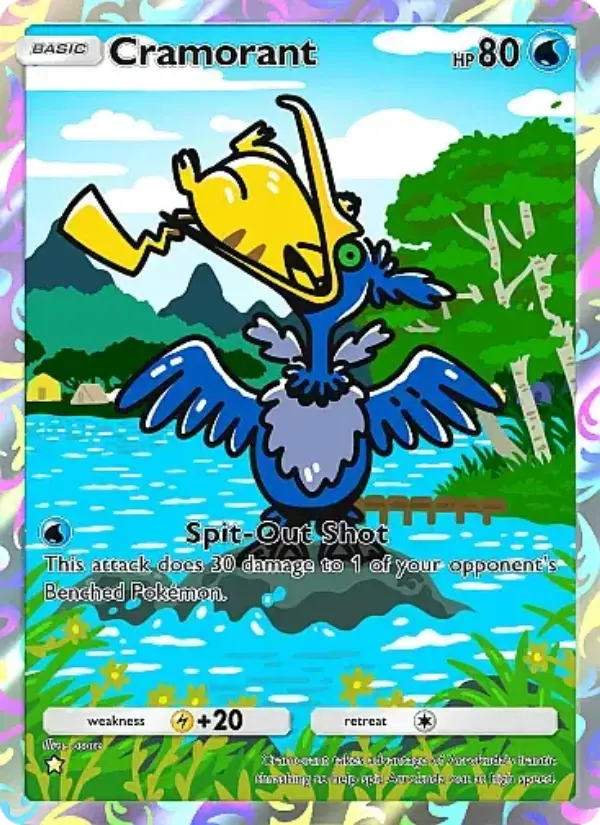
Cramorant exists as a singular evolutionary form with no pre-evolution or post-evolution stages, representing a complete species unto itself. Rather than evolving into other forms, Cramorant demonstrates form-changing capabilities through its signature Ability, Gulp Missile, which fundamentally alters its appearance and mechanics based on battle conditions. When Cramorant uses the moves Surf or Dive while maintaining health above 50%, it assumes its Gulping Form, visually depicted with an Arrokuda lodged in its throat, changing the Pokémon's elemental properties and movepool. Conversely, when its health drops to 50% or below and it uses either of these aquatic moves, Cramorant shifts into its Gorging Form, which features a half-swallowed Pikachu stuck within its gullet instead. These forms are not true evolutions in the traditional sense but rather conditional transformations that occur automatically during battle, making Cramorant one of the few non-legendary Pokémon with dynamic, health-dependent form changes that directly influence its battle capabilities and type distribution.
Where to Find
Location data not available for this Pokémon in the database.
Cramorant Behaviour and Natural Habitat
Cramorant is an extraordinarily gluttonous Pokémon driven by an almost uncontrollable instinct to swallow anything it encounters whole, regardless of whether the object constitutes appropriate food. The species typically hunts along riverbanks and shorelines, where it pursues its preferred prey, Arrokuda, with remarkable persistence. However, Cramorant's ravenous appetite frequently overrides its prey discrimination, causing it to attempt swallowing entirely unsuitable targets such as Pikachu, only to realize its error and attempt expelling the incorrectly consumed Pokémon. According to Pokédex entries, Cramorant possesses such devastating offensive power that it can knock out certain opponents in a single strike, yet this strength is offset by a peculiar tendency to forget what it is battling mid-conflict, suggesting a somewhat scatterbrained personality. Perhaps most bizarrely, Cramorant is known to occasionally sleep while actively swallowing its prey, a phenomenon that remains unexplained even to the Pokémon itself, indicating that its gluttonous drive operates on an almost autonomous level.
Pokedex Entries
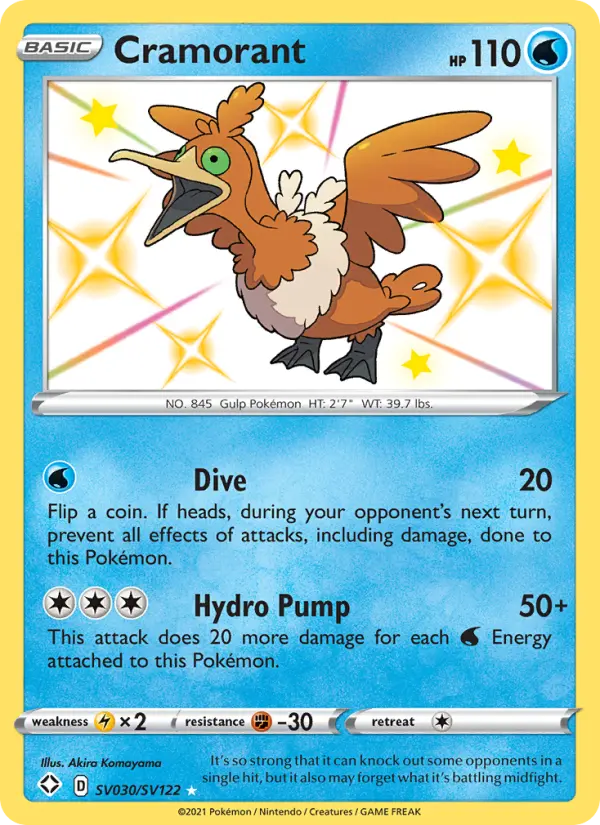
It’s so strong that it can knock out some opponents in a single hit, but it also may forget what it’s battling midfight.
This hungry Pokémon swallows Arrokuda whole. Occasionally, it makes a mistake and tries to swallow a Pokémon other than its preferred prey.
Cramorant Name Origin & Design Inspiration
Cramorant's name origin lies in a combination of "cram," referring to the act of stuffing something full to capacity, and "cormorant," the real-world aquatic bird family known for diving and fishing prowess. The Japanese name, Uu, is a stylized representation of a gull's call, further cementing its avian inspiration. Cramorant's design directly mirrors the cormorant's biology and hunting behavior, particularly the bird's exceptional diving abilities and fish-catching expertise, though Game Freak's interpretation exaggerates these traits to comedic extremes with Cramorant's ability to swallow creatures whole rather than merely fish. The color palette of bright blue with yellow facial markings reflects typical cormorant coloration, while the ruffled feather pattern mimics the disheveled appearance cormorants often display after diving and emerging from water. The Gulping and Gorging Forms represent a creative gameplay interpretation of how a gluttonous bird might look when struggling with oversized prey, with the visual comedy of catching a Pikachu instead of its preferred Arrokuda prey adding a layer of whimsical personality to an otherwise straightforward predator design.
Learnable Moves
Cramorant can learn 61 moves:
Move | Type | Cat. | Power | Acc. | PP |
|---|---|---|---|---|---|
| acrobatics | flying | Physical | 55 | 100 | 15 |
| aerial ace | flying | Physical | 60 | — | 20 |
| agility | psychic | Status | — | — | 30 |
| air cutter | flying | Special | 60 | 95 | 25 |
| air slash | flying | Special | 75 | 95 | 15 |
| amnesia | psychic | Status | — | — | 20 |
| aqua cutter | water | Physical | 70 | 100 | 20 |
| aqua ring | water | Status | — | — | 20 |
| assurance | dark | Physical | 60 | 100 | 10 |
| attract | normal | Status | — | 100 | 15 |
| belch | poison | Special | 120 | 90 | 10 |
| blizzard | ice | Special | 110 | 70 | 5 |
| brave bird | flying | Physical | 120 | 100 | 15 |
| chilling water | water | Special | 50 | 100 | 20 |
| defog | flying | Status | — | — | 15 |
| dive | water | Physical | 80 | 100 | 10 |
| drill peck | flying | Physical | 80 | 100 | 20 |
| dual wingbeat | flying | Physical | 40 | 90 | 10 |
| endeavor | normal | Physical | — | 100 | 5 |
| endure | normal | Status | — | — | 10 |
| facade | normal | Physical | 70 | 100 | 20 |
| feather dance | flying | Status | — | 100 | 15 |
| fly | flying | Physical | 90 | 95 | 15 |
| fury attack | normal | Physical | 15 | 85 | 20 |
| giga impact | normal | Physical | 150 | 90 | 5 |
| hurricane | flying | Special | 110 | 70 | 10 |
| hydro pump | water | Special | 110 | 80 | 5 |
| hyper beam | normal | Special | 150 | 90 | 5 |
| ice beam | ice | Special | 90 | 100 | 10 |
| icy wind | ice | Special | 55 | 95 | 15 |
| liquidation | water | Physical | 85 | 100 | 10 |
| peck | flying | Physical | 35 | 100 | 35 |
| pluck | flying | Physical | 60 | 100 | 20 |
| pounce | bug | Physical | 50 | 100 | 20 |
| protect | normal | Status | — | — | 10 |
| rain dance | water | Status | — | — | 5 |
| rest | psychic | Status | — | — | 5 |
| reversal | fighting | Physical | — | 100 | 15 |
| roost | flying | Status | — | — | 5 |
| round | normal | Special | 60 | 100 | 15 |
| scald | water | Special | 80 | 100 | 15 |
| sleep talk | normal | Status | — | — | 10 |
| snore | normal | Special | 50 | 100 | 15 |
| spit up | normal | Special | — | 100 | 10 |
| steel wing | steel | Physical | 70 | 90 | 25 |
| stockpile | normal | Status | — | — | 20 |
| substitute | normal | Status | — | — | 10 |
| superpower | fighting | Physical | 120 | 100 | 5 |
| surf | water | Special | 90 | 100 | 15 |
| swallow | normal | Status | — | — | 10 |
| tailwind | flying | Status | — | — | 15 |
| take down | normal | Physical | 90 | 85 | 20 |
| tera blast | normal | Special | 80 | 100 | 10 |
| thief | dark | Physical | 60 | 100 | 25 |
| thrash | normal | Physical | 120 | 100 | 10 |
| throat chop | dark | Physical | 80 | 100 | 15 |
| uproar | normal | Special | 90 | 100 | 10 |
| water gun | water | Special | 40 | 100 | 25 |
| water pulse | water | Special | 60 | 100 | 20 |
| weather ball | normal | Special | 50 | 100 | 10 |
| whirlpool | water | Special | 35 | 85 | 15 |
Cramorant Competitive Battle Guide
Cramorant presents a fascinating competitive profile with a total base stat of 475 distributed across balanced offensive and defensive capabilities. Its Attack and Special Attack both stand at 85, granting equal offensive potential regardless of which attacking stat a trainer chooses to utilize, while its Speed of 85 allows it to outpace many bulkier threats. Defensively, Cramorant boasts a Special Defense of 95, its most impressive stat, providing notable resistance to special attacks, though its Defense of only 55 leaves it vulnerable to physical assaults. The HP stat of 70 provides minimal bulk when combined with lower Defense, limiting Cramorant's ability to absorb sustained physical damage. The signature Ability Gulp Missile fundamentally shapes Cramorant's competitive viability, transforming it into an unpredictable threat whose form and type distribution change mid-battle when it uses Surf or Dive. This dynamic transforms these typically defensive moves into offensive tools that alter matchups dramatically, catching opponents off-guard with type changes that disrupt their coverage calculations. Cramorant's movepool includes strategic options like Amnesia for Special Attack boosting, Hydro Pump for devastating special damage output, and Drill Peck for physical Flying-type coverage, though its success depends heavily on proper prediction and form manipulation.
Commonly Asked Questions About Cramorant
What type is Cramorant?
Cramorant is a flying and water type Pokemon.
What does Cramorant evolve from?
Cramorant does not evolve.
What are Cramorant's weaknesses?
Cramorant is weak to rock and electric type moves.
Cramorant Cultural Impact & Franchise History
Cramorant achieved modest cultural recognition within the Pokémon community, particularly among players who appreciate mechanics-driven Pokémon designs that offer strategic depth beyond straightforward stat distribution. The visual comedy of Cramorant attempting to swallow inappropriate prey like Pikachu resonated with casual players, generating humorous content and fan discussions about the absurdity of its predatory behavior. The species appeared in Pokémon Sword and Shield with notable representation in the Galar region's native Pokédex, establishing it as a regional icon alongside other Generation VIII debuts. Its appearance in Pokémon: Twilight Wings animated shorts provided character development and narrative significance beyond traditional Pokédex descriptions. While not achieving the mainstream recognition of iconic Pokémon like Pikachu or Charizard, Cramorant garnered appreciation from competitive players intrigued by its Gulp Missile mechanics and from casual enthusiasts who enjoyed its quirky personality and design philosophy. The species has maintained steady presence in subsequent generations including Pokémon Scarlet and Violet, suggesting moderate enduring appeal within the franchise.
Where to Find Cramorant in Every Pokémon Game
Cramorant first became available to players in Pokémon Sword and Shield as a wild encounter in the Galar region, where it was assigned Local Pokédex number #309. The species appeared in aquatic environments including various water routes and coastal areas appropriate to its piscivorous nature. In the Isle of Armor DLC expansion, Cramorant received Local Pokédex designation #0093, maintaining its availability within the expanded Galar region locations. The Teal Mask DLC further included Cramorant in its regional Pokédex as #0185, confirming its continued presence throughout the expanded Sword and Shield content. Subsequent to its Galar debut, Cramorant became available in Pokémon Legends: Arceus, Pokémon Scarlet and Violet, and Pokémon Legends: Z-A, establishing it as a permanent fixture of the modern Pokémon ecosystem. The species maintains a capture rate of 45, classifying it as moderately difficult to capture with standard Poké Balls, though weakness to common types like Electric and Rock moves facilitates capture with proper type advantage application. Players seeking Cramorant in contemporary games can typically locate it in aquatic environments appropriate to its water-dwelling nature, and breeding provides additional avenues for obtaining multiple individuals for team composition or competitive purposes.