Arrokuda
Generation VIII · #0846 — Rush Pokémon
Among water-type Pokémon, Arrokuda stands out for a stat line that pushes hardest into hp. The Pokémon evolves into the far more formidable Barraskewda at level 26, making it a staple in early-game water-type rosters. Its unusual ability Propeller Tail, which ignores moves and abilities that draw in moves, sets it apart mechanically from other water-types and provides strategic utility in competitive play.
Editor's Take
Arrokuda's line ends in Barraskewda, which has 136 base Speed and is one of the fastest Water-types in the series.
Base Stats
Height
0.5m
Weight
1.0kg
Category
Rush Pokémon
Gender
Male 50% / Female 50%
Color
brown
Shape
fish
Abilities
Doubles Speed during rain.
Ignores moves and abilities that draw in moves.

Arrokuda Biology & Physical Characteristics
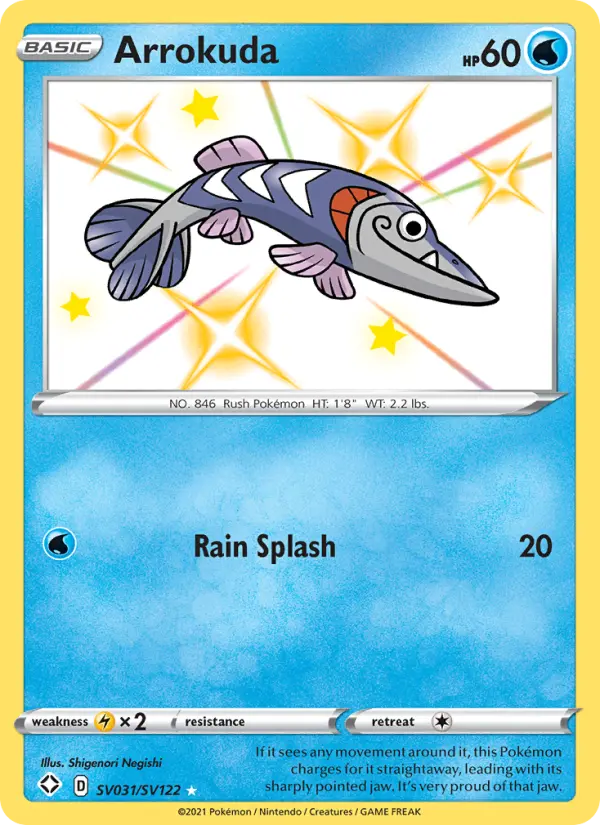
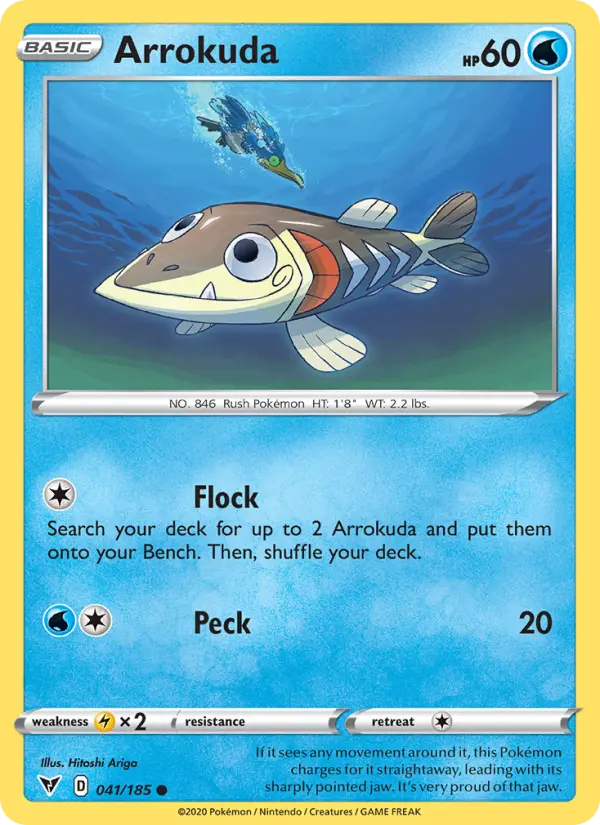
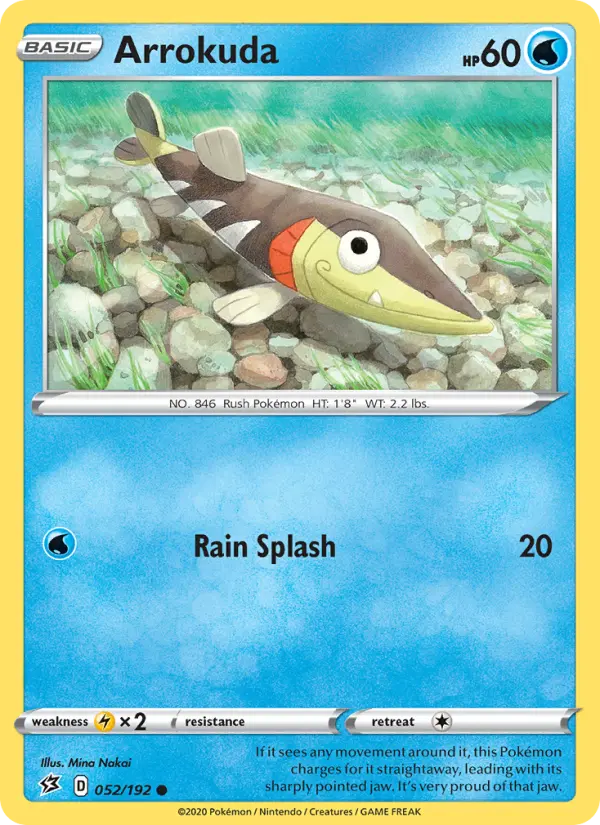
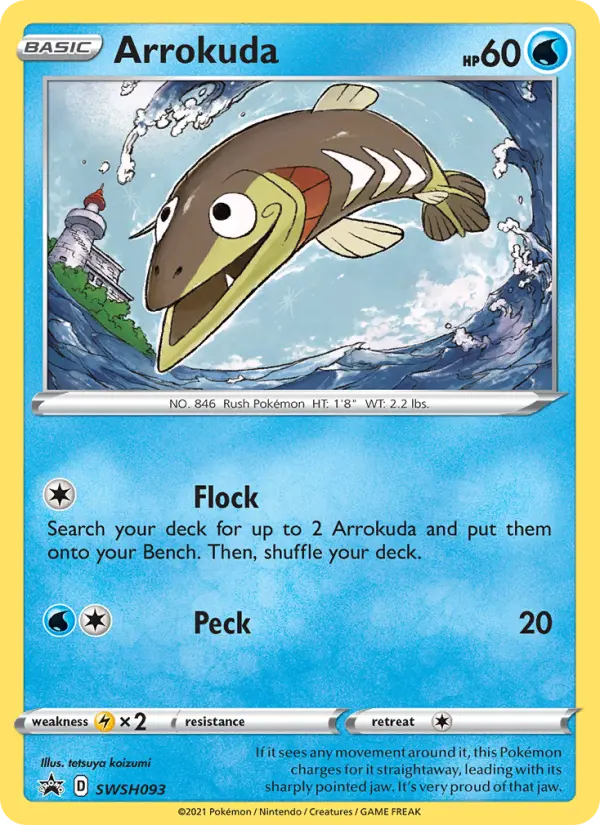
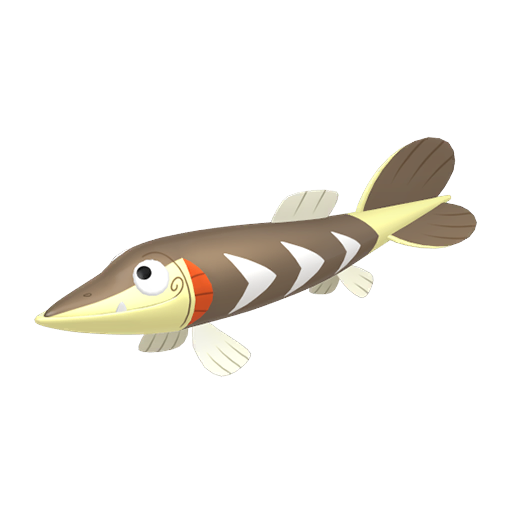
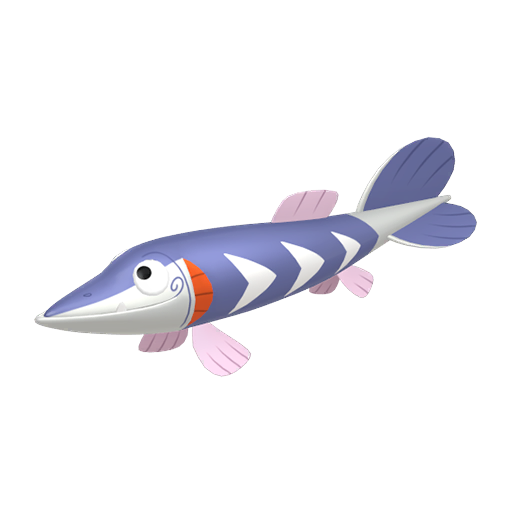
Arrokuda is a small, fish-like Pokémon that bears a striking resemblance to a barracuda, with a body composed primarily of brown and tan coloration. Its most distinctive feature is its pair of small, upward-pointing teeth protruding from its mouth—a trait Arrokuda is notably proud of according to Pokédex entries. The creature possesses five fins distributed across its body: two pelvic fins, two anal fins, and one dorsal fin, allowing for aquatic maneuvering despite its limited swimming mechanics. Its tail features three back fins arranged in a propeller-like formation, beginning in tan coloration but darkening to brown at the edges, which both give the Pokémon its name and form the biological basis for its signature ability. Arrokuda also displays two distinctive red spots positioned behind its jaw and three white scales running along each side of its body. At merely 0.5 meters in height and weighing only 1.0 kilogram, Arrokuda ranks among the smallest water-type Pokémon, contributing to its vulnerable status in natural ecosystems.
Pokedex Numbers
Training
Breeding
Arrokuda Breeding, Gender Ratio & Egg Groups
Arrokuda splits evenly down the middle — 50% male, 50% female. The species belongs to the Water 2 egg group, which comprises primarily aquatic and semi-aquatic Pokémon, restricting breeding partners to other creatures within this group. Arrokuda has a base friendship value of 50, indicating a neutral disposition that requires effort to develop into a genuinely affectionate bond with trainers. The species follows a slow growth rate, meaning it requires significantly more experience points to level up compared to species with medium or fast growth rates, extending the time required to reach its evolution threshold of level 26. When breeding Arrokuda, trainers can produce offspring that inherit egg moves including Acupressure, Night Slash, Slash, and Thrash, moves not naturally learned through leveling that can provide competitive advantages when passed to offspring. The hatch counter value of 20 cycles translates to approximately 4,884 to 5,140 steps required for an egg to hatch, positioning Arrokuda within the mid-range for hatch times among Generation VIII Pokémon.
Sprites




TMs & HMs
tm03
ruby sapphire
tm03
platinum
tm03
firered leafgreen
tm03
heartgold soulsilver
tm03
diamond pearl
tm03
emerald
tm03
xd
tm03
colosseum
tm05
lets go pikachu lets go eevee
tm07
lets go pikachu lets go eevee
tm08
lets go pikachu lets go eevee
tm09
yellow
tm09
red blue
tm98
sun moon
hm03
ruby sapphire
hm03
platinum
hm03
omega ruby alpha sapphire
hm06
gold silver
hm07
ruby sapphire
hm07
platinum
+288 more TMs/HMs
Arrokuda's Evolution Chain


Arrokuda Evolution, Mega Evolution & Special Forms
Arrokuda undergoes a standard single-stage evolution into Barraskewda upon reaching level 26, a relatively early evolution that reflects its role as a base-stage Pokémon. This evolution represents a dramatic transformation from the small, ineffectual Rush Pokémon into a powerful, lance-like water-type that maintains the core barracuda-inspired design while amplifying its predatory characteristics. Barraskewda's stats show significant improvement across the board, particularly in Attack and Speed, transforming Arrokuda's speed advantage into a genuinely threatening competitive presence. The evolved form retains the propeller-tail design but manifests it with greater ferocity and control, allowing Barraskewda to effectively utilize its straight-line swimming constraint as an asset rather than a liability. The evolution fundamentally addresses Arrokuda's weaknesses—its fragility (base Defense of 40) and low Special Defense (base 30) are replaced by Barraskewda's more balanced defensive profile, while its respectable Attack of 63 becomes Barraskewda's commanding strength, making the evolved form a genuinely viable threat in competitive frameworks.
Where to Find
Location data not available for this Pokémon in the database.
Arrokuda Behaviour and Natural Habitat
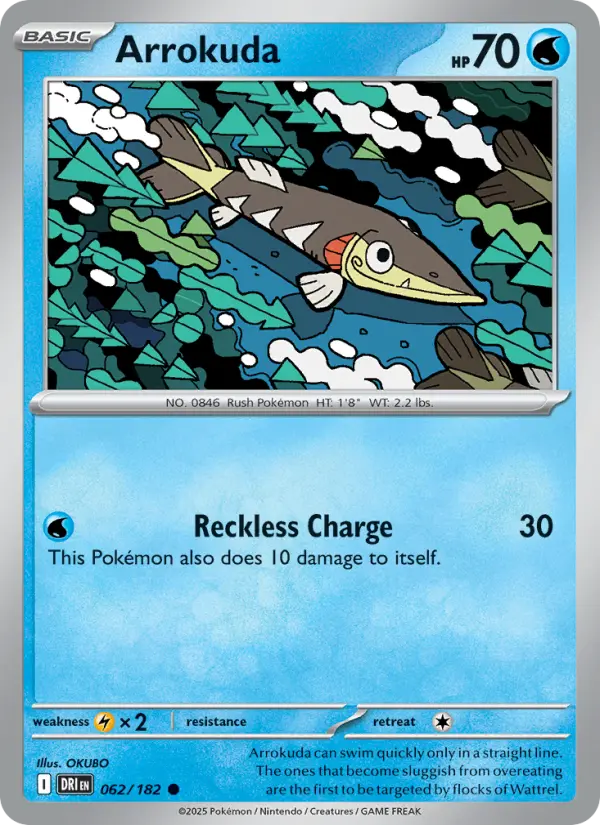
Arrokuda is characterized by aggressive and straightforward behavior, immediately charging at any movement it detects in its vicinity with its sharply pointed jaw. However, this combative nature is significantly hampered by its poor eyesight, resulting in a remarkably low success rate for these charges despite the Pokémon's confident demeanor. The creature can only swim in a straight line, restricting its maneuverability in three-dimensional aquatic environments and making it vulnerable to predation. One of Arrokuda's most significant behavioral vulnerabilities occurs after it has consumed a full meal—its movements become extremely sluggish during digestion, leaving it defenseless against its primary predators. In the Galar region, Cramorant specializes in hunting satiated Arrokuda, catching them in its cavernous mouth and sometimes expelling them violently when attacked. This predator-prey relationship becomes so significant that Cramorant actually incorporates Arrokuda into its combat strategy during moves like Surf and Dive. In the Paldea region, Wattrel has become Arrokuda's primary predator, creating a similar dangerous dynamic for the Rush Pokémon when it becomes sluggish from overeating.
Pokedex Entries
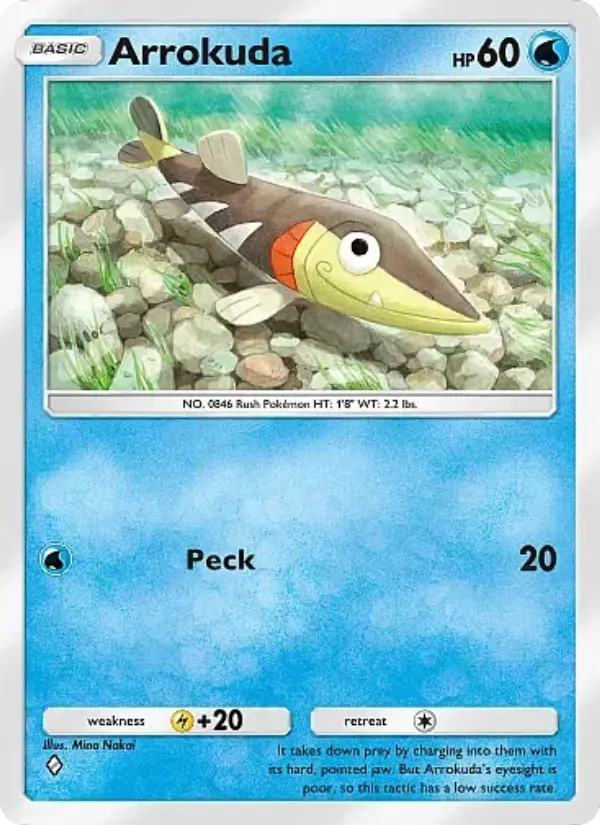
If it sees any movement around it, this Pokémon charges for it straightaway, leading with its sharply pointed jaw. It’s very proud of that jaw.
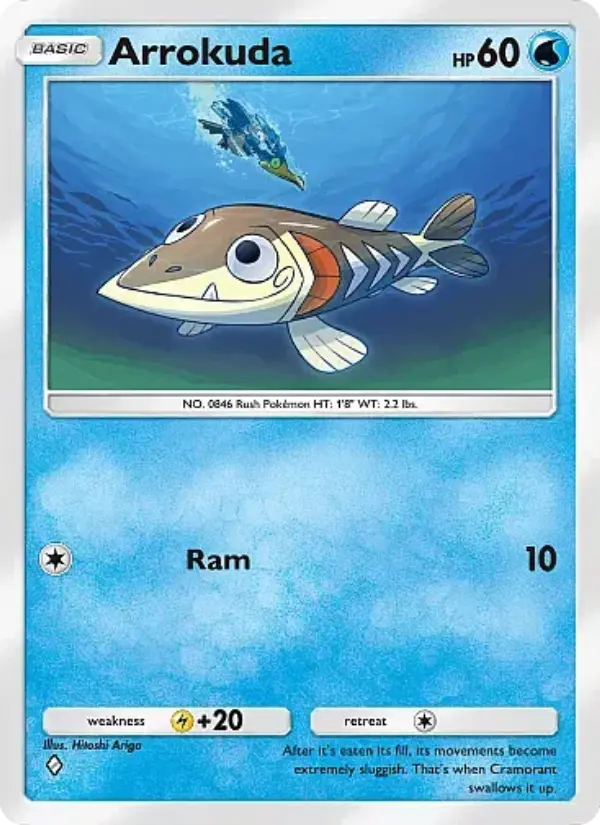
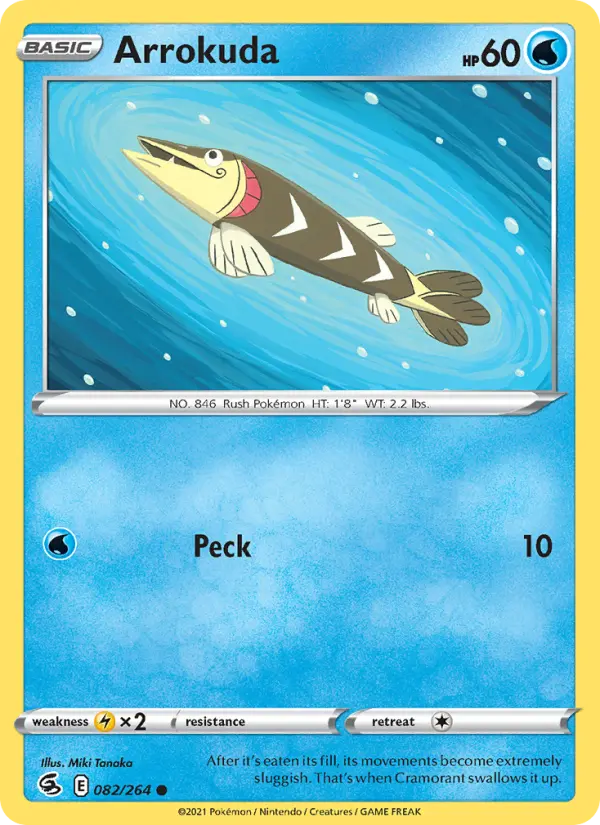
After it’s eaten its fill, its movements become extremely sluggish. That’s when Cramorant swallows it up.
Arrokuda Name Origin & Design Inspiration
Arrokuda's name derives from the Spanish word 'arroz' (rice) combined with 'barracuda,' reflecting the Pokémon's clear inspiration from actual barracuda fish while incorporating linguistic flourishes from Spanish-speaking regions. In Japanese, the Pokémon is called Sasikamasu (サシカマス), a name that combines 'sashi' (刺し, meaning to pierce or stab) with 'kamasu' (カマス, the Japanese word for barracuda). This etymological approach emphasizes the creature's defining characteristic: its sharp, pointed jaw that it uses as its primary weapon. The design intentionally evokes the aesthetic of actual barracudas—sleek predatory fish known for their aggressive strikes and streamlined bodies—while maintaining distinctly Pokémon-like proportions and features. The propeller-like tail fins serve dual purposes, both functionally representing the creature's preferred straight-line swimming method and visually emphasizing its forward-momentum-focused design philosophy. The creature's diminutive size despite its predatory nature creates an intentional contrast that underscores its vulnerability despite its aggressive temperament, making it a thematically cohesive design that communicates both ambition and fragility.
Learnable Moves
Arrokuda can learn 46 moves:
Move | Type | Cat. | Power | Acc. | PP |
|---|---|---|---|---|---|
| acupressure | normal | Status | — | — | 30 |
| agility | psychic | Status | — | — | 30 |
| aqua jet | water | Physical | 40 | 100 | 20 |
| assurance | dark | Physical | 60 | 100 | 10 |
| attract | normal | Status | — | 100 | 15 |
| bite | dark | Physical | 60 | 100 | 25 |
| bounce | flying | Physical | 85 | 85 | 5 |
| brick break | fighting | Physical | 75 | 100 | 15 |
| chilling water | water | Special | 50 | 100 | 20 |
| close combat | fighting | Physical | 120 | 100 | 5 |
| crunch | dark | Physical | 80 | 100 | 15 |
| dive | water | Physical | 80 | 100 | 10 |
| double edge | normal | Physical | 120 | 100 | 15 |
| drill run | ground | Physical | 80 | 95 | 10 |
| endure | normal | Status | — | — | 10 |
| facade | normal | Physical | 70 | 100 | 20 |
| flip turn | water | Physical | 60 | 100 | 20 |
| focus energy | normal | Status | — | — | 30 |
| fury attack | normal | Physical | 15 | 85 | 20 |
| hydro pump | water | Special | 110 | 80 | 5 |
| ice fang | ice | Physical | 65 | 95 | 15 |
| laser focus | normal | Status | — | — | 30 |
| liquidation | water | Physical | 85 | 100 | 10 |
| night slash | dark | Physical | 70 | 100 | 15 |
| peck | flying | Physical | 35 | 100 | 35 |
| poison jab | poison | Physical | 80 | 100 | 20 |
| protect | normal | Status | — | — | 10 |
| psychic fangs | psychic | Physical | 85 | 100 | 10 |
| rain dance | water | Status | — | — | 5 |
| rest | psychic | Status | — | — | 5 |
| round | normal | Special | 60 | 100 | 15 |
| scald | water | Special | 80 | 100 | 15 |
| scale shot | dragon | Physical | 25 | 90 | 20 |
| slash | normal | Physical | 70 | 100 | 20 |
| sleep talk | normal | Status | — | — | 10 |
| snore | normal | Special | 50 | 100 | 15 |
| substitute | normal | Status | — | — | 10 |
| surf | water | Special | 90 | 100 | 15 |
| swift | normal | Special | 60 | — | 20 |
| take down | normal | Physical | 90 | 85 | 20 |
| tera blast | normal | Special | 80 | 100 | 10 |
| thrash | normal | Physical | 120 | 100 | 10 |
| throat chop | dark | Physical | 80 | 100 | 15 |
| water pulse | water | Special | 60 | 100 | 20 |
| waterfall | water | Physical | 80 | 100 | 15 |
| whirlpool | water | Special | 35 | 85 | 15 |
Arrokuda Competitive Battle Guide
Arrokuda's competitive viability is limited by its comprehensive stat distribution, with a total base stat sum of only 280 and no individual stat exceeding 66. Its highest stat is Speed at 66 base, which, while respectable for early-game play, falls short of competitive thresholds once trainers access higher-tier water-types like Gastrodon or Lapras. Its offensive capability is hampered by a mere 63 base Attack and 40 base Special Attack, forcing trainers to carefully select coverage moves to avoid complete vulnerability. However, Arrokuda's hidden ability Propeller Tail provides genuine strategic value by ignoring opponent moves and abilities that switch in Pokémon, such as Dragon Tail or Eject Button effects, creating niche utility in specific match-ups. The creature learns Aqua Jet as a priority move from level 1, granting it access to priority-based offense that can outspeed opponents despite its modest Speed stat. In competitive contexts, Arrokuda is primarily utilized in early-game or casual formats; serious competitive players typically wait until evolution into Barraskewda to field the species, as the evolved form's dramatically improved statistics and enhanced Speed stat (123 base) make it genuinely threatening.
Commonly Asked Questions About Arrokuda
What type is Arrokuda?
Arrokuda is a water type Pokemon.
What does Arrokuda evolve into?
Arrokuda evolves into barraskewda.
What are Arrokuda's weaknesses?
Arrokuda is weak to grass and electric type moves.
Does Arrokuda evolve by trading?
No — Arrokuda evolves entirely through leveling up, with no trade required at any stage.
Arrokuda Cultural Impact & Franchise History
Arrokuda has established itself as a memorable introduction to the Generation VIII water-type roster, appearing prominently in Pokémon Sword and Shield promotional materials and serving as an accessible first water-type encounter in Galar. The species has garnered attention for its predator-prey relationship with Cramorant, a dynamic that manifests mechanically in battles and narratively in Pokédex entries, creating an ecosystem feel that resonates with players invested in Pokémon worldbuilding. Its distinctive appearance and aggressive personality have made it a favorite among fan communities, inspiring artwork, discussions about its competitive potential, and analysis of its ecological role within the Galar region. The Propeller Tail ability has become iconic to the species and its evolution, generating interest in move mechanics and ability interactions within the competitive community. Despite its statistical limitations, Arrokuda has maintained cultural relevance through subsequent generations, appearing in Pokémon Scarlet and Violet with expanded Pokédex entries detailing its regional variant predator relationships with Wattrel. The creature's design simplicity and clear barracuda inspiration have made it pedagogically useful in introducing players to the concept of specialized predators within Pokémon ecosystems.
Where to Find Arrokuda in Every Pokémon Game
Arrokuda is available in Pokémon Sword and Shield as a native Generation VIII species with a remarkably high capture rate of 255, making it nearly guaranteed to catch in any encounter. In Sword and Shield, Arrokuda can be found in the Galar region at Pokédex number #180, with additional availability in the Isle of Armor DLC at #096. The species did not receive Pokédex entries in Pokémon Brilliant Diamond, Shining Pearl, or Legends: Arceus, indicating its absence from those games. In Pokémon Scarlet and Violet, Arrokuda returned as an available species with Pokédex number #0136 in the regional Pokédex and #0090 in The Teal Mask DLC. The creature has not yet appeared in Pokémon Legends: Z-A, though its potential future availability remains speculative. Arrokuda's wide availability across multiple games and generations, combined with its high capture rate and early-game accessibility, has made it one of the more commonly obtained water-types for players beginning their Galar adventures. The species' presence in multiple game iterations ensures that players seeking a water-type starter alternative or team member have consistent access to Arrokuda throughout various Pokémon titles released since Generation VIII.