Croconaw
Generation II · #0159 — Big Jaw Pokémon
Trainers who write off Croconaw on looks alone are missing that its Attack of 80 is genuinely one of the higher marks among water-type Pokémon. With a aggregate stat total of 405, Croconaw demonstrates balanced physical capabilities, particularly excelling in Attack and Defense with 80 points each. Its Torrent ability activates when its HP drops to one-third or below, amplifying Water-type moves to 1.5 times their normal power, making it a dangerous opponent even when weakened. The hidden ability Sheer Force offers an alternative playstyle, increasing the power of moves with secondary effects by 1.3 times while preventing those effects from occurring. Standing at 1.1 meters tall and weighing 25.0 kilograms, Croconaw is a moderately sized Pokémon that falls squarely between its smaller pre-evolution and larger evolution.
Editor's Take
Croconaw is the middle stage nobody minds keeping, and Feraligatr evolving at 30 makes the Totodile line the most convenient of the Johto starters to actually play with.
Base Stats
Height
1.1m
Weight
25.0kg
Category
Big Jaw Pokémon
Gender
Male 87.5% / Female 12.5%
Color
blue
Shape
upright
Habitat
waters-edge
Abilities
Strengthens water moves to inflict 1.5× damage at 1/3 max HP or less.
Strengthens moves with extra effects to 1.3× their power, but prevents their extra effects.

Croconaw Biology & Physical Characteristics
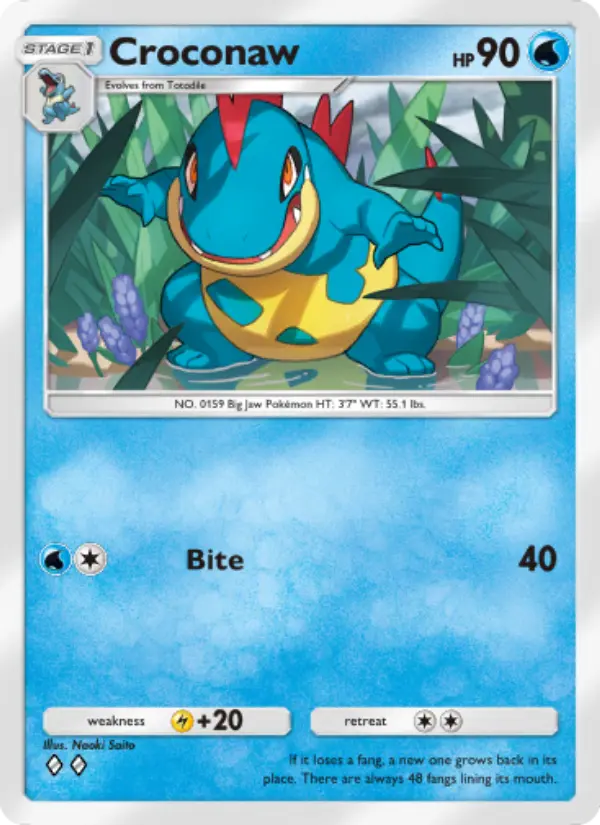
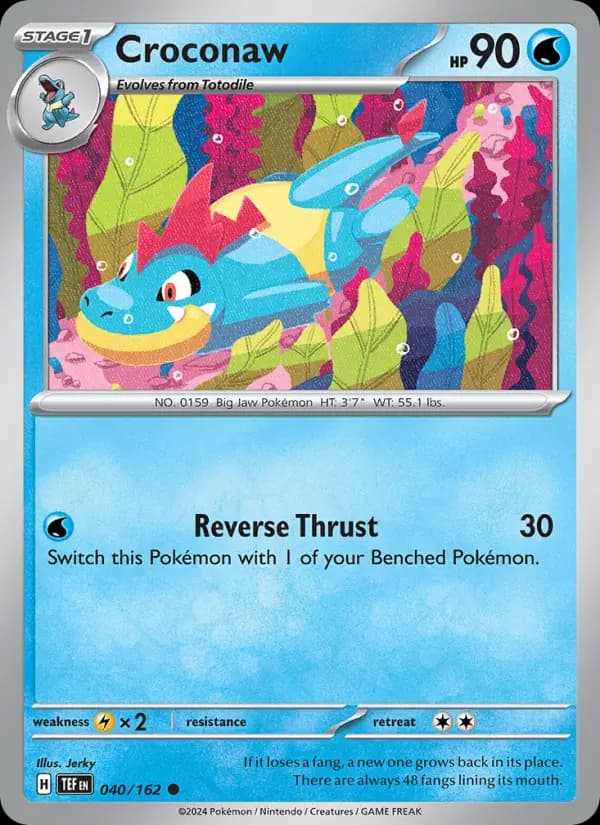
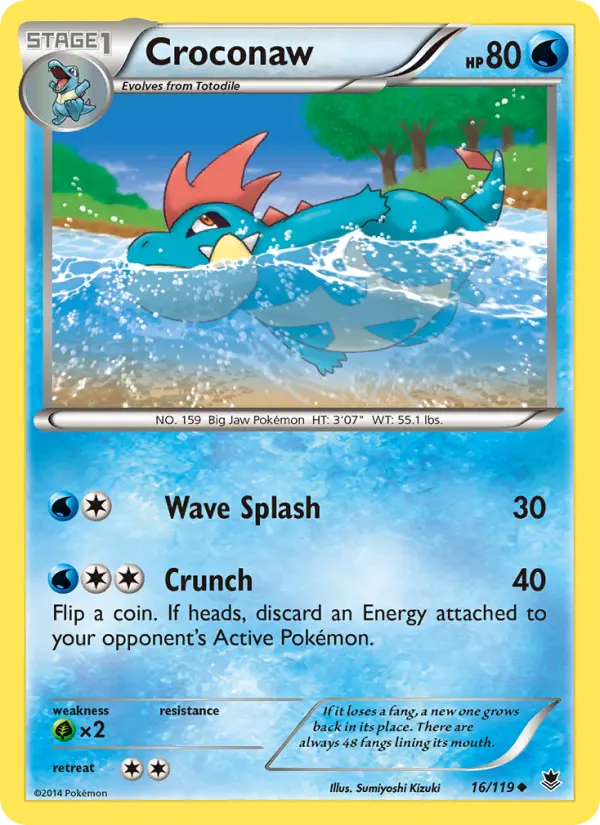
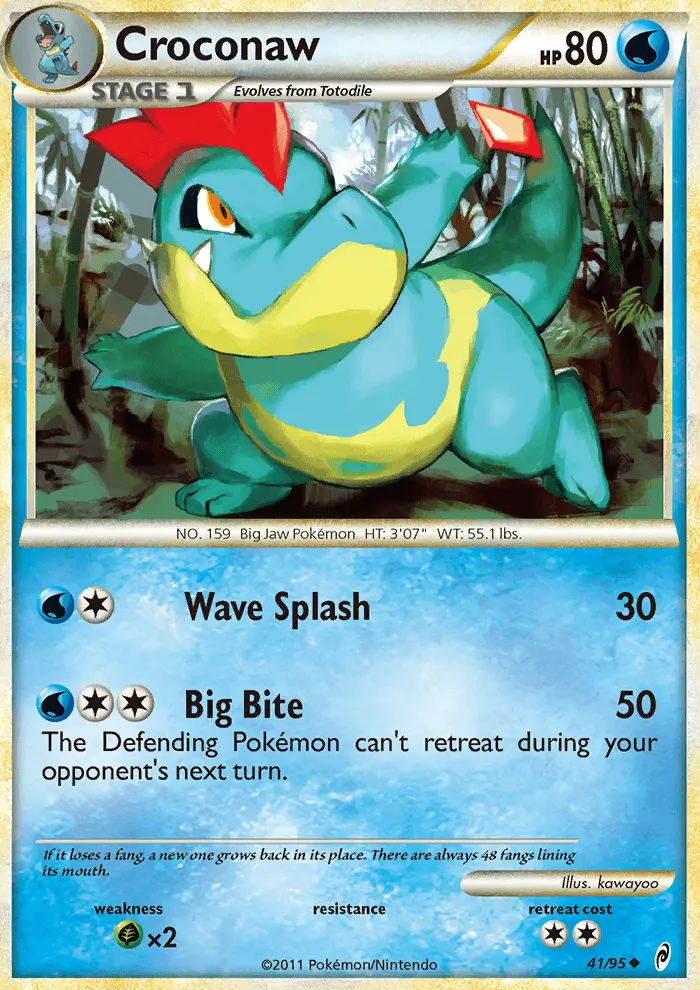
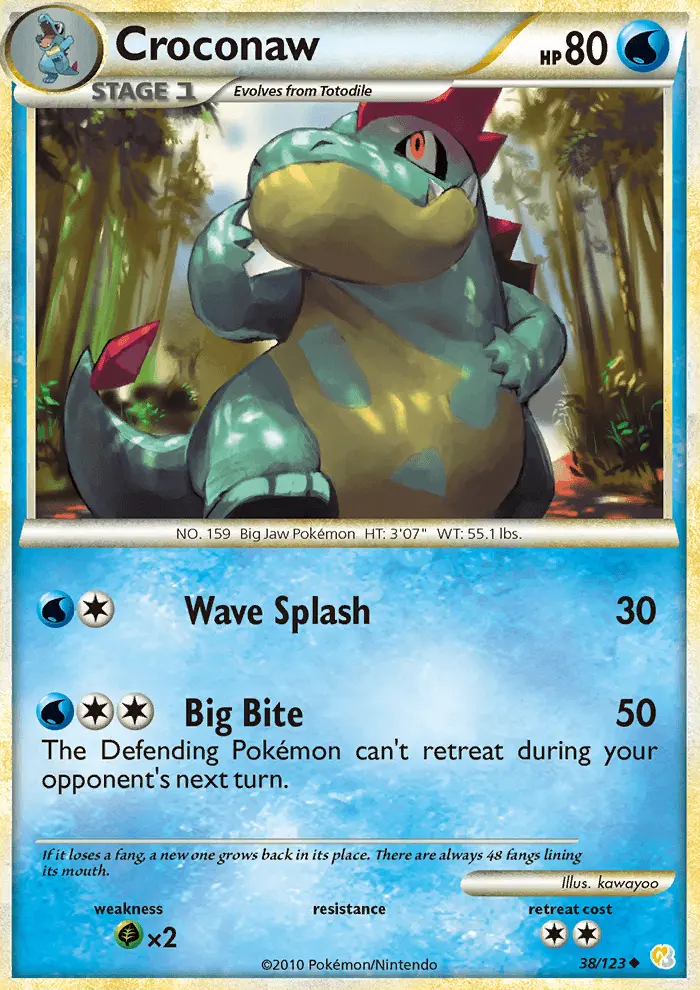
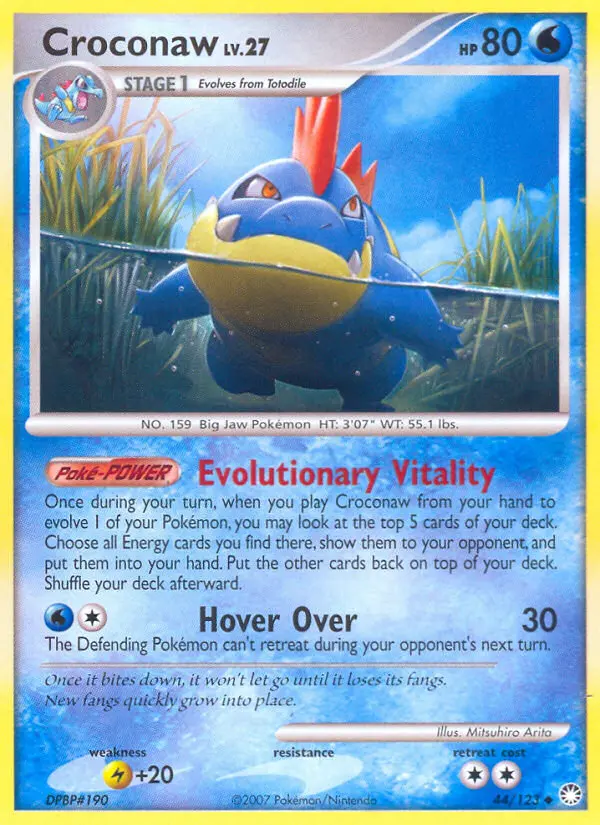
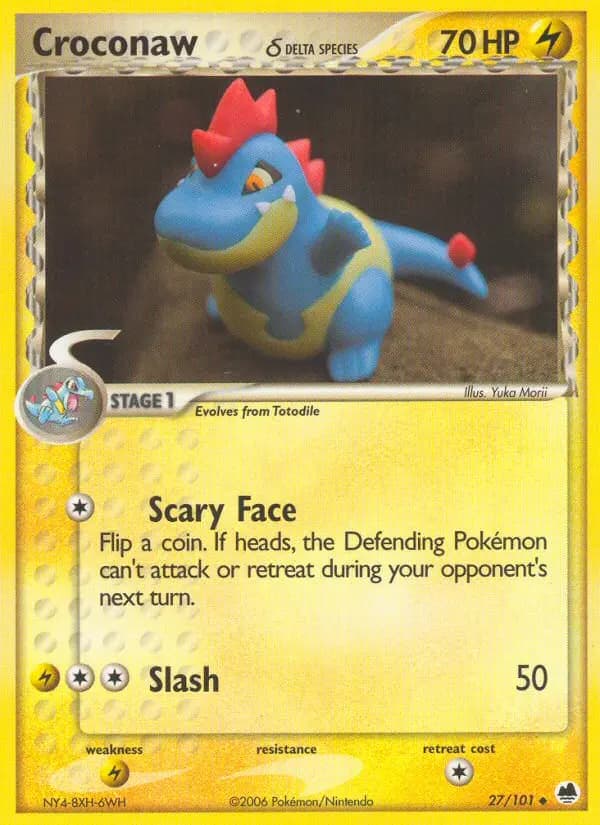
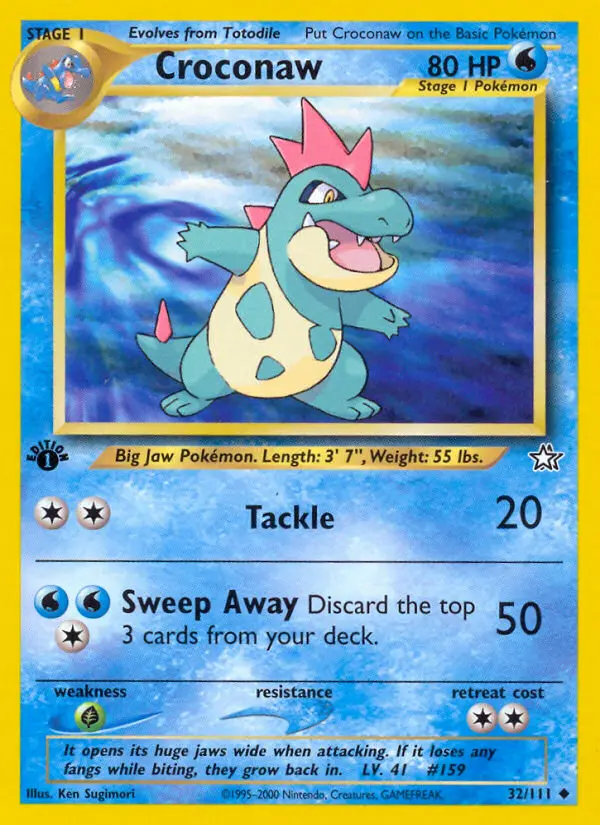
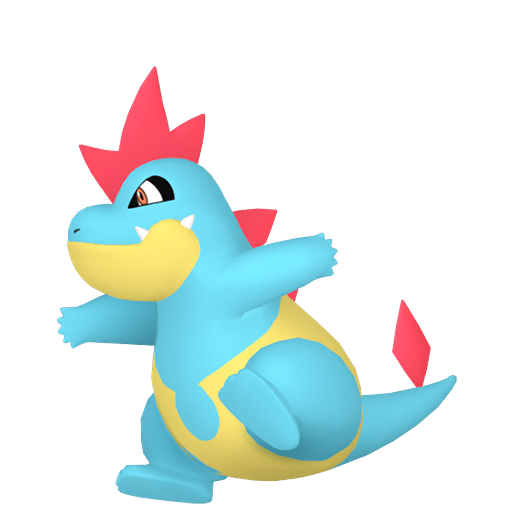
Croconaw is a bipedal, crocodilian Pokémon characterized by its well-developed, rounded jaws and distinctive dentition. The most striking biological feature documented across Pokédex entries is its remarkable dental system: Croconaw perpetually maintains forty-eight fangs lining its mouth, and these teeth possess backward-slanted tips similar to barbed fishhooks. This anatomical adaptation ensures that once Croconaw's fangs penetrate a target, removal becomes virtually impossible without the fang breaking or the Pokémon releasing its grip voluntarily. If a fang is lost during combat or feeding, a replacement grows back in its place with remarkable speed, ensuring this apex water predator never loses its primary hunting advantage. Beyond its fearsome dentition, Croconaw displays three clusters of prominent red spikes across its body: one with three points crowning its head, another with two points between its shoulders, and a diamond-shaped formation near the tip of its tail. Its coloration is predominantly blue across its body, with a distinctive yellow lower jaw and an asymmetrical yellow-and-blue pattern across its chest resembling spotted animal hide. The Pokémon possesses red eyes marked with black bands, giving it an intense, focused appearance suited to its predatory nature.
Pokedex Numbers
Training
Breeding
Croconaw Breeding, Gender Ratio & Egg Groups
Croconaw exhibits a pronounced sexual dimorphism in gender distribution, with approximately 87.5% of individuals being male and 12.5% female, meaning male Croconaw are roughly seven times more common than females in the wild. This heavily male-biased ratio creates interesting dynamics in breeding populations and wild encounters. Both male and female Croconaw belong to two egg groups: the Monster egg group and the Water 1 egg group, providing flexibility in breeding combinations with other compatible Pokémon. The species has a base happiness value of 70, indicating moderate friendliness toward trainers, and requires twenty egg cycles to hatch from an egg—approximately 4,884 to 5,140 steps depending on various in-game mechanics. When breeding Croconaw with compatible partners, offspring will emerge as Totodile rather than directly as Croconaw, following the standard inheritance pattern of starter Pokémon lines. The gender ratio's heavy male bias may reflect real-world crocodilian populations where male bias occurs in certain temperature-dependent sex determination scenarios, lending biological plausibility to the Pokédex data. Trainers seeking female Croconaw for breeding purposes will find them considerably rarer than males, making them more challenging to locate for specific breeding projects.
Sprites




TMs & HMs
tm00
sword shield
tm01
yellow
tm01
gold silver
tm01
crystal
tm01
red blue
tm01
platinum
tm01
emerald
tm01
diamond pearl
tm01
firered leafgreen
tm01
ruby sapphire
tm01
black white
tm01
black 2 white 2
tm01
xd
tm01
colosseum
tm01
heartgold soulsilver
tm01
lets go pikachu lets go eevee
tm01
ultra sun ultra moon
tm01
omega ruby alpha sapphire
tm01
sun moon
tm01
x y
+773 more TMs/HMs
Croconaw's Evolution Chain


Croconaw Evolution, Mega Evolution & Special Forms
Croconaw occupies a crucial position within its evolution line, serving as the second stage between Totodile and Feraligatr. Totodile evolves into Croconaw upon reaching level 18, marking a significant power spike in the young water starter's development. The transformation involves substantial growth, with Croconaw becoming notably larger and more powerful than its pre-evolution, reflected in increased Attack and Defense stats. The visual changes are dramatic: Croconaw develops the two distinctive fangs visible at the corners of its mouth even when closed, gains additional spike formations on its body, and develops a more aggressive overall appearance. At level 30, Croconaw undergoes its final evolution into Feraligatr, a transformation that unleashes its full potential as a formidable water-type predator. This final evolution brings significant stat increases across the board, particularly in Attack and Speed, transforming Croconaw from a balanced mid-stage evolution into an offensive powerhouse. The evolutionary progression mirrors the growth trajectory of a real crocodile, progressing from a small hatchling to a territorial juvenile to a dominant apex predator. Neither Croconaw nor its relatives possess Mega Evolution forms, as the species line was established before Mega Evolution was introduced to the franchise.
Where to Find
Location data not available for this Pokémon in the database.
Croconaw Behaviour and Natural Habitat
Croconaw is a solitary, aggressive predator that exhibits behavior consistent with its crocodilian inspiration. Once its jaws clamp down on a target, it will not release until the effort would cost it its teeth—at which point new fangs quickly grow into place anyway. This relentless grip, combined with its barbed fangs, makes Croconaw an exceptional hunter capable of securing prey that other Water-type Pokémon might lose. According to Pokédex entries across multiple generations, Croconaw is rarely encountered far from water sources, suggesting it spends most of its life in or near aquatic environments where it can hunt effectively. The species exhibits unihemispheric sleep behavior similar to dolphins, resting only half of its brain at a time while keeping one eye open—a trait shared with its evolutionary relatives Totodile and Feraligatr. This adaptation allows Croconaw to remain alert to predators and opportunities even while sleeping, a critical survival advantage in competitive aquatic ecosystems. Croconaw's temperament during these developmental years shows increasing aggression compared to Totodile, with its powerful jaws and predatory instincts taking center stage in its behavioral profile.
Pokedex Entries
If it loses a fang, a new one grows back in its place. There are always 48 fangs lining its mouth.
It opens its huge jaws wide when attacking. If it loses any fangs while biting, they grow back in.
The tips of its fangs are slanted backward. Once those fangs clamp down, the prey has no hope of escape.
Once CROCONAW has clamped its jaws on its foe, it will absolutely not let go. Because the tips of its fangs are forked back like barbed fishhooks, they become impossible to remove when they have sunk in.
Once its jaws clamp down on its foe, it will absolutely not let go. Because the tips of its fangs are forked back like fishhooks, they become irremovably embedded.
It opens its huge jaws wide when attacking. If it loses any fangs while biting, they grow back in.
If it loses a fang, a new one grows back in its place. There are always 48 fangs lining its mouth.
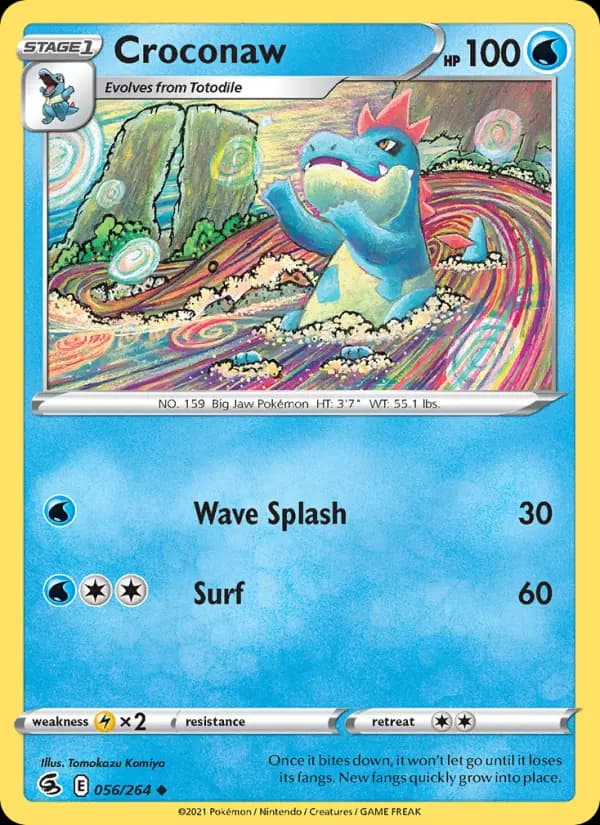
Once it bites down, it won’t let go until it loses its fangs. New fangs quickly grow into place.
If it loses a fang, a new one grows back in its place. There are always 48 fangs lining its mouth.
It opens its huge jaws wide when attacking. If it loses any fangs while biting, they grow back in.
Once it bites down, it won’t let go until it loses its fangs. New fangs quickly grow into place.
Once it bites down, it won’t let go until it loses its fangs. New fangs quickly grow into place.
If it loses a fang, a new one grows back in its place. There are always 48 fangs lining its mouth.
Once it bites down, it won’t let go until it loses its fangs. New fangs quickly grow into place.
Once Croconaw has clamped its jaws on its foe, it will absolutely not let go. Because the tips of its fangs are forked back like barbed fishhooks, they become impossible to remove when they have sunk in.
Once Croconaw has clamped its jaws on its foe, it will absolutely not let go. Because the tips of its fangs are forked back like barbed fishhooks, they become impossible to remove when they have sunk in.
Croconaw Name Origin & Design Inspiration
The name Croconaw combines 'crocodile' with 'gnaw,' reflecting both the Pokémon's crocodilian inspiration and its devastating bite attack. The Japanese name, Alligates, similarly blends 'alligator' with a verbal component, emphasizing the species' predatory mouth-based attacks. As the Big Jaw Pokémon, Croconaw's genus directly acknowledges its most prominent anatomical feature and primary hunting tool. The design philosophy bridges the gap between Totodile's cute, juvenile appearance and Feraligatr's intimidating adult form. Croconaw's two visible fangs and spike formations represent the middle ground in this transition, appearing more dangerous than its pre-evolution while remaining somewhat less terrifying than its final form. The blue coloration with yellow accents maintains visual consistency with Totodile while the increased spike protrusions and more pronounced facial features signal Croconaw's progression toward adulthood and increased predatory capability. The backward-slanted fangs and barbed-hook comparison in Pokédex entries reflect real crocodilian dental anatomy, while the extraordinary regenerative capacity represents the fantastical element of Pokémon biology. The overall aesthetic successfully captures the essence of a juvenile crocodile at the cusp of becoming a formidable predator, neither cute nor fully intimidating.
Learnable Moves
Croconaw can learn 100 moves:
Move | Type | Cat. | Power | Acc. | PP |
|---|---|---|---|---|---|
| aerial ace | flying | Physical | 60 | — | 20 |
| ancient power | rock | Special | 60 | 100 | 5 |
| aqua jet | water | Physical | 40 | 100 | 20 |
| aqua tail | water | Physical | 90 | 90 | 10 |
| attract | normal | Status | — | 100 | 15 |
| bite | dark | Physical | 60 | 100 | 25 |
| blizzard | ice | Special | 110 | 70 | 5 |
| block | normal | Status | — | — | 5 |
| body slam | normal | Physical | 85 | 100 | 15 |
| breaking swipe | dragon | Physical | 60 | 100 | 15 |
| brick break | fighting | Physical | 75 | 100 | 15 |
| captivate | normal | Status | — | 100 | 20 |
| chilling water | water | Special | 50 | 100 | 20 |
| chip away | normal | Physical | 70 | 100 | 20 |
| confide | normal | Status | — | — | 20 |
| counter | fighting | Physical | — | 100 | 20 |
| crunch | dark | Physical | 80 | 100 | 15 |
| curse | ghost | Status | — | — | 10 |
| cut | normal | Physical | 50 | 95 | 30 |
| detect | fighting | Status | — | — | 5 |
| dig | ground | Physical | 80 | 100 | 10 |
| dive | water | Physical | 80 | 100 | 10 |
| double team | normal | Status | — | — | 15 |
| double edge | normal | Physical | 120 | 100 | 15 |
| dragon claw | dragon | Physical | 80 | 100 | 15 |
| dragon dance | dragon | Status | — | — | 20 |
| dynamic punch | fighting | Physical | 100 | 50 | 5 |
| endeavor | normal | Physical | — | 100 | 5 |
| endure | normal | Status | — | — | 10 |
| facade | normal | Physical | 70 | 100 | 20 |
| fake tears | dark | Status | — | 100 | 20 |
| flail | normal | Physical | — | 100 | 15 |
| flatter | dark | Status | — | 100 | 15 |
| fling | dark | Physical | — | 100 | 10 |
| flip turn | water | Physical | 60 | 100 | 20 |
| focus punch | fighting | Physical | 150 | 100 | 20 |
| frustration | normal | Physical | — | 100 | 20 |
| fury cutter | bug | Physical | 40 | 95 | 20 |
| hail | ice | Status | — | — | 10 |
| headbutt | normal | Physical | 70 | 100 | 15 |
| hidden power | normal | Special | 60 | 100 | 15 |
| hone claws | dark | Status | — | — | 15 |
| hydro pump | water | Special | 110 | 80 | 5 |
| ice beam | ice | Special | 90 | 100 | 10 |
| ice fang | ice | Physical | 65 | 95 | 15 |
| ice punch | ice | Physical | 75 | 100 | 15 |
| icy wind | ice | Special | 55 | 95 | 15 |
| iron tail | steel | Physical | 100 | 75 | 15 |
| leer | normal | Status | — | 100 | 30 |
| liquidation | water | Physical | 85 | 100 | 10 |
| low kick | fighting | Physical | — | 100 | 20 |
| mega kick | normal | Physical | 120 | 75 | 5 |
| mega punch | normal | Physical | 80 | 85 | 20 |
| metal claw | steel | Physical | 50 | 95 | 35 |
| mimic | normal | Status | — | — | 10 |
| mud slap | ground | Special | 20 | 100 | 10 |
| muddy water | water | Special | 90 | 85 | 10 |
| natural gift | normal | Physical | — | 100 | 15 |
| power up punch | fighting | Physical | 40 | 100 | 20 |
| protect | normal | Status | — | — | 10 |
| psychic fangs | psychic | Physical | 85 | 100 | 10 |
| rage | normal | Physical | 20 | 100 | 20 |
| rain dance | water | Status | — | — | 5 |
| rest | psychic | Status | — | — | 5 |
| return | normal | Physical | — | 100 | 20 |
| roar | normal | Status | — | — | 20 |
| rock slide | rock | Physical | 75 | 90 | 10 |
| rock smash | fighting | Physical | 40 | 100 | 15 |
| rock tomb | rock | Physical | 60 | 95 | 15 |
| round | normal | Special | 60 | 100 | 15 |
| scald | water | Special | 80 | 100 | 15 |
| scary face | normal | Status | — | 100 | 10 |
| scratch | normal | Physical | 40 | 100 | 35 |
| screech | normal | Status | — | 85 | 40 |
| secret power | normal | Physical | 70 | 100 | 20 |
| seismic toss | fighting | Physical | — | 100 | 20 |
| shadow claw | ghost | Physical | 70 | 100 | 15 |
| slash | normal | Physical | 70 | 100 | 20 |
| sleep talk | normal | Status | — | — | 10 |
| snore | normal | Special | 50 | 100 | 15 |
| spite | ghost | Status | — | 100 | 10 |
| strength | normal | Physical | 80 | 100 | 15 |
| substitute | normal | Status | — | — | 10 |
| superpower | fighting | Physical | 120 | 100 | 5 |
| surf | water | Special | 90 | 100 | 15 |
| swagger | normal | Status | — | 85 | 15 |
| swords dance | normal | Status | — | — | 20 |
| take down | normal | Physical | 90 | 85 | 20 |
| tera blast | normal | Special | 80 | 100 | 10 |
| thief | dark | Physical | 60 | 100 | 25 |
| thrash | normal | Physical | 120 | 100 | 10 |
| toxic | poison | Status | — | 90 | 10 |
| trailblaze | grass | Physical | 50 | 100 | 20 |
| uproar | normal | Special | 90 | 100 | 10 |
| water gun | water | Special | 40 | 100 | 25 |
| water pledge | water | Special | 80 | 100 | 10 |
| water pulse | water | Special | 60 | 100 | 20 |
| waterfall | water | Physical | 80 | 100 | 15 |
| whirlpool | water | Special | 35 | 85 | 15 |
| work up | normal | Status | — | — | 30 |
Croconaw Competitive Battle Guide
Competitively, Croconaw occupies an unusual niche as a middle-stage evolution rarely seen in serious competitive play, as trainers typically use either Totodile for early-game advantages or Feraligatr for late-game power. However, Croconaw possesses a respectable 405 total stat allocation with balanced physical capabilities that make it functional in casual or lower-tier competitive formats. Its Attack and Defense stats both reach 80, providing a solid foundation for physical attacking roles, while its Special Defense of 63 and Special Attack of 59 lag behind its physical capabilities. The Torrent ability remains Croconaw's primary competitive tool, enabling critical comebacks when HP drops below one-third by boosting Water-type moves to 1.5 times their normal damage. Moves learned by Croconaw in early levels include Scratch, Water Gun, and Leer, with access to more powerful moves like Crunch and Waterfall through level-up progression. The hidden ability Sheer Force offers an alternative competitive approach, increasing move power by 1.3 times on moves with secondary effects while removing those effects—a potentially useful tool for specific movesets. Competitive viability remains limited compared to Feraligatr due to lower stat totals, making Croconaw a choice primarily for players seeking challenge runs, casual matches, or themed teams that specifically feature middle-stage evolutions. Its relatively modest speed of 58 makes outspeeding opponents challenging without external boosts.
Commonly Asked Questions About Croconaw
What type is Croconaw?
Croconaw is a water type Pokemon.
What does Croconaw evolve into?
Croconaw evolves into feraligatr.
What are Croconaw's weaknesses?
Croconaw is weak to grass and electric type moves.
Does Croconaw evolve by trading?
No — Croconaw evolves entirely through leveling up, with no trade required at any stage.
Croconaw Cultural Impact & Franchise History
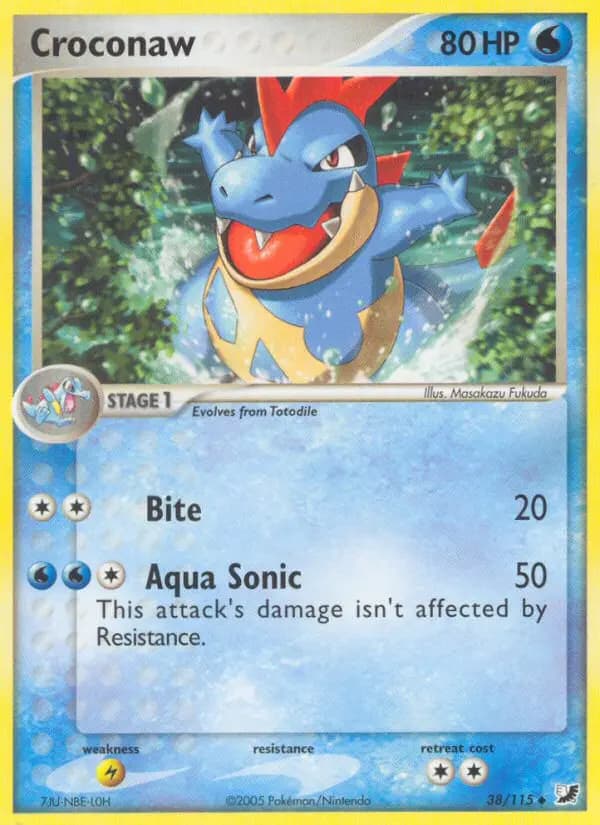
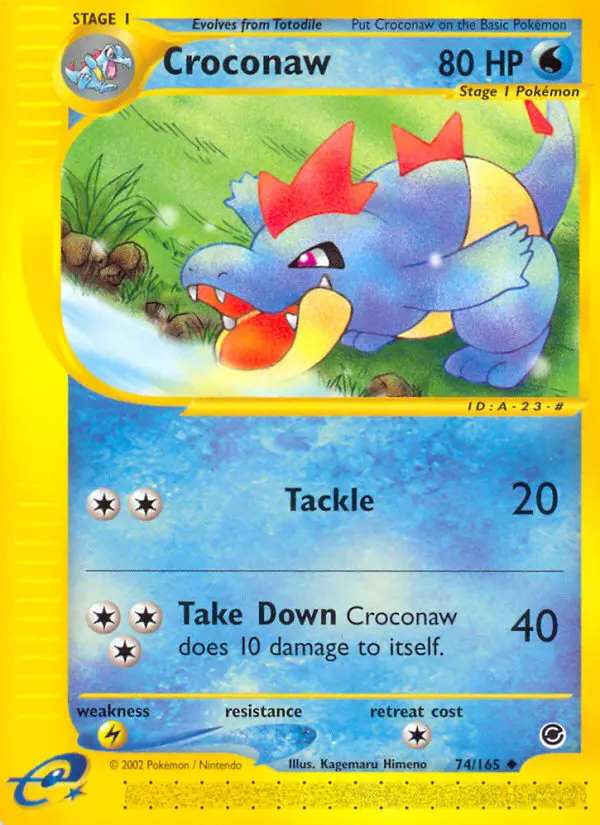
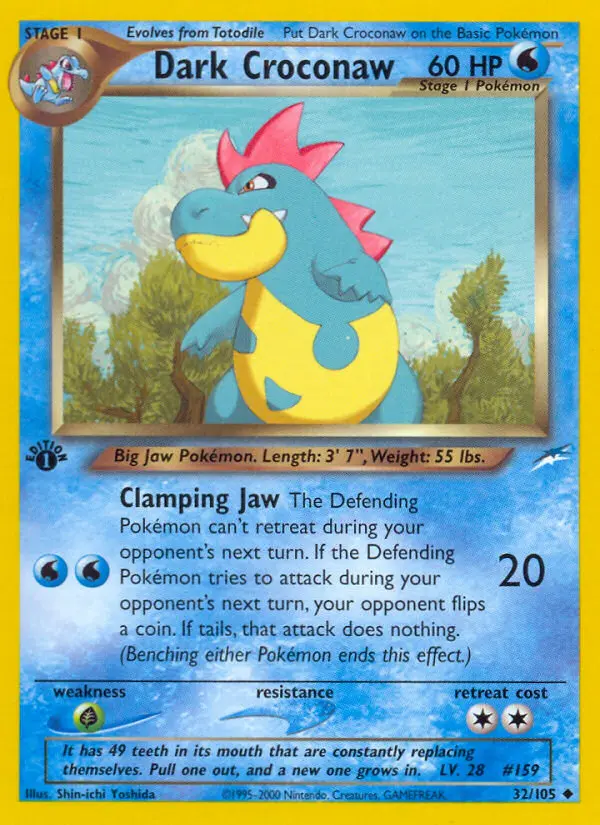
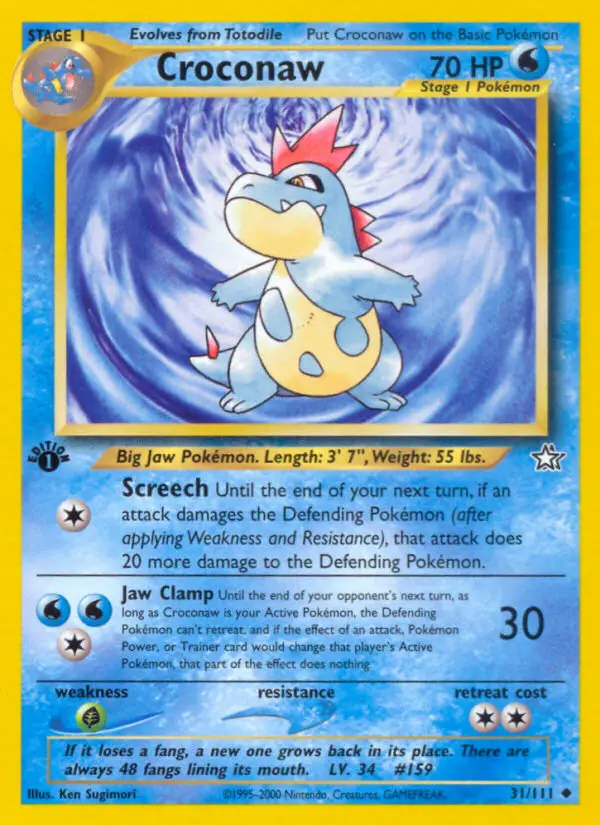
Croconaw has achieved modest recognition within Pokémon culture as a solid member of the Johto starter evolution line, which continues to hold nostalgic significance for players who experienced Generation II during the original Game Boy Color era. The species appears in various Pokémon animated series episodes, most notably in an episode featuring a Croconaw named Wani-Wani that became memorable for its determined personality and powerful bite attacks. Another notable anime appearance involved Khoury's Croconaw, which demonstrated the species' predatory capabilities and aggressive nature through its battle performance. The design has proven consistently appealing to players seeking water-type Pokémon with predatory aesthetics, sitting comfortably in the shadow of both its more iconic pre-evolution and its genuinely intimidating final form. Merchandise featuring Croconaw exists in moderate quantities within the broader Pokémon product ecosystem, though typically receiving less attention than the fan-favorite Feraligatr or the adorable Totodile. The species has maintained consistent presence in the competitive Pokédex community and fan discussions about Generation II Pokémon, respected for its role in the evolutionary line and its balanced stat distribution. Trading card game representations of Croconaw have appeared throughout TCG history, providing collectors with numerous options for building water-type or starter-themed decks, though cards featuring Feraligatr typically command greater collector interest.
Where to Find Croconaw in Every Pokémon Game
Croconaw's availability varies significantly across different Pokémon game generations and regions. In its native Johto region (Generation II: Gold, Silver, and Crystal), Croconaw is available as the evolved form of the Totodile starter Pokémon, obtained by raising a starter Totodile to level 18. In HeartGold and SoulSilver remakes, the same availability applies with identical level-up requirements for evolution. The Hoenn region (Generations III: Ruby, Sapphire, and Emerald) does not include Croconaw in its native Pokédex, making it unavailable in the main story without prior possession or trading. In the Sinnoh region (Diamond, Pearl, and Platinum), Croconaw is similarly unavailable in the primary Pokédex. Later generations gradually incorporated Croconaw into their available Pokémon pools through expanded Pokédexes and post-game content. Legends: Z-A includes Croconaw as entry #0008 in its regional Pokédex. Scarlet and Violet, through their Indigo Disk DLC expansion, made Croconaw available through its regional entry #0180, allowing trainers to acquire and raise the species in modern generation games. Croconaw cannot be encountered in the wild in most games; instead, it is obtained exclusively through evolution of Totodile. Some games permit catching wild Croconaw in specific water-based locations, though these instances remain relatively uncommon compared to more typical water-type encounters.