Crustle
Generation V · #0558 — Stone Home Pokémon
Crustle is a bug/rock-type Pokémon whose defense — 125 at base — does more to define its role than its overall spread does. Standing 1.4 m tall and weighing 200.0 kg, it's built around a distinct combination of bug traits that shapes how it performs both in the wild and in battle. Standing 1.4 meters tall and weighing a substantial 200.0 kilograms, Crustle is a heavily armored insectoid creature that has become emblematic of territorial behavior and defensive prowess in the Pokémon world. Its cumulative stat total of 485 reflects a distribution heavily favoring physical defense, with particularly impressive Attack and Defense values that make it a formidable opponent in battles focused on physical confrontation.
Editor's Take
Crustle's Shell Smash on 125 base Defense and 95 base Attack is a genuine sweeping threat in its tier, and Bug/Rock's quad weaknesses are why it stays there.
Base Stats
Height
1.4m
Weight
200.0kg
Category
Stone Home Pokémon
Gender
Male 50% / Female 50%
Color
red
Shape
armor
Abilities
Prevents being KOed from full HP, leaving 1 HP instead. Protects against the one-hit KO moves regardless of HP.
Protects against critical hits.
Raises Speed and lowers Defense by one stage each upon being hit by a physical move.
Crustle Biology & Physical Characteristics
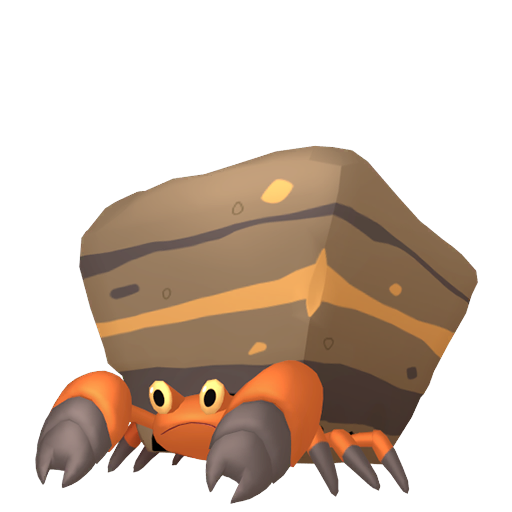
Crustle is an orangish Pokémon whose most striking feature is its massive boulder-like shell, which resembles a cut geological cross-section complete with visible strata and layering. This shell serves as both armor and home, providing exceptional defensive capabilities that allow Crustle to withstand tremendous physical punishment. Beneath this protective exterior lies an insectoid body with six dark gray legs of remarkable strength, enabling this Pokémon to carry heavy stone slabs across arid terrain for extended periods. Its two yellow, glaring eyes peer outward with an expression of determination, while its most dangerous weapons are its thick claws, which are formidable enough to crack the carapace of even Rhyperior. Crustle possesses a straight tail concealed within its shell, and interestingly, the Pokémon exhibits behavioral patterns related to rainfall, preferring not to emerge from its boulder on rainy days due to its adaptation to dry climates. According to the Sleep Style Dex, Crustle can be observed sleeping atop their boulders in four distinct styles: Sheltered Sleep, Unsheltered Sleep, On-Top Sleep, and Atop-Belly Sleep.
Pokedex Numbers
Training
Breeding
Crustle Breeding, Gender Ratio & Egg Groups
Crustle exhibits a perfectly balanced gender ratio with exactly 50% male and 50% female distribution among the species, allowing for straightforward breeding opportunities. The species belongs to both the Bug and Mineral egg groups, providing trainers with diverse breeding possibilities and connection to various evolutionary lines. With a base happiness of 70, Crustle demonstrates moderate receptivity to trainer care, responding well to affectionate treatment and bonding activities. The species has a hatch counter value of 20, indicating that eggs take approximately 4,884 to 5,140 steps to hatch, placing it within a moderate incubation period that balances accessibility with investment. Crustle's medium growth rate means that its experience curve follows a standard progression, requiring consistent training to reach higher levels but not presenting the extreme grinds associated with slow-growth Pokémon.
Sprites




Held Items
Rare Bone
loot
Sell for 5000 Pokédollars, or to Bone Man for 10000 Pokédollars.
Cost: 5000
Rare Bone
loot
Sell for 5000 Pokédollars, or to Bone Man for 10000 Pokédollars.
Cost: 5000
Rare Bone
loot
Sell for 5000 Pokédollars, or to Bone Man for 10000 Pokédollars.
Cost: 5000
Rare Bone
loot
Sell for 5000 Pokédollars, or to Bone Man for 10000 Pokédollars.
Cost: 5000
Hard Stone
type-enhancement
Held: Rock-Type moves from holder do 20% more damage.
Cost: 1000
Hard Stone
type-enhancement
Held: Rock-Type moves from holder do 20% more damage.
Cost: 1000
Hard Stone
type-enhancement
Held: Rock-Type moves from holder do 20% more damage.
Cost: 1000
Hard Stone
type-enhancement
Held: Rock-Type moves from holder do 20% more damage.
Cost: 1000
Hard Stone
type-enhancement
Held: Rock-Type moves from holder do 20% more damage.
Cost: 1000
Hard Stone
type-enhancement
Held: Rock-Type moves from holder do 20% more damage.
Cost: 1000
Hard Stone
type-enhancement
Held: Rock-Type moves from holder do 20% more damage.
Cost: 1000
Hard Stone
type-enhancement
Held: Rock-Type moves from holder do 20% more damage.
Cost: 1000
Hard Stone
type-enhancement
Held: Rock-Type moves from holder do 20% more damage.
Cost: 1000
Hard Stone
type-enhancement
Held: Rock-Type moves from holder do 20% more damage.
Cost: 1000
Hard Stone
type-enhancement
Held: Rock-Type moves from holder do 20% more damage.
Cost: 1000
Hard Stone
type-enhancement
Held: Rock-Type moves from holder do 20% more damage.
Cost: 1000
TMs & HMs
tm01
black white
tm01
black 2 white 2
tm01
omega ruby alpha sapphire
tm01
x y
tm03
yellow
tm03
red blue
tm03
blue japan
tm03
red green japan
tm05
lets go pikachu lets go eevee
tm06
yellow
tm06
gold silver
tm06
red blue
tm06
crystal
tm06
emerald
tm06
firered leafgreen
tm06
diamond pearl
tm06
platinum
tm06
ruby sapphire
tm06
colosseum
tm06
black 2 white 2
+584 more TMs/HMs
Crustle's Evolution Chain


Crustle Evolution, Mega Evolution & Special Forms
Crustle evolves from Dwebble upon reaching level 34, marking a significant physical and statistical transformation. While Crustle does not possess a Mega Evolution or an alternative form, its evolution from Dwebble represents a dramatic increase in size, weight, and combat capability. The evolution process grants Crustle its impressive base Defense stat of 125, a substantial increase from Dwebble's more modest defenses, along with an Attack stat of 105 that emphasizes its role as a physical attacker. The evolution also represents a maturation in the Pokémon's behavior, as Crustle has grown large enough and confident enough to engage in serious territorial disputes with other members of its species. This singular evolutionary line provides a straightforward progression path for trainers seeking to develop a defensive Bug/Rock-type Pokémon with respectable offensive capabilities.
Where to Find
Unova Route 18
unova
+5 more
Seaside Cave
unova
Ultra Space Wilds
alola
Crustle Behaviour and Natural Habitat
Crustle is an intensely territorial Pokémon that inhabits arid, rocky regions where it can establish and defend its domain. These creatures engage in viciously competitive battles with members of their own species, with territorial disputes forming the central conflict of Crustle's social structure. The outcome of these territorial clashes is determined by a singular criterion: whichever Crustle has its boulder broken is deemed the loser, establishing a clear hierarchy based on the integrity of their protective stone. This dependency on an intact shell creates a fascinating psychological dimension to Crustle's behavior—when its boulder is shattered during these territorial conflicts, the Pokémon becomes unsure and noticeably weakens, suggesting a profound psychological connection between its physical armor and its confidence and capability. Crustle prefers dry climates and will remain sheltered within its boulder during rainy weather, displaying an adaptation to arid environments that shapes its daily behavior and mobility patterns.
Pokedex Entries
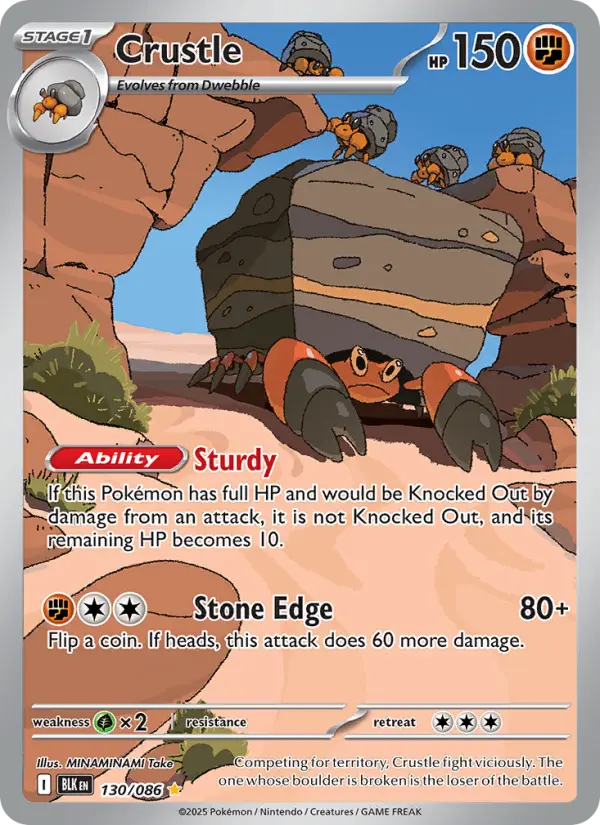
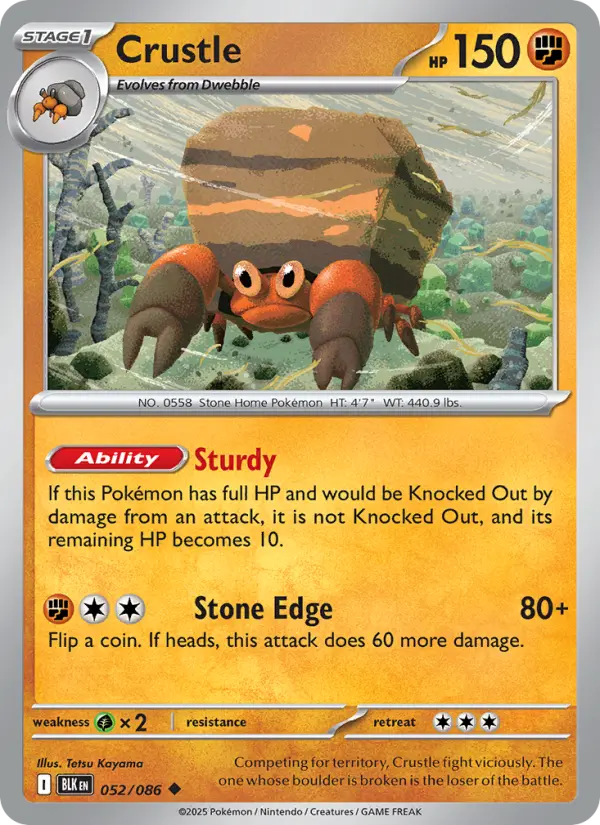
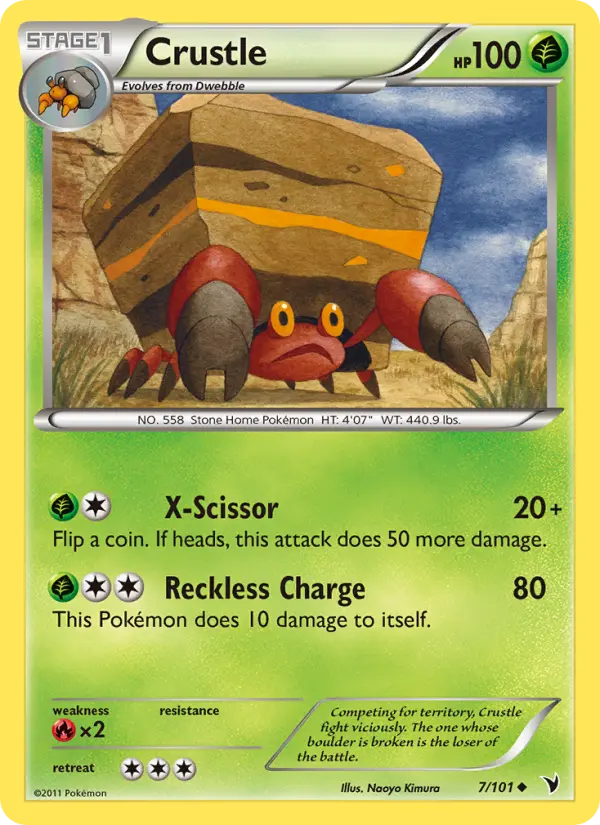
Competing for territory, Crustle fight viciously. The one whose boulder is broken is the loser of the battle.
When its boulder is broken in battles for territory, it feels unsure and begins to weaken.
It possesses legs of enormous strength, enabling it to carry heavy slabs for many days, even when crossing arid land.
It possesses legs of enormous strength, enabling it to carry heavy slabs for many days, even when crossing arid land.
Competing for territory, Crustle fight viciously. The one whose boulder is broken is the loser of the battle.
It possesses legs of enormous strength, enabling it to carry heavy slabs for many days, even when crossing arid land.
Competing for territory, Crustle fight viciously. The one whose boulder is broken is the loser of the battle.
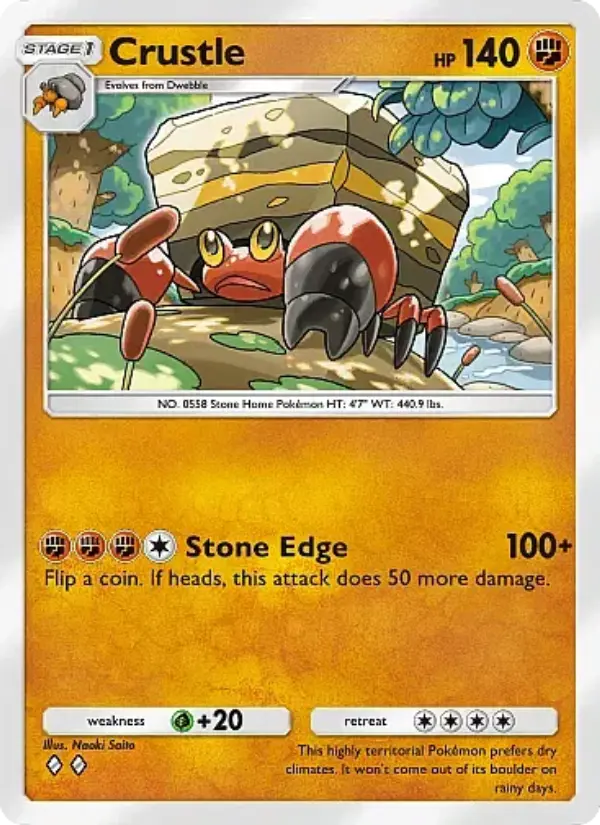
This highly territorial Pokémon prefers dry climates. It won’t come out of its boulder on rainy days.
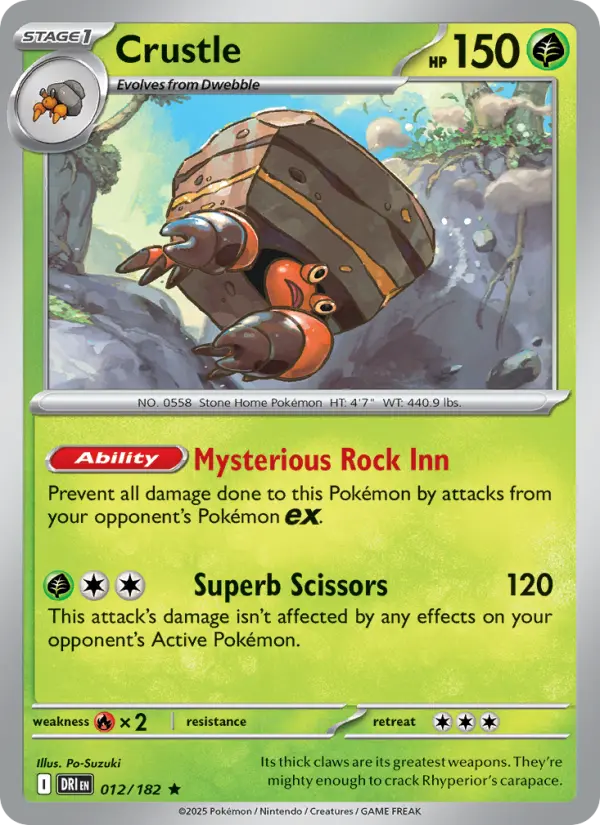
Its thick claws are its greatest weapons. They’re mighty enough to crack Rhyperior’s carapace.
Crustle Name Origin & Design Inspiration
The Japanese name Iwapalace combines the elements 'Iwa' (rock) and 'Palace' (referring to its role as a stone home, establishing its identity as a mobile fortress). The English name 'Crustle' appears to be a portmanteau of 'Crust' and 'Castle,' cleverly encapsulating both the geological nature of its armor and its function as a protective dwelling. The design draws inspiration from hermit crabs that inhabit shells, though Crustle's shell is far more substantial and geological in nature, featuring visible sedimentary layers that emphasize its rocky composition. The visual stratification of the shell references actual geological formations, with distinct layers visible on its orange-brown exterior that create a naturalistic appearance. The creature's overall morphology—combining insectoid characteristics with crustacean elements and incorporating a rock-based home—represents an innovative synthesis of biological inspiration, making Crustle a distinctive design within the Bug/Rock typing that few Pokémon share.
Learnable Moves
Crustle can learn 62 moves:
Move | Type | Cat. | Power | Acc. | PP |
|---|---|---|---|---|---|
| aerial ace | flying | Physical | 60 | — | 20 |
| attract | normal | Status | — | 100 | 15 |
| block | normal | Status | — | — | 5 |
| body press | fighting | Physical | 80 | 100 | 10 |
| bug bite | bug | Physical | 60 | 100 | 20 |
| bulldoze | ground | Physical | 60 | 100 | 20 |
| confide | normal | Status | — | — | 20 |
| cut | normal | Physical | 50 | 95 | 30 |
| dig | ground | Physical | 80 | 100 | 10 |
| double team | normal | Status | — | — | 15 |
| earthquake | ground | Physical | 100 | 100 | 10 |
| endure | normal | Status | — | — | 10 |
| facade | normal | Physical | 70 | 100 | 20 |
| feint attack | dark | Physical | 60 | — | 20 |
| flail | normal | Physical | — | 100 | 15 |
| frustration | normal | Physical | — | 100 | 20 |
| fury cutter | bug | Physical | 40 | 95 | 20 |
| giga impact | normal | Physical | 150 | 90 | 5 |
| heavy slam | steel | Physical | — | 100 | 10 |
| hidden power | normal | Special | 60 | 100 | 15 |
| hone claws | dark | Status | — | — | 15 |
| hyper beam | normal | Special | 150 | 90 | 5 |
| iron defense | steel | Status | — | — | 15 |
| knock off | dark | Physical | 65 | 100 | 20 |
| meteor beam | rock | Special | 120 | 90 | 10 |
| nature power | normal | Status | — | — | 20 |
| poison jab | poison | Physical | 80 | 100 | 20 |
| protect | normal | Status | — | — | 10 |
| rest | psychic | Status | — | — | 5 |
| return | normal | Physical | — | 100 | 20 |
| rock blast | rock | Physical | 25 | 90 | 10 |
| rock polish | rock | Status | — | — | 20 |
| rock slide | rock | Physical | 75 | 90 | 10 |
| rock smash | fighting | Physical | 40 | 100 | 15 |
| rock tomb | rock | Physical | 60 | 95 | 15 |
| rock wrecker | rock | Physical | 150 | 90 | 5 |
| round | normal | Special | 60 | 100 | 15 |
| sand attack | ground | Status | — | 100 | 15 |
| sand tomb | ground | Physical | 35 | 85 | 15 |
| sandstorm | rock | Status | — | — | 10 |
| secret power | normal | Physical | 70 | 100 | 20 |
| shadow claw | ghost | Physical | 70 | 100 | 15 |
| shell smash | normal | Status | — | — | 15 |
| skitter smack | bug | Physical | 70 | 90 | 10 |
| slash | normal | Physical | 70 | 100 | 20 |
| sleep talk | normal | Status | — | — | 10 |
| smack down | rock | Physical | 50 | 100 | 15 |
| snore | normal | Special | 50 | 100 | 15 |
| solar beam | grass | Special | 120 | 100 | 10 |
| solar blade | grass | Physical | 125 | 100 | 10 |
| spikes | ground | Status | — | — | 20 |
| stealth rock | rock | Status | — | — | 20 |
| stomping tantrum | ground | Physical | 75 | 100 | 10 |
| stone edge | rock | Physical | 100 | 80 | 5 |
| strength | normal | Physical | 80 | 100 | 15 |
| struggle bug | bug | Special | 50 | 100 | 20 |
| substitute | normal | Status | — | — | 10 |
| swagger | normal | Status | — | 85 | 15 |
| swords dance | normal | Status | — | — | 20 |
| toxic | poison | Status | — | 90 | 10 |
| withdraw | water | Status | — | — | 40 |
| x scissor | bug | Physical | 80 | 100 | 15 |
Crustle Competitive Battle Guide
In tournament-level play, Crustle fills a specialized defensive niche with its exceptional base Defense stat of 125, which is complemented by adequate HP (70) and Special Defense (75) to create a reasonably well-rounded defensive profile. Its base Attack of 105 provides legitimate offensive presence, allowing Crustle to threaten opponents rather than serving purely as a defensive wall. The critical weakness lies in its abysmal base Speed of 45, making Crustle vulnerable to faster threats unless supported by team members or held items that mitigate this vulnerability. Its ability selection provides valuable options: Sturdy prevents immediate knockout from full health and protects against one-hit KO moves, making it exceptionally resilient in specific match-ups; Shell Armor blocks critical hits, further enhancing its defensive capabilities; and the hidden ability Weak Armor, while reducing Defense, grants Speed boosts when struck by physical moves, potentially transforming Crustle's speed liability into an asset. Crustle's Bug/Rock typing grants resistances to Normal and Flying moves while providing immunities through its abilities, though the typing introduces significant weaknesses to Water, Grass, and Rock-type attacks that savvy opponents can exploit. In team compositions, Crustle functions best as a physical wall that discourages contact-based attackers and pairs well with team members capable of covering its offensive weaknesses.
Commonly Asked Questions About Crustle
What type is Crustle?
Crustle is a bug and rock type Pokemon.
What does Crustle evolve from?
Crustle evolved from dwebble.
What are Crustle's weaknesses?
Crustle is weak to rock, steel and water type moves.
Where can I find Crustle?
Crustle can be found in unova route 18 (unova), seaside cave (unova) and ultra space wilds (alola).
Crustle Cultural Impact & Franchise History
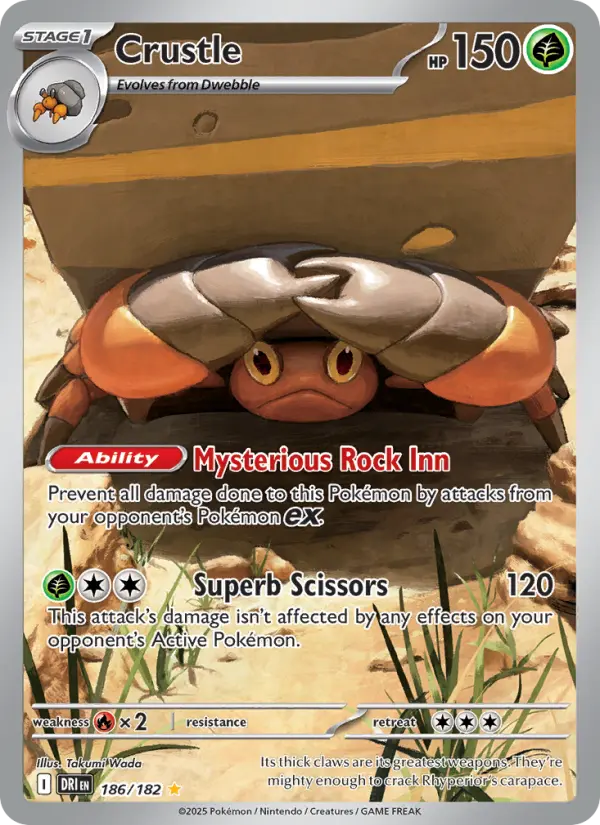
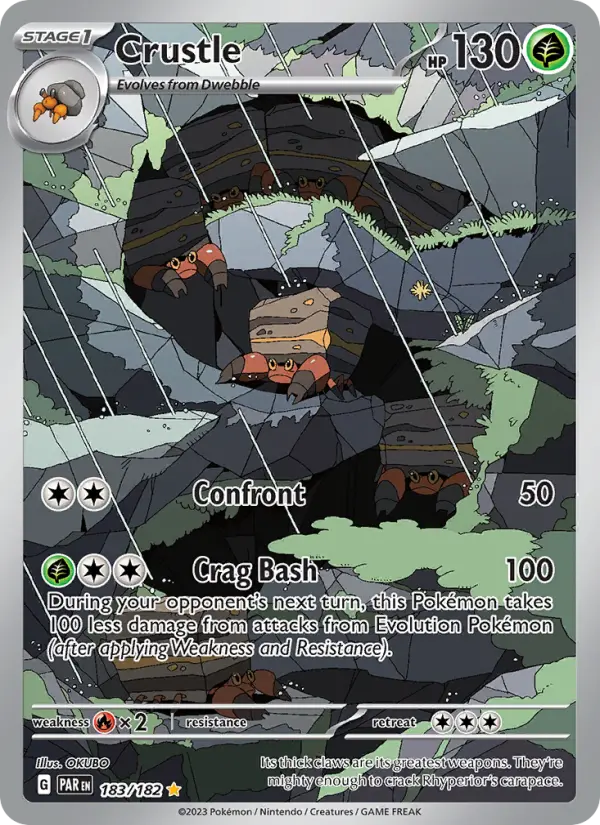
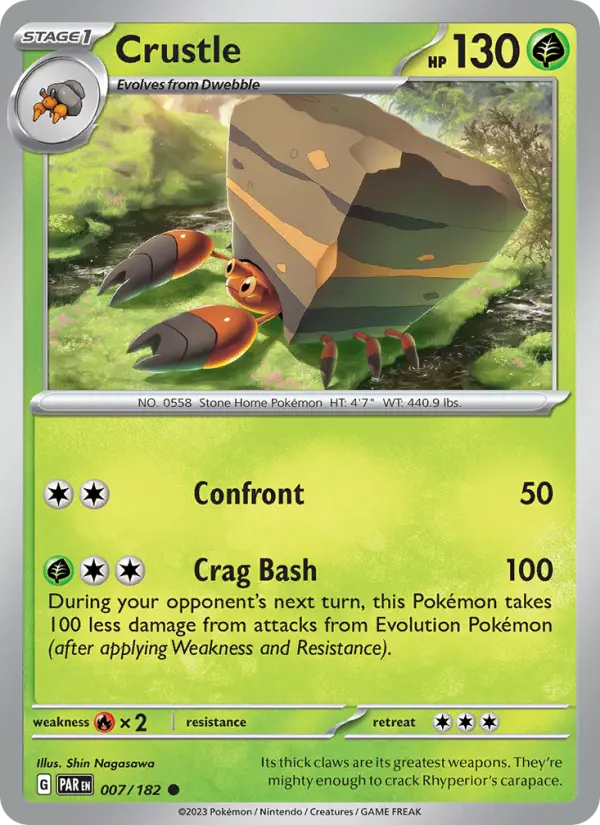
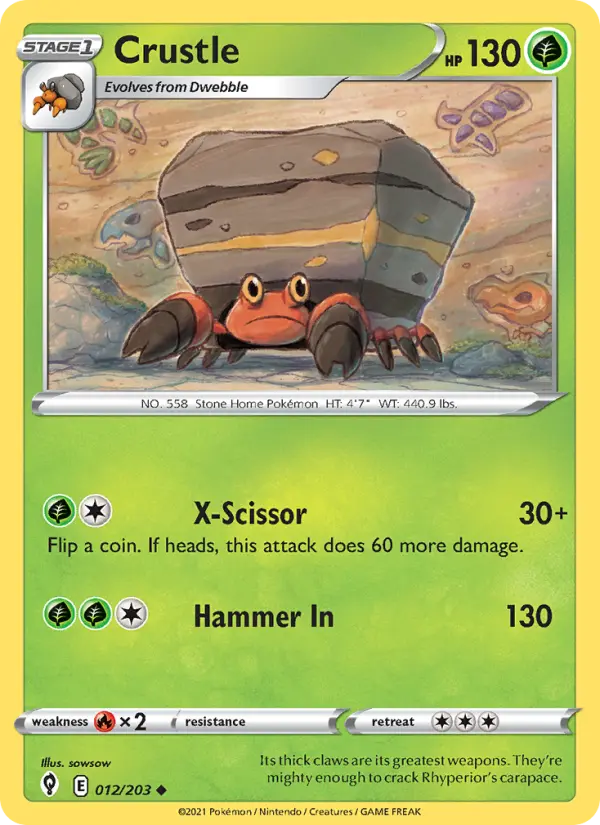
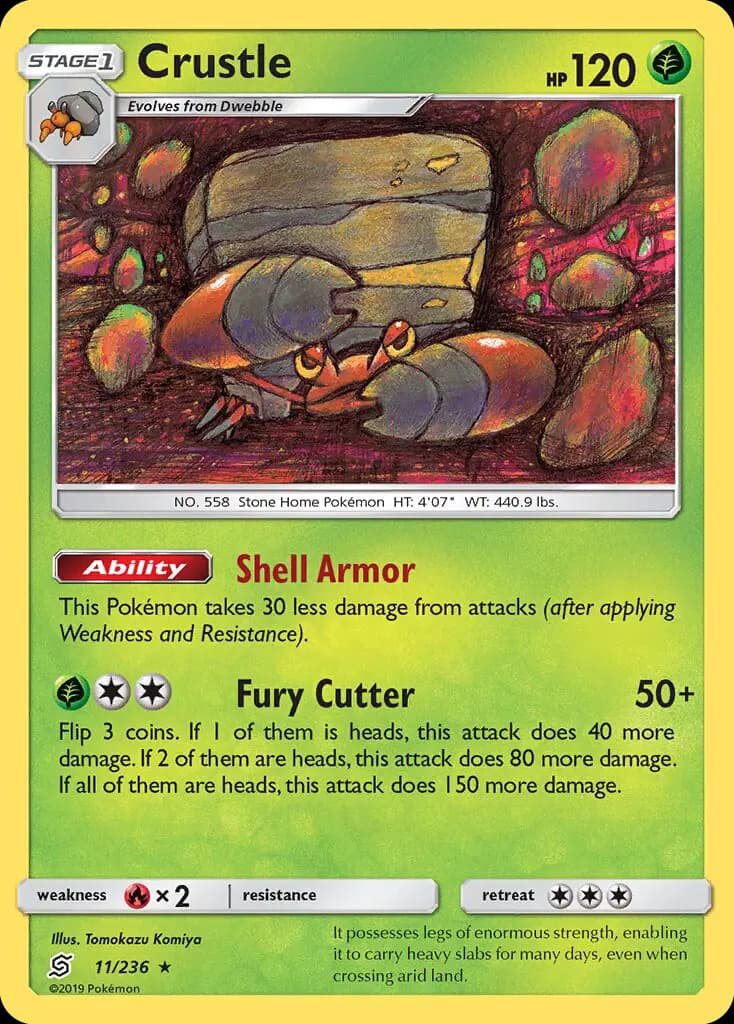
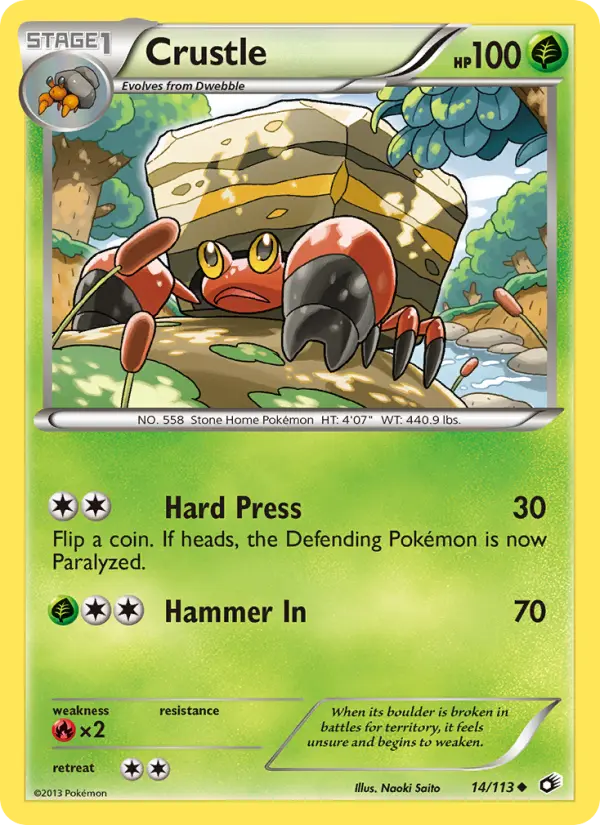
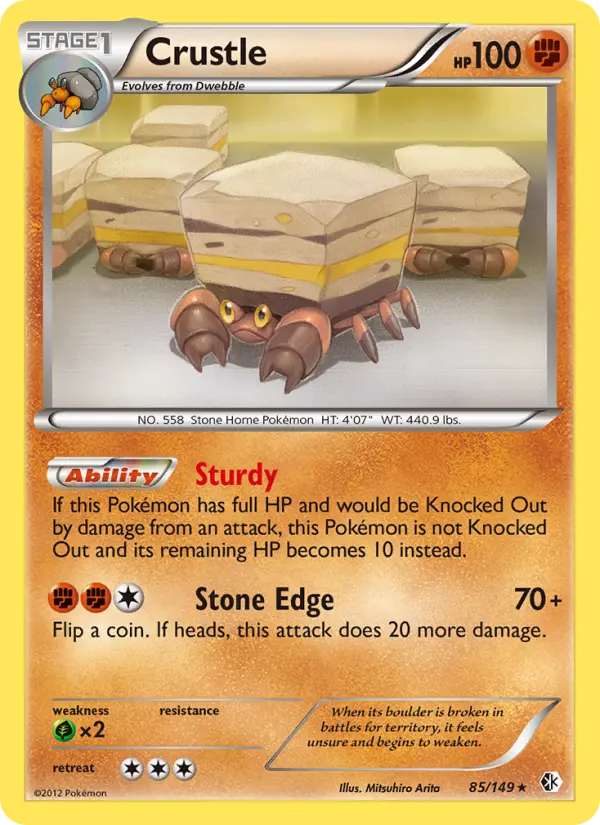
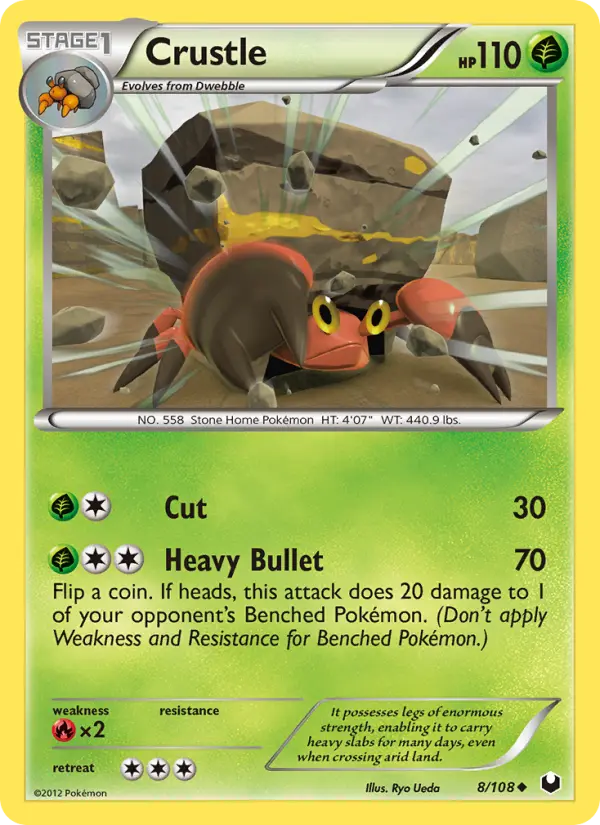
Crustle has maintained a consistent presence in Pokémon media since its introduction in Generation V, with notable appearances in the animated series most memorably through Cilan's Crustle, which served as a reliable partner throughout multiple seasons of the Unova region adventures. The species has appeared in various Pokémon trading card game sets, contributing to the game's diverse creature roster. The concept of a Pokémon whose identity and confidence are intrinsically tied to its physical armor has resonated with players, creating an emotionally compelling narrative around shell integrity and territorial pride. Crustle's design philosophy—combining geological features with biological organisms—has influenced subsequent Pokémon design discussions, particularly regarding how rock-type Pokémon can incorporate environmental elements into their core identity. The species appears in Pokémon UNITE as a playable character, extending its reach into the MOBA gaming space and introducing Crustle to players engaging with the franchise through different gaming genres.
Where to Find Crustle in Every Pokémon Game
Crustle became available to players beginning with the Generation V games (Black and White), where it could be caught as a wild Pokémon or obtained by evolving Dwebble. The species has maintained consistent availability across subsequent generations, appearing in localized Pokédex entries for various regional forms and appearing prominently in games set in the Unova region including Black 2 and White 2. In Generation VI, Crustle appeared in the Coastal Kalos regional Pokédex, making it accessible within the Kalos region. The species continued its distribution through Generation VII and into the modern era, with documented appearances in the base games of Sword and Shield (where it holds regional Pokédex number 0087 and returns in The Isle of Armor expansion at number 0123). Crustle's consistent availability across multiple gaming generations and regions reflects its status as an established member of the Pokémon roster, ensuring that trainers interested in adding this Stone Home Pokémon to their teams have numerous opportunities to acquire one, whether through wild encounters, breeding Dwebble, or transferring from previous generation games through Pokémon HOME or similar mechanics.