Dolliv
Generation IX · #0929 — Olive Pokémon
As a Generation IX grass/normal-type, Dolliv leans on early bird to cover what its raw numbers don't, particularly on the special attack side. The species represents an important cultural symbol within the Paldea region, having coexisted alongside humans since ancient times and serving as a living connection to traditional olive cultivation practices that define much of the region's heritage.
Editor's Take
Dolliv is a middle stage in a line whose endpoint has a genuinely useful ability, and Grass/Normal is a rarer typing than it sounds.
Base Stats
Height
0.6m
Weight
11.9kg
Category
Olive Pokémon
Gender
Male 50% / Female 50%
Color
green
Shape
humanoid
Abilities
Makes sleep pass twice as quickly.
Has a 50% chance of restoring a used Berry after each turn if the Pokémon has held no items in the meantime.
Dolliv Biology & Physical Characteristics
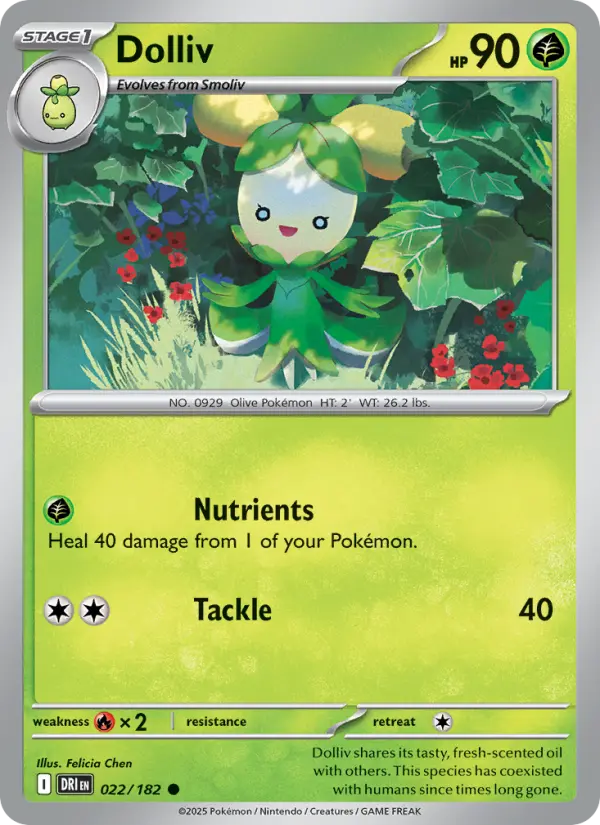
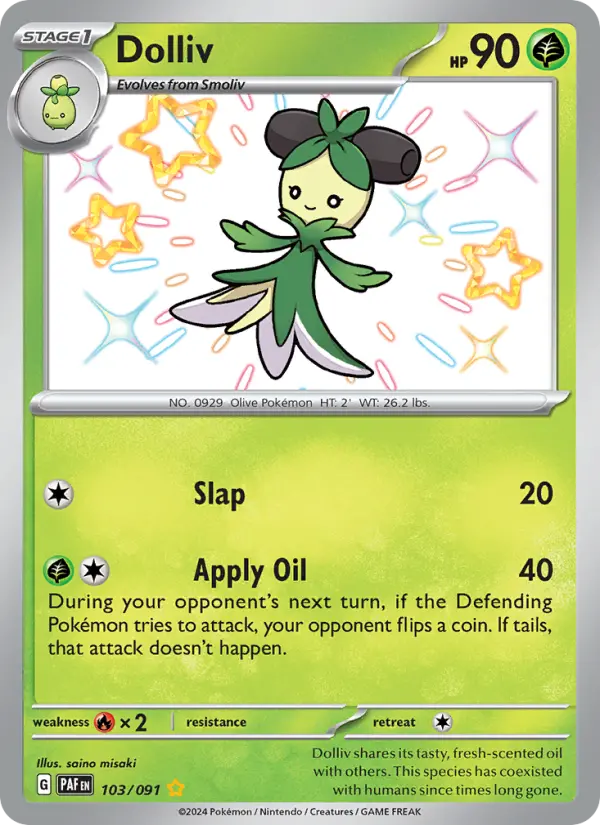
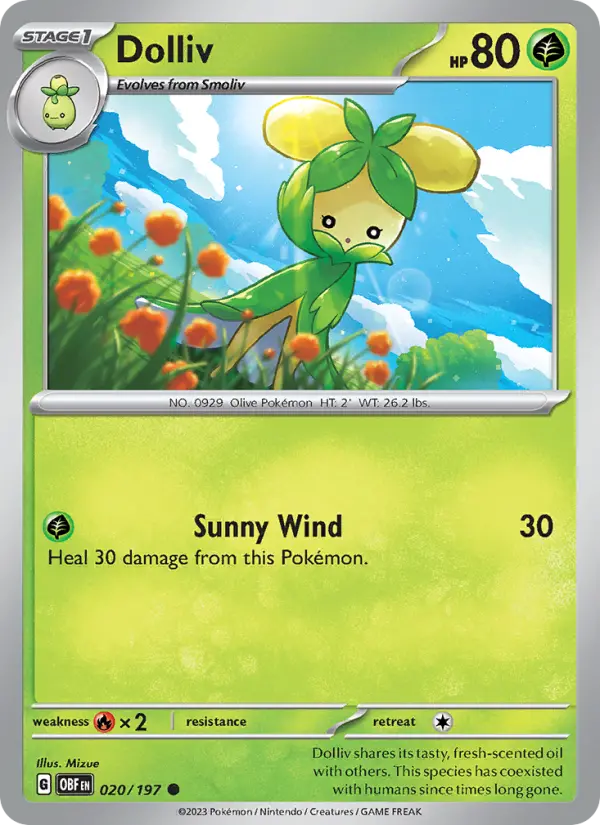
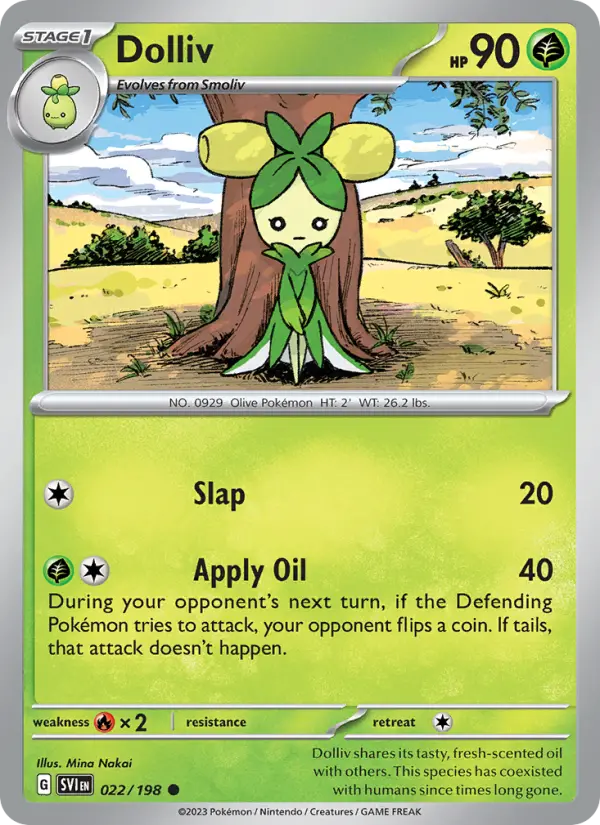
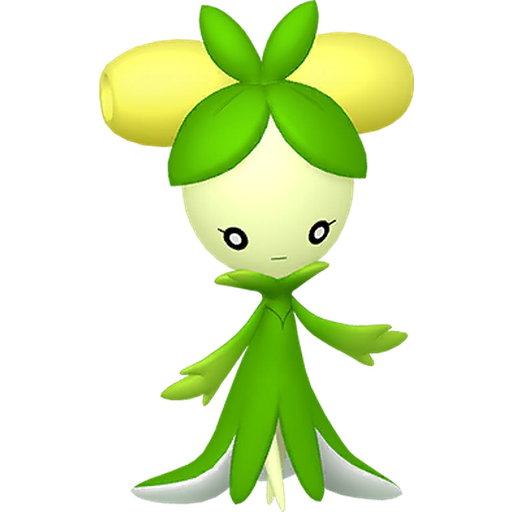
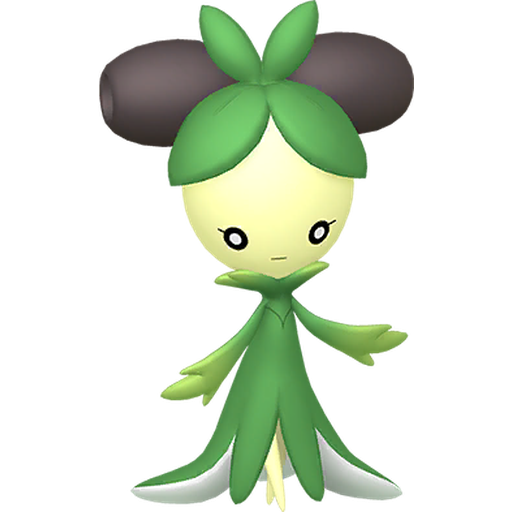
Dolliv presents a distinctly humanoid appearance, resembling a small figure wearing a flowing green dress. Its head is predominantly light green in coloration, crowned with several delicate leaves and two olive fruits situated atop its rounded crown, serving as both visual markers of its maturity and functional components in its biological processes. The Pokémon possesses relatively small, beady black eyes and a proportionally diminutive mouth that convey a gentle, approachable demeanor. Below its head, Dolliv features a distinctive collar-like formation that transitions into a flared body structure at the base, effectively hiding its thin, light green legs from casual observation. Its two long, slender leaves function as arms, providing sufficient dexterity for interaction with its environment despite their delicate appearance. The most remarkable biological feature is Dolliv's capacity to produce fresh-scented, tasty oil that it willingly shares with both humans and other Pokémon, a characteristic that has fostered centuries of peaceful cohabitation and made the species invaluable to human communities throughout history.
Pokedex Numbers
Training
Breeding
Dolliv Breeding, Gender Ratio & Egg Groups
Dolliv maintains a perfectly balanced gender ratio with exactly 50% male and 50% female individuals within wild populations and breeding populations, ensuring equitable reproductive opportunities across the species. The Pokémon belongs exclusively to the Grass egg group, meaning it can only breed with other members of this botanical family, including Pokémon such as Oddish, Bellsprout, and other flora-based creatures. With a base friendship value of 50—classified as 'normal' on the friendship scale—Dolliv displays a neutral temperament toward its trainer initially, requiring consistent positive interactions and care to develop deeper bonds. The egg hatching cycle for Dolliv requires exactly 20 cycles to complete, translating to approximately 4,884 to 5,140 steps of trainer movement to bring an egg to hatching, a moderate timeframe that places Dolliv within the accessible range for casual breeders. The species' medium-slow growth rate means that while Dolliv doesn't reach maximum level as quickly as fast-growing Pokémon, it also avoids the extended training periods required by slow-growth species, making it a reasonable middle ground for competitive trainers. Breeding with compatible Grass-type parents can yield Dolliv offspring with egg moves including Memento, Strength Sap, Synthesis, and Weather Ball—moves that significantly expand Dolliv's competitive movepool beyond what it can learn through leveling and TM instruction.
Sprites




TMs & HMs
tm03
lets go pikachu lets go eevee
tm05
lets go pikachu lets go eevee
tm07
lets go pikachu lets go eevee
tm08
lets go pikachu lets go eevee
tm09
ruby sapphire
tm09
firered leafgreen
tm09
emerald
tm09
diamond pearl
tm09
xd
tm11
platinum
tm11
xd
tr65
sword shield
tm02
scarlet violet
tm159
scarlet violet
tm193
scarlet violet
tm09
platinum
tm11
diamond pearl
tm11
x y
tr59
sword shield
tm81
scarlet violet
+211 more TMs/HMs
Dolliv's Evolution Chain


Dolliv Evolution, Mega Evolution & Special Forms
Dolliv occupies the crucial middle position within a three-stage evolutionary line, evolving from Smoliv upon reaching level 25 and subsequently evolving into the powerful Arboliva at level 35. This two-step progression mirrors traditional olive tree maturation, with Smoliv representing the young sapling, Dolliv embodying the productive young tree, and Arboliva symbolizing the ancient, gnarled olive tree steeped in wisdom and strength. The evolutionary transition from Smoliv to Dolliv results in modest statistical increases across most categories, with particular emphasis on Special Attack and Special Defense, both rising from 60 to 78 base points respectively. This evolution marks the point where Dolliv develops the specialized spellcasting abilities that distinguish it from its unevolved predecessor, gaining access to powerful moves like Grassy Terrain at level 23 and the signature Terrain Pulse at level 42—a move that Dolliv and its evolutionary family notably share as an exclusive capability among all known Pokémon when learned through leveling. The subsequent evolution into Arboliva further enhances these capabilities while introducing the legendary status befitting the ancient, venerable form of this ancient species, completing a transformation that mirrors the olive tree's journey from youth to maturity to revered age.
Where to Find
Location data not available for this Pokémon in the database.
Dolliv Behaviour and Natural Habitat
According to Pokédex documentation from both Scarlet and Violet versions, Dolliv exhibits distinctly seasonal behavioral patterns tied to the ripening cycles of the fruits adorning its head. The species demonstrates a profound affinity for solar exposure, basking contentedly in sunlight for extended periods as the fruits undergo their maturation process—a biological imperative that shapes its daily routine and habitat preferences. Dolliv's natural inclination is to establish itself within human settlements where it can benefit from consistent sunlight and human interaction, a behavioral adaptation refined over countless generations of symbiotic coexistence. Once the fruits have fully ripened, Dolliv undergoes a remarkable behavioral transformation, instinctively departing from human settlements to embark on solitary journeys through the natural world. This migratory impulse suggests an innate need to propagate its species and distribute seeds across diverse ecosystems, representing an essential ecological function despite its domesticated temperament. In their preferred habitats, Dolliv can be found in sun-drenched meadows and cultivated areas where it gravitates toward light and warmth, making it particularly common in the Mediterranean-inspired regions of Paldea.
Pokedex Entries
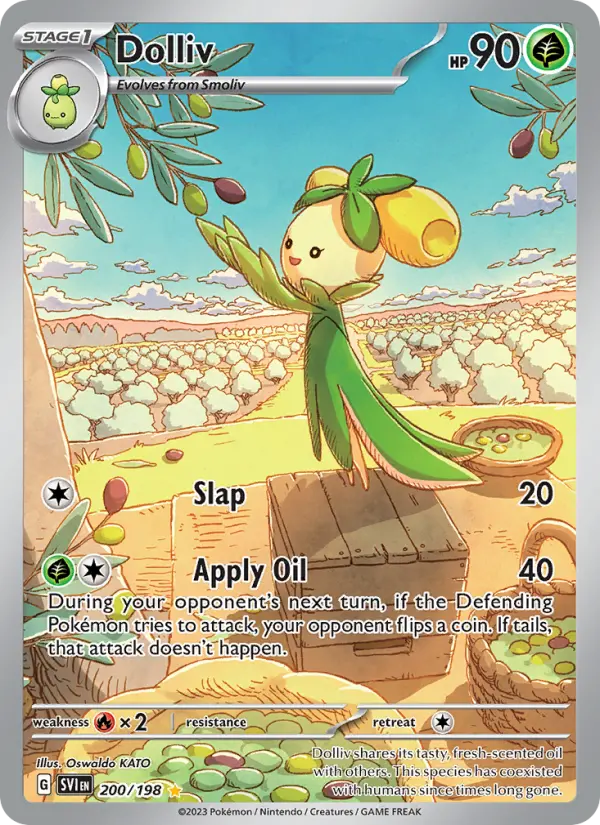
Dolliv shares its tasty, fresh-scented oil with others. This species has coexisted with humans since times long gone.
It basks in the sun to its heart’s content until the fruits on its head ripen. After that, Dolliv departs from human settlements and goes on a journey.
Dolliv Name Origin & Design Inspiration
Dolliv's name origin lies in a straightforward combination of 'doll' and 'olive,' reflecting both the Pokémon's diminutive, doll-like humanoid proportions and its fundamental identity as an olive-based creature. The Japanese designation 'Orinyo' similarly combines the words for olive (オリーブ) with a diminutive suffix, creating a name that emphasizes the species' youthful, approachable character. Visually, Dolliv's design intentionally evokes the appearance of a person wearing traditional Mediterranean clothing—specifically a dress or tunic—a cultural reference that underscores the species' deep integration into human society and its association with Mediterranean agricultural heritage. The fruits positioned atop Dolliv's head serve dual narrative purposes: they function as literal representations of olive production while simultaneously evoking the imagery of a decorative crown or headdress, suggesting both natural productivity and dignified status within its community. The choice to render Dolliv's limbs as long, slender leaves rather than typical appendages emphasizes its botanical nature while maintaining sufficient humanoid qualities to reinforce its symbiotic relationship with humanity. This design philosophy perfectly captures the essence of the Olive Pokémon, creating a creature that feels simultaneously natural and fantastical, grounded in real-world agricultural symbolism yet distinctly Pokémon in its whimsical presentation.
Learnable Moves
Dolliv can learn 33 moves:
Move | Type | Cat. | Power | Acc. | PP |
|---|---|---|---|---|---|
| absorb | grass | Special | 20 | 100 | 25 |
| bullet seed | grass | Physical | 25 | 100 | 30 |
| charm | fairy | Status | — | 100 | 20 |
| earth power | ground | Special | 90 | 100 | 10 |
| endure | normal | Status | — | — | 10 |
| energy ball | grass | Special | 90 | 100 | 10 |
| facade | normal | Physical | 70 | 100 | 20 |
| flail | normal | Physical | — | 100 | 15 |
| giga drain | grass | Special | 75 | 100 | 10 |
| grass knot | grass | Special | — | 100 | 20 |
| grassy terrain | grass | Status | — | — | 10 |
| growth | normal | Status | — | — | 20 |
| helping hand | normal | Status | — | — | 20 |
| leaf storm | grass | Special | 130 | 90 | 5 |
| leech seed | grass | Status | — | 90 | 10 |
| magical leaf | grass | Special | 60 | — | 20 |
| mega drain | grass | Special | 40 | 100 | 15 |
| protect | normal | Status | — | — | 10 |
| razor leaf | grass | Physical | 55 | 95 | 25 |
| rest | psychic | Status | — | — | 5 |
| seed bomb | grass | Physical | 80 | 100 | 15 |
| sleep talk | normal | Status | — | — | 10 |
| solar beam | grass | Special | 120 | 100 | 10 |
| solar blade | grass | Physical | 125 | 100 | 10 |
| substitute | normal | Status | — | — | 10 |
| sunny day | fire | Status | — | — | 5 |
| sweet scent | normal | Status | — | 100 | 20 |
| swift | normal | Special | 60 | — | 20 |
| tackle | normal | Physical | 40 | 100 | 35 |
| tera blast | normal | Special | 80 | 100 | 10 |
| terrain pulse | normal | Special | 50 | 100 | 10 |
| trailblaze | grass | Physical | 50 | 100 | 20 |
| weather ball | normal | Special | 50 | 100 | 10 |
Dolliv Competitive Battle Guide
In terms of competitive use, Dolliv occupies an interesting niche as a fully evolved intermediate form with respectable special statistics but crippling speed deficiencies. Its base Special Attack and Special Defense both reach 78, substantially exceeding its physical attacking power of 53, establishing Dolliv as fundamentally a special-focused attacker that benefits from proper EV investment and nature selection. The move Terrain Pulse represents Dolliv's most distinctive offensive tool, functioning as a flexible attack that adapts its typing based on active terrain conditions, dealing Normal-type damage at 50 base power in neutral conditions but converting to Grass-type damage within Grassy Terrain—a strategic synergy further enhanced by Dolliv's access to Grassy Terrain setup moves. However, Dolliv's base speed of 33 severely limits its competitive viability in faster-paced metagames, forcing it into either specialized slow-team compositions or roles requiring support from speed-control mechanics like Trick Room. Its early-bird ability, which reduces sleep duration by half, provides utility against status-heavy opponents, while its hidden ability Harvest offers potential longevity through berry recovery—particularly valuable when paired with berries like Sitrus Berry or Assault Vest. Most competitive players recognize that Dolliv's intermediate evolutionary status means that stronger teams should prioritize its final evolution Arboliva, which significantly improves Dolliv's stat distribution while maintaining similar competitive profiles. Nevertheless, in specialized metagames restricting Pokédex access or in specific format tournaments, Dolliv can function as a support Pokémon specializing in terrain setup and special-based coverage moves like Energy Ball and Mega Drain.
Commonly Asked Questions About Dolliv
What type is Dolliv?
Dolliv is a grass and normal type Pokemon.
What does Dolliv evolve into?
Dolliv evolves into arboliva.
What are Dolliv's weaknesses?
Dolliv is weak to fighting, flying, poison, bug, fire and ice type moves.
Does Dolliv evolve by trading?
No — Dolliv evolves entirely through leveling up, with no trade required at any stage.
Dolliv Cultural Impact & Franchise History
Dolliv holds profound cultural significance within the Paldea region as a living embodiment of ancient human-Pokémon cooperation and agricultural heritage. The Pokédex entries specifically emphasize that this species 'has coexisted with humans since times long gone,' positioning Dolliv as a historical witness to Paldean civilization's development and a tangible connection to ancestral practices predating modern Pokémon training. In the context of Pokémon Scarlet and Violet narratives, Dolliv represents the natural world's rhythms and cycles—its behavioral patterns of basking and eventual departure mirror the seasons and life cycles that govern agricultural societies, making it a symbol of natural wisdom and the passage of time. The fresh-scented oil that Dolliv generously shares has become iconic to Paldean culture and cuisine, appearing throughout regional food preparations and traditional remedies, effectively making Dolliv an economically significant species beyond its battle capabilities. Within the fanbase, Dolliv's gentle demeanor and humanoid appearance have made it a beloved design that transcends typical Pokémon appeal, generating considerable appreciation for its cultural authenticity and aesthetic charm. The species' journey from settlement-dwelling companion to solitary wanderer resonates with players on a thematic level, representing themes of growth, independence, and harmony with nature that resonate far beyond typical monster-catching narratives. Educational materials and regional tourism campaigns in Paldea frequently feature Dolliv as an ambassador for sustainable agriculture and human-Pokémon symbiosis, cementing its status as more than merely a game creature but rather a cultural icon representing values of cooperation and environmental stewardship.
Where to Find Dolliv in Every Pokémon Game
Dolliv became available to trainers exclusively beginning with Generation IX, making its first appearance in Pokémon Scarlet and Violet as a catchable Pokémon within the Paldea region. Within these games, Dolliv occupies Pokédex slot 0085 in the regional Pokédex and slot 0929 in the National Pokédex, reflecting its recent introduction to the broader Pokémon franchise. The species can be obtained through standard leveling progression of Smoliv, the first-stage evolution that serves as the primary route for trainers seeking to build Dolliv on their teams. Trainers can encounter Smoliv in various outdoor locations throughout Paldea during their main campaign, with wild Smoliv evolving into Dolliv upon reaching level 25 in normal gameplay conditions. For players seeking to obtain Dolliv more efficiently, trading with other trainers who have already progressed past the evolution stage provides an alternative path, though this requires access to online trading functionality or local wireless connection with other trainers. The species has not appeared in subsequent generation games, including the upcoming Pokémon Legends: Z-A, suggesting that availability remains limited to the Generation IX titles Pokémon Scarlet and Violet at present. A catch rate of 120 makes Dolliv moderately difficult but not prohibitively challenging to capture, meaning that standard Pokéballs prove effective for most encounters with wild Smoliv before evolution. Players seeking optimal competitive specimens may utilize picnicking mechanics and mass-outbreak events to locate Smoliv with favorable natures and IV distributions before committing to leveling them through evolution.