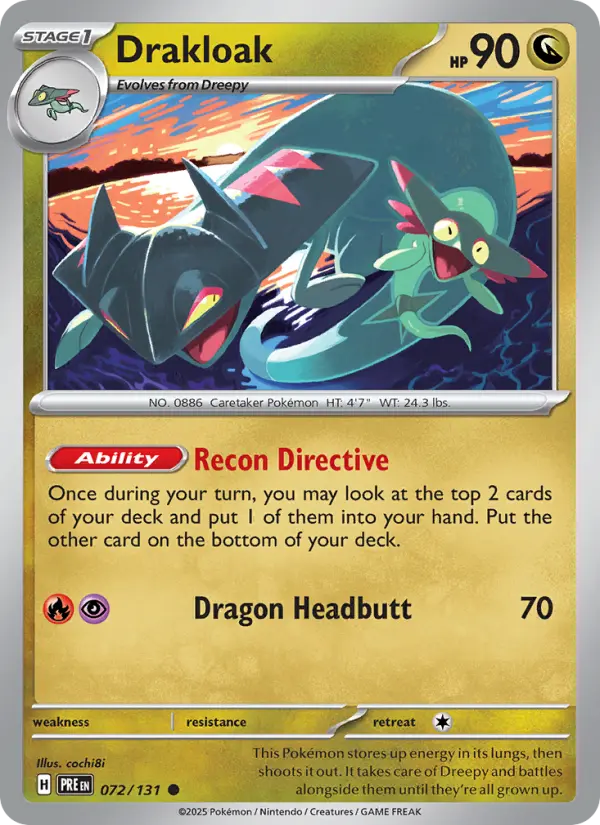
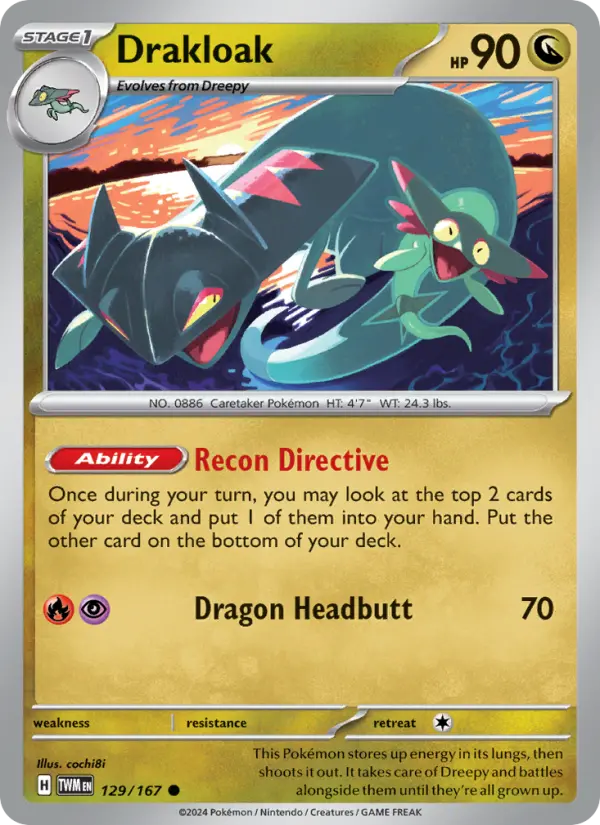
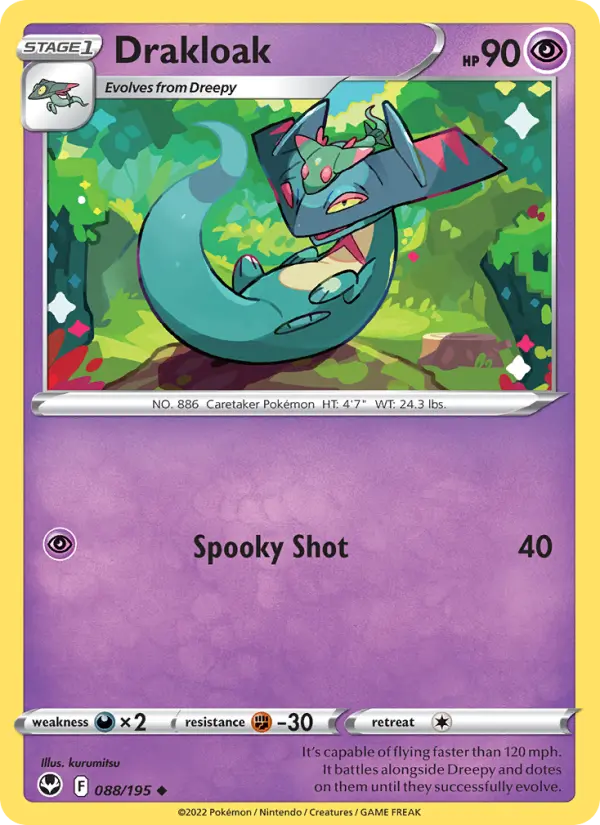
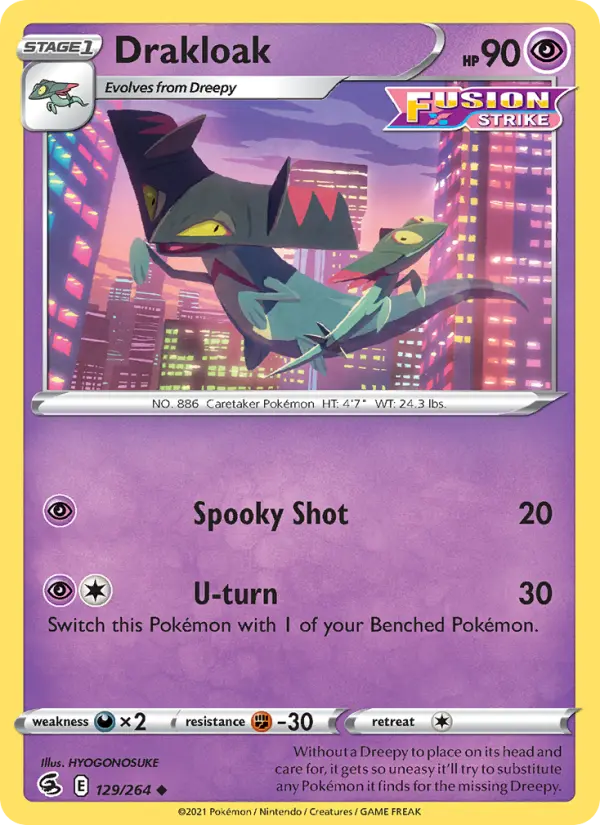
Drakloak
Generation VIII · #0886 — Caretaker Pokémon
Drakloak is a dual-type Dragon/Ghost Pokémon introduced in Generation VIII that occupies a unique middle ground in its evolutionary line. As the Caretaker Pokémon, Drakloak serves as both a protective guardian and a fierce combatant, bridging the gap between the timid Dreepy and the powerful Dragapult. This Galar region native was first made available in Pokémon Sword and Shield, where it quickly captured the imagination of trainers with its distinctive caregiving behavior and impressive aerial capabilities. With a National Pokédex number of #886, Drakloak represents an interesting case study in Pokémon design philosophy—creating a form that feels complete and compelling despite being sandwiched between two more visually striking evolutions.
Editor's Take
Drakloak can already learn Dragon Darts before it finishes evolving into Dragapult, which is unusual — most signature-adjacent moves wait for the final stage — and it means the mid-evolution is genuinely usable in its own right rather than just a stepping stone.
Base Stats
Height
1.4m
Weight
11.0kg
Category
Caretaker Pokémon
Gender
Male 50% / Female 50%
Color
green
Shape
arms
Abilities
Prevents stats from being lowered by other Pokémon.
Bypasses light screen, reflect, and safeguard.
Has a 30% chance of Disabling any move that hits the Pokémon.

Drakloak Biology & Physical Characteristics
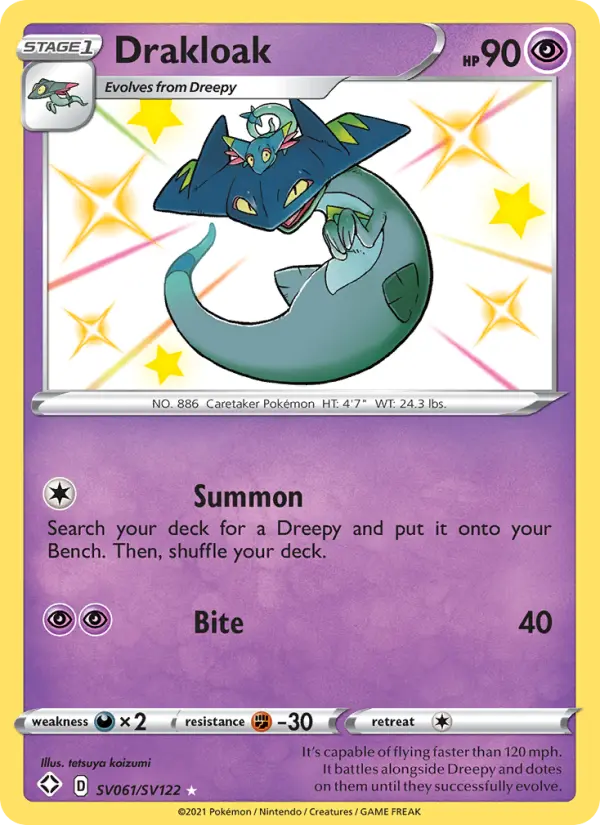
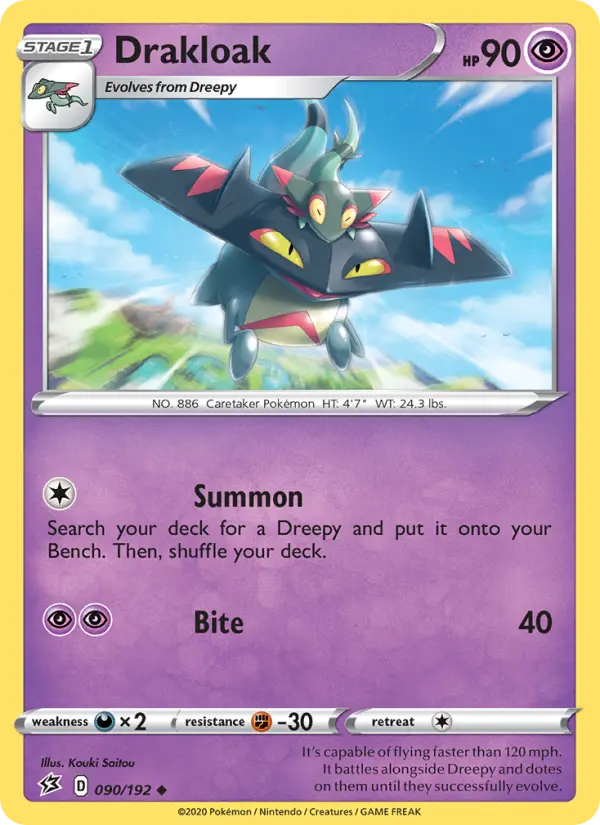
Drakloak is a quadrupedal creature resembling a small dragon or lizard, standing at 1.4 meters tall and weighing only 11.0 kilograms despite its fearsome reputation. Its body is predominantly light blue with a distinctive yellow belly marked by a red, upside-down V-shaped pattern that mirrors its emotional state. The Pokémon's most striking feature is its wide, black-colored head crowned with two vertical horns, complemented by two pinkish-red triangular stripes on either side of its face. Its yellow eyes are framed by pink eyelids, and the underside of its mouth transitions to a pale light blue. Drakloak possesses short, stubby limbs that belie its remarkable mobility, a long tapering tail, and the most notable physical characteristic—a depression or flattened area on its head specifically designed to cradle a Dreepy. This biological adaptation for caregiving demonstrates that even Pokémon anatomy evolves to suit behavioral needs. Despite its small stature, Drakloak is capable of flying at velocities exceeding 120 miles per hour, making it one of the faster aerial combatants in its weight class. Shiny Drakloak is a recolor rare enough that most players go through many standard encounters before finding one in the wild; breeding for the Masuda Method or building up an Odds chain remain the most reliable ways to guarantee one.
Pokedex Numbers
Training
Breeding
Drakloak Breeding, Gender Ratio & Egg Groups
Drakloak exhibits a perfectly balanced gender distribution with exactly 50% of individuals being male and 50% female, allowing for flexible breeding strategies in competitive and casual play alike. The species belongs to both the Amorphous and Dragon egg groups, which opens diverse breeding possibilities with a wide range of compatible Pokémon species. With a base friendship value of 50, Drakloak starts with a neutral disposition toward its trainer but can develop stronger bonds through consistent care and battle experience, mirroring its own behavioral investment in nurturing Dreepy. The hatch counter value of 40 cycles means Drakloak eggs require a moderate amount of breeding time—approximately 10,024 to 10,280 steps to hatch—positioning them as neither quick-breeding nor unusually time-consuming options for players seeking to raise this species from birth. The species employs a slow growth rate, requiring significantly more experience points to advance levels compared to species with faster growth rates, which is thematically appropriate given Drakloak's role as a patient, long-suffering caretaker that gradually matures into a more formidable combatant.
Sprites






TMs & HMs
tm03
crystal
tm03
gold silver
tm03
lets go pikachu lets go eevee
tm05
lets go pikachu lets go eevee
tm06
lets go pikachu lets go eevee
tm07
lets go pikachu lets go eevee
tm08
lets go pikachu lets go eevee
tm09
yellow
tm09
red blue
tm11
platinum
tm11
xd
tm99
sword shield
hm03
ruby sapphire
hm03
platinum
hm03
omega ruby alpha sapphire
hm08
colosseum
tm100
scarlet violet
tm107
scarlet violet
tm142
scarlet violet
tm10
blue japan
+486 more TMs/HMs
Drakloak's Evolution Chain


Drakloak Evolution, Mega Evolution & Special Forms
Drakloak occupies a critical position within its three-stage evolutionary line that begins with the diminutive Dreepy and concludes with the powerful Dragapult. Evolution from Dreepy to Drakloak occurs at level 50, representing a significant milestone where the tiny ghost dragon gains its characteristic head shape and caregiving abilities. The transition marks a dramatic shift in battle capability, with base Attack increasing from 34 to 80 and Speed from 82 to 102, though overall bulk remains comparable. The subsequent evolution to Dragapult at level 60 represents another quantum leap, with Drakloak serving as the essential bridge between youth and maturity in this evolutionary narrative. This two-stage progression from the fearful Dreepy, through the protective Drakloak, to the apex predator Dragapult mirrors a coming-of-age journey that few other Pokémon evolutionary lines capture as effectively. Notably, Drakloak's typing remains constant throughout its evolution, maintaining the Dragon/Ghost combination that defines the entire line's strategic identity and coverage options.
Where to Find
Location data not available for this Pokémon in the database.
Drakloak Behaviour and Natural Habitat
Drakloak exhibits some of the most distinctive behavioral patterns in the Pokémon world, fundamentally shaped by its role as a devoted caretaker. In the wild, mature Drakloak seek out Dreepy to carry and protect, engaging in battles alongside their young charges and nurturing them until they reach level 50 and evolve into their own Drakloak form. This deeply ingrained parental instinct is so powerful that a Drakloak without a Dreepy becomes visibly distressed and anxious, desperately attempting to find any Pokémon as a substitute for its missing charge—a behavioral quirk that speaks to the species' emotional depth and bonding mechanisms. The Pokédex notes that Drakloak dotes on their Dreepy, actively engaging in combat training and protection, creating a symbiotic relationship where both benefit from the partnership. Tragically, if a Drakloak falls in battle, its Dreepy will abandon it without hesitation, moving on to find a new guardian. Drakloak primarily inhabit the Galar region, though they can be encountered in various locations including the Crown Tundra, suggesting they favor cooler, more desolate environments that match their ghost-like nature.
Pokedex Entries
It’s capable of flying faster than 120 mph. It battles alongside Dreepy and dotes on them until they successfully evolve.
Without a Dreepy to place on its head and care for, it gets so uneasy it’ll try to substitute any Pokémon it finds for the missing Dreepy.
Drakloak Name Origin & Design Inspiration
Drakloak's name traces to a combination of 'Drake' (a small dragon) and 'Cloak,' perfectly encapsulating the Pokémon's role as a protective guardian that figuratively 'cloaks' its young Dreepy in safety and care. The Japanese name, Doronchi, maintains this thematic through phonetic association with dragon-like sounds and protective imagery. The design philosophy behind Drakloak clearly emphasizes the caregiving mechanic—the flattened head with its characteristic horns and striped markings creates a natural 'seat' for Dreepy, making the Pokédex entries about carrying young feel biologically plausible within the game world. Visually, Drakloak strikes a balance between the cute, timid aesthetics of Dreepy and the menacing silhouette of Dragapult, featuring rounded proportions and proportionally smaller limbs that give it an almost endearing quality despite its ghost-dragon typing. The color scheme of light blue with yellow and red accents suggests a spectral origin while maintaining visual distinction from its evolutionary relatives. This middle-ground design aesthetic deliberately avoids overwhelming visual complexity, allowing Drakloak to feel like a natural stepping stone rather than a fully mature form.
Learnable Moves
Drakloak can learn 59 moves:
Move | Type | Cat. | Power | Acc. | PP |
|---|---|---|---|---|---|
| acrobatics | flying | Physical | 55 | 100 | 15 |
| agility | psychic | Status | — | — | 30 |
| ally switch | psychic | Status | — | — | 15 |
| assurance | dark | Physical | 60 | 100 | 10 |
| astonish | ghost | Physical | 30 | 100 | 15 |
| attract | normal | Status | — | 100 | 15 |
| baton pass | normal | Status | — | — | 40 |
| beat up | dark | Physical | — | 100 | 10 |
| bite | dark | Physical | 60 | 100 | 25 |
| breaking swipe | dragon | Physical | 60 | 100 | 15 |
| brine | water | Special | 65 | 100 | 10 |
| curse | ghost | Status | — | — | 10 |
| dive | water | Physical | 80 | 100 | 10 |
| double hit | normal | Physical | 35 | 90 | 10 |
| double edge | normal | Physical | 120 | 100 | 15 |
| draco meteor | dragon | Special | 130 | 90 | 5 |
| dragon cheer | dragon | Status | 0 | 0 | 15 |
| dragon dance | dragon | Status | — | — | 20 |
| dragon pulse | dragon | Special | 85 | 100 | 10 |
| dragon rush | dragon | Physical | 100 | 75 | 10 |
| dragon tail | dragon | Physical | 60 | 90 | 10 |
| endure | normal | Status | — | — | 10 |
| facade | normal | Physical | 70 | 100 | 20 |
| fire blast | fire | Special | 110 | 85 | 5 |
| flamethrower | fire | Special | 90 | 100 | 15 |
| helping hand | normal | Status | — | — | 20 |
| hex | ghost | Special | 65 | 100 | 10 |
| hydro pump | water | Special | 110 | 80 | 5 |
| infestation | bug | Special | 20 | 100 | 20 |
| last resort | normal | Physical | 140 | 100 | 5 |
| light screen | psychic | Status | — | — | 30 |
| lock on | normal | Status | — | — | 5 |
| night shade | ghost | Special | — | 100 | 15 |
| outrage | dragon | Physical | 120 | 100 | 10 |
| phantom force | ghost | Physical | 90 | 100 | 10 |
| pounce | bug | Physical | 50 | 100 | 20 |
| protect | normal | Status | — | — | 10 |
| psychic fangs | psychic | Physical | 85 | 100 | 10 |
| quick attack | normal | Physical | 40 | 100 | 30 |
| reflect | psychic | Status | — | — | 20 |
| rest | psychic | Status | — | — | 5 |
| round | normal | Special | 60 | 100 | 15 |
| scald | water | Special | 80 | 100 | 15 |
| shadow ball | ghost | Special | 80 | 100 | 15 |
| sleep talk | normal | Status | — | — | 10 |
| snore | normal | Special | 50 | 100 | 15 |
| steel wing | steel | Physical | 70 | 90 | 25 |
| substitute | normal | Status | — | — | 10 |
| sunny day | fire | Status | — | — | 5 |
| surf | water | Special | 90 | 100 | 15 |
| swift | normal | Special | 60 | — | 20 |
| take down | normal | Physical | 90 | 85 | 20 |
| tera blast | normal | Special | 80 | 100 | 10 |
| thief | dark | Physical | 60 | 100 | 25 |
| thunder | electric | Special | 110 | 70 | 10 |
| thunder wave | electric | Status | — | 90 | 20 |
| thunderbolt | electric | Special | 90 | 100 | 15 |
| u turn | bug | Physical | 70 | 100 | 20 |
| will o wisp | fire | Status | — | 85 | 15 |
Drakloak Competitive Battle Guide
In tournament-level play, Drakloak operates as a respectable mid-tier physical attacker and scout with a base Speed stat of 102 that allows it to outpace many common threats before they can move. Its base Attack of 80 provides reliable damage output when utilized with physical Dragon and Ghost-type moves, though its Special Attack of 60 makes special sets significantly less viable. The defensive profile is notably fragile with base Defense and Special Defense both sitting at 50, coupled with modest HP of 68, making Drakloak vulnerable to priority moves and concentrated damage output—a limitation that actually encourages offensive play and careful positioning. Drakloak's three ability options each serve specific competitive niches: Clear Body prevents problematic stat drops from opponents, Infiltrator bypasses defensive screens like Light Screen and Reflect to maintain pressure, and the hidden ability Cursed Body provides a 30% chance to disable moves that strike the Pokémon, creating unpredictable defensive opportunities. The movepool supports this versatile competitive role, with access to key moves like Dragon Dance for setup sweeping, Phantom Force for consistent Ghost-type coverage, Dragon Rush for powerful Dragon-type hits, and U-turn for pivoting and scouting. While Drakloak rarely dominates competitive formats at the highest levels, it performs admirably in mid-tier competitive environments and casual battles, making it a solid choice for trainers seeking a competent combatant without resorting to pseudo-legendary Pokémon.
Commonly Asked Questions About Drakloak
What type is Drakloak?
Drakloak is a dragon and ghost type Pokemon.
What does Drakloak evolve into?
Drakloak evolves into dragapult.
What are Drakloak's weaknesses?
Drakloak is weak to ghost, ice, dragon, dark and fairy type moves.
Does Drakloak evolve by trading?
No — Drakloak evolves entirely through leveling up, with no trade required at any stage.
Is Shiny Drakloak different in stats from a normal Drakloak?
No — a Shiny Drakloak has identical base stats, abilities, and movepool to the standard form. The only difference is the color palette; nothing about its performance in or out of battle changes.
How rare is Shiny Drakloak in the wild?
Like any Shiny Pokémon, a wild Shiny Drakloak has roughly a 1-in-4096 base encounter rate in modern games (better with a Shiny Charm). Breeding with the Masuda Method or building up an Odds/chain encounter both shorten those odds significantly for trainers hunting one specifically.
Drakloak Cultural Impact & Franchise History
Since its introduction in Generation VIII, Drakloak has carved out a modest but devoted following within the Pokémon community, largely due to its unique caregiving mechanics and the emotional narrative embedded in its Pokédex entries. The concept of a Pokémon literally carrying and nurturing another Pokémon struck a chord with many trainers, adding narrative depth and character development to mechanical gameplay elements. Drakloak's appearance in the mainline games and subsequent titles established it as a fan-favorite for those seeking depth of characterization and lore-rich Pokémon that transcend mere battle statistics. The species appears prominently in the Sword and Shield storyline within the Wild Area and Crown Tundra, cementing its place in Galar's regional identity. Digital media, including the Pokémon anime, has featured Drakloak to varying degrees, though it remains less iconic than its final evolution Dragapult. Among competitive communities and content creators, Drakloak represents the kind of mid-tier Pokémon that generates interesting teambuilding discussions and creative set compositions, even if it doesn't dominate tournament results. The species particularly resonates with players who appreciate Pokémon with compelling behavioral stories and those who favor Dragon-type specialists seeking underutilized options.
Where to Find Drakloak in Every Pokémon Game
Drakloak is exclusively available in Generation VIII and onward, first becoming obtainable in Pokémon Sword and Shield where it appears in the Galar region's Pokédex as entry #396. Within Sword and Shield, Drakloak can be encountered in the Crown Tundra DLC area (Pokédex #111), making it primarily available to players who have purchased and accessed this expansion content. The species remains available in subsequent Generation VIII remakes and reworkings, though notably absent from Pokémon Brilliant Diamond, Shining Pearl, and Legends: Arceus. In Generation IX, introduced with Pokémon Scarlet and Violet, Drakloak received new local Pokédex numbers (#306 in the Paldea region) and appears across various locations in the expanded Galar and Paldea regions, making it more readily accessible to modern players. The capture rate of 45 indicates moderate difficulty in catching wild Drakloak, requiring patience and appropriate Poké Ball selection when attempting to recruit this species in the wild. Players seeking Drakloak typically either encounter it as an evolution from captured Dreepy that reach level 50, or seek out wild specimens in designated spawn locations within the Crown Tundra or Paldea regions, both viable approaches for different playstyles and progression speeds.