Ducklett
Generation V · #0580 — Water Bird Pokémon
Since its Generation V debut, Ducklett has carried a stat spread built around hp — 62 at base, its clearest strength. Ducklett's introduction in the Unova region marked an important addition to the Water/Flying-type roster, offering trainers a charming alternative to established water birds while serving as a stepping stone to the more formidable Swanna. With a catch rate of 190 and a base happiness of 70, Ducklett demonstrates approachability both in wild encounters and in trainer-Pokémon relationships, making it an accessible choice for early-game team building.
Editor's Take
Ducklett's line ends in Swanna, and a Water/Flying type with 98 base Speed and Hurricane access is a perfectly reasonable rain sweeper nobody uses.
Base Stats
Height
0.5m
Weight
5.5kg
Category
Water Bird Pokémon
Gender
Male 50% / Female 50%
Color
blue
Shape
wings
Abilities
Prevents accuracy from being lowered.
Protects against Defense drops.
Cures any major status ailment after each turn during rain.

Ducklett Biology & Physical Characteristics
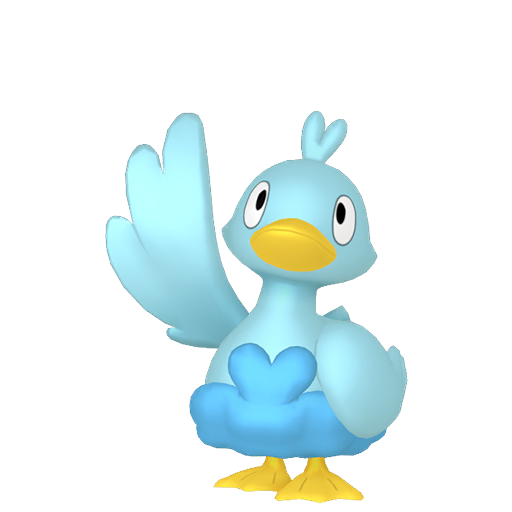
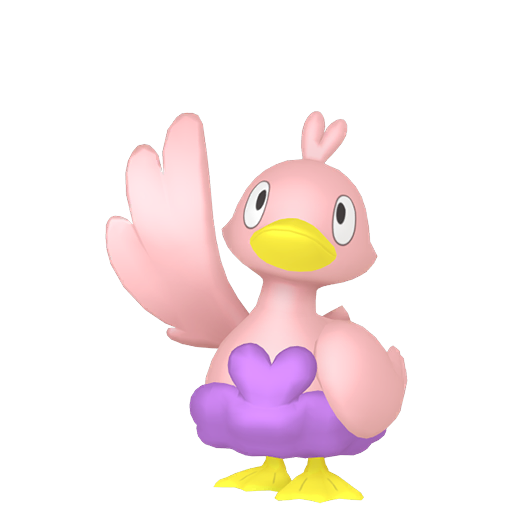
Ducklett presents a distinctly duckling-like appearance characterized by light blue plumage covering most of its diminutive 0.5-meter frame, which weighs only 5.5 kilograms. The Pokémon features two prominent feathery tufts on its head that converge at the base to form a distinctive V-shape, while its underside displays darker blue coloration that creates the visual impression of a bird mid-molt. Its most notable physical characteristics include bright yellow webbed feet perfectly adapted for aquatic locomotion and a small tail that aids in swimming. The 50% male-to-female gender ratio reflects typical biological dimorphism seen in avian Pokémon. Despite its dual typing, Ducklett is notably better adapted to aquatic environments than aerial ones, with its body structure optimized for diving and swimming rather than sustained flight, evidenced by its relatively low speed stat of 55.
Pokedex Numbers
Training
Breeding
Ducklett Breeding, Gender Ratio & Egg Groups
Ducklett maintains an even 50% male-to-female gender distribution, making gender-based breeding considerations equivalent for both male and female trainers seeking to establish breeding populations. The species falls into the Water 1 and Flying egg groups, categorizations that permit breeding compatibility with numerous other water-type and flying-type Pokémon, facilitating diverse competitive breeding strategies. Ducklett requires 20 egg cycles to hatch from an egg, translating to approximately 4,884 to 5,140 steps, positioning it as a moderate-incubation species compared to other water-types. The species demonstrates a medium-fast growth rate, allowing relatively expedited development toward its level 35 evolution threshold. Male Ducklett can serve effectively as breeding partners with compatible females from related egg groups, while female Ducklett can pass species-specific moves to offspring when bred with appropriate father Pokémon, creating opportunities for move pool optimization in competitive or casual breeding programs.
Sprites




TMs & HMs
tm03
ruby sapphire
tm03
platinum
tm03
firered leafgreen
tm03
heartgold soulsilver
tm03
diamond pearl
tm03
emerald
tm03
xd
tm03
colosseum
tm03
lets go pikachu lets go eevee
tm05
lets go pikachu lets go eevee
tm06
yellow
tm06
gold silver
tm06
red blue
tm06
crystal
tm06
emerald
tm06
firered leafgreen
tm06
diamond pearl
tm06
platinum
tm06
ruby sapphire
tm06
colosseum
+464 more TMs/HMs
Ducklett's Evolution Chain


Ducklett Evolution, Mega Evolution & Special Forms
Ducklett evolves into Swanna upon reaching level 35, a transformation that maintains its Water/Flying typing while significantly enhancing its overall capabilities and elegance. The evolution represents a maturation from an ungainly duckling into a graceful swan, with corresponding improvements across most statistical categories, particularly in Attack, Special Attack, and Speed. This evolution line lacks any Mega Evolution forms or alternate evolutionary pathways, following a straightforward linear progression that has remained consistent across all generations since its introduction. Trainers seeking to complete their Pokédex entries or develop a powerful water-flying team member should prioritize leveling Ducklett to the pivotal 35th level, at which point the transition to Swanna becomes available and largely inevitable through standard gameplay progression.
Where to Find
Driftveil Drawbridge
unova
+45 more
Kalos Route 7
kalos
+3 more
Ducklett Behaviour and Natural Habitat
Ducklett inhabits freshwater environments including ponds and rivers throughout various regions, where it spends considerable time honing its diving abilities in the depths of bodies of water to build strength. These sociable Pokémon demonstrate a learning-oriented behavior pattern, as they actively observe their evolved Swanna counterparts to develop their own aerial skills, suggesting a matriarchal or social learning structure within populations. Their defensive capabilities are uniquely characterized by their ability to manipulate water through their feathering, allowing them to splash water from their plumage when threatened, creating a distracting spray that enables escape. Ducklett displays a pronounced dietary specialization, consuming peat moss and bog moss as their favorite foods, a notably specific ecological niche that distinguishes them from many other water-type Pokémon. Their curious nature and trainable temperament, combined with their preference for aquatic environments, make them readily observable in their natural habitats during exploratory expeditions through water-rich areas.
Pokedex Entries
These bird Pokémon are excellent divers. They swim around in the water eating their favorite food--peat moss.
They are better at swimming than flying, and they happily eat their favorite food, peat moss, as they dive underwater.
When attacked, it uses its feathers to splash water, escaping under cover of the spray.
When attacked, it uses its feathers to splash water, escaping under cover of the spray.
They are better at swimming than flying, and they happily eat their favorite food, peat moss, as they dive underwater.
When attacked, it uses its feathers to splash water, escaping under cover of the spray.
They are better at swimming than flying, and they happily eat their favorite food, peat moss, as they dive underwater.
Ducklett Name Origin & Design Inspiration
Ducklett's design draws obvious inspiration from real-world ducklings, particularly mallard ducklings characterized by their distinctive coloration and aquatic adaptations. The Japanese name Koaruhie (コアルヒー) reflects this duckling concept while incorporating phonetic elements that suggest the transition toward its evolved form. The English nomenclature directly combines 'duck' with the diminutive suffix '-lett,' emphasizing the Pokémon's juvenile status and smaller stature relative to fully evolved water birds. The visual design cleverly incorporates feathering patterns that suggest ongoing development, with the darker underside plumage appearing incomplete or transitional, a design choice that reinforces Ducklett's role as an unskilled flyer still learning from more experienced Pokémon. The V-shaped head tufts may reference the formation flying patterns observed in real migratory waterfowl, hinting at Ducklett's eventual mastery of aerial movement upon evolution into Swanna.
Learnable Moves
Ducklett can learn 60 moves:
Move | Type | Cat. | Power | Acc. | PP |
|---|---|---|---|---|---|
| aerial ace | flying | Physical | 60 | — | 20 |
| air cutter | flying | Special | 60 | 95 | 25 |
| air slash | flying | Special | 75 | 95 | 15 |
| aqua jet | water | Physical | 40 | 100 | 20 |
| aqua ring | water | Status | — | — | 20 |
| attract | normal | Status | — | 100 | 15 |
| brave bird | flying | Physical | 120 | 100 | 15 |
| brine | water | Special | 65 | 100 | 10 |
| bubble beam | water | Special | 65 | 100 | 20 |
| chilling water | water | Special | 50 | 100 | 20 |
| confide | normal | Status | — | — | 20 |
| defog | flying | Status | — | — | 15 |
| disarming voice | fairy | Special | 40 | — | 15 |
| dive | water | Physical | 80 | 100 | 10 |
| double team | normal | Status | — | — | 15 |
| double edge | normal | Physical | 120 | 100 | 15 |
| endeavor | normal | Physical | — | 100 | 5 |
| endure | normal | Status | — | — | 10 |
| facade | normal | Physical | 70 | 100 | 20 |
| feather dance | flying | Status | — | 100 | 15 |
| fly | flying | Physical | 90 | 95 | 15 |
| frustration | normal | Physical | — | 100 | 20 |
| gust | flying | Special | 40 | 100 | 35 |
| hail | ice | Status | — | — | 10 |
| helping hand | normal | Status | — | — | 20 |
| hidden power | normal | Special | 60 | 100 | 15 |
| hurricane | flying | Special | 110 | 70 | 10 |
| ice beam | ice | Special | 90 | 100 | 10 |
| icy wind | ice | Special | 55 | 95 | 15 |
| liquidation | water | Physical | 85 | 100 | 10 |
| lucky chant | normal | Status | — | — | 30 |
| me first | normal | Status | — | — | 20 |
| mirror move | flying | Status | — | — | 20 |
| mud sport | ground | Status | — | — | 15 |
| pluck | flying | Physical | 60 | 100 | 20 |
| protect | normal | Status | — | — | 10 |
| rain dance | water | Status | — | — | 5 |
| rest | psychic | Status | — | — | 5 |
| return | normal | Physical | — | 100 | 20 |
| roost | flying | Status | — | — | 5 |
| round | normal | Special | 60 | 100 | 15 |
| scald | water | Special | 80 | 100 | 15 |
| secret power | normal | Physical | 70 | 100 | 20 |
| sleep talk | normal | Status | — | — | 10 |
| snore | normal | Special | 50 | 100 | 15 |
| steel wing | steel | Physical | 70 | 90 | 25 |
| substitute | normal | Status | — | — | 10 |
| surf | water | Special | 90 | 100 | 15 |
| swagger | normal | Status | — | 85 | 15 |
| swift | normal | Special | 60 | — | 20 |
| tailwind | flying | Status | — | — | 15 |
| tera blast | normal | Special | 80 | 100 | 10 |
| toxic | poison | Status | — | 90 | 10 |
| trailblaze | grass | Physical | 50 | 100 | 20 |
| uproar | normal | Special | 90 | 100 | 10 |
| water gun | water | Special | 40 | 100 | 25 |
| water pulse | water | Special | 60 | 100 | 20 |
| water sport | water | Status | — | — | 15 |
| whirlpool | water | Special | 35 | 85 | 15 |
| wing attack | flying | Physical | 60 | 100 | 35 |
Ducklett Competitive Battle Guide
Ducklett occupies a limited niche in competitive Pokémon battling due to its modest combined stat total of 305, with no individual stat exceeding the low to mid-50s range, making it generally outclassed by evolved alternatives and other established water-flying types. Its base defensive stats of 50 Defense and 50 Special Defense provide minimal protection despite being relatively balanced, while the 62 HP and 55 Speed statistics fail to compensate sufficiently for its low offensive capabilities of 44 Attack and 44 Special Attack. However, Ducklett's ability selection provides some strategic viability; Keen Eye and Big Pecks offer defensive utility against accuracy reduction and defense drops respectively, while the hidden ability Hydration enables automatic status condition removal during rainfall, potentially supporting rain-based team compositions. Competitively minded trainers typically utilize Ducklett exclusively as a placeholder during early-game scenarios or within specifically crafted handicap formats, recognizing that immediate evolution to Swanna or selection of alternative water-flying Pokémon with superior stat distributions provides substantially more reliable competitive performance in serious battle environments.
Commonly Asked Questions About Ducklett
What type is Ducklett?
Ducklett is a water and flying type Pokemon.
What does Ducklett evolve into?
Ducklett evolves into swanna.
What are Ducklett's weaknesses?
Ducklett is weak to rock and electric type moves.
Does Ducklett evolve by trading?
No — Ducklett evolves entirely through leveling up, with no trade required at any stage.
Where can I find Ducklett?
Ducklett can be found in driftveil drawbridge (unova) and kalos route 7 (kalos).
Ducklett Cultural Impact & Franchise History
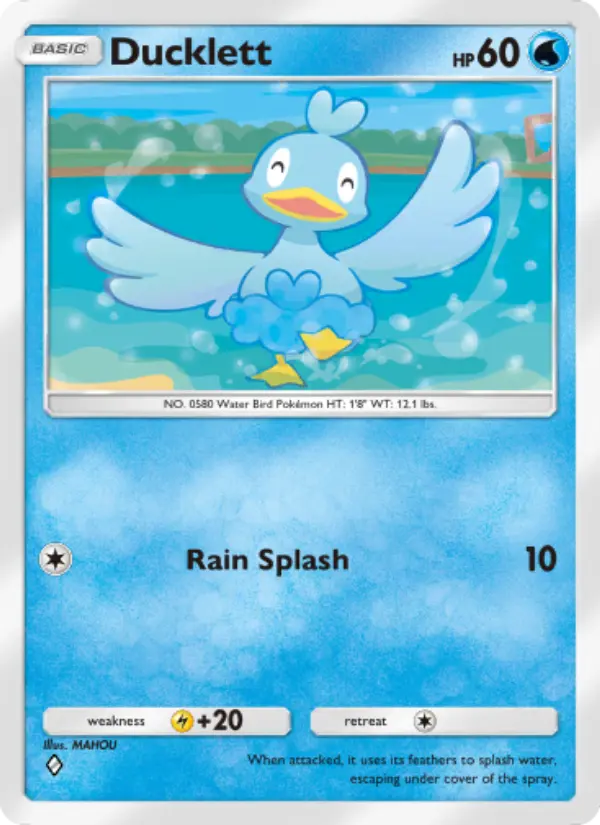
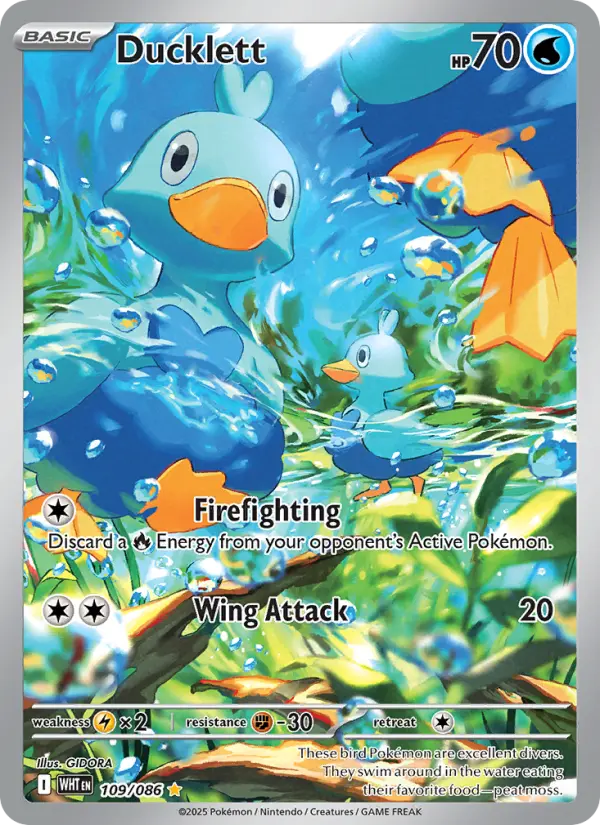
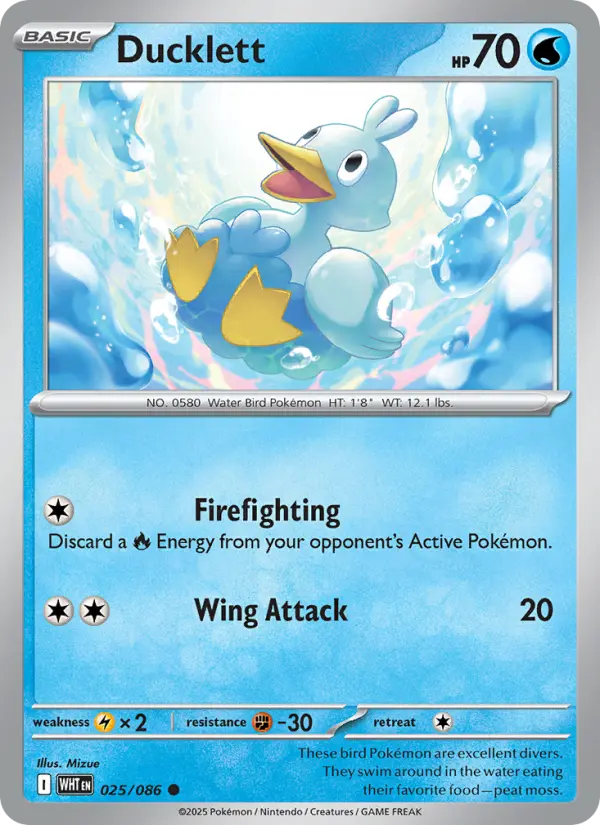
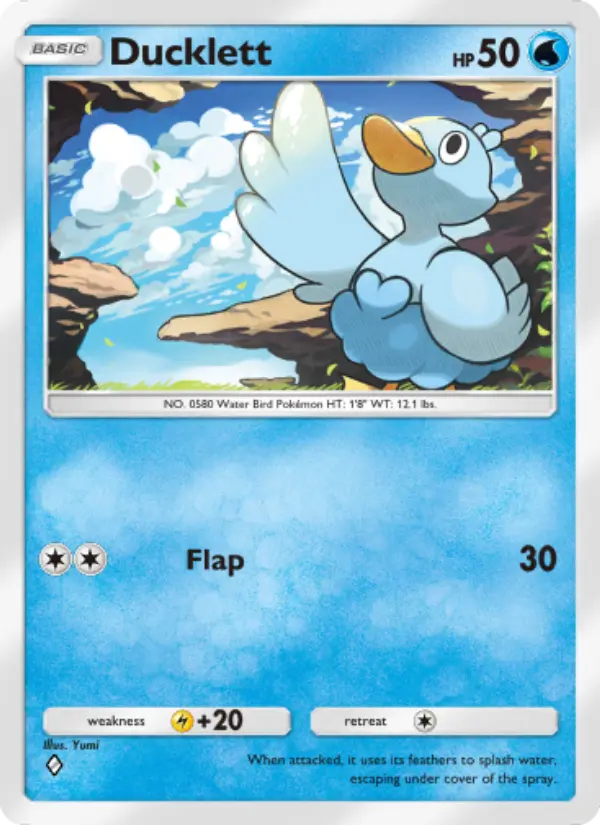
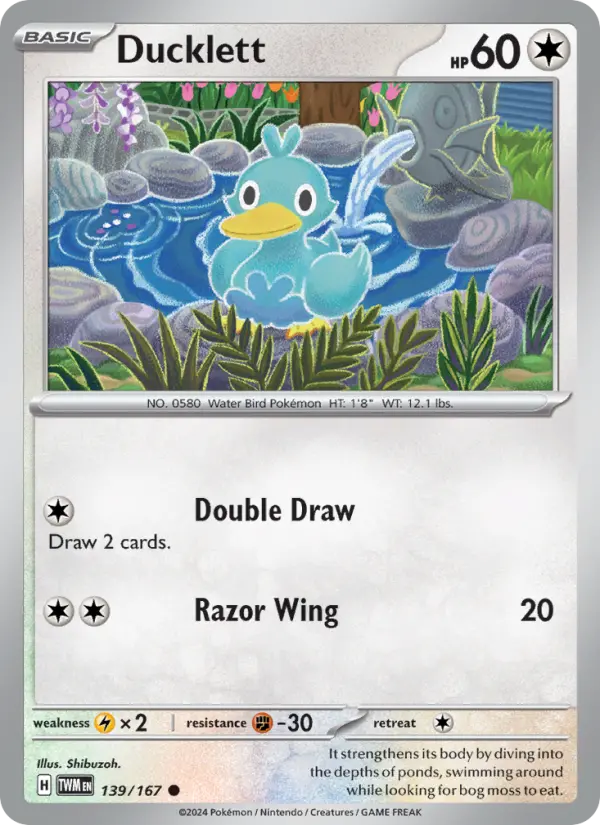
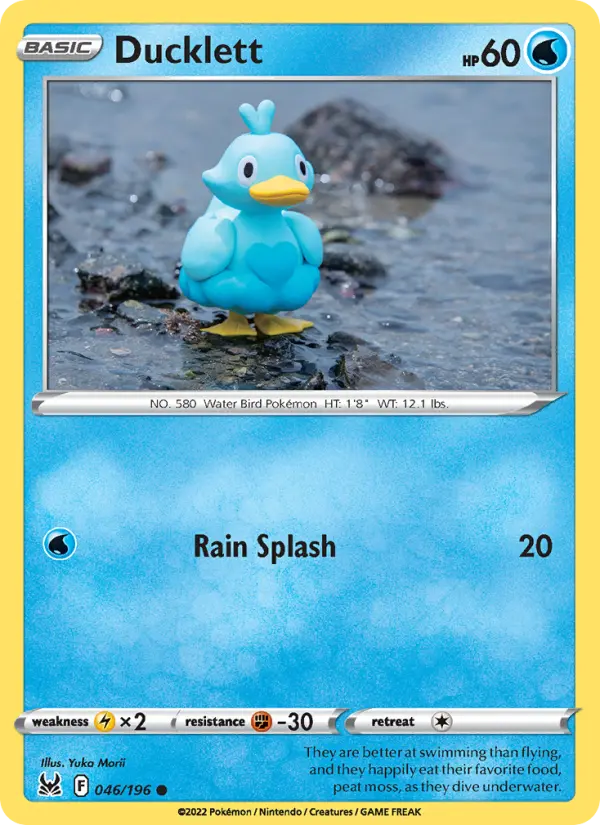
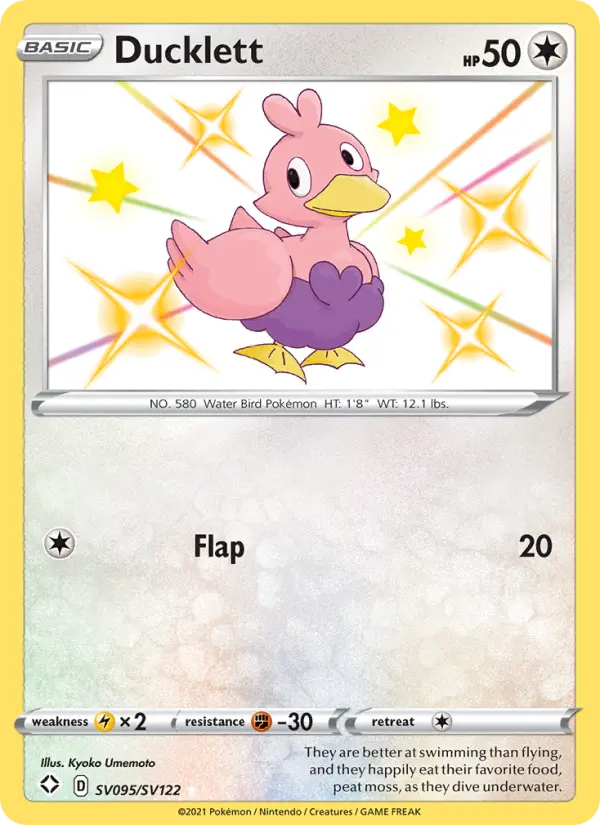
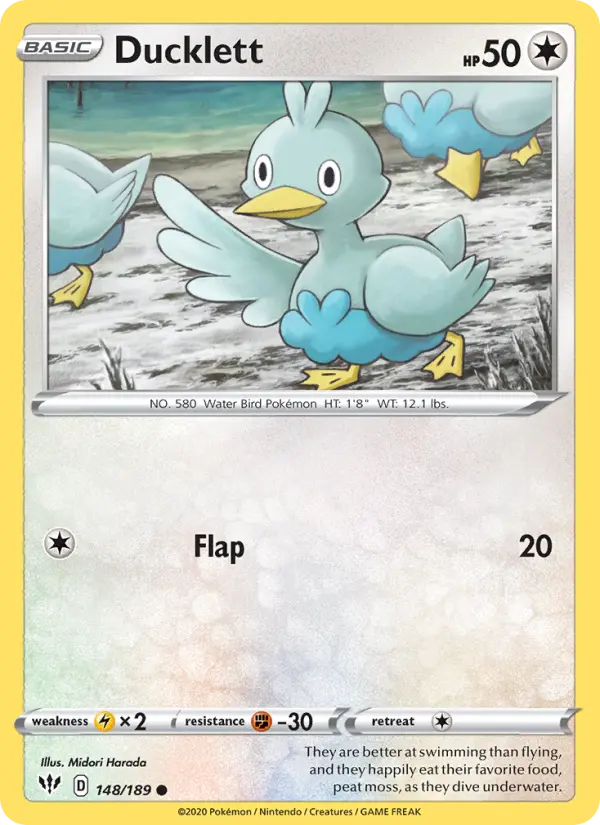
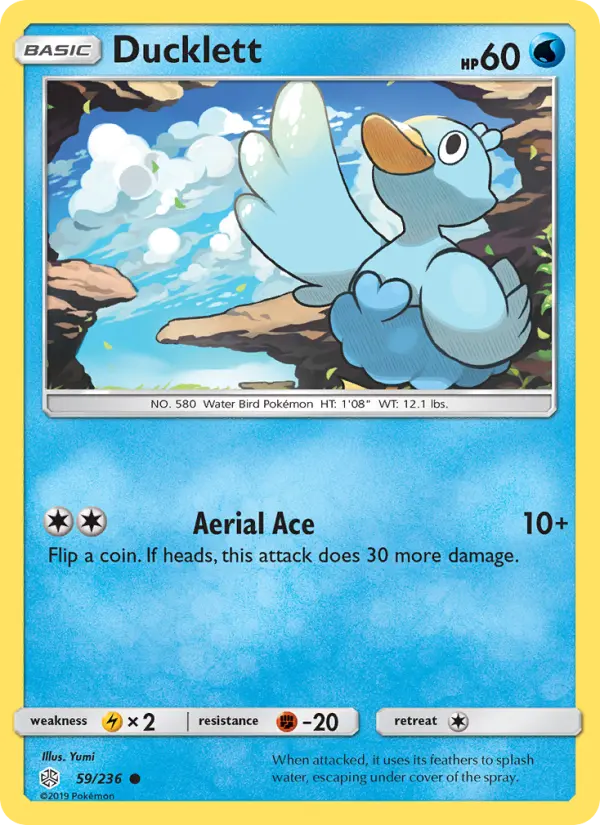
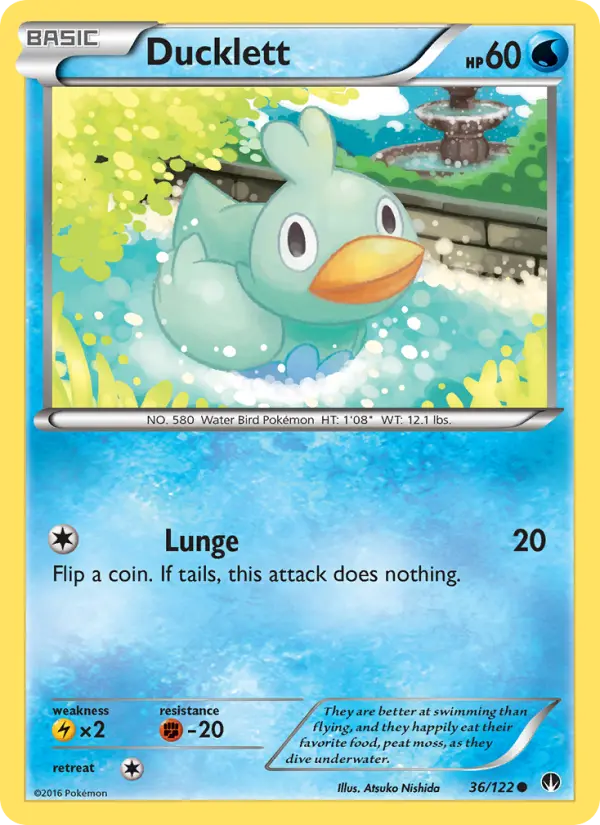
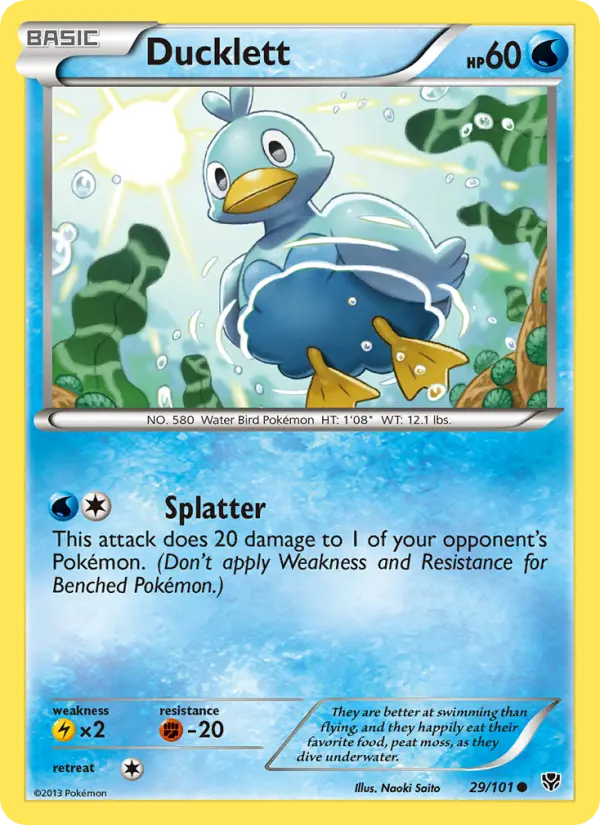
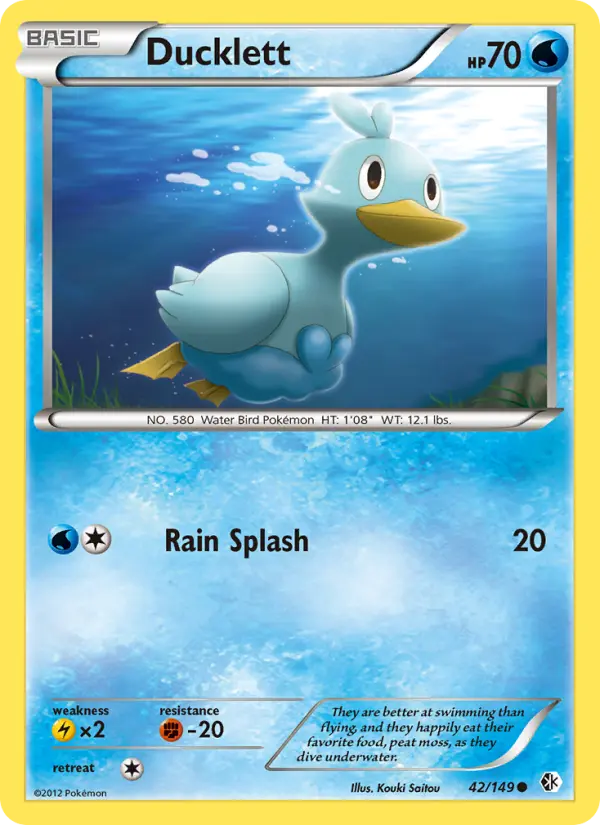
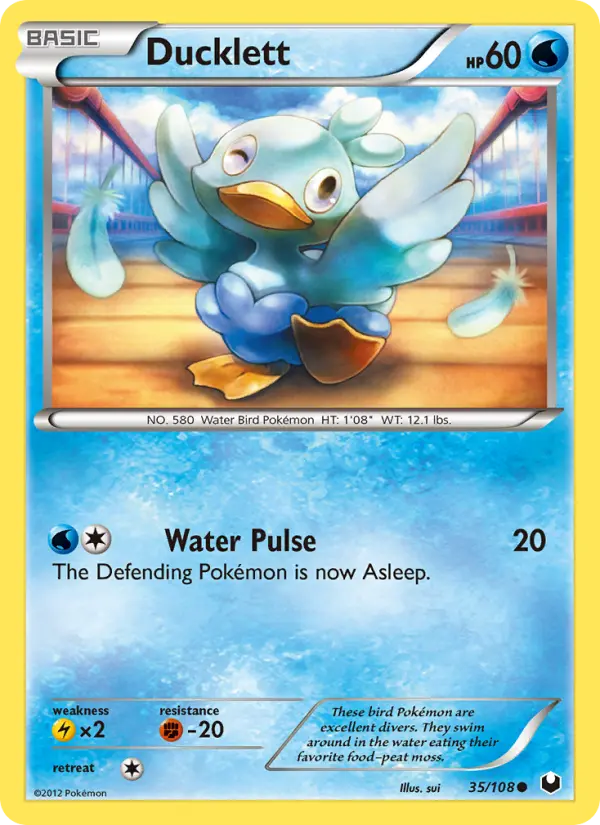
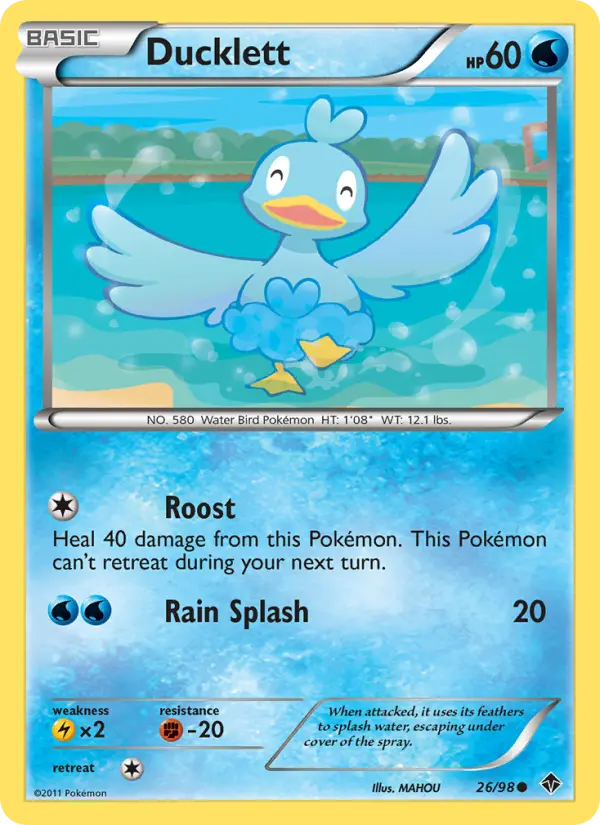
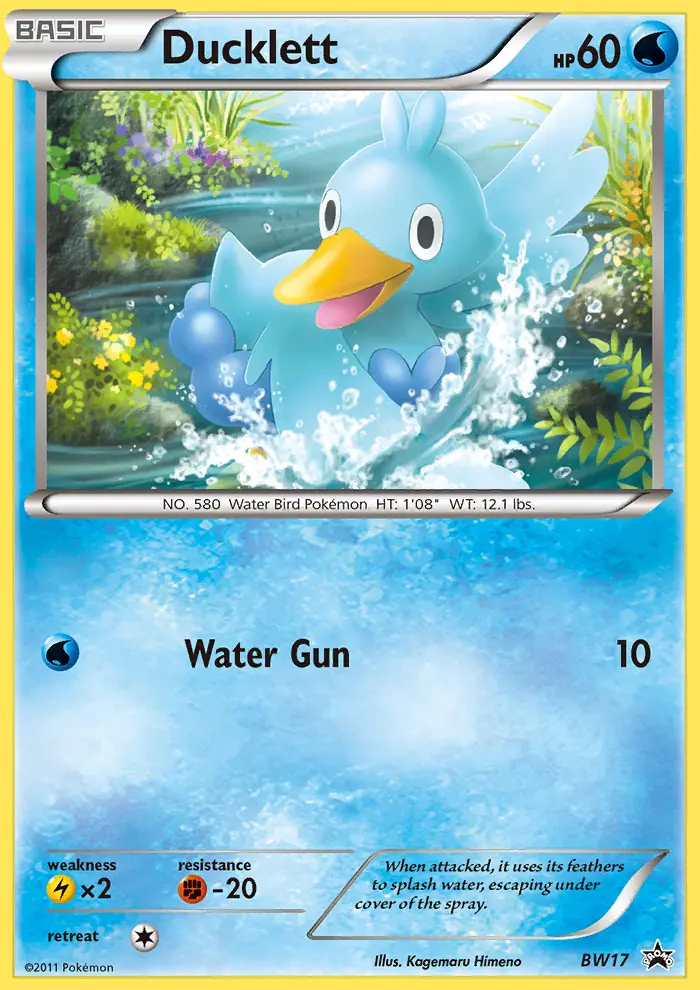
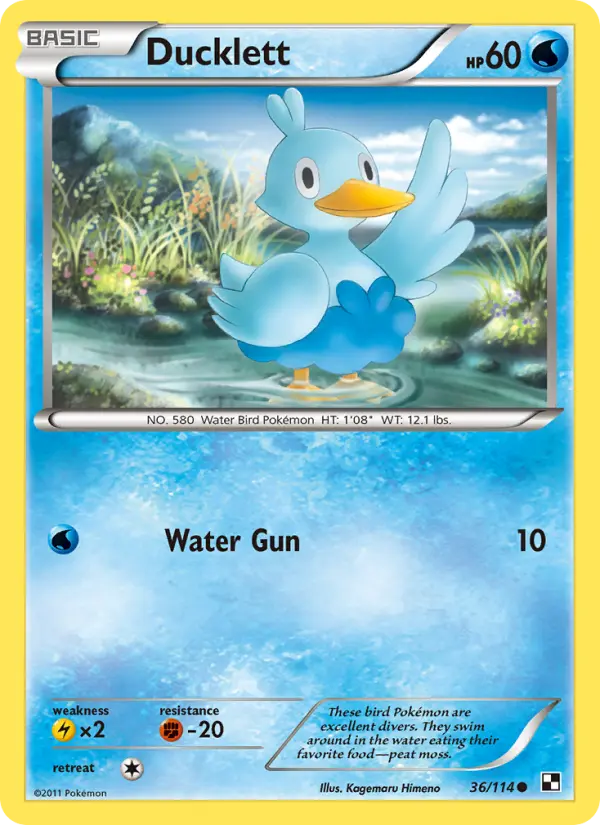
Ducklett emerged as part of Generation V's broader effort to expand the Pokémon roster with fresh designs while maintaining thematic consistency within established type categories. The species has appeared in various animated episodes featuring trainers discovering and training new Pokémon during their Unova-region adventures, though it maintains a relatively minor presence compared to flagship regional Pokémon. Its inclusion in trading card games has produced several collectible cards across multiple expansions, appealing to collectors drawn to water-type and bird-type card variants. The design resonates particularly with trainers who appreciate ornithological inspiration in Pokémon, as it authentically captures the essence of young waterfowl learning essential survival skills. While not achieving the cultural prominence of iconic water-flying types like Dragonite or Gyarados, Ducklett maintains a dedicated fanbase that appreciates its charming aesthetic and role as an accessible entry point into water-type team building for new and casual players.
Where to Find Ducklett in Every Pokémon Game
Ducklett's availability has varied considerably across games and regions since its Generation V introduction. In Black and White, Ducklett appears as Pokédex number 086 in the Unova regional listing and can be encountered in water routes throughout the early game, providing accessibility for trainers building initial teams. Black 2 and White 2 relocated Ducklett to number 153 in the expanded Unova Pokédex while maintaining encounter opportunities in similar aquatic habitats. Generation VI games including X and Y feature Ducklett in the Central Kalos region as Pokédex number 127, though availability varies between versions. Subsequent generations have included Ducklett in regional Pokédexes where water-type diversity receives emphasis, with appearances in Sword and Shield's Galar region and Scarlet and Violet's expanded National Pokédex. The species demonstrates consistent availability in modern titles through conventional water encounters, breeding chains, and occasionally through gift or in-game trade mechanics, ensuring that dedicated trainers can reliably obtain Ducklett regardless of game version or generation, though specific encounter methods and availability windows depend heavily on individual game mechanics and version exclusivity.