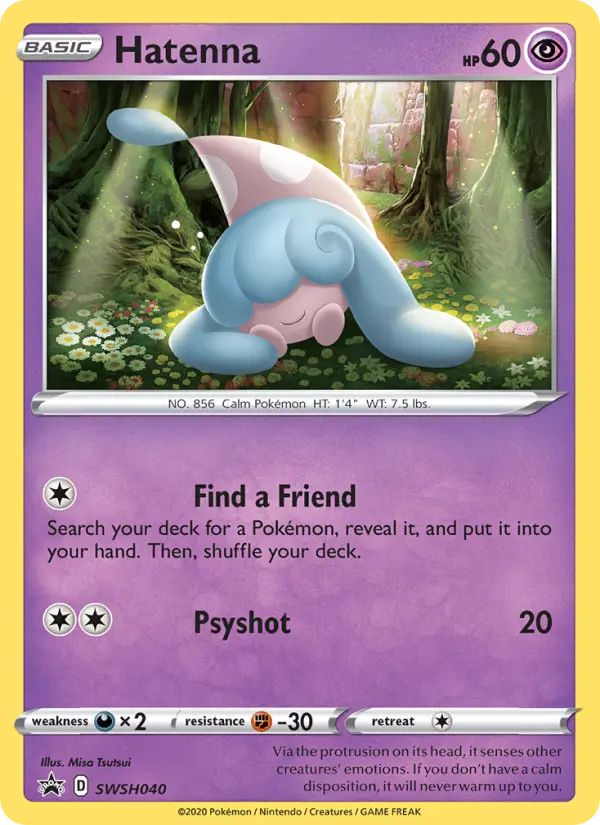
Hatenna
Generation VIII · #0856 — Calm Pokémon
Hatenna, known as the Calm Pokémon and designated as National Pokédex entry #856, is a Psychic-type Pokémon introduced in Generation VIII. This diminutive creature stands at a mere 0.4 meters tall and weighs only 3.4 kilograms, making it one of the smaller Psychic-types available to trainers. Despite its unimposing stature, Hatenna possesses a fascinating ability to sense and interpret the emotions of those around it through a specialized protrusion atop its head. It serves as the first form in a three-stage evolutionary line that culminates in the powerful Hatterene, with an intermediate evolution into Hattrem occurring at level 32. Hatenna's appeal lies not just in its eventual potential, but in its unique mechanics and emotional sensitivity that set it apart from other Psychic-type Pokémon.
Editor's Take
Hatenna's line ends in Hatterene, whose Magic Bounce plus 136 base Special Attack makes it one of the most complete Psychic/Fairy types in the game.
Base Stats
Height
0.4m
Weight
3.4kg
Category
Calm Pokémon
Gender
100% Female
Color
pink
Shape
legs
Abilities
Has a 30% chance of curing each adjacent ally of any major status ailment after each turn.
Notifies all trainers upon entering battle if an opponent has a super-effective move, self destruct, explosion, or a one-hit KO move.
Reflects most non-damaging moves back at their user.

Hatenna Biology & Physical Characteristics
Hatenna's physical structure is distinctly charming and somewhat unusual, featuring a small, rounded pink body supported by diminutive feet that contrast with its oversized head region. The most striking feature of Hatenna's anatomy is the prominent blue, wig-like covering that dominates its upper body, topped with an erect, hat-like pink tail decorated with a white spot and a blue bulbous growth at its tip. The flaps positioned on either side of its head can function as limbs, allowing for limited manipulation of objects and its environment. The most functionally significant aspect of Hatenna's biology is the psychic protrusion on its head, which serves as an emotional sensory organ, constantly absorbing and processing the emotional states of nearby creatures. This sensitive organ is responsible for both Hatenna's empathic abilities and its tendency toward exhaustion when exposed to particularly intense emotions for extended periods. The species is exclusively female, with a gender ratio of 0% male to 100% female, making it a uniquely gendered Pokémon without male representation.
Pokedex Numbers
Training
Breeding
Hatenna Breeding, Gender Ratio & Egg Groups
Hatenna represents a rare case within the Pokédex of an exclusively female species with no male counterparts whatsoever, maintaining a gender ratio of 0% male to 100% female. This gender-exclusive design is relatively uncommon and carries significant implications for breeding mechanics and evolutionary strategy within competitive pokémon training. Despite being exclusively female, Hatenna can reproduce through breeding when paired with appropriate males from compatible egg groups, specifically the Fairy egg group, allowing trainers to obtain multiple Hatenna through careful breeding programs. The species exhibits moderate base friendship of 50, suggesting that Hatenna requires genuine emotional connection and patient bonding rather than immediate attachment to new trainers. Hatenna's slow growth rate means that trainers must invest considerable time and experience-sharing to bring the species from its base level to level 32 for the first evolution, requiring dedication and long-term commitment. The egg cycle duration of 20 cycles, translating to approximately 4,884 to 5,140 steps, places Hatenna among the moderately quick-hatching species, making breeding programs reasonably accessible to committed players. The feminine-only nature of the species potentially contributes to its characterization as inherently nurturing and emotionally intuitive, traits that manifest through its status-healing abilities and empathic nature.
Sprites






TMs & HMs
tm03
x y
tm03
black 2 white 2
tm03
black white
tm03
sun moon
tm03
lets go pikachu lets go eevee
tm03
ultra sun ultra moon
tm03
omega ruby alpha sapphire
tm04
emerald
tm04
firered leafgreen
tm04
ruby sapphire
tm04
diamond pearl
tm04
xd
tm04
heartgold soulsilver
tm04
black white
tm04
colosseum
tm04
platinum
tm04
sun moon
tm04
ultra sun ultra moon
tm04
x y
tm04
omega ruby alpha sapphire
+352 more TMs/HMs
Hatenna's Evolution Chain


Hatenna Evolution, Mega Evolution & Special Forms
Hatenna's evolutionary path represents a progression from its timid, emotionally-sensitive base form toward increasingly confident and powerful iterations of itself. At level 32, Hatenna evolves into Hattrem, a Psychic-type that maintains the emotional-sensing capabilities of its predecessor while gaining increased physical presence and battle competency. The final evolution into Hatterene occurs at level 42, introducing the Fairy-type alongside Psychic, fundamentally altering the species' type coverage and strategic applications in competitive play. This three-stage evolutionary line exemplifies gradual character development, with each stage reflecting Hatenna's journey from a fragile, emotion-sensitive creature toward a powerful, balanced psychic warrior. The introduction of the Fairy-type in the final evolution provides significant advantages in competitive environments, offering new resistances and attacking options unavailable to the base form. Notably, Hatenna does not undergo Mega Evolution or other special transformations, relying instead on traditional level-based advancement to reach its ultimate form. The evolutionary journey also tends to increase the species' emotional resilience, suggesting that maturation allows these Pokémon to better manage and process the ambient emotions they detect.
Where to Find
Location data not available for this Pokémon in the database.
Hatenna Behaviour and Natural Habitat
Hatenna exhibits distinctly reclusive behavior driven entirely by its heightened emotional sensitivity. As documented in Pokédex entries across multiple games, this Pokémon actively avoids areas with significant human or creature populations, preferring isolated environments where emotional stimuli remain minimal and manageable. When Hatenna senses strong emotions from those around it, its instinctive response is to flee at considerable speed, prioritizing escape over confrontation or engagement. This behavioral pattern reflects not cowardice, but rather a genuine physiological and psychological need to protect itself from emotional overstimulation. The Pokédex notes that Hatenna will become exhausted if exposed to powerful emotions for extended durations, suggesting that emotional processing constitutes a significant expenditure of its physical and mental energy. Crucially, Hatenna demonstrates discriminatory social behavior regarding potential trainers, refusing to warm up to individuals who lack a calm disposition. This means that potential trainers must cultivate genuine inner peace and emotional stability to establish a bond with this temperamental species, making Hatenna particularly appealing to trainers who value meditation, mindfulness, and emotional equilibrium.
Pokedex Entries
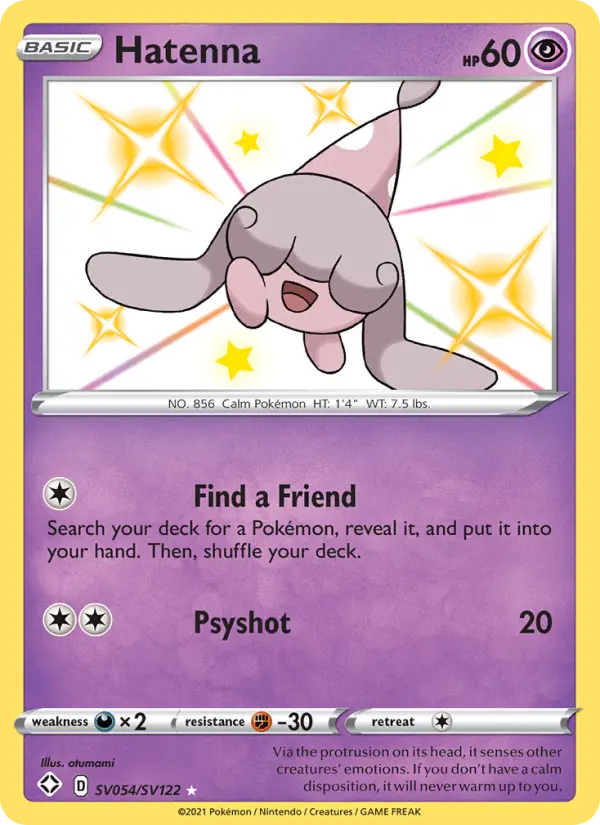
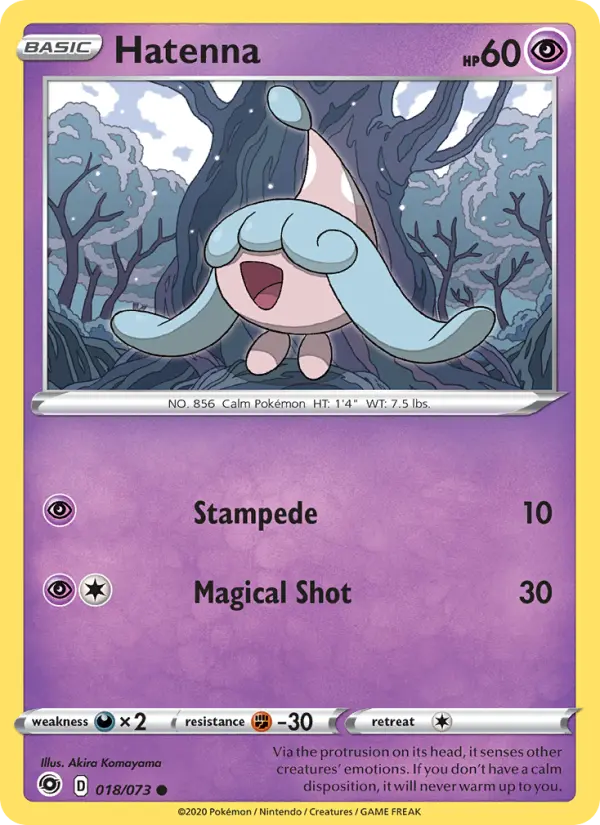
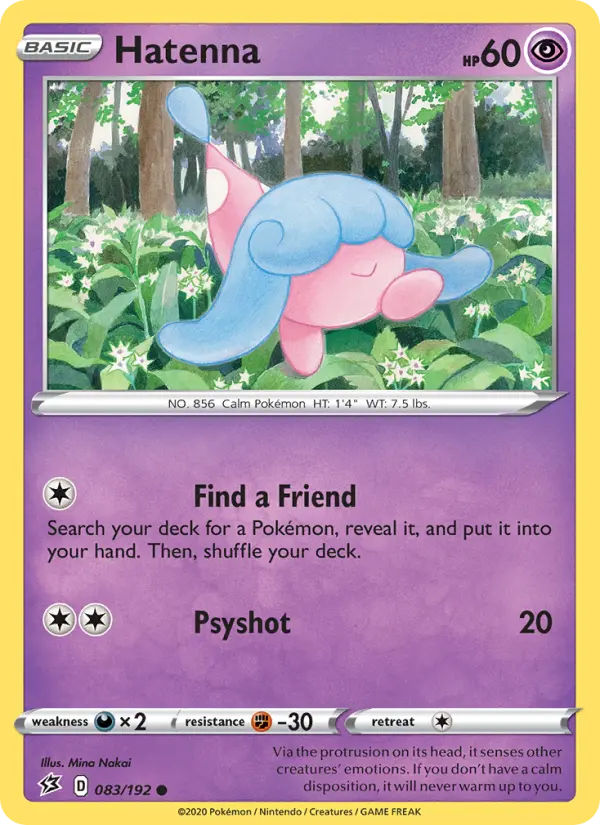
Via the protrusion on its head, it senses other creatures’ emotions. If you don’t have a calm disposition, it will never warm up to you.
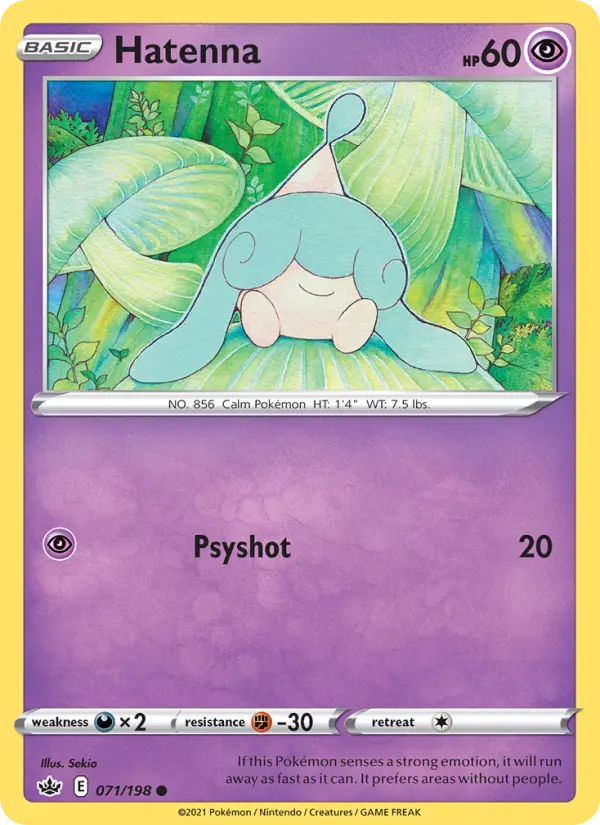
If this Pokémon senses a strong emotion, it will run away as fast as it can. It prefers areas without people.
Hatenna Name Origin & Design Inspiration
Hatenna's design cleverly combines elements of clothing with organic Pokémon features, resulting in a creature that appears to wear an elaborate hat and wig despite these features being integral to its biological structure. The Japanese name Mibrim derives from 'miburi' (身振り), meaning gesture or body language, reflecting the species' ability to read non-verbal emotional cues from others. The English name Hatenna blends 'hat' with 'antenna,' perfectly capturing the dual nature of the prominent head protrusion that simultaneously resembles both a decorative hat element and a sensory antenna. The color scheme—predominantly pink with blue accents—evokes feelings of calm, tranquility, and psychic energy, aesthetic choices that reinforce the species' emotional and psychic nature. The hat-and-wig appearance serves a narrative purpose beyond mere decoration, suggesting that Hatenna wears its emotional sensitivity visibly, with its distinctive appearance serving as an external representation of its unique internal capabilities. The evolutionary line maintains these design elements through increasingly sophisticated iterations, with Hattrem and Hatterene building upon the foundation established by Hatenna's distinctive silhouette and building toward more majestic, crown-like formations.
Learnable Moves
Hatenna can learn 51 moves:
Move | Type | Cat. | Power | Acc. | PP |
|---|---|---|---|---|---|
| after you | normal | Status | — | — | 15 |
| aromatherapy | grass | Status | — | — | 5 |
| aromatic mist | fairy | Status | — | — | 20 |
| attract | normal | Status | — | 100 | 15 |
| baton pass | normal | Status | — | — | 40 |
| calm mind | psychic | Status | — | — | 20 |
| charm | fairy | Status | — | 100 | 20 |
| confusion | psychic | Special | 50 | 100 | 25 |
| dark pulse | dark | Special | 80 | 100 | 15 |
| dazzling gleam | fairy | Special | 80 | 100 | 10 |
| disarming voice | fairy | Special | 40 | — | 15 |
| draining kiss | fairy | Special | 50 | 100 | 10 |
| endure | normal | Status | — | — | 10 |
| expanding force | psychic | Special | 80 | 100 | 10 |
| facade | normal | Physical | 70 | 100 | 20 |
| future sight | psychic | Special | 120 | 100 | 10 |
| giga drain | grass | Special | 75 | 100 | 10 |
| heal pulse | psychic | Status | — | — | 10 |
| healing wish | psychic | Status | — | — | 10 |
| helping hand | normal | Status | — | — | 20 |
| imprison | psychic | Status | — | — | 10 |
| life dew | water | Status | — | — | 10 |
| light screen | psychic | Status | — | — | 30 |
| magical leaf | grass | Special | 60 | — | 20 |
| metronome | normal | Status | — | — | 10 |
| misty terrain | fairy | Status | — | — | 10 |
| mystical fire | fire | Special | 75 | 100 | 10 |
| nuzzle | electric | Physical | 20 | 100 | 20 |
| play nice | normal | Status | — | — | 20 |
| play rough | fairy | Physical | 90 | 90 | 10 |
| protect | normal | Status | — | — | 10 |
| psybeam | psychic | Special | 65 | 100 | 20 |
| psych up | normal | Status | — | — | 10 |
| psychic | psychic | Special | 90 | 100 | 10 |
| psychic terrain | psychic | Status | — | — | 10 |
| psyshock | psychic | Special | 80 | 100 | 10 |
| quash | dark | Status | — | 100 | 15 |
| reflect | psychic | Status | — | — | 20 |
| rest | psychic | Status | — | — | 5 |
| round | normal | Special | 60 | 100 | 15 |
| safeguard | normal | Status | — | — | 25 |
| skill swap | psychic | Status | — | — | 10 |
| sleep talk | normal | Status | — | — | 10 |
| snore | normal | Special | 50 | 100 | 15 |
| stored power | psychic | Special | 20 | 100 | 10 |
| substitute | normal | Status | — | — | 10 |
| swift | normal | Special | 60 | — | 20 |
| tera blast | normal | Special | 80 | 100 | 10 |
| thunder wave | electric | Status | — | 90 | 20 |
| trick | psychic | Status | — | 100 | 10 |
| trick room | psychic | Status | — | — | 5 |
Hatenna Competitive Battle Guide
Looking at its competitive profile, Hatenna occupies a niche role as a supportive Psychic-type with base stats totaling 265, representing a deliberately weak early-stage Pokémon designed for eventual evolution rather than immediate competitive viability. Its current base stats distribute inadequately for aggressive strategies, with Special Attack reaching only 56, Attack a mere 30, and Speed just 39, making Hatenna fundamentally unsuitable for competitive play in its base form. However, Hatenna's three available abilities provide compelling strategic options for team support rather than individual combat prowess. The Healer ability grants a 30% chance per turn to cure adjacent allies of major status ailments, making Hatenna valuable in double or triple battles where it can provide passive healing support. Anticipation alerts all trainers upon Hatenna's entry if opponents carry super-effective moves, self-destruct, explosion, or one-hit knockout moves, providing crucial information for tactical decision-making. The hidden ability Magic Bounce reflects most non-damaging moves back at their user, offering defensive utility against common competitive strategies. Move pool options include Confusion, Disarming Voice, Psybeam, Psychic, Calm Mind, Dazzling Gleam, Heal Pulse, and Healing Wish, emphasizing support and special attack rather than physical offense. Trainers seeking competitive viability should prioritize training Hatenna toward its evolved forms rather than using it directly in ranked battles, as its base form represents the first step in a progressive power curve.
Commonly Asked Questions About Hatenna
What type is Hatenna?
Hatenna is a psychic type Pokemon.
What does Hatenna evolve into?
Hatenna evolves into hattrem, then into hatterene.
What are Hatenna's weaknesses?
Hatenna is weak to bug, ghost and dark type moves.
Does Hatenna evolve by trading?
No — Hatenna evolves entirely through leveling up, with no trade required at any stage.
Hatenna Cultural Impact & Franchise History
Since its introduction in Generation VIII, Hatenna has cultivated a dedicated fanbase drawn to its unique design philosophy and emotional-sensitivity mechanics that distinguish it from typical Psychic-type Pokémon. The species' appearance in the Pokémon Sword and Shield games introduced players to a Pokémon whose gameplay mechanics directly reflected its behavioral characterization, creating a cohesive narrative experience where emotional mechanics translated into actual game mechanics through its abilities. Hatenna's requirement for trainers to maintain calm dispositions to establish bonds resonated with audiences interested in meditation and mindfulness, positioning the species as culturally relevant to contemporary wellness discussions. The character Liko featured a Hatenna as a major companion in the animated series, introducing the species to broader audiences and demonstrating its potential as a beloved narrative companion. Hatenna's all-female species composition sparked conversations within fan communities regarding gender representation in Pokémon design, contributing to broader discussions about how Pokédex mechanics reflect and reinforce characterizations. The species' prevalence in fan art, creative writing, and community discussions demonstrates sustained cultural relevance beyond its initial release, with trainers appreciating both its aesthetic appeal and the philosophical implications of its emotional-sensing capabilities.
Where to Find Hatenna in Every Pokémon Game
Hatenna's availability varies significantly across different Pokémon games and regions. In Pokémon Sword and Shield, the species can be encountered in the wild as entry #241 in the Galar regional Pokédex, appearing in various locations throughout the base game. The Crown Tundra expansion includes Hatenna as entry #040, expanding availability options for players pursuing complete regional Pokédexes. In Pokémon Scarlet and Violet, Hatenna appears as entry #282 in the regional Pokédex, continuing its availability in more recent games with updated mechanics and move pools. The Pokémon Legends: Arceus games notably lack Hatenna in their Pokédex, making it unavailable in that particular game and its associated mechanics. Brilliant Diamond and Shining Pearl similarly exclude Hatenna from their available species, suggesting deliberate design choices regarding which Generation VIII species receive inclusion in remakes of earlier games. The Teal Mask DLC for Pokémon Scarlet and Violet introduces Hatenna as entry #0092, providing additional availability windows for players seeking the species. Catch rates favor trainers attempting to capture Hatenna, with a base catch rate of 235 out of 255 representing relatively high likelihood of successful capture with standard Poké Balls, reducing the necessity for specialized capturing equipment. Overall availability remains strong across contemporary Pokémon titles, ensuring that trainers seeking to add Hatenna to their teams can do so through legitimate gameplay in multiple games.