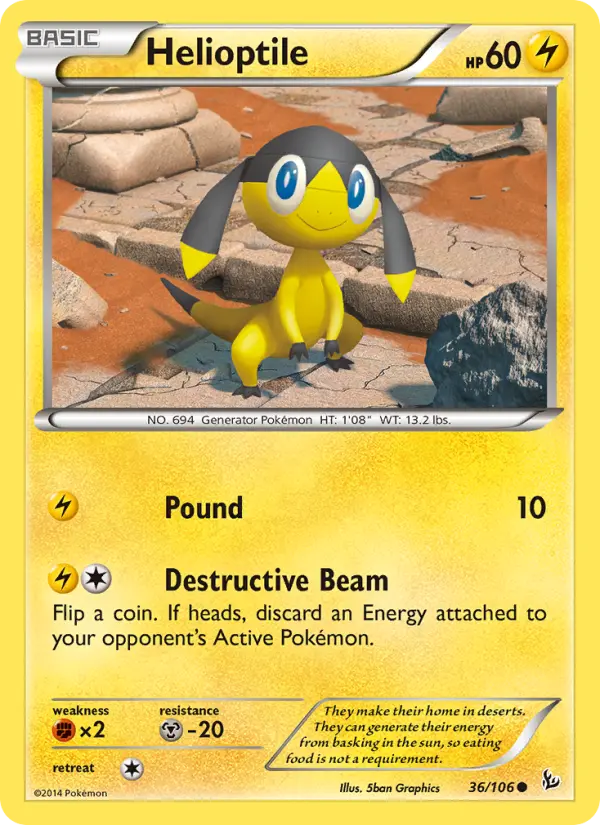
Helioptile
Generation VI · #0694 — Generator Pokémon
Helioptile is built around Speed first — 70 at base is the clearest signal of how it's meant to be used, more than its electric/normal typing alone would suggest. Despite its humble size and modest aggregate stat total of 289, Helioptile possesses unique characteristics that have made it a memorable addition to the franchise, particularly due to its specialized connection to solar energy and its distinctive biological features. The species represents an interesting middle ground in Pokémon design—not powerful enough to dominate competitive play, yet charming and strategically viable enough to warrant inclusion in many trainer teams across multiple game generations.
Editor's Take
Helioptile's line ends in Heliolisk, whose Dry Skin and Electric/Normal typing with 109 base Speed is a genuinely well-rounded package.
Base Stats
Height
0.5m
Weight
6.0kg
Category
Generator Pokémon
Gender
Male 50% / Female 50%
Color
yellow
Shape
upright
Abilities
Causes 1/8 max HP in damage each turn during strong sunlight, but heals for 1/8 max HP during rain. Increases damage from fire moves to 1.25×, but absorbs water moves, healing for 1/4 max HP.
Increases evasion to 1.25× during a sandstorm. Protects against sandstorm damage.
Increases Special Attack to 1.5× but costs 1/8 max HP after each turn during strong sunlight.
Helioptile Biology & Physical Characteristics
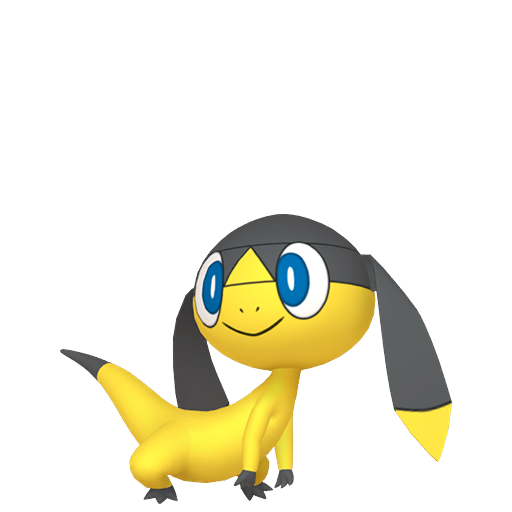
Helioptile is a bipedal, lizard-like Pokémon with a predominantly pale yellow coloration accented by black markings on its feet, tail tip, and head. Its most distinctive feature is the pair of pointed extensions hanging from either side of its head, which can stiffen and expand into elaborate frills—structures that function similarly to solar panels in their energy generation capabilities. These frills contain specialized cells that produce electricity when exposed to sunlight, allowing Helioptile to synthesize energy directly from light rather than requiring conventional food intake. The Pokémon possesses blue eyes, a characteristic V-shaped mouth, three toes on each foot, and a tapering tail that contributes to its streamlined appearance. When utilizing electric moves, Helioptile's head and frills glow with a pale yellow luminescence, visually demonstrating the energy generation process. This biological adaptation is so fundamental to the species' physiology that interruption of solar energy absorption causes Helioptile significant stress and weakness, highlighting the Pokémon's complete dependence on sunlight for optimal functioning.
Pokedex Numbers
Training
Breeding
Helioptile Breeding, Gender Ratio & Egg Groups
Half of all Helioptile are male, half are female — no skew to plan around, ensuring that both genders appear with equal frequency in the wild and in breeding populations. This equal distribution allows trainers to breed Helioptile without gender-based complications, making it accessible for players seeking to obtain this species through egg hatching. The species belongs to both the Monster and Dragon egg groups, a dual classification that grants it breeding compatibility with a wide range of Pokémon and allows for diverse movepool inheritance possibilities through strategic breeding. With a base friendship value of 70 (as documented in Generations VI and VII), Helioptile demonstrates moderate friendliness toward trainers, suggesting it bonds reasonably well with its captors but requires some effort to achieve maximum affection. The hatch counter of 20 cycles means that eggs containing Helioptile require approximately 4,884 to 5,140 steps to hatch, placing it in the mid-range of hatching times. The species' capture rate of 190 indicates that Helioptile can be caught relatively easily with standard Poké Balls when encountered in the wild, with approximately a 35.2% success rate on a full-health specimen, making it an accessible early-game acquisition for players beginning their journey.
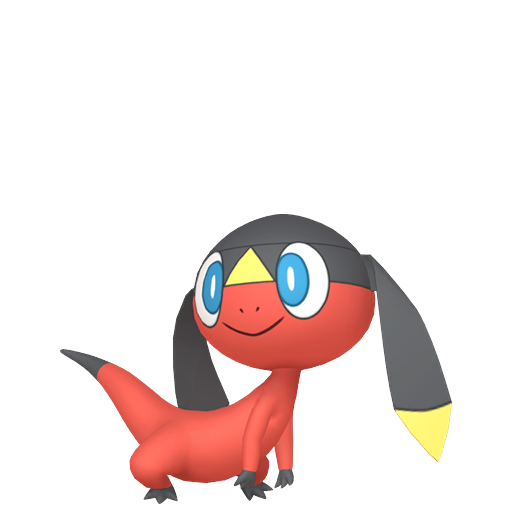
Sprites




TMs & HMs
tm02
yellow
tm02
red blue
tm02
blue japan
tm02
red green japan
tm05
lets go pikachu lets go eevee
tm06
yellow
tm06
gold silver
tm06
red blue
tm06
crystal
tm06
emerald
tm06
firered leafgreen
tm06
diamond pearl
tm06
platinum
tm06
ruby sapphire
tm06
colosseum
tm06
black 2 white 2
tm06
xd
tm06
black white
tm06
heartgold soulsilver
tm06
omega ruby alpha sapphire
+608 more TMs/HMs
Helioptile's Evolution Chain


Helioptile Evolution, Mega Evolution & Special Forms
Helioptile evolves into Heliolisk when exposed to a Sun Stone, a fitting evolutionary method that emphasizes the species' solar nature and its dependence on sunlight for power. The evolution process transforms Helioptile from a small, lizard-like creature into a larger, more powerful electric generator, with Heliolisk gaining significant stat improvements particularly in Special Attack and Speed. This evolution represents a natural progression in the species' development, as the solar panels on Heliolisk become even more pronounced and efficient at converting sunlight into electrical energy. The Sun Stone requirement is thematically appropriate, as it symbolizes the culmination of Helioptile's solar-powered capabilities reaching full maturity. Unlike many Pokémon that evolve through leveling or other traditional methods, Helioptile's evolution mechanic directly mirrors its biological nature and further cements the connection between this species and solar energy as a core aspect of its identity within the Pokémon universe.
Where to Find
Kalos Route 9
kalos
+5 more
Helioptile Behaviour and Natural Habitat
Helioptile makes its home exclusively in desert environments, where abundant sunlight provides ideal conditions for its unique energy generation system. The species has evolved to thrive in arid climates where food sources are scarce, compensating for this scarcity through its ability to convert solar radiation into usable energy. This adaptation means that unlike most Pokémon, Helioptile does not require conventional feeding to survive and maintain strength, instead relying entirely on regular exposure to sunlight. The Pokémon's behavior reflects its dependence on solar cycles—it would be most active during daylight hours when its energy generation reaches peak efficiency. During periods of cloud cover or extended darkness, Helioptile would become lethargic and weakened, making weather conditions a critical factor in its day-to-day existence. Trainers who capture Helioptile must understand that this Pokémon thrives when battles occur under clear, sunny conditions and suffers considerably in rain or darkness, making weather manipulation a key strategic consideration when employing this species.
Pokedex Entries
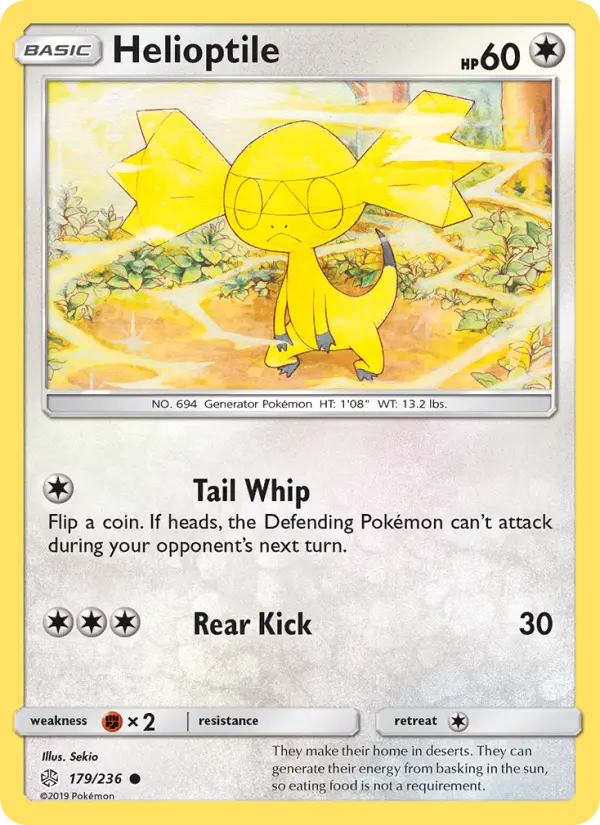
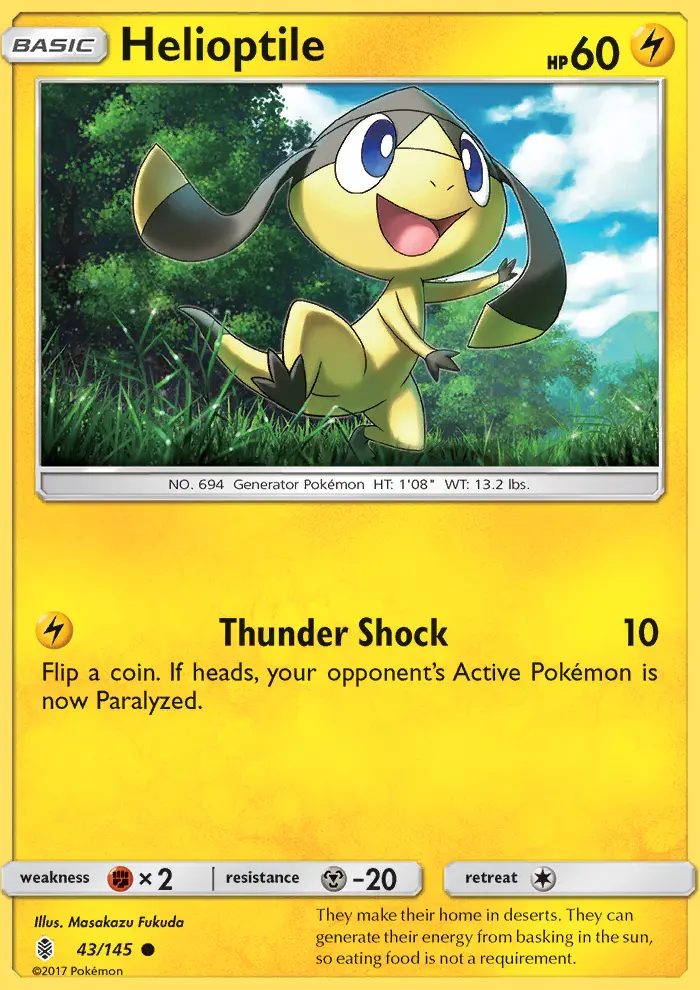
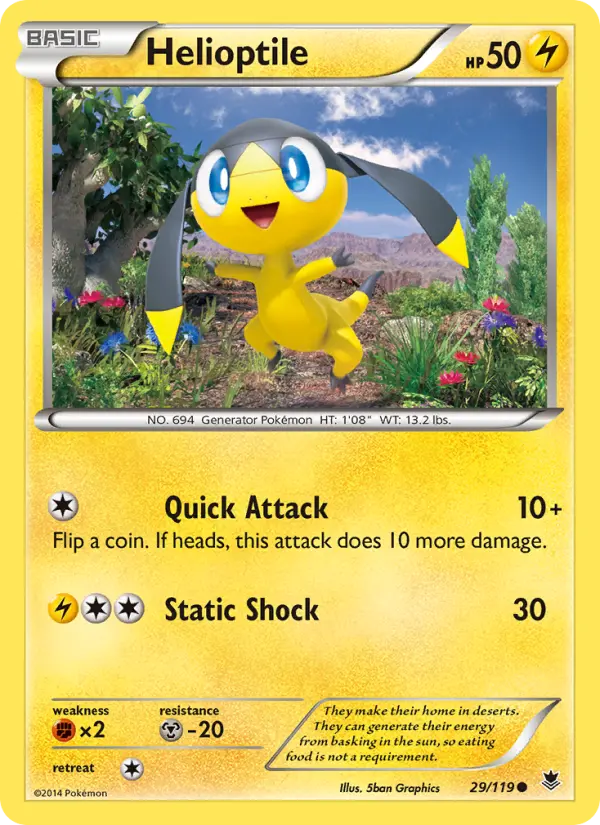
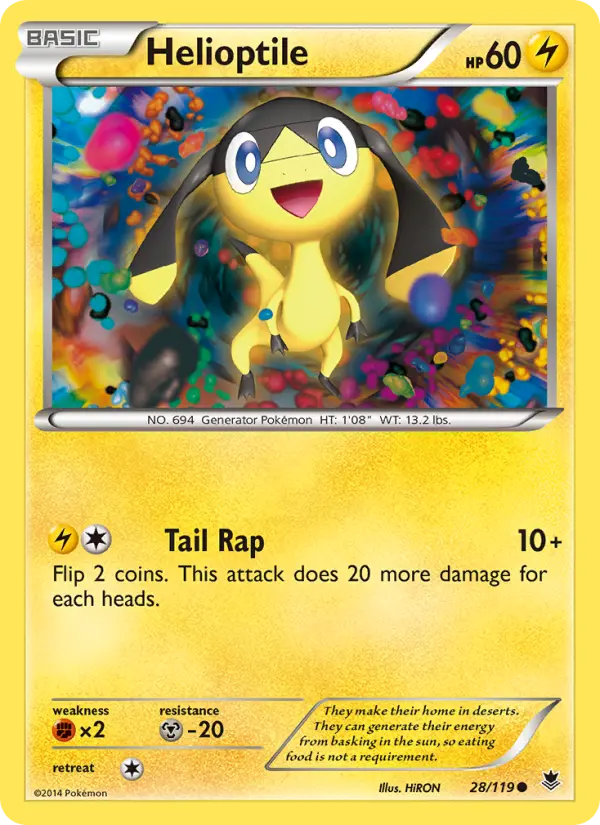
They make their home in deserts. They can generate their energy from basking in the sun, so eating food is not a requirement.
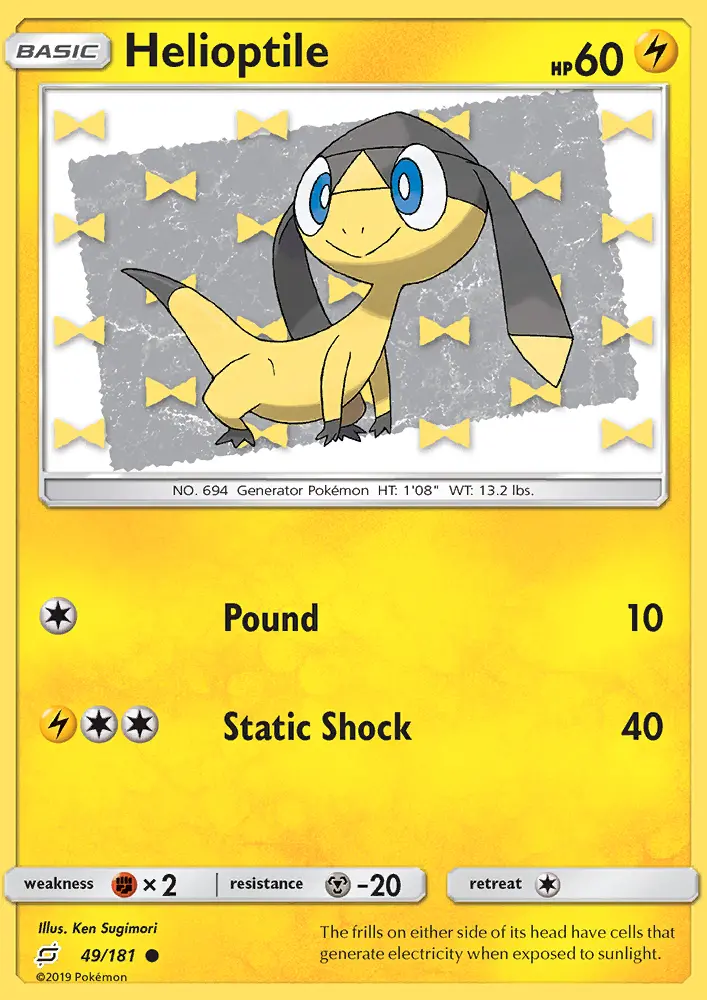
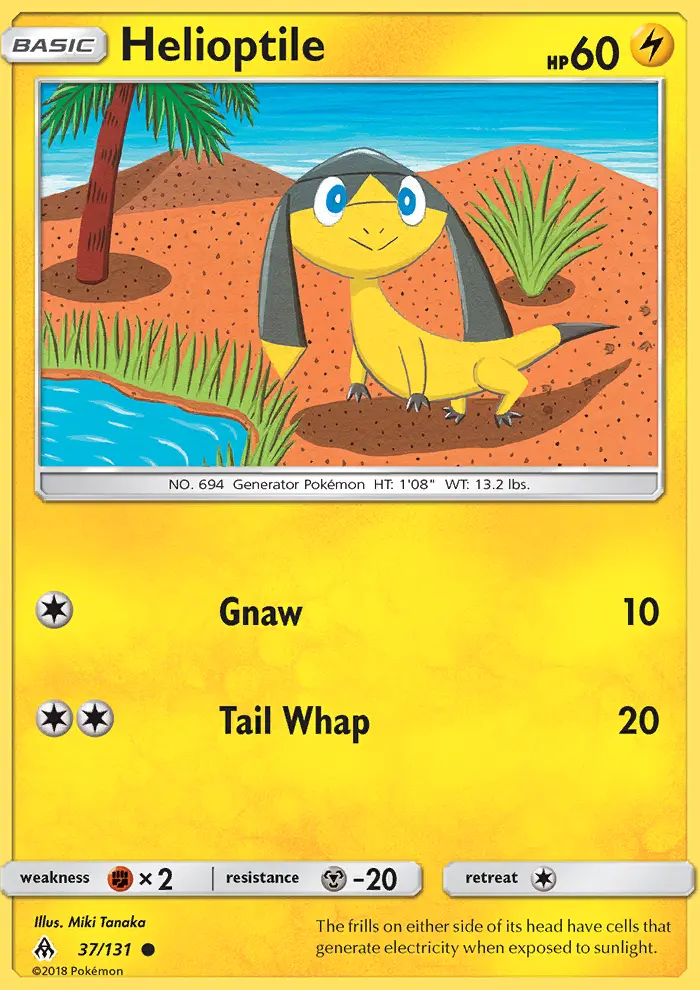
The frills on either side of its head have cells that generate electricity when exposed to sunlight.
They make their home in deserts. They can generate their energy from basking in the sun, so eating food is not a requirement.
The frills on either side of its head have cells that generate electricity when exposed to sunlight.
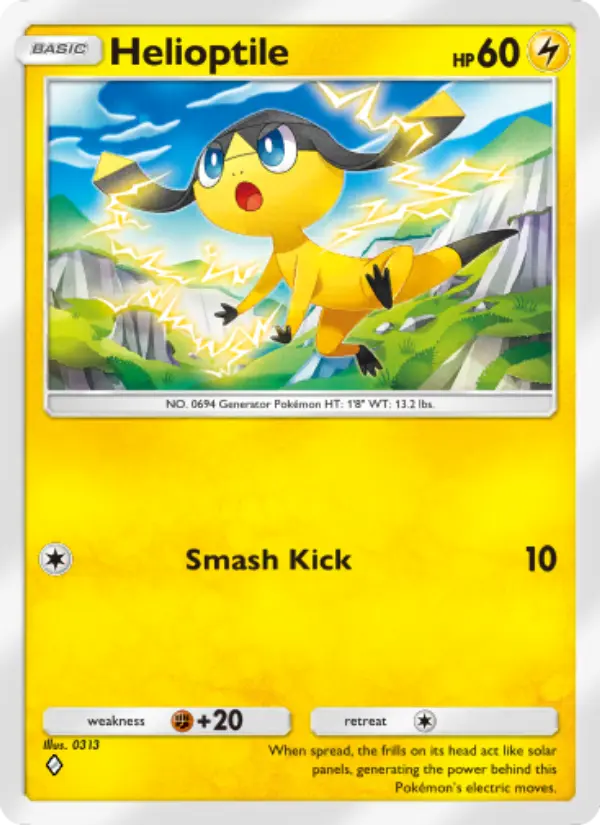
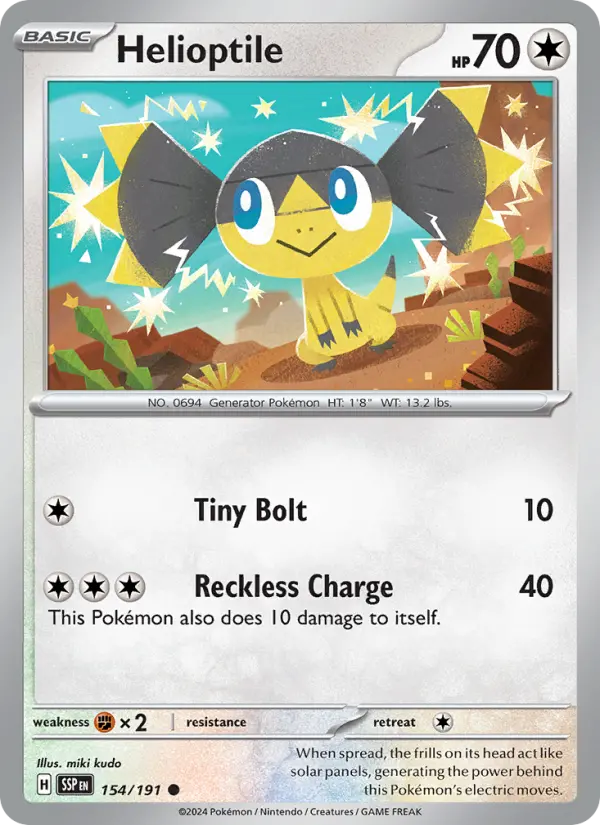
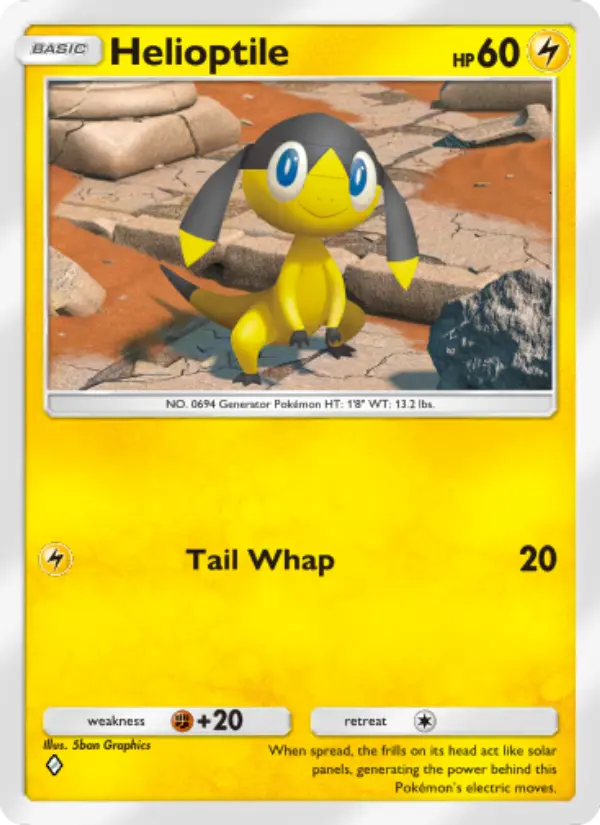
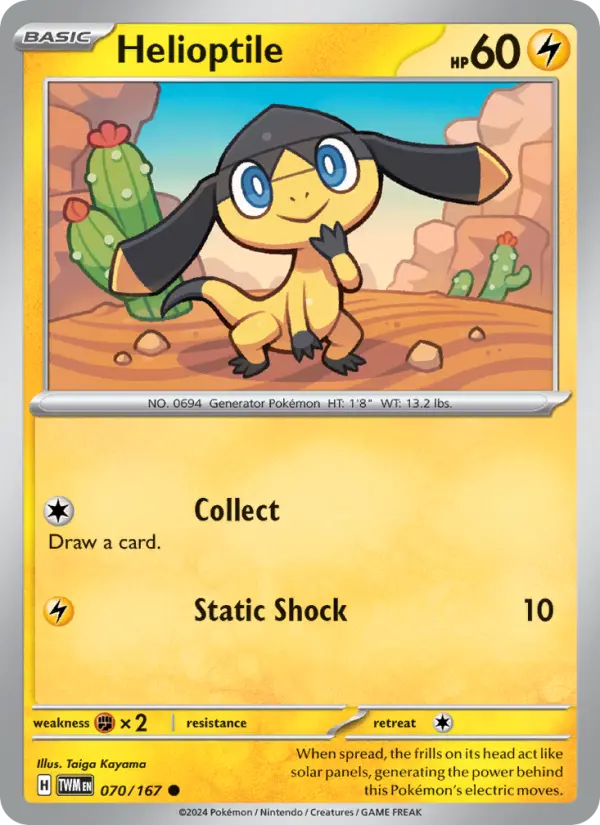
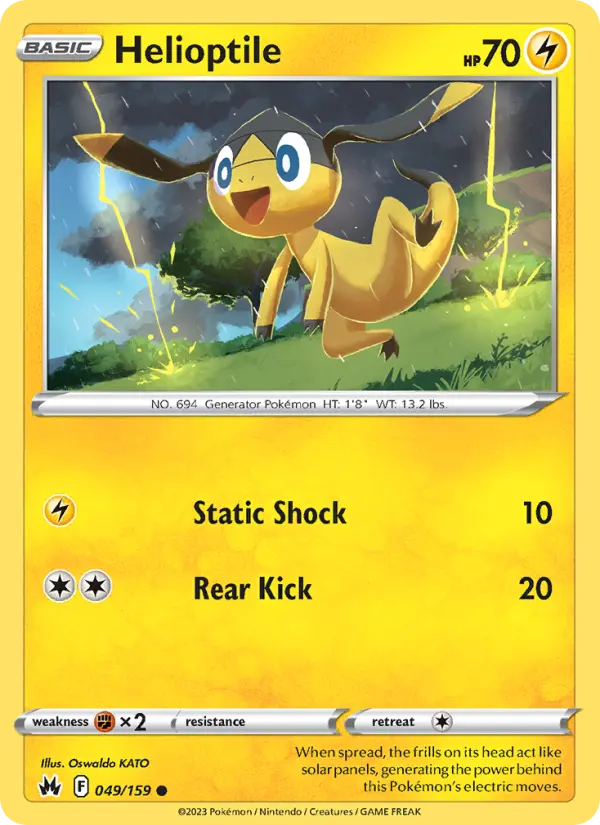
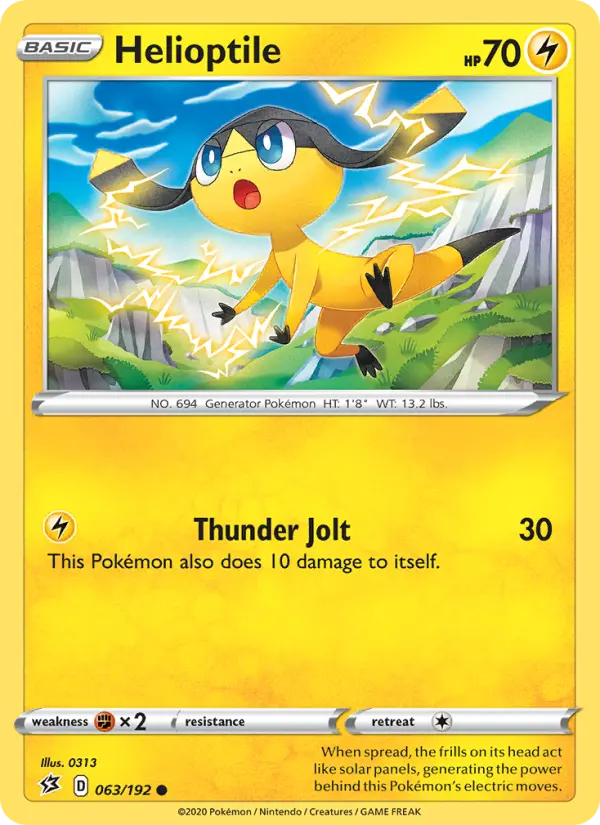
When spread, the frills on its head act like solar panels, generating the power behind this Pokémon’s electric moves.
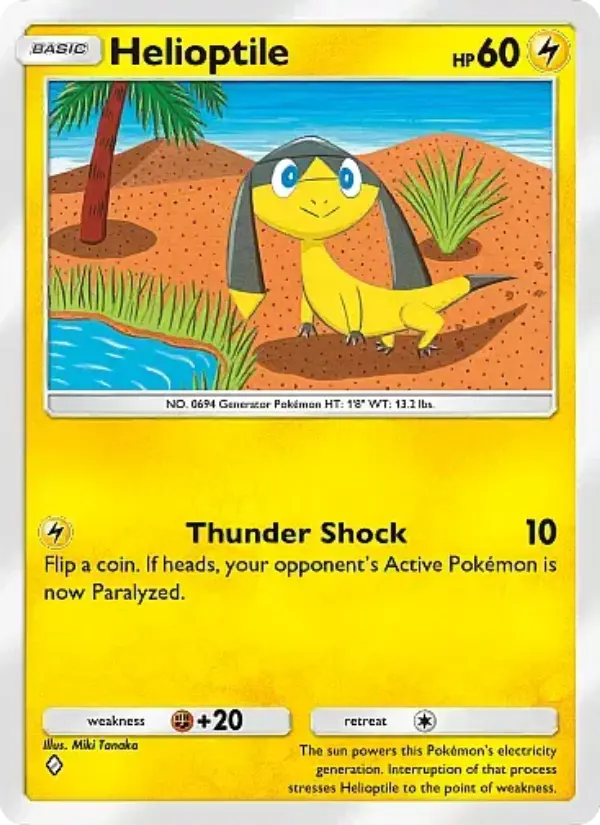
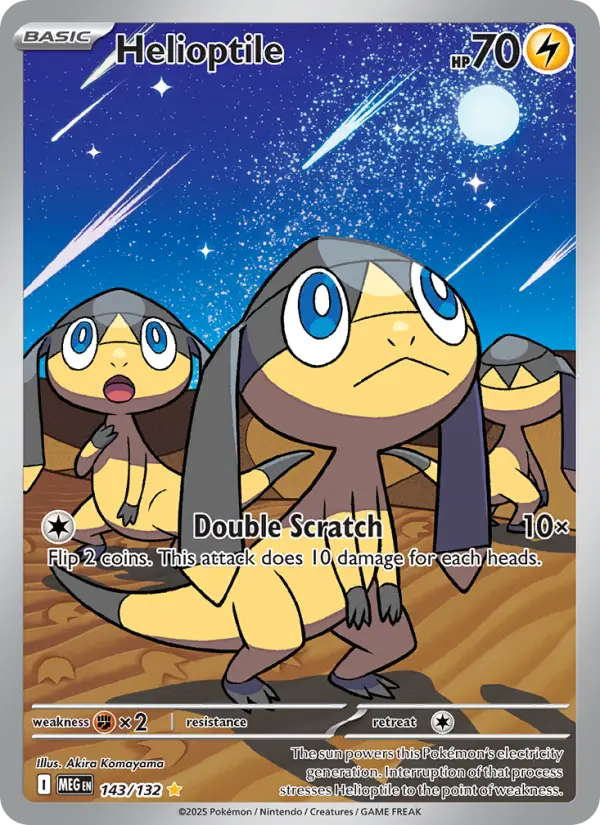
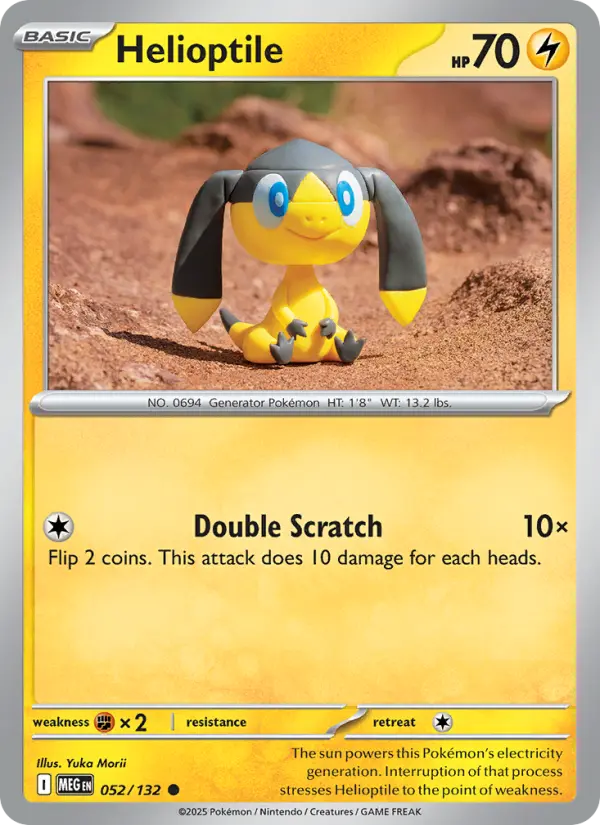
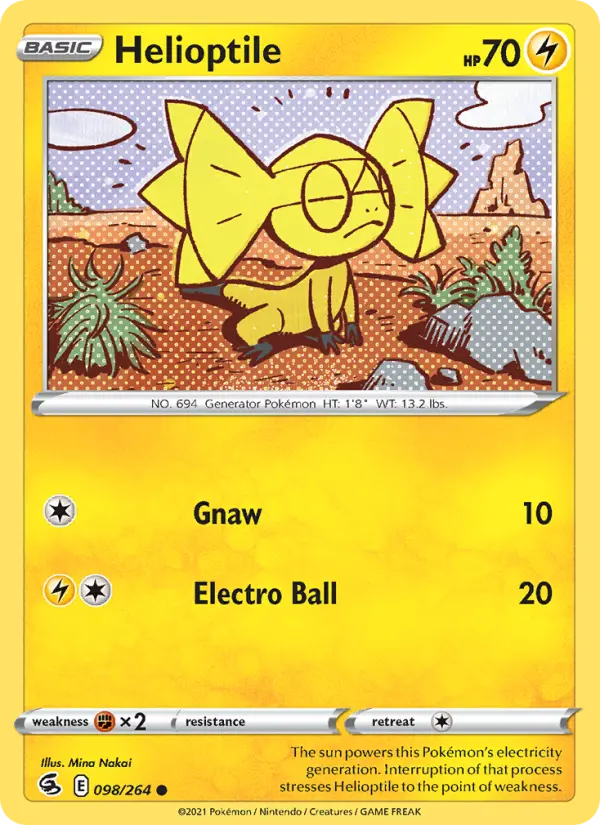
The sun powers this Pokémon’s electricity generation. Interruption of that process stresses Helioptile to the point of weakness.
Helioptile Name Origin & Design Inspiration
Helioptile's name traces to a combination of 'helio,' meaning sun, and 'ptile,' a suffix referring to feathers or wings—together creating a name that translates roughly to 'sun-feathered' or 'sun-winged,' perfectly capturing the essence of a solar-powered creature. The Japanese name, Erikiteru, follows a similar pattern of phonetic construction typical of Generation VI Pokémon naming conventions. The design itself draws inspiration from real-world desert lizards, particularly the frilled lizard, whose distinctive neck frill served as the primary visual basis for Helioptile's iconic head extensions. The evolutionary lineage continues this theme with Heliolisk, where the frills become even more exaggerated and solar-panel-like in appearance. The pale yellow coloration evokes both sunshine and the sandy deserts where the species naturally resides, while the black accents provide visual contrast and suggest the darker, more serious electrical potential hidden within this seemingly adorable creature. Every aspect of Helioptile's design—from its small stature to its prominent frills—serves to communicate its identity as a creature perfectly adapted to harness the power of the sun.
Learnable Moves
Helioptile can learn 63 moves:
Move | Type | Cat. | Power | Acc. | PP |
|---|---|---|---|---|---|
| agility | psychic | Status | — | — | 30 |
| ally switch | psychic | Status | — | — | 15 |
| attract | normal | Status | — | 100 | 15 |
| bulldoze | ground | Physical | 60 | 100 | 20 |
| camouflage | normal | Status | — | — | 20 |
| charge | electric | Status | — | — | 20 |
| charge beam | electric | Special | 50 | 90 | 10 |
| confide | normal | Status | — | — | 20 |
| cut | normal | Physical | 50 | 95 | 30 |
| dark pulse | dark | Special | 80 | 100 | 15 |
| dig | ground | Physical | 80 | 100 | 10 |
| double team | normal | Status | — | — | 15 |
| dragon rush | dragon | Physical | 100 | 75 | 10 |
| dragon tail | dragon | Physical | 60 | 90 | 10 |
| electric terrain | electric | Status | — | — | 10 |
| electrify | electric | Status | — | — | 20 |
| electro ball | electric | Special | — | 100 | 10 |
| electroweb | electric | Special | 55 | 95 | 15 |
| endure | normal | Status | — | — | 10 |
| facade | normal | Physical | 70 | 100 | 20 |
| flash | normal | Status | — | 100 | 20 |
| frustration | normal | Physical | — | 100 | 20 |
| glare | normal | Status | — | 100 | 30 |
| grass knot | grass | Special | — | 100 | 20 |
| hidden power | normal | Special | 60 | 100 | 15 |
| iron tail | steel | Physical | 100 | 75 | 15 |
| light screen | psychic | Status | — | — | 30 |
| low sweep | fighting | Physical | 65 | 100 | 20 |
| magnet rise | electric | Status | — | — | 10 |
| mud slap | ground | Special | 20 | 100 | 10 |
| parabolic charge | electric | Special | 65 | 100 | 20 |
| pound | normal | Physical | 40 | 100 | 35 |
| protect | normal | Status | — | — | 10 |
| psych up | normal | Status | — | — | 10 |
| quick attack | normal | Physical | 40 | 100 | 30 |
| rain dance | water | Status | — | — | 5 |
| razor wind | normal | Special | 80 | 100 | 10 |
| rest | psychic | Status | — | — | 5 |
| return | normal | Physical | — | 100 | 20 |
| rising voltage | electric | Special | 70 | 100 | 20 |
| rock slide | rock | Physical | 75 | 90 | 10 |
| rock tomb | rock | Physical | 60 | 95 | 15 |
| round | normal | Special | 60 | 100 | 15 |
| sandstorm | rock | Status | — | — | 10 |
| scale shot | dragon | Physical | 25 | 90 | 20 |
| secret power | normal | Physical | 70 | 100 | 20 |
| shock wave | electric | Special | 60 | — | 20 |
| signal beam | bug | Special | 75 | 100 | 15 |
| sleep talk | normal | Status | — | — | 10 |
| snore | normal | Special | 50 | 100 | 15 |
| substitute | normal | Status | — | — | 10 |
| surf | water | Special | 90 | 100 | 15 |
| swagger | normal | Status | — | 85 | 15 |
| swift | normal | Special | 60 | — | 20 |
| tail whip | normal | Status | — | 100 | 30 |
| thunder | electric | Special | 110 | 70 | 10 |
| thunder shock | electric | Special | 40 | 100 | 30 |
| thunder wave | electric | Status | — | 90 | 20 |
| thunderbolt | electric | Special | 90 | 100 | 15 |
| toxic | poison | Status | — | 90 | 10 |
| u turn | bug | Physical | 70 | 100 | 20 |
| volt switch | electric | Special | 70 | 100 | 20 |
| wild charge | electric | Physical | 90 | 100 | 15 |
Helioptile Competitive Battle Guide
In competitive Pokémon play, Helioptile occupies a unique but limited niche due to its modest aggregate stat total of 289 and relatively unbalanced stat distribution. Its most impressive stat is Speed at 70, which provides decent competitive utility, while Special Attack at 61 offers moderate offensive potential. However, its defensive stats are considerably weaker, with Defense at 33 and Special Defense at 43, making Helioptile fragile and vulnerable to most attacks. The species' three ability options each provide distinct strategic advantages: Dry Skin offers weather-dependent survivability with synergy against rain teams, Sand Veil provides evasion benefits during sandstorms, and the hidden ability Solar Power amplifies Special Attack to 1.5x during sunlight at the cost of 1/8 maximum health per turn. This makes Helioptile most viable in sun-based team compositions, where its offensive potential can be maximized while its frail defenses are compensated for through strategic team support. Competitive players rarely employ Helioptile in serious tournaments due to superior alternatives in the electric-type category, though dedicated trainers appreciate its unique moveset options and role as a sun-sweeper in casual and lower-tier competitive formats.
Commonly Asked Questions About Helioptile
What type is Helioptile?
Helioptile is a electric and normal type Pokemon.
What does Helioptile evolve into?
Helioptile evolves into heliolisk.
What are Helioptile's weaknesses?
Helioptile is weak to fighting and ground type moves.
Does Helioptile evolve by trading?
No — Helioptile evolves entirely through leveling up, with no trade required at any stage.
Where can I find Helioptile?
Helioptile can be found in kalos route 9 (kalos).
Helioptile Cultural Impact & Franchise History
Since its introduction in Generation VI, Helioptile has earned a dedicated fanbase despite not achieving mainstream competitive prominence, with many players appreciating its adorable design and unique solar-powered concept. The species has appeared in the Pokémon animated series, including the main series and various spin-off media, where its charming personality and unique abilities have endeared it to viewers. Fan communities have embraced Helioptile as a symbol of Generation VI's fresh approach to Pokémon design, celebrating how the game developers reimagined classic type combinations through novel biological mechanics. The species' cultural significance extends to its role in expanding the franchise's representation of renewable energy concepts, as Helioptile stands as a tangible example of solar power's potential within the Pokémon universe. Trading card game enthusiasts have also engaged with Helioptile through various TCG releases, while its appearance in spin-off titles and merchandise has solidified its place in the broader Pokémon cultural landscape. Additionally, Helioptile's appearance in Super Smash Bros. for Nintendo 3DS as a trophy further demonstrates its recognition within Nintendo's extended universe.
Where to Find Helioptile in Every Pokémon Game
Helioptile was introduced in Generation VI and has appeared in multiple mainline games since its debut, making it generally accessible to most trainers. In Pokémon X and Y, Helioptile can be found in the Coastal Kalos region as Pokédex number 046, appearing in desert-like locations appropriate to its natural habitat. The species has maintained availability across subsequent generations, appearing in Pokémon Sword and Shield where it holds the local Pokédex number 0318, and in the upcoming Pokémon Legends: Z-A where it receives updated move pools and integration with new mechanics. The relatively generous capture rate of 190 means that trainers encounter minimal difficulty in obtaining Helioptile once they locate it in appropriate areas, with standard Poké Balls providing reasonable success rates. Egg hatching presents an alternative acquisition method, as Helioptile can be bred from compatible parents within the Monster and Dragon egg groups, with 20-cycle eggs reliably producing this species. The species is not version-exclusive in any generation where it appears, ensuring that all players regardless of game version can obtain Helioptile without requiring trade-based acquisition methods, making it genuinely available and accessible to the broader player base.