Herdier
Generation V · #0507 — Loyal Dog Pokémon
Herdier entered the roster in Generation V as a normal-type, and what's stuck since is less its typing than its intimidate ability. With a National Pokédex number of 507, this canine companion stands 0.9 meters tall and weighs 14.7 kilograms, making it a moderately-sized addition to any trainer's team. Its total stat allocation of 370 emphasizes physical prowess with a base Attack of 80, complemented by balanced defenses and moderate Speed, creating a well-rounded intermediate Pokémon suitable for both casual play and competitive encounters.
Editor's Take
Herdier's Intimidate makes it genuinely useful in the mid-game, which is more than most early-route middle stages manage.
Base Stats
Height
0.9m
Weight
14.7kg
Category
Loyal Dog Pokémon
Gender
Male 50% / Female 50%
Color
gray
Shape
quadruped
Abilities
Lowers opponents' Attack one stage upon entering battle.
Doubles Speed during a sandstorm. Protects against sandstorm damage.
Lets the Pokémon's normal and fighting moves hit ghost Pokémon.

Herdier Biology & Physical Characteristics
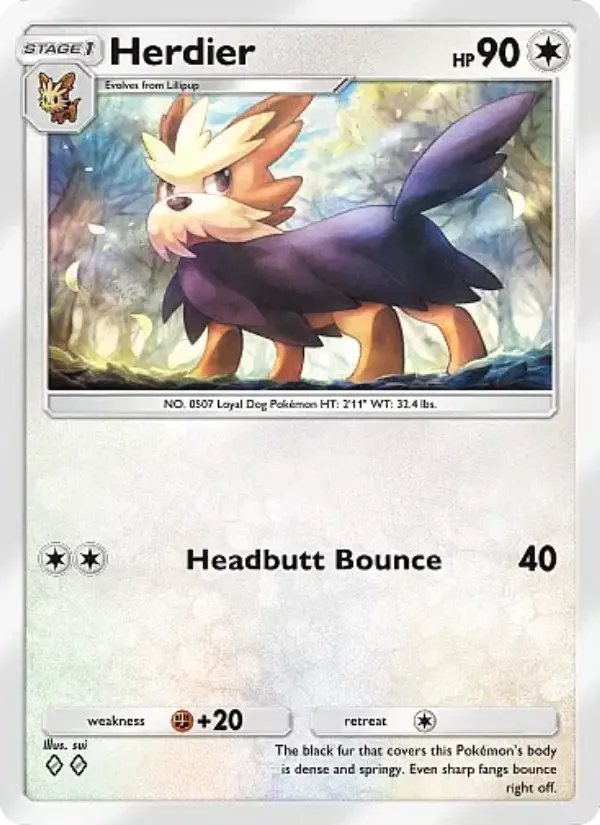
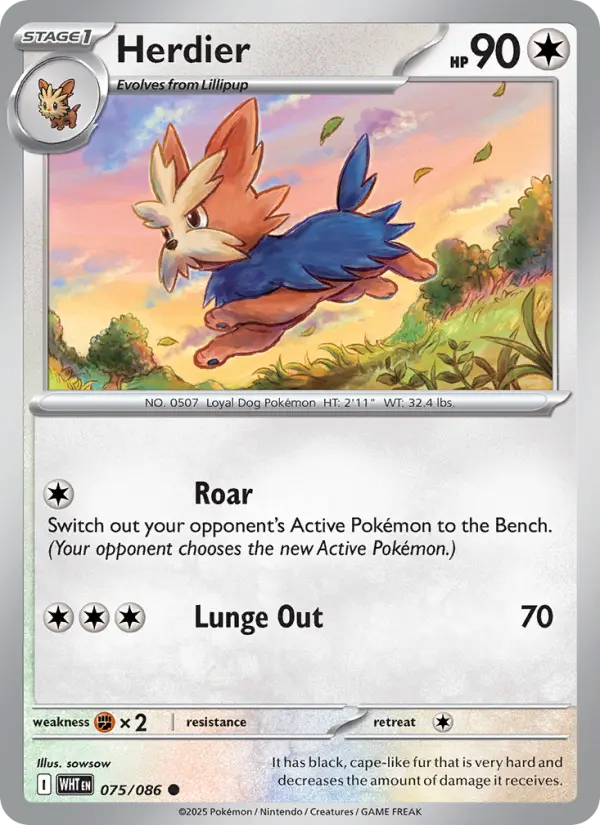
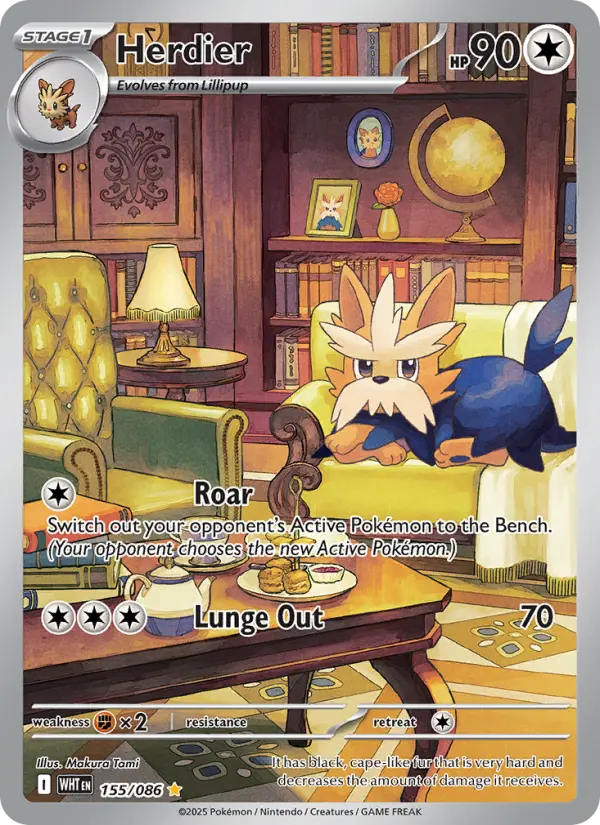
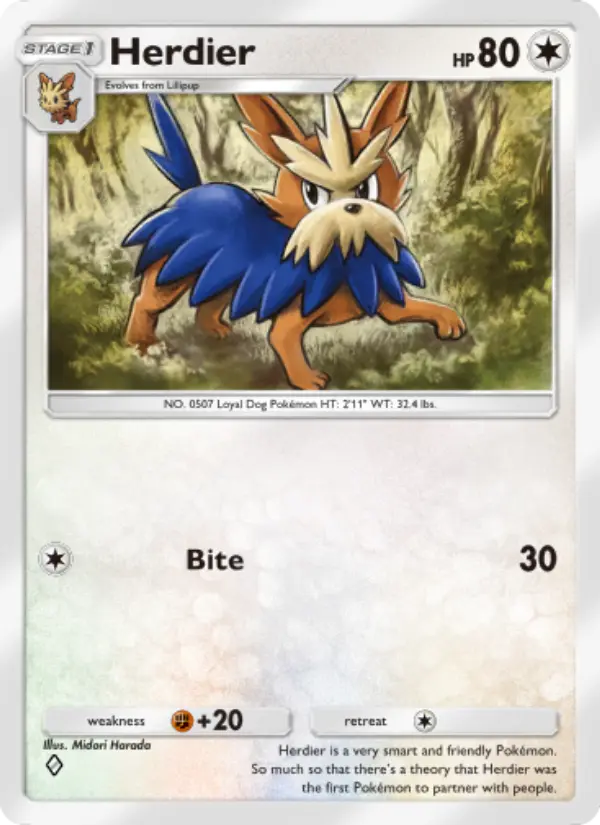
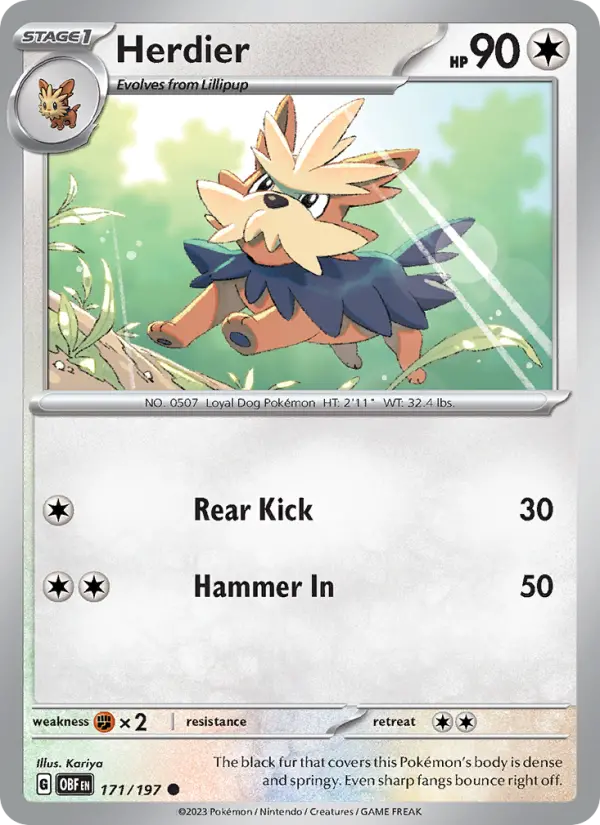
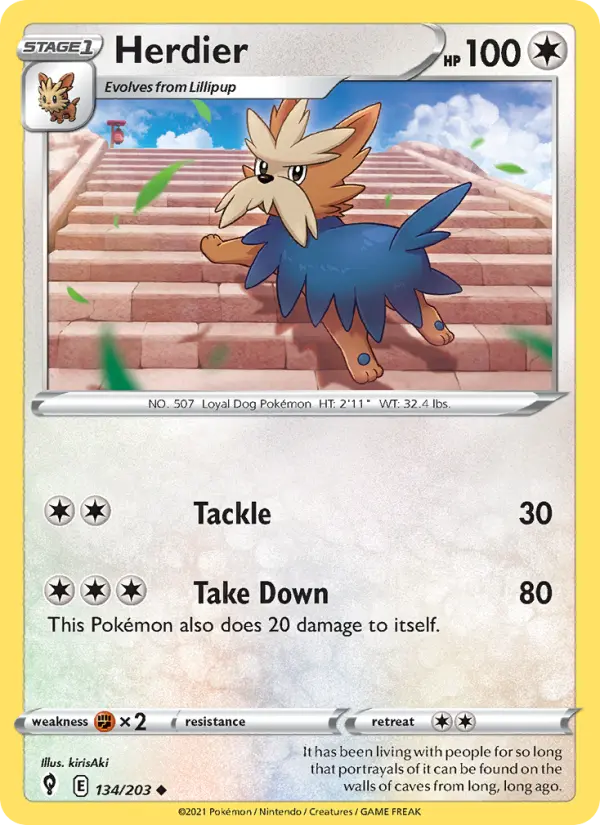
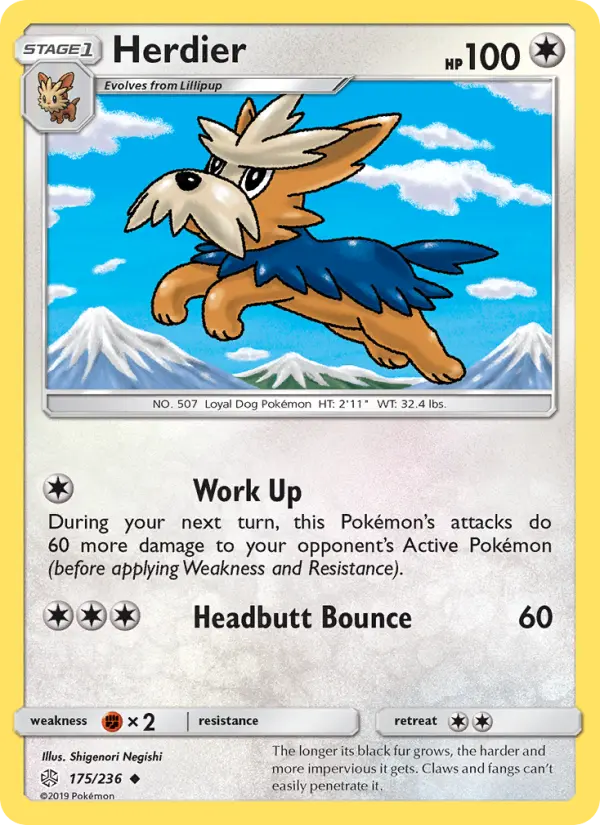
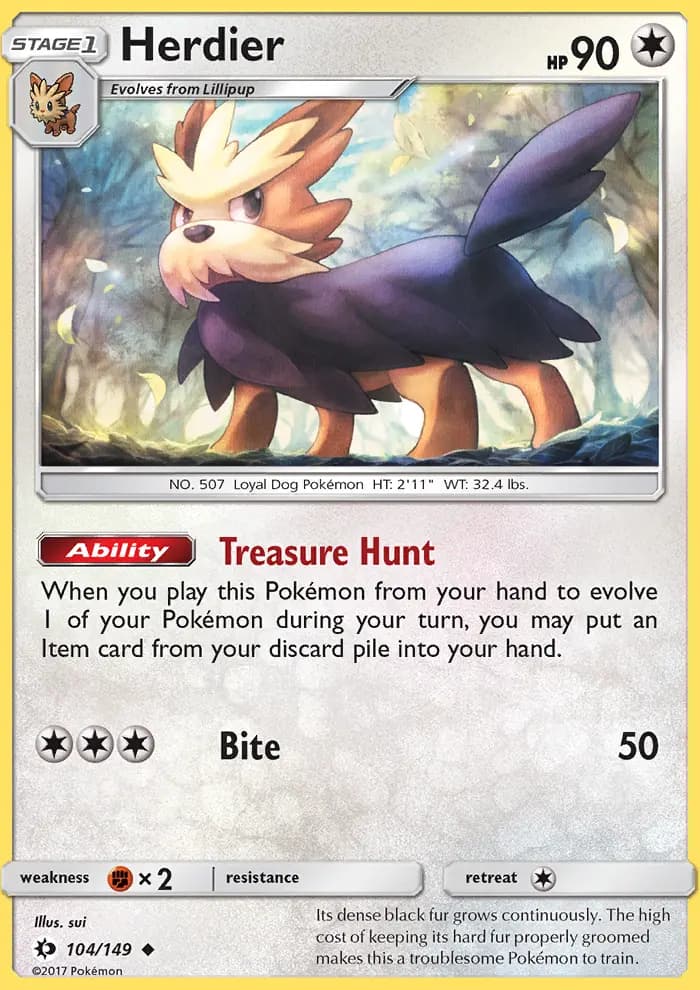
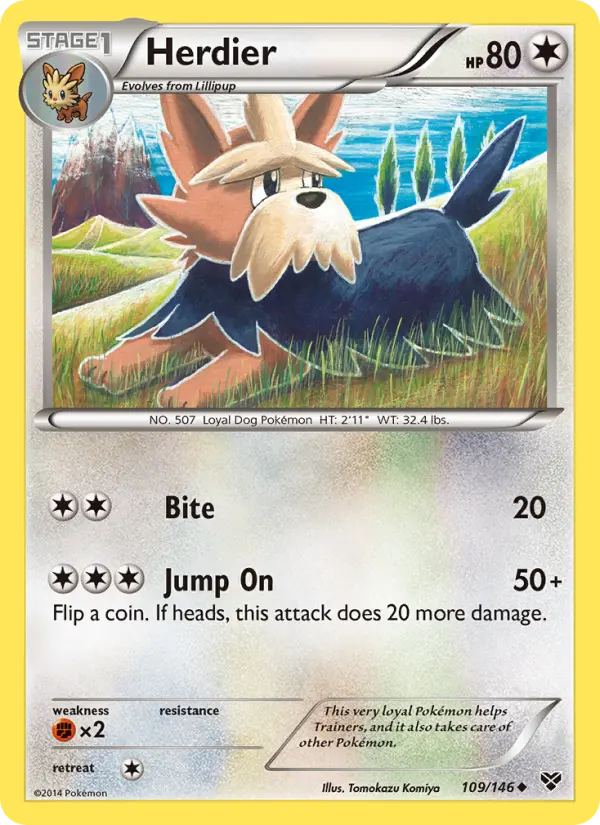
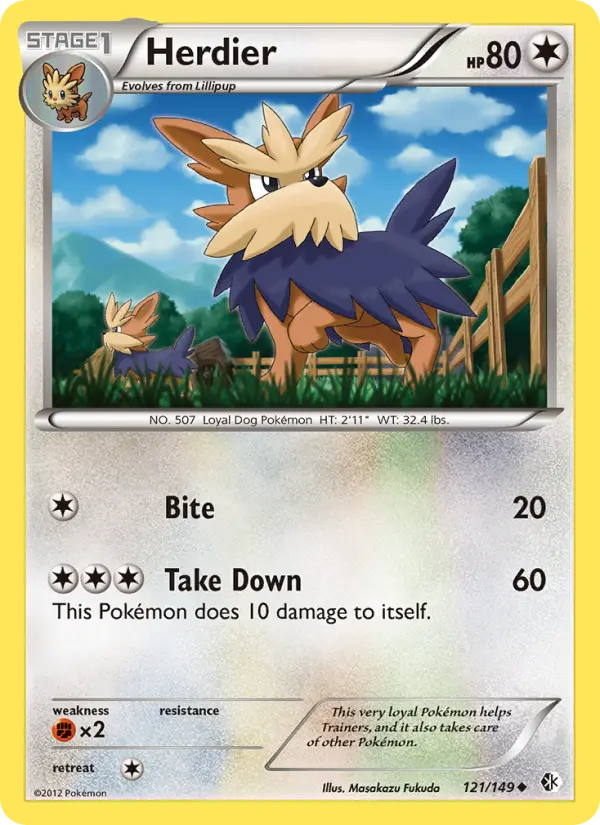
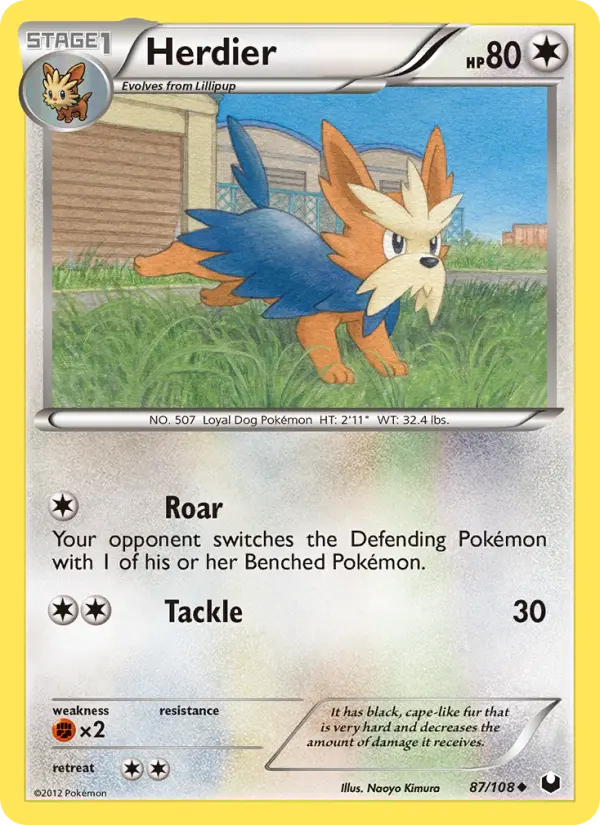
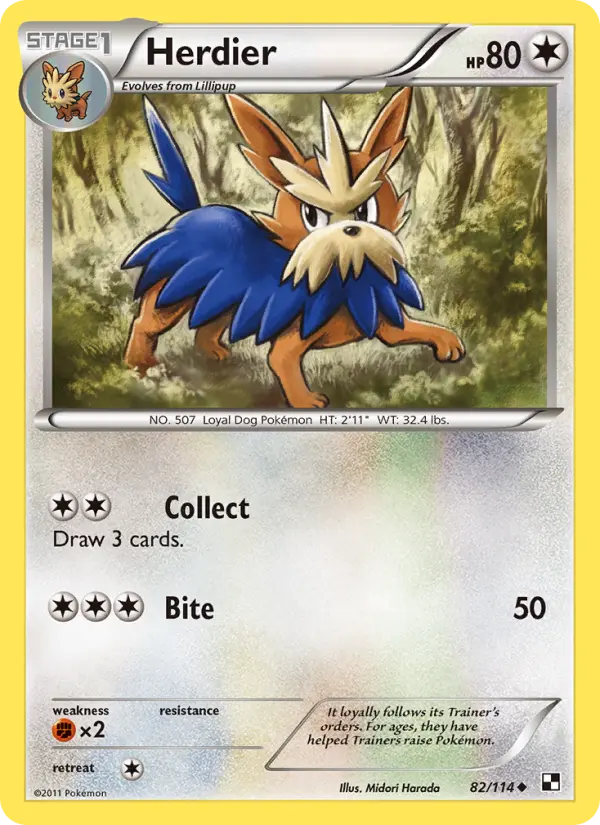
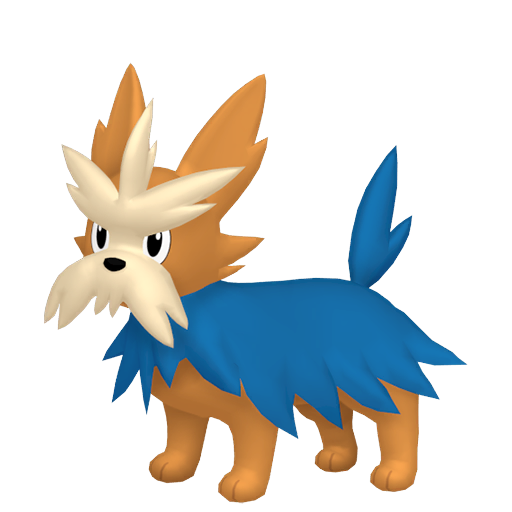
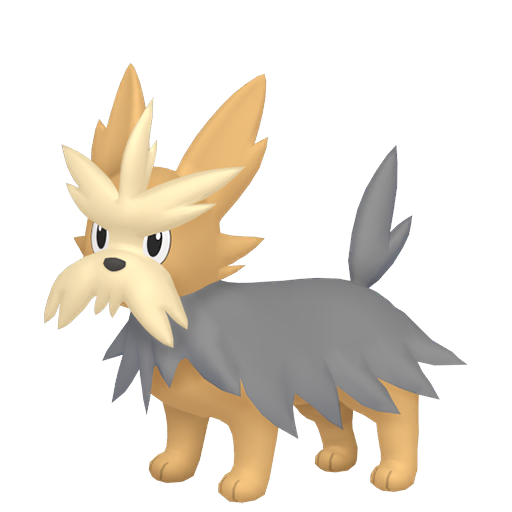
Herdier is a light brown, canine Pokémon distinguished by its striking dark blue and black shaggy fur that covers most of its body like a cape. Its face features distinctive long, cream-colored fur that forms both a prominent mustache and a three-pointed crest atop its head, while its large, perked ears and black nose complete its distinguished appearance. The Pokémon possesses four short legs with three-toed paws, each bearing dark blue paw pads that provide traction. Most notably, Herdier's dense fur is exceptionally hard and continues to grow endlessly throughout its lifetime, becoming increasingly springy and impervious to damage as it lengthens. This remarkable fur serves as natural armor, causing claws and fangs of attacking Pokémon to simply bounce off harmlessly, significantly reducing the amount of damage Herdier receives in battle. The continuous growth of its coat, while a biological advantage, presents a considerable challenge for trainers, as maintaining proper grooming requires substantial financial investment and effort, making Herdier a somewhat troublesome Pokémon to train despite its other desirable qualities.
Pokedex Numbers
Training
Breeding
Herdier Breeding, Gender Ratio & Egg Groups
Herdier maintains an equal gender distribution with exactly 50% male and 50% female individuals occurring naturally in the wild, ensuring balanced breeding potential regardless of which parent is selected. The species belongs to the Field egg group, a category that includes numerous terrestrial and quadrupedal Pokémon, allowing Herdier to breed with a diverse array of compatible species to produce offspring with varied movesets and abilities. With a base friendship value of 70 in Generation V through VII (adjusted to 50 in later generations), Herdier starts with a reasonably strong bond to its trainer, encouraging the raising of Lillipup from eggs rather than always catching wild specimens. The egg hatch counter of 15 cycles translates to approximately 3,599 to 3,855 steps required for eggs to hatch, making it a relatively quick breeding process compared to more exotic Pokémon species. Breeders value Herdier for its capacity to pass down Normal-type moves and Field egg group movepool possibilities to offspring, making it strategically important in competitive breeding programs designed to create optimized movesets in offspring Pokémon.
Sprites




TMs & HMs
tm01
ultra sun ultra moon
tm01
sun moon
tm03
lets go pikachu lets go eevee
tm05
ruby sapphire
tm05
emerald
tm05
gold silver
tm05
crystal
tm05
diamond pearl
tm05
black white
tm05
platinum
tm05
heartgold soulsilver
tm05
firered leafgreen
tm05
black 2 white 2
tm05
omega ruby alpha sapphire
tm05
x y
tm05
xd
tm05
colosseum
tm05
lets go pikachu lets go eevee
tm05
ultra sun ultra moon
tm05
sun moon
+535 more TMs/HMs
Herdier's Evolution Chain


Herdier Evolution, Mega Evolution & Special Forms
Herdier occupies the crucial middle stage of a three-stage evolutionary line, evolving from the puppy-like Lillipup starting at level 16 and further evolving into the powerful Stoutland upon reaching level 32. This evolutionary progression represents a natural maturation process, with Herdier serving as the transitional form between the youthful curiosity of Lillipup and the battle-hardened prowess of Stoutland. Unlike many Pokémon species that gain Mega Evolution capabilities, Herdier remains without a Mega Evolution form, meaning trainers who choose to keep their Herdier at this stage are committing to its current stats and abilities rather than accessing enhanced power through Mega Evolution. The evolution to Stoutland brings significant statistical improvements, particularly in Attack and HP, along with enhanced abilities that make the final form substantially more competitive in high-level battles. Many trainers deliberately delay evolution to Stoutland to maintain Herdier's more manageable size and lower experience requirements for leveling, though competitive players typically prioritize evolving to Stoutland for its superior stat distribution.
Where to Find
Unova Route 10
unova
+13 more
P2 Laboratory
unova
+7 more
Cold Storage
unova
+13 more
Unova Route 1
unova
+25 more
Unova Route 2
unova
+5 more
Unova Route 3
unova
+1 more
Herdier Behaviour and Natural Habitat
Herdier exemplifies loyalty and intelligence among Pokémon, demonstrating unwavering devotion to trainers who earn its respect and obedience. According to Pokédex records, this species is not merely intelligent but also friendly and helpful, actively assisting trainers in raising other Pokémon within their teams. However, Herdier maintains high standards for its masters—it refuses to listen to or obey anyone it perceives as disrespecting it, suggesting a strong sense of personal dignity and judgment. This selective obedience makes Herdier unique among companion Pokémon, as it requires trainers to demonstrate respect and worthiness before offering its considerable talents. The species has inhabited human settlements for so long that its partnership with people extends back to prehistoric times, evidenced by ancient cave wall portrayals discovered by researchers. In modern times, Herdier can be found in various regions throughout the Pokémon world, though it prefers environments where it can maintain close contact with its trainers, making it a predominantly domesticated species rather than a wild denizen.
Pokedex Entries
It has black, cape-like fur that is very hard and decreases the amount of damage it receives.
This very loyal Pokémon helps Trainers, and it also takes care of other Pokémon.
It loyally follows its Trainer’s orders. For ages, they have helped Trainers raise Pokémon.
This very loyal Pokémon helps Trainers, and it also takes care of other Pokémon.
It has black, cape-like fur that is very hard and decreases the amount of damage it receives.
This very loyal Pokémon helps Trainers, and it also takes care of other Pokémon.
It has black, cape-like fur that is very hard and decreases the amount of damage it receives.
Its dense black fur grows continuously. The high cost of keeping its hard fur properly groomed makes this a troublesome Pokémon to train.
The longer its black fur grows, the harder and more impervious it gets. Claws and fangs can’t easily penetrate it.
This Pokémon obeys its master’s orders faithfully. However, it refuses to listen to anything said by a person it doesn’t respect.
It has been living with people for so long that portrayals of it can be found on the walls of caves from long, long ago.
Herdier is a very smart and friendly Pokémon. So much so that there’s a theory that Herdier was the first Pokémon to partner with people.
The black fur that covers this Pokémon’s body is dense and springy. Even sharp fangs bounce right off.
Herdier Name Origin & Design Inspiration
Herdier's name can be traced to the combination of 'herd' and possibly 'derrier' or similar phonetic elements, reflecting its role as a herding and helper Pokémon. The Japanese name, Herderrie (ハーデリア), follows a similar etymological pattern, emphasizing the herding aspect of the species' function. Visually, Herdier draws heavy inspiration from real-world dog breeds, particularly terriers and similar working dogs known for their intelligence, loyalty, and distinctive facial hair. The prominent mustache and three-pointed crest are characteristic design features that differentiate Herdier from its pre-evolution and evolution, marking its status as a mature but not fully-developed canine Pokémon. The dark blue cape-like fur is particularly evocative of Victorian-era dogs and perhaps references the notion of a noble, distinguished companion. The design successfully balances cuteness with dignity, presenting a Pokémon that is both approachable and commanding respect—a duality that perfectly reflects its behavioral characteristics of friendliness tempered with selective obedience and pride.
Learnable Moves
Herdier can learn 56 moves:
Move | Type | Cat. | Power | Acc. | PP |
|---|---|---|---|---|---|
| aerial ace | flying | Physical | 60 | — | 20 |
| after you | normal | Status | — | — | 15 |
| attract | normal | Status | — | 100 | 15 |
| baby doll eyes | fairy | Status | — | 100 | 30 |
| bite | dark | Physical | 60 | 100 | 25 |
| charm | fairy | Status | — | 100 | 20 |
| confide | normal | Status | — | — | 20 |
| covet | normal | Physical | 60 | 100 | 25 |
| crunch | dark | Physical | 80 | 100 | 15 |
| dig | ground | Physical | 80 | 100 | 10 |
| double team | normal | Status | — | — | 15 |
| endure | normal | Status | — | — | 10 |
| facade | normal | Physical | 70 | 100 | 20 |
| fire fang | fire | Physical | 65 | 95 | 15 |
| frustration | normal | Physical | — | 100 | 20 |
| giga impact | normal | Physical | 150 | 90 | 5 |
| helping hand | normal | Status | — | — | 20 |
| hidden power | normal | Special | 60 | 100 | 15 |
| hyper voice | normal | Special | 90 | 100 | 10 |
| ice fang | ice | Physical | 65 | 95 | 15 |
| last resort | normal | Physical | 140 | 100 | 5 |
| leer | normal | Status | — | 100 | 30 |
| odor sleuth | normal | Status | — | — | 40 |
| payback | dark | Physical | 50 | 100 | 10 |
| play rough | fairy | Physical | 90 | 90 | 10 |
| protect | normal | Status | — | — | 10 |
| psychic fangs | psychic | Physical | 85 | 100 | 10 |
| rain dance | water | Status | — | — | 5 |
| rest | psychic | Status | — | — | 5 |
| retaliate | normal | Physical | 70 | 100 | 5 |
| return | normal | Physical | — | 100 | 20 |
| reversal | fighting | Physical | — | 100 | 15 |
| roar | normal | Status | — | — | 20 |
| rock smash | fighting | Physical | 40 | 100 | 15 |
| rock tomb | rock | Physical | 60 | 95 | 15 |
| round | normal | Special | 60 | 100 | 15 |
| secret power | normal | Physical | 70 | 100 | 20 |
| shadow ball | ghost | Special | 80 | 100 | 15 |
| shock wave | electric | Special | 60 | — | 20 |
| sleep talk | normal | Status | — | — | 10 |
| snarl | dark | Special | 55 | 95 | 15 |
| snore | normal | Special | 50 | 100 | 15 |
| strength | normal | Physical | 80 | 100 | 15 |
| substitute | normal | Status | — | — | 10 |
| sunny day | fire | Status | — | — | 5 |
| surf | water | Special | 90 | 100 | 15 |
| swagger | normal | Status | — | 85 | 15 |
| tackle | normal | Physical | 40 | 100 | 35 |
| take down | normal | Physical | 90 | 85 | 20 |
| thunder fang | electric | Physical | 65 | 95 | 15 |
| thunder wave | electric | Status | — | 90 | 20 |
| thunderbolt | electric | Special | 90 | 100 | 15 |
| toxic | poison | Status | — | 90 | 10 |
| uproar | normal | Special | 90 | 100 | 10 |
| wild charge | electric | Physical | 90 | 100 | 15 |
| work up | normal | Status | — | — | 30 |
Herdier Competitive Battle Guide
In competitive battling, Herdier occupies a niche role as a lower-tier Pokémon, with its total stat allocation of 370 rendering it significantly less viable than its final evolution Stoutland in higher-level competitive formats. The species' base Attack of 80 is its strongest stat, allowing it to function as a physical attacker, though this value pales in comparison to similarly-typed competitors at higher tiers. Herdier's primary competitive advantage lies in its ability Intimidate, which immediately lowers opposing Pokémon's Attack by one stage upon entering battle—a valuable utility effect that can shift momentum in physical matchups. The hidden ability Scrappy presents an interesting alternative, allowing Herdier's Normal and Fighting-type moves to damage Ghost-type Pokémon, which are normally immune to these move categories, creating unexpected offensive coverage. Sand Rush serves as a niche ability choice for specialized sandstorm teams, doubling Herdier's Speed in sandstorm conditions and providing immunity to sandstorm damage, though this remains inferior to Stoutland's competitive viability. Most competitive players evolved Herdier to Stoutland as quickly as possible to access superior stats, though innovative trainers in lower-tier formats occasionally employ Herdier's movepool and abilities for unexpected strategic advantages.
Commonly Asked Questions About Herdier
What type is Herdier?
Herdier is a normal type Pokemon.
What does Herdier evolve into?
Herdier evolves into stoutland.
What are Herdier's weaknesses?
Herdier is weak to fighting type moves.
Does Herdier evolve by trading?
No — Herdier evolves entirely through leveling up, with no trade required at any stage.
Where can I find Herdier?
Herdier can be found in unova route 10 (unova), p2 laboratory (unova) and cold storage (unova) and 3 other locations.
Herdier Cultural Impact & Franchise History
Herdier has carved out a meaningful place in Pokémon media and fan culture, representing the archetypal loyal companion Pokémon across multiple animated series and manga adaptations. The species' prominent role in narratives involving human-Pokémon partnerships, particularly given the lore suggesting Herdier was among the first Pokémon to bond with humans, positions it as culturally significant within the Pokémon universe's fictional history. Multiple notable characters have utilized Herdier in battle, contributing to its recognition among series viewers and establishing it as a recognizable and respected species. The emphasis on its loyalty and selective obedience has resonated with trainers who appreciate Pokémon with personalities and conditions for bonding, rather than creatures that blindly follow orders regardless of circumstance. In the trading card game, Herdier has received several card iterations across different sets, though it remains less iconic than its final evolution or the vastly more popular Lillipup. Fan communities appreciate Herdier for representing a middle ground between childhood innocence and mature strength, making it thematically significant in trainer journey narratives.
Where to Find Herdier in Every Pokémon Game
Herdier's availability varies considerably across Pokémon games, with the species appearing naturally in specific regional Pokédexes depending on the generation and game version. In Pokémon Black and White, Herdier was assigned local Pokédex number 13, making it readily available to trainers in the Unova region, though typically encountered only after evolving Lillipup at level 16. In Pokémon Black 2 and White 2, Herdier received local Pokédex number 23, maintaining availability in the Unova region with similar encounter methods. The species also appears in subsequent generations including X and Y, Sun and Moon, Ultra Sun and Ultra Moon, Sword and Shield, and Legends: Arceus, though availability methods and encounter rates fluctuate. In Sun and Moon games, Herdier was assigned local Pokédex number 121, while in Ultra Sun and Ultra Moon it became number 151, indicating its continued relevance to newer trainers discovering the Alola region. For trainers seeking Herdier without breeding, obtaining Lillipup in wild encounters and evolving it remains the most straightforward method. Modern games often provide alternative methods such as Pokédex completion rewards or guaranteed encounters in specific locations, making Herdier reasonably accessible to dedicated trainers willing to invest in its lengthy grooming requirements.