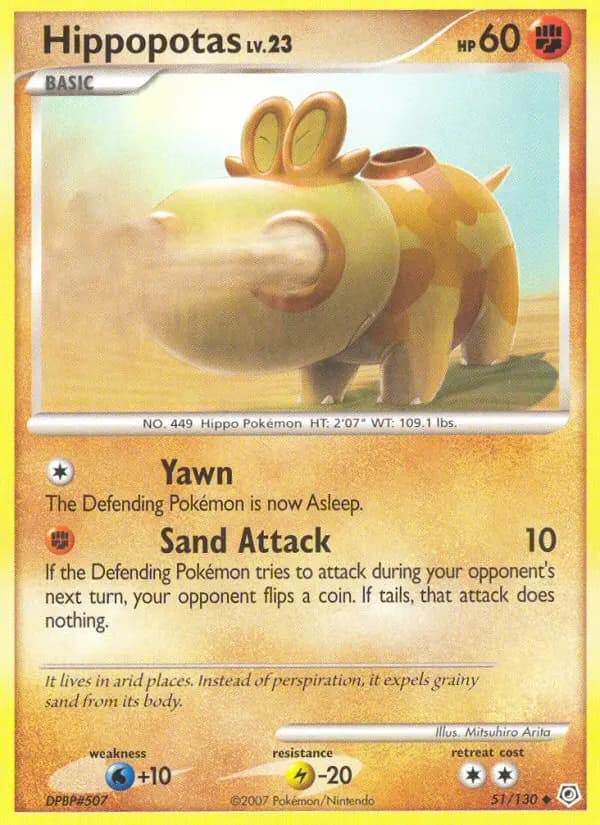
Hippopotas
Generation IV · #0449 — Hippo Pokémon
Since its Generation IV debut, Hippopotas has carried a stat spread built around hp — 50 at base, its clearest strength. The most distinctive feature of Hippopotas is its signature ability, Sand Stream, which automatically summons a sandstorm upon entering battle—a trait that has made it a valuable team member in competitive play and a foundational Pokémon for sand-based strategies. Its hidden ability, Sand Force, further emphasizes its role in sandstorm teams by amplifying the power of Rock, Ground, and Steel-type moves to 1.3 times their normal damage while simultaneously protecting Hippopotas from sandstorm damage.
Editor's Take
Hippopotas's line ends in Hippowdon with Sand Stream, and being one of only a handful of automatic sand setters gives it more strategic weight than its profile suggests.
Base Stats
Height
0.8m
Weight
49.5kg
Category
Hippo Pokémon
Gender
Male 50% / Female 50%
Color
brown
Shape
quadruped
Abilities
Summons a sandstorm that lasts indefinitely upon entering battle.
Strengthens rock, ground, and steel moves to 1.3× their power during a sandstorm. Protects against sandstorm damage.

Hippopotas Biology & Physical Characteristics
Hippopotas is a quadrupedal Pokémon with a bulbous, hippopotamus-like body structure that reflects its real-world inspiration. The Pokémon exhibits distinct sexual dimorphism in coloration: males display a tan base color with mottled dark brown patches, while females present this color scheme inverted. Its most prominent feature is a large snout equipped with round, protruding nostrils and several blunt teeth visible within its mouth, designed for its unique feeding mechanism of ingesting sand along with prey. The creature possesses small, rounded ears and eyes that protrude from the top of its head, providing awareness of its desert surroundings despite its tendency to remain buried. Each of its four feet is equipped with two blunt claws suitable for traversing sandy terrain, and it sports a diminutive tail relative to its body size. A distinctive small hole located on its back serves as an additional outlet for expelling sand, complementing the primary function of its nostrils. Unlike biological hippopotamuses that regulate body temperature through water immersion, Hippopotas has adapted to arid desert life by expelling sand from its body in place of perspiration, a remarkable physiological adaptation that allows it to thrive in environments where water is scarce.
Pokedex Numbers
Training
Breeding
Hippopotas Breeding, Gender Ratio & Egg Groups
Hippopotas maintains a perfect 50/50 gender ratio between males and females, ensuring balanced breeding opportunities without gender-specific complications. Both males and females belong to the Field Egg Group, making them compatible with a wide range of Pokémon for breeding purposes. The species demonstrates a relatively slow growth rate and requires 30 egg cycles to hatch from an egg, translating to approximately 7,454 to 7,710 steps of travel with the parent Pokémon in the player's party. The base friendship value of 70 indicates that Hippopotas has a moderate inclination toward its trainer, falling within the 'normal' friendship category—neither particularly difficult nor exceptionally easy to bond with. The sexual dimorphism extends beyond mere coloration to the actual appearance data, with males and females displaying the same height and weight specifications of 0.8 meters and 49.5 kilograms respectively. This consistency in physical dimensions despite the striking color differences suggests that the sexual differences are primarily pigmentation-based rather than related to structural size variations. For competitive breeding projects, trainers should note that Hippopotas inherits its abilities from parents, with the Sand Stream ability being far more valuable than the hidden Sand Force in most competitive contexts, making careful parent selection important.
Sprites






TMs & HMs
tm01
lets go pikachu lets go eevee
tm02
crystal
tm02
gold silver
tm03
crystal
tm03
gold silver
tm03
ruby sapphire
tm03
platinum
tm03
firered leafgreen
tm03
heartgold soulsilver
tm03
diamond pearl
tm03
emerald
tm03
xd
tm03
colosseum
tm03
lets go pikachu lets go eevee
tm04
yellow
tm04
red blue
tm04
red green japan
tm04
blue japan
tm05
ruby sapphire
tm05
emerald
+521 more TMs/HMs
Gender Differences
This Pokémon has visible differences between male and female forms.
Hippopotas's Evolution Chain


Hippopotas Evolution, Mega Evolution & Special Forms
Hippopotas undergoes a single evolutionary transformation into Hippowdon, triggered upon reaching level 34. This evolution marks a significant shift in the Pokémon's stats and overall combat capabilities. While Hippopotas establishes the foundation with its Sand Stream ability, Hippowdon builds upon this framework by achieving substantially higher defensive and offensive statistics. The evolution process represents a natural progression from the juvenile, exploratory Hippopotas to a more powerful, mature Hippowdon capable of dominating sandstorm-based battle strategies. The evolution is mandatory for those seeking to fully exploit Sand Force mechanics or achieve the raw power necessary for competitive sand teams, as Hippowdon gains significant boosts to its Attack, Defense, and Special Defense statistics. No Mega Evolution form exists for either Hippopotas or Hippowdon, keeping them within the standard evolutionary framework that has defined them since their introduction in Diamond and Pearl.
Where to Find
Ruin Maniac Cave
sinnoh
+12 more
Maniac Tunnel
sinnoh
+9 more
Kalos Route 9
kalos
+5 more
Hippopotas Behaviour and Natural Habitat
Hippopotas is primarily a diurnal creature, exhibiting peak activity during daylight hours when it traverses desert landscapes and other arid environments in search of sustenance. Rather than engaging in water-based cooling behavior like its real-world counterparts, Hippopotas actively avoids water and instead burrows deep into sand to protect itself from both the harsh elements and harmful germs. The Pokédex notes that it enshrouds itself with sand as a protective measure against pathogens, demonstrating a sophisticated adaptation to desert life. When walking through sand, Hippopotas shuts its nostrils tightly while keeping its mouth open, allowing it to swallow sand and any small prey encountered along its path—a feeding strategy that requires expelling excess sand through its nostrils. As temperatures drop during desert nights, Hippopotas burrows snugly into the sand to avoid the cold, emerging again with daylight. Despite its substantial size and seemingly cumbersome appearance, Hippopotas demonstrates remarkable stealth, remaining difficult to detect due to its exceptional burrowing abilities and tendency to lurk beneath the soil. The species exhibits a distinctly social nature, typically forming colonies of approximately ten individuals that travel and forage together, suggesting complex social structures within desert communities.
Pokedex Entries
It lives in arid places. Instead of perspiration, it expels grainy sand from its body.
It enshrouds itself with sand to protect itself from germs. It does not enjoy getting wet.
It shuts its nostrils tight then travels through sand as if walking. They form colonies of around ten.
It shrouds itself in sand to ward off germs. It travels easily through the sands of the desert.
It shuts its nostrils tight then travels through sand as if walking. They form colonies of around ten.
It shuts its nostrils tight then travels through sand as if walking. They form colonies of around 10.
It lives in arid places. Instead of perspiration, it expels grainy sand from its body.
It enshrouds itself with sand to protect itself from germs. It does not enjoy getting wet.
It lives in arid places. Instead of perspiration, it expels grainy sand from its body.
It enshrouds itself with sand to protect itself from germs. It does not enjoy getting wet.
It moves through the sands with its mouth open, swallowing sand along with its prey. It gets rid of the sand by spouting it from its nose.
This Pokémon is active during the day and passes the cold desert nights burrowed snugly into the sand.
Though large and languid, Hippopotas is difficult to detect due to its tendency to burrow into and lurk beneath the soil. When agitated or excited, it expels sand from its nostrils.
Hippopotas Name Origin & Design Inspiration
The name Hippopotas derives directly from 'Hippopotamus,' the large semi-aquatic mammal native to African rivers and lakes, combined with the suffix '-tas' which appears in several Pokémon names. However, the design inverts the traditional hippopotamus habitat preference by creating a desert-dwelling creature rather than one dependent on water, creating an interesting thematic contrast. This adaptation reflects the creative design philosophy of Generation IV, which frequently reimagined real-world animal concepts within fantastical contexts. The Japanese name 'ヒポポタス' (Hippopotas) maintains this etymological connection while fitting the phonetic patterns characteristic of Pokémon nomenclature. The gender-based color variation—tan with brown patches for males versus reversed coloration for females—draws inspiration from subtle dimorphic patterns found in some animal species, adding depth to the character design. The physical features, particularly the prominent nostrils and sand-expulsion mechanics, emphasize the creature's adaptation to desert environments while maintaining recognizable hippopotamus characteristics such as the barrel-shaped body and blunt features that define the original animal.
Learnable Moves
Hippopotas can learn 68 moves:
Move | Type | Cat. | Power | Acc. | PP |
|---|---|---|---|---|---|
| amnesia | psychic | Status | — | — | 20 |
| attract | normal | Status | — | 100 | 15 |
| bite | dark | Physical | 60 | 100 | 25 |
| body press | fighting | Physical | 80 | 100 | 10 |
| body slam | normal | Physical | 85 | 100 | 15 |
| bulldoze | ground | Physical | 60 | 100 | 20 |
| captivate | normal | Status | — | 100 | 20 |
| confide | normal | Status | — | — | 20 |
| crunch | dark | Physical | 80 | 100 | 15 |
| curse | ghost | Status | — | — | 10 |
| dig | ground | Physical | 80 | 100 | 10 |
| double team | normal | Status | — | — | 15 |
| double edge | normal | Physical | 120 | 100 | 15 |
| earth power | ground | Special | 90 | 100 | 10 |
| earthquake | ground | Physical | 100 | 100 | 10 |
| endure | normal | Status | — | — | 10 |
| facade | normal | Physical | 70 | 100 | 20 |
| fire fang | fire | Physical | 65 | 95 | 15 |
| fissure | ground | Physical | — | 30 | 5 |
| frustration | normal | Physical | — | 100 | 20 |
| headbutt | normal | Physical | 70 | 100 | 15 |
| helping hand | normal | Status | — | — | 20 |
| hidden power | normal | Special | 60 | 100 | 15 |
| high horsepower | ground | Physical | 95 | 95 | 10 |
| ice fang | ice | Physical | 65 | 95 | 15 |
| iron tail | steel | Physical | 100 | 75 | 15 |
| mud bomb | ground | Special | 65 | 85 | 10 |
| mud shot | ground | Special | 55 | 95 | 15 |
| mud slap | ground | Special | 20 | 100 | 10 |
| muddy water | water | Special | 90 | 85 | 10 |
| natural gift | normal | Physical | — | 100 | 15 |
| protect | normal | Status | — | — | 10 |
| rest | psychic | Status | — | — | 5 |
| return | normal | Physical | — | 100 | 20 |
| revenge | fighting | Physical | 60 | 100 | 10 |
| roar | normal | Status | — | — | 20 |
| rock slide | rock | Physical | 75 | 90 | 10 |
| rock smash | fighting | Physical | 40 | 100 | 15 |
| rock tomb | rock | Physical | 60 | 95 | 15 |
| round | normal | Special | 60 | 100 | 15 |
| sand attack | ground | Status | — | 100 | 15 |
| sand tomb | ground | Physical | 35 | 85 | 15 |
| sandstorm | rock | Status | — | — | 10 |
| scorching sands | ground | Special | 70 | 100 | 10 |
| secret power | normal | Physical | 70 | 100 | 20 |
| slack off | normal | Status | — | — | 5 |
| sleep talk | normal | Status | — | — | 10 |
| snore | normal | Special | 50 | 100 | 15 |
| spit up | normal | Special | — | 100 | 10 |
| stealth rock | rock | Status | — | — | 20 |
| stockpile | normal | Status | — | — | 20 |
| stomping tantrum | ground | Physical | 75 | 100 | 10 |
| stone edge | rock | Physical | 100 | 80 | 5 |
| strength | normal | Physical | 80 | 100 | 15 |
| substitute | normal | Status | — | — | 10 |
| sunny day | fire | Status | — | — | 5 |
| superpower | fighting | Physical | 120 | 100 | 5 |
| swagger | normal | Status | — | 85 | 15 |
| swallow | normal | Status | — | — | 10 |
| tackle | normal | Physical | 40 | 100 | 35 |
| take down | normal | Physical | 90 | 85 | 20 |
| tera blast | normal | Special | 80 | 100 | 10 |
| thunder fang | electric | Physical | 65 | 95 | 15 |
| toxic | poison | Status | — | 90 | 10 |
| water pulse | water | Special | 60 | 100 | 20 |
| weather ball | normal | Special | 50 | 100 | 10 |
| whirlwind | normal | Status | — | — | 20 |
| yawn | normal | Status | — | — | 10 |
Hippopotas Competitive Battle Guide
In terms of competitive use, Hippopotas serves as a specialized utility Pokémon whose primary value lies in its signature Sand Stream ability rather than its direct offensive or defensive capabilities. The automatic sandstorm summon upon entry has made Hippopotas an essential lead Pokémon for sand-based team structures since its debut, allowing teams to immediately establish weather control without dedicating a turn to setup moves. While Hippopotas itself possesses modest offensive statistics with a base Attack of 72 and Special Attack of merely 38, its defensive profile with base Defense of 78 provides sufficient bulk to function as an entry hazard setter or status spreader. However, the extremely low base Speed of 32 means Hippopotas will virtually always move last in battle, limiting its ability to execute offensive strategies. In modern competitive formats, Hippopotas often functions as a turn-one sand setter that either switches to Hippowdon or makes room for more offensively-oriented sand sweepers and setup sweepers that benefit from the sandstorm condition. The hidden ability Sand Force, which provides a 1.3x multiplier to Ground, Rock, and Steel moves while preventing sandstorm damage to Hippopotas, offers an alternative competitive avenue but remains underutilized compared to the standard Sand Stream configuration. Competitive players typically reserve Hippopotas for dedicated sand teams where its role is clearly defined within a broader strategic framework rather than as a standalone competitive threat.
Commonly Asked Questions About Hippopotas
What type is Hippopotas?
Hippopotas is a ground type Pokemon.
What does Hippopotas evolve into?
Hippopotas evolves into hippowdon.
What are Hippopotas's weaknesses?
Hippopotas is weak to water, grass and ice type moves.
Does Hippopotas evolve by trading?
No — Hippopotas evolves entirely through leveling up, with no trade required at any stage.
Where can I find Hippopotas?
Hippopotas can be found in ruin maniac cave (sinnoh), maniac tunnel (sinnoh) and kalos route 9 (kalos).
Hippopotas Cultural Impact & Franchise History
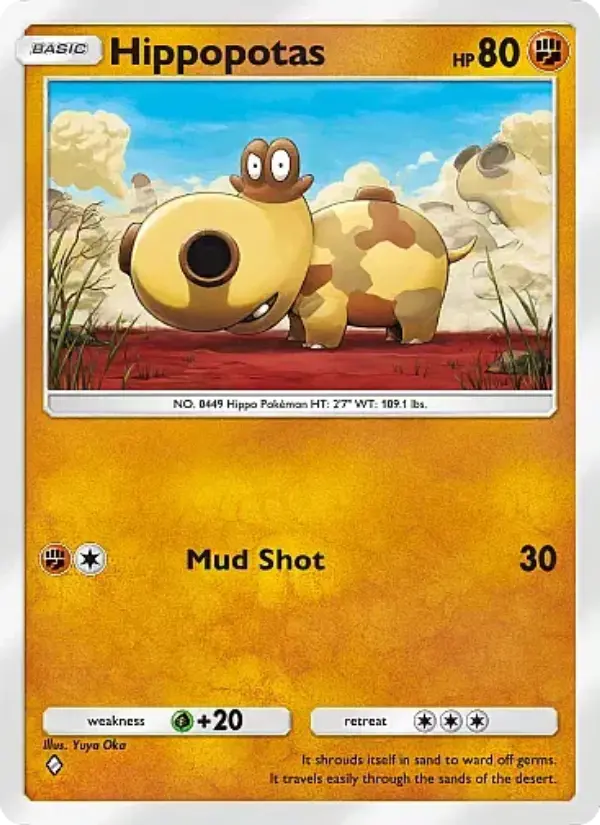
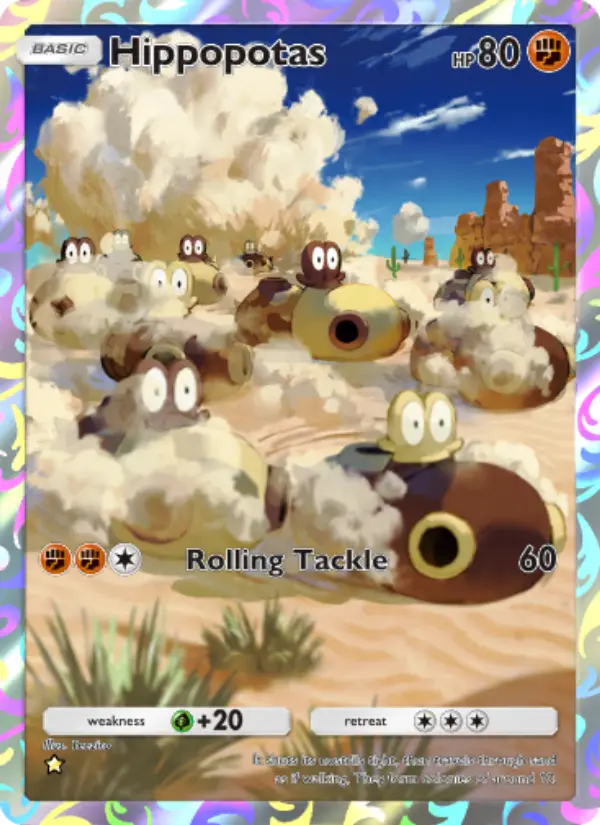
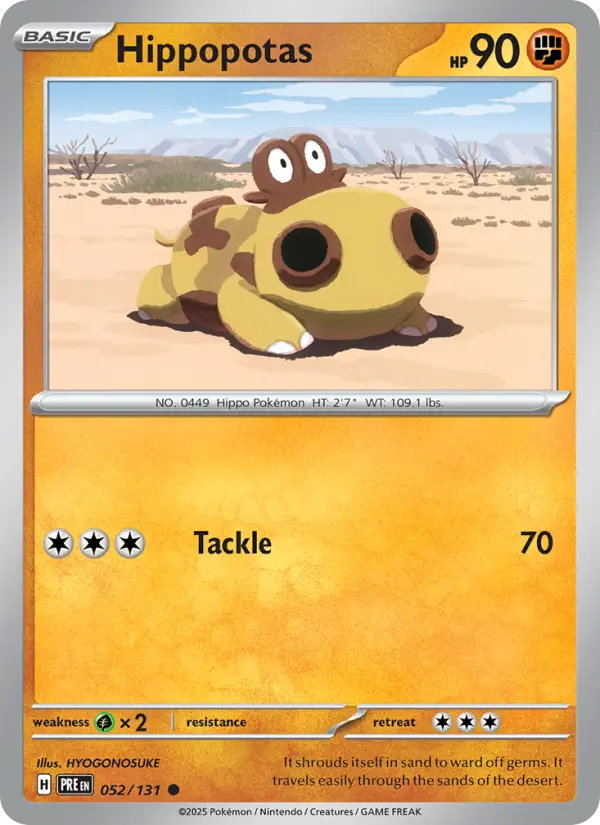
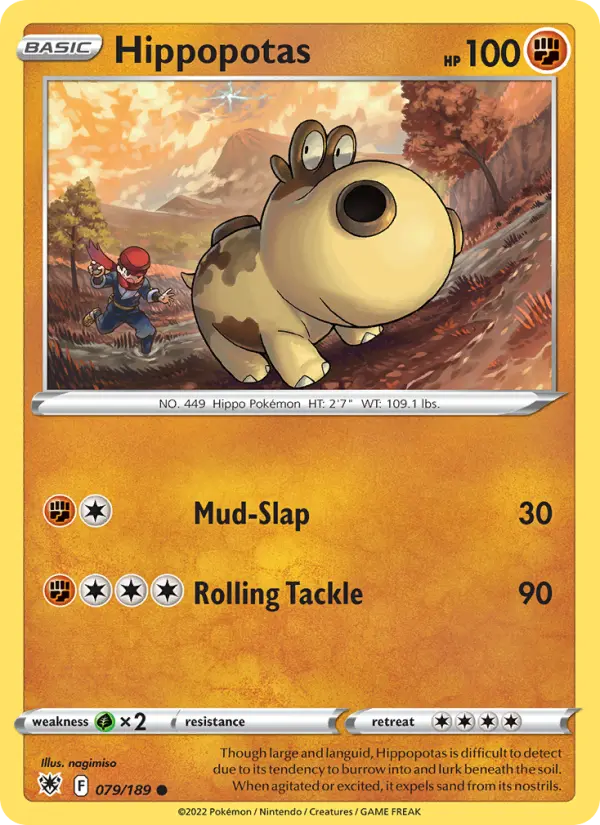
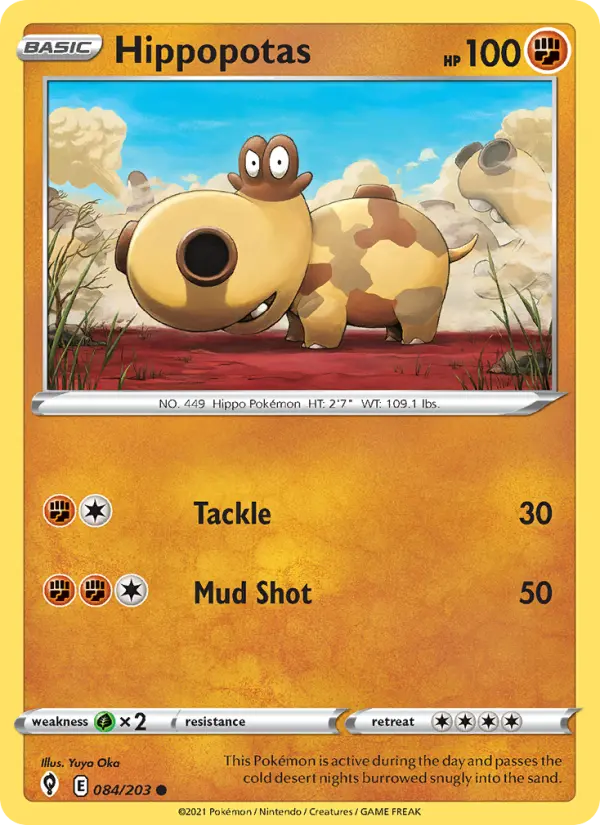
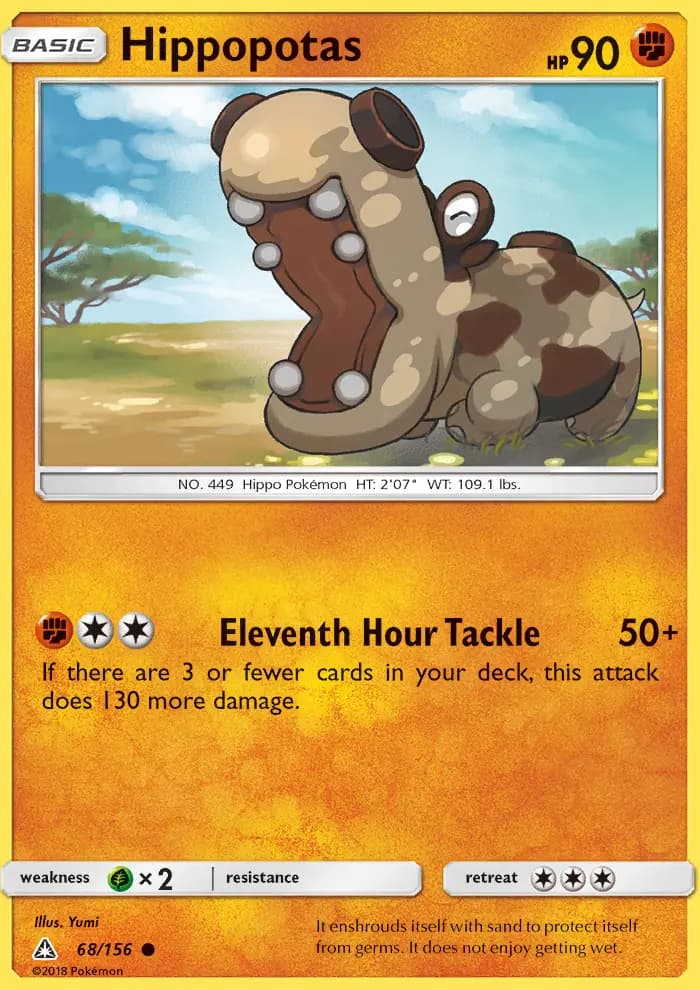
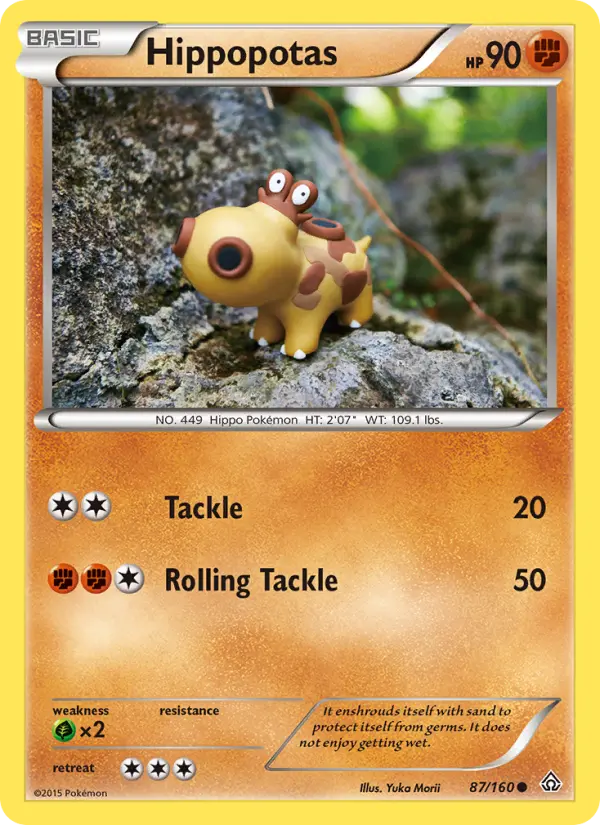
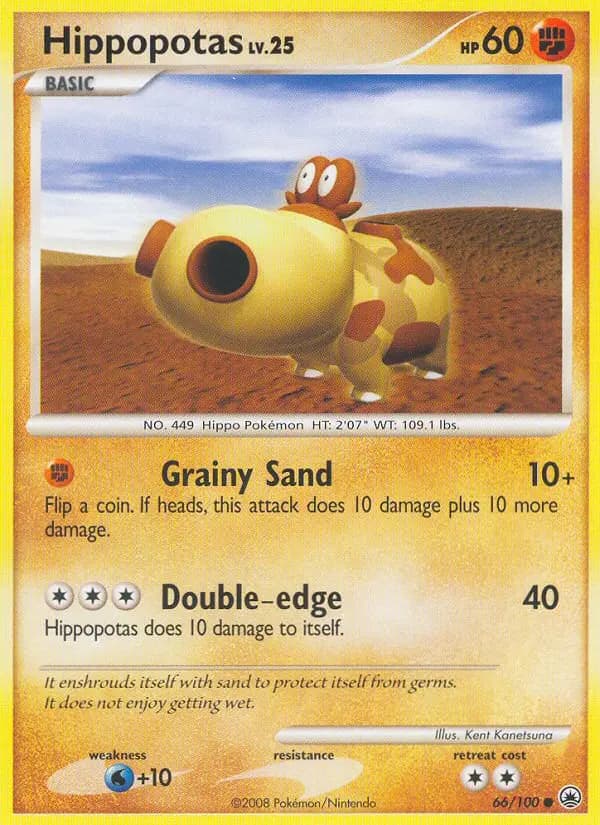
Hippopotas has maintained a consistent presence within Pokémon media and competitive communities since its introduction in Diamond and Pearl, establishing itself as the iconic sand-setting Pokémon that defined an entire archetype of competitive team-building. The species gained significant cultural recognition through its appearances in the animated series and related media, where its sandstorm mechanics have been portrayed as both tactical assets and environmental hazards. Within the broader Pokémon fan community, Hippopotas and its evolution Hippowdon became synonymous with weather-based strategies, influencing team construction philosophy across multiple generations and competitive formats. The Pokémon has appeared in numerous trading card game expansions since its debut, with various card iterations reflecting its roles as both a weather setter and a supporting Pokémon. While not achieving the iconic status of legendary Pokémon or universally recognizable creatures like Pikachu, Hippopotas has carved a respectable niche as the recognizable face of sand teams, making it instantly identifiable to competitive players and enthusiasts who engage with team-building theory. The species continues to receive representation in newer games and media, maintaining relevance even as new Pokémon and mechanics introduce alternative weather-setting options. Its consistent availability across multiple game generations has ensured that aspiring competitive players can reliably obtain Hippopotas as a foundational team component.
Where to Find Hippopotas in Every Pokémon Game
Hippopotas first became available to players in Pokémon Diamond and Pearl, where it could be encountered in desert and mountainous routes, establishing its place in the Sinnoh Pokédex at position 122. The species has maintained consistent availability throughout subsequent generations, appearing in various locations across multiple games including HeartGold and SoulSilver, the Black and White series, X and Y, Omega Ruby and Alpha Sapphire, and the more recent Sword and Shield versions. In Pokémon Legends: Arceus, Hippopotas received a new Pokédex entry describing its languid nature and burrowing tendencies, available in select desert-like locations fitting its habitat preferences. The species continues to appear in Pokémon Brilliant Diamond and Shining Pearl, maintaining its position within the Sinnoh regional Pokédex at entry 122, ensuring that modern players can access it through remakes of the original games where it debuted. In Pokémon Scarlet and Violet, Hippopotas is available at National Pokédex entry 265, continuing its tradition of appearing in the most recent generation of games. Additionally, Hippopotas has been available through various special distribution events and online trading mechanisms, making it relatively accessible compared to many Pokémon that remain version-exclusive or regionally limited. The species' widespread availability across multiple generations and platforms has prevented it from becoming rare or difficult to obtain, ensuring that trainers committed to sand-based competitive strategies can reliably source Hippopotas for their teams.