Huntail
Generation III · #0367 — Deep Sea Pokémon
As a Generation III water-type, Huntail leans on swift swim to cover what its raw numbers don't, particularly on the hp side. With a National Pokédex number of 367, Huntail has captured the imagination of trainers for decades with its alien-like appearance and predatory hunting techniques. Standing at 1.7 meters tall and weighing 27 kilograms, this serpentine creature possesses a perfectly adapted physiology for life in extreme ocean depths, combining defensive capabilities with surprising offensive prowess. The species has earned a place in maritime folklore, with traditional accounts suggesting that a Huntail washing ashore serves as an omen of misfortune, adding an element of mystique to this already fascinating Pokémon.
Editor's Take
Huntail is the physical half of the Clamperl split and the one almost nobody chooses, largely because Gorebyss gets Shell Smash and does the job better.
Base Stats
Height
1.7m
Weight
27.0kg
Category
Deep Sea Pokémon
Gender
Male 50% / Female 50%
Color
blue
Shape
squiggle
Habitat
sea
Abilities
Doubles Speed during rain.
Prevents burns.

Huntail Biology & Physical Characteristics
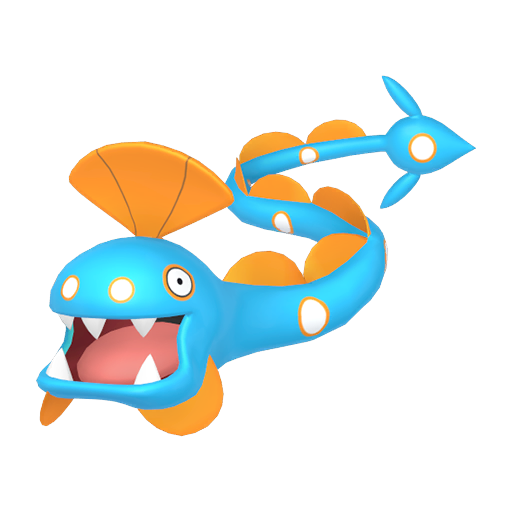
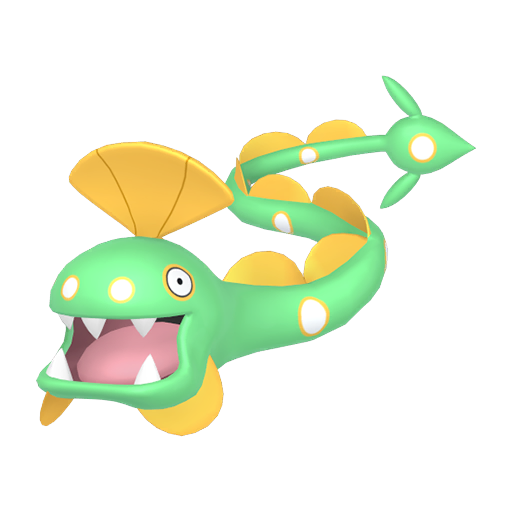
Huntail presents a distinctly otherworldly appearance that reflects its deep-sea origin, featuring a light-blue coloration that allows it to blend seamlessly with its dark aquatic environment. The Pokémon's body is long and serpentine, lined with distinctive orange semi-circular fins that run along the length of its spine, complemented by two additional fins beneath its lower jaw and a prominent fan-like dorsal fin projecting from the top of its head. Perhaps most striking are the white spots surrounded by orange rings scattered across its body, which resemble eyes and may serve multiple functions in the pitch-black depths of the ocean. Its most recognizable feature is its fish-shaped tail, which is equipped with glowing eye-spots that illuminate in the darkness, along with a single dorsal and pectoral fin. The mouth of Huntail is particularly formidable, featuring sharp teeth and capable of opening remarkably wide to engulf prey whole, making it a consummate ambush predator. To withstand the crushing pressures of the deep sea, Huntail possesses an exceptionally thick and sturdy spine, and its large, well-developed eyes grant it superior night vision that allows clear sight even in the murky darkness where it makes its home.
Pokedex Numbers
Training
Breeding
Huntail Breeding, Gender Ratio & Egg Groups
Gender-wise, Huntail is an even 50/50 split between males and females, allowing trainers equal opportunity to breed either gender and providing flexibility in breeding strategies. This species belongs to the Water 1 Egg Group, meaning it can only breed with other Pokémon sharing this classification, including various fish-type Pokémon and amphibious creatures found throughout the Pokédex. The breeding cycle for Huntail requires twenty egg cycles to complete, translating to approximately 4,884 to 5,140 steps before a Clamperl egg hatches, placing it within the moderate range of breeding times. Trainers seeking to breed Huntail competitively must first obtain a Clamperl, as breeding always produces eggs of the pre-evolutionary form regardless of the parent's current evolutionary stage. The base happiness value of Huntail was 70 in Generations III through VII before being adjusted to 50 in later generations, indicating a moderate degree of friendliness toward trainers who capture or breed this species. Female Huntail do not exhibit any visually distinguishing characteristics compared to males, meaning gender identification requires checking the Pokédex or party menu explicitly. For competitive breeders, the predictable gender distribution and moderate breeding time make Huntail a manageable option for developing optimized specimens with desired nature and individual values.
Sprites




Held Items
Deep Sea Tooth
species-specific
Doubles Clamperl’s Special Attack. Traded on a Clamperl: Holder evolves into Huntail.
Cost: 2000
Deep Sea Tooth
species-specific
Doubles Clamperl’s Special Attack. Traded on a Clamperl: Holder evolves into Huntail.
Cost: 2000
Deep Sea Tooth
species-specific
Doubles Clamperl’s Special Attack. Traded on a Clamperl: Holder evolves into Huntail.
Cost: 2000
Deep Sea Tooth
species-specific
Doubles Clamperl’s Special Attack. Traded on a Clamperl: Holder evolves into Huntail.
Cost: 2000
Deep Sea Tooth
species-specific
Doubles Clamperl’s Special Attack. Traded on a Clamperl: Holder evolves into Huntail.
Cost: 2000
Deep Sea Tooth
species-specific
Doubles Clamperl’s Special Attack. Traded on a Clamperl: Holder evolves into Huntail.
Cost: 2000
Deep Sea Tooth
species-specific
Doubles Clamperl’s Special Attack. Traded on a Clamperl: Holder evolves into Huntail.
Cost: 2000
Deep Sea Tooth
species-specific
Doubles Clamperl’s Special Attack. Traded on a Clamperl: Holder evolves into Huntail.
Cost: 2000
Deep Sea Tooth
species-specific
Doubles Clamperl’s Special Attack. Traded on a Clamperl: Holder evolves into Huntail.
Cost: 2000
Deep Sea Tooth
species-specific
Doubles Clamperl’s Special Attack. Traded on a Clamperl: Holder evolves into Huntail.
Cost: 2000
Deep Sea Tooth
species-specific
Doubles Clamperl’s Special Attack. Traded on a Clamperl: Holder evolves into Huntail.
Cost: 2000
Deep Sea Tooth
species-specific
Doubles Clamperl’s Special Attack. Traded on a Clamperl: Holder evolves into Huntail.
Cost: 2000
Deep Sea Tooth
species-specific
Doubles Clamperl’s Special Attack. Traded on a Clamperl: Holder evolves into Huntail.
Cost: 2000
Deep Sea Tooth
species-specific
Doubles Clamperl’s Special Attack. Traded on a Clamperl: Holder evolves into Huntail.
Cost: 2000
Deep Sea Tooth
species-specific
Doubles Clamperl’s Special Attack. Traded on a Clamperl: Holder evolves into Huntail.
Cost: 2000
Deep Sea Tooth
species-specific
Doubles Clamperl’s Special Attack. Traded on a Clamperl: Holder evolves into Huntail.
Cost: 2000
Deep Sea Tooth
species-specific
Doubles Clamperl’s Special Attack. Traded on a Clamperl: Holder evolves into Huntail.
Cost: 2000
TMs & HMs
tm03
ruby sapphire
tm03
platinum
tm03
firered leafgreen
tm03
heartgold soulsilver
tm03
diamond pearl
tm03
emerald
tm03
xd
tm03
colosseum
tm05
lets go pikachu lets go eevee
tm06
yellow
tm06
gold silver
tm06
red blue
tm06
crystal
tm06
emerald
tm06
firered leafgreen
tm06
diamond pearl
tm06
platinum
tm06
ruby sapphire
tm06
colosseum
tm06
black 2 white 2
+507 more TMs/HMs
Huntail's Evolution Chain


Huntail Evolution, Mega Evolution & Special Forms
Huntail represents one of two distinct evolutionary branches available to Clamperl, with the other branch leading to the equally aquatic but distinctly different Gorebyss. This branching evolution occurs when Clamperl is traded while holding a Deep Sea Tooth, causing the Pokémon to transform into Huntail rather than evolving into Gorebyss, which requires a Deep Sea Scale during trade instead. This dual-evolution design was innovative for Generation III and reflects the ancient Pokémon tradition where certain species offer trainers meaningful choices about their evolutionary path. Huntail represents a more aggressive and predatory approach compared to Gorebyss, with superior Attack (104) and Defense (105) base statistics that equip it for physical combat, whereas its Water-type counterpart emphasizes Special Attack instead. The evolution itself is permanent, making the choice between Huntail and Gorebyss a significant decision point for trainers seeking to optimize their team composition. Notably, Huntail does not receive a Mega Evolution, distinguishing it from certain other Generation III Pokémon that gained access to these powerful transformations in later game generations. The permanence of this evolutionary choice means trainers must carefully consider whether they value the balanced but predatory nature of Huntail over the more gracefully built Gorebyss.
Where to Find
Unova Route 4
unova
+1 more
Kalos Route 12
kalos
Melemele Sea
alola
+1 more
Alola Route 15
alola
+1 more
Hauoli City
alola
+1 more
Huntail Behaviour and Natural Habitat
Huntail is exclusively found in the deepest regions of the ocean, where water pressure is immense and no natural light penetrates the darkness. This secretive nature meant that human knowledge of Huntail remained limited for an extended period, as the species lives far beyond the reach of most surface-dwelling observers. The Pokémon employs a sophisticated hunting strategy centered around its bioluminescent tail, which it wiggles and undulates in a manner that mimics a small fish or other prey animal, thereby attracting unsuspecting victims to their doom. Once prey draws near, Huntail's powerful jaws snap shut, and the creature swallows its meal whole without hesitation. Despite its predatory nature, Huntail is not an particularly agile swimmer, instead relying on a serpentine wiggling motion of its slender body to propel itself through the water column. The species exhibits a measured approach to life, moving deliberately through its lightless domain rather than darting about with the speed characteristic of smaller or more energetic water-types. Its ability to attract prey through mimicry suggests a level of intelligence and behavioral sophistication that far exceeds typical expectations for a creature so alien in appearance.
Pokedex Entries
HUNTAIL’s presence went unnoticed by people for a long time because it lives at extreme depths in the sea. This POKéMON’s eyes can see clearly even in the murky dark depths of the ocean.
HUNTAIL’s tail is shaped like a fish. It uses the tail to attract prey, then swallows the prey whole with its large, gaping mouth. This POKéMON swims by wiggling its slender body like a snake.
To withstand the crushing pressure of water deep under the sea, its spine is very thick and sturdy. Its tail, which is shaped like a small fish, has eyes that light up.
It lives deep in the sea where no light ever filters down. It lights up its small fishlike tail to attract prey.
It lives deep in the sea. With a tail shaped like a small fish, it attracts unsuspecting prey.
It lives deep in the pitch-dark sea. It attracts prey by moving its tail in mimicry of a small animal.
It lives deep in the sea. With a tail shaped like a small fish, it attracts unsuspecting prey.
It lives deep in the sea. With a tail shaped like a small fish, it attracts unsuspecting prey.
It lives deep in the sea where no light ever filters down. It lights up its small fishlike tail to attract prey.
It lives deep in the sea. With a tail shaped like a small fish, it attracts unsuspecting prey.
Huntail’s presence went unnoticed by people for a long time because it lives at extreme depths in the sea. This Pokémon’s eyes can see clearly even in the murky dark depths of the ocean.
Huntail’s tail is shaped like a fish. It uses the tail to attract prey, then swallows the prey whole with its large, gaping mouth. This Pokémon swims by wiggling its slender body like a snake.
It’s not the strongest swimmer. It wags its tail to lure in its prey and then gulps them down as soon as they get close.
Deep seas are their habitat. According to tradition, when Huntail wash up onshore, something unfortunate will happen.
Huntail Name Origin & Design Inspiration
Huntail's name comes from a straightforward combination of 'hunt' and 'tail', directly referencing the Pokémon's primary hunting mechanism—its luminous, fish-shaped tail that lures unsuspecting prey into its waiting jaws. In Japanese, Huntail is known as Hantēru (ハンテール), which maintains the hunting nomenclature while adding a distinct phonetic character to the name. The design philosophy behind Huntail appears to have drawn inspiration from real deep-sea creatures such as the fangtooth fish and anglerfish, which similarly employ bioluminescent appendages to attract prey in the abyssal depths. The serpentine body structure and fan-like dorsal fin suggest influences from various deep-sea eels and gulper eels, creatures known for their expandable mouths and ability to consume remarkably large prey. The glowing eye-spots on its tail directly parallel the lures of deep-sea anglerfish, translating real biological adaptation into Pokémon design. The overall aesthetic creates a creature that feels simultaneously elegant and deeply alien, evoking the sense of wonder and mystery associated with genuine deep-sea exploration. The color palette of light blue with orange accents provides visual contrast that would stand out even in the darkness, reflecting the need for intraspecies recognition in an environment where traditional color variation would be invisible.
Learnable Moves
Huntail can learn 58 moves:
Move | Type | Cat. | Power | Acc. | PP |
|---|---|---|---|---|---|
| aqua tail | water | Physical | 90 | 90 | 10 |
| attract | normal | Status | — | 100 | 15 |
| baton pass | normal | Status | — | — | 40 |
| bind | normal | Physical | 15 | 85 | 20 |
| bite | dark | Physical | 60 | 100 | 25 |
| blizzard | ice | Special | 110 | 70 | 5 |
| body slam | normal | Physical | 85 | 100 | 15 |
| bounce | flying | Physical | 85 | 85 | 5 |
| brine | water | Special | 65 | 100 | 10 |
| captivate | normal | Status | — | 100 | 20 |
| coil | poison | Status | — | — | 20 |
| confide | normal | Status | — | — | 20 |
| crunch | dark | Physical | 80 | 100 | 15 |
| dive | water | Physical | 80 | 100 | 10 |
| double team | normal | Status | — | — | 15 |
| double edge | normal | Physical | 120 | 100 | 15 |
| endure | normal | Status | — | — | 10 |
| facade | normal | Physical | 70 | 100 | 20 |
| feint attack | dark | Physical | 60 | — | 20 |
| frustration | normal | Physical | — | 100 | 20 |
| giga impact | normal | Physical | 150 | 90 | 5 |
| hail | ice | Status | — | — | 10 |
| hidden power | normal | Special | 60 | 100 | 15 |
| hydro pump | water | Special | 110 | 80 | 5 |
| hyper beam | normal | Special | 150 | 90 | 5 |
| ice beam | ice | Special | 90 | 100 | 10 |
| ice fang | ice | Physical | 65 | 95 | 15 |
| icy wind | ice | Special | 55 | 95 | 15 |
| infestation | bug | Special | 20 | 100 | 20 |
| iron defense | steel | Status | — | — | 15 |
| mimic | normal | Status | — | — | 10 |
| mud slap | ground | Special | 20 | 100 | 10 |
| natural gift | normal | Physical | — | 100 | 15 |
| protect | normal | Status | — | — | 10 |
| rain dance | water | Status | — | — | 5 |
| rest | psychic | Status | — | — | 5 |
| return | normal | Physical | — | 100 | 20 |
| rock tomb | rock | Physical | 60 | 95 | 15 |
| round | normal | Special | 60 | 100 | 15 |
| scald | water | Special | 80 | 100 | 15 |
| scary face | normal | Status | — | 100 | 10 |
| screech | normal | Status | — | 85 | 40 |
| secret power | normal | Physical | 70 | 100 | 20 |
| shell smash | normal | Status | — | — | 15 |
| sleep talk | normal | Status | — | — | 10 |
| snatch | dark | Status | — | — | 10 |
| snore | normal | Special | 50 | 100 | 15 |
| substitute | normal | Status | — | — | 10 |
| sucker punch | dark | Physical | 70 | 100 | 5 |
| super fang | normal | Physical | — | 90 | 10 |
| surf | water | Special | 90 | 100 | 15 |
| swagger | normal | Status | — | 85 | 15 |
| swift | normal | Special | 60 | — | 20 |
| toxic | poison | Status | — | 90 | 10 |
| water gun | water | Special | 40 | 100 | 25 |
| water pulse | water | Special | 60 | 100 | 20 |
| waterfall | water | Physical | 80 | 100 | 15 |
| whirlpool | water | Special | 35 | 85 | 15 |
Huntail Competitive Battle Guide
Huntail occupies a niche role in competitive Pokémon battling, with a total base stat allocation of 485 points distributed to emphasize physical attack and defense. The Pokémon's Attack stat of 104 represents its primary strength, enabling it to deal respectable physical damage, while its Defense stat of 105 provides solid bulk for weathering physical assaults. However, its Speed stat of only 52 stands as a significant liability, making Huntail one of the slower Pokémon available to trainers and requiring careful team building to compensate for its sluggish nature. Huntail's signature ability, Swift Swim, doubles its Speed during rain, transforming it from a liability into a potent sweeper when weather conditions favor water-type Pokémon. This makes Huntail potentially useful in rain-based team compositions, though its mediocre Special Attack (94) limits its viability as a special sweeper even with the speed boost. The hidden ability Water Veil provides immunity to burns, which offers utility against Fire-type opponents but lacks the offensive presence of Swift Swim. In competitive contexts, Huntail's limited move pool and moderate stats make it a less popular choice compared to more dominant water-types like Gyarados or Politoed, though dedicated players have found success using it as a rain-team specialist. The combination of decent defensive stats and Swift Swim utility suggests that Huntail functions best as a physical attacker in rain-centered strategies rather than as a standalone competitive threat.
Commonly Asked Questions About Huntail
What type is Huntail?
Huntail is a water type Pokemon.
What does Huntail evolve into?
Huntail evolves into gorebyss.
What are Huntail's weaknesses?
Huntail is weak to grass and electric type moves.
Does Huntail evolve by trading?
No — Huntail evolves entirely through leveling up, with no trade required at any stage.
Where can I find Huntail?
Huntail can be found in unova route 4 (unova), kalos route 12 (kalos) and melemele sea (alola) and 2 other locations.
Huntail Cultural Impact & Franchise History
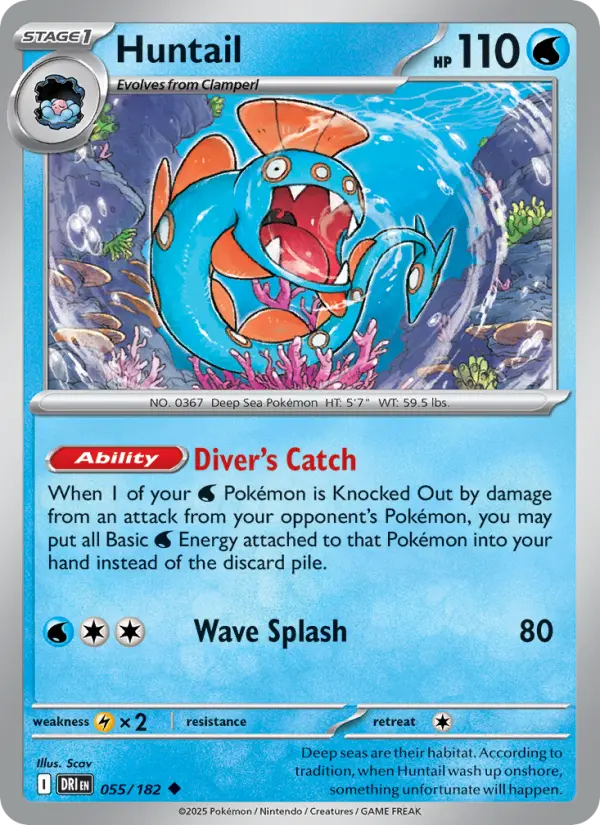
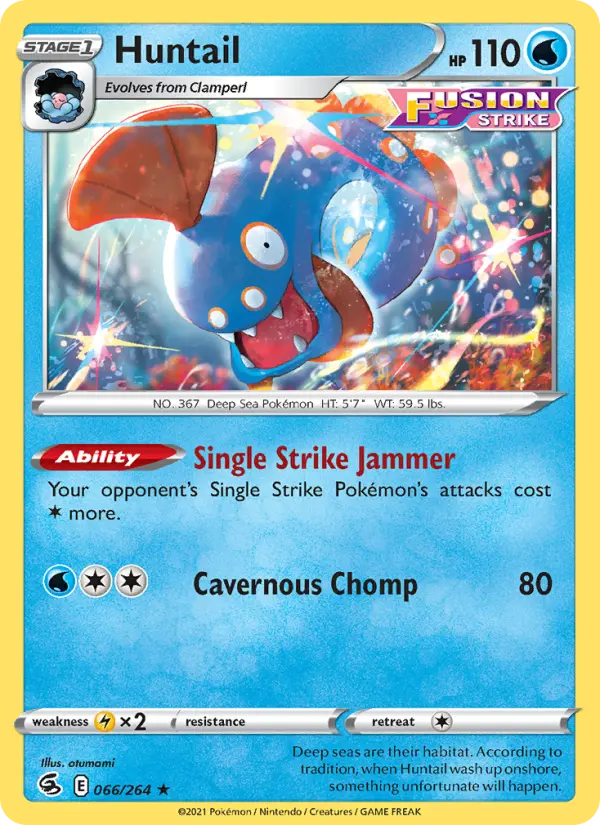
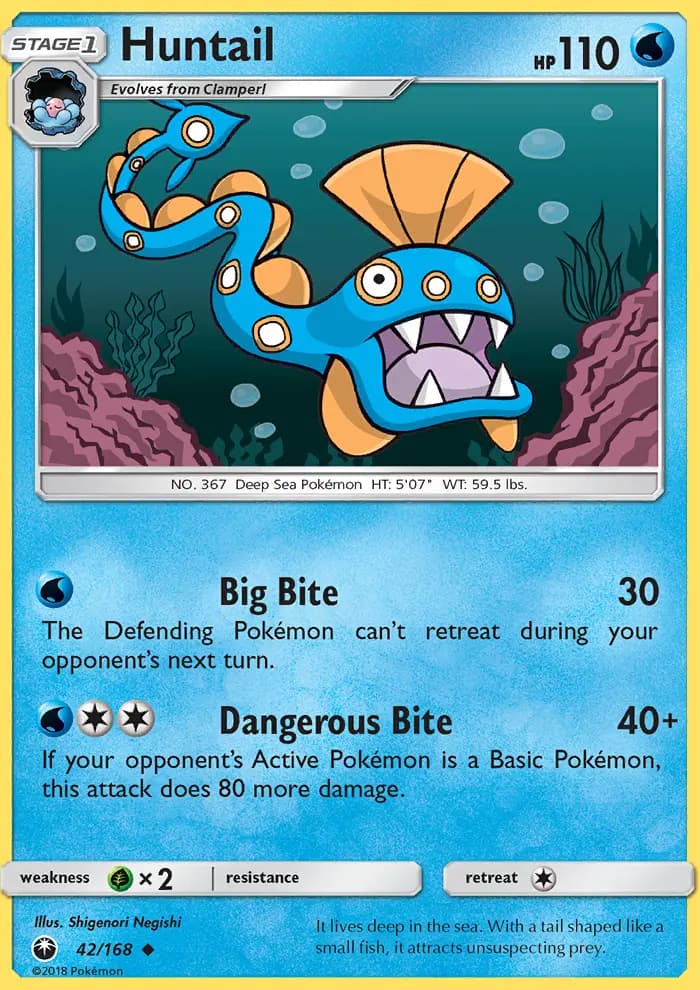
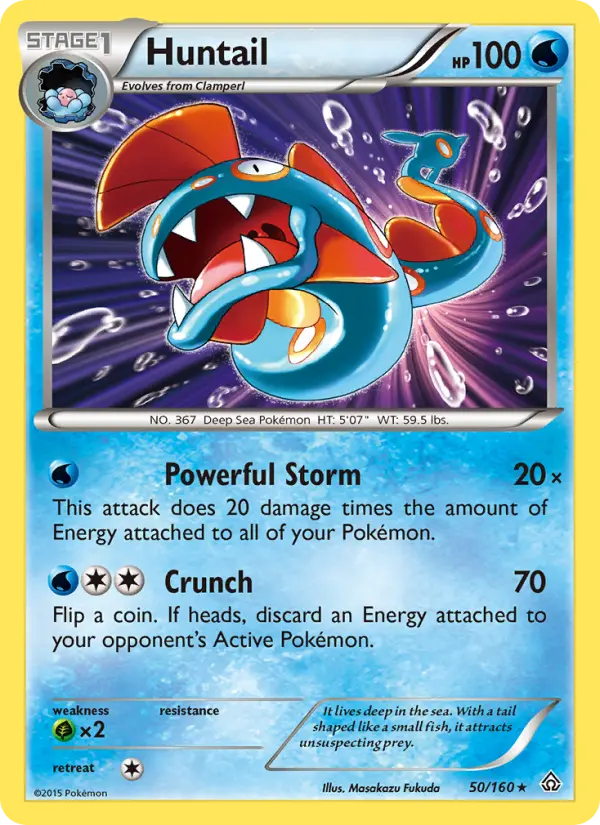
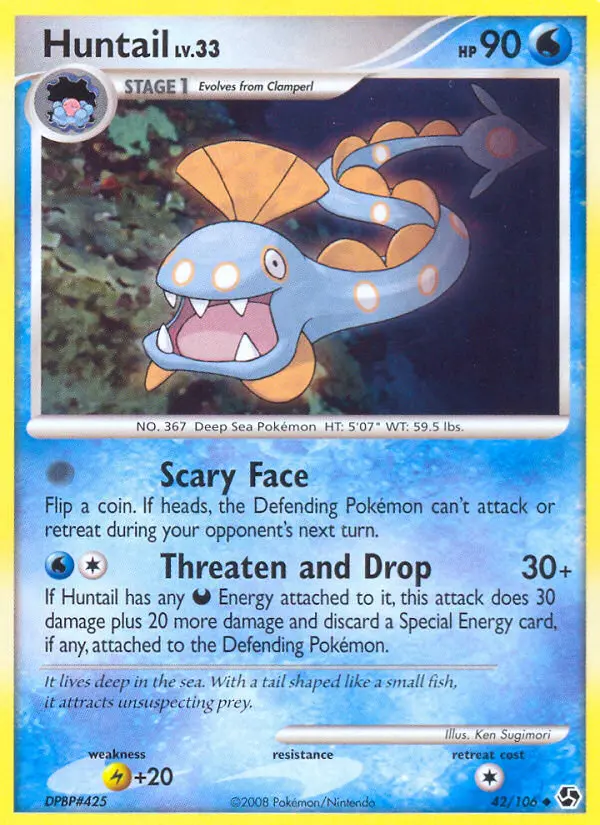
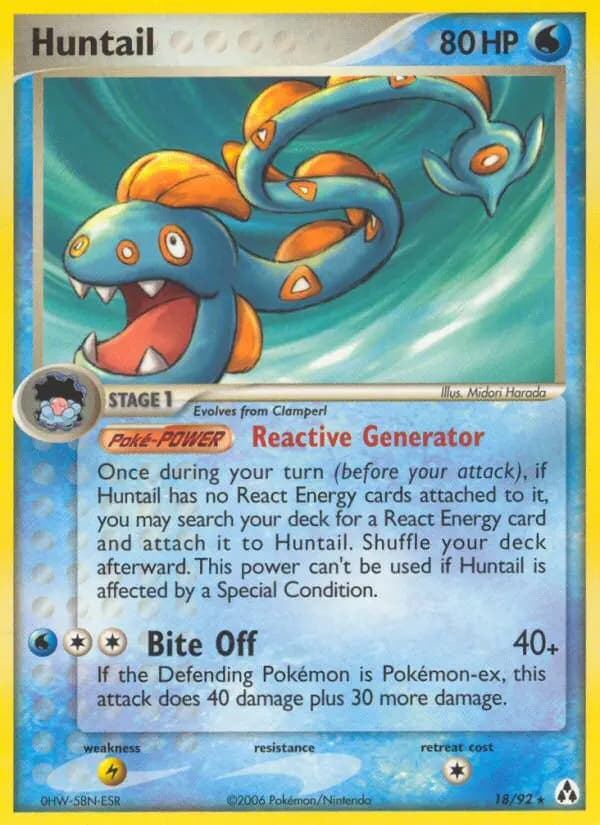
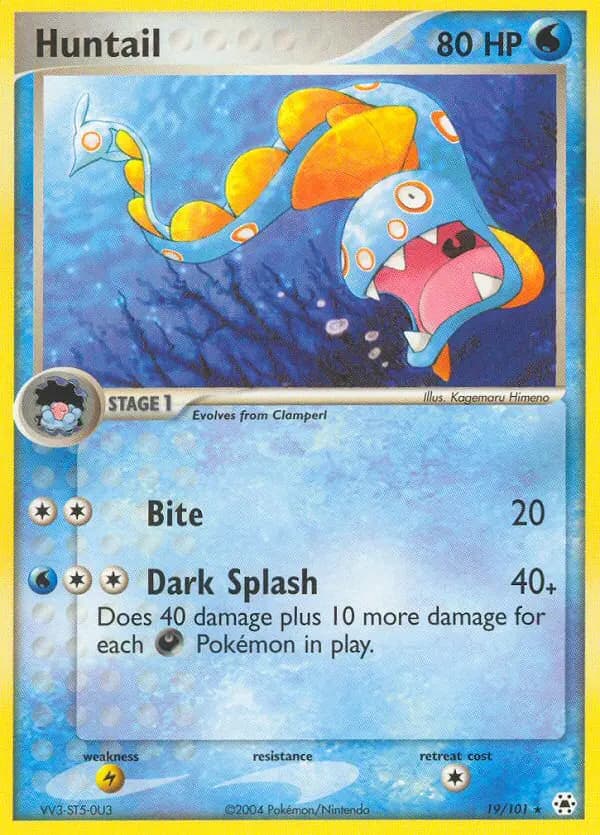
Huntail has maintained a modest but consistent presence in Pokémon culture since its introduction in Generation III, appearing in the anime, manga, and trading card game across multiple decades. The Pokémon's deep-sea origins and mysterious nature have made it a favorite among players drawn to aquatic Pokémon, particularly those who appreciate the more alien and unusual designs in the Pokédex. Its bioluminescent lure mechanism has inspired numerous fan artworks and creative interpretations exploring the Pokémon's hunting behavior and deep-sea ecosystem. In competitive Pokémon communities, Huntail has experienced periodic surges in popularity whenever rain-based strategies gain prominence in tournament metagames, though it remains overshadowed by more dominant water-type options. The species' association with maritime folklore and omens of misfortune has captured the imagination of fans interested in Pokémon lore, leading to creative theories about the relationship between Huntail sightings and in-game events. Trading card game representations of Huntail have ranged from straightforward attack-focused designs to more complex ability-dependent strategies, reflecting its varied competitive applications across different card game formats. The Pokémon's distinctive silhouette and recognizable design make it immediately identifiable to longtime fans, cementing its place within the broader tapestry of iconic Generation III Pokémon.
Where to Find Huntail in Every Pokémon Game
Huntail's availability varies significantly across different Pokémon games, with its presence limited primarily to games featuring expanded water routes or specific water-based areas. In Generation III titles Pokémon Ruby and Sapphire, Huntail can be encountered in the Hoenn regional Pokédex and is found in various ocean routes and underwater locations throughout the region. To obtain Huntail in gameplay, trainers must first catch a Clamperl and subsequently trade it while holding a Deep Sea Tooth, making access to this evolution contingent upon in-game trading mechanics or communication with other players. Later generations have adjusted Huntail's availability, with appearances in games such as HeartGold and SoulSilver, X and Y, Omega Ruby and Alpha Sapphire, and the Ultra Sun and Ultra Moon entries. In Pokémon Sword and Shield, Huntail was unavailable in the base games but became accessible through the Isle of Armor expansion, broadening its availability to a new generation of players. Huntail's rarity in the wild makes it a less common Pokémon compared to more frequently encountered water-types, though its evolutionary line's prominence in Generation III ensured it received significant distribution across multiple game titles. The requirement of trading to obtain Huntail means that players seeking this Pokémon must either access local or online trading functionality or capture and evolve Clamperl themselves using the appropriate held item, making it a more involved acquisition process than simply encountering it in tall grass or cave systems.