Moth Iron
Generation IX · #0994 — Paradox Pokémon
Iron-Moth's fire/poison typing gets most of the attention, but quark drive is doing just as much work in how it holds up in practice. The Pokémon's mysterious nature is further emphasized by its genderless classification and its inability to breed, reinforcing the theory that it may be something far removed from typical biological Pokémon.
Editor's Take
Iron Moth has 140 base Special Attack and 110 base Speed on future Volcarona, and Fire/Poison is a considerably more aggressive typing than the original's Bug/Fire.
Base Stats
Height
1.2m
Weight
36.0kg
Category
Paradox Pokémon
Gender
Genderless
Color
yellow
Shape
bug-wings
Abilities
Raises highest stat on Electric Terrain, or if holding Booster Energy.

Moth Iron Biology & Physical Characteristics
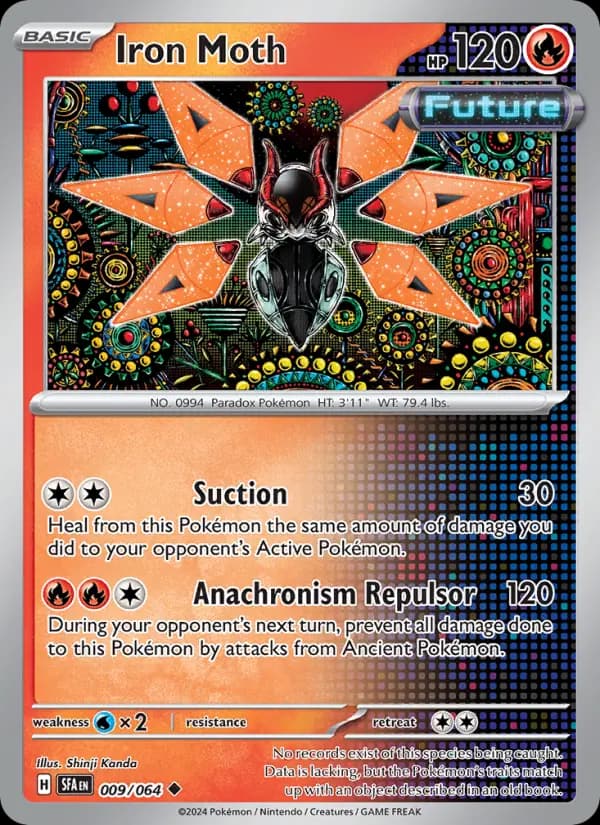
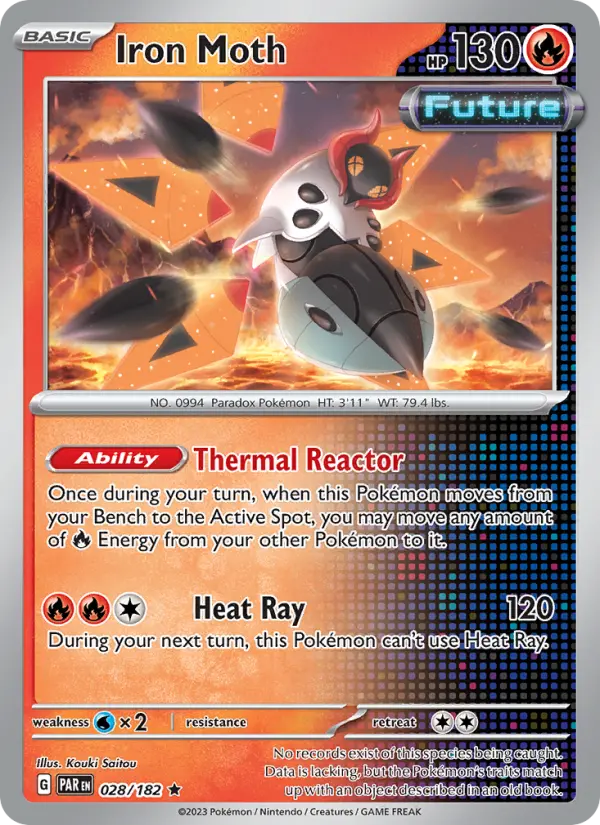
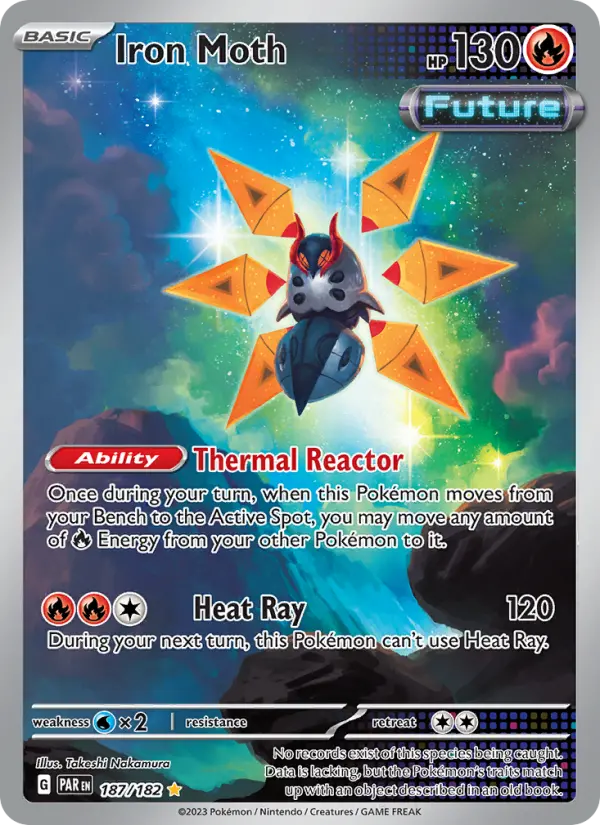
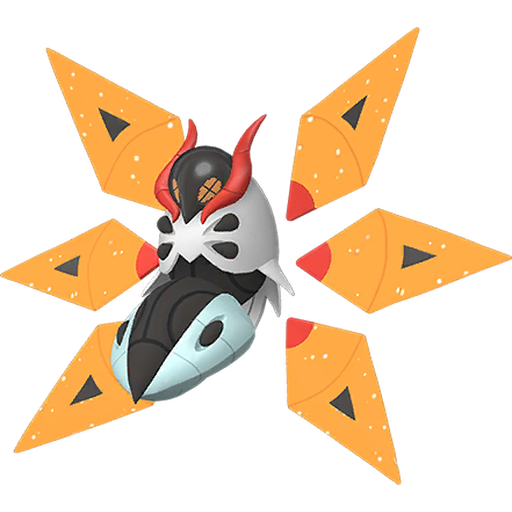
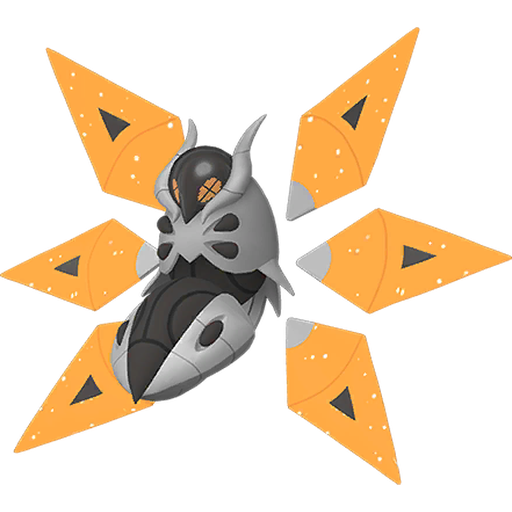
Iron Moth's physical structure is remarkably mechanical in appearance, resembling a highly advanced robotic moth that bears striking similarities to the legendary Volcarona. The Pokémon features an impressive array of biological-technological components, including four small cylindrical feet that can be fired as projectiles, functioning like a form of weaponry that the creature can reload from an internal magazine. Its most distinctive feature is its set of six diamond-shaped wings composed of orange plating with white speckles and black triangular markings, which levitate independently at a short distance from the creature's body rather than being physically attached. The thorax is heavily armored with white plating, while the abdomen displays a black and light blue coloration marked with two black diamond spots. When Iron Moth enters a sleep state, it undergoes a complete transformation, with its wings retracting to connect directly to its back and the orange energy across its plating shifting to black, effectively powering down into a dormant state. Its compound red eyes and red horn-like structures positioned on the sides of its head contribute to its extraterrestrial appearance.
Pokedex Numbers
Training
Breeding
Moth Iron Breeding, Gender Ratio & Egg Groups
Iron Moth belongs to the Undiscovered egg group and is classified as genderless, possessing no biological sex characteristics or reproductive capacity. This fundamental aspect of Iron Moth's nature distinguishes it from nearly all other Pokémon species and provides strong evidence supporting the theory that it may not be a naturally occurring biological entity. The genderless classification combined with the complete inability to breed suggests that Iron Moth either propagates through non-biological means or originates from a timeline or dimension where traditional reproduction is unnecessary. The base friendship stat of 0, significantly lower than the standard baseline for Pokémon species, further reinforces the impression that Iron Moth exists outside the normal parameters of Pokémon biology and sociology. No egg cycles or hatching mechanisms apply to Iron Moth, as the species cannot produce offspring through conventional breeding methods. This reproductive isolation makes each individual Iron Moth encountered potentially a unique instance, impossible to multiply through standard game mechanics, which has profound implications for its scarcity and value in competitive and collection contexts.
Sprites


TMs & HMs
tm03
lets go pikachu lets go eevee
tm04
yellow
tm04
red blue
tm04
red green japan
tm04
blue japan
tm05
lets go pikachu lets go eevee
tm06
yellow
tm06
gold silver
tm06
red blue
tm06
crystal
tm06
emerald
tm06
firered leafgreen
tm06
diamond pearl
tm06
platinum
tm06
ruby sapphire
tm06
colosseum
tm06
black 2 white 2
tm06
xd
tm06
black white
tm06
heartgold soulsilver
+428 more TMs/HMs
Moth Iron Evolution, Mega Evolution & Special Forms
Iron Moth does not evolve into or from any other known Pokémon species, existing as a standalone entry in the Pokédex with no evolutionary relatives. However, its relationship to other Pokémon species is subject to ongoing scientific debate and temporal theory. According to AI Turo from the futuristic timeline within Pokémon Scarlet, Iron Moth is theorized to be a future relative or descendant of Volcarona, representing either an evolved form from a distant future or a version of Volcarona that has been transformed through advanced technological means or temporal manipulation. This theory is substantiated by the remarkable morphological similarities between the two species, though Iron Moth's mechanical and metallic nature suggests a more artificial origin than its organic predecessor. A counterpart species known as Slither Wing is believed to represent an ancient or alternate timeline version of this lineage, suggesting that both Iron Moth and Slither Wing may exist as temporal or dimensional variants of the same evolutionary concept. The existence of a second Turo variant at the Crystal Pool presented an alternative hypothesis regarding Iron Moth's origins, though this version's theories remain incomplete in documented records.
Where to Find
Location data not available for this Pokémon in the database.
Moth Iron Behaviour and Natural Habitat
The behavior of Iron Moth remains largely speculative due to the complete absence of documented captures and behavioral studies. According to articles from Occulture magazine cited in historical records, Iron Moth would allegedly descend from the skies following people through various locations and occasionally attacking them, suggesting an aggressive and potentially predatory nature. Some researchers theorize that Iron Moth's documented aggression may indicate external control by an unknown intelligence, supporting the hypothesis that the creature functions as an observation probe for an extraterrestrial civilization. The Pokémon's combat capabilities include the ability to fire its feet like bullets before rapidly reloading them, and it can release devastating attacks through its six connected wings, which form into a sun-shaped cannon formation. The lack of natural habitat records and breeding capability suggest that Iron Moth may not originate from the contemporary timeline or dimension, instead existing as a visitor from an alternate temporal or spatial location. Its presence in certain battle-accessible locations within Paldea remains restricted and heavily guarded.
Pokedex Entries
This Pokémon resembles an unknown object described in a paranormal magazine as a UFO sent to observe humanity.
No records exist of this species being caught. Data is lacking, but the Pokémon’s traits match up with an object described in an old book.
Moth Iron Name Origin & Design Inspiration
The Japanese name Tetsunodokuga combines the elements of "tetsu" (鉄), meaning iron, with "dokuga" (毒蛾), the Japanese term for a poison moth, creating a direct translation of Iron Poison Moth. The English name Iron Moth follows this same conceptual naming convention, emphasizing the metallic nature of the creature while maintaining the lepidopteran association. The name "Iron Moth" was reportedly borrowed from a paranormal reference in the Violet Book, an ancient text that documents unexplained phenomena, suggesting that the creature's designation was derived from cryptozoological or UFOlogical literature rather than standard scientific nomenclature. The genus classification as "Paradox Pokémon" reflects the fundamental mystery surrounding Iron Moth's origin and nature, placing it in the same specialized category as other temporally or dimensionally anomalous creatures. The design itself draws inspiration from 1950s-era UFO depictions and mechanical insect aesthetics, creating a fusion of retro-futuristic imagery with biomechanical Pokémon design principles. The creature's visual elements, including its angular diamond-shaped wings, mechanical feet, and overall silver-and-orange color scheme, evoke both genuine moths and science-fiction spacecraft design, reinforcing the ambiguity between biological organism and technological construct.
Learnable Moves
Moth Iron can learn 52 moves:
Move | Type | Cat. | Power | Acc. | PP |
|---|---|---|---|---|---|
| acid spray | poison | Special | 40 | 100 | 20 |
| acrobatics | flying | Physical | 55 | 100 | 15 |
| agility | psychic | Status | — | — | 30 |
| air slash | flying | Special | 75 | 95 | 15 |
| bug buzz | bug | Special | 90 | 100 | 10 |
| charge beam | electric | Special | 50 | 90 | 10 |
| confuse ray | ghost | Status | — | 100 | 10 |
| dazzling gleam | fairy | Special | 80 | 100 | 10 |
| discharge | electric | Special | 80 | 100 | 15 |
| electric terrain | electric | Status | — | — | 10 |
| ember | fire | Special | 40 | 100 | 25 |
| endure | normal | Status | — | — | 10 |
| energy ball | grass | Special | 90 | 100 | 10 |
| facade | normal | Physical | 70 | 100 | 20 |
| fiery dance | fire | Special | 80 | 100 | 10 |
| fire blast | fire | Special | 110 | 85 | 5 |
| fire spin | fire | Special | 35 | 85 | 15 |
| flame charge | fire | Physical | 50 | 100 | 20 |
| flamethrower | fire | Special | 90 | 100 | 15 |
| flare blitz | fire | Physical | 120 | 100 | 15 |
| flash cannon | steel | Special | 80 | 100 | 10 |
| giga impact | normal | Physical | 150 | 90 | 5 |
| gust | flying | Special | 40 | 100 | 35 |
| heat wave | fire | Special | 95 | 90 | 10 |
| helping hand | normal | Status | — | — | 20 |
| hurricane | flying | Special | 110 | 70 | 10 |
| hyper beam | normal | Special | 150 | 90 | 5 |
| light screen | psychic | Status | — | — | 30 |
| lunge | bug | Physical | 80 | 100 | 15 |
| metal sound | steel | Status | — | 85 | 40 |
| meteor beam | rock | Special | 120 | 90 | 10 |
| morning sun | normal | Status | — | — | 5 |
| overheat | fire | Special | 130 | 90 | 5 |
| pounce | bug | Physical | 50 | 100 | 20 |
| protect | normal | Status | — | — | 10 |
| psychic | psychic | Special | 90 | 100 | 10 |
| rest | psychic | Status | — | — | 5 |
| screech | normal | Status | — | 85 | 40 |
| sleep talk | normal | Status | — | — | 10 |
| sludge wave | poison | Special | 95 | 100 | 10 |
| solar beam | grass | Special | 120 | 100 | 10 |
| struggle bug | bug | Special | 50 | 100 | 20 |
| substitute | normal | Status | — | — | 10 |
| sunny day | fire | Status | — | — | 5 |
| swift | normal | Special | 60 | — | 20 |
| take down | normal | Physical | 90 | 85 | 20 |
| tera blast | normal | Special | 80 | 100 | 10 |
| toxic | poison | Status | — | 90 | 10 |
| toxic spikes | poison | Status | — | — | 20 |
| u turn | bug | Physical | 70 | 100 | 20 |
| venoshock | poison | Special | 65 | 100 | 10 |
| whirlwind | normal | Status | — | — | 20 |
Moth Iron Competitive Battle Guide
Iron Moth operates as a specialized special attacker with a base Special Attack stat of 140, supplemented by an impressive base Speed of 110 that allows it to outpace many conventional threats without Speed investment. Its defensive profile includes a respectable Special Defense stat of 110, providing unexpected durability against special moves, while its physical Defense of 60 leaves it vulnerable to physical attacks. The signature ability Quark Drive functions as a crucial component of Iron Moth's competitive viability, boosting the Pokémon's highest stat when Electric Terrain is in effect or when holding Booster Energy, essentially granting either a 50% Speed increase or a 50% Special Attack increase depending on game state. Iron Moth's movepool includes critical offensive coverage options such as Overheat (base 130 power), Sludge Wave (95 power), Hurricane (110 power), and Bug Buzz (90 power), providing excellent neutral and super-effective coverage against most competitive threats. The ability to learn Discharge at level 42 and access to Electric Terrain through move reminder functionality enables Iron Moth to set up its own Quark Drive boost, creating a self-sufficient sweeping strategy. With a total base stat of 570, Iron Moth occupies a competitive niche where it functions as a powerful but not overwhelmingly dominant special attacker, requiring careful team building and prediction to maximize its potential.
Commonly Asked Questions About Moth Iron
What type is Moth Iron?
Moth Iron is a fire and poison type Pokemon.
What does Moth Iron evolve from?
Moth Iron does not evolve.
What are Moth Iron's weaknesses?
Moth Iron is weak to ground, rock, water and psychic type moves.
Moth Iron Cultural Impact & Franchise History
Iron Moth represents a significant departure from traditional Pokémon design philosophy, introducing genuine ambiguity regarding the nature of Pokémon themselves and their origins. The creature has captured the imagination of the Pokémon community due to its mysterious Paradox classification and the lore suggesting it may be either a future technology or an extraterrestrial observer, fundamentally challenging players' understanding of the Pokémon world's scientific principles. The design has inspired considerable fan speculation and creative interpretation, with numerous theories proposed regarding its true nature and origins, cementing Iron Moth's status as one of Generation IX's most conceptually intriguing species. The creature's appearance in Pokémon Scarlet and Violet's post-game content as a temporally displaced entity from alternate timelines has resonated with players interested in the games' complex narrative involving time travel and parallel dimensions. Iron Moth has become emblematic of Generation IX's willingness to introduce genuinely alien and unsettling concepts to the traditionally family-friendly Pokémon franchise, appealing to players who appreciate darker or more science-fiction oriented storytelling. The species' connection to UFO mythology and paranormal investigation tropes has positioned it as a cult favorite among fans interested in cryptozoology and unexplained phenomena, bridging mainstream Pokémon culture with niche internet subcultures.
Where to Find Moth Iron in Every Pokémon Game
Iron Moth can be encountered in Pokémon Scarlet and Violet as a Paradox Pokémon with a notably low catch rate of 30, classified as 3.9% when using a standard Poké Ball against a full-health specimen. The species does not appear in the wild through conventional means but is instead available exclusively within specific post-game locations and encounters tied to the Paradox Pokémon mechanic introduced in Generation IX. Access to Iron Moth requires progression through the end-game content of Pokémon Scarlet or Violet, as these creatures exist outside the normal timeline and can only be accessed through specific temporal rifts or special battle scenarios. The genderless, non-breeding nature of Iron Moth means that obtaining multiple specimens requires encountering them separately in-game, as no breeding mechanics or trade alternatives exist to duplicate the species. Iron Moth has also been distributed through Poké Portal News events, providing alternative accessibility pathways for players unable to access the species through standard gameplay. The creature's rarity and post-game exclusive status have made it a sought-after specimen among competitive players and completionists, requiring significant gameplay investment to obtain. As of current generation availability, Iron Moth remains exclusive to Pokémon Scarlet and Violet, with its inclusion in future game titles remaining unconfirmed by official sources.