Kartana
Generation VII · #0798 — Drawn Sword Pokémon
Kartana measures in at 0.3 m and 0.1 kg, a build that matches its beast boost ability better than it matches raw offense or defense.
Editor's Take
Kartana has 181 base Attack and 59 base HP, the sharpest offensive-defensive contrast in the series, and Beast Boost on that Attack stat is why it was banned.
Base Stats
Height
0.3m
Weight
0.1kg
Category
Drawn Sword Pokémon
Gender
Genderless
Color
white
Shape
humanoid
Abilities
Raises this Pokémon's highest stat by one stage when it faints another Pokémon.
Kartana Biology & Physical Characteristics
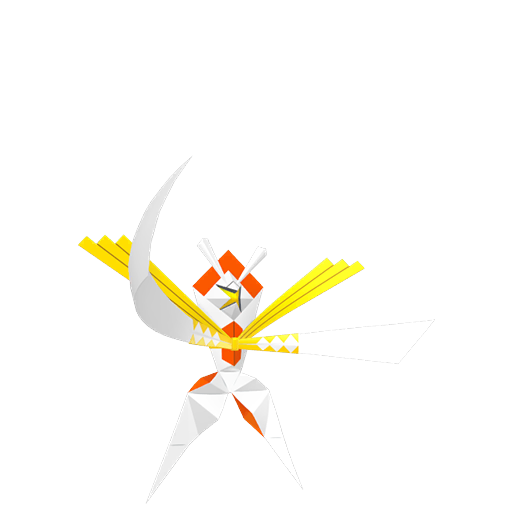
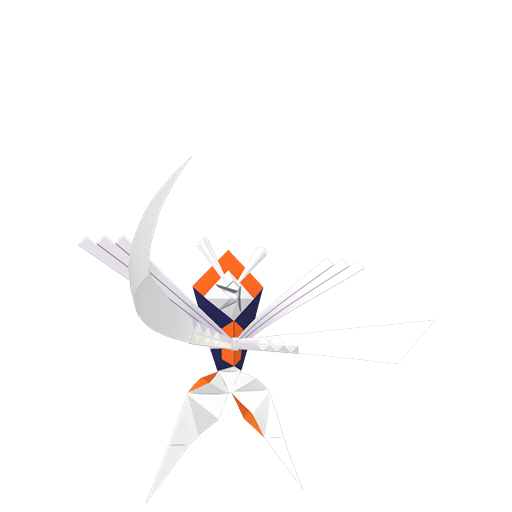
Kartana's most remarkable biological feature is its paper-thin body structure, which resembles a carefully folded origami creation with white and orange coloring. The Pokémon appears to be composed of material similar to paper, yet possesses cutting edges as sharp as any well-honed katana blade. Its design is deceptively simple: a compact form with long, thin arms that function as slashing weapons, each with a yellow sheath-like structure near the shoulders and three projections extending from the base of each sheath. The creature's head features a four-sided star pattern in its center and operates similarly to a paper fortune teller, serving as both eye and mouth. Atop its head sit two distinctive antennae or horns that widen at their tips. Its legs appear creased with visible red edges, and at only 0.3 meters in height and 0.1 kilograms in weight, Kartana ranks among the lightest Pokémon known to exist, rivaling even the most diminutive species in the Pokédex.
Pokedex Numbers
Training
Breeding
Kartana Breeding, Gender Ratio & Egg Groups
Kartana is classified as a genderless Pokémon, reflecting its alien nature and non-biological origin as an Ultra Beast. The species belongs to the Undiscovered egg group, meaning Kartana cannot breed with any other Pokémon and cannot produce eggs under any circumstances. This reproductive status is consistent with other Ultra Beasts, suggesting that these creatures from alternate dimensions operate outside the normal reproductive frameworks of terrestrial Pokémon. With a base friendship of zero, Kartana also begins encounters with trainers with significantly lower affection than most species, though this can be improved through gameplay interactions and care. The species' inability to breed emphasizes its singular existence as a complete organism, unable to perpetuate itself through conventional means and representing a finite population limited to individual specimens encountered through Ultra Wormholes.
Sprites


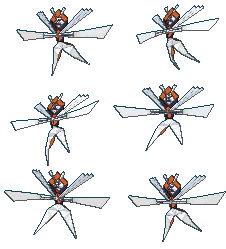
TMs & HMs
tm03
yellow
tm03
red blue
tm03
blue japan
tm03
red green japan
tm04
emerald
tm04
firered leafgreen
tm04
ruby sapphire
tm04
diamond pearl
tm04
xd
tm04
heartgold soulsilver
tm04
black white
tm04
colosseum
tm04
platinum
tm04
sun moon
tm04
ultra sun ultra moon
tm04
x y
tm04
omega ruby alpha sapphire
tm04
black 2 white 2
tm05
lets go pikachu lets go eevee
tm06
yellow
+340 more TMs/HMs
Kartana Evolution, Mega Evolution & Special Forms
Kartana does not evolve from any other Pokémon, nor does it evolve into any subsequent form. This makes Kartana a standalone species within the Pokédex, much like other Ultra Beasts such as Celesteela and Guzzlord. As an Ultra Beast introduced in Generation VII, Kartana's singular evolutionary status reflects its nature as a complete organism from an alien dimension, having no connection to natural evolutionary chains found within the traditional Pokémon world. The species' design and capabilities are presented as fully formed from its initial discovery, and no Mega Evolution or regional variant forms have been documented for Kartana across subsequent generations including Sword/Shield and the games that followed.
Where to Find
Malie Garden
alola
Alola Route 17
alola
Ultra Space
alola
Kartana Behaviour and Natural Habitat
In its native Ultra Forest dimension, Kartana is described as a common organism that poses no threat to its native ecosystem, suggesting it evolved to fulfill a natural ecological role in that world. However, in the Alola region, its alien nature makes it inherently dangerous despite appearing not to actively attack enemies of its own volition. According to Pokédex entries, Kartana has demonstrated the ability to cut through massive steel structures with a single slash, as evidenced by observations of it severing a gigantic steel tower in one stroke. The species possesses the Beast Boost ability, which automatically raises its highest stat by one stage whenever it faints another Pokémon, indicating an adaptation toward continuous improvement through combat encounters. Its behavior suggests an almost passive existence where danger emanates from its very nature rather than aggressive intent, making Kartana a uniquely paradoxical threat in its adopted environment.
Pokedex Entries
This Ultra Beast came from the Ultra Wormhole. It seems not to attack enemies on its own, but its sharp body is a dangerous weapon in itself.
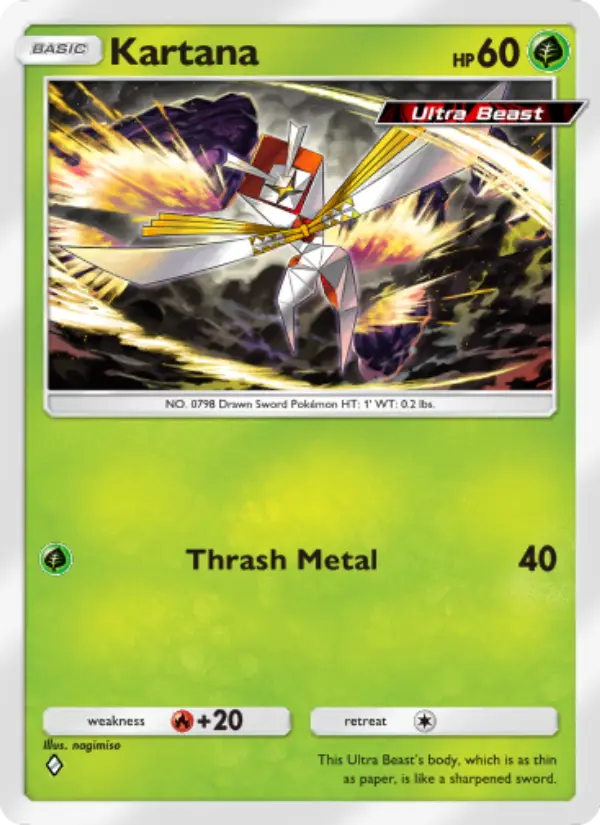
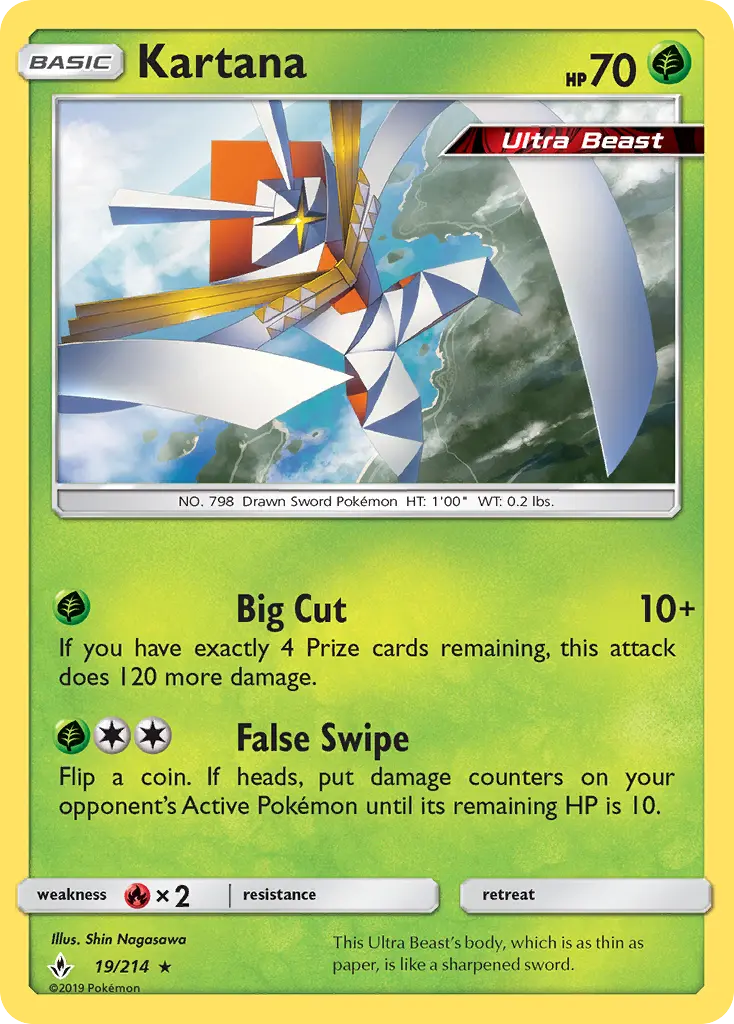
This Ultra Beast’s body, which is as thin as paper, is like a sharpened sword.
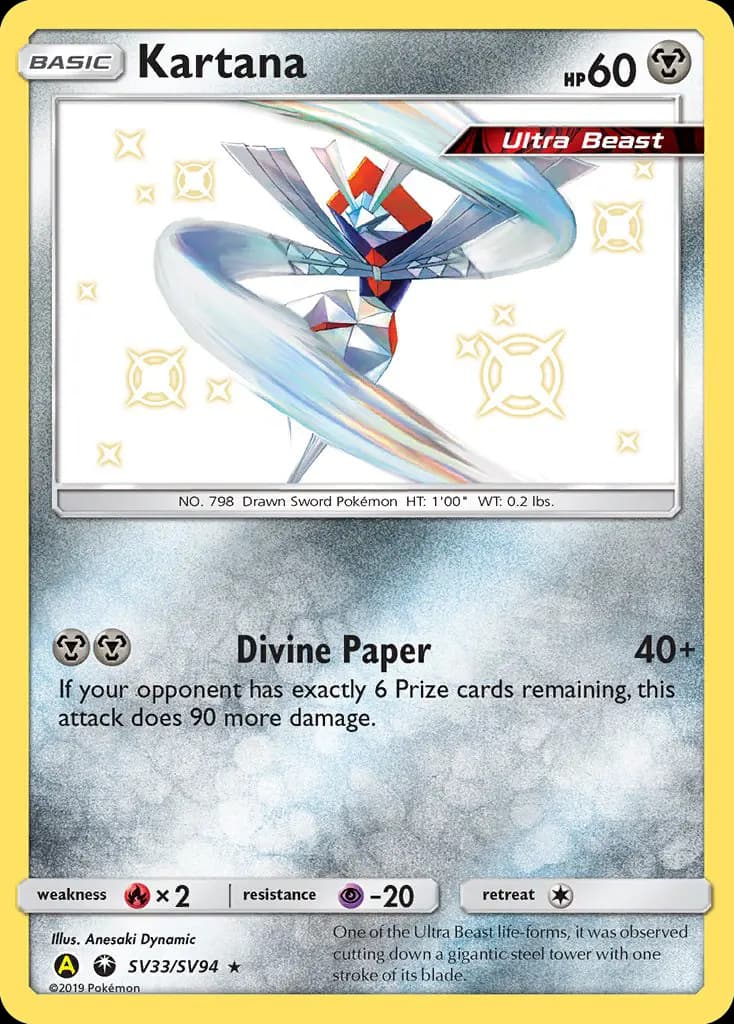
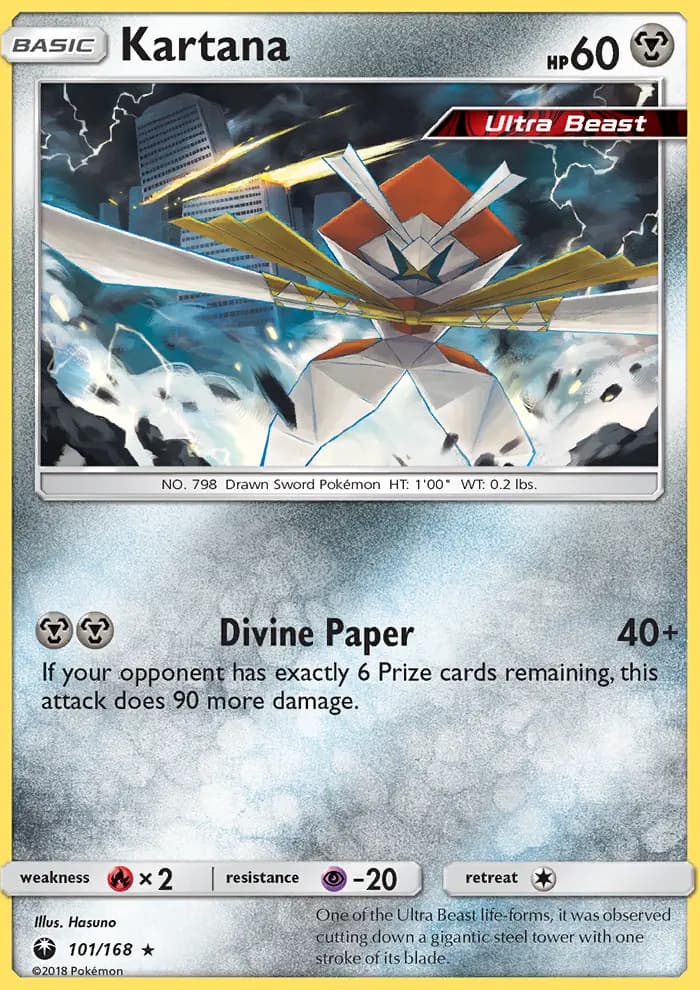
One of the Ultra Beast life-forms, it was observed cutting down a gigantic steel tower with one stroke of its blade.
Although it’s alien to this world and a danger here, it’s apparently a common organism in the world where it normally lives.
Kartana Name Origin & Design Inspiration
Kartana's design draws clear inspiration from origami art and Japanese sword culture, particularly the katana and the concept of paper-thin sharpness. The name Kartana itself is derived from the Sanskrit word 'kartana,' meaning 'cutting' or 'knife,' perfectly encapsulating the Pokémon's most defining characteristic. In Japanese, Kartana is called Kamiturugi, combining 'kami' (paper) and 'tsurugi' (sword), making the translation even more explicit. The origami-like aesthetic reflects a blend of Eastern artistic traditions with ultra-modern alien design, creating a creature that looks simultaneously delicate and lethal. Its color scheme of white and orange, coupled with the yellow sheaths and red hexagonal accent on its torso, gives it a geometric, almost minimalist appearance that contrasts sharply with more organically-designed Pokémon. This deliberate aesthetic choice emphasizes Kartana's otherworldly origins and its role as a living weapon.
Learnable Moves
Kartana can learn 45 moves:
Move | Type | Cat. | Power | Acc. | PP |
|---|---|---|---|---|---|
| aerial ace | flying | Physical | 60 | — | 20 |
| air cutter | flying | Special | 60 | 95 | 25 |
| air slash | flying | Special | 75 | 95 | 15 |
| brick break | fighting | Physical | 75 | 100 | 15 |
| calm mind | psychic | Status | — | — | 20 |
| confide | normal | Status | — | — | 20 |
| cut | normal | Physical | 50 | 95 | 30 |
| defog | flying | Status | — | — | 15 |
| detect | fighting | Status | — | — | 5 |
| double team | normal | Status | — | — | 15 |
| endure | normal | Status | — | — | 10 |
| false swipe | normal | Physical | 40 | 100 | 40 |
| frustration | normal | Physical | — | 100 | 20 |
| fury cutter | bug | Physical | 40 | 95 | 20 |
| giga drain | grass | Special | 75 | 100 | 10 |
| giga impact | normal | Physical | 150 | 90 | 5 |
| guillotine | normal | Physical | — | 30 | 5 |
| hidden power | normal | Special | 60 | 100 | 15 |
| iron defense | steel | Status | — | — | 15 |
| knock off | dark | Physical | 65 | 100 | 20 |
| laser focus | normal | Status | — | — | 30 |
| last resort | normal | Physical | 140 | 100 | 5 |
| leaf blade | grass | Physical | 90 | 100 | 15 |
| night slash | dark | Physical | 70 | 100 | 15 |
| protect | normal | Status | — | — | 10 |
| psycho cut | psychic | Physical | 70 | 100 | 20 |
| razor leaf | grass | Physical | 55 | 95 | 25 |
| rest | psychic | Status | — | — | 5 |
| return | normal | Physical | — | 100 | 20 |
| round | normal | Special | 60 | 100 | 15 |
| sacred sword | fighting | Physical | 90 | 100 | 15 |
| screech | normal | Status | — | 85 | 40 |
| sleep talk | normal | Status | — | — | 10 |
| smart strike | steel | Physical | 70 | — | 10 |
| snore | normal | Special | 50 | 100 | 15 |
| solar blade | grass | Physical | 125 | 100 | 10 |
| steel beam | steel | Special | 140 | 95 | 5 |
| substitute | normal | Status | — | — | 10 |
| swagger | normal | Status | — | 85 | 15 |
| swords dance | normal | Status | — | — | 20 |
| synthesis | grass | Status | — | — | 5 |
| tailwind | flying | Status | — | — | 15 |
| toxic | poison | Status | — | 90 | 10 |
| vacuum wave | fighting | Special | 40 | 100 | 30 |
| x scissor | bug | Physical | 80 | 100 | 15 |
Kartana Competitive Battle Guide
Kartana's competitive viability centers almost entirely on its phenomenal attack stat of 181, the highest non-legendary offensive stat among Grass-type Pokémon and comparable to many legendary creatures. With access to a diverse movepool including Leaf Blade, Knock Off, Smart Strike, and X-Scissor, Kartana can adapt to various defensive cores and threat profiles in competitive play. Its base speed of 109 provides respectable offensive momentum, allowing it to outpace many common threats and threaten hyper-offense strategies. However, Kartana's considerably lower special defense stat of 31 and modest HP of 59 create significant vulnerabilities, particularly to special attacks and coverage moves from specially-inclined opponents. The Beast Boost ability provides valuable stat boosts after securing knockouts, though this ability is primarily utilitarian in longer battles. In competitive formats, Kartana functions best as a physical sweeper on teams built around setting up physical attack boosts through Swords Dance or weakness-exploiting strategies, though its relative frailty requires careful team support and entry hazard management.
Commonly Asked Questions About Kartana
What type is Kartana?
Kartana is a grass and steel type Pokemon.
What does Kartana evolve from?
Kartana does not evolve.
What are Kartana's weaknesses?
Kartana is weak to fighting, poison and fire type moves.
Where can I find Kartana?
Kartana can be found in malie garden (alola), alola route 17 (alola) and ultra space (alola).
Kartana Cultural Impact & Franchise History
Since its introduction in Pokémon Sun and Moon, Kartana has captivated fans and competitive players alike with its unique aesthetic and formidable stat distribution. The Ultra Beast concept itself, introduced in Generation VII, generated significant excitement within the Pokémon community, and Kartana became one of the most recognizable members of this group due to its striking origami-inspired design and straightforward concept as a living sword. Its appearance in competitive tournaments and player-created content has established it as an iconic representation of the Generation VII era. The species has inspired artistic discussions about minimalist design in Pokémon, with many fans appreciating how Kartana manages to convey danger and elegance through geometric simplicity. Its integration into the broader Ultra Beast narrative within the Alola region expanded the Pokémon universe's lore significantly, suggesting dimensions and ecosystems far different from those known on the traditional continents, thereby opening new creative possibilities for future generations and fan theories.
Where to Find Kartana in Every Pokémon Game
Kartana is exclusive to Pokémon Sun and Ultra Sun as a post-game encounter in the Ultra Forest, accessible through Ultra Wormholes after defeating the main storyline. In Pokémon Moon and Ultra Moon, players receive Celesteela instead through their respective Ultra Wormhole encounters, making Kartana version-exclusive to the Sun titles. The Pokédex entry number for Kartana is #798 in the National Pokédex, and it can be found at #298 in the Alola dex for Sun/Moon and #398 in the Alola dex for Ultra Sun/Ultra Moon. With a catch rate of 45 in later games (originally 255 in Sun/Moon), capturing Kartana requires some effort and proper preparation. Following its Generation VII introduction, Kartana has maintained availability in subsequent generations through methods including Pokémon Sword and Shield's DLC content and later releases. The species' relatively restricted distribution and version exclusivity have contributed to its appeal among collectors and competitive players seeking to complete their Pokédex or build specialized teams around its unique capabilities.