Larvesta
Generation V · #0636 — Torch Pokémon
The numbers on Larvesta tell you where to look first: Attack at 85, well above what its bug/fire typing alone would predict. Standing 1.1 m tall and weighing 28.8 kg, it's built around a distinct combination of bug traits that shapes how it performs both in the wild and in battle. With a overall stat sum of 360, Larvesta demonstrates competent offensive capabilities with an Attack stat of 85, though its other statistics are more modest, suggesting it functions best as a special physical attacker in the early stages of its evolution line. Larvesta's most notable feature is its eventual evolution into Volcarona at level 59, transforming from a fuzzy larval creature into a magnificent moth-like being engulfed in flames. The Pokédex entries reveal that ancient peoples believed Larvesta fell from the sun itself, earning it titles such as "the Larva That Stole the Sun" and "emissary of the sun," suggesting that this Pokémon has held cultural significance across various civilizations throughout history.
Editor's Take
Larvesta takes until level 59 to become Volcarona, which is a very long time to carry a Bug-type with a base stat total of 360 through a playthrough.
Base Stats
Height
1.1m
Weight
28.8kg
Category
Torch Pokémon
Gender
Male 50% / Female 50%
Color
white
Shape
armor
Abilities
Has a 30% chance of burning attacking Pokémon on contact.
Strengthens bug moves to inflict 1.5× damage at 1/3 max HP or less.

Larvesta Biology & Physical Characteristics
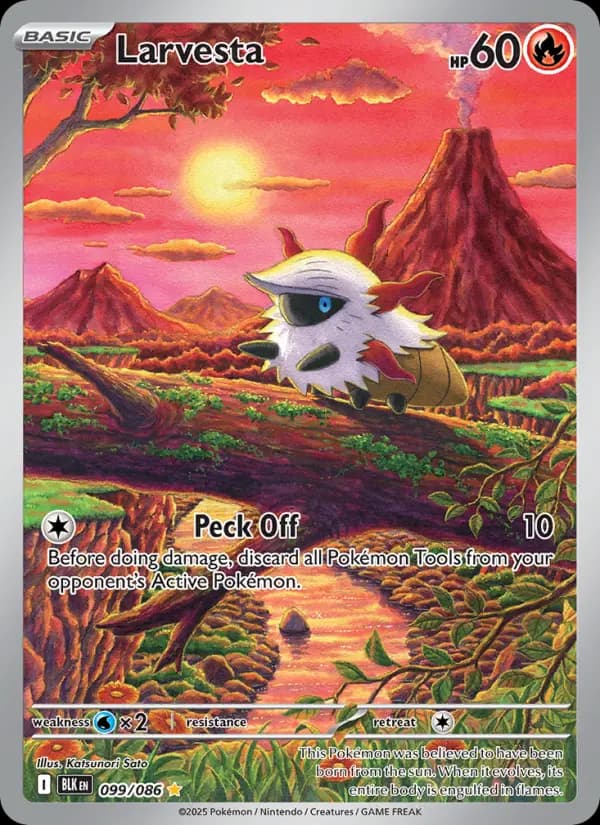
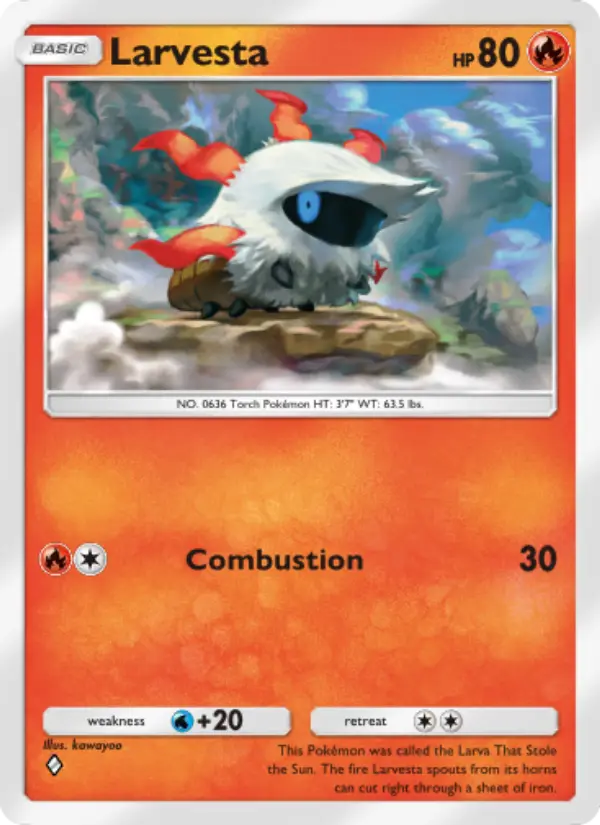
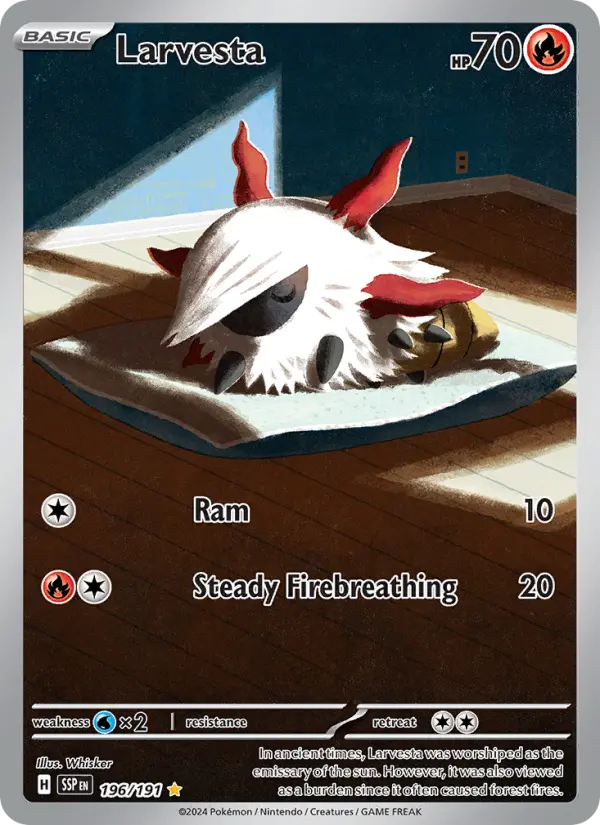
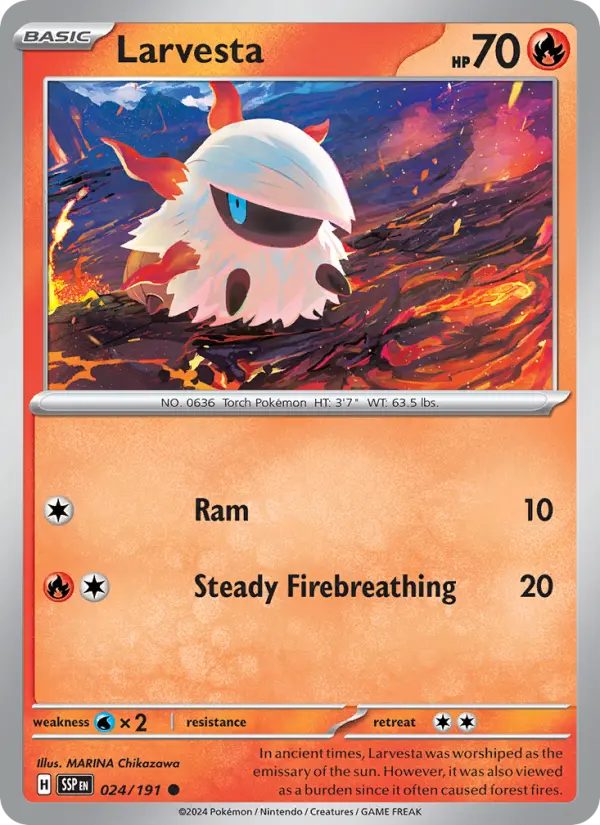
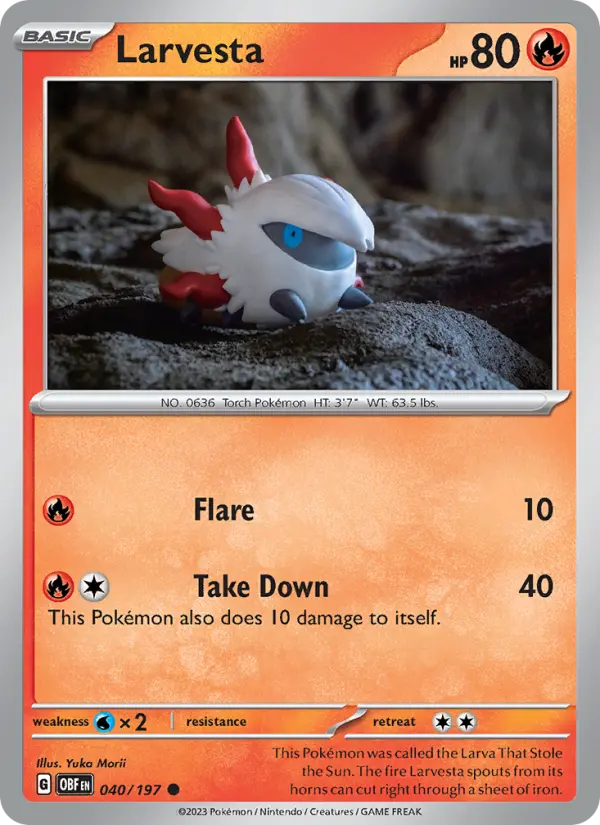
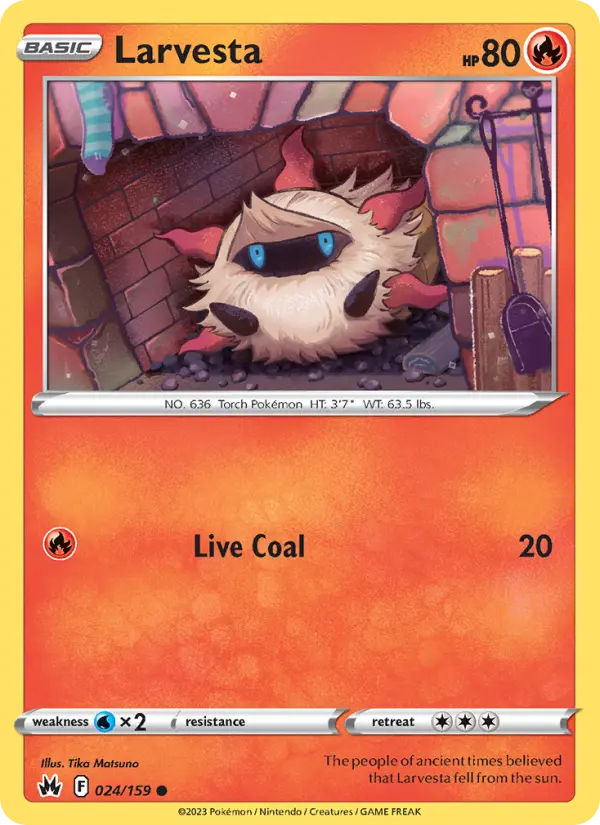
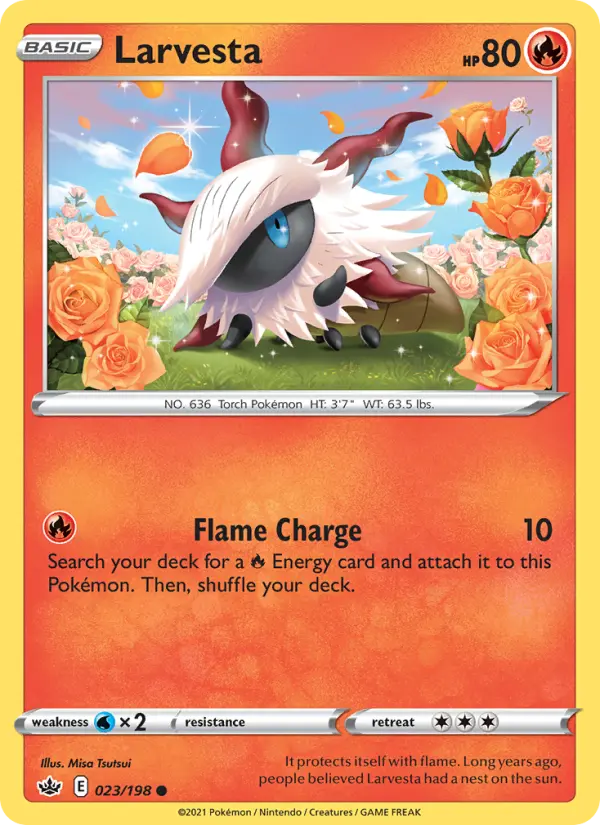
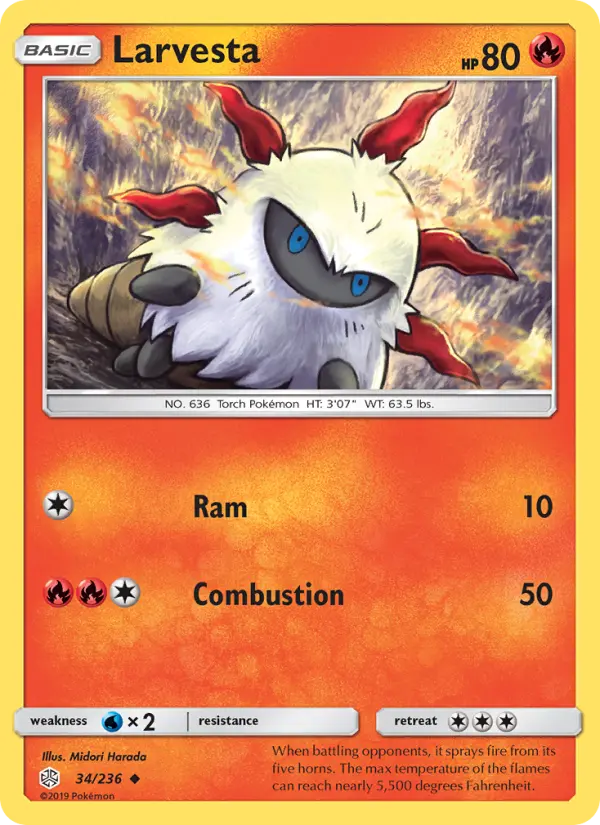
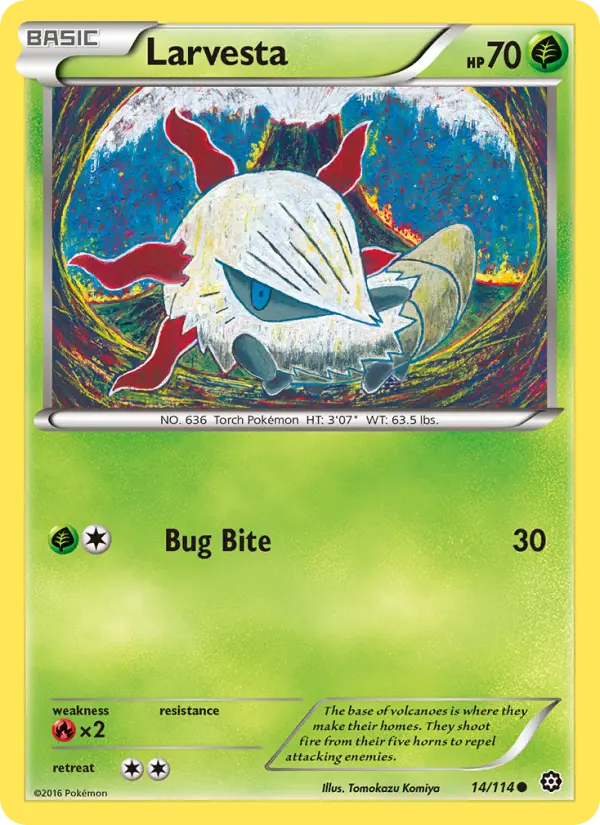
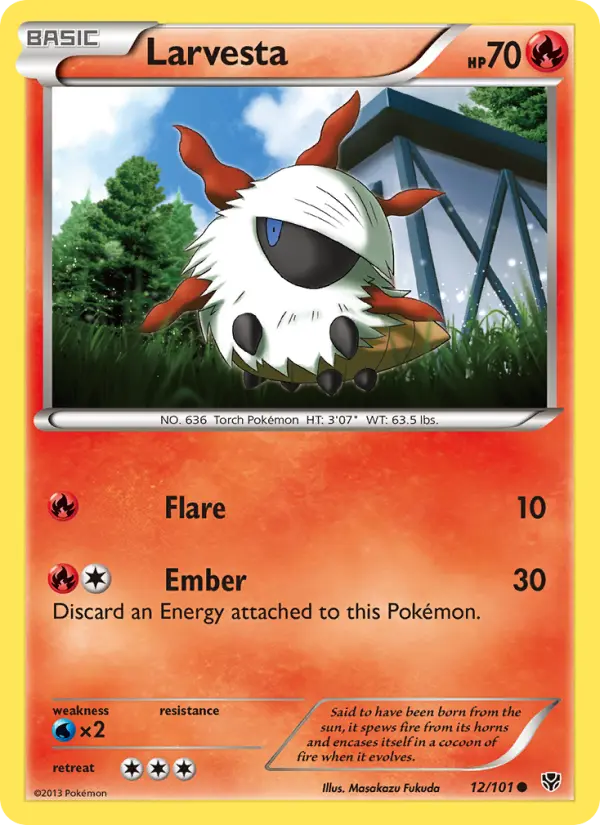
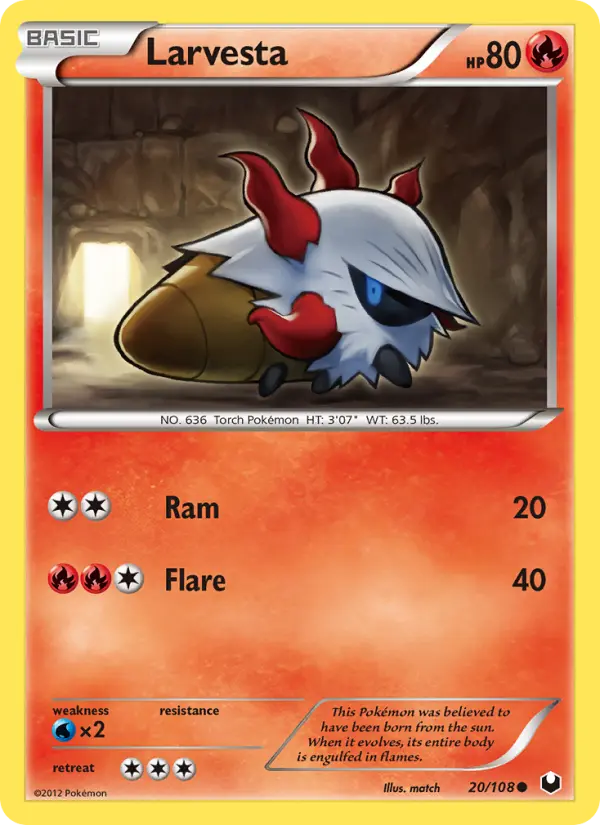
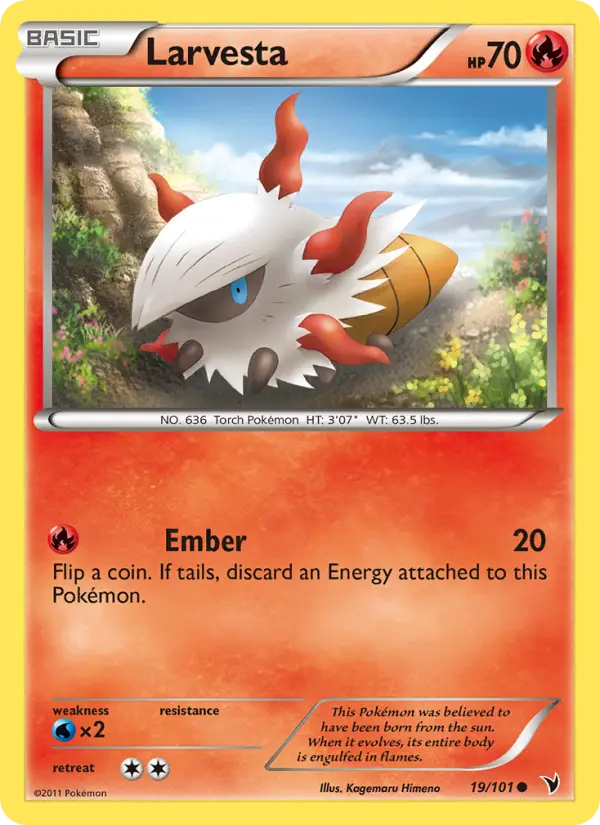
Larvesta presents a fascinating biological structure that blends lepidopteran larval characteristics with volcanic fire-manipulation capabilities. The Pokémon features a fuzzy, moth larva-like body with a predominantly white mane of fuzz enveloping its head and upper body, while its lower half maintains a brown coloration. Its most distinctive biological features are the five red, slightly whorled horns protruding from the sides of its head, which serve as the primary organs for fire generation and projection. These horns are not merely decorative but represent highly specialized structures capable of reaching temperatures of nearly 5,500 degrees Fahrenheit (approximately 3,000 degrees Celsius), hot enough to cut through sheets of iron with ease. Larvesta possesses three pairs of small black legs positioned along its lower body, supporting its terrestrial locomotion, though it demonstrates the remarkable ability to achieve flight by using the flames ejected from its horns as propulsive force. The creature's body temperature remains consistently elevated throughout its form, with its warm physiology contributing to the perpetual fire generation capability. Its large, blue eyes set within a shadowed facial region provide keen sensory perception, allowing it to detect predatory threats and prey species with considerable accuracy.
Pokedex Numbers
Training
Breeding
Larvesta Breeding, Gender Ratio & Egg Groups
Larvesta maintains a balanced 50% male to 50% female gender ratio, ensuring relatively straightforward breeding mechanics for trainers seeking to obtain multiple specimens or eggs. The Pokémon belongs exclusively to the Bug egg group, which restricts breeding compatibility to other Bug-type Pokémon and creatures within the same egg group classification. This egg group assignment reinforces Larvesta's fundamental insectoid nature, despite its fire-type secondary typing, aligning it with other true insects and insect-adjacent creatures in the Pokémon breeding system. Eggs laid by Larvesta require 40 cycles to hatch, translating to approximately 10,024 to 10,280 steps for the player character to traverse before the egg develops into a hatchling. This substantial hatching period reflects the creature's slow growth rate, which extends beyond merely the experience points required for leveling, encompassing the entire developmental timeline from conception through maturation. Larvesta exhibits a base friendship value of 70 in Generations V through VII, indicating moderate natural affection toward trainers and suggesting an inherent predisposition toward bonding despite its volcanic, fire-based nature. The combination of balanced gender distribution and exclusive Bug-group breeding makes Larvesta a manageable breeding prospect for trainers seeking to obtain optimized movesets or favorable individual values through selective breeding programs.
Sprites






TMs & HMs
tm04
emerald
tm04
firered leafgreen
tm04
ruby sapphire
tm04
diamond pearl
tm04
xd
tm04
heartgold soulsilver
tm04
black white
tm04
colosseum
tm04
platinum
tm04
sun moon
tm04
ultra sun ultra moon
tm04
x y
tm04
omega ruby alpha sapphire
tm04
black 2 white 2
tm05
lets go pikachu lets go eevee
tm06
yellow
tm06
gold silver
tm06
red blue
tm06
crystal
tm06
emerald
+515 more TMs/HMs
Larvesta's Evolution Chain


Larvesta Evolution, Mega Evolution & Special Forms
Larvesta's evolution into Volcarona at level 59 represents one of the most dramatic transformations in Pokémon evolution, marking a transition from a small, fuzzy larval creature to a magnificent Bug/Fire-type moth. The evolution process is preceded by a striking visual phenomenon wherein the evolving Pokémon becomes completely enveloped in flames, creating a fiery cocoon-like appearance. This evolution mechanism has deep mythological roots, connecting to ancient beliefs that Larvesta was born from the sun itself, suggesting that the transformation into Volcarona represents a return to its celestial origins. Upon evolution, Volcarona retains the Bug/Fire-type combination but undergoes radical morphological changes, developing a larger, more imposing body with expanded flame capabilities and significantly enhanced stat distributions. The evolved form receives substantial boosts to its HP, Special Attack, and Speed, transforming from a moderately powered creature into a competitive powerhouse with improved overall performance. This single-stage evolution line demonstrates the deliberate design philosophy wherein Larva-stage Pokémon serve as foundational forms that build anticipation for their dramatic mature versions. The level requirement of 59 places Volcarona's evolution late in typical gameplay progression, ensuring that trainers have invested considerable time and effort into their Larvesta before witnessing its magnificent transformation.
Where to Find
Unova Route 18
unova
Lush Jungle
alola
Larvesta Behaviour and Natural Habitat
Larvesta makes its home at the base of volcanoes, where the geothermal environment suits its fire-based nature and provides abundant resources for survival. These Pokémon utilize their horns' flames defensively to intimidate predators and aggressively to scare prey, demonstrating both territorial and predatory behaviors typical of insectoid creatures. However, this fire-spewing tendency creates a significant ecological burden; despite its revered status in ancient human mythology, modern societies view Larvesta as problematic due to its frequent role in causing devastating forest fires. The Pokémon's hunting and defensive strategies center entirely on its flame projection, making fire integral not just to combat but to daily survival. Larvesta exhibits semi-aquatic tendencies, as it lives in volcanic regions often characterized by shifting lava flows and high temperatures. Its behavior reflects an adaptation to extreme environments where most other Pokémon would struggle to survive, making volcanic foothill ecosystems its preferred natural habitat. The creature's tendency to cause uncontrolled fires suggests it operates without significant restraint in its flame usage, prioritizing immediate survival needs over environmental preservation.
Pokedex Entries
This Pokémon was believed to have been born from the sun. When it evolves, its entire body is engulfed in flames.
Said to have been born from the sun, it spews fire from its horns and encases itself in a cocoon of fire when it evolves.
The base of volcanoes is where they make their homes. They shoot fire from their five horns to repel attacking enemies.
Said to have been born from the sun, it spews fire from its horns and encases itself in a cocoon of fire when it evolves.
The base of volcanoes is where they make their homes. They shoot fire from their five horns to repel attacking enemies.
Said to have been born from the sun, it spews fire from its horns and encases itself in a cocoon of fire when it evolves.
The base of volcanoes is where they make their homes. They shoot fire from their five horns to repel attacking enemies.
When battling opponents, it sprays fire from its five horns. The max temperature of the flames can reach nearly 5,500 degrees Fahrenheit.
It protects itself with flame. Long years ago, people believed Larvesta had a nest on the sun.
The people of ancient times believed that Larvesta fell from the sun.
Larvesta’s body is warm all over. It spouts fire from the tips of its horns to intimidate predators and scare prey.
Larvesta Name Origin & Design Inspiration
The name "Larvesta" derives from a linguistic blend of "larva," the biological term for the juvenile stage of insects, and "fiesta," suggesting a celebration or festival of flames. The Japanese name "Merlarva" appears to combine "metallic" or "mercury" with "larva," hinting at the creature's reflective, shimmering qualities and insectoid nature. Visually, Larvesta embodies characteristics of both lepidopteran larvae and mythological phoenix-like creatures, with its fuzzy white mane resembling the silken cocoons spun by silkworm species. The five prominent horns serve as the most distinctive design element, establishing the Pokémon's fire-type identity while providing functional biological purpose. The brown lower body contrasts with the white upper body, creating visual interest and suggesting the creature exists at a transitional life stage between grub-like earthiness and ethereal aerial potential. The design philosophy deliberately emphasizes the duality of bug and fire types, with the fuzzy insectoid exterior housing an internal inferno that constantly radiates heat and generates flame. This creature's overall aesthetic suggests juvenile potential awaiting transformation, reinforcing the idea that Larvesta represents an intermediate form destined for spectacular evolution. The color palette of white, brown, red, and the inherent orange-yellow of flame creates a cohesive visual identity that immediately communicates its dual typing to observers.
Learnable Moves
Larvesta can learn 61 moves:
Move | Type | Cat. | Power | Acc. | PP |
|---|---|---|---|---|---|
| absorb | grass | Special | 20 | 100 | 25 |
| acrobatics | flying | Physical | 55 | 100 | 15 |
| amnesia | psychic | Status | — | — | 20 |
| attract | normal | Status | — | 100 | 15 |
| body slam | normal | Physical | 85 | 100 | 15 |
| bug bite | bug | Physical | 60 | 100 | 20 |
| bug buzz | bug | Special | 90 | 100 | 10 |
| calm mind | psychic | Status | — | — | 20 |
| confide | normal | Status | — | — | 20 |
| double team | normal | Status | — | — | 15 |
| double edge | normal | Physical | 120 | 100 | 15 |
| ember | fire | Special | 40 | 100 | 25 |
| endure | normal | Status | — | — | 10 |
| facade | normal | Physical | 70 | 100 | 20 |
| fire blast | fire | Special | 110 | 85 | 5 |
| fire spin | fire | Special | 35 | 85 | 15 |
| flame charge | fire | Physical | 50 | 100 | 20 |
| flame wheel | fire | Physical | 60 | 100 | 25 |
| flamethrower | fire | Special | 90 | 100 | 15 |
| flare blitz | fire | Physical | 120 | 100 | 15 |
| foresight | normal | Status | — | — | 40 |
| frustration | normal | Physical | — | 100 | 20 |
| giga drain | grass | Special | 75 | 100 | 10 |
| harden | normal | Status | — | — | 30 |
| heat wave | fire | Special | 95 | 90 | 10 |
| hidden power | normal | Special | 60 | 100 | 15 |
| incinerate | fire | Special | 60 | 100 | 15 |
| leech life | bug | Physical | 80 | 100 | 10 |
| light screen | psychic | Status | — | — | 30 |
| lunge | bug | Physical | 80 | 100 | 15 |
| magnet rise | electric | Status | — | — | 10 |
| morning sun | normal | Status | — | — | 5 |
| overheat | fire | Special | 130 | 90 | 5 |
| pounce | bug | Physical | 50 | 100 | 20 |
| protect | normal | Status | — | — | 10 |
| psychic | psychic | Special | 90 | 100 | 10 |
| rest | psychic | Status | — | — | 5 |
| return | normal | Physical | — | 100 | 20 |
| round | normal | Special | 60 | 100 | 15 |
| safeguard | normal | Status | — | — | 25 |
| screech | normal | Status | — | 85 | 40 |
| secret power | normal | Physical | 70 | 100 | 20 |
| signal beam | bug | Special | 75 | 100 | 15 |
| skitter smack | bug | Physical | 70 | 90 | 10 |
| sleep talk | normal | Status | — | — | 10 |
| snore | normal | Special | 50 | 100 | 15 |
| solar beam | grass | Special | 120 | 100 | 10 |
| string shot | bug | Status | — | 95 | 40 |
| struggle bug | bug | Special | 50 | 100 | 20 |
| substitute | normal | Status | — | — | 10 |
| sunny day | fire | Status | — | — | 5 |
| swagger | normal | Status | — | 85 | 15 |
| take down | normal | Physical | 90 | 85 | 20 |
| tera blast | normal | Special | 80 | 100 | 10 |
| thrash | normal | Physical | 120 | 100 | 10 |
| toxic | poison | Status | — | 90 | 10 |
| trailblaze | grass | Physical | 50 | 100 | 20 |
| u turn | bug | Physical | 70 | 100 | 20 |
| wild charge | electric | Physical | 90 | 100 | 15 |
| will o wisp | fire | Status | — | 85 | 15 |
| zen headbutt | psychic | Physical | 80 | 90 | 15 |
Larvesta Competitive Battle Guide
In competitive Pokémon formats, Larvesta generally occupies a transitional role as a Pokémon encountered during mid-game progression rather than as an endgame sweeper, with most serious competitors opting to evolve it into Volcarona rather than maintaining the base form. Larvesta's base stats of 360 total are insufficient for competitive viability in higher-tier formats, though its Attack stat of 85 provides a respectable foundation for physical attacking strategies. The creature's signature ability, Flame Body, offers competitive utility by imposing a 30% chance of burning any opponent that makes physical contact with Larvesta, potentially crippling physical attackers who may lack burn immunity. The hidden ability Swarm amplifies Larvesta's Bug-type moves to 1.5× damage when its health falls to one-third or below, providing a potential comeback mechanic though this threshold is difficult to reach reliably. Larvesta's movepool includes access to fundamental Fire and Bug attacks supplemented by coverage moves like Acrobatics, U-turn, and Flame Charge, establishing basic offensive coverage but without the comprehensive movepool diversity found in many competitive Pokémon. Its middling speed stat of 60 base prevents Larvesta from functioning as a reliable early-game threat against prepared opponents, allowing faster Pokémon to strike first. The speed handicap becomes irrelevant after evolution, as Volcarona achieves significantly improved statistics and competitive viability, making Larvesta's competitive value primarily theoretical or restricted to casual and amateur-level tournaments.
Commonly Asked Questions About Larvesta
What type is Larvesta?
Larvesta is a bug and fire type Pokemon.
What does Larvesta evolve into?
Larvesta evolves into volcarona.
What are Larvesta's weaknesses?
Larvesta is weak to flying, rock and water type moves.
Does Larvesta evolve by trading?
No — Larvesta evolves entirely through leveling up, with no trade required at any stage.
Where can I find Larvesta?
Larvesta can be found in unova route 18 (unova) and lush jungle (alola).
Larvesta Cultural Impact & Franchise History
Larvesta holds substantial mythological significance within Pokémon lore and broader human cultures depicted across various game narratives. Ancient civilizations within the Pokémon universe revered Larvesta as "the emissary of the sun" and titled it "the Larva That Stole the Sun," suggesting widespread belief that this creature possessed divine or celestial origins. The Pokédex entries consistently reference beliefs that Larvesta fell from the sun or was born directly from solar rays, establishing a foundational mythology that permeates the creature's entire existence and justifies its fire-type characteristics through pseudo-religious doctrine. However, this cultural reverence contrasts sharply with modern perspectives wherein Larvesta is perceived as a burden and environmental hazard due to its uncontrolled forest fire generation, demonstrating how mythological significance can diminish when practical concerns take precedence. This dichotomy between ancient veneration and contemporary disdain reflects broader themes within Pokémon narratives regarding the tension between mythological belief systems and practical reality. The evolutionary transformation into Volcarona, wherein the creature becomes engulfed entirely in flames, connects directly to phoenix mythology and solar resurrection symbolism, reinforcing cultural narratives of transformation and rebirth. Larvesta's design and lore have influenced fan communities and creative works, inspiring discussions about mythological Pokémon and creatures embodying natural forces, securing its position as a culturally meaningful entry within the extensive Pokédex.
Where to Find Larvesta in Every Pokémon Game
Larvesta's availability varies significantly across different Pokémon game generations and versions, with its introduction occurring in Generation V as a Unova region native species. In Black and White, Larvesta occupies Pokédex slot #142 locally and #636 nationally, appearing in limited locations that typically correspond to volcanic or geothermally active areas. The creature's availability shifted with Black 2 and White 2, becoming classified as #171 in the expanded Unova Pokédex, suggesting geographic or ecological redistribution within the region's environment. Subsequent generations have maintained Larvesta's availability through various methods including wild encounters in volcanic zones, breeding from Volcarona, or trading from previous-generation titles. Ultra Sun and Ultra Moon included Larvesta within the expanded Alola Pokédex at position #203, providing players with alternative methods for obtaining specimens beyond traditional Unova encounters. Sword and Shield initially represented Larvesta's absence from the Pokédex, though later DLC content through The Isle of Armor expansion (#186 locally) restored its availability to interested players. The most recent generation, Scarlet and Violet, includes Larvesta at #274 within the regional Pokédex, making it accessible to contemporary players through wild encounters and potential breeding mechanics. The Capture Rate of 45 indicates moderate difficulty in catching wild Larvesta specimens, requiring more advanced Poké Balls or strategic status condition application to ensure successful capture with reasonable efficiency.