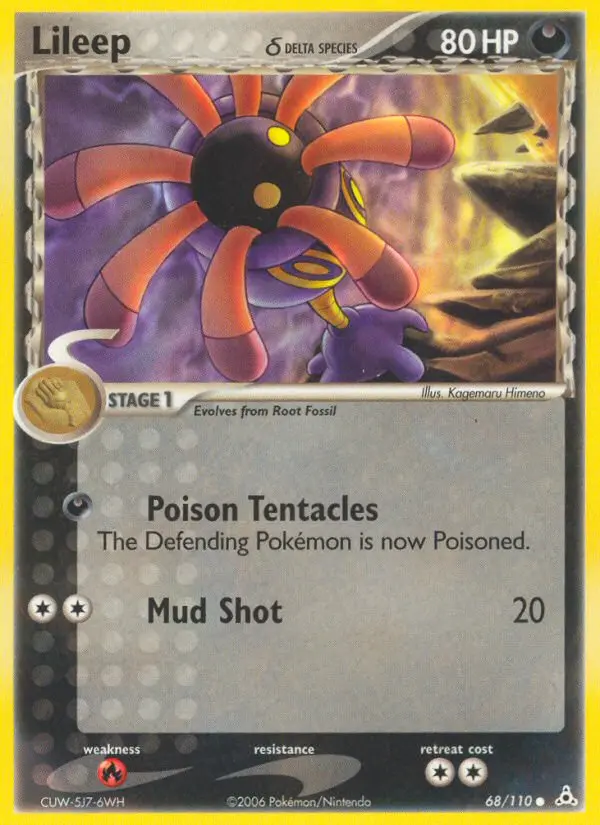
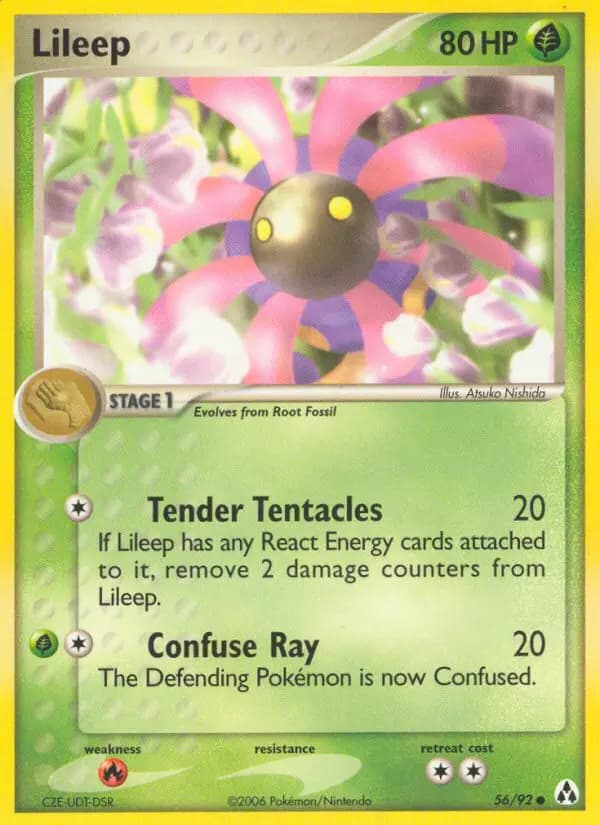
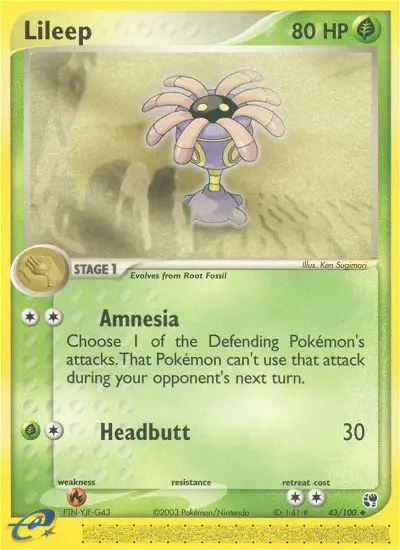
Lileep
Generation III · #0345 — Sea Lily Pokémon
Lileep's profile is easy to undersell: 1 m, 23.8 kg, and a rock/grass typing that doesn't scream power — until you look at its Special Defense of 87. Revived from Root Fossils discovered in ancient geological strata, Lileep carries the distinction of being extinct for approximately 100 million years, yet modern science allows trainers to experience this remarkable creature firsthand. With a combined stat total of 355, Lileep specializes in defensive capabilities, boasting notable Special Defense (87) and Defense (77) stats that make it surprisingly resilient despite its low Speed (23) and Attack (41) statistics.
Editor's Take
Lileep's line ends in Cradily with Storm Drain, and a Rock/Grass type with that ability is a genuinely irritating defensive pick in the tiers it inhabits.
Base Stats
Height
1.0m
Weight
23.8kg
Category
Sea Lily Pokémon
Gender
Male 87.5% / Female 12.5%
Color
purple
Shape
blob
Habitat
sea
Abilities
Prevents being forced out of battle by other Pokémon's moves.
Redirects single-target water moves to this Pokémon where possible. Absorbs Water moves, raising Special Attack one stage.

Lileep Biology & Physical Characteristics
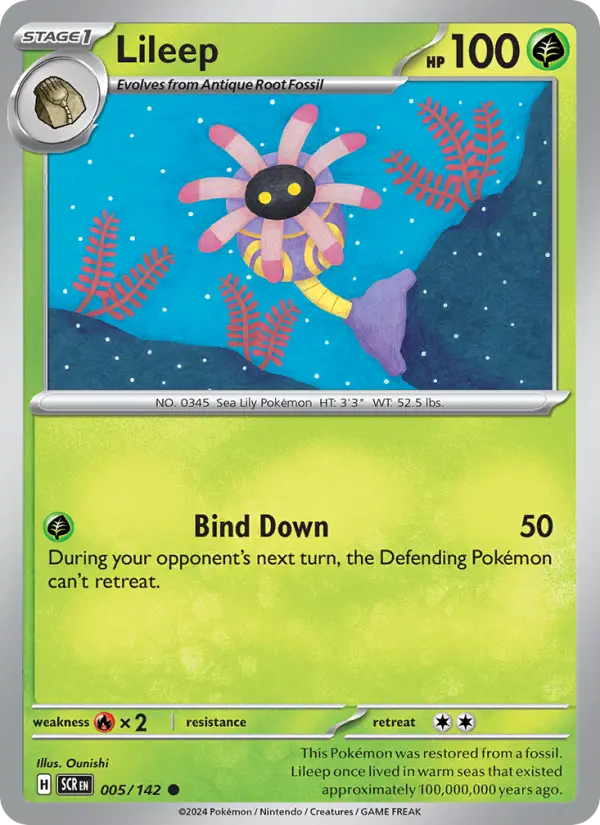
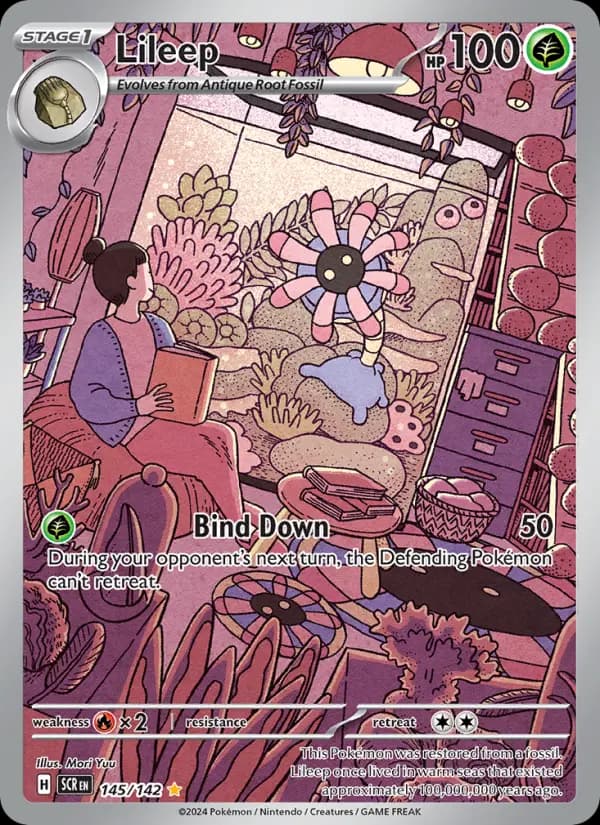
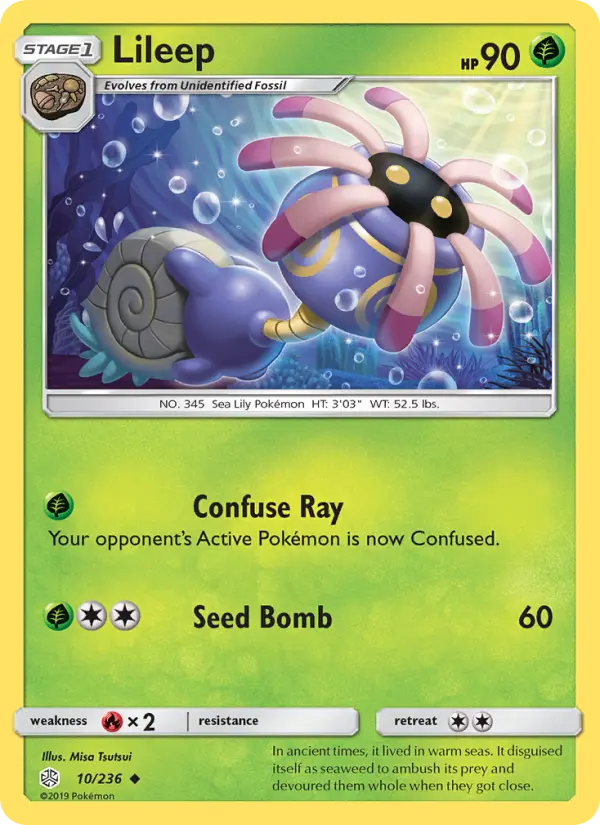
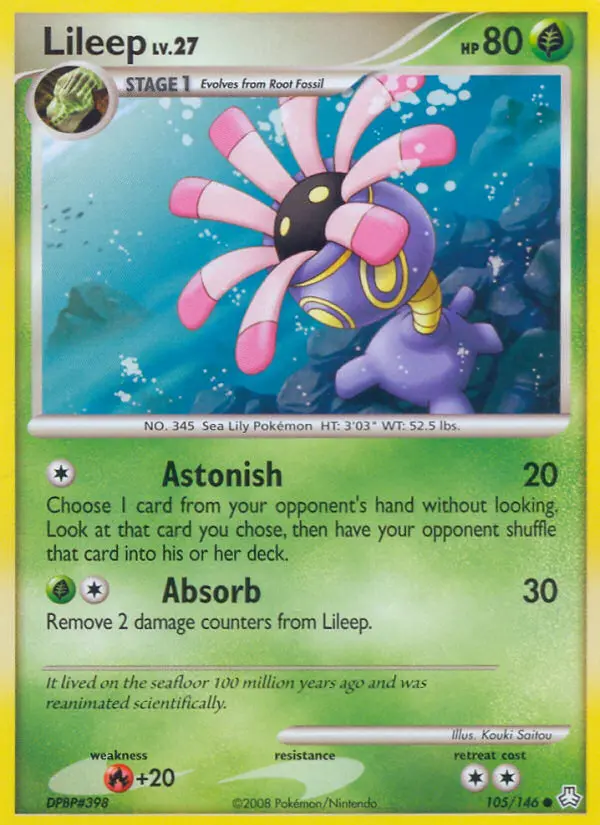
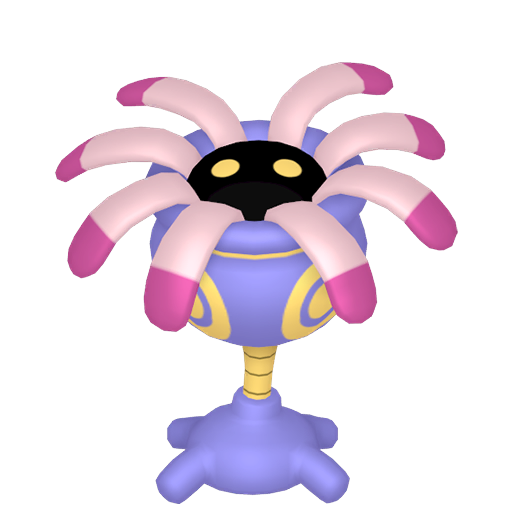
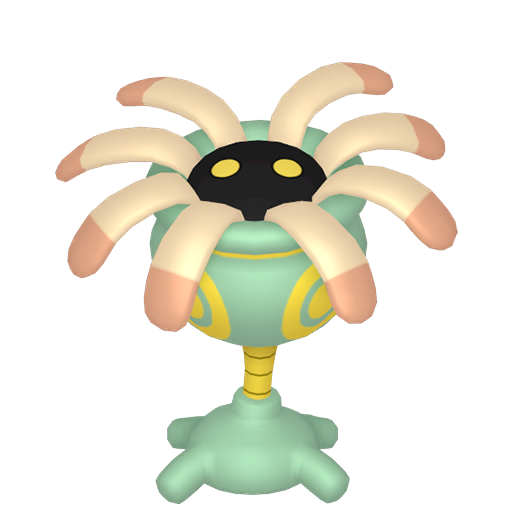
Lileep's anatomy represents a fascinating fusion of plant and ancient marine life, structured around a crinoid-like design with eight distinctive dark-tipped, pink petal-shaped tentacles protruding from an opening atop its head. Its primarily purple body features a semi-spherical lower section connected to its head via a yellow stem, while the head itself displays yellow eyespots resembling target markers and houses two glowing yellow eyes within the pitch-black central opening. Four stubby roots anchor Lileep firmly to rocks on the seafloor, providing essential stability for its stationary hunting lifestyle. The Pokémon's visual design elegantly mirrors actual prehistoric crinoids, creatures that thrived in ancient warm seas hundreds of millions of years ago, with the flower-petal tentacles serving as both defensive mechanisms and sophisticated hunting apparatus.
Pokedex Numbers
Training
Breeding
Lileep Breeding, Gender Ratio & Egg Groups
Lileep exhibits a pronounced sexual dimorphism in gender distribution, appearing male in approximately 88 percent of specimens while females comprise roughly 12 percent of populations—a notably skewed ratio that suggests significant biological differences between sexes in this species. All Lileep belong to the Water 3 Egg Group, allowing them to breed with a diverse range of water-dwelling Pokémon and amphibious creatures, though successful breeding requires careful partner selection and appropriate conditions. The Pokémon hatches from eggs after 30 cycles, translating to approximately 7,454 to 7,710 steps of travel, providing patient trainers with the opportunity to obtain custom Lileep with optimized individual values and desired movesets through selective breeding practices. The base happiness value of 70 indicates that freshly caught or hatched Lileep begin their relationship with trainers from a moderately positive foundation, responding well to basic care while gradually bonding more strongly through battle experience and trainer interaction.
Sprites




Held Items
Big Root
held-items
Held: Increases HP recovered from draining moves, Ingrain, and Aqua Ring by 3/10 (30%).
Cost: 4000
Big Root
held-items
Held: Increases HP recovered from draining moves, Ingrain, and Aqua Ring by 3/10 (30%).
Cost: 4000
Big Root
held-items
Held: Increases HP recovered from draining moves, Ingrain, and Aqua Ring by 3/10 (30%).
Cost: 4000
Big Root
held-items
Held: Increases HP recovered from draining moves, Ingrain, and Aqua Ring by 3/10 (30%).
Cost: 4000
Big Root
held-items
Held: Increases HP recovered from draining moves, Ingrain, and Aqua Ring by 3/10 (30%).
Cost: 4000
Big Root
held-items
Held: Increases HP recovered from draining moves, Ingrain, and Aqua Ring by 3/10 (30%).
Cost: 4000
Big Root
held-items
Held: Increases HP recovered from draining moves, Ingrain, and Aqua Ring by 3/10 (30%).
Cost: 4000
Big Root
held-items
Held: Increases HP recovered from draining moves, Ingrain, and Aqua Ring by 3/10 (30%).
Cost: 4000
Big Root
held-items
Held: Increases HP recovered from draining moves, Ingrain, and Aqua Ring by 3/10 (30%).
Cost: 4000
Big Root
held-items
Held: Increases HP recovered from draining moves, Ingrain, and Aqua Ring by 3/10 (30%).
Cost: 4000
Big Root
held-items
Held: Increases HP recovered from draining moves, Ingrain, and Aqua Ring by 3/10 (30%).
Cost: 4000
Big Root
held-items
Held: Increases HP recovered from draining moves, Ingrain, and Aqua Ring by 3/10 (30%).
Cost: 4000
Big Root
held-items
Held: Increases HP recovered from draining moves, Ingrain, and Aqua Ring by 3/10 (30%).
Cost: 4000
Big Root
held-items
Held: Increases HP recovered from draining moves, Ingrain, and Aqua Ring by 3/10 (30%).
Cost: 4000
Big Root
held-items
Held: Increases HP recovered from draining moves, Ingrain, and Aqua Ring by 3/10 (30%).
Cost: 4000
Big Root
held-items
Held: Increases HP recovered from draining moves, Ingrain, and Aqua Ring by 3/10 (30%).
Cost: 4000
Big Root
held-items
Held: Increases HP recovered from draining moves, Ingrain, and Aqua Ring by 3/10 (30%).
Cost: 4000
TMs & HMs
tm03
yellow
tm03
crystal
tm03
gold silver
tm03
red blue
tm03
blue japan
tm03
red green japan
tm05
lets go pikachu lets go eevee
tm06
yellow
tm06
gold silver
tm06
red blue
tm06
crystal
tm06
emerald
tm06
firered leafgreen
tm06
diamond pearl
tm06
platinum
tm06
ruby sapphire
tm06
colosseum
tm06
black 2 white 2
tm06
xd
tm06
black white
+509 more TMs/HMs
Lileep's Evolution Chain


Lileep Evolution, Mega Evolution & Special Forms
Lileep evolves into Cradily starting at level 40, transforming from a sessile tentacled creature into a more active and mobile Pokémon that retains its Rock/Grass typing. The evolution represents a developmental shift where Lileep's defensive foundation becomes integrated into a larger, more formidable frame capable of greater offensive and tactical versatility. Trainers should note that Lileep's evolution counterpart, Cradily, becomes significantly more powerful across multiple stat categories, particularly in its Attack, Special Attack, and Speed statistics, while maintaining the impressive Special Defense value that characterizes Lileep's natural strengths. Unlike many evolutionary lines, the transition from Lileep to Cradily maintains thematic consistency with the ancient sea creature concept, merely advancing the creature's life stage rather than fundamentally altering its core biological identity.
Where to Find
Rustboro City
hoenn
Alola Route 8
alola
Lileep Behaviour and Natural Habitat
Lileep exhibits a sedentary yet calculating hunting strategy, remaining permanently anchored to rocks on the seafloor where it lived in warm, shallow ancient seas. Rather than pursuing prey, Lileep ingeniously disguises its tentacles as swaying seaweed, luring unsuspecting creatures within striking distance before ensnaring and consuming them whole with its petal-like appendages. The Pokédex entries across multiple generations consistently emphasize Lileep's immobile perch as a strategic advantage, allowing it to intently scan for approaching prey with its two forward-facing eyes. Its ability to remain perfectly still while perfectly camouflaged demonstrates remarkable predatory patience, a trait essential for survival in competitive marine ecosystems. The Pokémon's natural tendency to cling to rocks and maintain its territorial position suggests a lifestyle evolved specifically for ambush predation rather than active hunting.
Pokedex Entries
LILEEP became extinct approximately a hundred million years ago. This ancient POKéMON attaches itself to a rock on the seafloor and catches approaching prey using tentacles shaped like flower petals.
LILEEP is an ancient POKéMON that was regenerated from a fossil. It remains permanently anchored to a rock. From its immobile perch, this POKéMON intently scans for prey with its two eyes.
It disguises itself as seaweed by making its tentacles sway. Unsuspecting prey that come too close are swallowed whole. It became extinct 100 million years ago.
It became extinct roughly 100 million years ago. It was regenerated from a fossil using advanced techniques.
It lived on the seafloor 100 million years ago and was reanimated scientifically.
It disguises its tentacles as flowers to attract and catch prey. It became extinct in ancient times.
It lived on the seafloor 100 million years ago and was reanimated scientifically.
It lived on the seafloor 100 million years ago and was reanimated scientifically.
It disguises its tentacles as flowers to attract and catch prey. It became extinct in ancient times.
It lived on the seafloor 100 million years ago and was reanimated scientifically.
Lileep became extinct approximately a hundred million years ago. This ancient Pokémon attaches itself to a rock on the seafloor and catches approaching prey using tentacles shaped like flower petals.
Lileep is an ancient Pokémon that was regenerated from a fossil. It remains permanently anchored to a rock. From its immobile perch, this Pokémon intently scans for prey with its two eyes.
In ancient times, it lived in warm seas. It disguised itself as seaweed to ambush its prey and devoured them whole when they got close.
It sticks to rocks with its powerful suckers and can’t be washed away no matter how rough the surf gets.
This Pokémon was restored from a fossil. Lileep once lived in warm seas that existed approximately 100,000,000 years ago.
Lileep clings to rocks on the seabed. When prey comes close, this Pokémon entangles it with petallike tentacles.
Lileep Name Origin & Design Inspiration
Lileep's name can be traced to a combination of 'lily,' referencing its flower-like tentacles and plant-based characteristics, and 'leap,' suggesting both its aquatic origins and potential for movement despite its generally stationary nature. The Japanese name Lilyla follows similar etymological roots, emphasizing the flower and sea lily components that define this Pokémon's visual and conceptual identity. The 'Sea Lily Pokémon' classification directly references crinoids, ancient marine organisms that superficially resemble flowering plants despite being animals, creating a deliberately ambiguous biological aesthetic. The design team at Game Freak successfully merged paleontological accuracy with Pokémon's signature creature design philosophy, resulting in a Pokémon that feels simultaneously alien and organically convincing. The purple coloration, tentacle structure, and anchoring root system all work in concert to create an instantly recognizable silhouette that clearly communicates both its fossil heritage and its parasitic flower-like hunting mechanism.
Learnable Moves
Lileep can learn 70 moves:
Move | Type | Cat. | Power | Acc. | PP |
|---|---|---|---|---|---|
| acid | poison | Special | 40 | 100 | 30 |
| amnesia | psychic | Status | — | — | 20 |
| ancient power | rock | Special | 60 | 100 | 5 |
| astonish | ghost | Physical | 30 | 100 | 15 |
| attract | normal | Status | — | 100 | 15 |
| barrier | psychic | Status | — | — | 20 |
| bind | normal | Physical | 15 | 85 | 20 |
| body slam | normal | Physical | 85 | 100 | 15 |
| brine | water | Special | 65 | 100 | 10 |
| bullet seed | grass | Physical | 25 | 100 | 30 |
| captivate | normal | Status | — | 100 | 20 |
| confide | normal | Status | — | — | 20 |
| confuse ray | ghost | Status | — | 100 | 10 |
| constrict | normal | Physical | 10 | 100 | 35 |
| curse | ghost | Status | — | — | 10 |
| double team | normal | Status | — | — | 15 |
| double edge | normal | Physical | 120 | 100 | 15 |
| earth power | ground | Special | 90 | 100 | 10 |
| endure | normal | Status | — | — | 10 |
| energy ball | grass | Special | 90 | 100 | 10 |
| facade | normal | Physical | 70 | 100 | 20 |
| flash | normal | Status | — | 100 | 20 |
| frustration | normal | Physical | — | 100 | 20 |
| gastro acid | poison | Status | — | 100 | 10 |
| giga drain | grass | Special | 75 | 100 | 10 |
| grass knot | grass | Special | — | 100 | 20 |
| hidden power | normal | Special | 60 | 100 | 15 |
| infestation | bug | Special | 20 | 100 | 20 |
| ingrain | grass | Status | — | — | 20 |
| mega drain | grass | Special | 40 | 100 | 15 |
| meteor beam | rock | Special | 120 | 90 | 10 |
| mimic | normal | Status | — | — | 10 |
| mirror coat | psychic | Special | — | 100 | 20 |
| mud shot | ground | Special | 55 | 95 | 15 |
| mud slap | ground | Special | 20 | 100 | 10 |
| natural gift | normal | Physical | — | 100 | 15 |
| pain split | normal | Status | — | — | 20 |
| protect | normal | Status | — | — | 10 |
| psych up | normal | Status | — | — | 10 |
| recover | normal | Status | — | — | 5 |
| rest | psychic | Status | — | — | 5 |
| return | normal | Physical | — | 100 | 20 |
| rock blast | rock | Physical | 25 | 90 | 10 |
| rock polish | rock | Status | — | — | 20 |
| rock slide | rock | Physical | 75 | 90 | 10 |
| rock tomb | rock | Physical | 60 | 95 | 15 |
| round | normal | Special | 60 | 100 | 15 |
| sandstorm | rock | Status | — | — | 10 |
| secret power | normal | Physical | 70 | 100 | 20 |
| seed bomb | grass | Physical | 80 | 100 | 15 |
| sleep talk | normal | Status | — | — | 10 |
| sludge bomb | poison | Special | 90 | 100 | 10 |
| smack down | rock | Physical | 50 | 100 | 15 |
| snore | normal | Special | 50 | 100 | 15 |
| solar beam | grass | Special | 120 | 100 | 10 |
| spit up | normal | Special | — | 100 | 10 |
| stealth rock | rock | Status | — | — | 20 |
| stockpile | normal | Status | — | — | 20 |
| string shot | bug | Status | — | 95 | 40 |
| substitute | normal | Status | — | — | 10 |
| sunny day | fire | Status | — | — | 5 |
| swagger | normal | Status | — | 85 | 15 |
| swallow | normal | Status | — | — | 10 |
| swords dance | normal | Status | — | — | 20 |
| synthesis | grass | Status | — | — | 5 |
| tickle | normal | Status | — | 100 | 20 |
| toxic | poison | Status | — | 90 | 10 |
| worry seed | grass | Status | — | 100 | 10 |
| wrap | normal | Physical | 15 | 90 | 20 |
| wring out | normal | Special | — | 100 | 5 |
Lileep Competitive Battle Guide
Lileep occupies a defensive niche in competitive Pokémon battling, leveraging its superior Special Defense (87) and Defense (77) stats to absorb incoming attacks while providing team support through its two distinct abilities. The standard ability Suction Cups prevents Lileep from being forcibly switched out of battle through moves like Dragon Tail or Roar, allowing trainers to maintain strategic positioning and protect Lileep from forced substitution tactics that would otherwise devastate its battle plan. The hidden ability Storm Drain represents a more offensive alternative, redirecting single-target Water-type moves toward Lileep while simultaneously granting a Special Attack boost for each Water move absorbed—a particularly valuable asset considering Water-type moves' prevalence across the competitive metagame. Lileep's painfully low Speed stat (23) necessitates careful move selection and team construction, with trainers often prioritizing priority moves and defensive coverage moves that exploit its solid defensive typing and resistance profile rather than attempting to outspeed opposing threats.
Commonly Asked Questions About Lileep
What type is Lileep?
Lileep is a rock and grass type Pokemon.
What does Lileep evolve into?
Lileep evolves into cradily.
What are Lileep's weaknesses?
Lileep is weak to fighting, bug, steel and ice type moves.
Does Lileep evolve by trading?
No — Lileep evolves entirely through leveling up, with no trade required at any stage.
Where can I find Lileep?
Lileep can be found in rustboro city (hoenn) and alola route 8 (alola).
Lileep Cultural Impact & Franchise History
Lileep represents an important entry point into Pokémon's fossil collecting mechanic, introduced alongside Cradily during Generation III's revolutionary expansion of the Pokédex and species availability. As one of the earliest rock-type fossil Pokémon trainers can obtain in their adventuring journey, Lileep has become synonymous with paleontology-themed gameplay and the concept of resurrecting extinct species through scientific advancement—themes that resonate with players fascinated by prehistoric life and evolutionary biology. The Pokémon's prominent role in the Hoenn region's fossil-hunting mechanics established important precedents for future fossil Pokémon introductions across subsequent generations, influencing how Game Freak designs and implements extinct creature lines into new regions. Despite not achieving the widespread recognition of legendary fossil Pokémon like Aerodactyl or Armaldo, Lileep maintains a dedicated fanbase appreciative of its unique design philosophy and defensive battle mechanics, particularly among competitive players who value strategic depth over raw statistical power.
Where to Find Lileep in Every Pokémon Game
Lileep primarily becomes available to trainers through the Root Fossil discovery mechanic in Generation III games (Pokémon Ruby, Sapphire, and Emerald), where players must choose between reviving either a Root Fossil into Lileep or a Claw Fossil into Anorith at a specific archaeological lab. The Pokémon has subsequently appeared in numerous later generations through similar fossil revival mechanics, appearing in Pokémon Diamond and Pearl, HeartGold and SoulSilver, and later games including Pokémon Omega Ruby and Alpha Sapphire, which return to the Hoenn region where Lileep originated. In Pokémon Sword and Shield's Crown Tundra DLC expansion, Lileep becomes available through the Max Lair challenge and fossil restoration mechanics, allowing players from more recent generations to experience this ancient creature firsthand. The Pokémon's availability across multiple game generations and platforms ensures that dedicated trainers can reliably obtain Lileep in most modern Pokémon titles, though specific acquisition methods vary depending on the particular game's mechanics and regional availability.