Mareep
Generation II · #0179 — Wool Pokémon
Trainers who write off Mareep on looks alone are missing that its Special Attack of 65 is genuinely one of the higher marks among electric-type Pokémon. It measures 0.6 m and 7.8 kg, dimensions that pair with that stat lean in noticeable ways. With a aggregate stat total of 280, Mareep represents a modest entry point into electric-type Pokémon, featuring notably higher Special Attack (65) compared to its Physical Attack (40), indicating a natural specialization in special-based moves despite its early evolutionary stage. The species demonstrates remarkable adaptability through its two standard abilities—the Static ability providing a 30% chance of paralyzing contact attackers, and its hidden ability Plus, which synergizes Special Attack to 1.5× when paired with another Pokémon bearing Plus or Minus. With a catch rate of 235 and base happiness of 70, Mareep is notably friendly and readily caught, making it an accessible first electric-type for trainers beginning their journey through the Johto region.
Editor's Take
Mareep's Static ability paying off with a 30% paralysis chance on contact is a nice bit of foreshadowing for Ampharos down the line, and it's one of the only early-route Pokémon whose tail literally tells you how charged its next move is going to be.
Base Stats
Height
0.6m
Weight
7.8kg
Category
Wool Pokémon
Gender
Male 50% / Female 50%
Color
white
Shape
quadruped
Habitat
grassland
Abilities
Has a 30% chance of paralyzing attacking Pokémon on contact.
Increases Special Attack to 1.5× when a friendly Pokémon has plus or minus.

Mareep Biology & Physical Characteristics
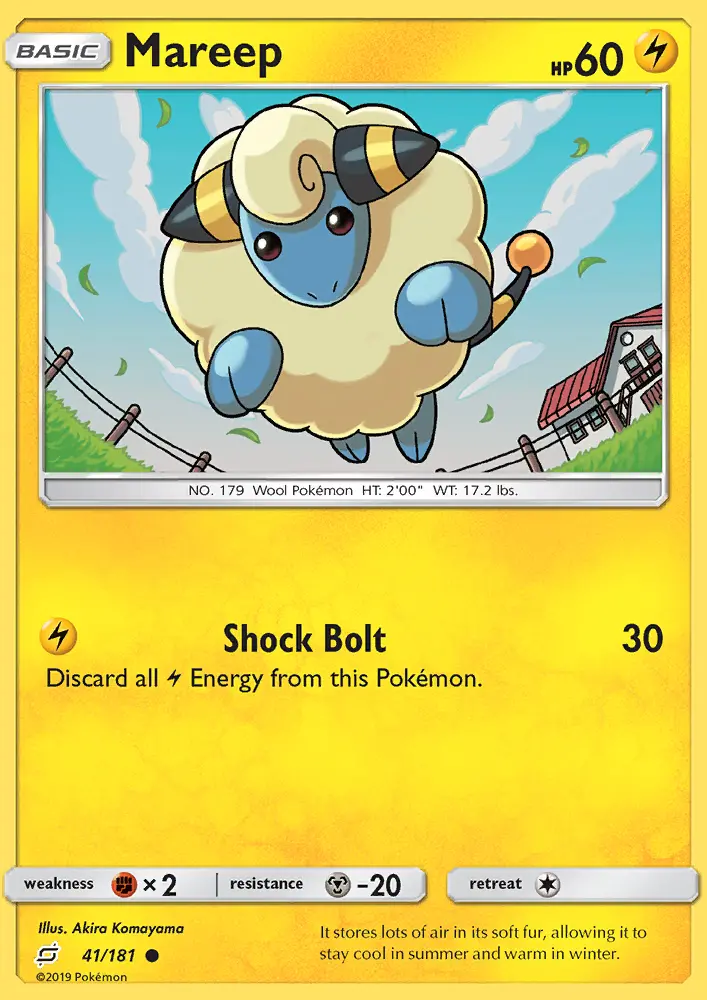
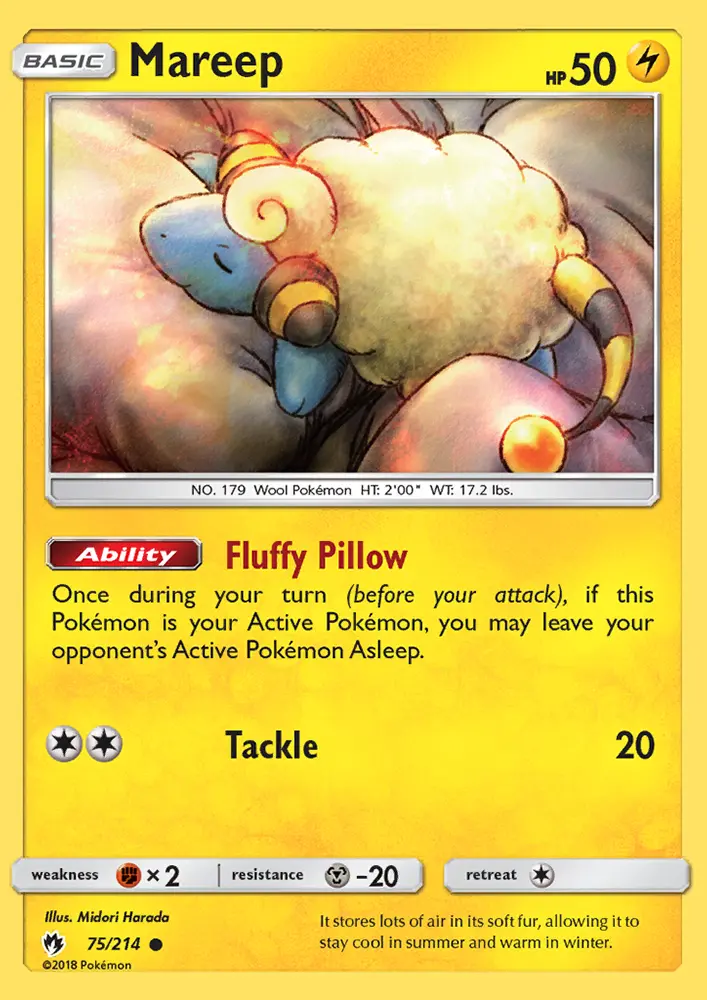
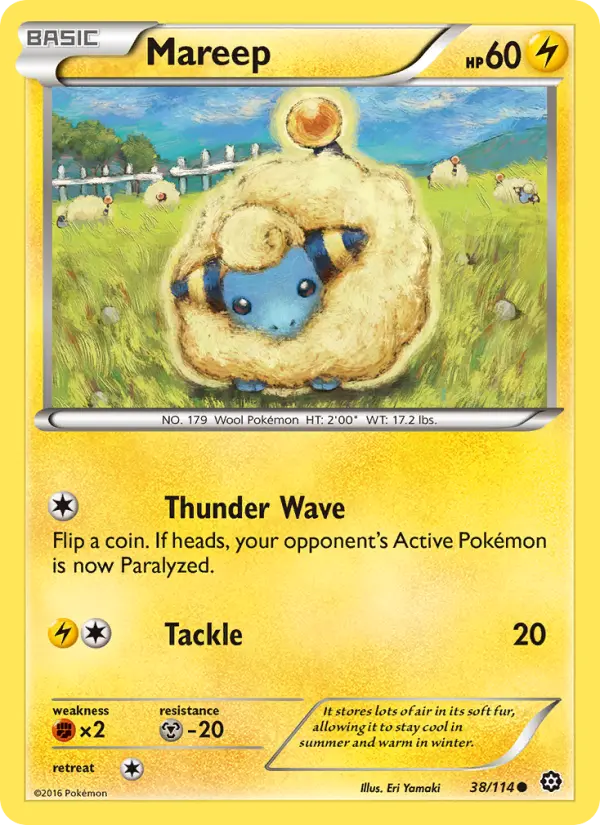
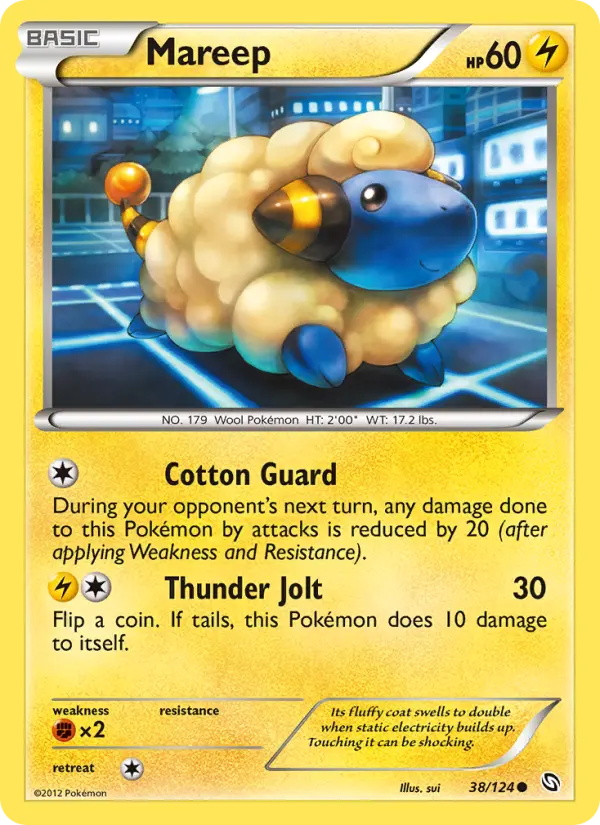
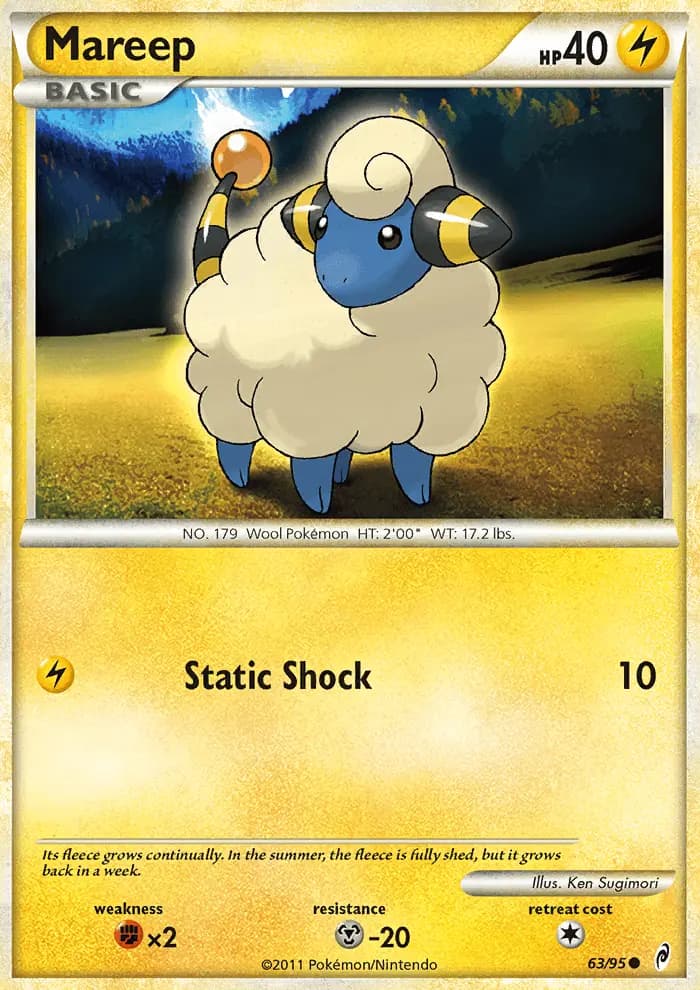
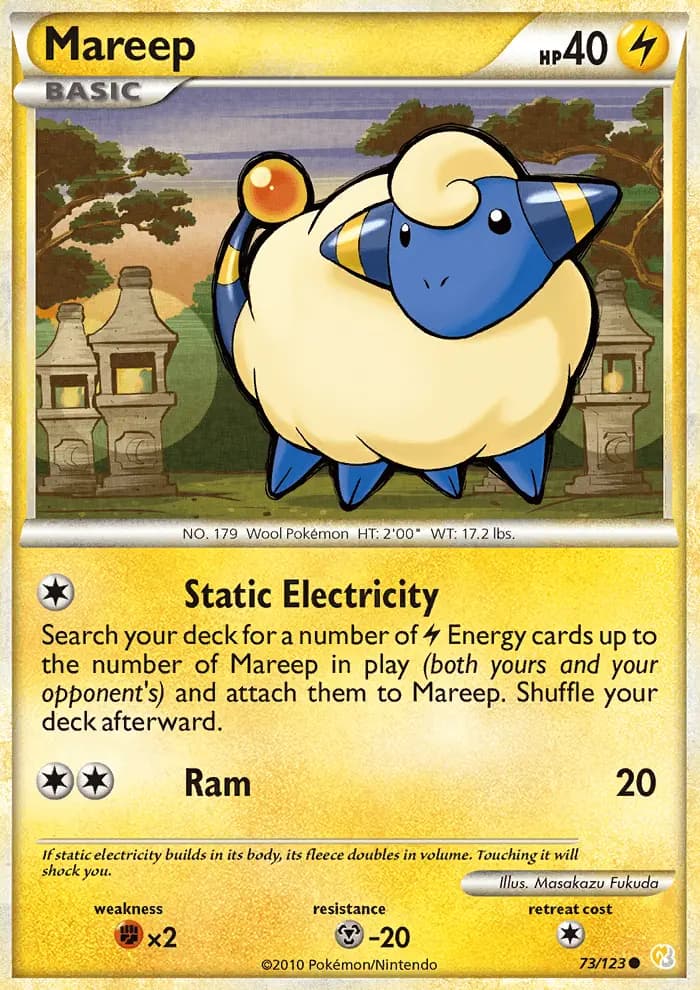
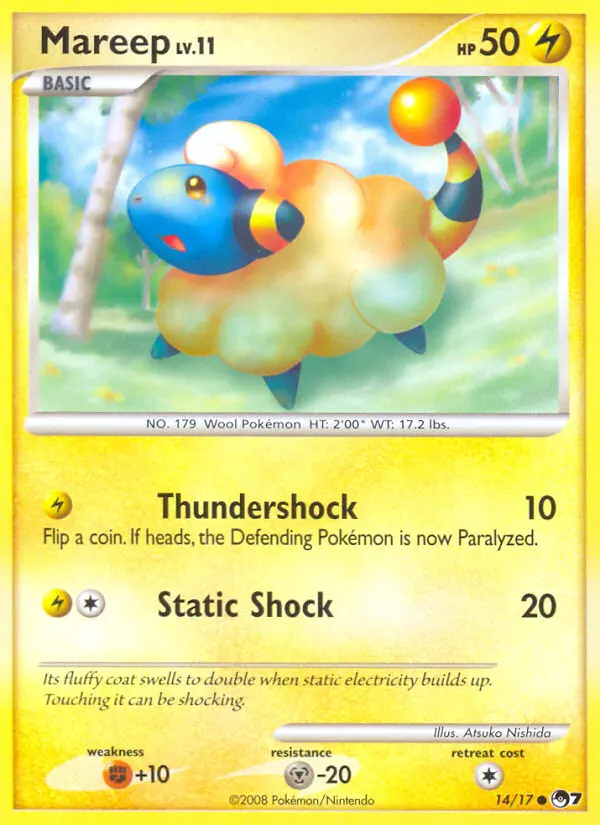
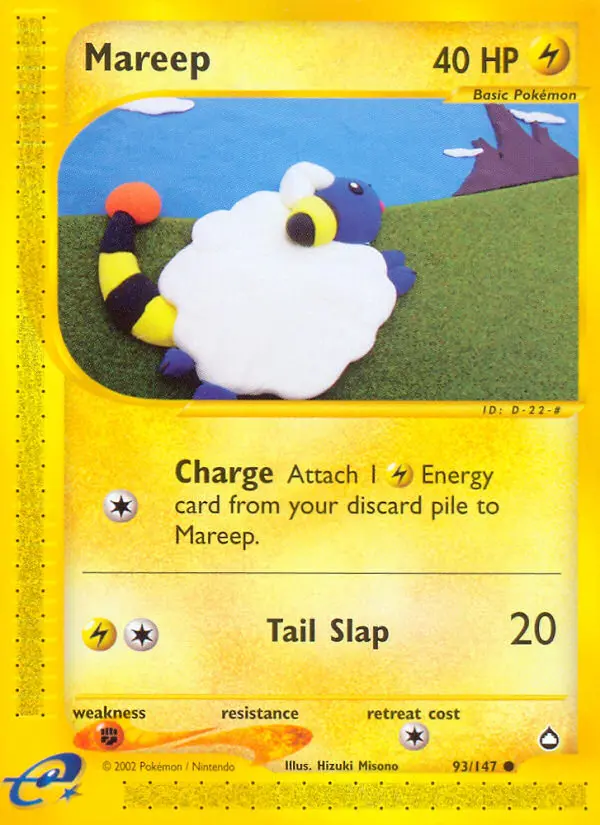
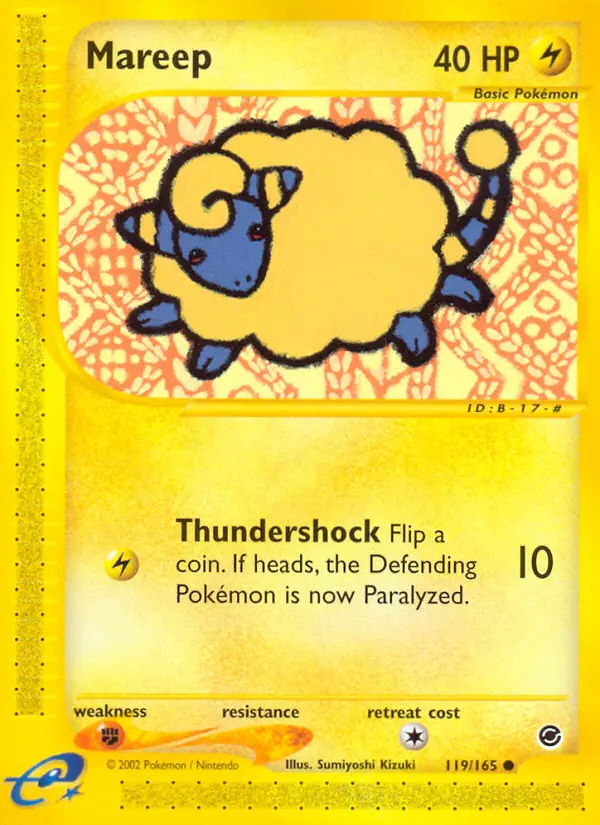
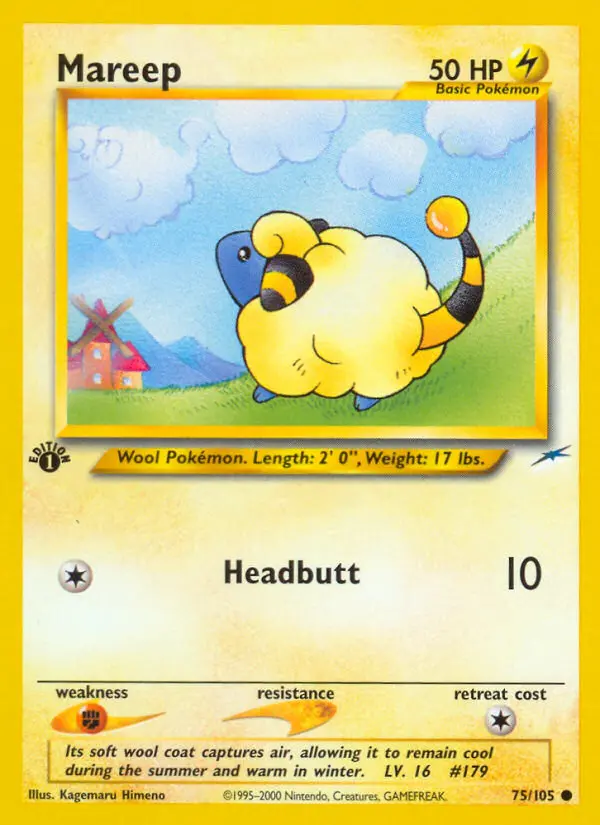
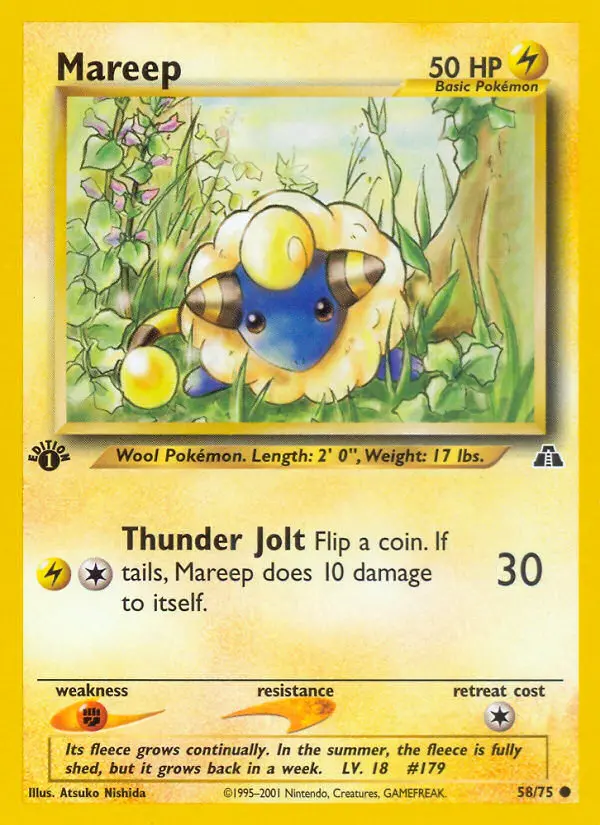
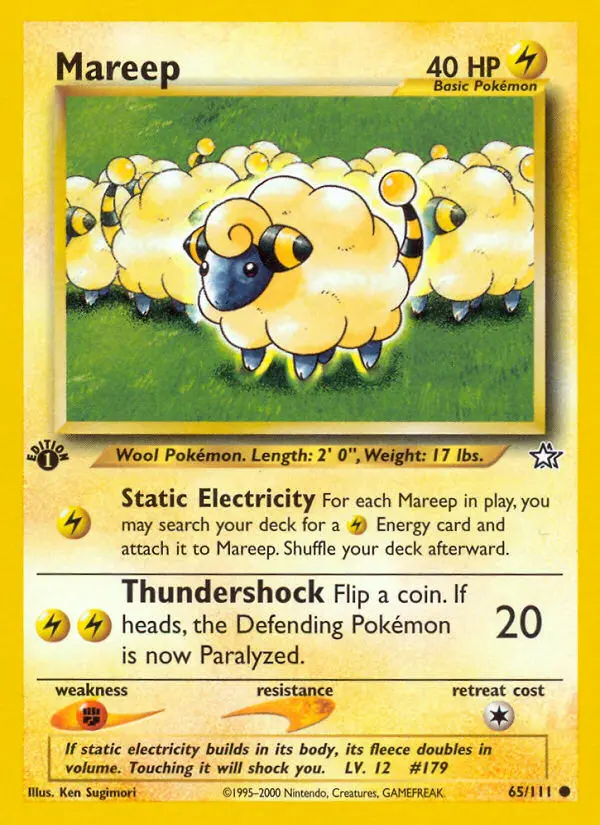
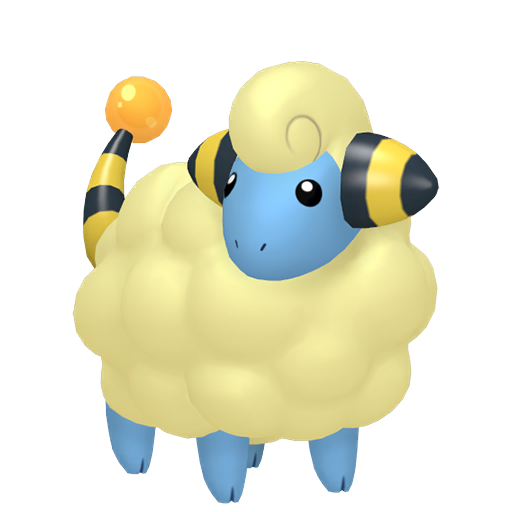
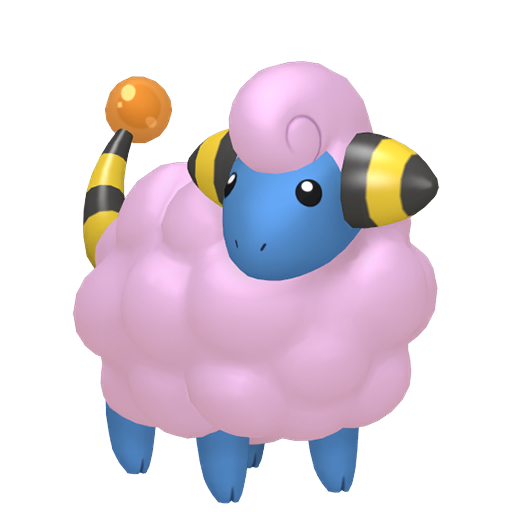
Mareep's most distinctive feature is its covering of fluffy, cream-colored wool that extends across its entire body, complemented by a distinctive curly tuft sprouting from the crown of its head. The Pokémon's head and four digitigrade feet are colored blue, with the feet featuring only two toes each, giving Mareep an appearance of perpetually standing on its tippy-toes. Perhaps most striking is the orange spherical bulb at the end of Mareep's tail, which functions as a biological light source that grows brighter in proportion to the electrical charge accumulated within the Pokémon's body. The conical ears and tail itself display a striking yellow-and-black striped pattern that intensifies as electricity builds. Mareep's wool grows continuously throughout its life, with the remarkable property that in summer months the fleece is completely shed before regenerating within a single week—a cycle that reflects the Pokémon's ability to regulate its body temperature. The wool simultaneously serves as both an electrical conductor and insulator, storing tremendous amounts of static charge as the individual strands rub together, causing the volume to visibly double when electricity accumulates. The air trapped within the dense wool provides thermal regulation, keeping Mareep cool during sweltering summers and warm during freezing winters, demonstrating a remarkable evolutionary adaptation to temperate climates. Mareep's shiny form swaps its usual cream-colored wool for a soft pink, with the blue head and feet shifting to a deeper, muted hue — a change that carries through the whole evolutionary line into Shiny Ampharos.
Pokedex Numbers
Training
Breeding
Mareep Breeding, Gender Ratio & Egg Groups
Mareep maintains a perfectly balanced 50% male to 50% female gender ratio, with both sexes participating equally in the species' reproductive cycle. The Pokémon belongs to two distinct breeding egg groups—both Monster and Field—granting considerable breeding flexibility and allowing trainers multiple pathways to produce Mareep offspring through various breeding combinations. With a base happiness value of 70 and moderate base friendship characteristics, Mareep demonstrates natural affinity for human interaction, suggesting that the species has been successfully domesticated and integrated into human pastoral culture for extended periods. The incubation period for Mareep eggs spans 20 cycles, translating to approximately 4,884 to 5,140 steps of overland travel or egg-care activity, placing it squarely in the medium-duration hatching range that allows players a reasonable timeframe between obtaining an egg and witnessing its emergence. The medium-slow growth rate means that Mareep requires a moderate amount of experience accumulation to reach higher levels, neither hastening nor significantly delaying its path to evolution compared to other starting-stage Pokémon. For breeders interested in producing perfect-IV Mareep offspring, the species' dual egg group membership and reasonably high catch rate make it accessible for capture-based breeding strategies, particularly if one obtains multiple individuals to establish a robust breeding population.
Sprites




TMs & HMs
tm01
lets go pikachu lets go eevee
tm02
crystal
tm02
gold silver
tm03
crystal
tm03
gold silver
tm03
lets go pikachu lets go eevee
tm05
lets go pikachu lets go eevee
tm06
yellow
tm06
gold silver
tm06
red blue
tm06
crystal
tm06
emerald
tm06
firered leafgreen
tm06
diamond pearl
tm06
platinum
tm06
ruby sapphire
tm06
colosseum
tm06
black 2 white 2
tm06
xd
tm06
black white
+546 more TMs/HMs
Mareep's Evolution Chain


Mareep Evolution, Mega Evolution & Special Forms
Mareep represents the first stage of a three-part evolutionary line leading toward the powerful Electric-type beacon Ampharos. At level 15, Mareep evolves into Flaaffy, retaining the Electric typing while developing a more substantial woolly appearance and increased base stats, particularly in Special Attack and Special Defense. The evolution from Flaaffy to Ampharos occurs at level 30, transforming the sheep-like creature into a bipedal electromancer whose tail bulb becomes a massive, beacon-like light source capable of illuminating vast distances. This three-stage progression demonstrates a clear developmental arc from humble pastoral origins to majestic power, with each evolution increasing overall bulk and electrical capability. The evolution mechanic is straightforward and level-based, requiring no special items, conditions, or held stones—a simplicity that makes the Mareep line particularly accessible to novice trainers building their first electric-type team. Mareep's relatively early evolution point at level 15 means that trainers can experience the transformation progression relatively quickly through standard gameplay, though some may choose to defer evolution to utilize Mareep's smaller frame and mobility for specific tactical scenarios before committing to Flaaffy's greater power.
Where to Find
Johto Route 32
johto
+15 more
Johto Route 43
johto
+15 more
Johto Route 42
johto
+12 more
Hoenn Altering Cave
hoenn
+9 more
Hoenn Safari Zone
hoenn
Kanto Altering Cave
kanto
+21 more
Valley Windworks
sinnoh
+9 more
Violet City
johto
Floccesy Ranch
unova
Paniola Ranch
alola
Mareep Behaviour and Natural Habitat
Mareep exhibits a notably gentle and mild disposition, tending to avoid direct conflict in the wild despite possessing the means to deliver potent electric shocks. The species is predominantly found in grassy meadows and pastoral fields, though it has also adapted well to agricultural farms where humans cultivate populations specifically for wool harvesting. True to its ovine inspiration, Mareep displays social behaviors suggesting herd-like tendencies, comfortable in proximity to other Pokémon and human handlers alike. Mareep is known to roll over during sleep, a curious behavioral trait documented in Pokémon Sleep research that reflects its placid nature. The Pokémon's wool generates static electricity almost passively through the friction of daily movement and environmental interaction, a process that intensifies during periods of physical activity or emotional excitement. When its electrical reserves become particularly saturated, the bulb at the tip of Mareep's tail glows with increasing intensity, serving as both a visual indicator of its internal electrical state and potentially a natural warning signal to nearby creatures. Despite its capacity to deliver shocks through contact, Mareep appears fundamentally non-aggressive and seems to reserve electrical discharge primarily as a defensive mechanism rather than an offensive hunting strategy.
Pokedex Entries
If static elec tricity builds in its body, its fleece doubles in volume. Touching it will shock you.
Its fleece grows continually. In the summer, the fleece is fully shed, but it grows back in a week.
It stores lots of air in its soft fur, allowing it to stay cool in summer and warm in winter.
MAREEP’s fluffy coat of wool rubs together and builds a static charge. The more static electricity is charged, the more brightly the lightbulb at the tip of its tail grows.
Its fluffy wool rubs together and builds a static charge. The more energy is charged, the more brightly the lightbulb at the tip of its tail glows.
Its fleece grows continually. In the summer, the fleece is fully shed, but it grows back in a week.
If static electricity builds in its body, its fleece doubles in volume. Touching it will shock you.
Its fluffy coat swells to double when static electricity builds up. Touching it can be shocking.
If static electricity builds in its body, its fleece doubles in volume. Touching it will shock you.
Its fleece grows continually. In the summer, the fleece is fully shed, but it grows back in a week.
Its fluffy coat swells to double when static electricity builds up. Touching it can be shocking.
When cold weather increases static electricity, its wool doubles in size and the tip of its tail glows slightly.
Its fluffy coat swells to double when static electricity builds up. Touching it can be shocking.
It stores lots of air in its soft fur, allowing it to stay cool in summer and warm in winter.
Mareep’s fluffy coat of wool rubs together and builds a static charge. The more static electricity is charged, the more brightly the lightbulb at the tip of its tail glows.
Clothing made from Mareep’s fleece is easily charged with static electricity, so a special process is used on it.
Rubbing its fleece generates electricity. You’ll want to pet it because it’s cute, but if you use your bare hand, you’ll get a painful shock.
Mareep Name Origin & Design Inspiration
Mareep's nomenclature derives directly from the English word "mare," referring to female horses, combined with the onomatopoeia "beep," referencing both the electrical sounds and the bulbous beacon at its tail tip. The Japanese designation Merriep similarly combines "merry" with "sheep," emphasizing the cheerful, pastoral nature of the species. The design itself represents a clever fusion of farming culture with electrical properties, drawing inspiration from real-world sheep while reimagining wool as an electrical conductor rather than merely insulation. The creation of a sheep-based electric-type Pokémon was a deliberate design choice for Generation II, filling a conceptual niche that previous games had not thoroughly explored—the idea of domesticated livestock transformed into sentient electric creatures. The glowing tail bulb clearly evokes the classic incandescent light bulb, serving as visual shorthand for electricity while simultaneously creating a memorable silhouette. The striped ears and tail directly reference the striped safety patterns used on electrical equipment and high-voltage warnings, subtly communicating danger despite Mareep's gentle demeanor. The color palette of cream wool contrasted with blue head and feet, combined with orange and yellow striping, creates a warm yet vibrant design that has remained visually appealing across all artistic iterations and game generations.
Learnable Moves
Mareep can learn 71 moves:
Move | Type | Cat. | Power | Acc. | PP |
|---|---|---|---|---|---|
| after you | normal | Status | — | — | 15 |
| agility | psychic | Status | — | — | 30 |
| attract | normal | Status | — | 100 | 15 |
| body slam | normal | Physical | 85 | 100 | 15 |
| captivate | normal | Status | — | 100 | 20 |
| charge | electric | Status | — | — | 20 |
| charge beam | electric | Special | 50 | 90 | 10 |
| confide | normal | Status | — | — | 20 |
| confuse ray | ghost | Status | — | 100 | 10 |
| cotton guard | grass | Status | — | — | 10 |
| cotton spore | grass | Status | — | 100 | 40 |
| curse | ghost | Status | — | — | 10 |
| dazzling gleam | fairy | Special | 80 | 100 | 10 |
| defense curl | normal | Status | — | — | 40 |
| dig | ground | Physical | 80 | 100 | 10 |
| discharge | electric | Special | 80 | 100 | 15 |
| double team | normal | Status | — | — | 15 |
| double edge | normal | Physical | 120 | 100 | 15 |
| echoed voice | normal | Special | 40 | 100 | 15 |
| eerie impulse | electric | Status | — | 100 | 15 |
| electric terrain | electric | Status | — | — | 10 |
| electro ball | electric | Special | — | 100 | 10 |
| electroweb | electric | Special | 55 | 95 | 15 |
| endeavor | normal | Physical | — | 100 | 5 |
| endure | normal | Status | — | — | 10 |
| facade | normal | Physical | 70 | 100 | 20 |
| flash | normal | Status | — | 100 | 20 |
| flatter | dark | Status | — | 100 | 15 |
| frustration | normal | Physical | — | 100 | 20 |
| growl | normal | Status | — | 100 | 40 |
| headbutt | normal | Physical | 70 | 100 | 15 |
| heal bell | normal | Status | — | — | 5 |
| helping hand | normal | Status | — | — | 20 |
| hidden power | normal | Special | 60 | 100 | 15 |
| iron tail | steel | Physical | 100 | 75 | 15 |
| light screen | psychic | Status | — | — | 30 |
| magnet rise | electric | Status | — | — | 10 |
| mimic | normal | Status | — | — | 10 |
| natural gift | normal | Physical | — | 100 | 15 |
| odor sleuth | normal | Status | — | — | 40 |
| power gem | rock | Special | 80 | 100 | 20 |
| protect | normal | Status | — | — | 10 |
| rain dance | water | Status | — | — | 5 |
| reflect | psychic | Status | — | — | 20 |
| rest | psychic | Status | — | — | 5 |
| return | normal | Physical | — | 100 | 20 |
| round | normal | Special | 60 | 100 | 15 |
| safeguard | normal | Status | — | — | 25 |
| sand attack | ground | Status | — | 100 | 15 |
| screech | normal | Status | — | 85 | 40 |
| secret power | normal | Physical | 70 | 100 | 20 |
| shock wave | electric | Special | 60 | — | 20 |
| signal beam | bug | Special | 75 | 100 | 15 |
| sleep talk | normal | Status | — | — | 10 |
| snore | normal | Special | 50 | 100 | 15 |
| substitute | normal | Status | — | — | 10 |
| sunny day | fire | Status | — | — | 5 |
| swagger | normal | Status | — | 85 | 15 |
| swift | normal | Special | 60 | — | 20 |
| tackle | normal | Physical | 40 | 100 | 35 |
| take down | normal | Physical | 90 | 85 | 20 |
| tera blast | normal | Special | 80 | 100 | 10 |
| thunder | electric | Special | 110 | 70 | 10 |
| thunder shock | electric | Special | 40 | 100 | 30 |
| thunder wave | electric | Status | — | 90 | 20 |
| thunderbolt | electric | Special | 90 | 100 | 15 |
| toxic | poison | Status | — | 90 | 10 |
| trailblaze | grass | Physical | 50 | 100 | 20 |
| volt switch | electric | Special | 70 | 100 | 20 |
| wild charge | electric | Physical | 90 | 100 | 15 |
| zap cannon | electric | Special | 120 | 50 | 5 |
Mareep Competitive Battle Guide
Mareep's competitive viability remains limited by its modest base stats and evolutionary design as an introductory stage Pokémon, though it possesses certain niche applications in specific metagames and casual formats. With a Special Attack base stat of 65, Mareep can utilize electric-type moves like Thunderbolt and Thunder Wave, the latter providing valuable paralysis support for team compositions that benefit from speed reduction. The Static ability's 30% paralyzing chance on contact offers passive disruption potential that can occasionally frustrate physical attackers, though this utility is most effectively leveraged when Mareep switches into predicted physical attacks. The hidden ability Plus becomes genuinely competitive only in double battles or mixed team structures where Mareep operates alongside another Pokémon bearing Plus or Minus, creating a potentially significant Special Attack boost that transforms Mareep's offensive capacity from pedestrian to moderate. In competitive environments where Mareep might legitimately participate—such as Little Cup formats that restrict Pokémon to unevolved species—it functions as a reliable special attacker with reasonable speed investment, though it must contend with other Electric-types like Magnemite and Chinchou that possess superior type coverage or bulk. Most competitive applications of Mareep's evolutionary line occur after evolution to Ampharos, where the species achieves legitimacy as a mixed attacker capable of supporting teams through light screen and thunder wave while maintaining offensive presence.
Commonly Asked Questions About Mareep
What type is Mareep?
Mareep is a electric type Pokemon.
What does Mareep evolve into?
Mareep evolves into flaaffy, then into ampharos.
What are Mareep's weaknesses?
Mareep is weak to ground type moves.
Does Mareep evolve by trading?
No — Mareep evolves entirely through leveling up, with no trade required at any stage.
Where can I find Mareep?
Mareep can be found in johto route 32 (johto), johto route 43 (johto) and johto route 42 (johto) and 7 other locations.
Is Shiny Mareep different in stats from a normal Mareep?
No — a Shiny Mareep has identical base stats, abilities, and movepool to the standard form. The only difference is the color palette; nothing about its performance in or out of battle changes.
How rare is Shiny Mareep in the wild?
Like any Shiny Pokémon, a wild Shiny Mareep has roughly a 1-in-4096 base encounter rate in modern games (better with a Shiny Charm). Breeding with the Masuda Method or building up an Odds/chain encounter both shorten those odds significantly for trainers hunting one specifically.
Mareep Cultural Impact & Franchise History
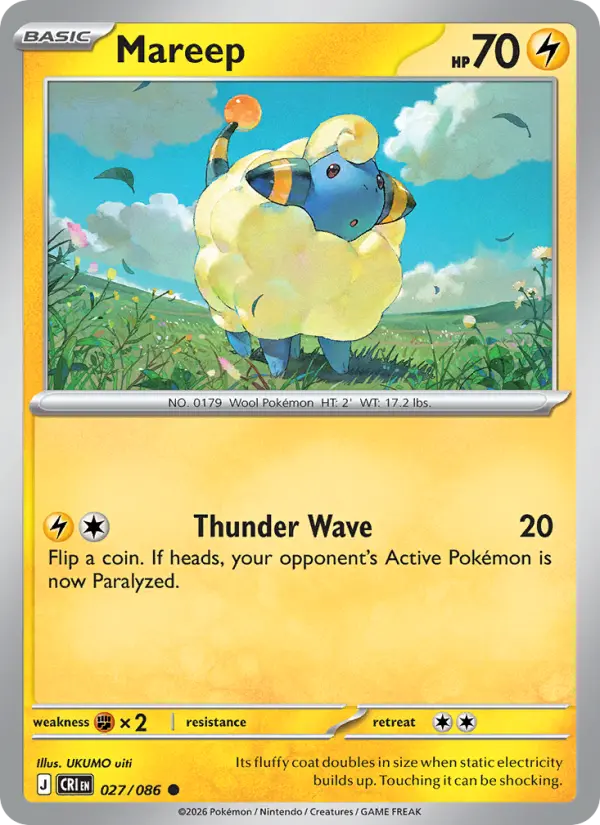
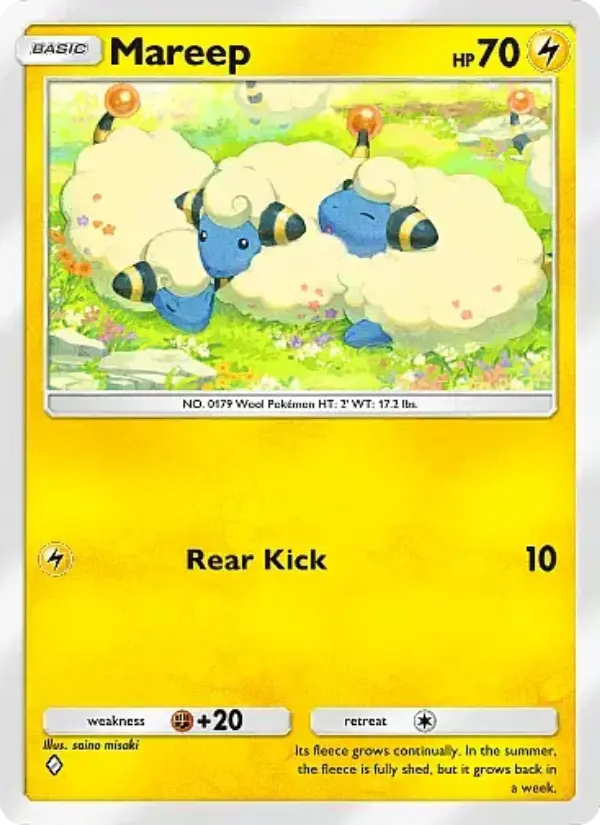
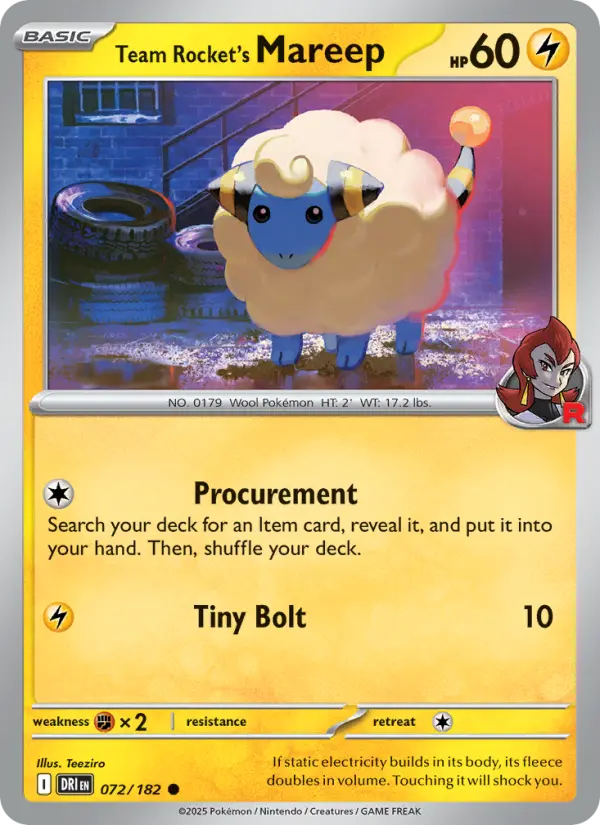
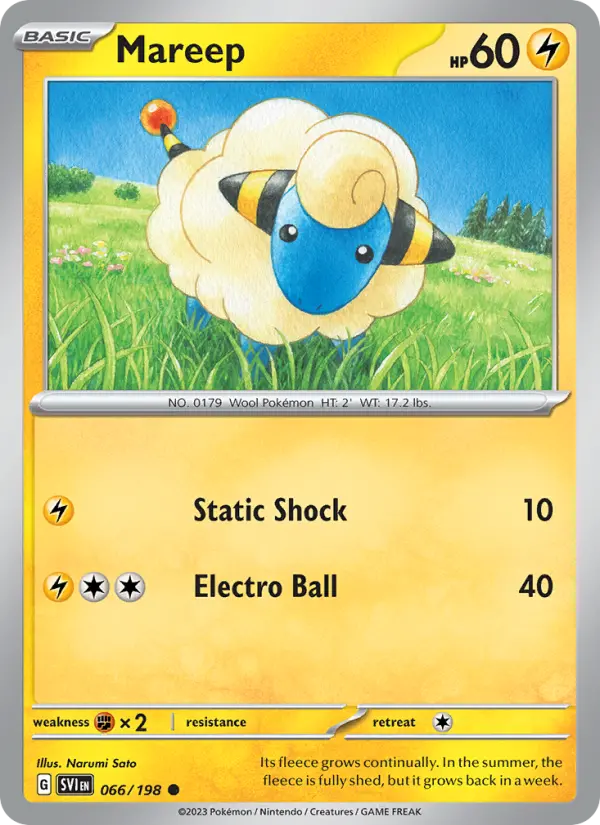
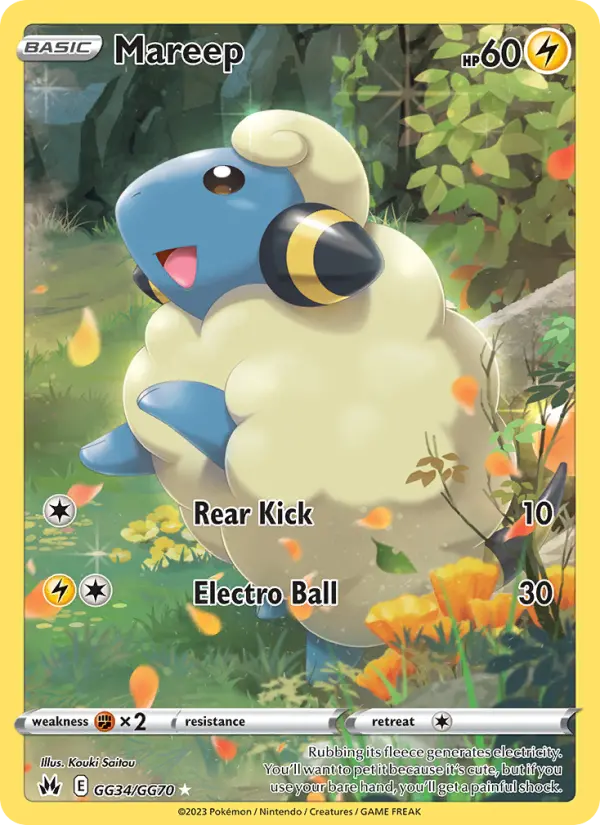
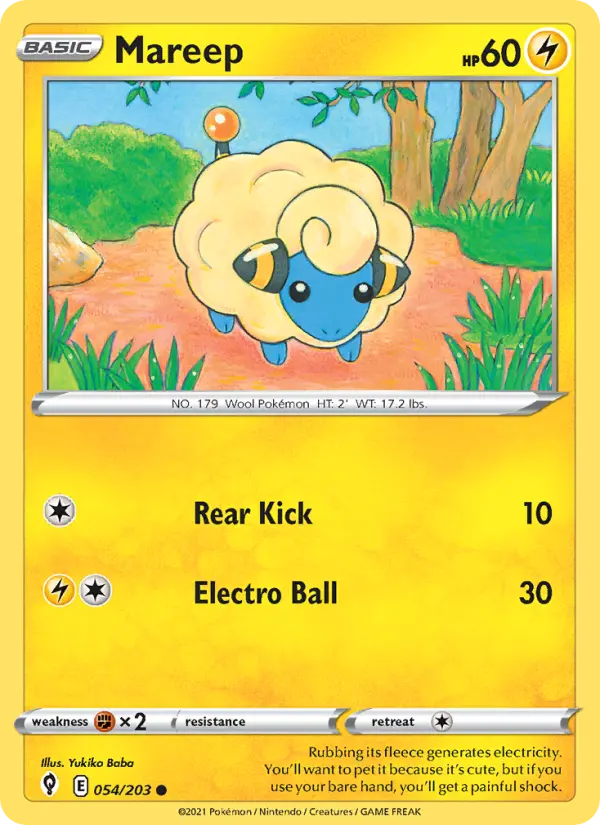
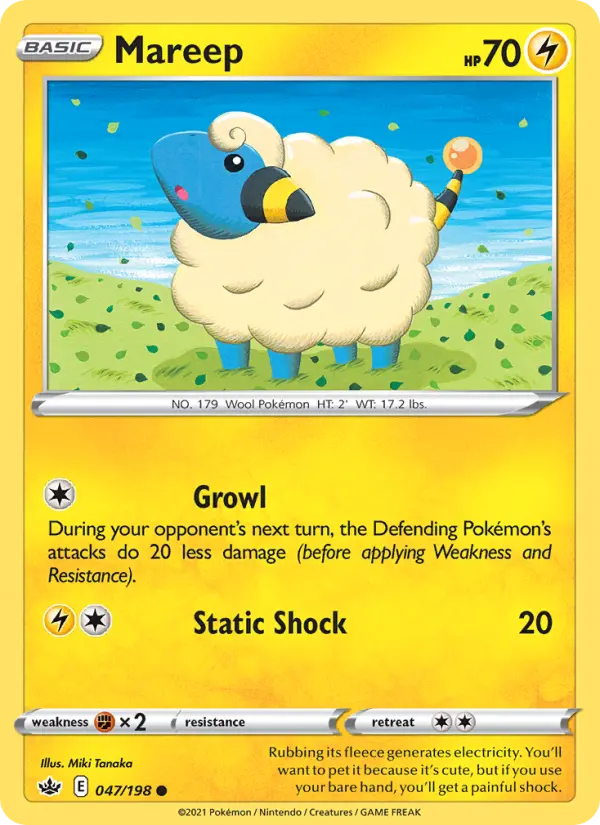
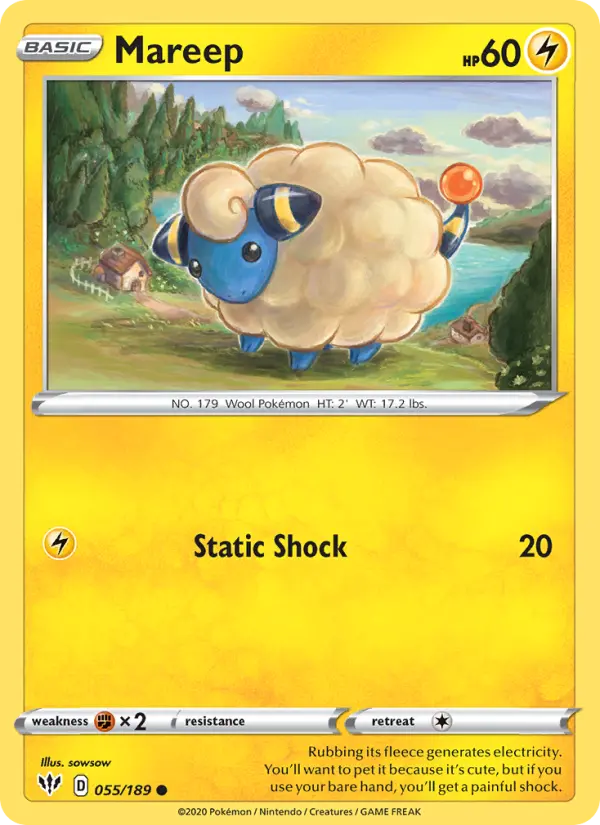
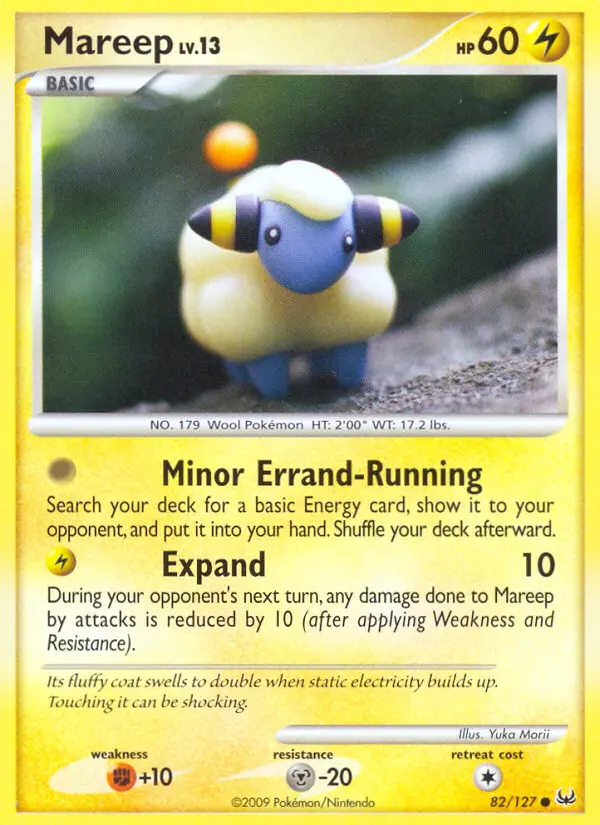
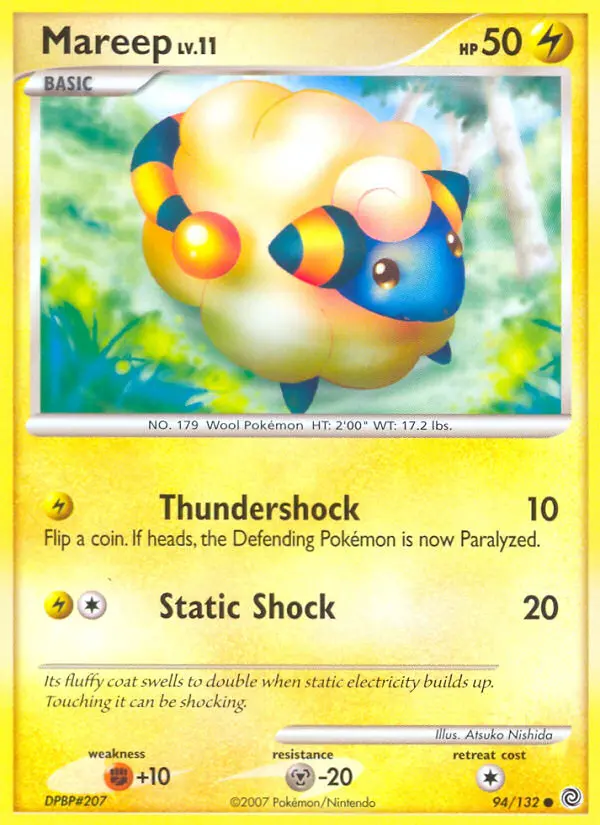
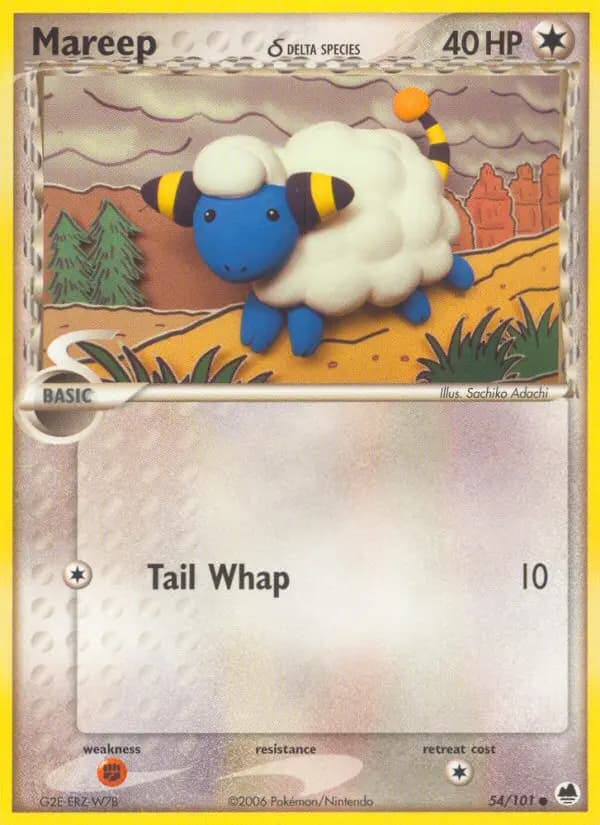
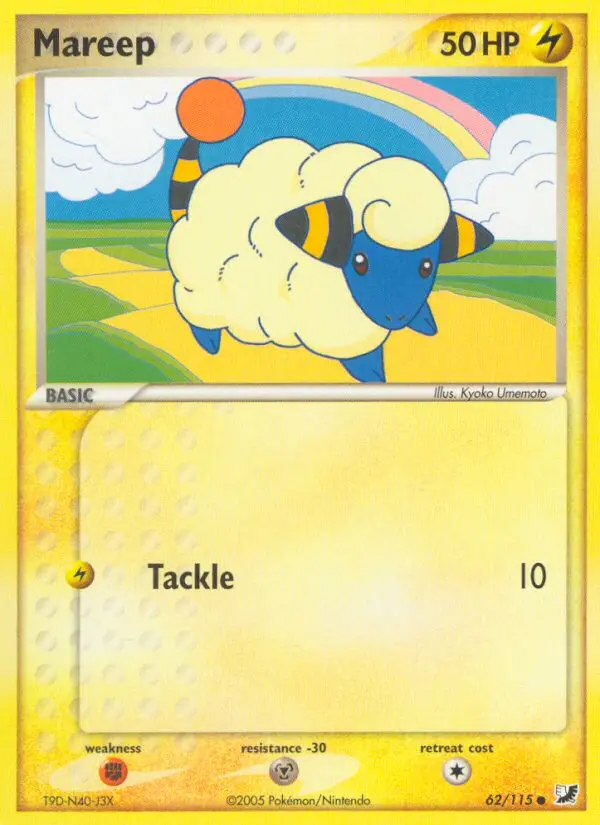
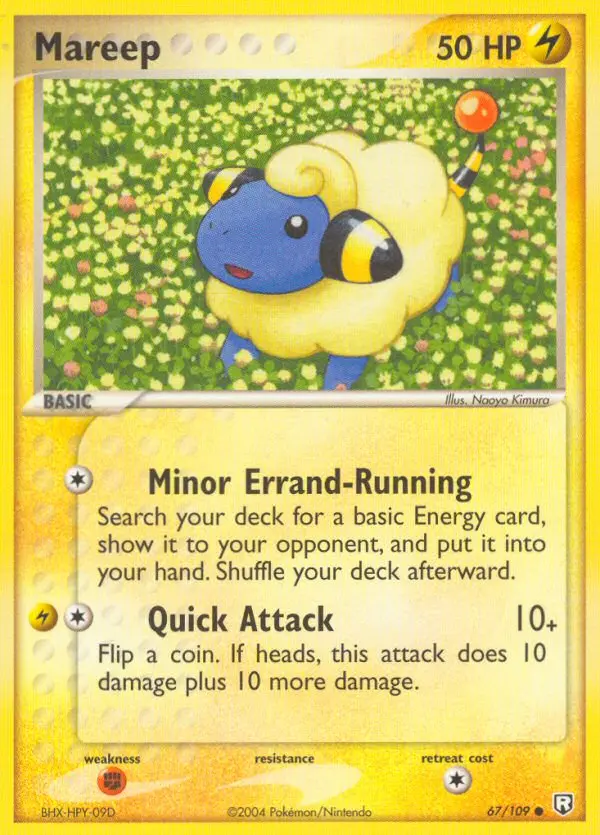
Mareep holds a cherished position within the broader Pokémon franchise as one of Generation II's most iconic electric-type representatives, frequently appearing in official artwork, trading card releases, and merchandise celebrating the Johto region. The species embodies the developmental philosophy of Generation II's design language, balancing new creative concepts with recognizable real-world inspirations in ways that resonated deeply with players during the era of Pokémon Gold and Silver. Mareep's gentle disposition and accessible nature made it an appealing introductory electric-type for players intimidated by Pikachu's cultural omnipresence, offering a gentler alternative that felt distinctly of the Johto region rather than derivative of Kanto. The sheep-based electric-type proved sufficiently popular that it has maintained consistent representation throughout subsequent generations, appearing in numerous games, anime episodes, and competitive contexts. Its evolution line, culminating in the powerful Ampharos, became legendary among players for its role as a reliable electric-type throughout Johto and Kanto exploration, with Ampharos' light beam ability providing both practical in-game utility and thematic resonance. Mareep has appeared in multiple anime seasons and the trading card game, though not at the level of hypervisibility enjoyed by series mascots, positioning it as a beloved secondary character rather than a franchise centerpiece. The species' domestication within human farming culture makes it one of the most humanized Pokémon species, reflecting broader themes about Pokémon coexisting with human civilization in economically integrated ways.
Where to Find Mareep in Every Pokémon Game
Mareep's availability varies considerably across generations and regional contexts, though it has maintained presence as a legitimate catchable species throughout most mainline games since its introduction. In the original Generation II titles (Gold and Silver), Mareep appears relatively early in the Johto region's grassy routes, providing accessible electric-type options for trainers building their initial teams. The species reappears in remakes HeartGold and SoulSilver with similar distribution patterns, occupying comparable Johto locations. Mareep gained expanded availability in Generation V's Black 2 and White 2, where it appears in specific areas, making it accessible to players seeking electric-type options during Unova exploration. In later generations including X and Y (Coastal Kalos), Sun and Moon (Alola region), and Scarlet and Violet, Mareep maintains regional availability varying by location—sometimes appearing in ranch-like or pastoral areas fitting its domesticated nature. The species' notably high catch rate of 235 (translating to approximately 30.7% success rate with a standard Poké Ball against a full-health target) ensures that once located, Mareep is readily captured without requiring excessive ball expenditure or damage reduction. For players seeking Mareep in modern titles, the Pokédex's expansion of available species and regional variants has positioned Mareep as readily accessible through various distribution methods, though availability patterns shift across Pokémon Sword and Shield, Legends: Arceus, and the most recent generation titles. Those seeking perfect-IV or shiny variants can utilize breeding mechanics or encounter manipulation techniques, with Mareep's moderate incubation period and dual egg group membership facilitating such specialized hunting strategies.