mudbray
Generation VII · #0749 — Donkey Pokémon
Mudbray is a Ground-type Pokémon from Generation VII that embodies surprising strength beneath a humble appearance. As National Pokédex entry #749, this Donkey Pokémon stands only 1.0 meter tall but weighs a substantial 110.0 kilograms, making it a compact but dense creature. Despite its unassuming stature, Mudbray possesses extraordinary physical capabilities that belie its modest size, capable of carrying loads up to fifty times its own body weight without difficulty. The species represents a remarkable conservation success story, having nearly vanished from the world through overhunting before finding refuge in the Alola region, though recent sightings in Galar and Paldea suggest its population is gradually recovering.
Base Stats
Height
1.0m
Weight
110.0kg
Category
Donkey Pokémon
Gender
Male 50% / Female 50%
Color
brown
Shape
quadruped
Abilities
Prevents confusion.
Raises this Pokémon's Defense by one stage when it takes damage from a move.
Prevents flinching.

Mudbray Biology & Physical Characteristics
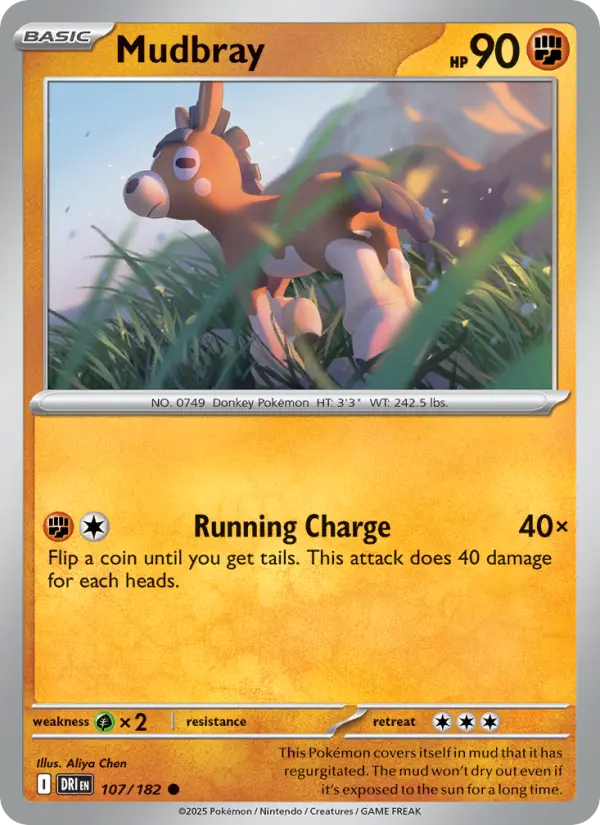
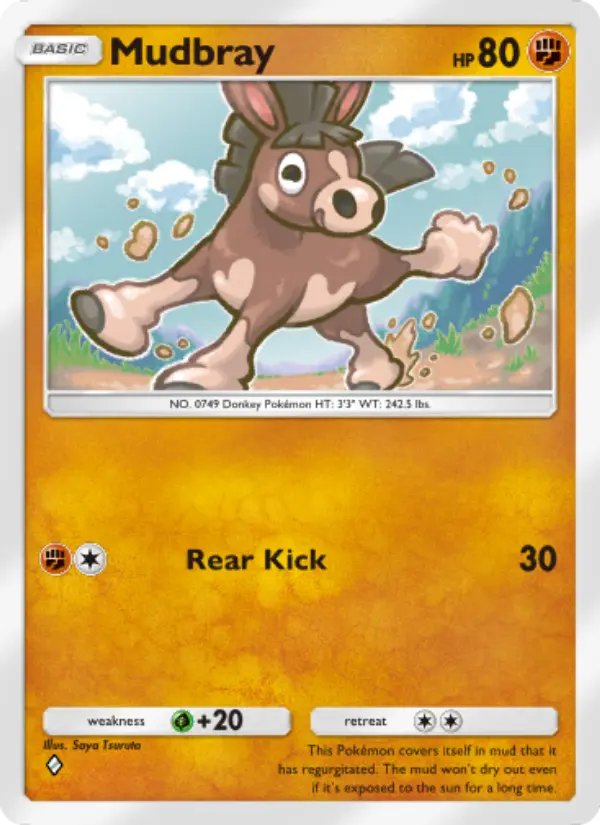
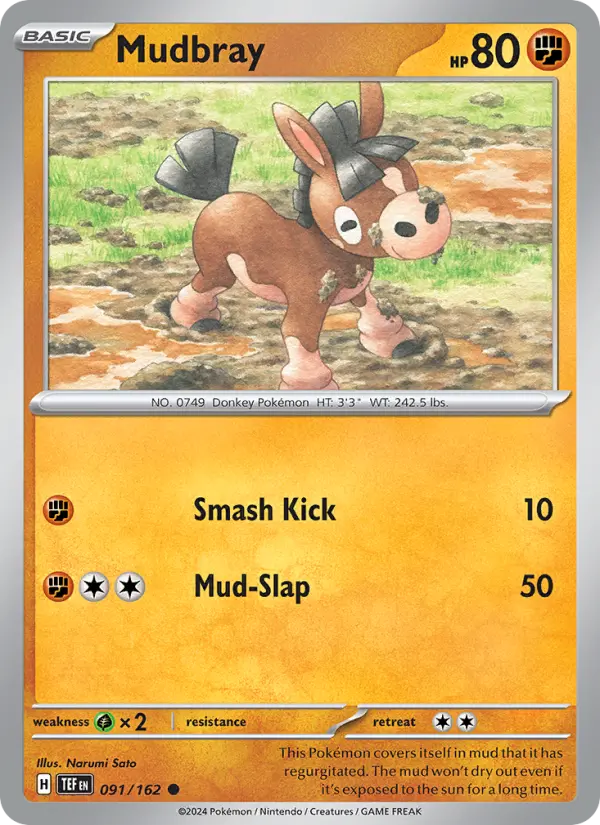
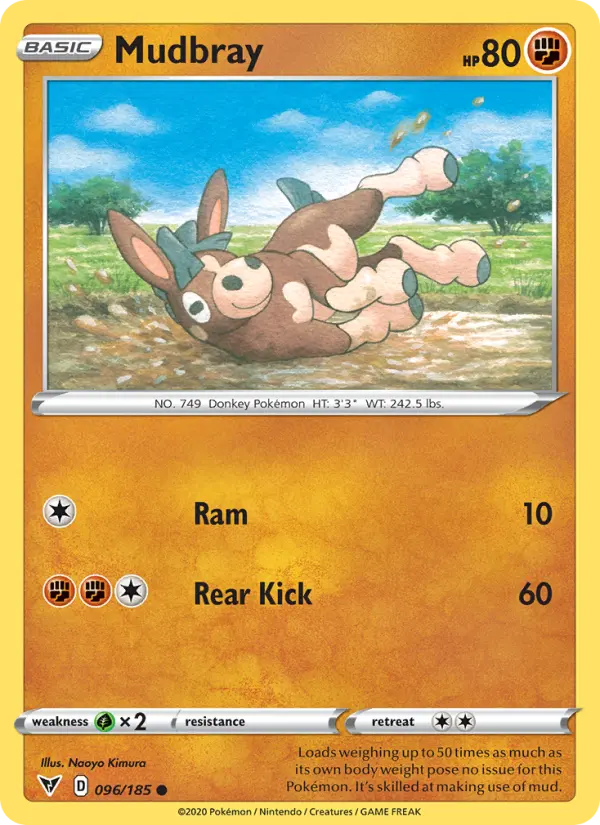
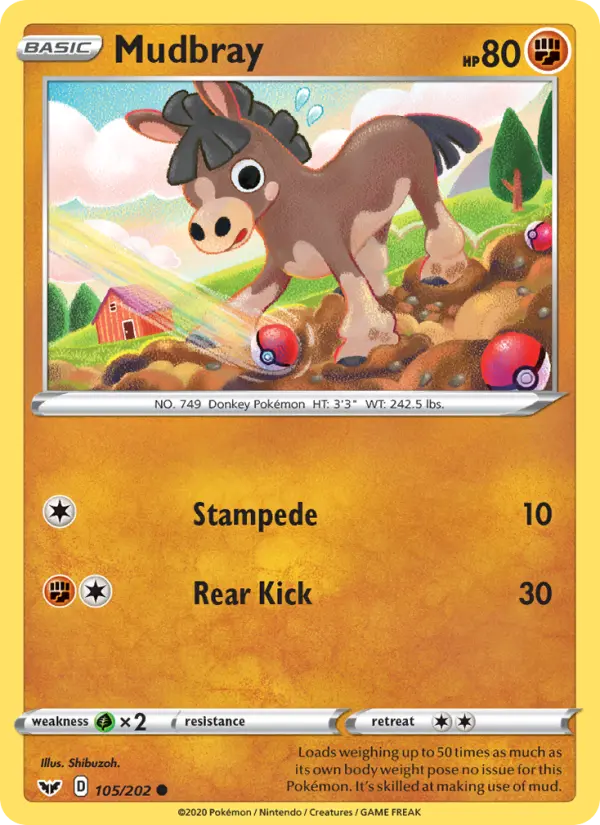
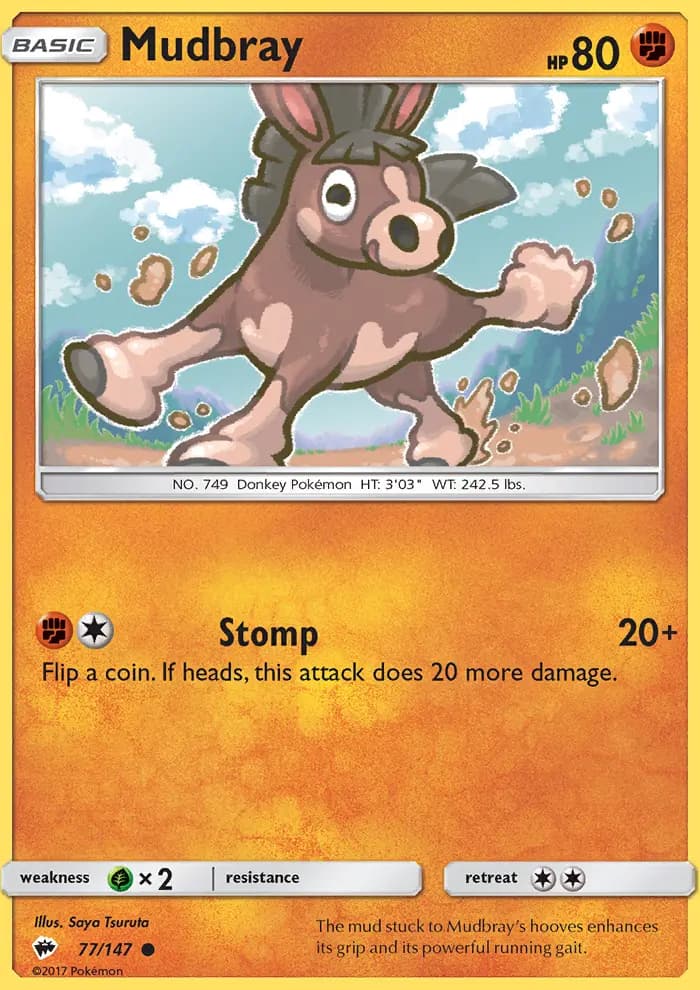
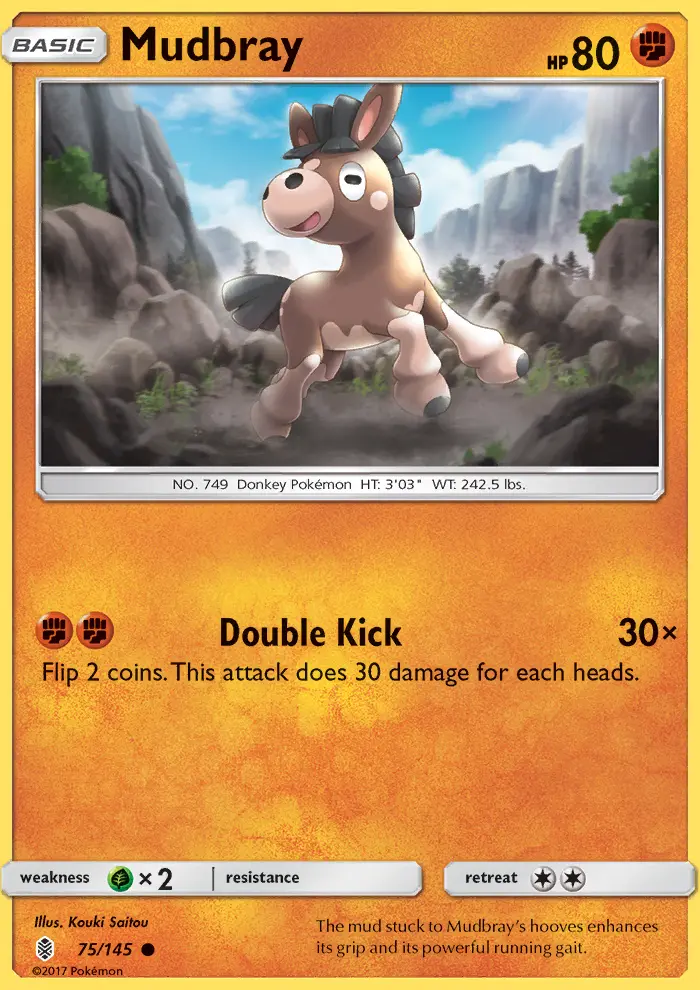
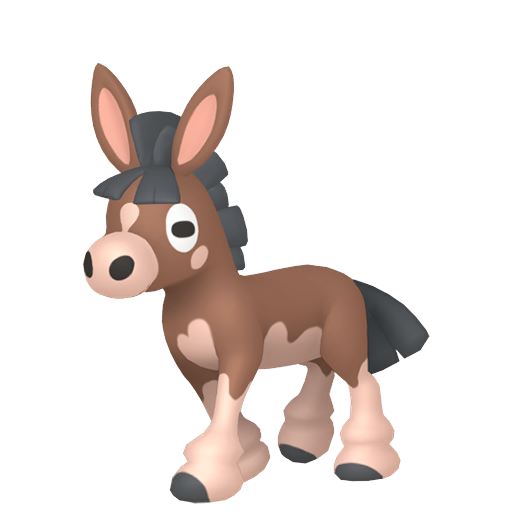
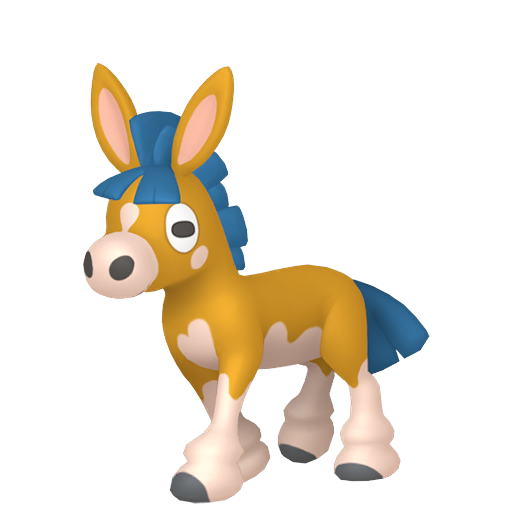
Mudbray is a quadrupedal, equine Pokémon that closely resembles a small donkey, with a distinctly stocky and muscular build despite its diminutive stature. Its body is covered in a dark brown coat with cream-colored markings including an underbelly, muzzle, and circular cheek patches, while a teardrop-shaped blaze extends upward from its muzzle. The creature features long, pointed ears with pink inner surfaces and large eyes with distinctive horizontal pupils, framed by black bangs that extend into a stiff mane along its neck. Most notably, each of its black hooves is encased in thick, cream-colored mud that serves both protective and functional purposes. Mudbray's mud possesses remarkable properties, remaining moist and supple even when exposed to prolonged sunlight, a critical adaptation for its lifestyle. The species sustains itself by consuming dirt, which it processes internally to create the special mud it regurgitates to coat its body and hooves, with this mud being essential for its wellbeing and grip.
Pokedex Numbers
Training
Breeding
Mudbray Breeding, Gender Ratio & Egg Groups
Mudbray exhibits a perfectly balanced gender ratio with 50% male and 50% female distribution among wild populations, allowing flexible breeding combinations for trainers seeking to build competitive lineages. The species belongs to the Field egg group, classifying it among Pokémon that breed in natural terrestrial environments, which aligns thematically with its mud-dwelling nature and ground-based ecology. With a base friendship value of 70 and an egg hatch counter of 20 cycles (approximately 4,884 to 5,140 steps), Mudbray is moderately friendly and hatches at a reasonable pace, making it accessible for players who wish to breed for optimal individual values and natures. The species employs a standard medium growth rate, progressing at a steady pace through typical level-based advancement that matches most common Pokémon training schedules.
Held Items
Sprites




Held Items
light-clay
held-items
Held: Light Screen and Reflect used by the holder last 8 rounds instead of 5.
Cost: 4000
light-clay
held-items
Held: Light Screen and Reflect used by the holder last 8 rounds instead of 5.
Cost: 4000
light-clay
held-items
Held: Light Screen and Reflect used by the holder last 8 rounds instead of 5.
Cost: 4000
light-clay
held-items
Held: Light Screen and Reflect used by the holder last 8 rounds instead of 5.
Cost: 4000
TMs & HMs
tm01
sword shield
tm03
crystal
tm03
gold silver
tm05
red blue
tm05
ruby sapphire
tm05
emerald
tm05
gold silver
tm05
crystal
tm05
yellow
tm05
diamond pearl
tm05
black white
tm05
platinum
tm05
heartgold soulsilver
tm05
firered leafgreen
tm05
black 2 white 2
tm05
omega ruby alpha sapphire
tm05
x y
tm05
xd
tm05
colosseum
tm05
red green japan
+482 more TMs/HMs


Mudbray Evolution, Mega Evolution & Special Forms
Mudbray belongs to a straightforward evolutionary line consisting of only two stages. At level 30, Mudbray evolves into Mudsdale, its fully-evolved form, which retains the Ground typing and builds upon Mudbray's exceptional physical attributes. The evolution represents a significant power increase, with Mudsdale gaining substantially higher base stats across most categories, particularly in Attack, which increases from 100 to 125, and Defense, which rises to 100. Mudsdale's evolution marks the transition from a capable early-game Pokémon to a formidable physical powerhouse, maintaining the same ability options while becoming a more threatening presence in competitive play. The evolution is triggered by simple level progression with no alternative conditions required, making it an accessible milestone for trainers using Mudbray in their teams.
Where to Find
blush mountain
alola
+1 more
alola route 6
alola
+1 more
paniola ranch
alola
+1 more
alola route 12
alola
+1 more
alola route 4
alola
+1 more
Mudbray Behaviour and Natural Habitat
Mudbray exhibits a notably stubborn and individualistic disposition, engaging in daily activities centered around mud and earth interaction. As documented in various Pokédex entries, eating dirt, making mud, and playing in mire form integral parts of its routine, and denying it access to regular mud bathing causes considerable stress that leads to disobedience toward its Trainer. The creature is known for its powerful running gait, enhanced by the mud clinging to its hooves which dramatically improves grip on rough terrain, allowing it to traverse difficult landscapes without slipping. While once distributed across the globe, Mudbray populations were decimated by overhunting and nearly driven to extinction; the species was believed to exist only in Alola for a considerable time. More recently, populations have been confirmed in the Galar and Paldea regions, indicating a slow recovery. Mudbray typically inhabits areas with suitable earth and moisture where it can freely engage in its mud-centric behaviors.
Pokedex Entries
The mud stuck to Mudbray’s hooves enhances its grip and its powerful running gait.
It loves playing in the mud. If it isn’t showered with mud on a daily basis, it gets stressed out and stops listening to its Trainer.
It has a stubborn, individualistic disposition. Eating dirt, making mud, and playing in the mire all form part of its daily routine.
Possessing mighty power, Mudbray can be loaded with 50 times its own body weight and will be totally fine.
Loads weighing up to 50 times as much as its own body weight pose no issue for this Pokémon. It’s skilled at making use of mud.
It eats dirt to create mud and smears this mud all over its feet, giving them the grip needed to walk on rough terrain without slipping.
Mudbray Name Origin & Design Inspiration
Mudbray's design and nomenclature reflect its core identity as a mud-loving, donkey-like creature perfectly adapted to earthen environments. The Japanese name "Dorobanko" combines "doro" (mud/dirt) and "banko" (stubborn or obstinate), capturing both the creature's muddy nature and its famously willful personality in a single concise term. The English name "Mudbray" similarly fuses "mud" with "bray," the characteristic sound made by donkeys, creating a straightforward moniker that immediately conveys the Pokémon's species inspiration and elemental association. Visually, Mudbray draws clear inspiration from miniature horses and donkeys, particularly draft animals known for their incredible strength relative to size, while the persistent mud coating its hooves references real-world animals that gather protective coating from terrain. The color palette of dark brown with cream accents creates a natural appearance reminiscent of earth and sediment, reinforcing its Ground-type identity and terrestrial lifestyle while making it visually distinct from other equine Pokémon.
Learnable Moves
Mudbray can learn 57 moves:
Move | Type | Cat. | Power | Acc. | PP |
|---|---|---|---|---|---|
| attract | normal | Status | — | 100 | 15 |
| bide | normal | Physical | — | — | 10 |
| body slam | normal | Physical | 85 | 100 | 15 |
| bulldoze | ground | Physical | 60 | 100 | 20 |
| close combat | fighting | Physical | 120 | 100 | 5 |
| confide | normal | Status | — | — | 20 |
| counter | fighting | Physical | — | 100 | 20 |
| curse | ghost | Status | — | — | 10 |
| double kick | fighting | Physical | 30 | 100 | 30 |
| double team | normal | Status | — | — | 15 |
| double edge | normal | Physical | 120 | 100 | 15 |
| earth power | ground | Special | 90 | 100 | 10 |
| earthquake | ground | Physical | 100 | 100 | 10 |
| endeavor | normal | Physical | — | 100 | 5 |
| endure | normal | Status | — | — | 10 |
| facade | normal | Physical | 70 | 100 | 20 |
| fissure | ground | Physical | — | 30 | 5 |
| frustration | normal | Physical | — | 100 | 20 |
| heavy slam | steel | Physical | — | 100 | 10 |
| hidden power | normal | Special | 60 | 100 | 15 |
| high horsepower | ground | Physical | 95 | 95 | 10 |
| iron defense | steel | Status | — | — | 15 |
| iron head | steel | Physical | 80 | 100 | 15 |
| low kick | fighting | Physical | — | 100 | 20 |
| low sweep | fighting | Physical | 65 | 100 | 20 |
| magnitude | ground | Physical | — | 100 | 30 |
| mega kick | normal | Physical | 120 | 75 | 5 |
| mud bomb | ground | Special | 65 | 85 | 10 |
| mud sport | ground | Status | — | — | 15 |
| mud slap | ground | Special | 20 | 100 | 10 |
| payback | dark | Physical | 50 | 100 | 10 |
| protect | normal | Status | — | — | 10 |
| rest | psychic | Status | — | — | 5 |
| return | normal | Physical | — | 100 | 20 |
| roar | normal | Status | — | — | 20 |
| rock slide | rock | Physical | 75 | 90 | 10 |
| rock smash | fighting | Physical | 40 | 100 | 15 |
| rock tomb | rock | Physical | 60 | 95 | 15 |
| rototiller | ground | Status | — | — | 10 |
| round | normal | Special | 60 | 100 | 15 |
| sand tomb | ground | Physical | 35 | 85 | 15 |
| sandstorm | rock | Status | — | — | 10 |
| sleep talk | normal | Status | — | — | 10 |
| smack down | rock | Physical | 50 | 100 | 15 |
| snore | normal | Special | 50 | 100 | 15 |
| stealth rock | rock | Status | — | — | 20 |
| stomp | normal | Physical | 65 | 100 | 20 |
| stomping tantrum | ground | Physical | 75 | 100 | 10 |
| stone edge | rock | Physical | 100 | 80 | 5 |
| strength | normal | Physical | 80 | 100 | 15 |
| substitute | normal | Status | — | — | 10 |
| sunny day | fire | Status | — | — | 5 |
| superpower | fighting | Physical | 120 | 100 | 5 |
| swagger | normal | Status | — | 85 | 15 |
| take down | normal | Physical | 90 | 85 | 20 |
| tera blast | normal | Special | 80 | 100 | 10 |
| toxic | poison | Status | — | 90 | 10 |
Mudbray Competitive Battle Guide
Assessing its battle viability, Mudbray functions as a solid physical attacker with a base Attack stat of 100, making it respectable for early-to-mid game scenarios despite its modest aggregate stat total of 385. Its ability composition offers tactical flexibility: Own Tempo provides protection against confusion, a useful defensive utility in competitive environments; Stamina, the rarer ability shared only with Mudsdale prior to Generation IX, raises Defense by one stage whenever the Pokémon takes damage, creating potential for defensive scaling strategies; and Inner Focus as the hidden ability prevents flinching, countering priority move users. However, with a base Speed of only 45 and Special Attack of 45, Mudbray lacks the velocity and special coverage for modern competitive formats at its evolution stage. Most competitive players favor its evolved form Mudsdale, which significantly improves Speed to 70 and overall bulk, but Mudbray can serve specialized roles in lower-tier formats or as part of strategic team compositions leveraging its Attack and ability advantages.
Commonly Asked Questions About Mudbray
What type is Mudbray?
Mudbray is a ground type Pokemon.
What does Mudbray evolve into?
Mudbray evolves into mudsdale.
What are Mudbray's weaknesses?
Mudbray is weak to water, grass and ice type moves.
Where can I find Mudbray?
Mudbray can be found in blush mountain (alola), alola route 6 (alola) and paniola ranch (alola) and 2 other locations.
Mudbray Cultural Impact & Franchise History
Mudbray has established itself as a memorable Ground-type representative from Generation VII, appearing prominently in the Alola region storylines where its near-extinction and recovery serve as environmental narrative elements. The species has appeared in various Pokémon animated media and manga adaptations, with its stubborn personality providing character development opportunities in storylines exploring trainer-Pokémon bonds and the effort required to properly care for specialized creatures. Its unique design as a compact yet powerful creature has resonated with players and fans who appreciate the thematic consistency between appearance and capability. Within the broader Pokémon community, Mudbray represents a successful example of a regionally-endemic species with a conservation narrative, adding world-building depth to the franchise and distinguishing the Alola generation with its themes of ecological recovery and preservation.
Where to Find Mudbray in Every Pokémon Game
Mudbray's availability has evolved significantly across Pokémon generations, reflecting both its fictional conservation narrative and development team distribution decisions. Initially endemic to the Alola region in Pokémon Sun and Moon, where it could be encountered in the wild, Mudbray became a key regional species defining Generation VII's local Pokédex. The species has since appeared in subsequent generations including Sword and Shield in the Galar region, and Scarlet and Violet in Paldea, confirming its expanded range and recovered population within the game world. In Pokémon Legends: Arceus and subsequent titles, Mudbray remains accessible through various encounter methods. The species' high capture rate of 190 makes it relatively easy to catch with standard Poké Balls, and its moderate egg hatch time and breeding accessibility mean trainers can readily obtain examples for their teams. With a base experience yield of 77, Mudbray provides reasonable experience gains during the early game, making it a viable companion for new players working toward evolving it at level 30.