Nincada
Generation III · #0290 — Trainee Pokémon
At 0.5 m and 5.5 kg, Nincada doesn't look like much on paper, but its compound eyes ability shapes how it actually plays more than its size suggests. At 0.5 m and 5.5 kg, its build reflects a specialist role rather than a generalist one. Despite its diminutive stature, Nincada holds significant importance in the Pokémon world due to its unique dual evolution mechanism, which can result in the acquisition of two different evolved forms—Ninjask and Shedinja—during a single level-up event. The species boasts a combined stat total of 266, with its most notable strength being its exceptional Defense stat of 90, which provides a remarkable foundation for an unevolved Pokémon. Nincada's Compound Eyes ability increases the accuracy of moves by 30%, while its hidden ability Run Away allows it to escape from wild Pokémon battles with guaranteed success, though this is overshadowed by its evolutionary potential.
Editor's Take
Nincada evolving into Ninjask and creating a second Pokémon in your party at the same time is the only evolution in the series that produces two Pokémon, and it still feels like a bug.
Base Stats
Height
0.5m
Weight
5.5kg
Category
Trainee Pokémon
Gender
Male 50% / Female 50%
Color
gray
Shape
armor
Habitat
forest
Abilities
Increases moves' accuracy to 1.3×.
Ensures success fleeing from wild battles.

Nincada Biology & Physical Characteristics
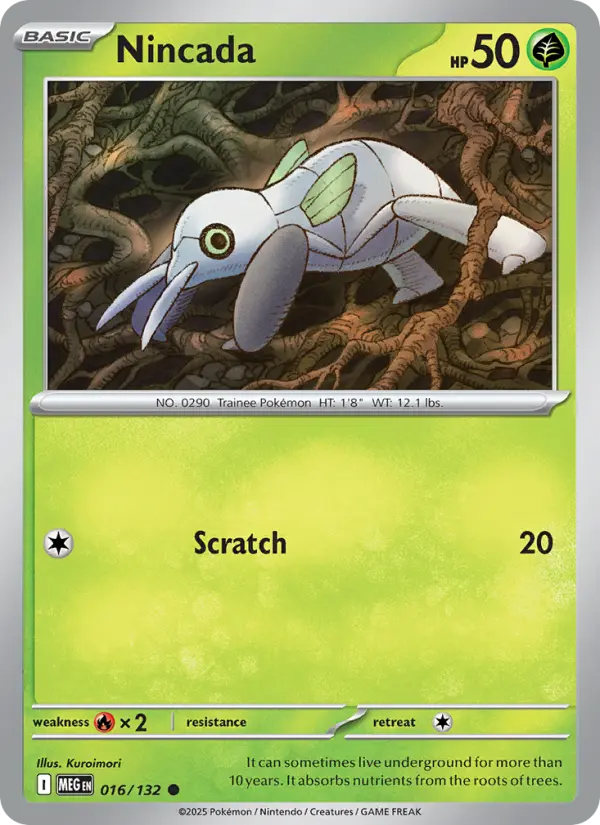
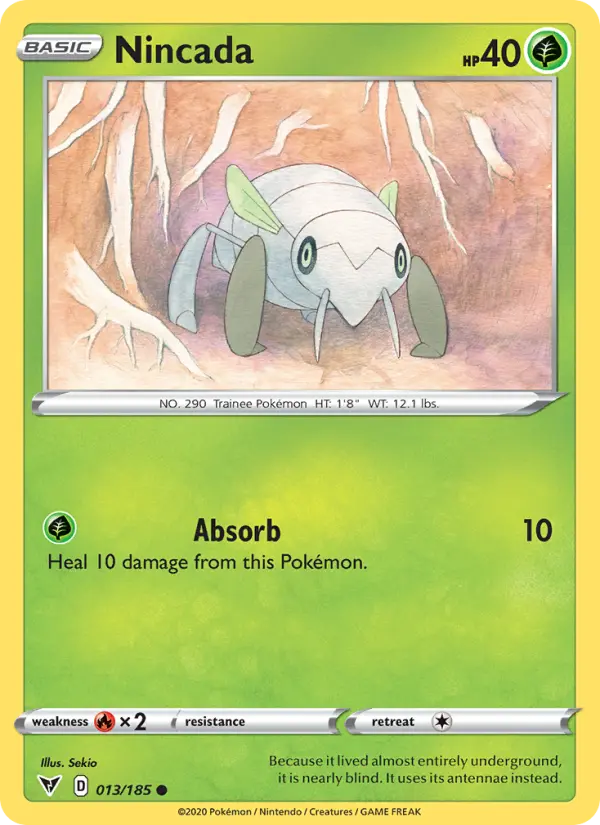
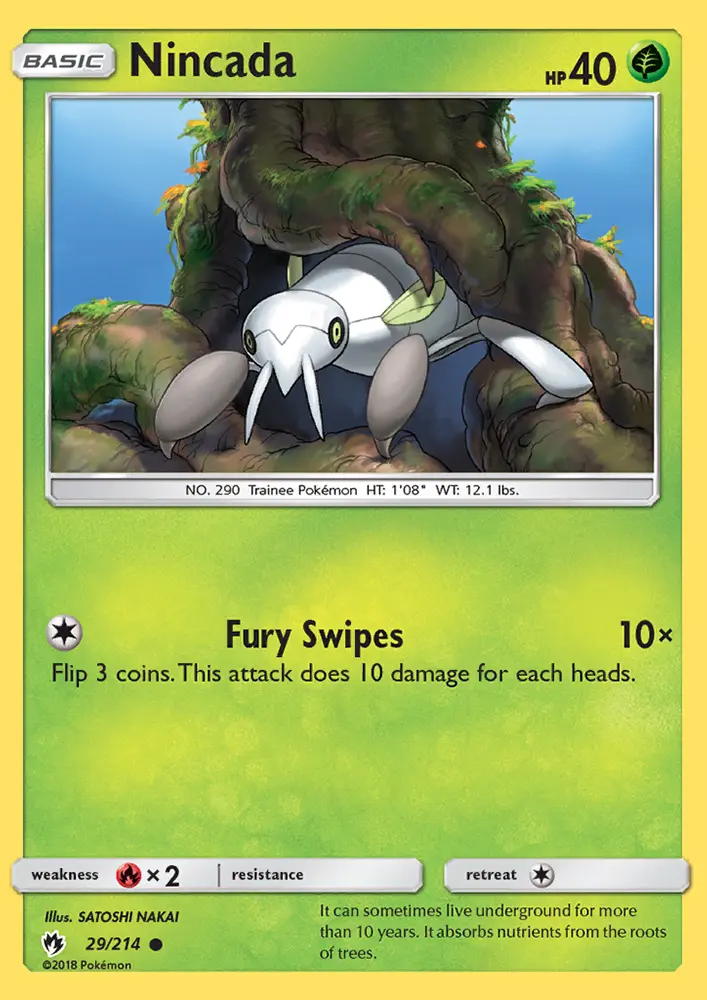
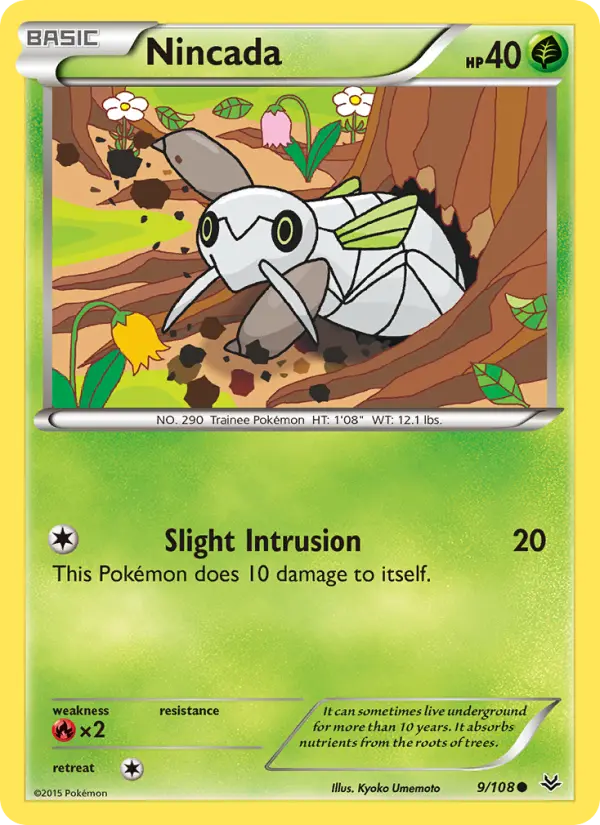
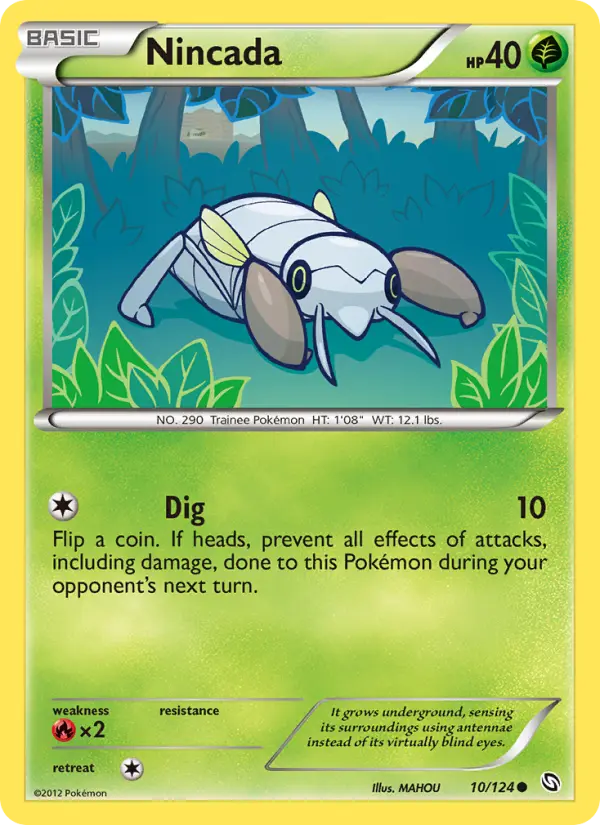
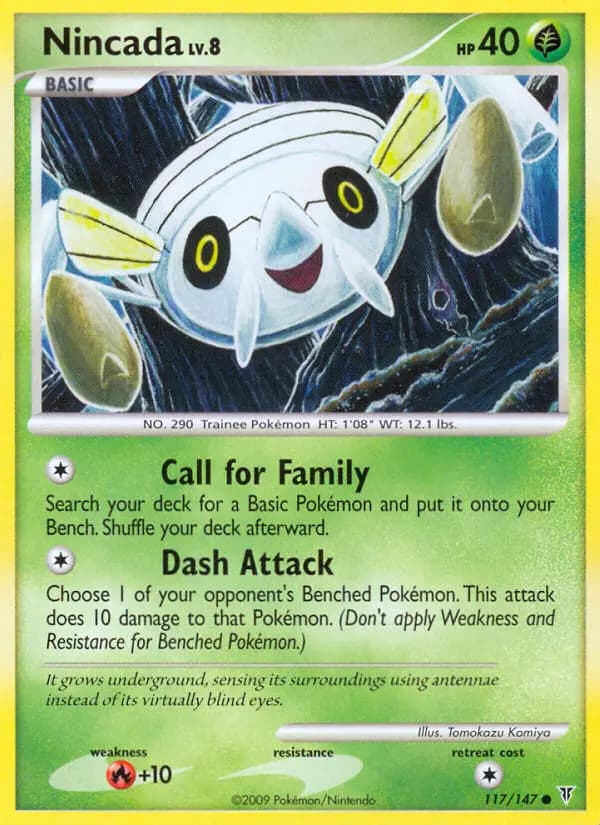
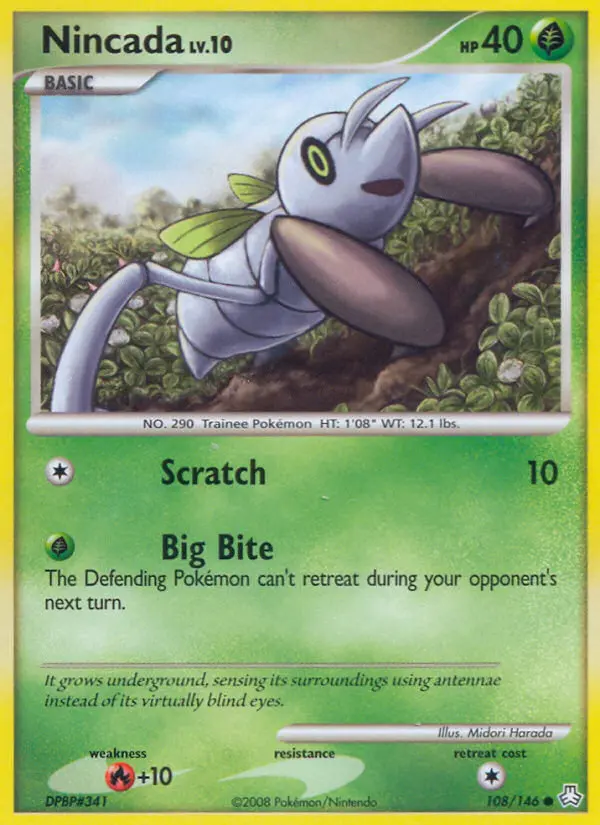
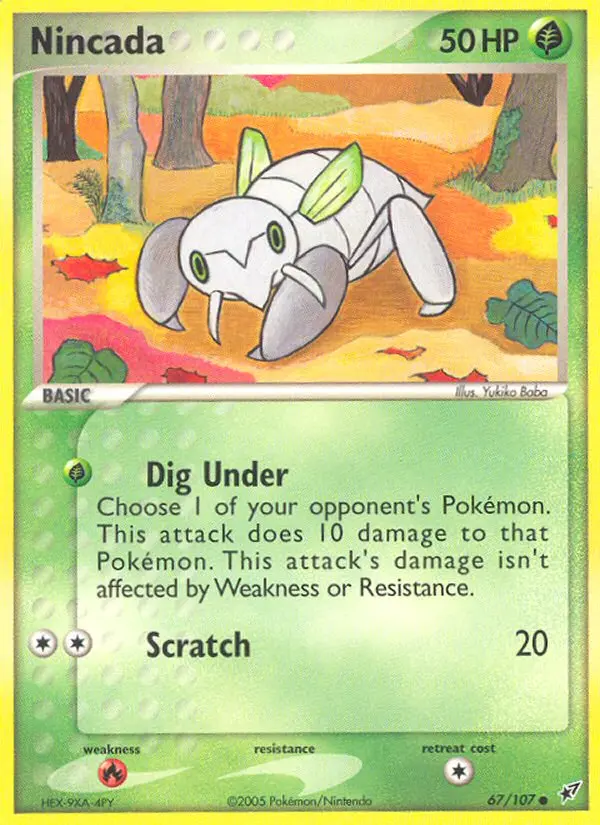
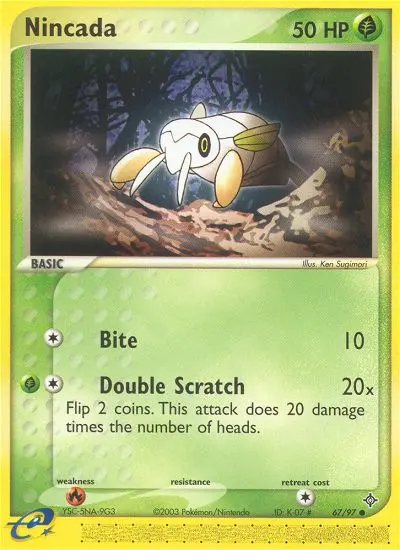
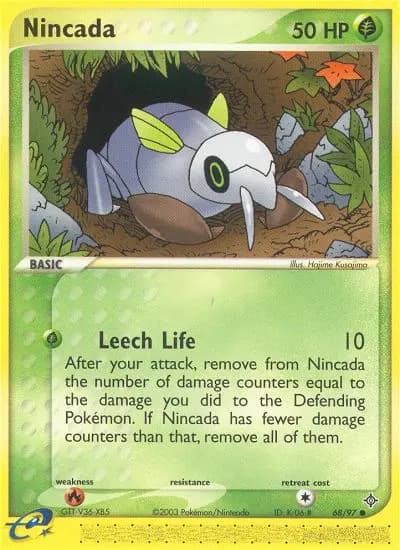
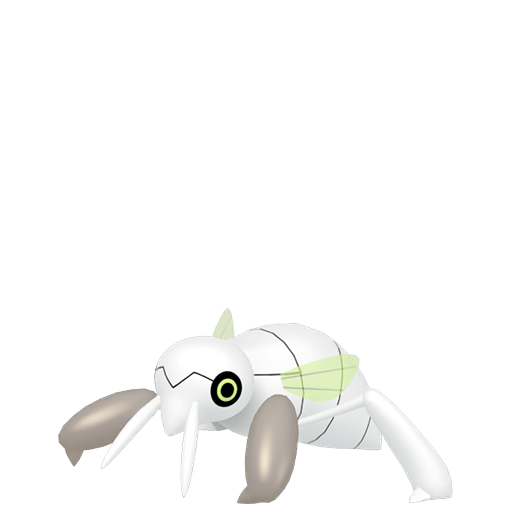
Nincada presents a distinctive insectoid appearance characterized by its small, whitish body covered in a subtle exoskeletal structure. The Pokémon features a pointed snout, a thin V-shaped stripe that dips between its eyes, and two prominent whisker-like antennae protruding from its face. Its eyes are black with striking green iris-like rings, though these optical organs are largely non-functional due to the creature's subterranean lifestyle. Compensating for its near-blindness, Nincada relies almost entirely on its highly sensitive antennae to navigate and sense its surroundings, allowing it to perceive the underground environment with remarkable accuracy. Its most practical features include a pair of small green wings on its back and powerful brown forelegs equipped with sharp, curved claws specifically adapted for excavation and carving into tree roots. The hind legs maintain a lighter white coloration in contrast to the darker brown of the front limbs, creating a visually balanced silhouette that reflects its burrowing nature.
Pokedex Numbers
Training
Breeding
Nincada Breeding, Gender Ratio & Egg Groups
There's no gender skew here: Nincada breeds at an even 50% male / 50% female rate. The species belongs exclusively to the Bug egg group, which restricts breeding compatibility to other Bug-type Pokémon and those that share the Bug classification, preventing cross-breeding with unrelated species types. With a base happiness value of 70, Nincada demonstrates moderate friendliness toward trainers, making it a reasonably cooperative Pokémon for bonding and competitive play. The species features an exceptional capture rate of 255, the highest possible value, meaning Nincada can be caught with a standard Poké Ball at full health with a 33.3% success rate—an unusually generous capture rate that reflects its non-threatening nature as a wild Pokémon. Breeding Nincada results in an egg cycle counter of 15 cycles, requiring approximately 3,599 to 3,855 steps before hatching, placing it in the moderate breeding timeframe compared to other species. The species' growth rate follows an Erratic pattern rather than the more common Medium Slow or Medium Fast rates, meaning it requires substantial experience to reach higher levels, though it progresses relatively quickly through mid-tier levels.
Sprites




Held Items
Soft Sand
type-enhancement
Held: Ground-Type moves from holder do 20% more damage.
Cost: 1000
Soft Sand
type-enhancement
Held: Ground-Type moves from holder do 20% more damage.
Cost: 1000
Soft Sand
type-enhancement
Held: Ground-Type moves from holder do 20% more damage.
Cost: 1000
Soft Sand
type-enhancement
Held: Ground-Type moves from holder do 20% more damage.
Cost: 1000
Soft Sand
type-enhancement
Held: Ground-Type moves from holder do 20% more damage.
Cost: 1000
Soft Sand
type-enhancement
Held: Ground-Type moves from holder do 20% more damage.
Cost: 1000
TMs & HMs
tm01
black white
tm01
black 2 white 2
tm01
omega ruby alpha sapphire
tm01
x y
tm05
lets go pikachu lets go eevee
tm06
yellow
tm06
gold silver
tm06
red blue
tm06
crystal
tm06
emerald
tm06
firered leafgreen
tm06
diamond pearl
tm06
platinum
tm06
ruby sapphire
tm06
colosseum
tm06
black 2 white 2
tm06
xd
tm06
black white
tm06
heartgold soulsilver
tm06
omega ruby alpha sapphire
+439 more TMs/HMs
Nincada's Evolution Chain


Nincada Evolution, Mega Evolution & Special Forms
Nincada's evolution line represents one of the most unique mechanics in Pokémon history. When Nincada reaches level 20, it evolves into Ninjask, a Bug/Flying-type Pokémon with dramatically increased Speed and Attack stats that transforms the slow subterranean creature into one of the fastest Pokémon in the entire game. Simultaneously, provided the trainer maintains an empty slot in their party and possesses an extra Poké Ball in their bag, a second evolution occurs: Shedinja manifests from the shed exoskeleton, inheriting Nincada's shell as a Bug/Ghost-type with the remarkable Wonder Guard ability. This dual evolution mechanic is exclusive to this evolutionary line and fundamentally changed how players approach team composition and strategic planning. The three-stage evolutionary chain perfectly encapsulates transformation and adaptation—Nincada remains earthbound and defensive, Ninjask achieves unprecedented mobility and speed, while Shedinja becomes an otherworldly spectral form. The interconnected evolution demonstrates the developers' creative approach to storytelling through mechanics, as Nincada's patient underground existence culminates in a simultaneous bifurcation that spawns two completely different entities from a single organism.
Where to Find
Hoenn Route 116
hoenn
+3 more
Eterna Forest
sinnoh
+9 more
Kalos Route 6
kalos
Nincada Behaviour and Natural Habitat
Nincada inhabits the underground networks beneath tropical and temperate forests, establishing its nests specifically at the roots of mighty trees where it can sustain itself for extended periods. According to Pokédex records, this species can occasionally remain underground for more than a decade without surfacing, demonstrating an extraordinary adaptation to subterranean existence. The creature exhibits a pronounced photophobia, actively avoiding bright sunlight at all costs due to its evolution in complete darkness. Rather than hunting conventional prey, Nincada sustains itself by carving into tree roots using its sharp claws and absorbing moisture and nutrients directly from the plant tissue, a feeding strategy unique among most other Pokémon species. The species remains almost motionless for years as it matures and approaches evolution, entering a dormant state that reflects its patient, meditative nature. This behavior aligns with its classification as the Trainee Pokémon, suggesting it is in a preparatory phase of development, waiting for the moment when it can shed its terrestrial limitations and transform into its more active evolved forms.
Pokedex Entries
NINCADA lives underground for many years in complete darkness. This POKéMON absorbs nutrients from the roots of trees. It stays motionless as it waits for evolution.
NINCADA lives underground. It uses its sharp claws to carve the roots of trees and absorb moisture and nutrients. This POKéMON can’t withstand bright sunlight so avoids it.
It makes its nest at the roots of a mighty tree. Using its whiskerlike antennae, it probes its surroundings in the pitch-black darkness of soil.
Because it lived almost entirely underground, it is nearly blind. It uses its antennae instead.
It grows underground, sensing its surroundings using antennae instead of its virtually blind eyes.
It can sometimes live underground for more than 10 years. It absorbs nutrients from the roots of trees.
It grows underground, sensing its surroundings using antennae instead of its virtually blind eyes.
It grows underground, sensing its surroundings using antennae instead of its virtually blind eyes.
Because it lived almost entirely underground, it is nearly blind. It uses its antennae instead.
It can sometimes live underground for more than 10 years. It absorbs nutrients from the roots of trees.
Nincada lives underground for many years in complete darkness. This Pokémon absorbs nutrients from the roots of trees. It stays motionless as it waits for evolution.
Nincada lives underground. It uses its sharp claws to carve the roots of trees and absorb moisture and nutrients. This Pokémon can’t withstand bright sunlight so avoids it.
Because it lived almost entirely underground, it is nearly blind. It uses its antennae instead.
It can sometimes live underground for more than 10 years. It absorbs nutrients from the roots of trees.
Nincada Name Origin & Design Inspiration
Nincada's name traces back to a combination of "ninja" and the word "cicada," reflecting both its stealthy subterranean existence and its connection to insectoid anatomy. The Japanese name Tutinin similarly references the cicada (tsutsutsu), an insect famous for emerging from underground after years of larval development—a parallel that becomes thematically evident upon evolution. The design inspiration clearly draws from cicada nymphs and underground burrowing insects, capturing the essence of a creature in transition between two states of being. The visual presentation emphasizes the creature's blind adaptation through its oversized antennae and absence of functional eyes, a design choice that communicates its complete reliance on alternative sensory organs. The sharp claws and digging posture reinforce its burrowing nature, while the small wings hint at the aerial capabilities that will manifest fully in its Ninjask evolution. The color palette of whites and browns mirrors soil and underground environments, providing perfect camouflage for a creature that spends its entire pre-evolution existence beneath the earth. This thoughtful design creates a cohesive visual narrative that explains the mechanics and behavior of the species through appearance alone.
Learnable Moves
Nincada can learn 54 moves:
Move | Type | Cat. | Power | Acc. | PP |
|---|---|---|---|---|---|
| absorb | grass | Special | 20 | 100 | 25 |
| aerial ace | flying | Physical | 60 | — | 20 |
| bide | normal | Physical | — | — | 10 |
| bug bite | bug | Physical | 60 | 100 | 20 |
| bug buzz | bug | Special | 90 | 100 | 10 |
| confide | normal | Status | — | — | 20 |
| cut | normal | Physical | 50 | 95 | 30 |
| dig | ground | Physical | 80 | 100 | 10 |
| double team | normal | Status | — | — | 15 |
| double edge | normal | Physical | 120 | 100 | 15 |
| endure | normal | Status | — | — | 10 |
| facade | normal | Physical | 70 | 100 | 20 |
| false swipe | normal | Physical | 40 | 100 | 40 |
| feint attack | dark | Physical | 60 | — | 20 |
| final gambit | fighting | Special | — | 100 | 5 |
| flail | normal | Physical | — | 100 | 15 |
| flash | normal | Status | — | 100 | 20 |
| frustration | normal | Physical | — | 100 | 20 |
| fury cutter | bug | Physical | 40 | 95 | 20 |
| fury swipes | normal | Physical | 18 | 80 | 15 |
| giga drain | grass | Special | 75 | 100 | 10 |
| gust | flying | Special | 40 | 100 | 35 |
| harden | normal | Status | — | — | 30 |
| hidden power | normal | Special | 60 | 100 | 15 |
| hone claws | dark | Status | — | — | 15 |
| leech life | bug | Physical | 80 | 100 | 10 |
| metal claw | steel | Physical | 50 | 95 | 35 |
| mimic | normal | Status | — | — | 10 |
| mind reader | normal | Status | — | — | 5 |
| mud slap | ground | Special | 20 | 100 | 10 |
| natural gift | normal | Physical | — | 100 | 15 |
| night slash | dark | Physical | 70 | 100 | 15 |
| protect | normal | Status | — | — | 10 |
| rest | psychic | Status | — | — | 5 |
| return | normal | Physical | — | 100 | 20 |
| round | normal | Special | 60 | 100 | 15 |
| sand attack | ground | Status | — | 100 | 15 |
| sandstorm | rock | Status | — | — | 10 |
| scratch | normal | Physical | 40 | 100 | 35 |
| secret power | normal | Physical | 70 | 100 | 20 |
| shadow ball | ghost | Special | 80 | 100 | 15 |
| silver wind | bug | Special | 60 | 100 | 5 |
| skitter smack | bug | Physical | 70 | 90 | 10 |
| sleep talk | normal | Status | — | — | 10 |
| snore | normal | Special | 50 | 100 | 15 |
| solar beam | grass | Special | 120 | 100 | 10 |
| spite | ghost | Status | — | 100 | 10 |
| string shot | bug | Status | — | 95 | 40 |
| struggle bug | bug | Special | 50 | 100 | 20 |
| substitute | normal | Status | — | — | 10 |
| sunny day | fire | Status | — | — | 5 |
| swagger | normal | Status | — | 85 | 15 |
| toxic | poison | Status | — | 90 | 10 |
| x scissor | bug | Physical | 80 | 100 | 15 |
Nincada Competitive Battle Guide
Judged by competitive standards, Nincada's role is severely limited due to its anemic offensive statistics and middling Speed tier, making it virtually unusable at any serious competitive level. With Attack and Special Attack base stats of merely 45 and 30 respectively, Nincada deals negligible damage even against defensively weak opponents, and its Speed of 40 ensures it will move after virtually all relevant threats. However, its exceptional Defense stat of 90 provides an unexpected bulwark against physical attackers, and when combined with the Compound Eyes ability increasing move accuracy to 130%, it can theoretically function as a tanky support Pokémon capable of utilizing moves like Stealth Rock or Bug Bite to provide team support. Its Bug/Ground typing, while uncommon, grants useful resistances to Poison, Rock, and Grass-type moves while providing immunity to Electric moves through its Ground classification, offering some defensive utility in specific metagames. The primary value of Nincada in competitive settings derives not from direct battle application but from its role as an evolution stepping stone—trainers specifically level Nincada to level 20 to obtain Shedinja, a glass-cannon Bug/Ghost Pokémon with Wonder Guard that fundamentally altered competitive strategies upon its introduction. Modern competitive players ignore Nincada entirely, immediately transitioning to its evolved forms, acknowledging that the base form serves no viable battle function beyond its unique evolutionary purpose.
Commonly Asked Questions About Nincada
What type is Nincada?
Nincada is a bug and ground type Pokemon.
What does Nincada evolve into?
Nincada evolves into ninjask, then into shedinja.
What are Nincada's weaknesses?
Nincada is weak to flying, fire, water and ice type moves.
Does Nincada evolve by trading?
No — Nincada evolves entirely through leveling up, with no trade required at any stage.
Where can I find Nincada?
Nincada can be found in hoenn route 116 (hoenn), eterna forest (sinnoh) and kalos route 6 (kalos).
Nincada Cultural Impact & Franchise History
Nincada occupies a uniquely important place in Pokémon culture as the species that revolutionized how players understood evolution and party building mechanics. The simultaneous dual evolution into both Ninjask and Shedinja represented a landmark moment in game design, forcing players to reconsider traditional team composition strategies by requiring empty party slots and maintaining specific item requirements. This mechanic generated tremendous discussion in early Pokémon forums and communities, with many players initially confused about how to trigger the simultaneous evolution and subsequently amazed by the species' creative innovation. Shedinja's subsequent competitive dominance through its Wonder Guard ability indelibly associated Nincada with strategic depth and creative game design, cementing the entire line's legacy in Pokémon history. The species appears throughout the animated series and various manga adaptations, though never achieving starring roles due to its limited practical applications outside its evolutionary purpose. The design and concept of Nincada has inspired countless fan theories and discussions about Pokémon biology, with players and researchers extensively debating the philosophical implications of a single organism splitting into two different entities during evolution—a question that continues to fuel speculation and creative interpretation within the community.
Where to Find Nincada in Every Pokémon Game
Nincada's availability has shifted across generations, beginning with its introduction in Generation III where it appeared as Hoenn Pokédex number 042 in Pokémon Ruby, Sapphire, and Emerald. The species was catchable in Route 110 in these original Hoenn games, where it could be found with relative frequency despite its elusive subterranean nature. In subsequent generations, Nincada's availability expanded as The Pokémon Company released remakes and new generations, appearing in various locations including routes in Kalos (X and Y), Alola (Sun and Moon), and Galar (Sword and Shield). Within Pokémon Sword and Shield, Nincada is classified as Pokédex number 104 in the Galar regional entry. The species remains one of the more commonly available Bug-type Pokémon in modern games, reflecting its role as an accessible entry point for trainers seeking to understand evolutionary mechanics and build competitive teams. Additionally, Nincada is available through breeding Ninjask or Shedinja in many games, allowing trainers who previously evolved their Nincada to potentially acquire additional specimens by breeding the evolved forms back into their unevolved state through various game mechanics and move tutors. The high capture rate of 255 ensures that trainers can reliably acquire Nincada specimens even in challenging situations, making it consistently obtainable across its available game appearances.