Palpitoad
Generation V · #0536 — Vibration Pokémon
Palpitoad debuted in Generation V, and its water/ground typing has aged into one of its more defining traits, especially paired with swift swim. At 0.8 m and 17.0 kg, its build reflects a specialist role rather than a generalist one. With a overall stat sum of 384, Palpitoad represents a balanced intermediate stage, featuring 75 HP and respectable Speed of 69, which allows it to function competently in both casual and competitive play. This amphibious creature stands 0.8 meters tall and weighs 17.0 kilograms, making it a moderately-sized Pokémon that embodies the aquatic-terrestrial lifestyle characteristic of its species. The Vibration Pokémon's striking appearance and useful movepool have earned it a notable place in trainers' parties throughout the Unova region and beyond.
Editor's Take
Palpitoad is a serviceable middle stage in a line that ends somewhere genuinely useful, which is more than most Gen 5 three-stage lines manage.
Base Stats
Height
0.8m
Weight
17.0kg
Category
Vibration Pokémon
Gender
Male 50% / Female 50%
Color
blue
Shape
upright
Abilities
Doubles Speed during rain.
Cures any major status ailment after each turn during rain.
Absorbs water moves, healing for 1/4 max HP.

Palpitoad Biology & Physical Characteristics
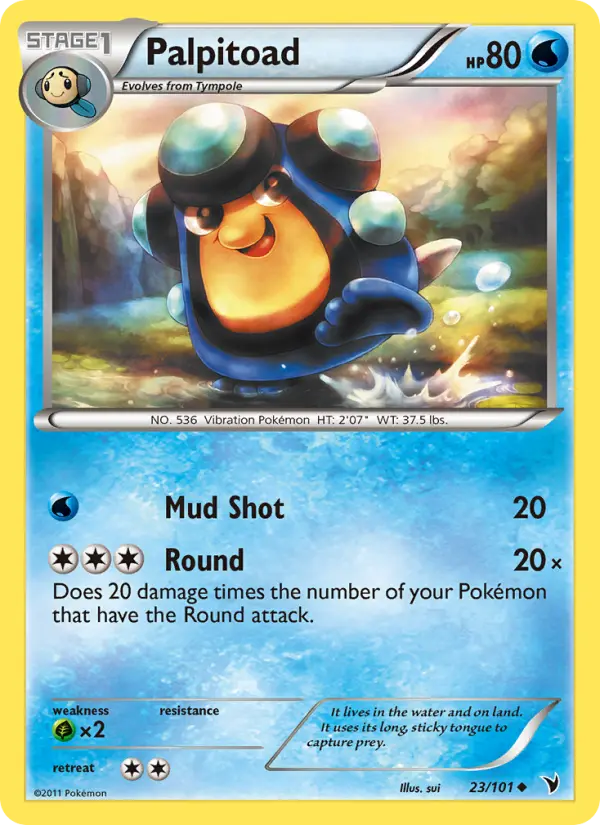
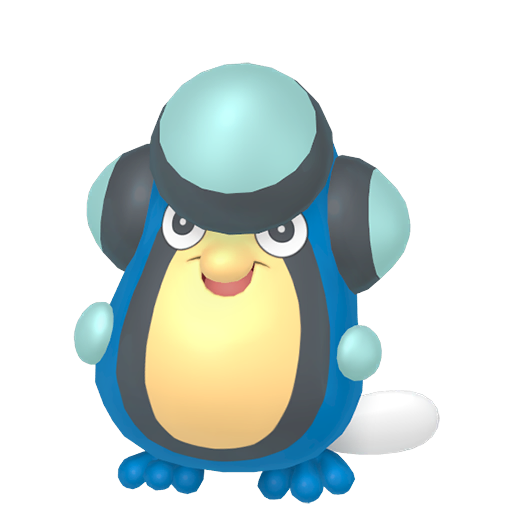
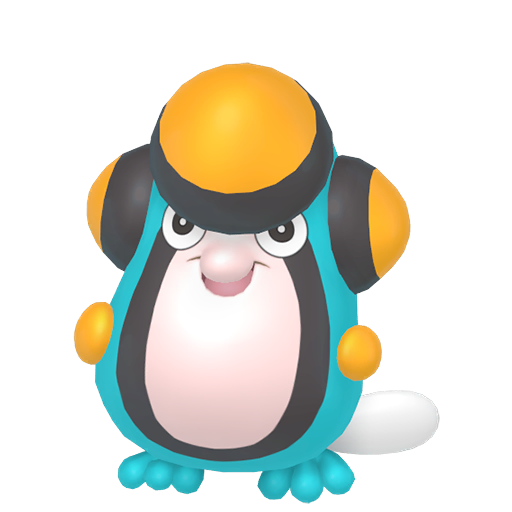
Palpitoad is an amphibious, bipedal Pokémon with a distinctive ovoid body predominantly colored in shades of blue. Its most eye-catching features are the three large, light turquoise half-spheres that encircle its head, each with a black base, which serve as sophisticated sensory and sonic organs. Running from the bottom of its belly to its forehead is a light tan oval marking lined in black, creating a striking visual symmetry. The Pokémon possesses round black eyes and a curved upper lip that drops sharply at the corners, framing a mouth containing an exceptionally long, sticky tongue perfectly adapted for capturing and immobilizing prey. Small three-toed feet support its body, while an oval, white tail completes its anatomical profile. Four round, light blue bumps extend from either side of its lower body across its back, which work in conjunction with the cranial lumps to produce vibrations. These bumps are not merely cosmetic features—according to Pokédex entries, the larger a Palpitoad's lumps are, the wider the range of sounds it can produce, demonstrating a direct correlation between physical development and acoustic capability.
Pokedex Numbers
Training
Breeding
Palpitoad Breeding, Gender Ratio & Egg Groups
There's no gender skew here: Palpitoad breeds at an even 50% male / 50% female rate. The species belongs to the Water 1 egg group, which is one of the largest and most versatile breeding groups in the Pokémon world, containing numerous aquatic and semi-aquatic species that can produce compatible offspring. With a base friendship value of 70, Palpitoad demonstrates moderate natural affection toward its trainer, making it reasonably amenable to breeding programs and companionship compared to Pokémon with lower friendship scores. The species requires 20 egg cycles to hatch, equivalent to approximately 4,884 to 5,140 steps in the overworld, making it a moderate investment in breeding time for trainers seeking to obtain competitive or shiny specimens. The medium-slow growth rate means that Palpitoad develops at a measured pace, neither rushed nor particularly delayed, which complements its role as a mid-stage evolution that players will likely use for a moderate portion of their playthrough before advancing to Seismitoad.
Sprites




Held Items
Pecha Berry
medicine
Held: Consumed when poisoned to cure poison.
Cost: 80
Pecha Berry
medicine
Held: Consumed when poisoned to cure poison.
Cost: 80
Persim Berry
medicine
Held: Consumed when confused to cure confusion.
Cost: 80
Persim Berry
medicine
Held: Consumed when confused to cure confusion.
Cost: 80
TMs & HMs
tm01
platinum
tm01
emerald
tm01
diamond pearl
tm01
firered leafgreen
tm01
ruby sapphire
tm01
xd
tm01
colosseum
tm01
heartgold soulsilver
tm03
ruby sapphire
tm03
platinum
tm03
firered leafgreen
tm03
heartgold soulsilver
tm03
diamond pearl
tm03
emerald
tm03
xd
tm03
colosseum
tm05
lets go pikachu lets go eevee
tm06
yellow
tm06
gold silver
tm06
red blue
+411 more TMs/HMs
Palpitoad's Evolution Chain


Palpitoad Evolution, Mega Evolution & Special Forms
Palpitoad occupies a crucial position in one of Generation V's most straightforward evolutionary lines. It evolves from Tympole starting at level 25, marking the moment when the tadpole-like Water-type acquires its Ground-typing and develops the specialized vibration organs that define the species. The evolution from Tympole to Palpitoad represents a significant morphological and ecological shift, as the young tadpole matures into a true amphibian capable of spending substantial time on land. At level 36, Palpitoad undergoes its final evolution into Seismitoad, a powerful and bulkier form that enhances the Vibration Pokémon's stats substantially—particularly in Attack, Defense, and Special Attack—while maintaining the Water/Ground typing. This three-stage evolution line demonstrates a clear progression from aquatic dependency through semi-aquatic adaptation to becoming a formidable dual-environment powerhouse. The evolutionary timing is well-distributed across the early-to-mid game, allowing trainers who catch Tympole in the wild to enjoy a fully-evolved partner by the time they reach the later challenges of their journey through Unova.
Where to Find
Icirrus City
unova
+57 more
Unova Route 8
unova
+61 more
Moor of Icirrus
unova
+57 more
Pinwheel Forest
unova
+9 more
Palpitoad Behaviour and Natural Habitat
Palpitoad exhibits a highly adaptable lifestyle, thriving equally in aquatic and terrestrial environments as reflected in its Water/Ground typing. These amphibians utilize their remarkable sensory bumps to create either water waves or earthquake-like vibrations depending on their environment, employing these phenomena both for navigation and as hunting mechanisms. The Vibration Pokémon is a skilled predator that weakens its prey through intense sound waves capable of causing severe headaches before immobilizing the stunned victim with its extraordinarily sticky tongue. According to Pokédex entries from multiple generations, Palpitoad lives comfortably in both water and on land, making it a true generalist in ecological terms. The species is known to emit various vocalizations, with Sword and Shield Pokédex entries noting that larger individuals with more prominent lumps can sing with a wider range of sounds, and occasionally their cries are described as sublimely pleasing to the ear. This behavioral flexibility and acoustic complexity suggest that Palpitoad likely inhabits marshes, swamps, and wetlands where water and land intermingle, allowing it to exploit resources from both biomes simultaneously.
Pokedex Entries
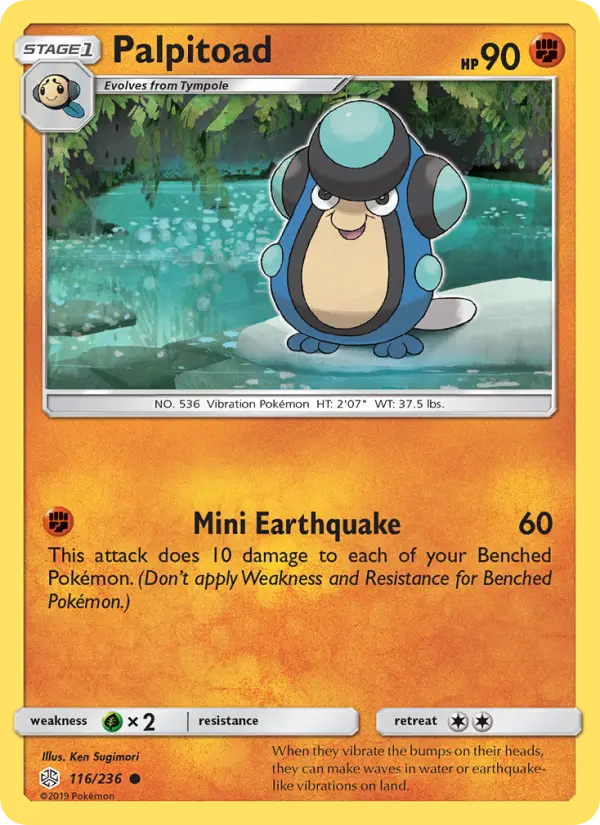
When they vibrate the bumps on their heads, they can make waves in water or earthquake-like vibrations on land.
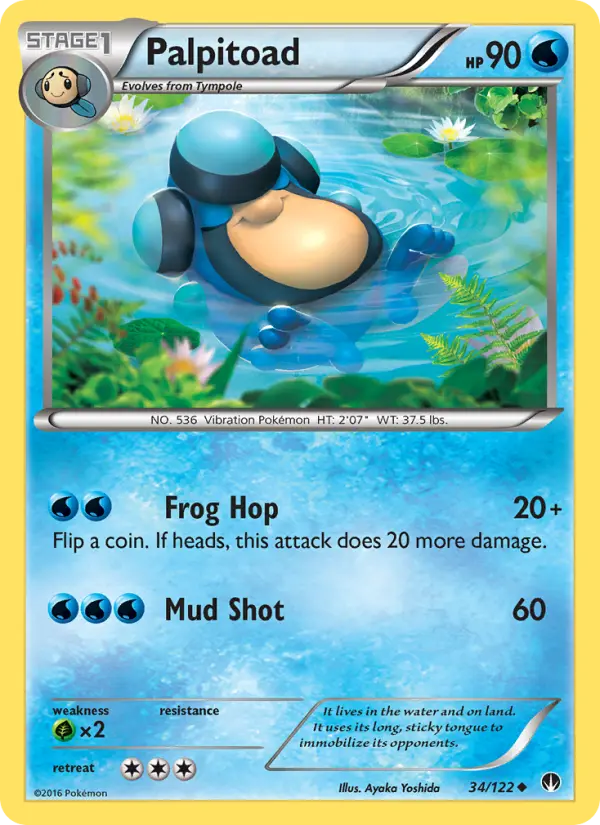
It lives in the water and on land. It uses its long, sticky tongue to immobilize its opponents.
It lives in the water and on land. It uses its long, sticky tongue to capture prey.
When they vibrate the bumps on their heads, they can make waves in water or earthquake-like vibrations on land.
It lives in the water and on land. It uses its long, sticky tongue to immobilize its opponents.
When they vibrate the bumps on their heads, they can make waves in water or earthquake-like vibrations on land.
It lives in the water and on land. It uses its long, sticky tongue to immobilize its opponents.
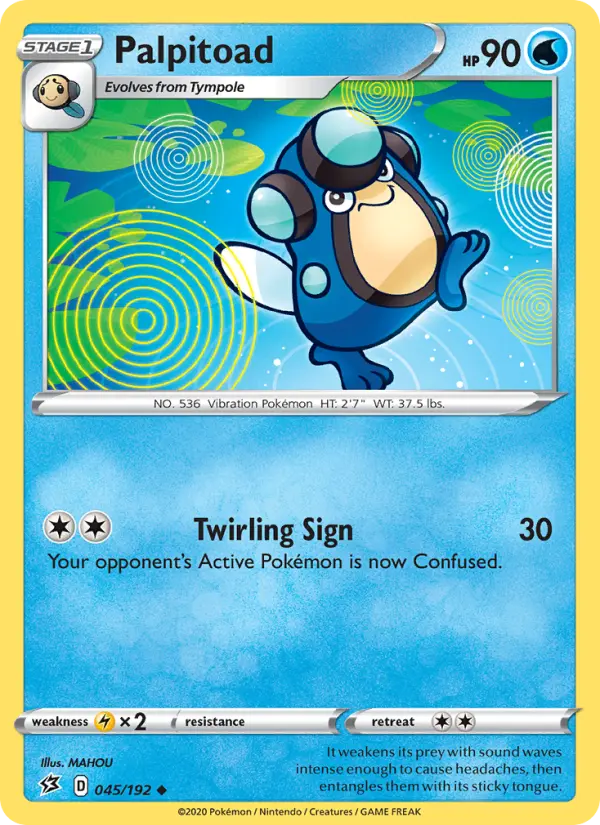
It weakens its prey with sound waves intense enough to cause headaches, then entangles them with its sticky tongue.
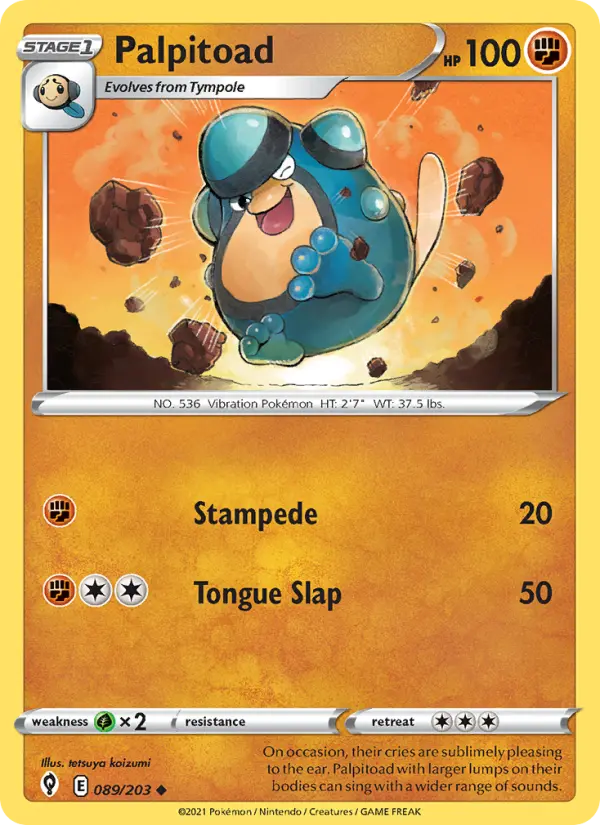
On occasion, their cries are sublimely pleasing to the ear. Palpitoad with larger lumps on their bodies can sing with a wider range of sounds.
Palpitoad Name Origin & Design Inspiration
Palpitoad's name traces back to 'palpitate,' referring to rapid vibrations or trembling, combined with 'toad,' reflecting its amphibious nature and evolutionary distance from its tadpole predecessor. The Japanese name Gamagaru similarly combines 'gama' (meaning frog or toad) with 'garu,' creating a name that emphasizes its croaking, vibration-based communication. The design philosophy clearly prioritizes sensory specialization, with the three distinctive bumps on its head serving as the visual embodiment of its vibrational abilities. These cranial structures recall the tympanum or ear-drum concept, creating a biological plausibility for the Pokémon's sonic capabilities while maintaining an aesthetically pleasing silhouette. The long, sticky tongue is a recognizable amphibian trait exaggerated for combat purposes, emphasizing Palpitoad's predatory nature and hunting prowess. The light tan belly stripe creates visual balance against its predominantly blue coloration, while the white tail provides an additional point of visual interest that helps distinguish it from purely aquatic Water-types.
Learnable Moves
Palpitoad can learn 52 moves:
Move | Type | Cat. | Power | Acc. | PP |
|---|---|---|---|---|---|
| acid | poison | Special | 40 | 100 | 30 |
| after you | normal | Status | — | — | 15 |
| aqua ring | water | Status | — | — | 20 |
| attract | normal | Status | — | 100 | 15 |
| bounce | flying | Physical | 85 | 85 | 5 |
| bubble | water | Special | 40 | 100 | 30 |
| bubble beam | water | Special | 65 | 100 | 20 |
| bulldoze | ground | Physical | 60 | 100 | 20 |
| confide | normal | Status | — | — | 20 |
| double team | normal | Status | — | — | 15 |
| earth power | ground | Special | 90 | 100 | 10 |
| echoed voice | normal | Special | 40 | 100 | 15 |
| endeavor | normal | Physical | — | 100 | 5 |
| endure | normal | Status | — | — | 10 |
| facade | normal | Physical | 70 | 100 | 20 |
| flail | normal | Physical | — | 100 | 15 |
| focus punch | fighting | Physical | 150 | 100 | 20 |
| frustration | normal | Physical | — | 100 | 20 |
| gastro acid | poison | Status | — | 100 | 10 |
| growl | normal | Status | — | 100 | 40 |
| hail | ice | Status | — | — | 10 |
| hidden power | normal | Special | 60 | 100 | 15 |
| hydro pump | water | Special | 110 | 80 | 5 |
| hyper voice | normal | Special | 90 | 100 | 10 |
| icy wind | ice | Special | 55 | 95 | 15 |
| infestation | bug | Special | 20 | 100 | 20 |
| mud shot | ground | Special | 55 | 95 | 15 |
| muddy water | water | Special | 90 | 85 | 10 |
| power whip | grass | Physical | 120 | 85 | 10 |
| protect | normal | Status | — | — | 10 |
| rain dance | water | Status | — | — | 5 |
| rest | psychic | Status | — | — | 5 |
| return | normal | Physical | — | 100 | 20 |
| rock smash | fighting | Physical | 40 | 100 | 15 |
| round | normal | Special | 60 | 100 | 15 |
| scald | water | Special | 80 | 100 | 15 |
| screech | normal | Status | — | 85 | 40 |
| secret power | normal | Physical | 70 | 100 | 20 |
| sleep talk | normal | Status | — | — | 10 |
| sludge bomb | poison | Special | 90 | 100 | 10 |
| sludge wave | poison | Special | 95 | 100 | 10 |
| snore | normal | Special | 50 | 100 | 15 |
| stealth rock | rock | Status | — | — | 20 |
| substitute | normal | Status | — | — | 10 |
| supersonic | normal | Status | — | 55 | 20 |
| surf | water | Special | 90 | 100 | 15 |
| swagger | normal | Status | — | 85 | 15 |
| toxic | poison | Status | — | 90 | 10 |
| uproar | normal | Special | 90 | 100 | 10 |
| venom drench | poison | Status | — | 100 | 20 |
| water pulse | water | Special | 60 | 100 | 20 |
| weather ball | normal | Special | 50 | 100 | 10 |
Palpitoad Competitive Battle Guide
In competitive contexts, Palpitoad occupies a specialized niche primarily defined by its three available abilities. Swift Swim doubles its Speed stat during rain weather, transforming Palpitoad's modest 69 Speed base into a competitive 138 in rain-based teams, making it a viable rain sweeper or pivoting support Pokémon. Hydration cures any major status condition after each turn during rain, providing valuable team utility and defensive capability against status-heavy offensive threats. The hidden ability Water Absorb allows Palpitoad to heal 25% of its maximum HP whenever it absorbs Water-type moves, potentially enabling stall strategies or enabling Palpitoad to serve as a Water-type switch-in. With balanced offensive stats of 65 in both Attack and Special Attack, Palpitoad can neither be classified as a specialization toward physical or special coverage, though its 75 HP and relatively low defenses of 55 in both categories limit its staying power. The movepool provides solid coverage options typical of Water/Ground Pokémon, including access to Earthquake, Scald, and various utility moves, though Palpitoad generally functions best as a lead or pivot Pokémon in rain-oriented teams rather than as a primary sweeper or wall.
Commonly Asked Questions About Palpitoad
What type is Palpitoad?
Palpitoad is a water and ground type Pokemon.
What does Palpitoad evolve into?
Palpitoad evolves into seismitoad.
What are Palpitoad's weaknesses?
Palpitoad is weak to grass and electric type moves.
Does Palpitoad evolve by trading?
No — Palpitoad evolves entirely through leveling up, with no trade required at any stage.
Where can I find Palpitoad?
Palpitoad can be found in icirrus city (unova), unova route 8 (unova) and moor of icirrus (unova) and 1 other locations.
Palpitoad Cultural Impact & Franchise History
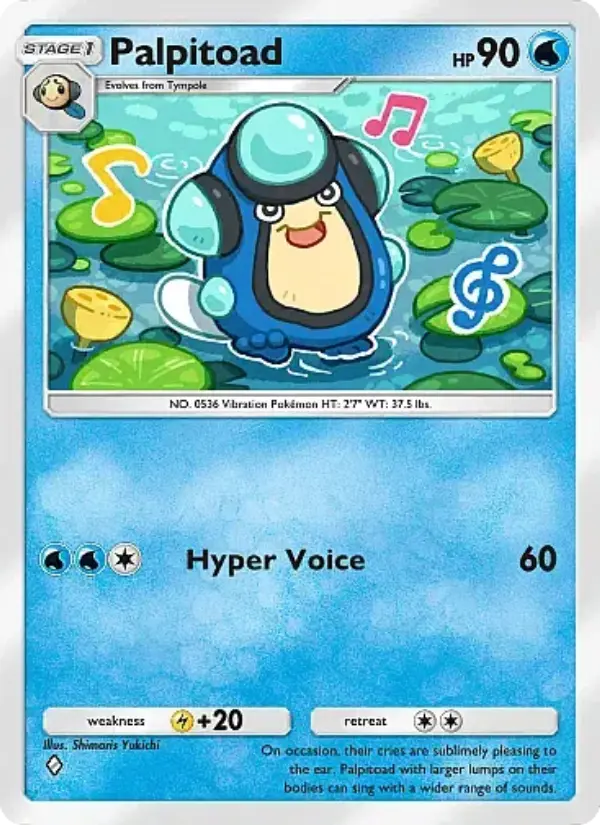
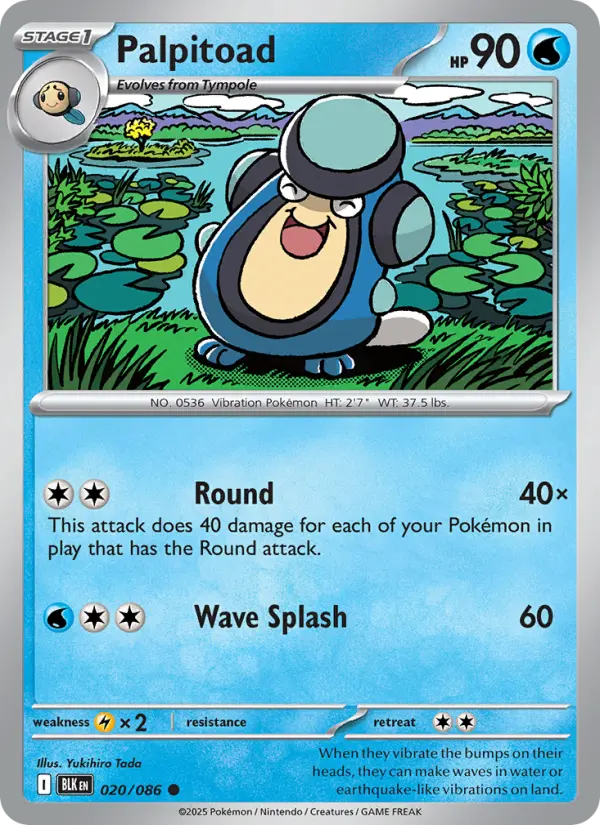
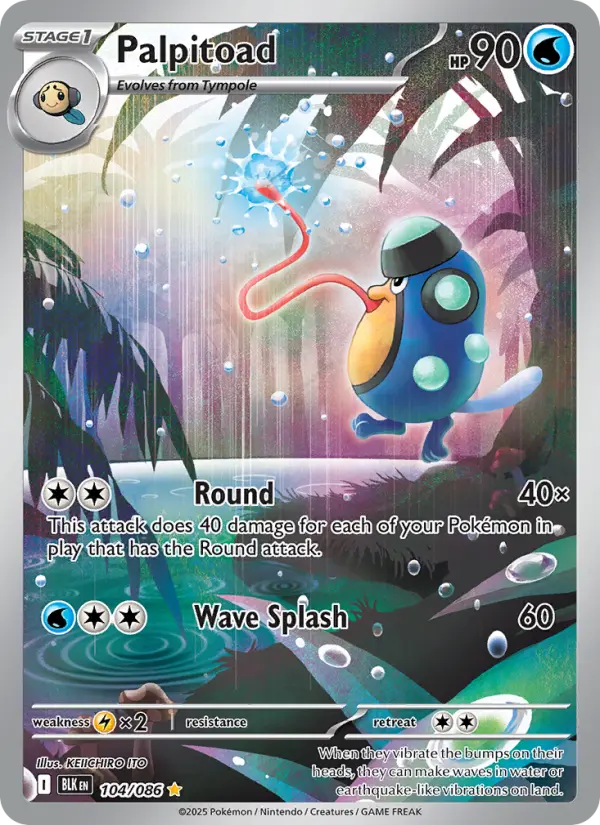
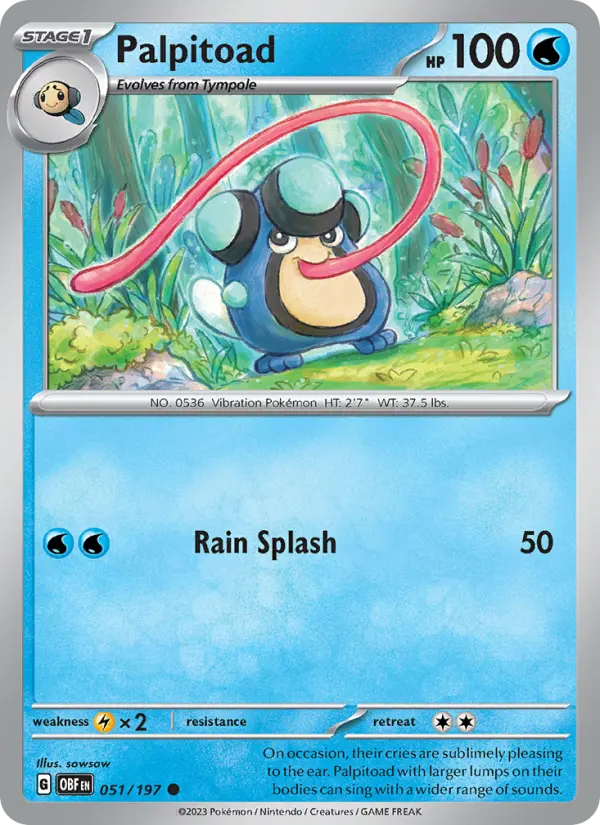
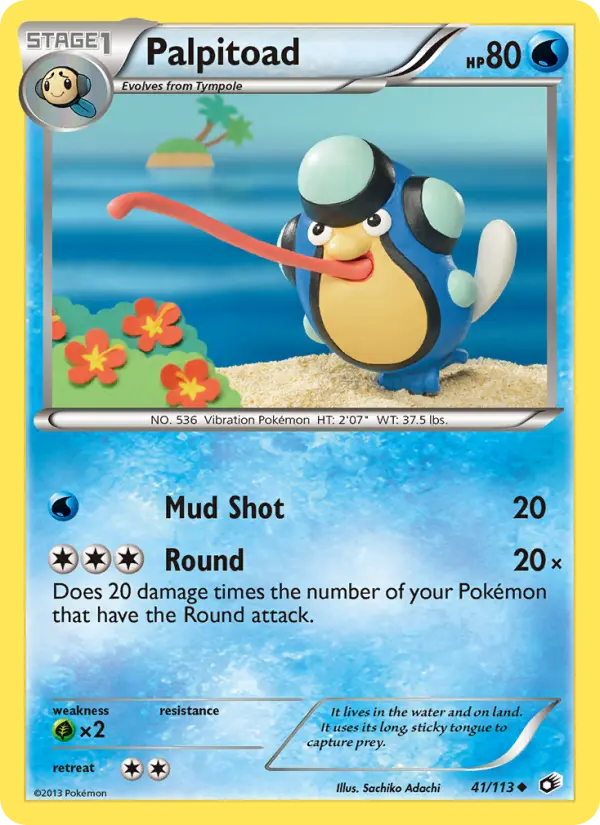
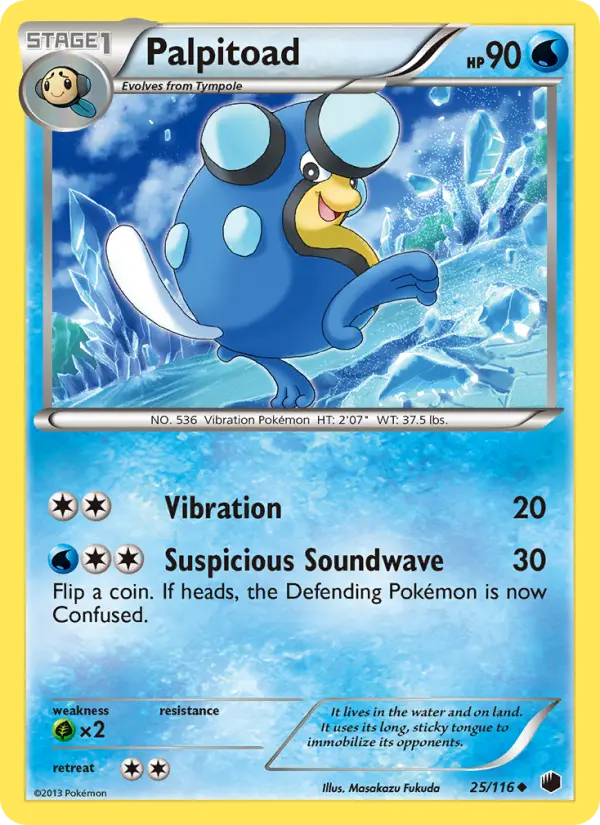
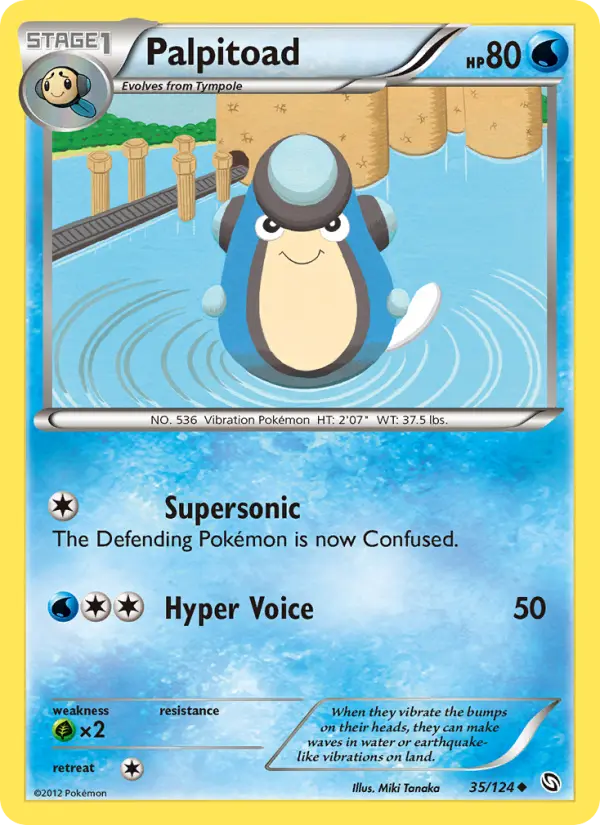
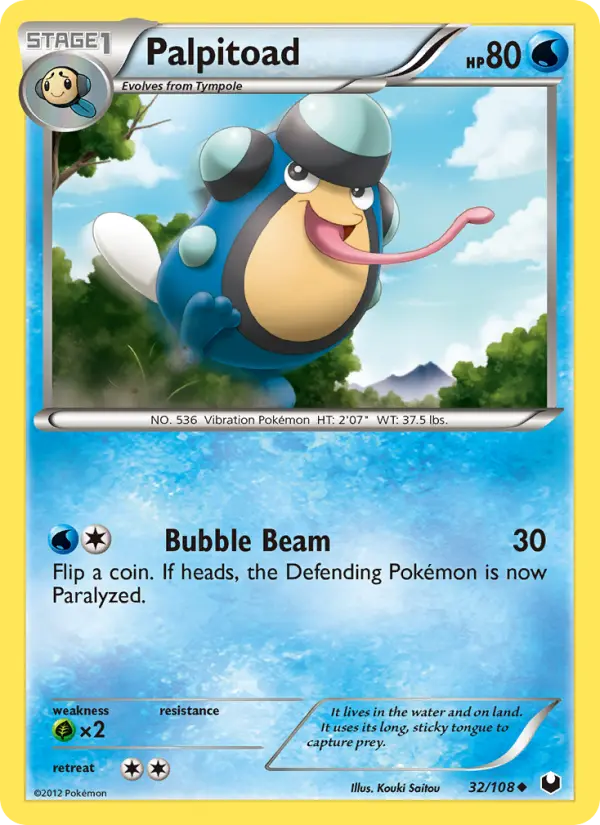
Palpitoad achieved notable cultural prominence through its prominent role in the Pokémon anime, most memorably as Ash Ketchum's team member during his journey through the Unova region. The partnership between Ash and Palpitoad provided significant narrative weight and character development, with the Pokémon demonstrating loyalty and growth through multiple battles and challenges. This anime exposure introduced Palpitoad to audiences who might not have encountered it in the games, cementing its place in Generation V's cultural legacy. The Vibration Pokémon has also featured in the Pokémon Trading Card Game with various card interpretations across multiple generations, allowing collectors and competitive players to experience the species in a different medium. Within the broader Pokémon community, Palpitoad occupies a respected if not iconic position—it is neither as celebrated as flagship Pokémon nor as obscure as many Generation V introductions, existing instead as a solid, reliable middle-evolution that many players encounter and appreciate without necessarily making it a personal favorite. The species' design and mechanics have inspired appreciation among players interested in weather-based team building and rain-dependent strategies.
Where to Find Palpitoad in Every Pokémon Game
Palpitoad is primarily available in Generation V games as the natural evolution of Tympole, which can be caught in various water routes and areas throughout Unova. Players can encounter wild Tympole in Generation V and evolve it to Palpitoad at level 25, or they can potentially find Palpitoad directly in certain routes depending on the specific game version and encounter table configuration. In subsequent generations, Palpitoad's availability varies significantly—it appears in some regional Pokédexes while being absent from others, reflecting the rotating inclusion strategy employed by Game Freak to maintain game balance and encourage trading between versions. The species has been available through various distribution methods including breeding chains, the Global Wonder Trade, and Pokémon Bank transfers across generations. In more recent titles such as Pokémon Sword and Shield, Palpitoad is available either through wild encounters or as an evolutionary target for Tympole caught in designated water routes. Its base catch rate of 120 makes it reasonably easy to capture in the wild, reducing the need for specialized catching strategies and contributing to its accessibility for players of varying skill levels.