Pidove
Generation V · #0519 — Tiny Pigeon Pokémon
Pidove entered the roster in Generation V as a normal/flying-type, and what's stuck since is less its typing than its big pecks ability. Despite its diminutive stature of just 0.3 meters in height and a mere 2.1 kilograms in weight, Pidove has captured the hearts of many trainers who appreciate its genuine friendliness and sincere nature, traits that often outweigh its intellectual limitations. The species' high catch rate of 255 makes it one of the easiest Pokémon to encounter and recruit early in a trainer's journey, with a base happiness of 70 reflecting its naturally affectionate disposition toward those who care for it.
Editor's Take
Pidove's line ends in Unfezant, which has a gender-based appearance difference and a stat gap — the males hit harder, which is unusual enough to be worth noting.
Base Stats
Height
0.3m
Weight
2.1kg
Category
Tiny Pigeon Pokémon
Gender
Male 50% / Female 50%
Color
gray
Shape
wings
Abilities
Protects against Defense drops.
Raises moves' critical hit rates one stage.
Increases damage inflicted to 1.25× against Pokémon of the same gender, but decreases damage to 0.75× against the opposite gender.

Pidove Biology & Physical Characteristics
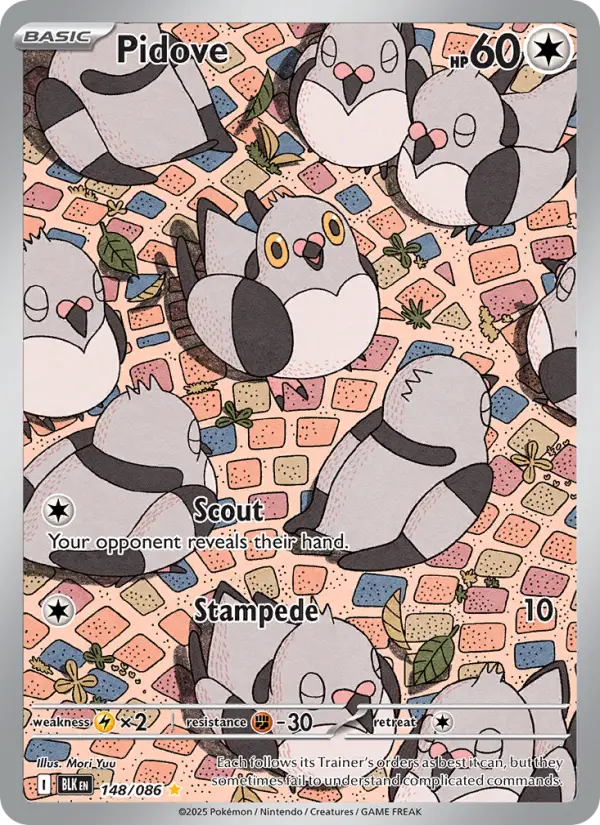
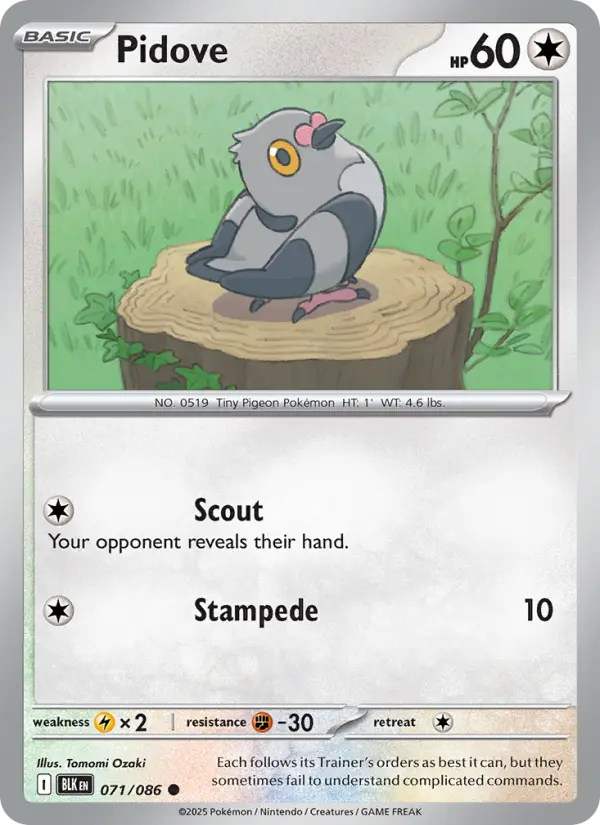
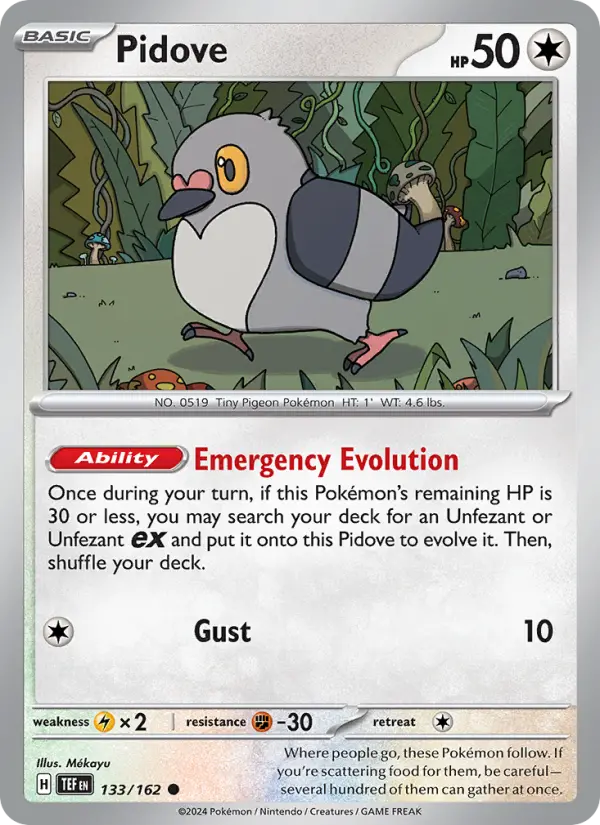
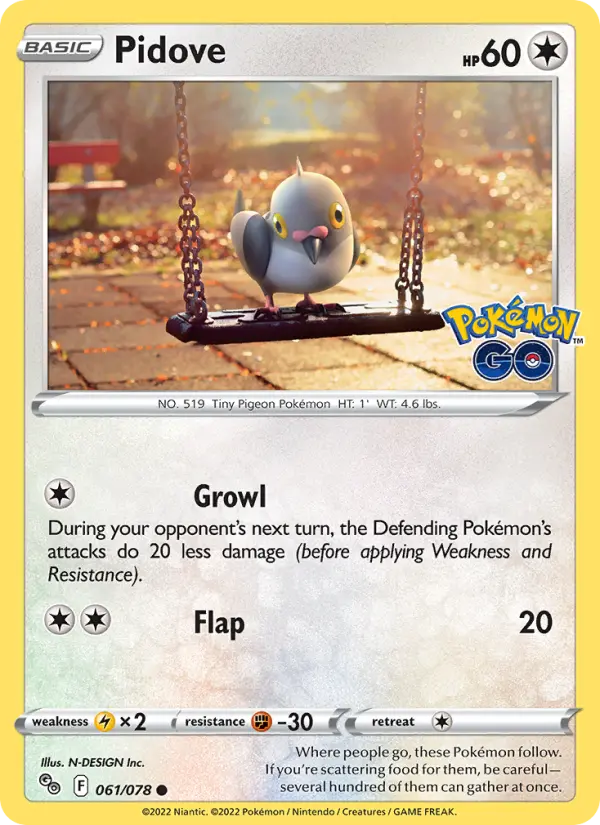
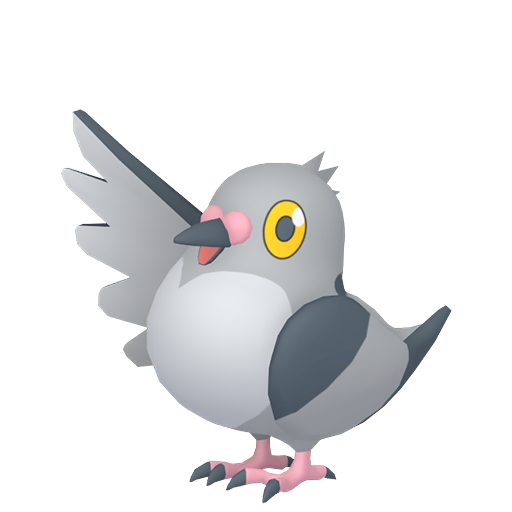
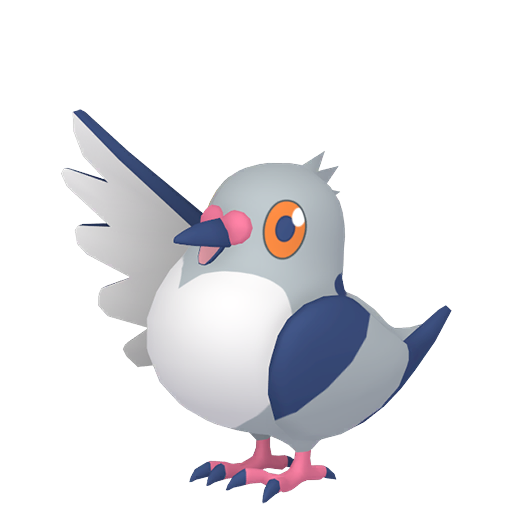
Pidove is a distinctly avian Pokémon with a gray, pigeon-like appearance that accurately reflects its biological design philosophy from Generation V. The creature features a rounded, gray body topped with a tuft of feathers, complemented by large, golden oval eyes that give it an perpetually curious expression. Its short black beak is accented with a bulbous pink cere, while a distinctive black patch adorns the nape of its neck. A striking heart-shaped area of lighter gray coloration marks its chest, serving as a recognizable identifier in the species. Pidove's black wings are emblazoned with thick gray stripes, and its small feet are pink with black talons designed for perching in urban environments. The species achieves a base stat total of 264, with its strengths concentrated in Attack (55) and Defense (50), while its Special Attack (36) and Special Defense (30) are notably weak, reflecting its role as a physical-focused flier.
Pokedex Numbers
Training
Breeding
Pidove Breeding, Gender Ratio & Egg Groups
Pidove has one of the simplest gender ratios in the game — a flat 50/50, allowing trainers equal opportunity to breed either gender for their teams or breeding projects. The species belongs to the Flying egg group, making it compatible with numerous other Flying-type Pokémon and a select group of non-Flying species that share the same reproductive classification. Breeding two Pidove together will consistently produce Pidove eggs rather than eggs of more advanced evolutions, requiring trainers to raise offspring from the base form if they wish to develop a team through breeding rather than traditional catching methods. The egg hatching counter of 15 cycles translates to approximately 3,599 to 3,855 steps before a Pidove egg hatches, making it a moderately quick breeder compared to many other Pokémon species. In Generations V through VII, Pidove exhibited a base happiness value of 70, which was later adjusted in subsequent generations, indicating the developers' desire to maintain Pidove's reputation as an exceptionally friendly and approachable Pokémon that bonds quickly with trainers who treat it with care and affection.
Sprites




TMs & HMs
tm01
ultra sun ultra moon
tm01
sun moon
tm02
yellow
tm02
red blue
tm02
lets go pikachu lets go eevee
tm02
blue japan
tm02
red green japan
tm05
lets go pikachu lets go eevee
tm06
yellow
tm06
gold silver
tm06
red blue
tm06
crystal
tm06
emerald
tm06
firered leafgreen
tm06
diamond pearl
tm06
platinum
tm06
ruby sapphire
tm06
colosseum
tm06
black 2 white 2
tm06
xd
+405 more TMs/HMs
Pidove's Evolution Chain


Pidove Evolution, Mega Evolution & Special Forms
Pidove exists as the first stage of a three-part evolutionary line that culminates in the powerful Unfezant, making its selection by trainers a long-term investment in a fully-fledged aerial combatant. Upon reaching level 21, Pidove undergoes its first transformation into Tranquill, a more composed and focused evolution that begins to shed the species' signature forgetfulness and gains improved stats across the board. The final evolution occurs at level 32, transforming Tranquill into Unfezant, a considerably more elegant and battle-capable Pokémon that gains both physical presence and competitive viability. This evolutionary progression mirrors the maturation process of real-world pigeons, transitioning from the humble, city-dwelling Pidove through the increasingly competent Tranquill to the finally confident and capable Unfezant. The evolution line demonstrates careful stat progression, with Pidove's baseline stats of 264 being deliberately conservative to allow dramatic improvements in subsequent evolutions, ensuring that trainers who invest time in nurturing their Pidove are rewarded with a genuinely powerful ally by the time they reach Unfezant.
Where to Find
Unova Route 3
unova
+17 more
Pinwheel Forest
unova
+9 more
Unova Route 20
unova
+13 more
Castelia City
unova
+5 more
Floccesy Ranch
unova
Virbank Complex
unova
+5 more
Pidove Behaviour and Natural Habitat
Pidove is characterized by a notable lack of intelligence that endears rather than hinders its appeal to trainers seeking a loyal companion. These Pokémon are remarkably forgetful, often waiting for new orders from their trainers even when they have already received instructions, a trait documented across numerous Pokédex entries from Black 2 through Omega Ruby. While Pidove always attempts to follow its trainer's commands to the best of its ability, it frequently struggles to comprehend complex instructions, leading to amusing miscommunications during training sessions. Despite their intellectual limitations, Pidove exhibit genuine friendliness and an almost childlike sincerity that resonates with trainers. The species thrives in urban environments, having become thoroughly acclimated to human presence and civilization. Flocks of Pidove gather regularly in city parks and plazas throughout the Unova region, their constant cooing creating a characteristic soundscape of urban areas. According to field observations, several hundred Pidove can congregate in a single location when food is scattered on the ground, demonstrating their highly social and opportunistic feeding behavior.
Pokedex Entries
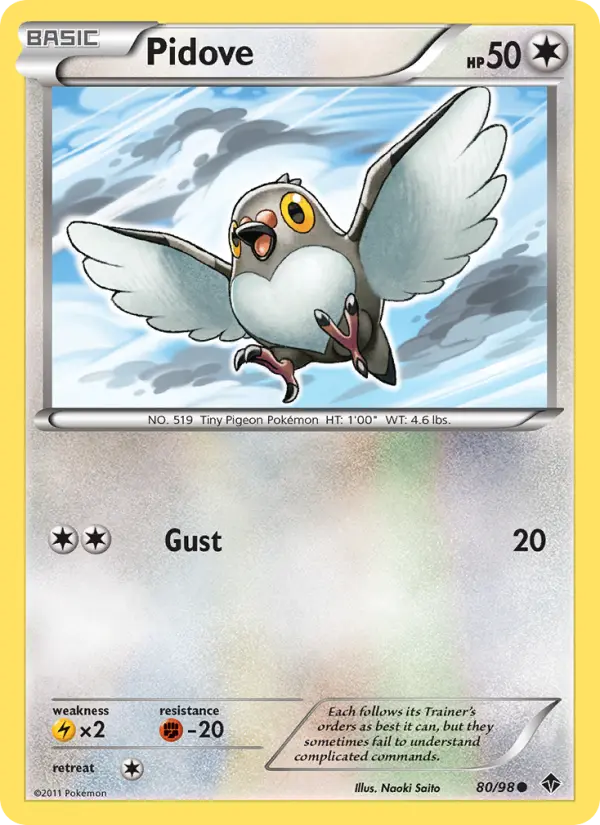
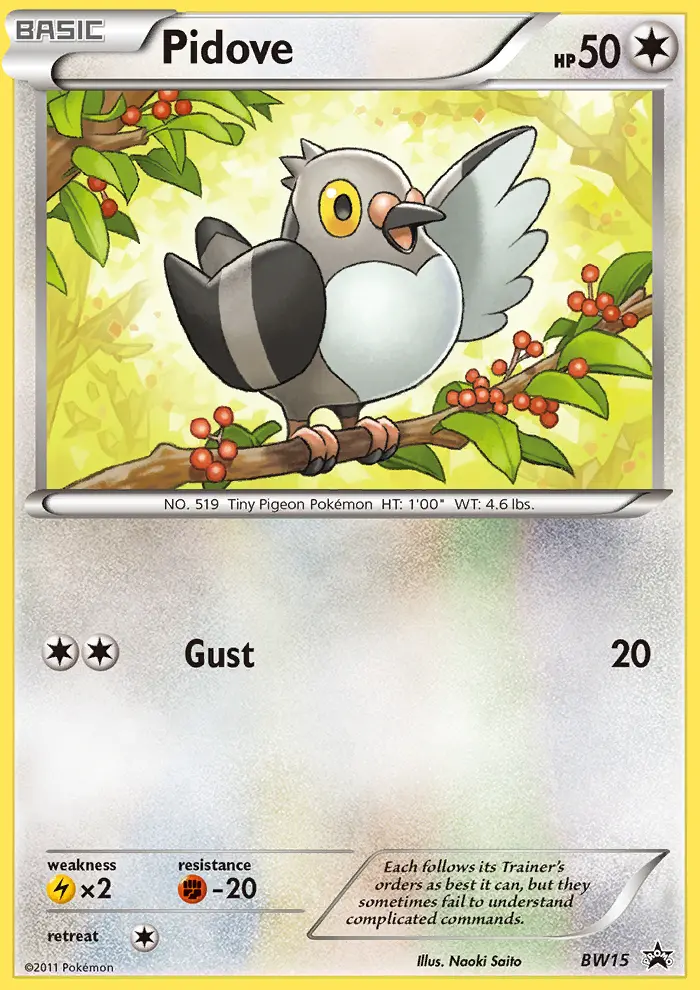
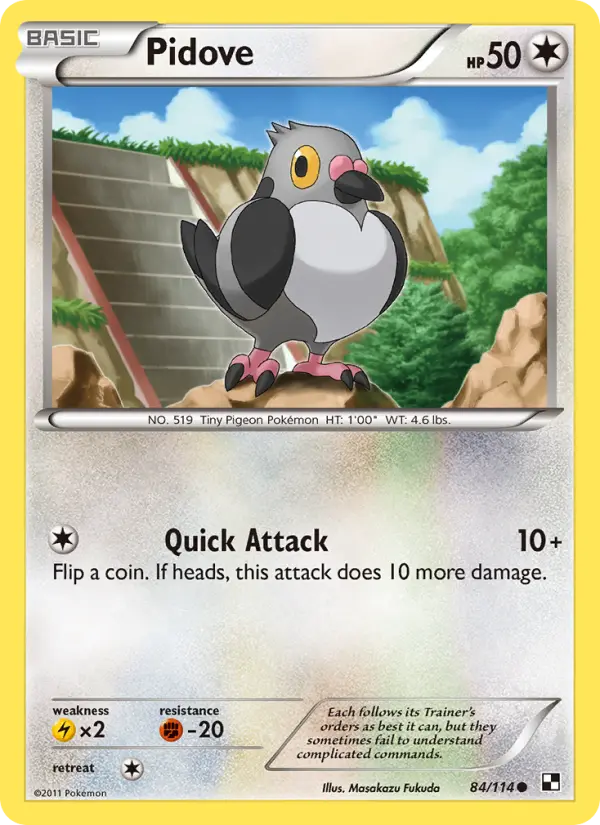
Each follows its Trainer’s orders as best it can, but they sometimes fail to understand complicated commands.
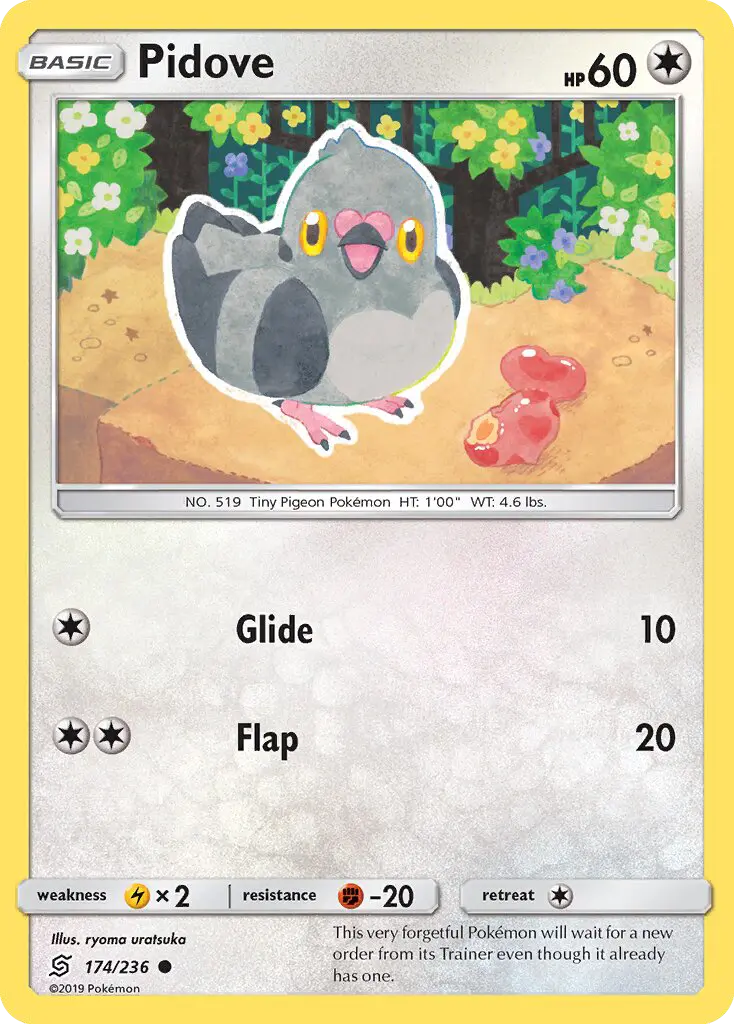
This very forgetful Pokémon will wait for a new order from its Trainer even though it already has one.
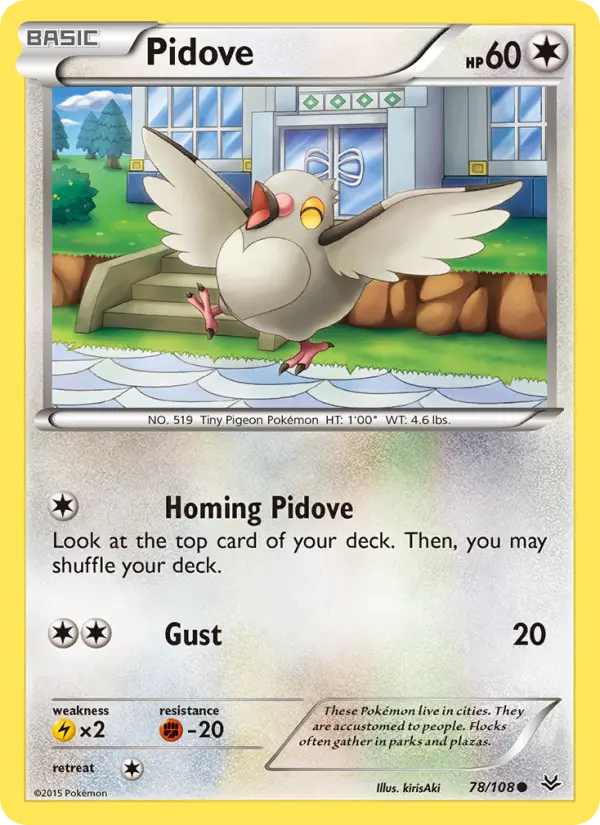
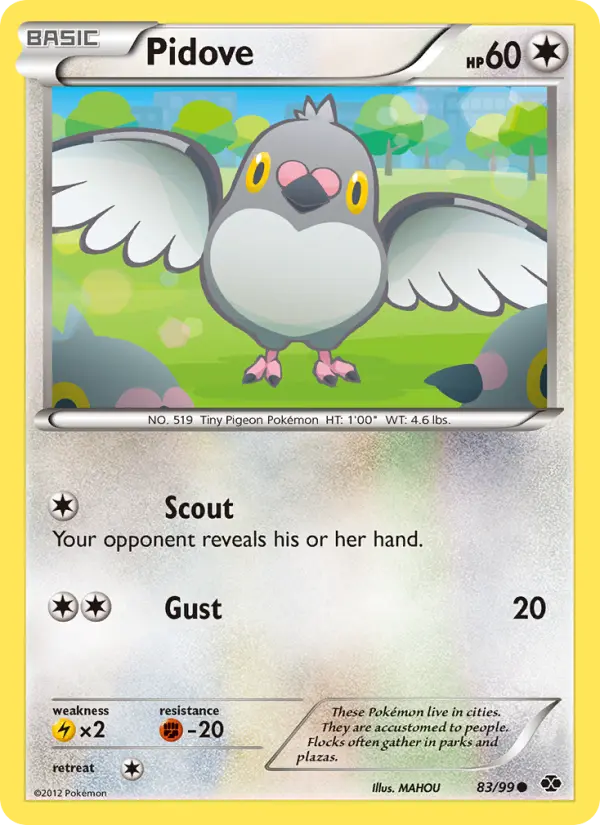
These Pokémon live in cities. They are accustomed to people. Flocks often gather in parks and plazas.
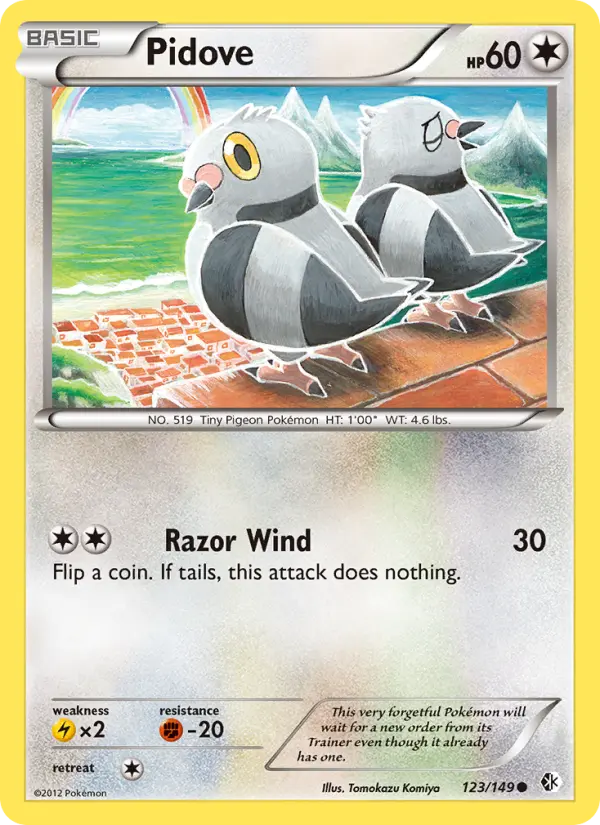
This very forgetful Pokémon will wait for a new order from its Trainer even though it already has one.
These Pokémon live in cities. They are accustomed to people. Flocks often gather in parks and plazas.
This very forgetful Pokémon will wait for a new order from its Trainer even though it already has one.
These Pokémon live in cities. They are accustomed to people. Flocks often gather in parks and plazas.
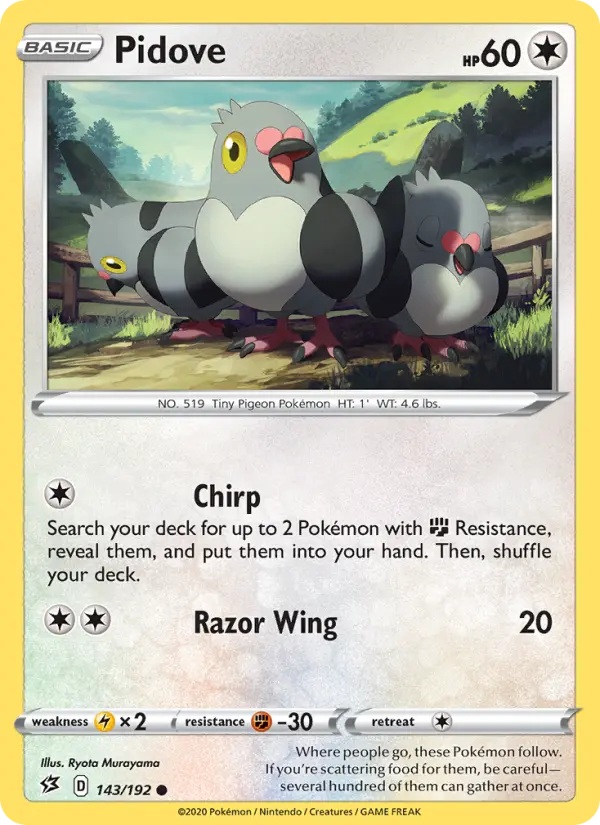
Where people go, these Pokémon follow. If you’re scattering food for them, be careful— several hundred of them can gather at once.
It’s forgetful and not very bright, but many Trainers love it anyway for its friendliness and sincerity.
Pidove Name Origin & Design Inspiration
Pidove's name can be traced to the combination of 'pigeon' and 'dove,' two terms for birds in the family Columbidae that are beloved worldwide for their gentle demeanor and homing instincts. In Japanese, the species is called Mamepato, which combines 'mame' (meaning small or bean) with 'pato' (the Japanese word for pigeon), emphasizing the tiny stature that defines this diminutive avian companion. The design philosophy behind Pidove reflects the generation's commitment to creating region-specific early-game bird encounters; while Kanto had Pidgey and Johto had Spearow, Unova trainers would rely on Pidove as their foundational flying-type ally. The species' physical design deliberately mimics common urban pigeons found throughout real-world cities, with its gray plumage, pink feet, and distinctive markings creating an instantly recognizable silhouette. The heart-shaped marking on its chest serves both as a visual identifier and a symbolic representation of the affection and sincerity that define its personality, while its bulbous pink cere echoes the characteristics of actual pigeon species, demonstrating the designers' commitment to biological accuracy within a fantastical context.
Learnable Moves
Pidove can learn 52 moves:
Move | Type | Cat. | Power | Acc. | PP |
|---|---|---|---|---|---|
| aerial ace | flying | Physical | 60 | — | 20 |
| agility | psychic | Status | — | — | 30 |
| air cutter | flying | Special | 60 | 95 | 25 |
| air slash | flying | Special | 75 | 95 | 15 |
| attract | normal | Status | — | 100 | 15 |
| bestow | normal | Status | — | — | 15 |
| confide | normal | Status | — | — | 20 |
| defog | flying | Status | — | — | 15 |
| detect | fighting | Status | — | — | 5 |
| double team | normal | Status | — | — | 15 |
| dual wingbeat | flying | Physical | 40 | 90 | 10 |
| echoed voice | normal | Special | 40 | 100 | 15 |
| endure | normal | Status | — | — | 10 |
| facade | normal | Physical | 70 | 100 | 20 |
| feather dance | flying | Status | — | 100 | 15 |
| fly | flying | Physical | 90 | 95 | 15 |
| focus energy | normal | Status | — | — | 30 |
| frustration | normal | Physical | — | 100 | 20 |
| growl | normal | Status | — | 100 | 40 |
| gust | flying | Special | 40 | 100 | 35 |
| heat wave | fire | Special | 95 | 90 | 10 |
| hidden power | normal | Special | 60 | 100 | 15 |
| hypnosis | psychic | Status | — | 60 | 20 |
| leer | normal | Status | — | 100 | 30 |
| lucky chant | normal | Status | — | — | 30 |
| morning sun | normal | Status | — | — | 5 |
| night slash | dark | Physical | 70 | 100 | 15 |
| pluck | flying | Physical | 60 | 100 | 20 |
| protect | normal | Status | — | — | 10 |
| quick attack | normal | Physical | 40 | 100 | 30 |
| rain dance | water | Status | — | — | 5 |
| razor wind | normal | Special | 80 | 100 | 10 |
| rest | psychic | Status | — | — | 5 |
| return | normal | Physical | — | 100 | 20 |
| roost | flying | Status | — | — | 5 |
| round | normal | Special | 60 | 100 | 15 |
| secret power | normal | Physical | 70 | 100 | 20 |
| sky attack | flying | Physical | 140 | 90 | 5 |
| sleep talk | normal | Status | — | — | 10 |
| snore | normal | Special | 50 | 100 | 15 |
| steel wing | steel | Physical | 70 | 90 | 25 |
| substitute | normal | Status | — | — | 10 |
| sunny day | fire | Status | — | — | 5 |
| swagger | normal | Status | — | 85 | 15 |
| swift | normal | Special | 60 | — | 20 |
| tailwind | flying | Status | — | — | 15 |
| taunt | dark | Status | — | 100 | 20 |
| toxic | poison | Status | — | 90 | 10 |
| u turn | bug | Physical | 70 | 100 | 20 |
| uproar | normal | Special | 90 | 100 | 10 |
| wish | normal | Status | — | — | 10 |
| work up | normal | Status | — | — | 30 |
Pidove Competitive Battle Guide
While Pidove itself is rarely seen in competitive Pokémon battles due to its modest aggregate stat total of 264 and weak Special Attack of 36, its evolutionary forms—particularly Unfezant—can serve viable roles in lower-tier competitive environments and casual play. Pidove's available abilities offer distinct strategic advantages: Big Pecks protects against Defense reductions, proving valuable against opponents who frequently employ stat-lowering tactics, while Super Luck increases the critical hit rate of Pidove's moves, complementing physical attacks like Quick Attack (40 power) and Air Cutter (60 power, 95 accuracy). The hidden ability Rivalry adds interesting strategic depth by increasing damage to same-gender opponents by 25% while reducing damage to opposite-gender opponents by 25%, encouraging trainers to carefully consider their Pidove's gender when building teams. Pidove's movepool develops gradually through leveling, gaining access to Taunt at level 12 for disruption, Air Cutter at level 16 for reliable aerial damage, and Feather Dance at level 24 for defensive utility through accuracy reduction. For serious competitive play, trainers would be better served by training Pidove into its final form Unfezant rather than using the base evolution, though Pidove can serve acceptably in Pokémon Mystery Dungeon and other spin-off titles where stat totals matter less than moveset availability and type coverage.
Commonly Asked Questions About Pidove
What type is Pidove?
Pidove is a normal and flying type Pokemon.
What does Pidove evolve into?
Pidove evolves into tranquill, then into unfezant.
What are Pidove's weaknesses?
Pidove is weak to rock, electric and ice type moves.
Does Pidove evolve by trading?
No — Pidove evolves entirely through leveling up, with no trade required at any stage.
Where can I find Pidove?
Pidove can be found in unova route 3 (unova), pinwheel forest (unova) and unova route 20 (unova) and 3 other locations.
Pidove Cultural Impact & Franchise History
Pidove achieved significant cultural prominence through its appearance as Ash Ketchum's reliable companion in the Pokémon animated series, where it demonstrated the species' characteristic forgetfulness while simultaneously showcasing its earnest desire to help its trainer in battle and adventure. The anime's portrayal of Ash's Pidove emphasized both comedic moments derived from its memory lapses and touching scenes highlighting the deep bond that can form between trainer and Pokémon despite intellectual differences. Beyond the main series, Pidove has appeared in various Pokémon manga adaptations and trading card games, establishing itself as an recognizable symbol of early-game Pokémon training and the beginning of every trainer's journey through the Unova region. The species' design has resonated with fans who appreciate its realistic bird aesthetics combined with charming personality quirks, leading to consistent representation in fan art and community discussions about underrated early-game Pokémon. Pidove represents a deliberate design choice to create a bridge between the familiar early-game bird format established by Pidgey in Generation I and the evolving design philosophy of later generations, proving that even modest creatures with limited capabilities can achieve meaningful cultural presence through personality and narrative significance.
Where to Find Pidove in Every Pokémon Game
Pidove is available in the early stages of Pokémon Black and White as a common encounter on Route 1, making it one of the first Pokémon trainers encounter when beginning their Unova adventure, with a local Pokédex number of #0025 in these games. In Pokémon Black 2 and White 2, Pidove's local number is #0014, reflecting its continued prominence in the early game despite the expanded Pokédex offerings of the sequel generation. The species has maintained consistent availability throughout subsequent generations, appearing in Pokémon X and Y, with further availability in Pokémon Sword and Shield where it received the local Pokédex number #0026. Pidove's exceptionally high catch rate of 255 means it can be captured with nearly any Poké Ball regardless of health status, making it accessible even to players with limited resources at the game's start. The species can be bred efficiently using any two compatible parents, and eggs hatch relatively quickly at 15 cycles, allowing dedicated trainers to obtain multiple Pidove for team building, trading, or collection purposes. Despite its availability across multiple game generations, Pidove remains most iconic to players' first experiences in the Unova region, where it serves as an accessible introduction to Flying-type Pokémon training and the foundational step toward eventually acquiring the more powerful Unfezant.