Pignite
Generation V · #0499 — Fire Pig Pokémon
Pignite entered the roster in Generation V as a fire/fighting-type, and what's stuck since is less its typing than its blaze ability. This Pokémon serves as a crucial pivot point in the evolutionary line, gaining its secondary Fighting-type classification upon reaching level 17 from Tepig, fundamentally altering its stat distribution and competitive viability. With a aggregate stat total of 418, Pignite boasts notably higher Attack (93) and HP (90) compared to its unevolved form, positioning it as an effective choice for trainers seeking a capable mid-game Fire-type before completing the evolution into Emboar at level 36.
Editor's Take
Pignite gaining Fighting typing follows the exact pattern Combusken and Monferno established, and by the third time it had stopped feeling like a reward.
Base Stats
Height
1.0m
Weight
55.5kg
Category
Fire Pig Pokémon
Gender
Male 87.5% / Female 12.5%
Color
red
Shape
upright
Abilities
Strengthens fire moves to inflict 1.5× damage at 1/3 max HP or less.
Halves damage from fire and ice moves.
Pignite Biology & Physical Characteristics
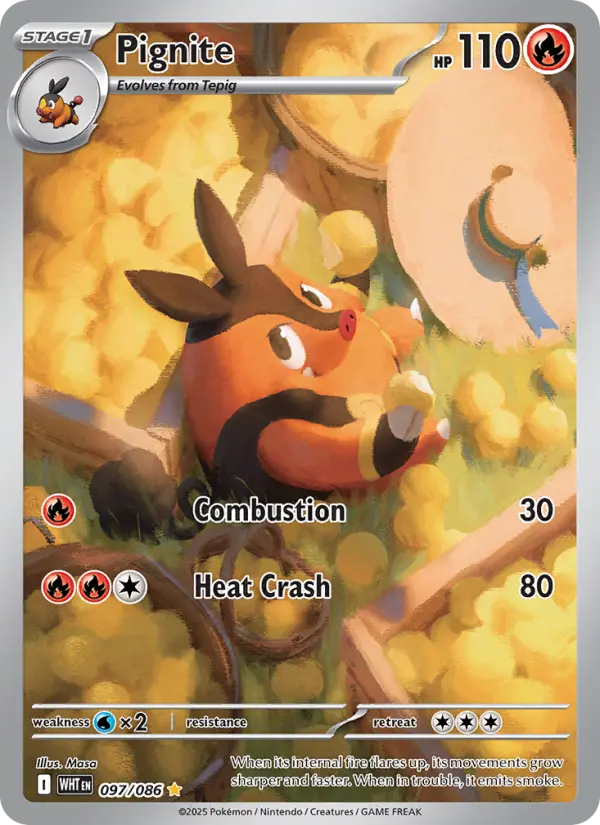
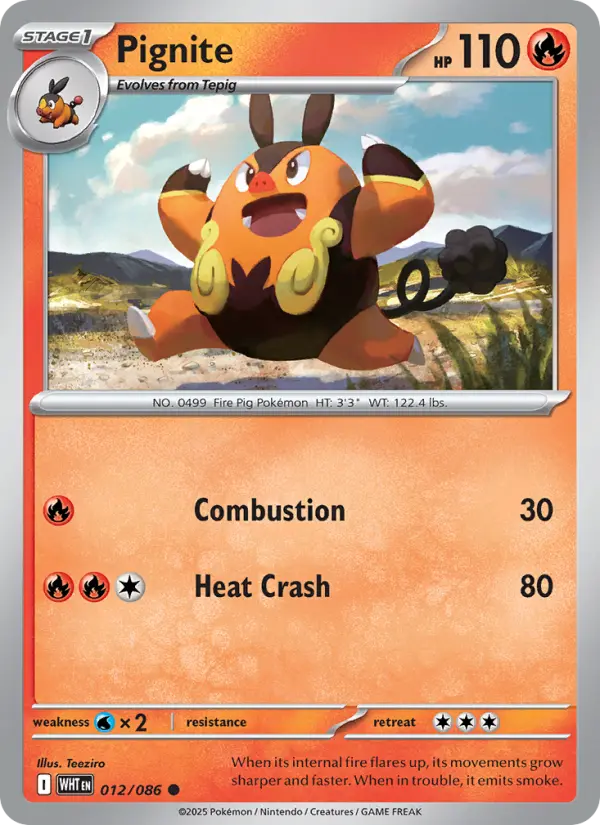
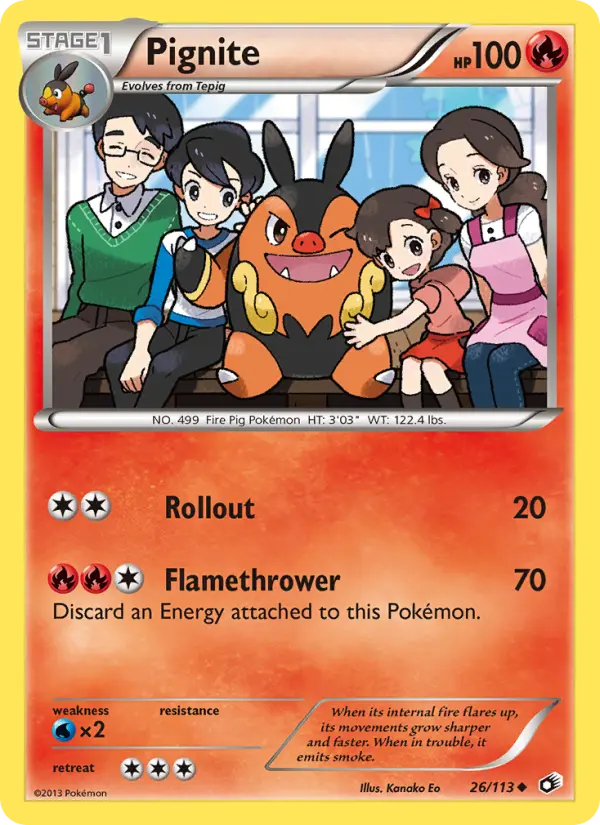
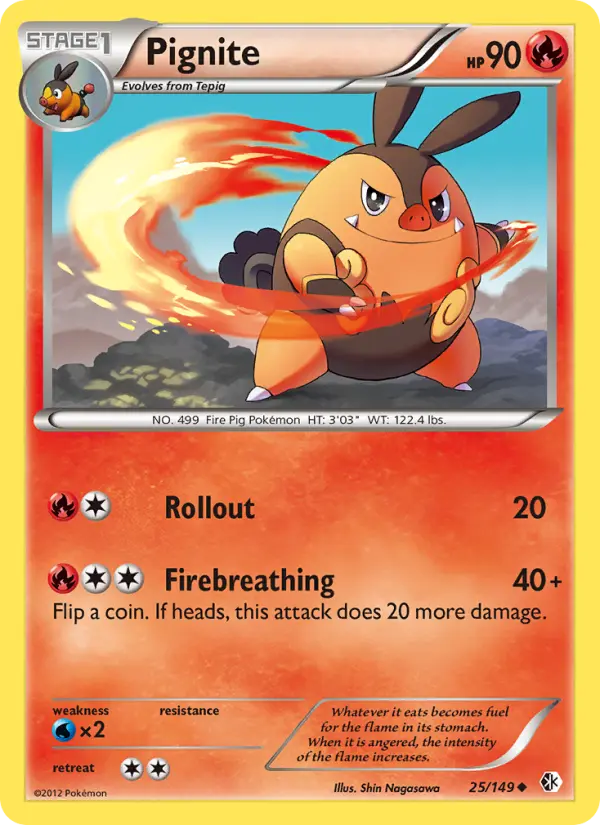
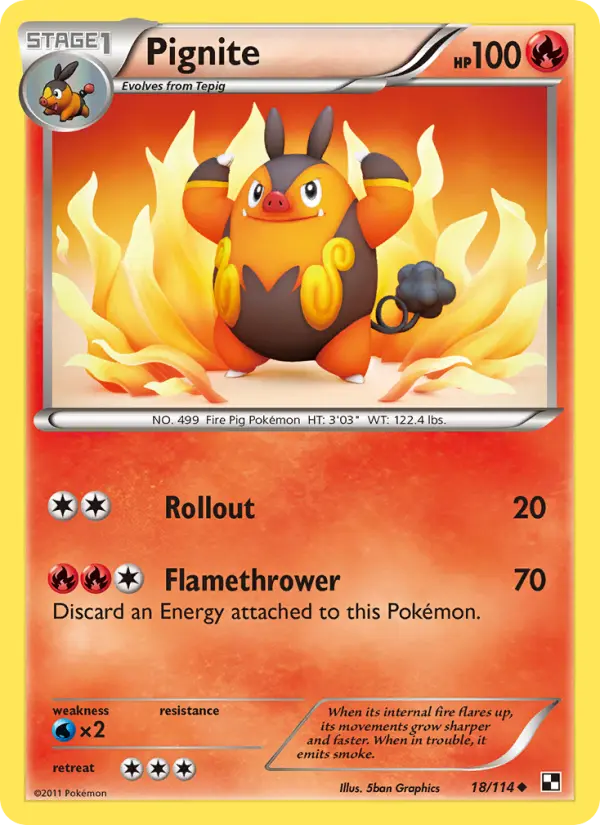
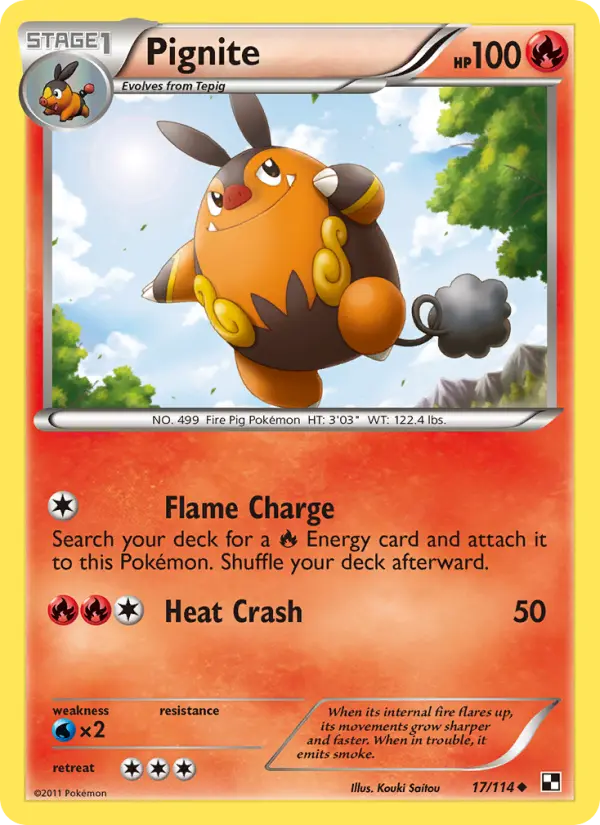
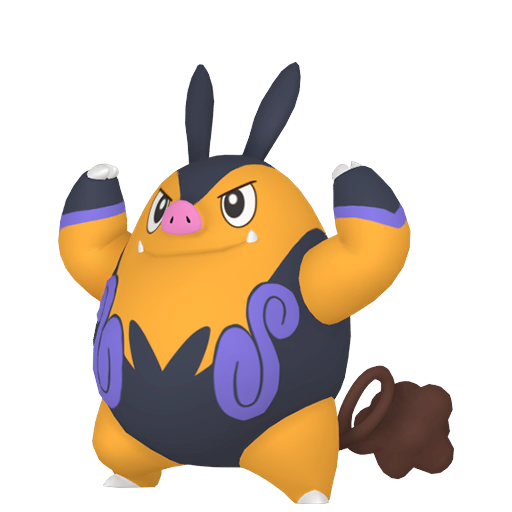
Pignite exhibits a distinctly anthropomorphic pig-like physiology with a bipedal stance and a chubby, well-proportioned body primarily colored in vibrant orange with brown striping across its shoulders, sides, belly, hands, and extending from the back of its head down its snout. Yellow bands encircle its wrists while swirled yellow designs bulge from its chest cavity, creating a striking visual contrast against its orange coloring. The Pokémon possesses a red pig-like nose, pointed ears standing erect on its head, and two characteristic pointed teeth that protrude prominently from its lower jaw. Each of its hands features two sharp claws for grappling and combat, while its feet are equipped with a single sturdy nail for stability, and its curled tail ends with a distinctive tuft of fur. The most remarkable aspect of Pignite's biology centers on the internal fire that perpetually burns within its stomach—this flame serves not merely as a biological process but as the fundamental energy source that powers the Pokémon's physical capabilities. The intensity of this internal fire directly correlates with Pignite's dietary intake and emotional state, increasing dramatically when angered or when it has consumed substantial fuel, thereby enhancing both its physical power and movement speed.
Pokedex Numbers
Training
Breeding
Pignite Breeding, Gender Ratio & Egg Groups
Pignite exhibits a pronounced gender bias characteristic of many Pokémon, with an 87.5 percent male to 12.5 percent female ratio that makes female specimens considerably rarer and more difficult to obtain through normal breeding procedures. This gender distribution necessitates strategic planning for trainers seeking to breed Pignite or its evolutionary relatives, as acquiring female specimens requires either fortunate encounters in the wild or participation in specialized breeding chains with Ditto. Pignite belongs to the Field egg group, a diverse category that includes numerous quadrupedal and bipedal mammals, reptiles, and other terrestrial creatures, allowing it to breed with a wide variety of Pokémon when paired appropriately. The species exhibits a base happiness value of 70 in Generations V through VII, indicating a moderately friendly disposition that gradually improves through positive trainer interactions, and the eggs produced require exactly 20 cycles to hatch—a process that translates to approximately 4,884 to 5,140 steps depending on game mechanics. Trainers pursuing competitive breeding projects or seeking specific nature and IV combinations should account for Pignite's male-heavy gender ratio when planning multi-generational breeding chains, as the availability of females may significantly impact timeline and resource expenditure.
Sprites





TMs & HMs
tm01
platinum
tm01
emerald
tm01
diamond pearl
tm01
firered leafgreen
tm01
ruby sapphire
tm01
xd
tm01
colosseum
tm01
heartgold soulsilver
tm01
ultra sun ultra moon
tm01
sun moon
tm02
lets go pikachu lets go eevee
tm03
crystal
tm03
gold silver
tm03
lets go pikachu lets go eevee
tm03
sword shield
tm04
gold silver
tm04
crystal
tm05
ruby sapphire
tm05
emerald
tm05
gold silver
+736 more TMs/HMs
Pignite's Evolution Chain


Pignite Evolution, Mega Evolution & Special Forms
Pignite occupies the crucial middle position of a three-stage evolutionary line beginning with Tepig at generation level one and culminating in the formidable Emboar upon reaching level 36. The evolution from Tepig to Pignite at level 17 represents a significant transformation, as the Fire-type Tepig gains the secondary Fighting-type classification and receives substantial stat improvements across multiple categories. The Attack stat increases from Tepig's 65 to Pignite's respectable 93, while HP also jumps from 65 to 90, providing Pignite with enhanced durability and physical offensive capabilities. Upon further evolution into Emboar at level 36, Pignite completes its transformation into a formidable Fire and Fighting-type dual-wielder, receiving even more dramatic stat enhancements, particularly to its Attack and Special Attack stats. This evolutionary progression is entirely level-based, requiring no special items, held objects, or environmental conditions, making it one of the more straightforward evolution paths available to trainers. The transition from Pignite to Emboar also grants access to additional moves and significantly improved stats, though Pignite itself represents a competent middle ground for trainers not yet ready to complete the full evolutionary sequence.
Where to Find
Location data not available for this Pokémon in the database.
Pignite Behaviour and Natural Habitat
Pignite demonstrates a fiercely protective nature despite its relatively docile appearance, showing unwavering willingness to defend its friends and allies from opponents regardless of their strength or size. The Pokédex entries reveal a Pokémon entirely dependent on food consumption to maintain and fuel its internal flame, with the White version specifically noting that whatever Pignite eats becomes fuel for the fire in its stomach. When its internal fire flares up through either nourishment or emotional agitation, its movements become noticeably sharper and faster, granting it sudden bursts of combat capability that can surprise unprepared opponents. In moments of danger or distress, Pignite employs a defensive strategy of emitting large clouds of thick smoke to obscure the vision of threats and facilitate escape. The Pokédex entries also warn that Pignite becomes practically powerless when its stomach is empty, implying that this Pokémon requires frequent meals to maintain its physical capabilities—a characteristic that underscores the intricate connection between its dietary habits and combat potential. Pignite's habitat preferences suggest it thrives in diverse environments found throughout the Unova region, though it appears particularly suited to warmer climates where its Fire-type nature allows it to flourish.
Pokedex Entries
When its internal fire flares up, its movements grow sharper and faster. When in trouble, it emits smoke.
The more it eats, the more fuel it has to make the fire in its stomach stronger. This fills it with even more power.
Whatever it eats becomes fuel for the flame in its stomach. When it is angered, the intensity of the flame increases.
The more it eats, the more fuel it has to make the fire in its stomach stronger. This fills it with even more power.
When its internal fire flares up, its movements grow sharper and faster. When in trouble, it emits smoke.
The more it eats, the more fuel it has to make the fire in its stomach stronger. This fills it with even more power.
When its internal fire flares up, its movements grow sharper and faster. When in trouble, it emits smoke.
Pignite Name Origin & Design Inspiration
Pignite's name comes from a straightforward combination of 'pig' and 'ignite,' perfectly capturing the essence of a fire-fueled swine Pokémon. In its original Japanese designation, Chaoboo (チャオブー) combines 'chao' with 'boo,' likely referencing the onomatopoeia of fire and the pig's nature. The design philosophy emphasizes the fusion of porcine characteristics with fiery elements, evident in the orange coloration symbolizing flames, the brown striping evoking charring or heat damage, and the yellow accents suggesting intense heat or embers. The prominent teeth and claws reflect the addition of fighting capability alongside its fire nature, while the bipedal stance elevates Pignite beyond typical four-legged animal designs, giving it an almost humanoid combat posture. The internal flame concept represents a core design element that ties together Pignite's entire identity—it's neither purely a realistic animal design nor an entirely fantastical creature, but rather a balance that makes Pignite immediately recognizable as a Fire and Fighting-type at a glance. The curled tail with its tuft of fur adds a touch of organic charm while maintaining visual interest without cluttering the design.
Learnable Moves
Pignite can learn 91 moves:
Move | Type | Cat. | Power | Acc. | PP |
|---|---|---|---|---|---|
| arm thrust | fighting | Physical | 15 | 100 | 20 |
| assurance | dark | Physical | 60 | 100 | 10 |
| attract | normal | Status | — | 100 | 15 |
| body slam | normal | Physical | 85 | 100 | 15 |
| brick break | fighting | Physical | 75 | 100 | 15 |
| bulk up | fighting | Status | — | — | 20 |
| bulldoze | ground | Physical | 60 | 100 | 20 |
| close combat | fighting | Physical | 120 | 100 | 5 |
| coaching | fighting | Status | — | — | 10 |
| confide | normal | Status | — | — | 20 |
| covet | normal | Physical | 60 | 100 | 25 |
| curse | ghost | Status | — | — | 10 |
| defense curl | normal | Status | — | — | 40 |
| dig | ground | Physical | 80 | 100 | 10 |
| double team | normal | Status | — | — | 15 |
| double edge | normal | Physical | 120 | 100 | 15 |
| drain punch | fighting | Physical | 75 | 100 | 10 |
| echoed voice | normal | Special | 40 | 100 | 15 |
| ember | fire | Special | 40 | 100 | 25 |
| endeavor | normal | Physical | — | 100 | 5 |
| endure | normal | Status | — | — | 10 |
| facade | normal | Physical | 70 | 100 | 20 |
| fire blast | fire | Special | 110 | 85 | 5 |
| fire pledge | fire | Special | 80 | 100 | 10 |
| fire punch | fire | Physical | 75 | 100 | 15 |
| fire spin | fire | Special | 35 | 85 | 15 |
| flame charge | fire | Physical | 50 | 100 | 20 |
| flamethrower | fire | Special | 90 | 100 | 15 |
| flare blitz | fire | Physical | 120 | 100 | 15 |
| fling | dark | Physical | — | 100 | 10 |
| focus blast | fighting | Special | 120 | 70 | 5 |
| focus punch | fighting | Physical | 150 | 100 | 20 |
| frustration | normal | Physical | — | 100 | 20 |
| grass knot | grass | Special | — | 100 | 20 |
| gyro ball | steel | Physical | — | 100 | 5 |
| head smash | rock | Physical | 150 | 80 | 5 |
| heat crash | fire | Physical | — | 100 | 10 |
| heat wave | fire | Special | 95 | 90 | 10 |
| heavy slam | steel | Physical | — | 100 | 10 |
| helping hand | normal | Status | — | — | 20 |
| hidden power | normal | Special | 60 | 100 | 15 |
| high horsepower | ground | Physical | 95 | 95 | 10 |
| incinerate | fire | Special | 60 | 100 | 15 |
| iron tail | steel | Physical | 100 | 75 | 15 |
| knock off | dark | Physical | 65 | 100 | 20 |
| low kick | fighting | Physical | — | 100 | 20 |
| low sweep | fighting | Physical | 65 | 100 | 20 |
| mud slap | ground | Special | 20 | 100 | 10 |
| odor sleuth | normal | Status | — | — | 40 |
| overheat | fire | Special | 130 | 90 | 5 |
| poison jab | poison | Physical | 80 | 100 | 20 |
| power up punch | fighting | Physical | 40 | 100 | 20 |
| protect | normal | Status | — | — | 10 |
| rest | psychic | Status | — | — | 5 |
| return | normal | Physical | — | 100 | 20 |
| reversal | fighting | Physical | — | 100 | 15 |
| roar | normal | Status | — | — | 20 |
| rock slide | rock | Physical | 75 | 90 | 10 |
| rock smash | fighting | Physical | 40 | 100 | 15 |
| rock tomb | rock | Physical | 60 | 95 | 15 |
| rollout | rock | Physical | 30 | 90 | 20 |
| round | normal | Special | 60 | 100 | 15 |
| scary face | normal | Status | — | 100 | 10 |
| secret power | normal | Physical | 70 | 100 | 20 |
| sleep talk | normal | Status | — | — | 10 |
| smog | poison | Special | 30 | 70 | 20 |
| snore | normal | Special | 50 | 100 | 15 |
| solar beam | grass | Special | 120 | 100 | 10 |
| stomping tantrum | ground | Physical | 75 | 100 | 10 |
| stone edge | rock | Physical | 100 | 80 | 5 |
| strength | normal | Physical | 80 | 100 | 15 |
| substitute | normal | Status | — | — | 10 |
| sucker punch | dark | Physical | 70 | 100 | 5 |
| sunny day | fire | Status | — | — | 5 |
| superpower | fighting | Physical | 120 | 100 | 5 |
| swagger | normal | Status | — | 85 | 15 |
| tackle | normal | Physical | 40 | 100 | 35 |
| tail whip | normal | Status | — | 100 | 30 |
| take down | normal | Physical | 90 | 85 | 20 |
| taunt | dark | Status | — | 100 | 20 |
| temper flare | fire | Physical | 75 | 100 | 10 |
| tera blast | normal | Special | 80 | 100 | 10 |
| thrash | normal | Physical | 120 | 100 | 10 |
| thunder punch | electric | Physical | 75 | 100 | 15 |
| toxic | poison | Status | — | 90 | 10 |
| trailblaze | grass | Physical | 50 | 100 | 20 |
| wild charge | electric | Physical | 90 | 100 | 15 |
| will o wisp | fire | Status | — | 85 | 15 |
| work up | normal | Status | — | — | 30 |
| yawn | normal | Status | — | — | 10 |
| zen headbutt | psychic | Physical | 80 | 90 | 15 |
Pignite Competitive Battle Guide
Pignite occupies an interesting position in competitive Pokémon formats as a functional intermediate choice between the limited Tepig and the more powerful Emboar, with its dual Fire and Fighting typing and aggregate stat total of 418 providing respectable competitive viability in lower-tier competitive environments. The Pokémon's Attack stat of 93 stands out as its primary strength, supported by decent HP at 90, enabling Pignite to function as a physical attacker capable of inflicting significant damage through moves like Flare Blitz, Head Smash, and Bulk Up. However, Pignite's defenses of 55 in both Defense and Special Defense leave it vulnerable to priority moves and special attacks, necessitating careful strategic planning and team support to maximize its potential. The dual Fire and Fighting typing, while offering excellent offensive coverage, comes with considerable defensive liabilities—quadruple weakness to Water-type moves compounds Pignite's defensive shortcomings, though its Hidden Ability Thick Fat provides alternative coverage by halving damage from Fire and Ice-type moves. The standard Blaze ability remains viable for competitive play, increasing Fire-type move power to 1.5x multiplier when Pignite's HP drops to one-third or below, potentially enabling late-game sweeps or emergency pivots. Pignite's movepool includes reliable options like Flare Blitz, Close Combat, Stone Edge, and various utility moves, making it more competitively viable than Tepig while remaining outclassed by Emboar in most competitive scenarios.
Commonly Asked Questions About Pignite
What type is Pignite?
Pignite is a fire and fighting type Pokemon.
What does Pignite evolve into?
Pignite evolves into emboar.
What are Pignite's weaknesses?
Pignite is weak to flying, ground, water and psychic type moves.
Does Pignite evolve by trading?
No — Pignite evolves entirely through leveling up, with no trade required at any stage.
Pignite Cultural Impact & Franchise History
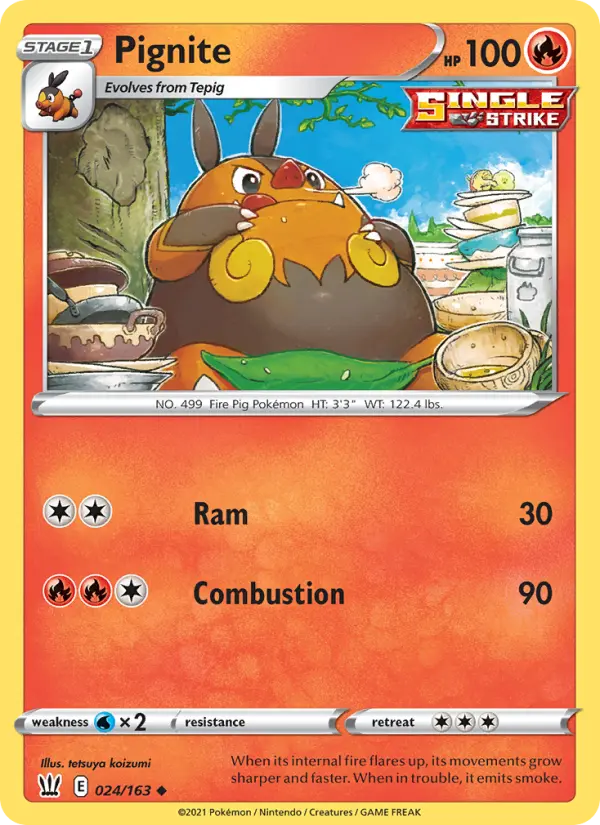
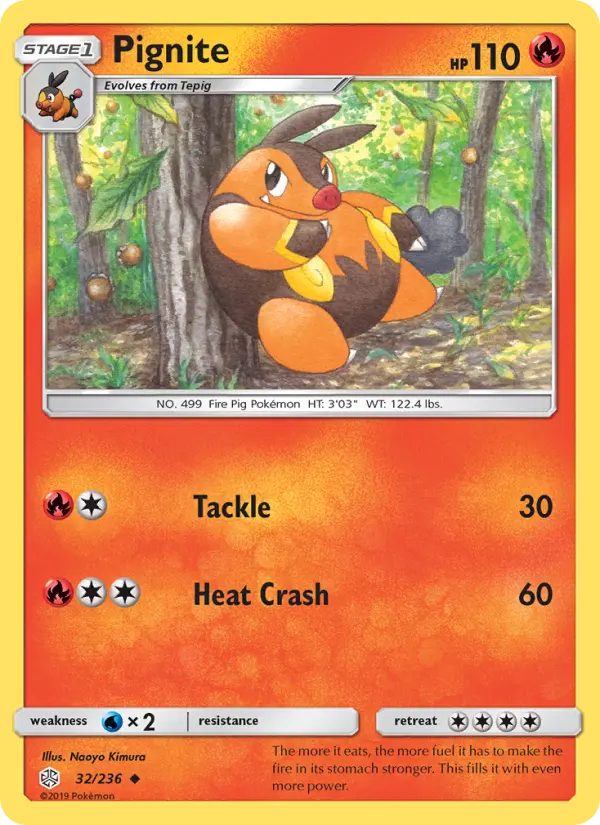
Pignite has achieved notable recognition within the Pokémon community primarily through its appearances in the animated television series, most significantly as the evolved form of Ash Ketchum's Tepig and as a central team member belonging to Gym Leader Elesa's rival Bianca, both instances demonstrating Pignite's appeal to anime audiences. The Fire Pig Pokémon's distinctive design and dual-type capability have made it a recognizable and beloved member of Generation V's starter Pokémon line, contributing to its enduring presence in fan communities and official Pokémon media across multiple generations and console platforms. While Pignite has not achieved the transcendent cultural status of iconic Fire-type starters like Charizard or Typhlosion, its role as the middle evolution of a full three-stage line and its representation in competitive and casual gameplay has earned it a dedicated following among trainers who appreciate its blend of design aesthetic and practical battle capability. The Pokémon's prominence in Unova-focused media and games has cemented its place in Generation V lore, and its presence in subsequent generations through remakes and expanded regional Pokédexes has ensured continued visibility and accessibility. Pignite's merchandise and trading card representations, though less prolific than for Emboar or Charizard, remain consistent fixtures in official Pokémon product lines, reflecting its stable if not spectacular cultural footprint.
Where to Find Pignite in Every Pokémon Game
Pignite's availability across Pokémon games varies significantly depending on the specific generation and regional context, with the Pokémon most readily obtainable in Generation V games—Pokémon Black, White, Black 2, and White 2—where the Tepig starter line features prominently in both early-game acquisition and mid-game encounters. In Pokémon Black and White, Tepig can be chosen as a starter Pokémon and naturally evolves into Pignite upon reaching level 17, making Pignite an inevitably available team member for trainers selecting the Fire-type starter option. Subsequent remakes and releases, including Pokémon X and Y, Omega Ruby and Alpha Sapphire, and the later Sword and Shield Expansion Pass titles, offer Pignite through various means including National Pokédex availability, Pokédex entries in the games' regional variants, and capture opportunities in expanded areas. The Pokémon's capture rate of 45 indicates moderate difficulty for wild encounters, suggesting that encounters with Pignite in the wild demand either standard Poké Balls used multiple times or specialized capture items for optimal efficiency. Transfer mechanics in later generations including Pokémon Bank and Pokémon HOME have ensured continued accessibility for competitive players and collectors seeking to migrate older specimens into modern titles. Recent titles like Pokémon Legends: Z-A list Pignite with a complete movepool and evolution data, indicating continued availability in the latest Pokémon gaming releases, though specific capture locations and encounter rates remain game-dependent.