Pikipek
Generation VII · #0731 — Woodpecker Pokémon
The numbers on Pikipek tell you where to look first: HP at 50, well above what its normal/flying typing alone would predict.
Editor's Take
Pikipek's line ends in Toucannon, whose Beak Blast burning anyone who makes contact while it charges is one of the most genuinely original move designs in the series.
Base Stats
Height
0.3m
Weight
1.2kg
Category
Woodpecker Pokémon
Gender
Male 50% / Female 50%
Color
black
Shape
wings
Abilities
Prevents accuracy from being lowered.
Extends two-to-five-hit moves and triple kick to their full length every time.
Picks up other Pokémon's used and Flung held items. May also pick up an item after battle.

Pikipek Biology & Physical Characteristics
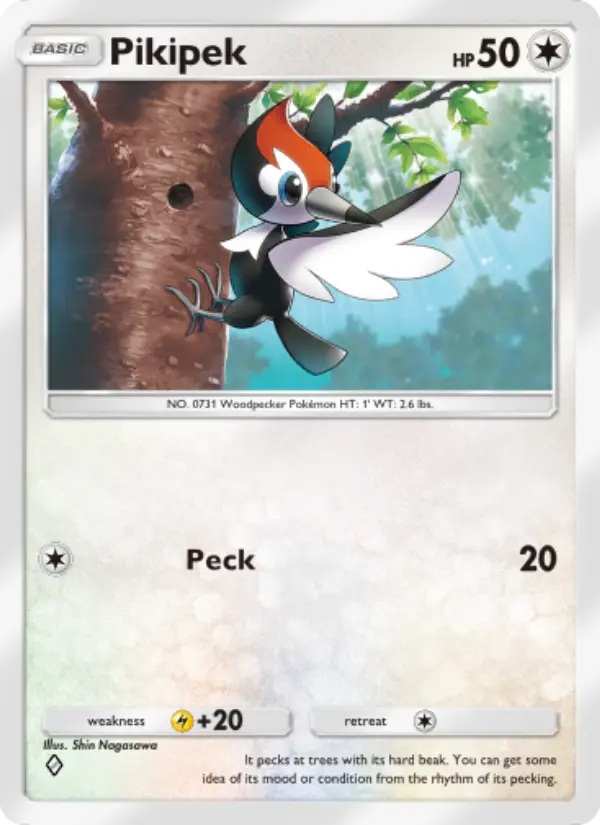
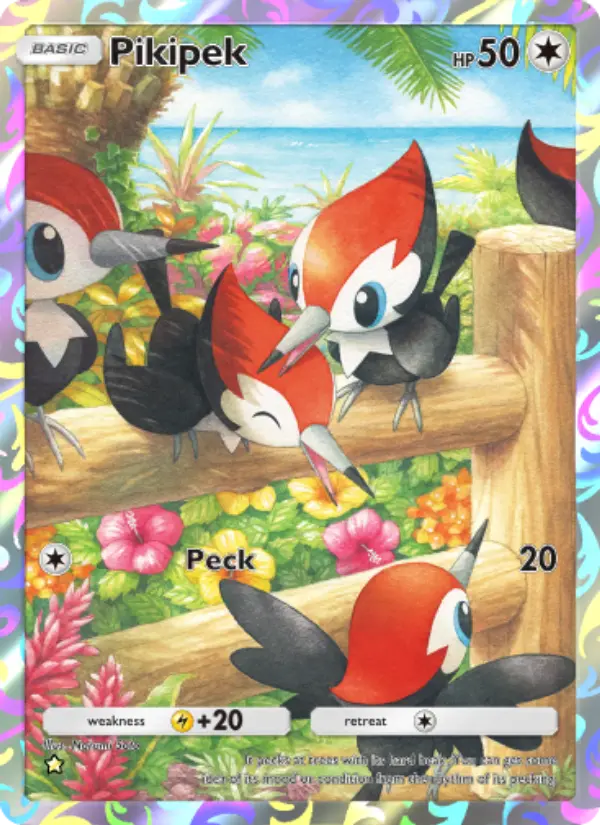
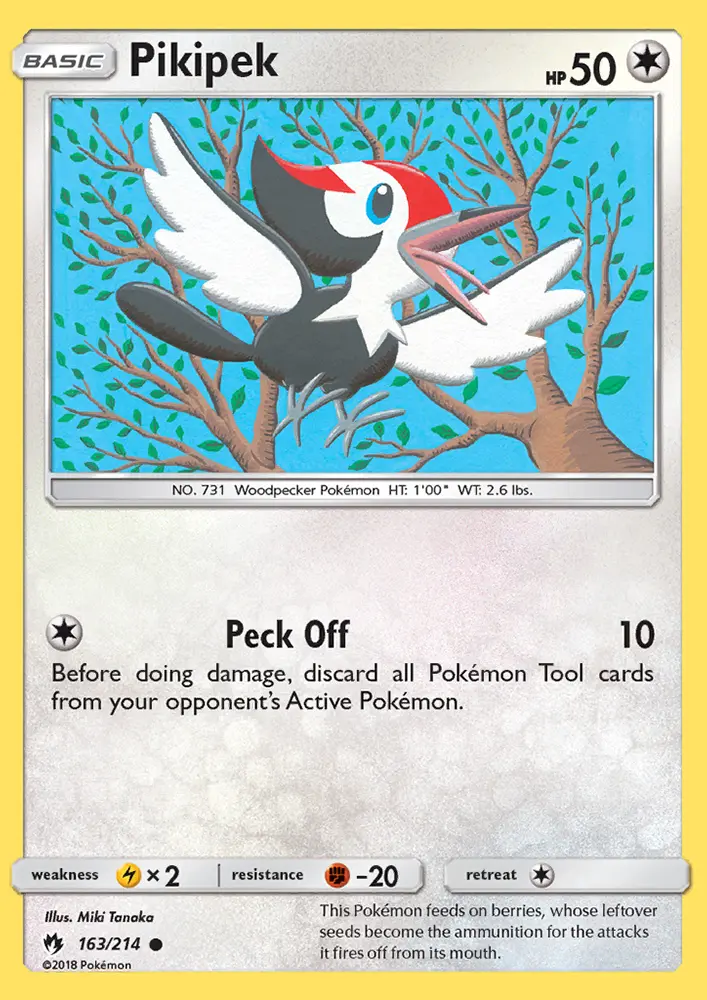
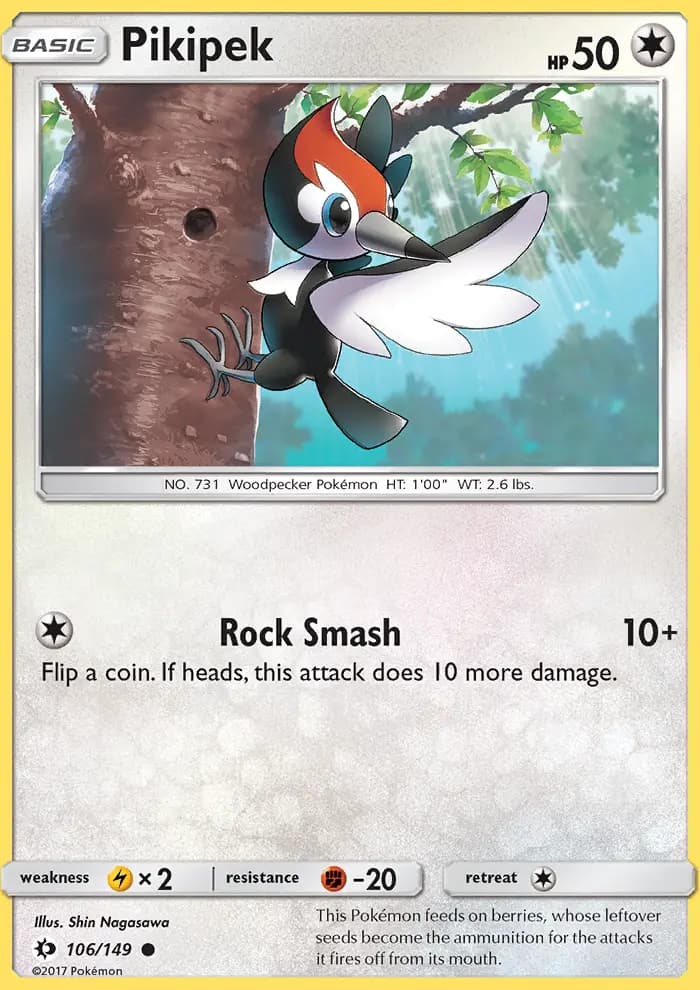
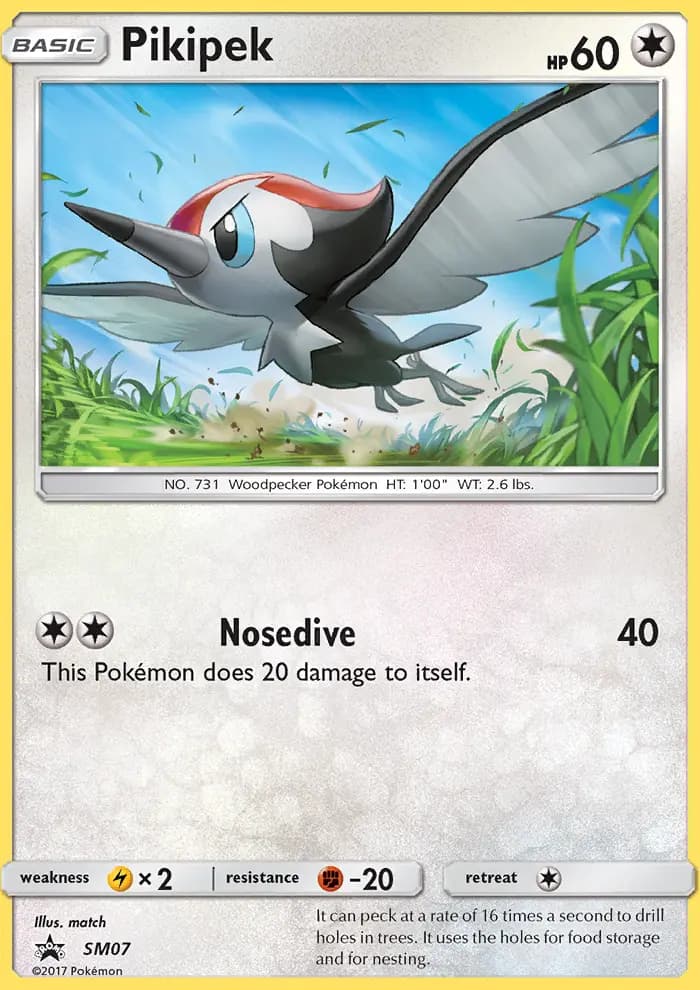
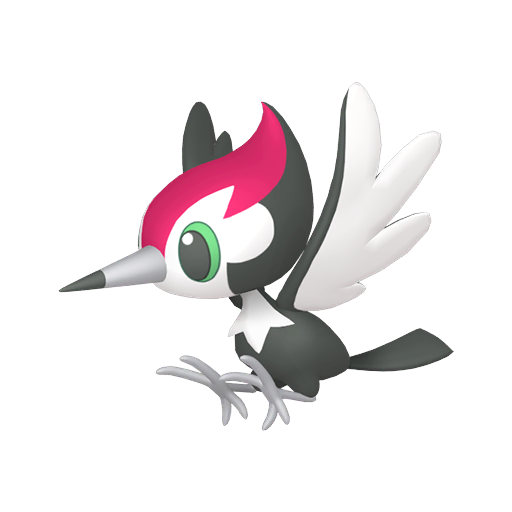
Pikipek is an avian Pokémon characterized by striking black plumage that covers most of its body, contrasted by distinctive white markings that create a mask-like pattern across its face and extend down its neck in a decorative tuft on its chest. Its most notable feature is its long, gray beak with a pointed black tip, which serves as both a feeding tool and devastating weapon. Large, expressive blue eyes give Pikipek an alert appearance, while a prominent crest sweeps upward from the back of its head, topped with a distinctive red stripe that runs toward its beak. The undersides of its wings are white, providing visual contrast during flight, and its legs are thin and gray with proportional feet. Perhaps most impressively, despite its slender and delicate appearance, Pikipek possesses extraordinarily powerful neck muscles that do not register pain when used, allowing it to strike with its beak at an astonishing rate of 16 times per second. These strikes are forceful enough to not only drill through wood to create nesting cavities and storage holes, but also to shatter stone when necessary. The Pokédex notes that the rhythm and intensity of Pikipek's pecking can communicate its emotional state and physical condition to other members of its species.
Pokedex Numbers
Training
Breeding
Pikipek Breeding, Gender Ratio & Egg Groups
Pikipek follows standard Pokémon breeding mechanics with a perfectly balanced 50% male to 50% female gender ratio, making it equally accessible to trainers seeking either sex for breeding purposes or team composition preferences. The species belongs to the Flying egg group, which encompasses all avian and many aerial Pokémon, allowing Pikipek to produce eggs when bred with compatible Pokémon of the opposite sex or with Ditto of either gender. Eggs hatch after 15 cycles of standard walking or riding, requiring approximately 3,599 to 3,855 steps for the egg to fully incubate and produce a new Pikipek. Baby Pikipek hatch with a base friendship value of 70 out of 255, representing a moderately positive starting relationship with their trainer that can be influenced through various in-game actions like battling, grooming, and using items. This base friendship level places Pikipek in a favorable position for trainers looking to maximize happiness-based evolution mechanics or develop strong bonds with their team members early in their journey. The species is not considered a baby Pokémon in the traditional sense, unlike Pichu or Togepi, meaning Pikipek itself can breed without requiring evolution into a higher form. Careful breeding with favorable natures and individual values can produce optimized Pikipek specimens for competitive play or personal collection, though most trainers will encounter wild Pikipek before pursuing breeding strategies.
Sprites





Held Items
Oran Berry
medicine
Held: Consumed at 1/2 max HP to recover 10 HP.
Cost: 80
Oran Berry
medicine
Held: Consumed at 1/2 max HP to recover 10 HP.
Cost: 80
Oran Berry
medicine
Held: Consumed at 1/2 max HP to recover 10 HP.
Cost: 80
Oran Berry
medicine
Held: Consumed at 1/2 max HP to recover 10 HP.
Cost: 80
TMs & HMs
tm01
ultra sun ultra moon
tm01
sun moon
tm03
yellow
tm03
red blue
tm03
lets go pikachu lets go eevee
tm03
blue japan
tm03
red green japan
tm05
lets go pikachu lets go eevee
tm06
yellow
tm06
gold silver
tm06
red blue
tm06
crystal
tm06
emerald
tm06
firered leafgreen
tm06
diamond pearl
tm06
platinum
tm06
ruby sapphire
tm06
colosseum
tm06
black 2 white 2
tm06
xd
+466 more TMs/HMs
Pikipek's Evolution Chain


Pikipek Evolution, Mega Evolution & Special Forms
Pikipek follows a straightforward linear evolutionary progression within the Alola region's bird-type Pokémon diversity. Upon reaching level 14, Pikipek evolves into Trumbeak, which represents a significant increase in size and refinement of the woodpecker design. The final evolution at level 28 results in Toucannon, a large, toucan-inspired Pokémon that maintains the Normal/Flying typing while gaining substantially in all statistical categories. This three-stage evolution line is representative of Generation VII's design philosophy of introducing complete evolutionary families native to the Alola Pokédex. Interestingly, unlike many evolution lines that gain diversity in typing or lose accessibility, the Pikipek line maintains consistent Normal/Flying typing throughout, ensuring that players who catch a Pikipek early in their journey maintain type consistency throughout their Pokémon's development. The progression from tiny woodpecker to powerful toucan mirrors real-world biological diversity in avian species and provides trainers with a tangible representation of growth and development as they advance through the game. Pikipek's excellent catch rate of 255 makes it easily obtainable early in the game, allowing most players to invest in the line and witness its complete evolution.
Where to Find
Alola Route 6
alola
+13 more
Alola Route 5
alola
+1 more
Poke Pelago
alola
+9 more
Alola Route 8
alola
Alola Route 1
alola
+7 more
Alola Route 4
alola
+5 more
Pikipek Behaviour and Natural Habitat
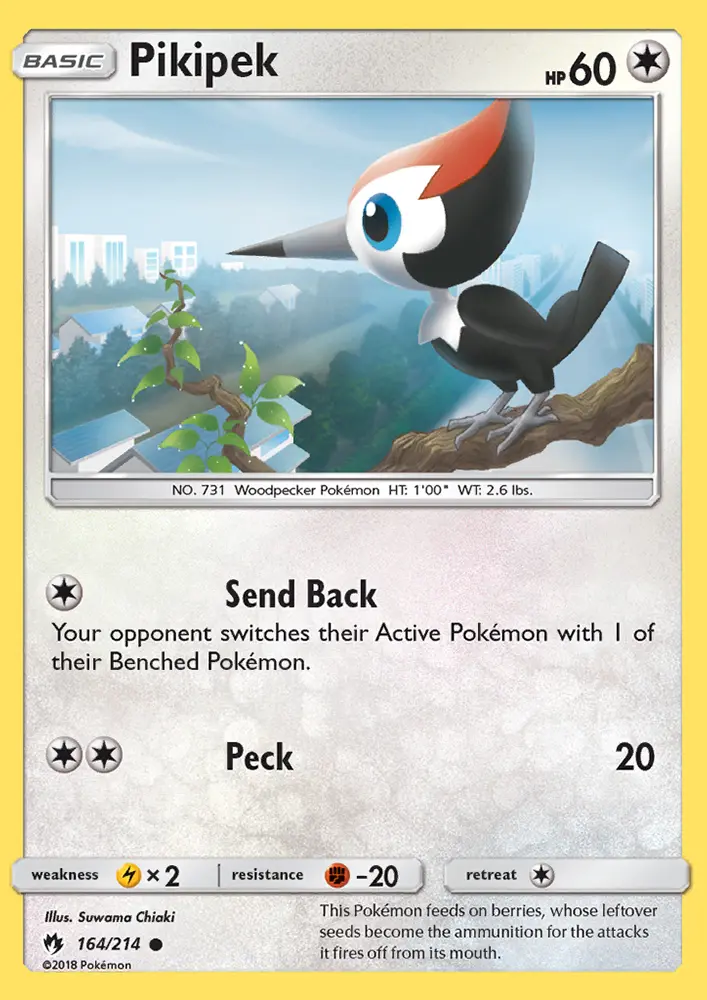
Pikipek is a berry-eating Pokémon that has adapted a unique feeding strategy involving the seeds left over from consuming berries. Rather than simply discarding these seeds, Pikipek has evolved the ability to fire them from its mouth with sufficient force to embed them in tree trunks, effectively weaponizing its food waste. The Pokémon inhabits humid forests, where it spends considerable time pecking at trees to create cavities for multiple purposes: food storage to ensure year-round sustenance, nesting sites for reproduction, and repositories for small, glittering objects it collects, suggesting a behavior pattern similar to actual woodpeckers and magpies. Within its ecosystem, Pikipek occupies an intermediate position in the food chain—it preys upon Metapod, while simultaneously serving as prey for the considerably larger and more powerful Talonflame. The pecking noise Pikipek produces is not merely incidental to feeding; it serves as a form of communication between individuals, allowing Pikipek to convey information to potential mates, rivals, and other family members. This multi-functional behavior demonstrates the species' sophisticated adaptation to forest life despite its small size.
Pokedex Entries
It can peck at a rate of 16 times a second to drill holes in trees. It uses the holes for food storage and for nesting.
It pecks at trees with its hard beak. You can get some idea of its mood or condition from the rhythm of its pecking.
This Pokémon feeds on berries, whose leftover seeds become the ammunition for the attacks it fires off from its mouth.
It may look spindly, but its neck muscles are heavy-duty. It can peck at a tree 16 times per second!
Pikipek Name Origin & Design Inspiration
Pikipek's design draws clear inspiration from real-world woodpeckers, particularly incorporating the characteristic features that make these birds distinctive: the powerful specialized neck muscles adapted for high-speed pecking, the elongated pointed beak optimized for drilling through wood, and the energetic, determined personality associated with these industrious birds. The name "Pikipek" itself is onomatopoetic, directly referencing the "pika-pika" sound of rapid pecking that woodpeckers produce, while also echoing the names of other bird Pokémon in the series. The Japanese name "Tsutsukera" follows a similar linguistic pattern, with "tsutsu" (筒) referring to the tubular holes the Pokémon creates in trees. The visual design cleverly combines traditional woodpecker characteristics with distinctive artistic choices: the white facial mask resembles a painted decoration, the red-striped crest gives the creature personality and visual interest, and the white wing undersides are typical of many real woodpecker species. The berries-as-ammunition concept introduces a unique ecological twist, transforming the Pokémon from a mere woodpecker replica into something distinctly Pokémon-specific, giving it a gameplay identity separate from its biological inspiration. The overall aesthetic successfully balances naturalism with the fantastical elements that define the Pokémon franchise.
Learnable Moves
Pikipek can learn 58 moves:
Move | Type | Cat. | Power | Acc. | PP |
|---|---|---|---|---|---|
| acrobatics | flying | Physical | 55 | 100 | 15 |
| aerial ace | flying | Physical | 60 | — | 20 |
| air cutter | flying | Special | 60 | 95 | 25 |
| air slash | flying | Special | 75 | 95 | 15 |
| attract | normal | Status | — | 100 | 15 |
| boomburst | normal | Special | 140 | 100 | 10 |
| brave bird | flying | Physical | 120 | 100 | 15 |
| brick break | fighting | Physical | 75 | 100 | 15 |
| bullet seed | grass | Physical | 25 | 100 | 30 |
| confide | normal | Status | — | — | 20 |
| defog | flying | Status | — | — | 15 |
| double team | normal | Status | — | — | 15 |
| drill peck | flying | Physical | 80 | 100 | 20 |
| dual wingbeat | flying | Physical | 40 | 90 | 10 |
| echoed voice | normal | Special | 40 | 100 | 15 |
| endeavor | normal | Physical | — | 100 | 5 |
| endure | normal | Status | — | — | 10 |
| facade | normal | Physical | 70 | 100 | 20 |
| feather dance | flying | Status | — | 100 | 15 |
| flame charge | fire | Physical | 50 | 100 | 20 |
| fly | flying | Physical | 90 | 95 | 15 |
| frustration | normal | Physical | — | 100 | 20 |
| fury attack | normal | Physical | 15 | 85 | 20 |
| growl | normal | Status | — | 100 | 40 |
| gunk shot | poison | Physical | 120 | 80 | 5 |
| heat wave | fire | Special | 95 | 90 | 10 |
| helping hand | normal | Status | — | — | 20 |
| hidden power | normal | Special | 60 | 100 | 15 |
| hyper voice | normal | Special | 90 | 100 | 10 |
| knock off | dark | Physical | 65 | 100 | 20 |
| mirror move | flying | Status | — | — | 20 |
| peck | flying | Physical | 35 | 100 | 35 |
| pluck | flying | Physical | 60 | 100 | 20 |
| protect | normal | Status | — | — | 10 |
| rest | psychic | Status | — | — | 5 |
| return | normal | Physical | — | 100 | 20 |
| rock smash | fighting | Physical | 40 | 100 | 15 |
| roost | flying | Status | — | — | 5 |
| round | normal | Special | 60 | 100 | 15 |
| screech | normal | Status | — | 85 | 40 |
| sky attack | flying | Physical | 140 | 90 | 5 |
| sleep talk | normal | Status | — | — | 10 |
| smack down | rock | Physical | 50 | 100 | 15 |
| snore | normal | Special | 50 | 100 | 15 |
| steel wing | steel | Physical | 70 | 90 | 25 |
| substitute | normal | Status | — | — | 10 |
| sunny day | fire | Status | — | — | 5 |
| supersonic | normal | Status | — | 55 | 20 |
| swagger | normal | Status | — | 85 | 15 |
| swords dance | normal | Status | — | — | 20 |
| tailwind | flying | Status | — | — | 15 |
| take down | normal | Physical | 90 | 85 | 20 |
| tera blast | normal | Special | 80 | 100 | 10 |
| thief | dark | Physical | 60 | 100 | 25 |
| toxic | poison | Status | — | 90 | 10 |
| u turn | bug | Physical | 70 | 100 | 20 |
| uproar | normal | Special | 90 | 100 | 10 |
| work up | normal | Status | — | — | 30 |
Pikipek Competitive Battle Guide
Within competitive battling, Pikipek occupies an ultra-low tier position due to its modest overall stat sum of 265, with particularly weak special attack and special defense stats of only 30 each. However, the species possesses two abilities with specific competitive applications: Keen Eye, which prevents accuracy-lowering effects from reducing Pikipek's hit accuracy, and Skill Link, which extends two-to-five hit moves and Triple Kick to their maximum length every turn, guaranteeing maximum damage output from multi-hit move sets. The hidden ability Pickup, while useful for item collection outside of battle, offers limited competitive value in direct trainer-versus-trainer matches. Pikipek's attacking stat of 75 allows it to function as a physical attacker, with access to moves like Peck, Drill Peck, Fury Attack, and Pluck throughout its level-up movepool. Early-game moves like Rock Smash and Supersonic provide some utility and coverage, though Pikipek's limited special attack means special moves are rarely viable options. In competitive contexts, Pikipek is typically only encountered in beginner-level formats or Nuzlocke challenges where trainers are forced to use early-route captures without access to fully-evolved powerhouses. Any serious competitive player would immediately evolve their Pikipek into Trumbeak or Toucannon to gain access to significantly improved stats and move pools, making Pikipek itself effectively obsolete in competitive play.
Commonly Asked Questions About Pikipek
What type is Pikipek?
Pikipek is a normal and flying type Pokemon.
What does Pikipek evolve into?
Pikipek evolves into trumbeak, then into toucannon.
What are Pikipek's weaknesses?
Pikipek is weak to rock, electric and ice type moves.
Does Pikipek evolve by trading?
No — Pikipek evolves entirely through leveling up, with no trade required at any stage.
Where can I find Pikipek?
Pikipek can be found in alola route 6 (alola), alola route 5 (alola) and poke pelago (alola) and 3 other locations.
Pikipek Cultural Impact & Franchise History
Pikipek achieved significant cultural prominence within the Pokémon community as the iconic early-game bird Pokémon of Generation VII, succeeding Pidgeot, Fearow, and Talonflame in the tradition of accessible flying-type companions for new trainers in the Alola region. The species' rapid pecking mechanic at 16 strikes per second resonated with players as a compelling game mechanic that reinforced the connection between real-world bird behavior and Pokémon design philosophy. Pikipek received notable exposure through the Pokémon anime series, where it appeared prominently in the Sun and Moon era of the show, gaining recognition among viewers as a memorable character in its own right. The species has been featured in official Pokémon media, merchandise, and promotional materials, establishing itself as part of Generation VII's legacy alongside Rowlet, Litten, and Popplio. Gaming communities developed appreciation for Pikipek's role as a pedagogical tool for teaching new players about Pokémon mechanics, evolution chains, and type advantages. The design's successful balance between biological authenticity and creative Pokémon interpretation inspired fan art communities and contributed to ongoing discussions about how the franchise translates real-world animals into fantastical creatures. Additionally, Pikipek's berry-seed attack mechanic influenced how future generations approached Pokémon design, demonstrating how ecological relationships and feeding behaviors could translate into battle mechanics.
Where to Find Pikipek in Every Pokémon Game
Pikipek was originally introduced in Generation VII and can be found in Pokémon Sun, Moon, Ultra Sun, and Ultra Moon, where it appears as one of the earliest bird-type encounters in the Alola region. In Pokémon Sun and Moon, Pikipek has local Pokédex number #0010 and is available on routes and in forests throughout the early game, making it highly accessible to new players. The species maintains this accessibility in Ultra Sun and Ultra Moon, appearing with the same local Pokédex designation and similar encounter rates. More recently, Pikipek has been reintroduced in Pokémon Scarlet and Violet, where it receives local Pokédex number #0047 in the Indigo Disk expansion, maintaining its position as an early-game normal/flying type. The species' exceptional catch rate of 255 (the maximum possible) makes it nearly guaranteed to be caught on the first attempt with any standard Poké Ball, encouraging trainers to add it to their teams. Additionally, Pikipek can be obtained through Pokémon Home transfers from earlier games for trainers who wish to build teams with Generation VII Pokémon. Breeding populations are readily available through online trading communities and official distribution events, ensuring that trainers in any generation can obtain Pikipek regardless of which games they own. The species' widespread availability and early-route placement guarantee that nearly every player who completes a Generation VII game will encounter and likely capture at least one Pikipek during their journey.