Poliwag
Generation I · #0060 — Tadpole Pokémon
Weighing 12.4 kg and standing 0.6 m, Poliwag carries its water typing into battle with a stat spread that leans hardest into Speed. Standing 0.6 m tall and weighing 12.4 kg, it's built around a distinct combination of water traits that shapes how it performs both in the wild and in battle. With a combined stat total of only 300, Poliwag is clearly designed as an early-game Pokémon, yet its exceptional Speed stat of 90 and access to powerful abilities make it surprisingly viable in the right circumstances. Its extremely high catch rate of 255 means trainers will rarely struggle to add one to their roster, and its base happiness of 70 indicates it bonds readily with those who catch it. Poliwag evolves into Poliwhirl at level 25, marking the beginning of its transformation from a helpless tadpole into a capable fighter, and this evolution path represents one of the most iconic progressions in Pokémon history.
Editor's Take
Poliwag's line splitting into Poliwrath and Politoed via trade item was Gen 2 experimenting with branching evolution, and Politoed's Drizzle is the only reason anyone remembers which branch to take.
Base Stats
Height
0.6m
Weight
12.4kg
Category
Tadpole Pokémon
Gender
Male 50% / Female 50%
Color
blue
Shape
legs
Habitat
waters-edge
Abilities
Absorbs water moves, healing for 1/4 max HP.
Prevents self destruct, explosion, and aftermath from working while the Pokémon is in battle.
Doubles Speed during rain.

Poliwag Biology & Physical Characteristics
Poliwag is a small, spherical amphibian Pokémon that resembles a blue tadpole with a distinctly unusual physiology. The most striking feature of this creature is its semitransparent skin, so thin that its internal organs are clearly visible through it, most notably the distinctive black and white spiral pattern on its abdomen. This spiral serves as more than mere decoration—it represents Poliwag's exposed internal anatomy, and interestingly, the swirl becomes noticeably clearer after the Pokémon has eaten, providing a visual indicator of its nutritional state. The spiral's orientation varies by geographic region, with the equator thought to exert some influence on this variation, suggesting that Poliwag may possess some form of geographic adaptation or that environmental factors play a role in its development. Despite its fragile appearance, Poliwag's skin is remarkably flexible and durable, capable of withstanding sharp fangs and other physical attacks that would normally penetrate thinner materials. The Pokémon possesses large, prominent eyes and distinctive pink lips that function as suction cups, allowing it to adhere to rocks and other surfaces. Poliwag's most notable physical limitation is its newly developed legs, which are poorly suited for terrestrial locomotion, and the complete absence of arms. However, its long, thin tail, surrounded by a light-blue semitransparent fin, makes it an exceptionally powerful swimmer, and this appendage serves as its primary means of propulsion through water.
Pokedex Numbers
Training
Breeding
Poliwag Breeding, Gender Ratio & Egg Groups
Poliwag splits evenly down the middle — 50% male, 50% female. The species belongs to the Water 1 egg group, which contains numerous other amphibious and aquatic Pokémon, allowing trainers flexibility in breeding partner selection for creating competitive offspring. With an egg hatch counter of 20 cycles, representing approximately 4,884 to 5,140 steps, Poliwag has a relatively moderate incubation period that makes breeding expeditions reasonably time-efficient compared to some other Pokémon. The base friendship value of 70 indicates that Poliwag is inherently friendly and bonds readily with trainers, which can facilitate breeding activities when the Pokémon needs to be kept in the player's party during incubation periods. Poliwag's medium-slow growth rate means it reaches higher experience thresholds for leveling, but this growth trajectory is balanced against its evolutionary availability at level 25, which comes relatively early in most players' gaming experiences. Competitive breeders often utilize Poliwag as a parent for movepool inheritance, passing down exclusive or tutored moves to offspring through careful breeding chains, making the species valuable for creating optimized competitive Pokémon despite its own limited competitive viability as a final form.
Sprites






TMs & HMs
tm01
platinum
tm01
emerald
tm01
diamond pearl
tm01
firered leafgreen
tm01
ruby sapphire
tm01
xd
tm01
colosseum
tm01
heartgold soulsilver
tm01
lets go pikachu lets go eevee
tm02
crystal
tm02
gold silver
tm03
crystal
tm03
gold silver
tm03
ruby sapphire
tm03
platinum
tm03
firered leafgreen
tm03
heartgold soulsilver
tm03
diamond pearl
tm03
emerald
tm03
xd
+572 more TMs/HMs
Poliwag's Evolution Chain


Poliwag Evolution, Mega Evolution & Special Forms
Poliwag's evolutionary line is one of the most complex and fascinating in the entire Pokédex, offering trainers three distinct final forms depending on the evolution method employed. The standard evolutionary path begins at level 25, when Poliwag evolves into Poliwhirl, a more humanoid and muscular Water-type that retains the spiral pattern but gains functional arms and improved terrestrial mobility. From Poliwhirl, trainers may choose between two divergent paths: exposing the Pokémon to a Water Stone results in the evolution into Poliwrath, a Water and Fighting-type hybrid that gains tremendous physical strength and combat prowess, or trading Poliwhirl while it holds a King's Rock produces Politoed, a Water-type that maintains better special statistics and unique competitive properties. This branching evolution system was introduced in Generation II and represents a significant evolution milestone for the franchise, as it provides players with meaningful strategic choices that fundamentally alter their Pokémon's capabilities and role within their team. Each evolutionary path offers distinct advantages: Poliwrath excels in physical combat with high Attack and good offensive typing, while Politoed gains access to Drizzle in later generations, fundamentally changing rain weather teams. The evolutionary transformation from Poliwag to either final form is dramatic and mechanically significant, elevating the species from a relatively weak early-game encounter to a genuinely competitive threat capable of holding its own in competitive play.
Where to Find
Cerulean Cave
kanto
+40 more
Kanto Route 24
kanto
Kanto Route 25
kanto
+4 more
Vermilion City
kanto
+2 more
Celadon City
kanto
Fuchsia City
kanto
+2 more
Kanto Route 6
kanto
+43 more
Kanto Route 13
kanto
Kanto Route 22
kanto
+64 more
Viridian City
kanto
+35 more
Pallet Town
kanto
+6 more
Kanto Sea Route 21
kanto
Kanto Sea Route 20
kanto
Kanto Safari Zone
kanto
+17 more
Kanto Sea Route 19
kanto
Seafoam Islands
kanto
+3 more
Kanto Route 11
kanto
Cinnabar Island
kanto
Cerulean City
kanto
Kanto Route 10
kanto
+29 more locations in other games
Poliwag Behaviour and Natural Habitat
Poliwag is fundamentally an aquatic Pokémon despite its status as an amphibian, and most Pokédex entries emphasize its overwhelming preference for swimming over the awkward waddling it attempts on land. Because its newly grown legs are so ineffective at terrestrial locomotion, Poliwag invariably returns to water, where it moves with grace and agility. The species exhibits a curious behavioral contradiction: despite the obvious dangers of its clumsy terrestrial movement and its inability to walk properly without daily training, Poliwag demonstrates a love for waddling on land, though it will quickly retreat to the safety of water upon sensing any threat. This behavior suggests a youthful curiosity or playfulness characteristic of tadpole-stage Pokémon. Poliwag is primarily found in freshwater environments such as ponds, lakes, and slow-moving streams where it can swim freely and hunt for small aquatic prey. The species appears to be most active in warm, temperate regions, and its distribution varies across different geographical areas, which correlates with the aforementioned variation in belly spiral orientation. In the wild, Poliwag tends to stay close to water sources, rarely venturing far into terrestrial habitats where its vulnerability would be more pronounced.
Pokedex Entries
Its newly grown legs prevent it from running. It appears to prefer swimming than trying to stand.
The direction of the spiral on the belly differs by area. It is more adept at swimming than walking.
Because it is in ept at walking on its newly grown legs, it always swims around in water.
The direction of its belly spiral differs by area. The equator is thought to have an effect on this.
The swirl on its belly is its insides showing through the skin. It looks clearer after it eats.
POLIWAG has a very thin skin. It is possible to see the POKéMON’s spiral innards right through the skin. Despite its thinness, however, the skin is also very flexible. Even sharp fangs bounce right off it.
It is possible to see this POKéMON’s spiral innards right through its thin skin. However, the skin is also very flexible. Even sharp fangs bounce right off it.
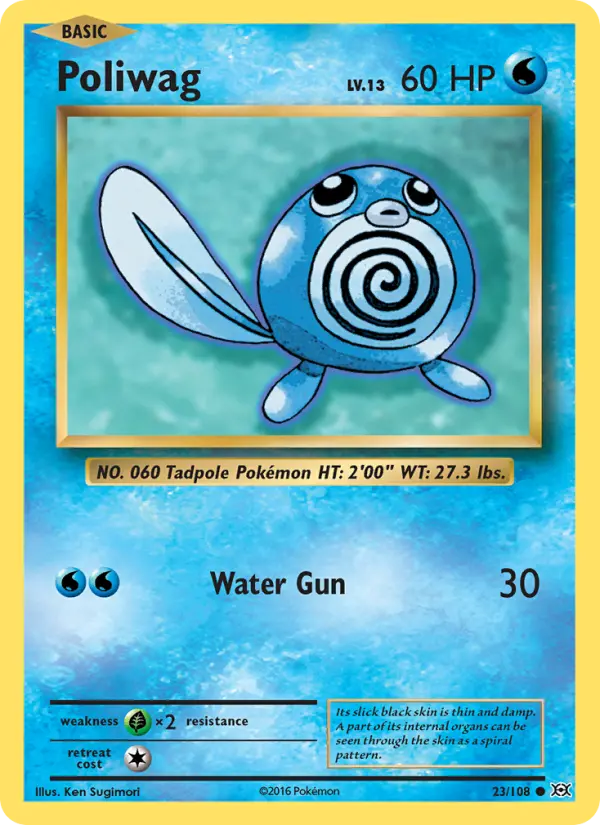
Its slick black skin is thin and damp. A part of its internal organs can be seen through the skin as a spiral pattern.
Its newly grown legs prevent it from walking well. It appears to prefer swimming over walking.
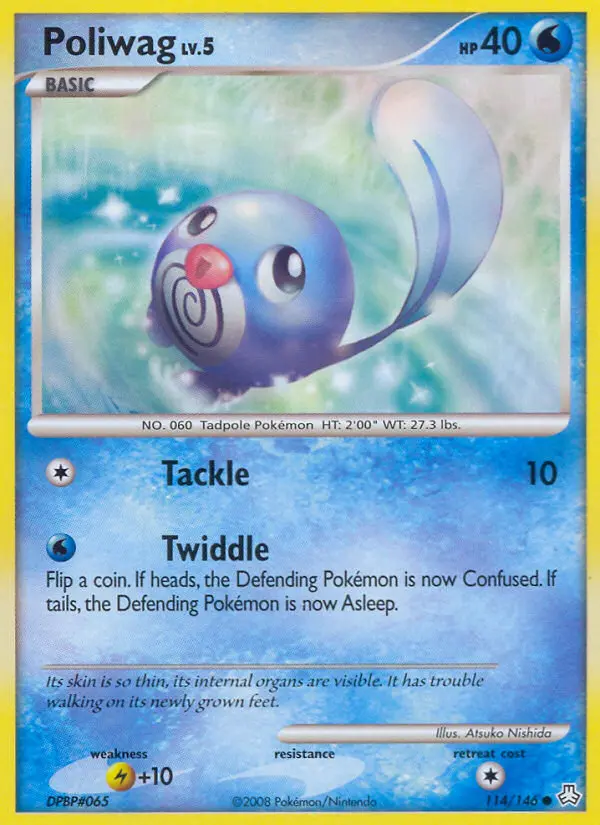
Its skin is so thin, its internal organs are visible. It has trouble walking on its newly grown feet.
Because it is inept at walking on its newly grown legs, it always swims around in water.
The direction of its belly spiral differs by area. The equator is thought to have an effect on this.
Its skin is so thin, its internal organs are visible. It has trouble walking on its newly grown feet.
Its skin is so thin, its internal organs are visible. It has trouble walking on its newly grown feet.
Its slick black skin is thin and damp. A part of its internal organs can be seen through the skin as a spiral pattern.
The direction of the spiral on the belly differs by area. It is more adept at swimming than walking.
Poliwag has a very thin skin. It is possible to see the Pokémon’s spiral innards right through the skin. Despite its thinness, however, the skin is also very flexible. Even sharp fangs bounce right off it.
Poliwag has a very thin skin. It is possible to see the Pokémon’s spiral innards right through the skin. Despite its thinness, however, the skin is also very flexible. Even sharp fangs bounce right off it.
The swirl on its belly is its internal organs showing through. If the swirl is tinged white, that means it’s affected by some disease.
Despite the danger, it wants to come up on land. So it does its best to waddle along, but when an enemy finds it, it rushes back to the water.
It’s still not very good at walking. Its Trainers should train this Pokémon to walk every day.
The direction of the swirl on their stomachs differs depending on where they live. Poliwag aficionados can tell them apart at a glance.
The direction of the spiral on the belly differs by area. It is more adept at swimming than walking.
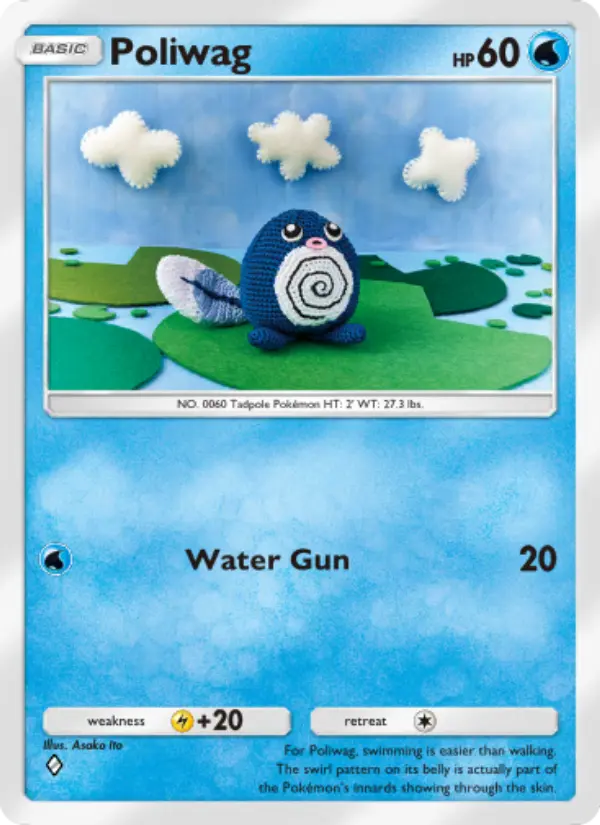
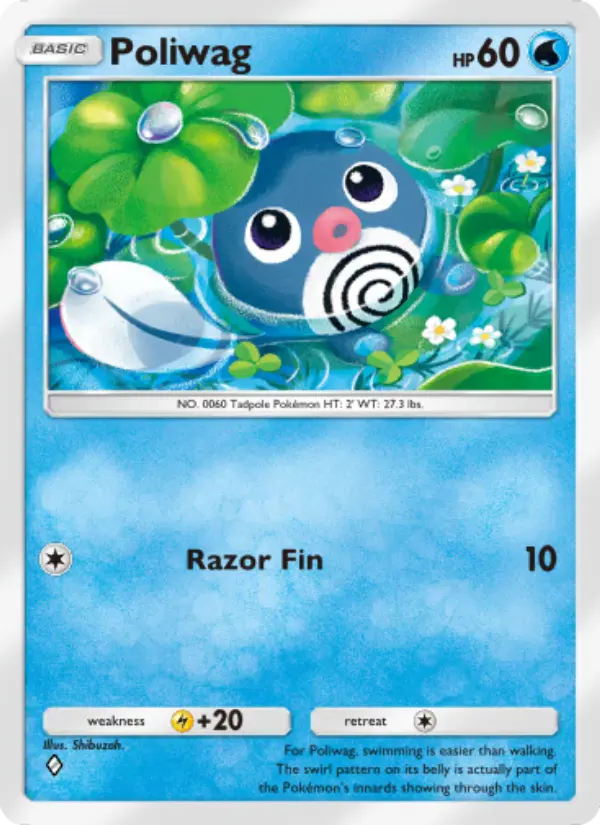
For Poliwag, swimming is easier than walking. The swirl pattern on its belly is actually part of the Pokémon’s innards showing through the skin.
In rivers with fast-flowing water, this Pokémon will cling to a rock by using its thick lips, which act like a suction cup.
Poliwag Name Origin & Design Inspiration
Poliwag's name derives from the combination of 'poly-' (meaning many or multiple) and 'wag' (referring to the wagging motion of its tail), reflecting both the creature's swimming locomotion and its overall tadpole-like appearance. The Japanese name 'Nyoromo' (ニョロモ) similarly combines elements that evoke the wriggling, slimy movement characteristic of aquatic larvae. The design itself draws heavily from real-world tadpoles, particularly in its spherical body, prominent eyes, and long tail, though the fantastical semitransparent skin revealing internal organs is an original creative choice that distinguishes it from its biological inspirations. The distinctive spiral on Poliwag's belly serves as a visual trademark that has become iconic enough to appear on all evolutionary descendants of the line, making it instantly recognizable across the entire Poliwag family. The color scheme of bright blue combined with pink accents gives the Pokémon an appealing, almost cute quality that makes it particularly attractive to younger players and casual fans, while the anatomically exposed organs add a layer of uniqueness that distinguishes it from other early-game Water-types. The design successfully balances scientific realism with fantastical elements, creating a creature that feels simultaneously grounded in aquatic biology and distinctly Pokémon in its execution.
Learnable Moves
Poliwag can learn 77 moves:
Move | Type | Cat. | Power | Acc. | PP |
|---|---|---|---|---|---|
| amnesia | psychic | Status | — | — | 20 |
| attract | normal | Status | — | 100 | 15 |
| belly drum | normal | Status | — | — | 10 |
| bide | normal | Physical | — | — | 10 |
| blizzard | ice | Special | 110 | 70 | 5 |
| body slam | normal | Physical | 85 | 100 | 15 |
| bubble | water | Special | 40 | 100 | 30 |
| bubble beam | water | Special | 65 | 100 | 20 |
| bulldoze | ground | Physical | 60 | 100 | 20 |
| captivate | normal | Status | — | 100 | 20 |
| chilling water | water | Special | 50 | 100 | 20 |
| confide | normal | Status | — | — | 20 |
| curse | ghost | Status | — | — | 10 |
| defense curl | normal | Status | — | — | 40 |
| dig | ground | Physical | 80 | 100 | 10 |
| dive | water | Physical | 80 | 100 | 10 |
| double slap | normal | Physical | 15 | 85 | 10 |
| double team | normal | Status | — | — | 15 |
| double edge | normal | Physical | 120 | 100 | 15 |
| earth power | ground | Special | 90 | 100 | 10 |
| encore | normal | Status | — | 100 | 5 |
| endeavor | normal | Physical | — | 100 | 5 |
| endure | normal | Status | — | — | 10 |
| facade | normal | Physical | 70 | 100 | 20 |
| focus punch | fighting | Physical | 150 | 100 | 20 |
| frustration | normal | Physical | — | 100 | 20 |
| hail | ice | Status | — | — | 10 |
| haze | ice | Status | — | — | 30 |
| headbutt | normal | Physical | 70 | 100 | 15 |
| helping hand | normal | Status | — | — | 20 |
| hidden power | normal | Special | 60 | 100 | 15 |
| hydro pump | water | Special | 110 | 80 | 5 |
| hypnosis | psychic | Status | — | 60 | 20 |
| ice ball | ice | Physical | 30 | 90 | 20 |
| ice beam | ice | Special | 90 | 100 | 10 |
| icy wind | ice | Special | 55 | 95 | 15 |
| liquidation | water | Physical | 85 | 100 | 10 |
| low kick | fighting | Physical | — | 100 | 20 |
| mimic | normal | Status | — | — | 10 |
| mind reader | normal | Status | — | — | 5 |
| mist | ice | Status | — | — | 30 |
| mud bomb | ground | Special | 65 | 85 | 10 |
| mud shot | ground | Special | 55 | 95 | 15 |
| mud slap | ground | Special | 20 | 100 | 10 |
| muddy water | water | Special | 90 | 85 | 10 |
| natural gift | normal | Physical | — | 100 | 15 |
| pound | normal | Physical | 40 | 100 | 35 |
| protect | normal | Status | — | — | 10 |
| psychic | psychic | Special | 90 | 100 | 10 |
| psywave | psychic | Special | — | 100 | 15 |
| rage | normal | Physical | 20 | 100 | 20 |
| rain dance | water | Status | — | — | 5 |
| refresh | normal | Status | — | — | 20 |
| rest | psychic | Status | — | — | 5 |
| return | normal | Physical | — | 100 | 20 |
| round | normal | Special | 60 | 100 | 15 |
| scald | water | Special | 80 | 100 | 15 |
| secret power | normal | Physical | 70 | 100 | 20 |
| skull bash | normal | Physical | 130 | 100 | 10 |
| sleep talk | normal | Status | — | — | 10 |
| snore | normal | Special | 50 | 100 | 15 |
| splash | normal | Status | — | — | 40 |
| substitute | normal | Status | — | — | 10 |
| surf | water | Special | 90 | 100 | 15 |
| swagger | normal | Status | — | 85 | 15 |
| swift | normal | Special | 60 | — | 20 |
| take down | normal | Physical | 90 | 85 | 20 |
| tera blast | normal | Special | 80 | 100 | 10 |
| thief | dark | Physical | 60 | 100 | 25 |
| toxic | poison | Status | — | 90 | 10 |
| wake up slap | fighting | Physical | 70 | 100 | 10 |
| water gun | water | Special | 40 | 100 | 25 |
| water pulse | water | Special | 60 | 100 | 20 |
| water sport | water | Status | — | — | 15 |
| waterfall | water | Physical | 80 | 100 | 15 |
| weather ball | normal | Special | 50 | 100 | 10 |
| whirlpool | water | Special | 35 | 85 | 15 |
Poliwag Competitive Battle Guide
From a competitive standpoint, Poliwag itself sees virtually no usage due to its anemic combined stat total of 300 and mediocre offensive capabilities, with Attack, Special Attack, and both defensive stats all capped at only 40. However, the species possesses an exceptional Speed stat of 90, which is genuinely noteworthy for an early-game Pokémon and allows it to outspeed many contemporary threats if it were given the opportunity to compete. Poliwag's offensive movepool is limited but includes essential Water-type moves like Water Gun and Bubble, along with Hypnosis for utility, but the species lacks the power or special Attack investment to effectively leverage these moves. The three possible abilities—Water Absorb, Damp, and the hidden ability Swift Swim—each serve specific strategic purposes: Water Absorb grants Poliwag passive recovery when struck by Water-type moves, Damp prevents explosive moves from executing, and Swift Swim doubles Speed during rain weather. It is Swift Swim that occasionally enables niche Poliwag usage in rain-based competitive teams, though even this application has been largely superseded by superior Water-type options. The practical reality is that trainers should view Poliwag as a stepping stone to its superior evolutions rather than a competitive battler in its own right, with Poliwrath and Politoed serving as the actual competitive threats within this evolutionary family.
Commonly Asked Questions About Poliwag
What type is Poliwag?
Poliwag is a water type Pokemon.
What does Poliwag evolve into?
Poliwag evolves into poliwhirl, then into poliwrath, then into politoed.
What are Poliwag's weaknesses?
Poliwag is weak to grass and electric type moves.
Does Poliwag evolve by trading?
No — Poliwag evolves entirely through leveling up, with no trade required at any stage.
Where can I find Poliwag?
Poliwag can be found in cerulean cave (kanto), kanto route 24 (kanto) and kanto route 25 (kanto) and 46 other locations.
Poliwag Cultural Impact & Franchise History
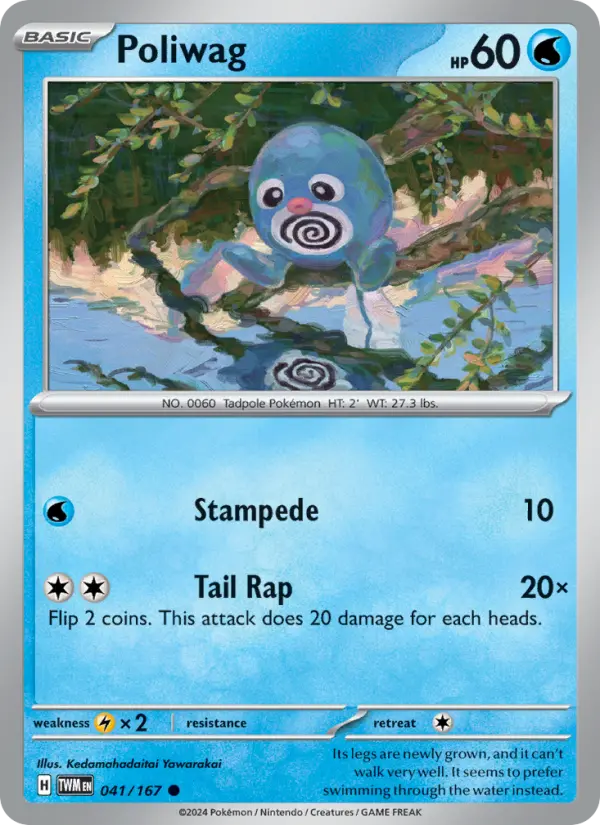
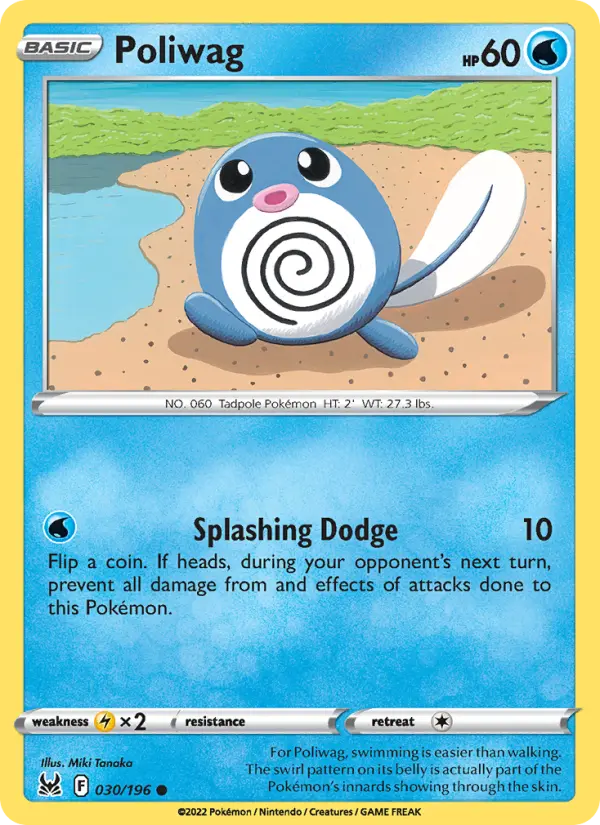
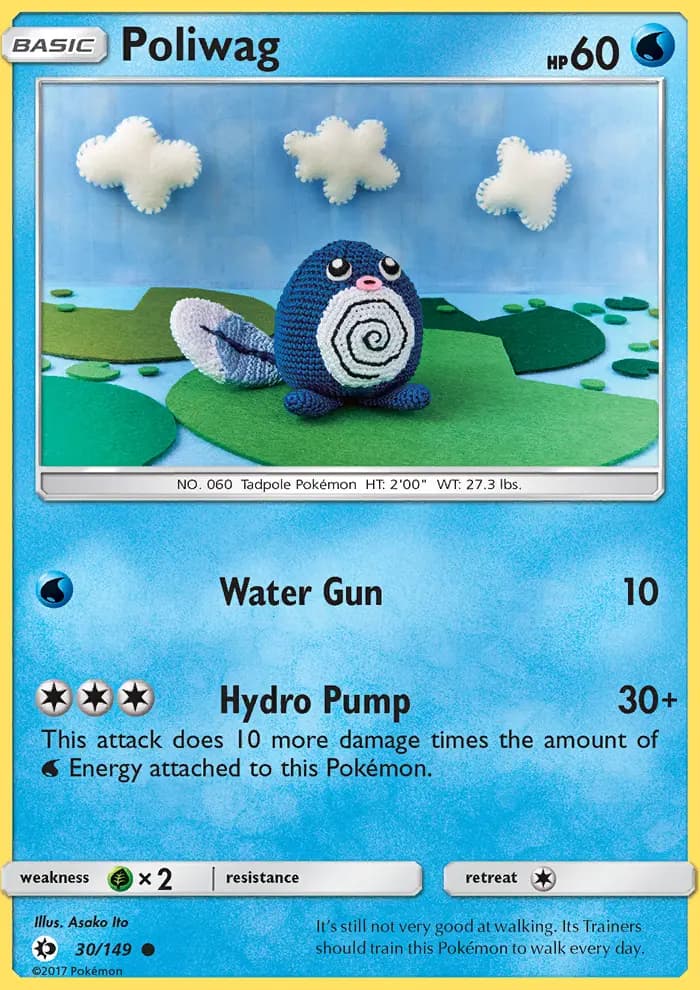
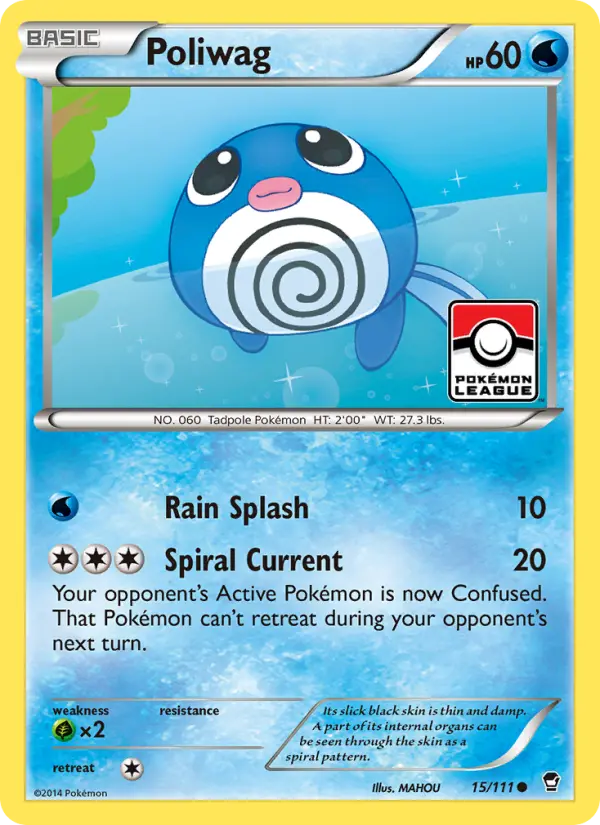
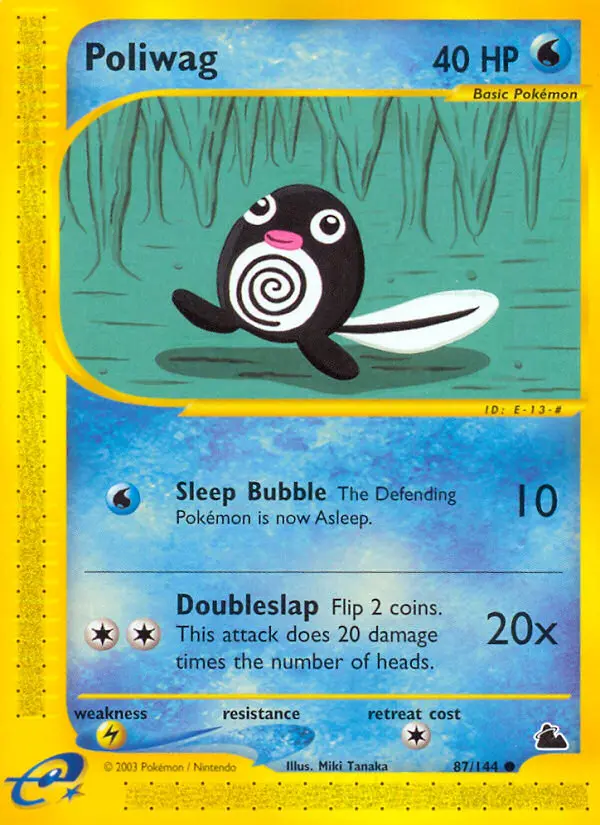
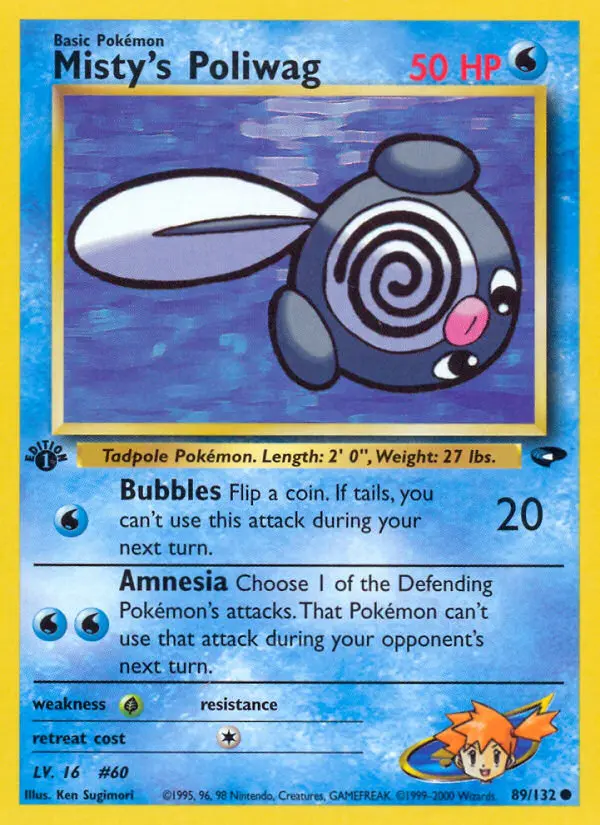
Poliwag has maintained a significant presence in Pokémon media and popular culture since the franchise's inception, most notably through its prominent association with Misty, the water-specialist gym leader and traveling companion from the anime series. Misty's Poliwag, which later evolved into Poliwrath, became one of the most iconic Pokémon in the early anime, appearing frequently throughout the series and establishing the species as a fan-favorite despite its weak base form. The Pokémon has appeared consistently across all major Pokémon games, trading card games, and animated media, and its instantly recognizable spiral belly pattern has made it a memorable design that resonates with players of all ages. The evolutionary line's branching structure also contributed to cultural conversations about game design and player choice, as the King's Rock evolution mechanic introduced genuine strategic decision-making that many players appreciated. In the trading card game, Poliwag has received numerous printings across multiple sets and generations, though it has typically been overshadowed by its evolutions in competitive play. The species has also appeared in various Pokémon spin-off games and merchandise, including plushies, figures, and apparel, indicating its enduring appeal to the broader fanbase. The tadpole design has made Poliwag particularly appealing to younger players, serving as an excellent gateway Pokémon for those learning to appreciate the franchise's biological diversity and design philosophy.
Where to Find Poliwag in Every Pokémon Game
Poliwag's availability varies significantly across the numerous Pokémon games due to its presence in nearly every generation since its introduction in Generation I. In the original Red and Blue versions, Poliwag was available as a wild encounter in multiple water routes throughout Kanto, making it one of the most accessible Water-types for early-game teams. It maintains a high catch rate of 255, ensuring that trainers rarely struggle to capture one when encountered. In subsequent generations, Poliwag has appeared in various regional Pokédexes at different local numbers: #0072 in Gold, Silver, and Crystal; #0033 in X and Y's Mountain Kalos area; #0149 in Sun and Moon's Alola dex; and #0182 in Ultra Sun and Ultra Moon. The species appears in Pokémon Let's Go Pikachu and Eevee, Sword and Shield's expansions, and Scarlet and Violet, though its specific availability routes and encounter rates differ between titles. In most games, Poliwag can be found in bodies of freshwater such as ponds, lakes, and river routes, occasionally appearing in grassy areas adjacent to water. The species' widespread availability across nearly every generation ensures that trainers seeking to build a Poliwag family team have ample opportunity to capture specimens, and its early-game appearance and low catch difficulty make it an ideal choice for players new to the franchise who wish to explore Water-type Pokémon without specialized capture techniques or late-game availability constraints.