Quilava
Generation II · #0156 — Volcano Pokémon
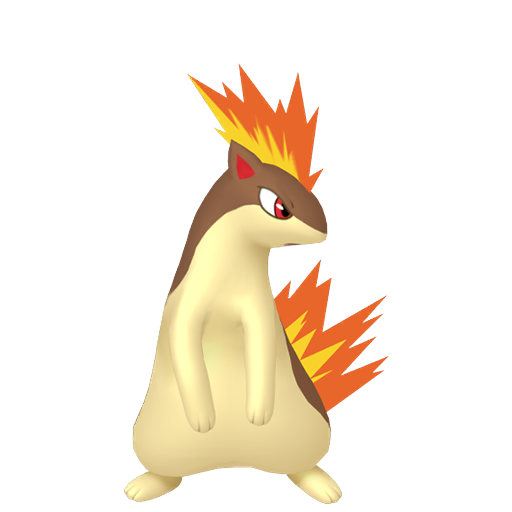
Quilava measures in at 0.9 m and 19 kg, a build that matches its blaze ability better than it matches raw offense or defense. Standing 0.9 m tall and weighing 19.0 kg, it's built around a distinct combination of fire traits that shapes how it performs both in the wild and in battle. With a overall stat sum of 405 distributed across well-balanced offensive and defensive capabilities, Quilava demonstrates improved speed and special attack compared to its pre-evolution, making it a competent Pokémon during the mid-stages of gameplay. Standing at just 0.9 meters tall and weighing a modest 19.0 kilograms, this quadrupedal creature carries the signature flames that define the Cyndaquil line, projecting them from specific points on its body during combat.
Editor's Take
Quilava is one of the better-looking middle stages in the series and evolves at 36, which is late enough that plenty of players spent most of Johto with it rather than Typhlosion.
Base Stats
Height
0.9m
Weight
19.0kg
Category
Volcano Pokémon
Gender
Male 87.5% / Female 12.5%
Color
yellow
Shape
quadruped
Habitat
grassland
Abilities
Strengthens fire moves to inflict 1.5× damage at 1/3 max HP or less.
Protects against fire moves. Once one has been blocked, the Pokémon's own Fire moves inflict 1.5× damage until it leaves battle.

Quilava Biology & Physical Characteristics
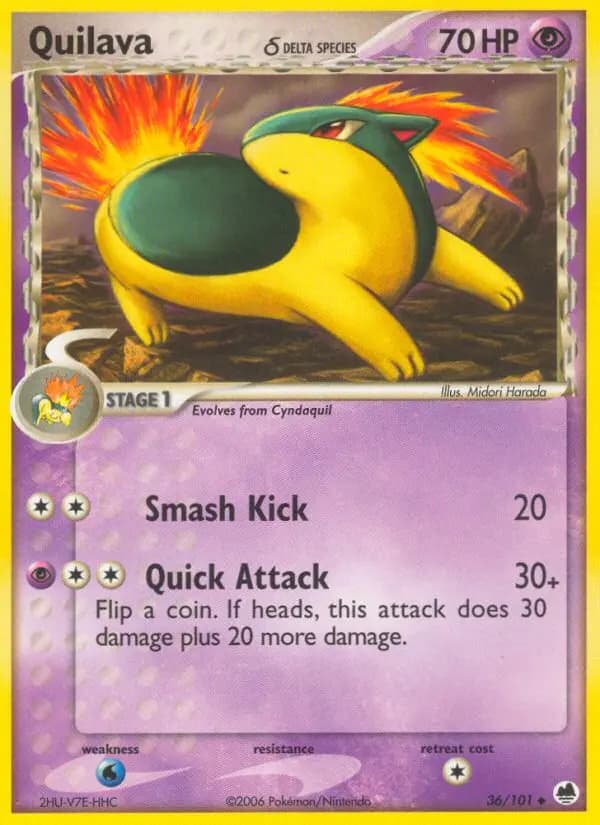
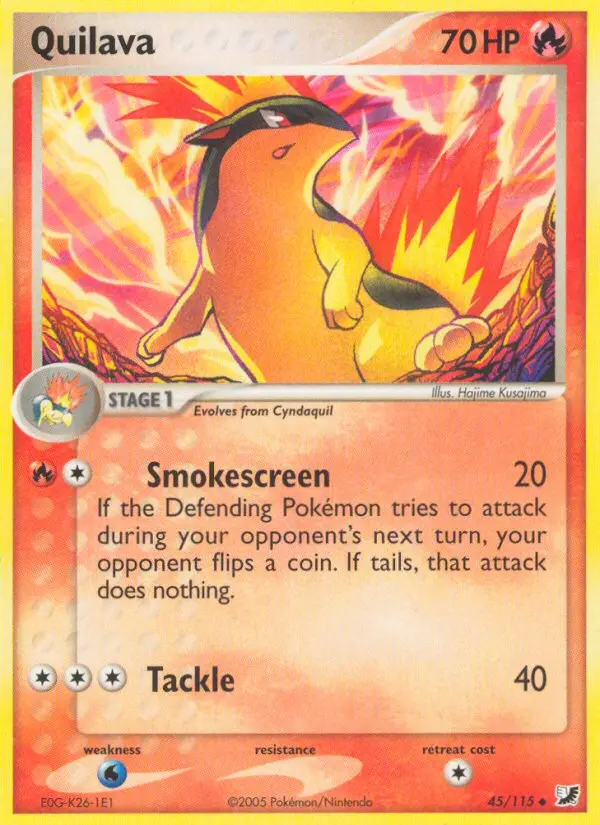
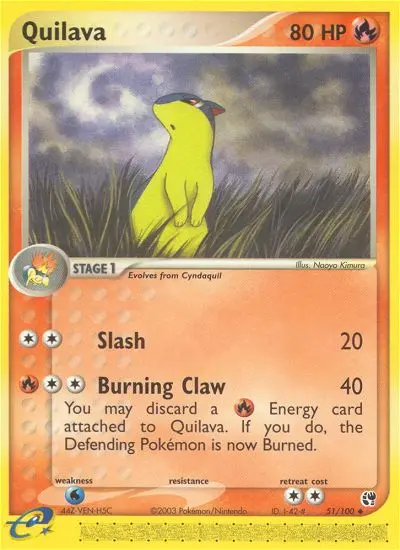
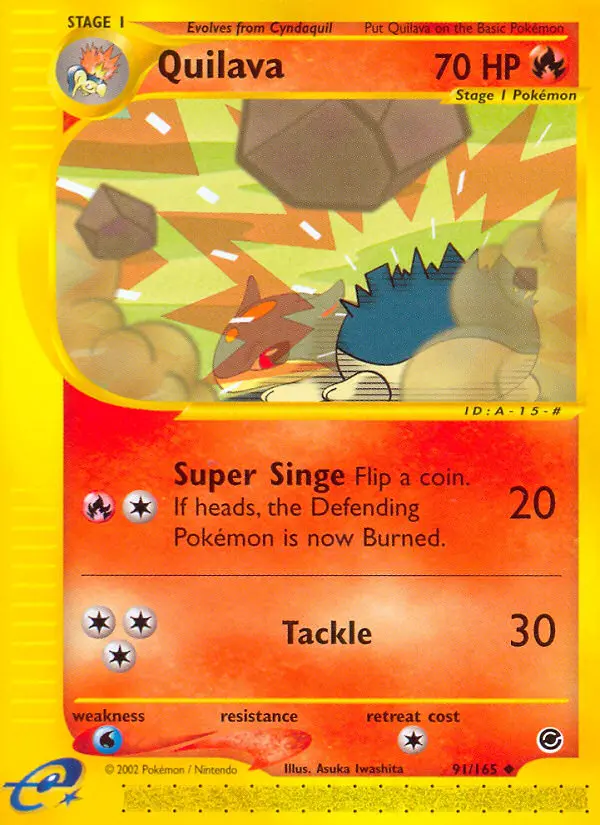
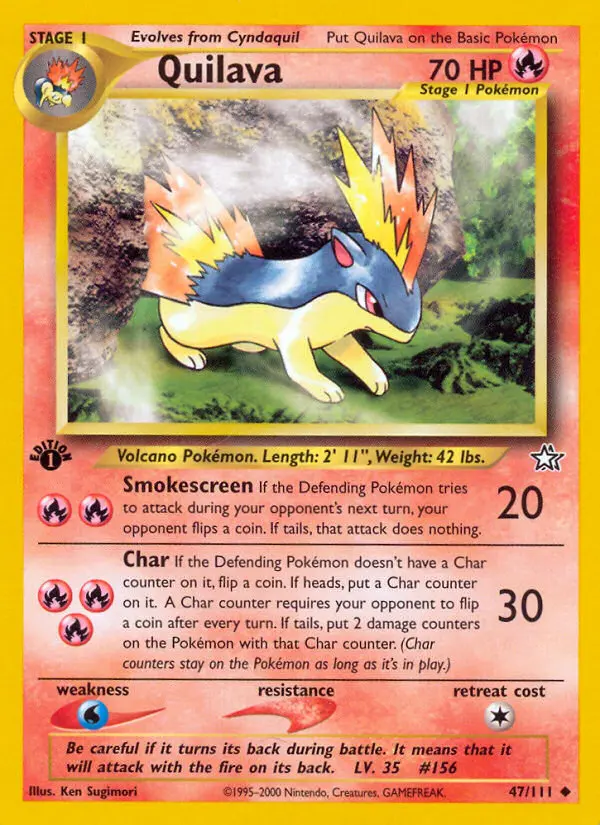
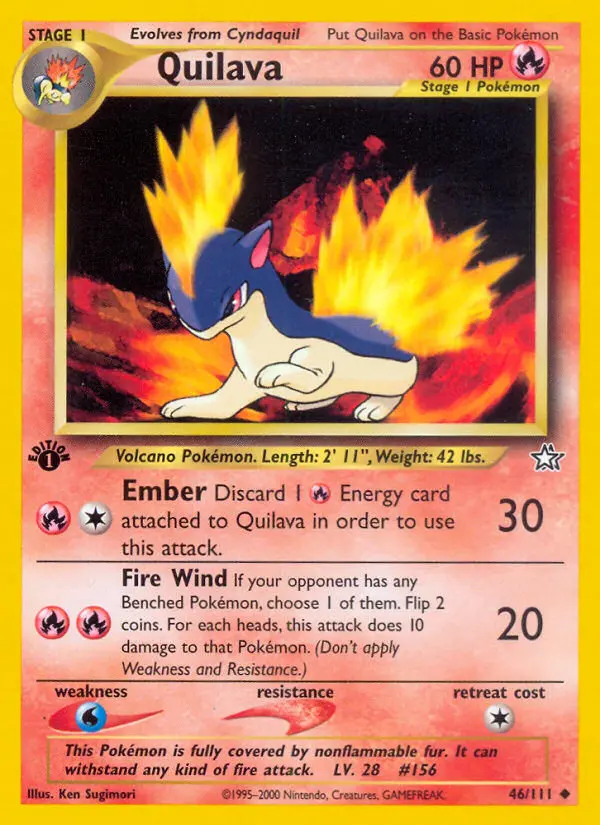
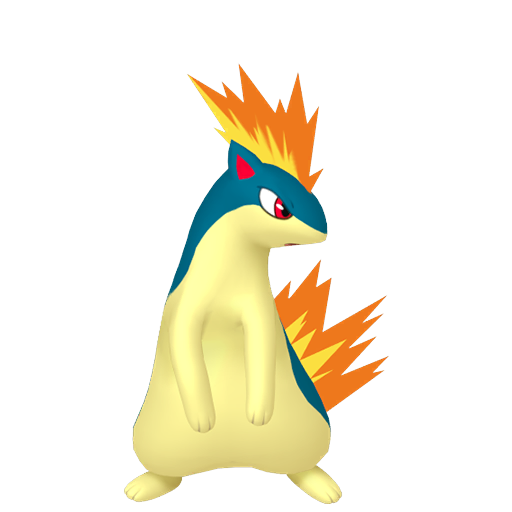
Quilava is a quadrupedal Pokémon with a distinctly elongated and slender body structure, featuring a dark blue-green coloration on its upper body that contrasts sharply with its cream-colored underside. The species possesses triangular ears with deep red interiors, a rounded snout, and angular red eyes that give it an alert appearance. Each of its four paws is equipped with three toes, providing it with reliable ground contact for its swift movements. The most remarkable biological feature of Quilava is its system of five red-colored flame projectors distributed across its body: two arranged vertically on its forehead and three aligned horizontally across its rear. These flame generators are not merely for offense—Quilava's entire body is covered in non-flammable fur that grants it complete immunity to fire-based attacks, a protective adaptation that allows it to manipulate and project intense flames without self-harm. The fur's unique composition enables Quilava to withstand any kind of fire attack, making it an excellent defensive candidate against opposing Fire-type Pokémon despite its classification as a Fire-type itself.
Pokedex Numbers
Training
Breeding
Quilava Breeding, Gender Ratio & Egg Groups
Quilava exhibits a pronounced sexual dimorphism in breeding patterns, with an 87.5% to 12.5% male-to-female ratio that heavily favors males, making female Quilava considerably rarer in both wild encounters and breeding programs. This significant gender disparity has important implications for trainers attempting to breed Quilava or its evolutionary relatives, as female specimens are far more difficult to obtain through normal gameplay progression. Quilava belongs to the Field egg group, which encompasses a diverse range of terrestrial and quadrupedal Pokémon, allowing it to breed with numerous compatible species. The breeding mechanics for Quilava follow standard Pokémon breeding protocols, with eggs requiring 20 cycles to hatch, translating to approximately 4,884 to 5,140 steps of travel before the offspring emerges. The base happiness value of Quilava is 70, indicating a moderate level of friendliness that allows for reasonable bonding with trainers from the outset, though this was adjusted from earlier generations where it held a base friendship of 50. This moderate happiness baseline means that Quilava responds well to positive training experiences and develops stronger bonds with attentive trainers.
Sprites




TMs & HMs
tm01
platinum
tm01
emerald
tm01
diamond pearl
tm01
firered leafgreen
tm01
ruby sapphire
tm01
xd
tm01
colosseum
tm01
heartgold soulsilver
tm01
lets go pikachu lets go eevee
tm01
ultra sun ultra moon
tm01
sun moon
tm02
crystal
tm02
gold silver
tm03
crystal
tm03
gold silver
tm04
gold silver
tm04
crystal
tm05
ruby sapphire
tm05
emerald
tm05
gold silver
+568 more TMs/HMs
Quilava's Evolution Chain


Quilava Evolution, Mega Evolution & Special Forms
Quilava represents the intermediate evolutionary stage of the classic Cyndaquil line, evolving from Cyndaquil at level 14 and subsequently evolving into Typhlosion upon reaching level 36. This progression reflects a gradual power increase, with each stage building upon the previous form's capabilities. In the Hisui region, the evolution levels are slightly adjusted, with Quilava evolving from Cyndaquil at level 17 and then into the region's unique Hisuian Typhlosion at level 36. The Hisuian variant represents a significant departure from the standard line, as Typhlosion gains a Ghost-type secondary typing when exposed to the mysterious energy of Mount Coronet, fundamentally altering its type matchups and moveset potential compared to the conventional Fire-type final form. This regional variation demonstrates how environmental and supernatural influences can create divergent evolutionary paths within the same species, offering trainers distinct strategic choices depending on their location and the version of the game they are playing.
Where to Find
Location data not available for this Pokémon in the database.
Quilava Behaviour and Natural Habitat
Before engaging in battle, Quilava exhibits a characteristic behavioral pattern of turning its back toward its opponent to demonstrate the ferocity of its rear-mounted flames, serving as both a warning display and a psychological intimidation tactic. This posture is not merely ceremonial—it directly precedes a devastating attack, as the Pokédex entries consistently warn trainers to take caution when Quilava assumes this position. In combat, Quilava employs a sophisticated fighting strategy that combines intense flames with gusts of superheated air, using its outstanding nimbleness to dodge incoming attacks while simultaneously scorching opponents with its fire. This combination of offensive pressure and evasive maneuverability makes Quilava a deceptively formidable combatant despite its moderate defensive statistics. In terms of habitat, Quilava tends to be relatively rare in the wild but can sometimes be found inhabiting grasslands where it can freely express its pyrokinetic abilities. According to Pokémon Sleep research, Quilava's flames burn particularly bright while the creature is sleeping, suggesting that its fire-based biology maintains constant activity even during rest periods.
Pokedex Entries
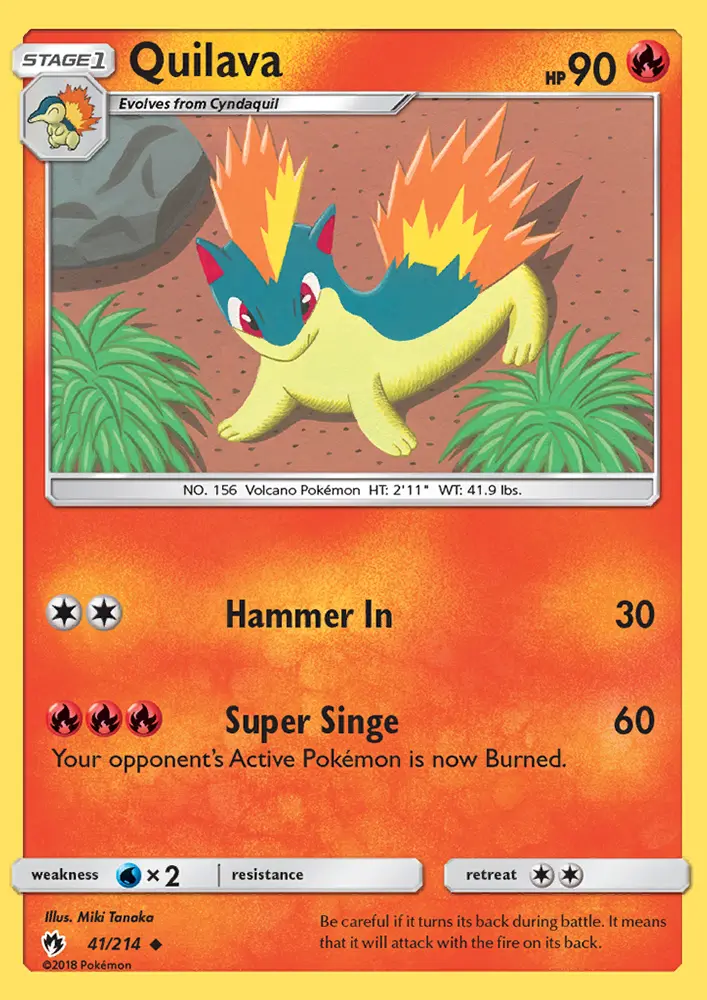
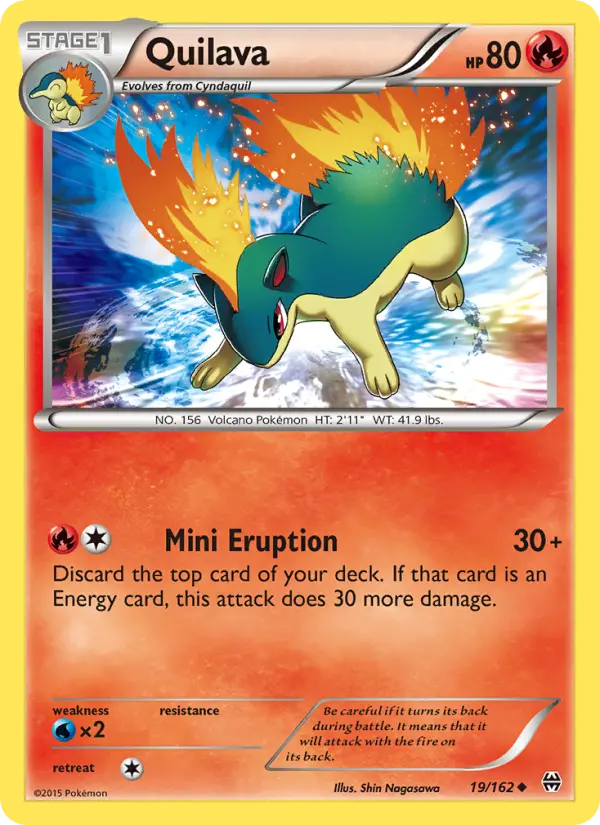
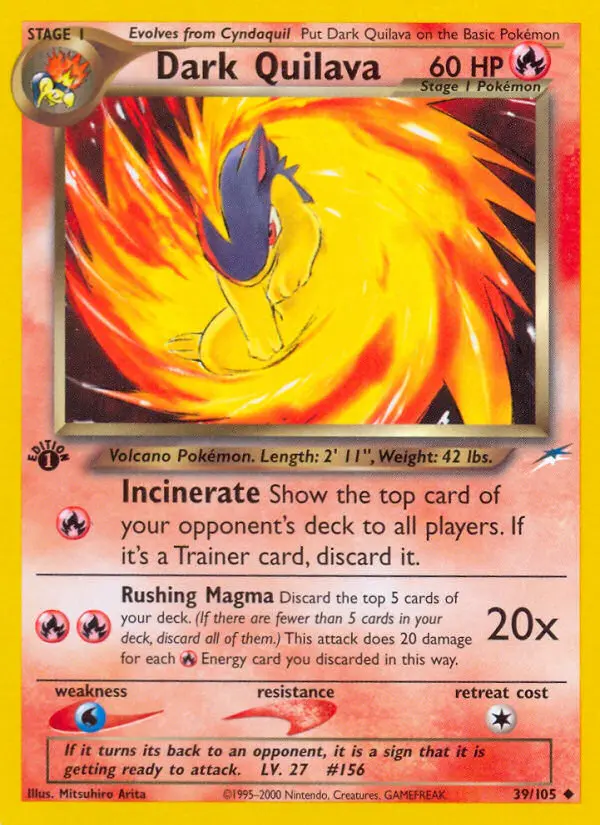
Be careful if it turns its back during battle. It means that it will attack with the fire on its back.
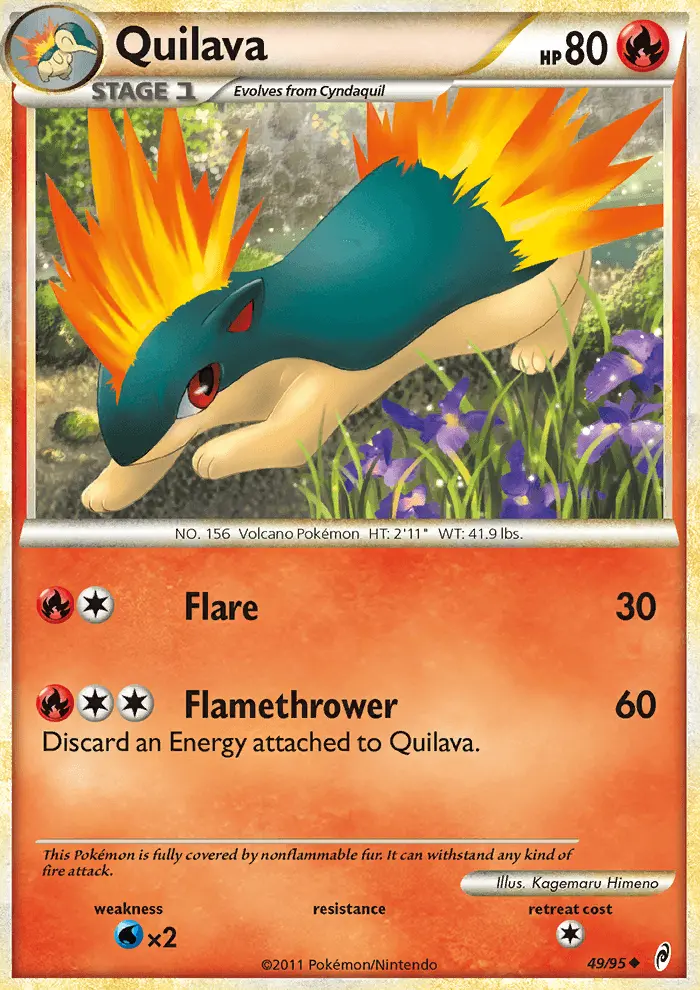
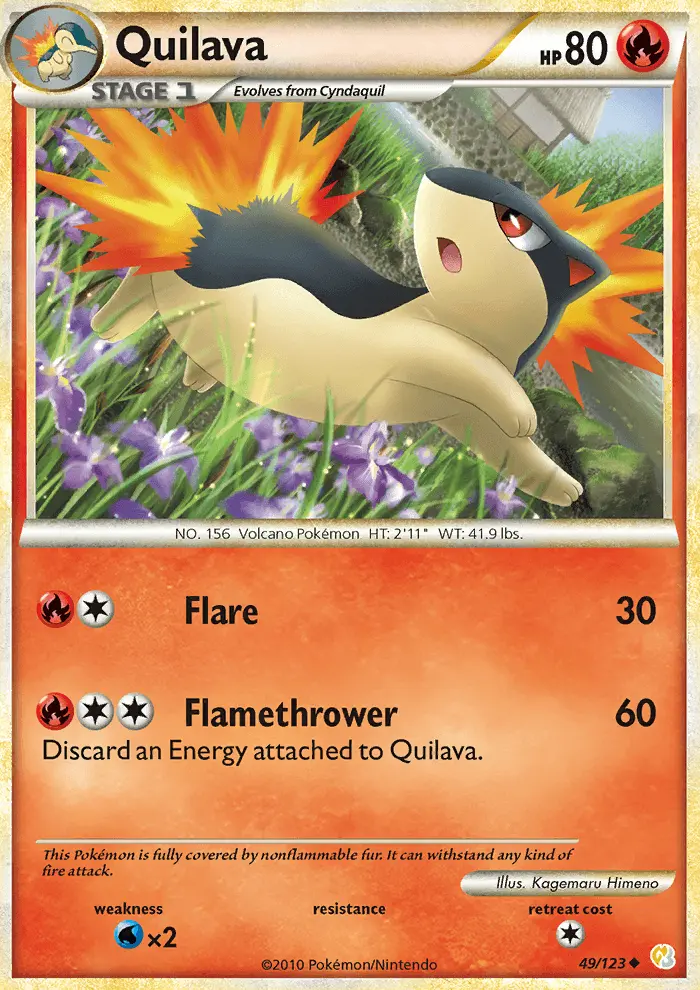
This POKéMON is fully covered by nonflammable fur. It can withstand any kind of fire attack.
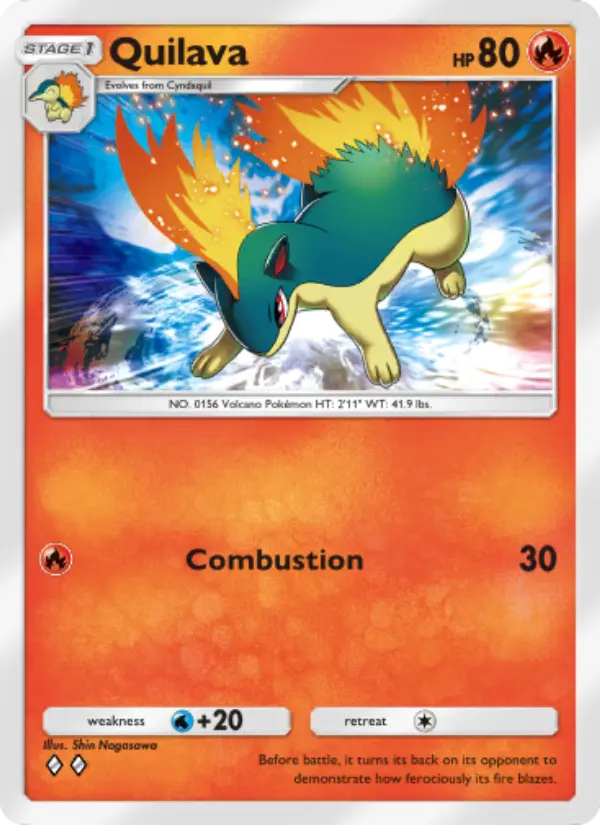
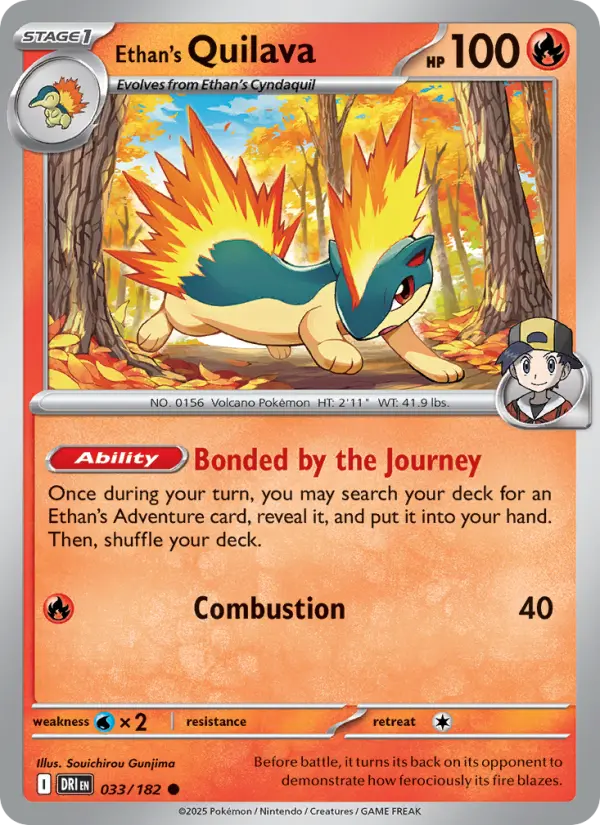
Before battle, it turns its back on its opponent to demonstrate how ferociously its fire blazes.
QUILAVA keeps its foes at bay with the intensity of its flames and gusts of superheated air. This POKéMON applies its outstanding nimbleness to dodge attacks even while scorching the foe with flames.
It intimidates foes with intense gusts of flames and superheated air. Its quick nimbleness lets it dodge attacks even while scorching an enemy.
This POKéMON is fully covered by nonflammable fur. It can withstand any kind of fire attack.
Be careful if it turns its back during battle. It means that it will attack with the fire on its back.
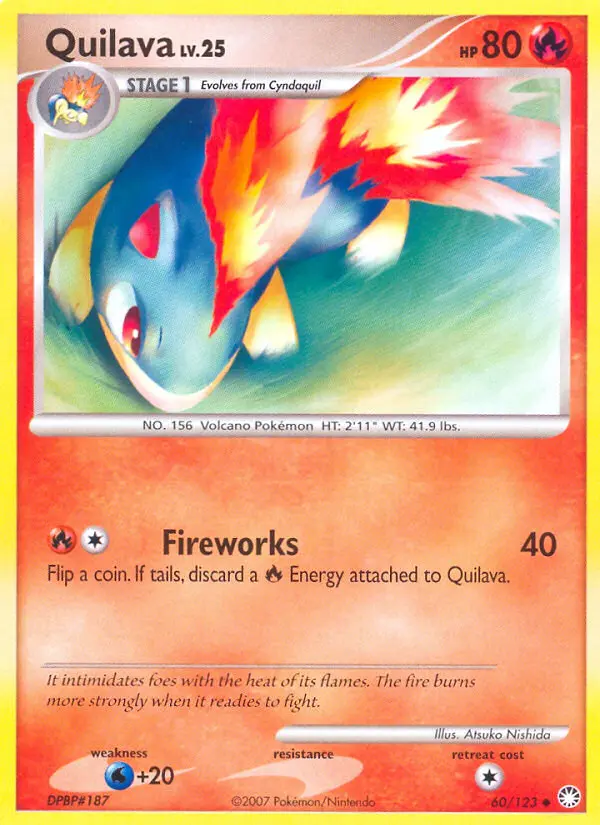
It intimidates foes with the heat of its flames. The fire burns more strongly when it readies to fight.
Be careful if it turns its back during battle. It means that it will attack with the fire on its back.
This Pokémon is fully covered by nonflammable fur. It can withstand any kind of fire attack.
It intimidates foes with the heat of its flames. The fire burns more strongly when it readies to fight.
It intimidates foes with the heat of its flames. The fire burns more strongly when it readies to fight.
Before battle, it turns its back on its opponent to demonstrate how ferociously its fire blazes.
Be careful if it turns its back during battle. It means that it will attack with the fire on its back.
Quilava keeps its foes at bay with the intensity of its flames and gusts of superheated air. This Pokémon applies its outstanding nimbleness to dodge attacks even while scorching the foe with flames.
Quilava keeps its foes at bay with the intensity of its flames and gusts of superheated air. This Pokémon applies its outstanding nimbleness to dodge attacks even while scorching the foe with flames.
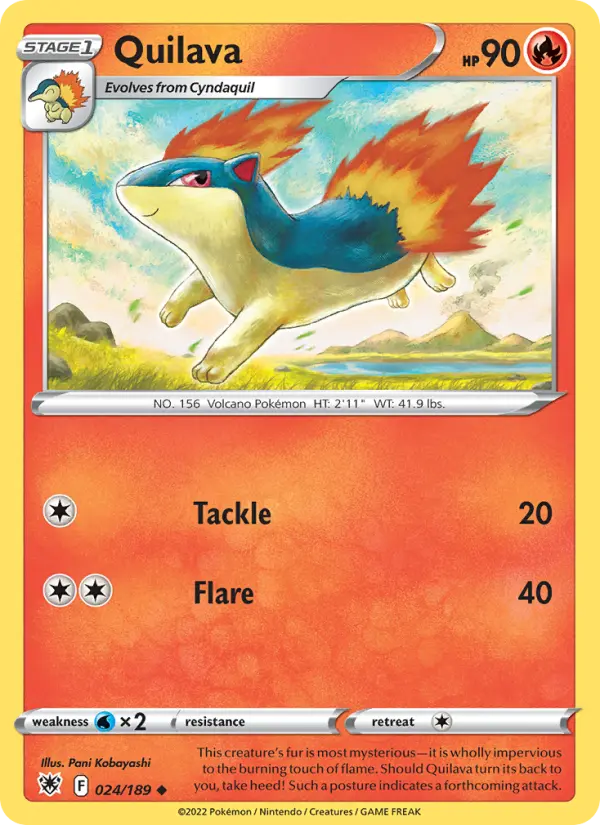
This creature's fur is most mysterious—it is wholly impervious to the burning touch of flame. Should Quilava turn its back to you, take heed! Such a posture indicates a forthcoming attack.
Quilava Name Origin & Design Inspiration
Quilava's name derives from the combination of 'quill' and 'lava,' referencing both the creature's pointed flame projectors and its inherent volcanic fire-based nature. The Japanese name, Magmarashi (マグマラシ), combines 'magma' (マグマ) with 'rashi,' suggesting the volcanic associations that define this Pokémon's identity. The design philosophy behind Quilava emphasizes the transition between its pre-evolution and final form, maintaining the fundamental quadrupedal structure and flame-projection mechanism while introducing a more mature and aggressive aesthetic. The dark coloration, angular features, and prominent rear-mounted flames create a sense of dangerous potential that distinguishes Quilava from the more juvenile appearance of Cyndaquil. The creature's design language emphasizes speed and agility through its slender body proportions, with the three-toed paws and streamlined physique suggesting swift movement across grassland terrain. The positioning of the flame projectors, particularly the three aligned horizontally on the rear, creates a visually striking silhouette when the Pokémon assumes its pre-battle stance.
Learnable Moves
Quilava can learn 77 moves:
Move | Type | Cat. | Power | Acc. | PP |
|---|---|---|---|---|---|
| aerial ace | flying | Physical | 60 | — | 20 |
| attract | normal | Status | — | 100 | 15 |
| body slam | normal | Physical | 85 | 100 | 15 |
| brick break | fighting | Physical | 75 | 100 | 15 |
| burn up | fire | Special | 130 | 100 | 5 |
| burning jealousy | fire | Special | 70 | 100 | 5 |
| captivate | normal | Status | — | 100 | 20 |
| confide | normal | Status | — | — | 20 |
| covet | normal | Physical | 60 | 100 | 25 |
| curse | ghost | Status | — | — | 10 |
| cut | normal | Physical | 50 | 95 | 30 |
| defense curl | normal | Status | — | — | 40 |
| detect | fighting | Status | — | — | 5 |
| dig | ground | Physical | 80 | 100 | 10 |
| double kick | fighting | Physical | 30 | 100 | 30 |
| double team | normal | Status | — | — | 15 |
| double edge | normal | Physical | 120 | 100 | 15 |
| ember | fire | Special | 40 | 100 | 25 |
| endeavor | normal | Physical | — | 100 | 5 |
| endure | normal | Status | — | — | 10 |
| eruption | fire | Special | 150 | 100 | 5 |
| extrasensory | psychic | Special | 80 | 100 | 20 |
| facade | normal | Physical | 70 | 100 | 20 |
| fire blast | fire | Special | 110 | 85 | 5 |
| fire fang | fire | Physical | 65 | 95 | 15 |
| fire pledge | fire | Special | 80 | 100 | 10 |
| fire spin | fire | Special | 35 | 85 | 15 |
| flame charge | fire | Physical | 50 | 100 | 20 |
| flame wheel | fire | Physical | 60 | 100 | 25 |
| flamethrower | fire | Special | 90 | 100 | 15 |
| flare blitz | fire | Physical | 120 | 100 | 15 |
| focus punch | fighting | Physical | 150 | 100 | 20 |
| frustration | normal | Physical | — | 100 | 20 |
| fury cutter | bug | Physical | 40 | 95 | 20 |
| headbutt | normal | Physical | 70 | 100 | 15 |
| heat wave | fire | Special | 95 | 90 | 10 |
| hidden power | normal | Special | 60 | 100 | 15 |
| howl | normal | Status | — | — | 40 |
| incinerate | fire | Special | 60 | 100 | 15 |
| inferno | fire | Special | 100 | 50 | 5 |
| iron head | steel | Physical | 80 | 100 | 15 |
| iron tail | steel | Physical | 100 | 75 | 15 |
| lava plume | fire | Special | 80 | 100 | 15 |
| leer | normal | Status | — | 100 | 30 |
| mimic | normal | Status | — | — | 10 |
| mud slap | ground | Special | 20 | 100 | 10 |
| natural gift | normal | Physical | — | 100 | 15 |
| nature power | normal | Status | — | — | 20 |
| overheat | fire | Special | 130 | 90 | 5 |
| play rough | fairy | Physical | 90 | 90 | 10 |
| protect | normal | Status | — | — | 10 |
| quick attack | normal | Physical | 40 | 100 | 30 |
| rest | psychic | Status | — | — | 5 |
| return | normal | Physical | — | 100 | 20 |
| reversal | fighting | Physical | — | 100 | 15 |
| roar | normal | Status | — | — | 20 |
| rock smash | fighting | Physical | 40 | 100 | 15 |
| rollout | rock | Physical | 30 | 90 | 20 |
| round | normal | Special | 60 | 100 | 15 |
| secret power | normal | Physical | 70 | 100 | 20 |
| sleep talk | normal | Status | — | — | 10 |
| smokescreen | normal | Status | — | 100 | 20 |
| snore | normal | Special | 50 | 100 | 15 |
| strength | normal | Physical | 80 | 100 | 15 |
| substitute | normal | Status | — | — | 10 |
| sunny day | fire | Status | — | — | 5 |
| swagger | normal | Status | — | 85 | 15 |
| swift | normal | Special | 60 | — | 20 |
| tackle | normal | Physical | 40 | 100 | 35 |
| take down | normal | Physical | 90 | 85 | 20 |
| temper flare | fire | Physical | 75 | 100 | 10 |
| tera blast | normal | Special | 80 | 100 | 10 |
| toxic | poison | Status | — | 90 | 10 |
| wild charge | electric | Physical | 90 | 100 | 15 |
| will o wisp | fire | Status | — | 85 | 15 |
| work up | normal | Status | — | — | 30 |
| zen headbutt | psychic | Physical | 80 | 90 | 15 |
Quilava Competitive Battle Guide
Quilava occupies a niche role in competitive Pokémon battling, with a overall stat sum of 405 that is respectable for a second-stage evolution but generally insufficient for competitive viability at the highest levels without strategic team support. Its special attack stat of 80 and speed stat of 80 represent its strongest attributes, creating a glass cannon archetype that excels in offensive pressure but struggles with durability. The base attack of 64 combined with a special attack of 80 creates a clear specialization in special-based Fire moves, particularly moves like Flamethrower, Fire Blast, and Ancient Power that leverage its superior special attack stat. Quilava's ability choices provide distinct strategic advantages: Blaze strengthens Fire-type moves to 1.5 times damage when Quilava's health drops to one-third of its maximum, enabling desperate comeback strategies in close battles, while the hidden ability Flash Fire presents a defensive option that blocks incoming Fire moves and increases the wielder's Fire-type move power by 1.5 times until the Pokémon exits battle. Flash Fire is particularly valuable in matchups against other Fire-type opponents, effectively converting a defensive liability into an offensive advantage. Competitive players typically view Quilava as a bridge form rather than a standalone competitive choice, preferring to evolve it into Typhlosion for significantly enhanced statistics across all categories.
Commonly Asked Questions About Quilava
What type is Quilava?
Quilava is a fire type Pokemon.
What does Quilava evolve into?
Quilava evolves into typhlosion.
What are Quilava's weaknesses?
Quilava is weak to ground, rock and water type moves.
Does Quilava evolve by trading?
No — Quilava evolves entirely through leveling up, with no trade required at any stage.
Quilava Cultural Impact & Franchise History
Quilava holds significant cultural importance within the Pokémon franchise as a member of one of the most beloved starter lines, representing player choice and progression throughout the Generation II games and their modern remakes. The Pokédex entries' repeated warnings about the significance of Quilava turning its back have become iconic gameplay moments for players, creating memorable battle encounters and establishing the species as a recognizable character within the franchise's lore. Jimmy's Quilava in the animated series provided a notable character association, while trainers like Dawn utilized Quilava in memorable television episodes, cementing its place in the anime's visual culture. The mysterious properties of Quilava's non-flammable fur, described across multiple Pokédex entries as an inexplicable biological phenomenon, have contributed to the species' mystique and generated fan interest in understanding the underlying mechanisms of Pokémon biology. The introduction of Hisuian Typhlosion in Pokémon Legends: Arceus expanded Quilava's cultural relevance by offering a regional variant that transforms the evolutionary line into Ghost/Fire hybrids, introducing the species to new audiences and reinvigorating interest in the classic starter line among longtime fans.
Where to Find Quilava in Every Pokémon Game
Quilava's availability varies significantly across different Pokémon games and generations, reflecting its status as a Pokémon typically associated with starter choice and specific in-game progression. In the original Gold and Silver versions and their HeartGold and SoulSilver remakes, Quilava is obtained exclusively through evolving the Cyndaquil starter Pokémon chosen at the beginning of gameplay, making it unavailable through wild encounters or trades early in the game. In Pokémon Legends: Arceus, Quilava follows the same progression pattern, evolving from Cyndaquil at level 17 rather than the standard level 14 found in other games. The species' appearance in various other games and Pokédex entries throughout later generations suggests sporadic availability in specific regions and games, though it generally remains a Pokémon most easily obtained through the starter evolutionary line rather than wild catching. A capture rate of 45 indicates moderate difficulty in capturing wild Quilava specimens when they do appear, making trainer battles or breeding through evolutionary lines the most reliable acquisition methods for players seeking this species outside of starter selection. The availability restrictions and evolutionary requirements have contributed to Quilava's perception as a valuable and somewhat exclusive Pokémon, particularly for players seeking to complete regional Pokédex entries without access to the Johto region's starter mechanics.